
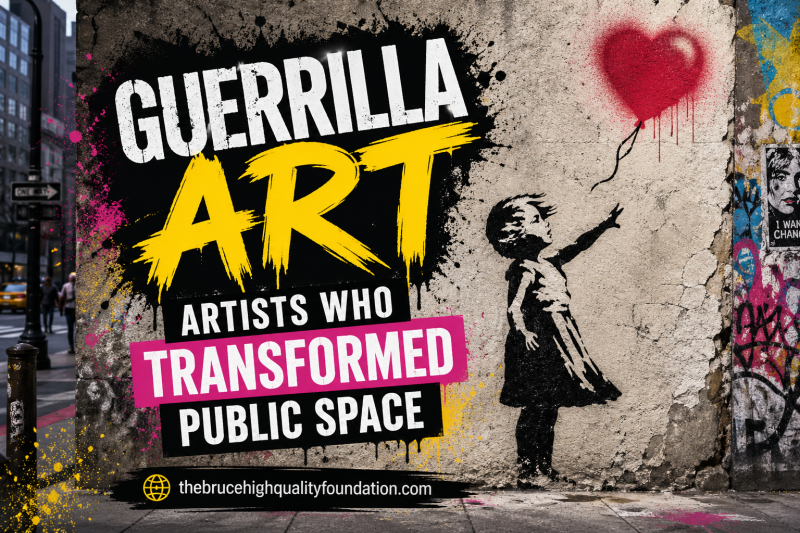
“Guerrilla art” is a movement where artists create unauthorized works in public spaces, challenging traditional boundaries between art institutions and everyday life. This rebellious form of expression emerged from the underground art scenes of the 1970s and 1980s, transforming city streets into open-air galleries without permits or permission. Artists working in this tradition use streets, walls, and urban infrastructure as their canvas to deliver political messages, social commentary, or simply moments of unexpected beauty.
What draws me to guerrilla art is its raw immediacy and democratic spirit. Unlike museum pieces guarded by velvet ropes, these works appear overnight in the spaces where people actually live, work, and commute. Some pieces last for years, while others are painted over within hours, creating an ever-changing visual dialogue between artists and their communities.
In this guide, I have compiled 20 guerrilla artists from six continents who have redefined public space through their unauthorized interventions. From stencil masters to muralists, from political activists to whimsical interventionists, these artists prove that creativity cannot be contained by walls or bylaws.
Table of Contents
European Guerrilla Artists
Europe has long served as the epicenter of guerrilla art, with cities like London, Paris, and Berlin providing fertile ground for unauthorized creativity. The continent’s dense urban environments and complex political histories have produced some of the most iconic street artists working today.
1. Banksy (United Kingdom)
Banksy remains the most recognizable name in guerrilla art, having operated anonymously from Bristol since the early 1990s. His stencil-based works combine dark humor with biting political commentary, appearing overnight on walls, bridges, and buildings worldwide.
Notable works include “Girl with Balloon,” which partially shredded itself during a Sotheby’s auction in 2018, and the series of pieces that appeared along the Israeli West Bank barrier. His 2015 Dismaland installation in Weston-super-Mare transformed a seaside town into a dystopian theme park that drew over 150,000 visitors.
Banksy’s influence extends beyond art circles, having inspired an entire generation of stencil artists and sparked global conversations about the commercialization of street art.
2. JR (France)
JR began his career as a teenage graffiti artist in Paris, tagging the city’s suburbs before finding his signature medium: large-scale black-and-white photographic portraits. His Inside Out project has created participatory art installations in over 130 countries, plastering monumental faces on buildings, bridges, and streets.
In 2017, he created a massive optical illusion at the Louvre, making the museum’s pyramid appear to sink into the earth. His 2019 project at the US-Mexico border featured a giant toddler peering over the wall from the Mexican side.
JR was awarded the TED Prize in 2011 and continues to blur the lines between guerrilla art and institutional acceptance, having mounted exhibitions at the Brooklyn Museum and the San Francisco Museum of Modern Art.
3. Invader (France)
Invader has spent over two decades cementing ceramic mosaic characters from the 1978 Space Invaders video game onto walls across 80 cities worldwide. Each piece is meticulously planned and installed under cover of darkness, creating permanent interventions that withstand weather and time.
The artist maintains a detailed map of every installation on his website, encouraging fans to hunt for his works like a real-world scavenger hunt. In 2019, one of his pieces traveled to the International Space Station with astronaut Samantha Cristoforetti.
His invasion of Paris includes over 1,400 individual mosaics, with additional colonies established in Los Angeles, Tokyo, London, and dozens of other major cities.
4. Stik (United Kingdom)
Stik began painting his signature stick figures on the streets of East London while living in homeless shelters and social housing during the early 2000s. His minimalist human forms, composed of just six lines and two dots, communicate profound emotional states through simple gestures.
The artist has maintained his commitment to social justice, using proceeds from gallery sales to support community art programs and housing advocacy. His 2014 mural “Little Big Mother” in Hackney has become a beloved local landmark.
Stik’s 2020 “Holding Hands (Maquette)” sculpture in Hoxton Square marked a rare foray into authorized public art, though he continues to create unsanctioned works when the message demands it.
5. Slinkachu (United Kingdom)
Slinkachu creates tiny interventions using miniature figures left in urban environments, transforming cracks in pavement, discarded bottles, and puddle reflections into scenes of microscopic drama. His Little People project has placed over 250 installations across cities worldwide.
Each piece is photographed and then abandoned to the elements, creating ephemeral moments of surprise for observant passersby. His 2013 book “Global Model Village” documented installations from 40 countries including Norway, Cambodia, and the United States.
The artist’s work comments on urban alienation and the overlooked details of city life, encouraging viewers to look closer at the world beneath their feet.
North American Street Artists
The United States gave birth to modern graffiti culture in the 1970s New York subway scene, evolving into a sophisticated guerrilla art movement that now spans the continent. From the East Village to the Mission District, American cities continue to nurture radical public art.
6. Jean-Michel Basquiat (United States)
Basquiat began as SAMO, a graffiti tag he created with Al Diaz in 1977, spraying cryptic aphorisms across Manhattan’s Lower East Side. His transition from street poet to gallery sensation happened within just five years, culminating in his death at age 27 in 1988.
His work “Untitled” sold for $110.5 million in 2017, making it the most expensive artwork by an American artist ever auctioned. Yet his roots in guerrilla art remain central to his legacy, with his neo-expressionist paintings retaining the raw urgency of his subway origins.
Basquiat proved that street art could move from sidewalks to museums without losing its revolutionary edge, opening doors for countless artists who followed.
7. Keith Haring (United States)
Haring arrived in New York in 1978 and immediately began drawing chalk figures on empty subway advertisement panels, creating hundreds of unsanctioned works that commuters encountered daily. His radiant baby, barking dog, and dancing figures became instantly recognizable symbols of the 1980s downtown art scene.
He maintained that public art was the most democratic form, creating murals in hospitals, schools, and neighborhoods often overlooked by the art world. His Crack is Wack mural in Harlem remains a powerful anti-drug statement decades after his death from AIDS-related complications in 1990.
The Keith Haring Foundation continues his mission, supporting AIDS research and children’s programs while preserving his legacy as both street artist and activist.
8. Shepard Fairey (United States)
Fairey launched his career with the Andre the Giant Has a Posse sticker campaign while studying at the Rhode Island School of Design in 1989. The cryptic image spread globally through sticker culture, evolving into the OBEY Giant brand that now encompasses clothing, posters, and authorized murals.
His 2008 Hope poster for Barack Obama became one of the most recognizable political images in American history, leading to both a copyright dispute with AP and a permanent collection spot at the National Portrait Gallery.
Fairey has been arrested 18 times for street art activities but continues to create unsanctioned works alongside his commercial practice, arguing that both serve important cultural functions.
9. KAWS (United States)
Brian Donnelly began as a graffiti writer in 1990s Jersey City before developing the KAWS persona, characterized by X-ed out eyes and hybrid cartoon characters. His early interventions involved removing advertisements from bus shelters, modifying them in his studio, and returning them to their displays.
In 2019, his 37-foot tall sculpture “Companion (Expanded)” appeared on a barge floating down the Thames in London without prior announcement. His work now commands millions at auction, yet he maintains connections to street culture through collaborations with Dior, Uniqlo, and Nike.
KAWS represents the commercial evolution of guerrilla art, demonstrating how unauthorized beginnings can lead to global brand recognition while retaining subversive visual language.
10. Guerrilla Girls (United States)
Founded in 1985, this anonymous collective of feminist artists wears gorilla masks in public appearances and adopts names of deceased women artists to maintain anonymity. Their bold poster campaigns target sexism and racism within the art establishment, appearing unsanctioned on walls and in museums worldwide.
Classic works include “Do women have to be naked to get into the Met Museum?” and statistical exposes of gallery representation gaps. In 2015, they opened a temporary headquarters at the Tate Modern, blurring the line between guerrilla activists and institutional collaborators.
With over 200 projects spanning four decades, the Guerrilla Girls remain one of the most enduring and impactful art collectives in history, proving that masks and humor can deliver serious social critique.
South American Urban Artists
South America’s guerrilla art scene reflects the continent’s complex relationship with political upheaval, social inequality, and vibrant cultural expression. From the favelas of Brazil to the streets of Mexico City, artists transform public space into platforms for resistance and celebration.
11. Zeh Palito (Brazil)
Zeh Palito creates colorful murals across Sao Paulo’s urban landscape, using simplified forms and bold colors to depict everyday Brazilian life. His work frequently appears in favelas and working-class neighborhoods, bringing art to communities traditionally excluded from gallery culture.
In 2019, he completed a 450-square-meter mural in downtown Sao Paulo depicting Black Brazilian historical figures, creating one of the largest unsanctioned works in the city’s history. His characters often feature elongated limbs and bright patterns inspired by Brazilian folk art.
Palito represents a new generation of South American street artists who combine political messaging with joyful visual language, making serious subjects accessible through approachable aesthetics.
12. Libre (Mexico)
Libre operates throughout Mexico City, creating stencil and freehand works that address migration, indigenous rights, and government corruption. Her pieces often appear in high-traffic areas near government buildings, speaking truth to power through striking visual interventions.
Her 2020 series “Las Desaparecidas” honored missing women across Mexico, placing 100 portraits in public spaces to demand justice. She frequently collaborates with community organizations to create murals that reflect local struggles and aspirations.
Working in one of the world’s most dangerous environments for journalists and activists, Libre maintains anonymity while continuing to produce work that challenges state narratives and amplifies marginalized voices.
African Guerrilla Art Movement
Africa’s street art scene has exploded over the past decade, with cities like Lagos, Nairobi, and Cape Town becoming hubs for creative expression. Artists across the continent use public space to address post-colonial identity, social justice, and rapid urbanization.
13. Osa Seven (Nigeria)
Osa Seven brings Nigerian culture to the streets through vibrant murals that blend traditional patterns with contemporary hip-hop aesthetics. His Lagos murals have transformed highway underpasses and abandoned buildings into celebrations of Yoruba heritage and modern African identity.
In 2018, he completed a 200-foot mural at the Ikeja City Mall depicting Nigerian music legends, creating an unsanctioned tribute that was eventually adopted by the community. His work often features Adire textile patterns reimagined through spray paint.
Seven also runs art education programs for Lagos youth, converting his guerrilla art practice into community development while maintaining an active street presence.
14. Alaa Satir (Sudan)
Satir emerged during the 2019 Sudanese revolution, creating murals that supported pro-democracy protests in Khartoum. Her work depicts Sudanese women as powerful agents of change, countering traditional media representations with bold, colorful figures.
Her mural “The Woman in White” became an icon of the revolution, honoring the women who led demonstrations against the authoritarian regime. When the military cracked down on protesters, Satir’s murals were among the first cultural targets destroyed.
Now working in exile, she continues to create art that supports Sudanese democracy movements while documenting the role of women in revolutionary change.
15. Ricky Lee Gordon (South Africa)
Gordon creates large-scale murals that explore themes of consciousness, spirituality, and human connection across Cape Town and Johannesburg. His ethereal portraits seem to emerge from walls themselves, dissolving the boundary between structure and image.
His 2019 mural “Ubuntu” in the township of Khayelitsha addressed xenophobic violence, depicting interconnected faces that celebrated South Africa’s diversity. He frequently works with local communities to develop imagery that reflects their specific experiences.
Gordon also organizes the IPAF festival, bringing international artists to South Africa while maintaining his own practice of unsanctioned interventions in neglected urban spaces.
Asia & Oceania Guerrilla Artists
From the laneways of Melbourne to the street corners of Kuala Lumpur, Asia and Oceania have developed distinct guerrilla art traditions that blend local cultural heritage with global street art influences. These artists navigate increasingly regulated urban environments to maintain creative autonomy.
16. Ernest Zacharevic (Lithuania/Malaysia)
Zacharevic transformed Georgetown, Malaysia into an interactive art destination with his 2012 “Mirrors Georgetown” series, combining painted figures with physical objects to create 3D illusions. Visitors must interact with his works to complete the compositions, turning viewers into participants.
His piece “Children on Bicycle” became so popular that the local government protected it from removal, a rare case of official recognition for unsanctioned work. He has since created similar interventions in Singapore, London, and Barcelona.
Zacharevic’s playful approach demonstrates how guerrilla art can drive tourism and economic development while maintaining its outsider spirit, proving that unauthorized creativity and community benefit can coexist.
17. Fintan Magee (Australia)
Magee creates monumental figurative works across Australian cities, often depicting ordinary people in surreal situations that comment on environmental and social issues. His 2015 mural “The Scooter Boy” in Brisbane became an instant landmark, inspiring preservation efforts when the building faced demolition.
His work frequently addresses climate change, depicting flooded landscapes and displaced communities with haunting beauty. In 2019, he painted a 15-story firefighter honoring Australia’s emergency services during the catastrophic bushfire season.
Though increasingly commissioned for legal murals, Magee maintains an active guerrilla practice, arguing that some messages demand immediate delivery regardless of permitting processes.
Middle Eastern Intervention Artists
Middle Eastern guerrilla artists operate within some of the world’s most politically charged environments, transforming walls that often separate communities into spaces for dialogue and healing. Their work addresses conflict, displacement, and the universal desire for creative expression.
18. Hamza Abu Ayyash (Palestine)
Abu Ayyash creates murals across Ramallah and the West Bank that document Palestinian daily life under occupation. His work transforms separation barriers and checkpoint walls into galleries of resistance and resilience, depicting children playing, elders sharing tea, and families persisting.
His 2018 mural “The Key” in the Aida refugee camp featured a giant key symbolizing the right of return for displaced Palestinians, painted on the camp’s main wall facing an Israeli military tower. The piece has survived multiple attempts at removal.
Through his organization Art4All, he trains young Palestinians in mural techniques, converting guerrilla art skills into community empowerment while maintaining his own unsanctioned practice.
19. Know Hope (Israel)
This pseudonymous Israeli artist creates delicate interventions using text and minimalist figures that explore themes of temporality, longing, and human connection. His work often appears on abandoned structures and construction barriers throughout Tel Aviv and Jerusalem.
The recurring motif of a flag planted in rubble has appeared in over 30 countries, adapted to local contexts while maintaining its message of hope amid destruction. His 2015 project “The Weight of the World” created a temporary memorial to displaced persons in Athens.
Know Hope maintains strict anonymity, giving few interviews and never appearing unmasked, arguing that the work matters more than the artist’s identity.
20. Shamsia Hassani (Afghanistan)
Hassani is Afghanistan’s first female street artist, creating murals in Kabul that challenge restrictions on women’s public presence. Her stylized figures, often playing musical instruments or reading, imagine an Afghanistan where women have full freedom of expression.
Her 2015 mural “The Burqa” in central Kabul depicted a woman transforming her burqa into a bird taking flight, becoming an instant symbol of women’s aspirations under Taliban threat. Since the 2021 Taliban takeover, she has continued working from exile.
Hassani founded the Berang Arts organization to train young Afghan artists, creating a network of cultural resistance that persists despite regime changes and personal danger.
The Global Reach of Guerrilla Art
Guerrilla art has evolved from localized subcultures into a truly global movement spanning six continents and countless urban environments. What began in 1970s New York and 1980s Bristol has been adapted by artists worldwide to address local contexts while sharing common techniques and philosophical approaches.
Each region has developed distinct characteristics reflecting local political conditions and cultural traditions. European artists often engage with institutional critique and refugee crises, while African artists increasingly address post-colonial identity and rapid urbanization. Middle Eastern guerrilla art frequently transforms barriers into bridges, and South American artists channel revolutionary traditions into visual resistance.
The internet has accelerated this global exchange, allowing artists to share techniques instantly while physically crossing borders for festivals and collaborative projects. Yet local contexts remain essential, as successful guerrilla art must speak to specific communities while participating in worldwide conversations about public space and creative freedom.
Frequently Asked Questions
What is guerrilla art?
Guerrilla art is unauthorized artwork created in public spaces without official permission from property owners or government authorities. It encompasses various techniques including stencils, wheat paste posters, murals, and installations. The movement emphasizes democratic access to art, political commentary, and the transformation of urban environments through unsanctioned creative intervention.
Who is the most famous street art artist?
Banksy is widely considered the most famous street artist globally, having operated anonymously since the 1990s. His stencil-based works combine dark humor with political commentary and have appeared in cities worldwide. His pieces command millions at auction, and his 2018 self-shredding artwork ‘Girl with Balloon’ became one of the most discussed art events of the decade.
Is Banksy a guerrilla artist?
Yes, Banksy is a quintessential guerrilla artist. He creates unauthorized works in public spaces, maintains anonymity to avoid legal consequences, and his art challenges authority and commercialization. While his works now sell for millions in galleries, he continues to create unsanctioned street pieces that appear overnight without warning or permission.
What is the difference between guerrilla art and graffiti?
While all guerrilla art is unsanctioned, not all graffiti qualifies as guerrilla art. Graffiti traditionally emphasizes stylized lettering and tagging culture, while guerrilla art encompasses broader interventions including stencils, murals, installations, and performance. Guerrilla art typically has clearer conceptual or political intentions, whereas graffiti often focuses on style, reputation, and territorial marking within writing culture.
Who are the Guerrilla Girls?
The Guerrilla Girls are an anonymous collective of feminist artists founded in 1985 who wear gorilla masks in public and use deceased women artists’ names. They create poster campaigns exposing sexism and racism in the art world, appearing unsanctioned in museums and public spaces. Their work combines statistical research with bold graphics and humor to challenge institutional inequality.
The Future of Guerrilla Art
As cities become increasingly surveilled and commercialized, guerrilla art faces new challenges and opportunities in 2026. Technology has created both obstacles and tools for artists, with security cameras making nighttime operations riskier while social media amplifies the reach of each piece beyond its physical location.
The 20 artists profiled here represent diverse approaches to working in public space without permission. From Banksy’s global stencil operations to Slinkachu’s microscopic interventions, from the Guerrilla Girls’ institutional critiques to Shamsia Hassani’s defiant murals in Kabul, each demonstrates that creativity cannot be fully controlled by permits or property lines.
What unites these artists is their commitment to art as a democratic right and a form of resistance. Whether addressing climate change, political oppression, gender inequality, or simply bringing unexpected beauty to daily commutes, guerrilla artists continue to prove that public space belongs to the people who inhabit it. Their work reminds us that cities are not just infrastructure and real estate, but living canvases where imagination can challenge power and transform consciousness.