
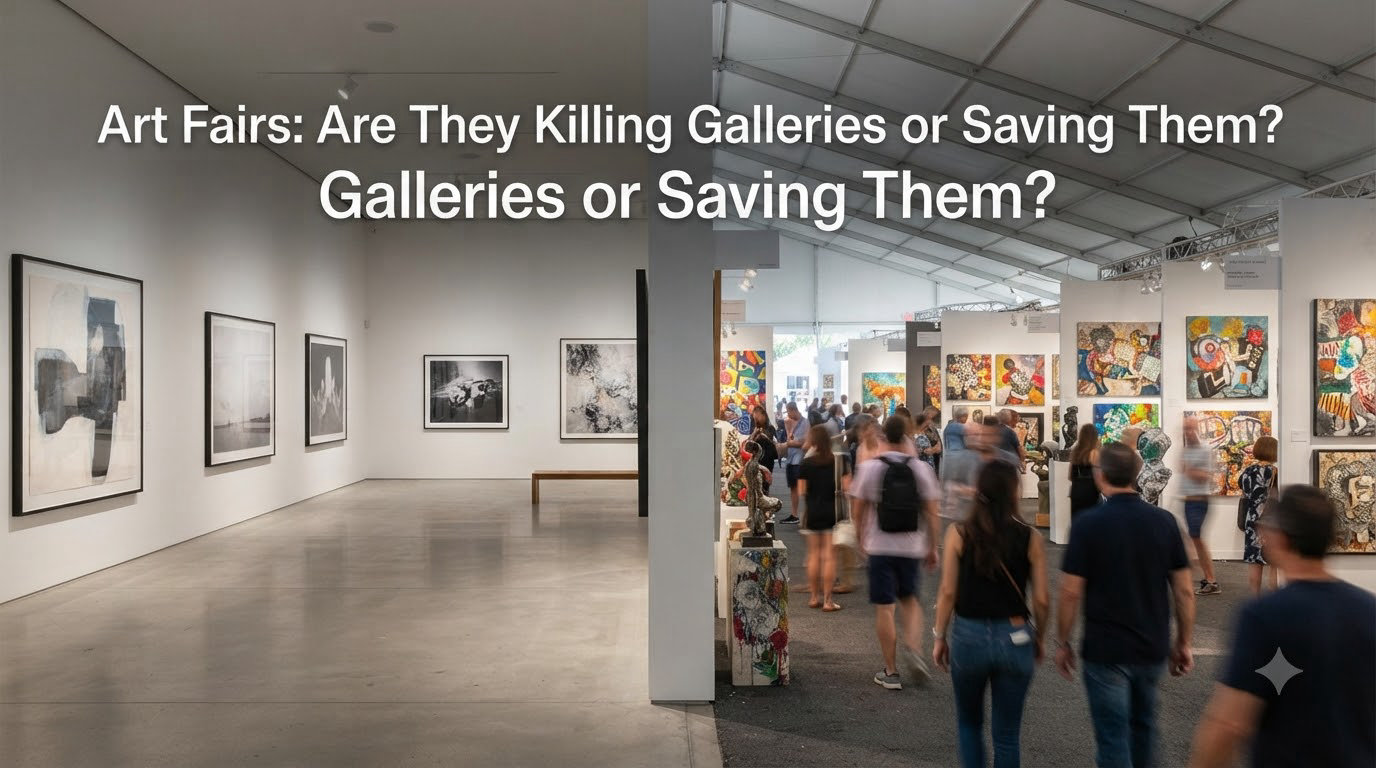
The art fair circuit has become the beating heart of the contemporary art market, but that heart is showing signs of strain. Every year, galleries shell out tens of thousands—sometimes hundreds of thousands—of dollars to secure booth space at events like Art Basel, Frieze, and the Armory Show. The question on everyone’s mind is simple yet profound: are art fairs killing galleries or saving them?
I’ve spent the last several months talking with gallerists, collectors, and fair directors across three continents. The answers I received were rarely straightforward. Some dealers described fairs as a necessary evil, a costly gamble they can’t afford to skip. Others spoke of fair participation as the single greatest threat to their survival, a financial drain that has pushed dozens of galleries into closure.
The art fair debate matters because over 30% of gallery revenue now comes from these temporary exhibitions. Yet rising costs are forcing gallery closures and reshaping the entire art market ecosystem. This article examines both sides of the argument, traces how we got here, and explores what the future might hold for galleries navigating the fair-industrial complex.
Table of Contents
The Crushing Cost of Fair Participation
Let’s start with the numbers because they tell a sobering story. For a small gallery with a modest booth at a mid-tier fair, costs can easily reach $50,000 per event. This includes booth fees, shipping artwork internationally, flights and hotels for staff, and the opportunity cost of closing the physical gallery for a week. Larger galleries showing at Art Basel Miami Beach or Frieze London? They’re often looking at $200,000 to $400,000 for a single fair.
The breakdown is relentless. Booth fees at major fairs range from $20,000 to $80,000 depending on location and size. Shipping delicate artwork across continents adds another $10,000 to $30,000. Insurance, installation, hospitality, and marketing push the total higher. And that’s assuming nothing goes wrong—a damaged piece, a delayed shipment, or a last-minute customs issue can add thousands more.
A recent First Thursday survey revealed that many galleries suffered revenue drops of more than 50% in recent years. Despite this, fair costs have continued to climb. The math has stopped working for many dealers, especially emerging galleries operating on thin margins. As one New York gallerist told me off the record: “We’re paying more to make less. It doesn’t take a genius to see that’s unsustainable.”
| Fair Tier | Examples | Booth Fee Range | Total Cost Estimate |
|---|---|---|---|
| Tier 1 (Global) | Art Basel, Frieze London | $50,000-$80,000 | $200,000-$400,000 |
| Tier 2 (Major) | Armory Show, FIAC | $25,000-$50,000 | $75,000-$150,000 |
| Tier 3 (Regional) | NADA, Material | $10,000-$25,000 | $30,000-$60,000 |
| Emerging | Spring/Break, Satellite | $3,000-$10,000 | $15,000-$35,000 |
The gallery closure data backs up these concerns. Over the past five years, we’ve seen the shuttering of significant spaces including Clearing, Van Doren Waxter, and various regional mainstays. While not every closure can be blamed on fairs, dealers consistently cite fair costs as a major contributing factor. The sad irony? Many of these galleries participated in fairs precisely to avoid closure, only to find the costs accelerating their demise.
Fair fatigue has become a genuine phenomenon. Collectors, overwhelmed by the sheer number of events, are becoming more selective. Galleries, burned by repeated losses, are cutting back their fair schedules. Yet the fear of missing out keeps most dealers locked into the system. Skip a major fair and you risk being forgotten by collectors who now expect to do their buying within the fair circuit.
The ROI Problem
Return on investment at art fairs has become increasingly elusive. A decade ago, a gallery might expect to sell 60-70% of their booth within the first two days. Today, that figure has dropped significantly for many participants. Some galleries report selling only 30-40% of displayed work, barely covering costs or, in many cases, falling short entirely.
The delayed sale phenomenon adds another layer of difficulty. Collectors now use fairs as browsing opportunities, then contact galleries weeks later to negotiate. This stretches cash flow and makes it impossible to know if a fair was truly successful until months after the fact. For small galleries operating on tight margins, this delay can be devastating.
Meanwhile, the pressure to present museum-quality booths has escalated. Fairs have become theatrical productions, with galleries competing to create Instagram-worthy spaces. This arms race benefits no one except the fair organizers collecting booth fees. Dealers find themselves spending more on presentation while selling less actual artwork.
The Gallery Paradox: Why Dealers Can’t Quit Fairs
Here’s where the narrative gets complicated. Despite all the financial pain, most galleries can’t afford to stop doing fairs. This paradox defines the current art market moment. Fairs have become so central to collector behavior that skipping them means becoming invisible to the very people who buy art.
Collector habits have shifted dramatically over the past two decades. Where serious buyers once made regular rounds of gallery districts, many now concentrate their purchases at fairs. The convenience is undeniable—hundreds of galleries in one location, VIP previews with curated events, the social spectacle of seeing and being seen. Why trek to Chelsea or the Lower East Side when everything converges in Miami for a long weekend?
This shift has created a dependency that’s difficult to break. A gallery that stops doing fairs risks being dropped from collector radar. The fear of missing out isn’t just psychological; it’s financial. I’ve heard countless gallerists describe the same calculus: “We lose money at fairs, but we lose more money if we don’t go.”
The brand necessity factor complicates matters further. For established galleries, maintaining a presence at Art Basel or Frieze signals continued relevance. Skipping these events raises questions among collectors and artists alike. Is the gallery in trouble? Have they lost their edge? The appearance of success has become as important as success itself.
For emerging galleries, fairs represent a shortcut to legitimacy. Getting accepted into a respected fair like NADA or Liste can validate years of hard work. It opens doors to collectors who might never visit a small gallery in a secondary city. The opportunity cost of not participating feels impossibly high, even when the financial cost is clearly unsustainable.
The FOMO Trap
Fear of missing out drives unnecessary fair participation across the industry. I’ve watched galleries with no realistic chance of profitability at Art Basel apply year after year, burning through capital that could sustain their physical space for months. The justification is always the same: presence, relationships, future sales.
Some of these bets pay off. A single connection made at a fair can lead to years of sales. But increasingly, dealers are recognizing that the scattershot approach isn’t working. The galleries surviving this moment are those being strategic about which fairs they attend and why. They’re calculating true costs, including the hidden ones like staff burnout and neglected gallery programming.
The psychological toll matters too. Fair preparation consumes months of energy. The events themselves are physically exhausting—long days on your feet, constant social performance, the stress of valuable artwork in temporary conditions. Many gallerists describe fair season as a period of sustained anxiety that takes weeks to recover from. This human cost rarely appears in financial spreadsheets but affects gallery operations profoundly.
From Art Basel to Fair Fatigue: A Brief History
To understand the current crisis, we need to look back at how we got here. The modern art fair era began in 1970 with the founding of Art Basel. That first event gathered just 90 galleries and 10 publishers in a modest Swiss venue. The concept was revolutionary at the time: bring the gallery experience to collectors in a concentrated format, creating efficiency for both buyers and sellers.
For three decades, the fair model grew steadily but remained relatively contained. Art Basel expanded to Miami in 2002, signaling international ambitions. Then came 2003 and the launch of Frieze London, which changed everything. Frieze introduced a more glamorous, magazine-driven approach to art fairs. The event felt less like a trade show and more like a cultural festival. Collectors loved it.
The floodgates opened. Between 2003 and 2015, the number of international art fairs exploded from roughly 50 to over 400. Every major city wanted its own art week. Fairs proliferated in Dubai, Hong Kong, São Paulo, Istanbul, and dozens of other locations. The art calendar became a year-round circuit, with significant events happening nearly every month.
This expansion served the market’s globalization. New wealth in Asia, the Middle East, and elsewhere created demand for access points to the Western art world. Fairs provided that access. They also created opportunities for galleries from smaller markets to reach international collectors. For a time, the system seemed to work for everyone.
The peak has passed. According to recent data, the number of operating fairs has declined from its high of 400+ to approximately 336 in 2024. This contraction represents a market correction, not a collapse. The most sustainable fairs are strengthening while weaker events fade away. But the correction has been painful for galleries caught in the transition.
The Pre-Frieze vs Post-Frieze Divide
Those who remember the pre-2003 gallery world describe it with nostalgia. Collectors visited spaces regularly. Relationships developed over years. Artists had time to mature before facing the global spotlight. The pace was slower, the stakes seemingly lower.
The post-Frieze era accelerated everything. Artists might go from MFA shows to Art Basel booths within months. Collectors developed fair-driven acquisition habits. Galleries found themselves spending more time preparing for temporary exhibitions than nurturing their permanent spaces. The transformation has been total.
Some argue this change democratized the art world, giving more galleries access to international markets. Others lament the loss of depth, the replacement of sustained engagement with transactional encounters. Both perspectives contain truth. The question is whether the current system can sustain itself or whether further evolution is inevitable.
How Fairs Keep Galleries Alive
Despite the financial burden and operational stress, art fairs provide genuine value that keeps galleries participating. Understanding these benefits is essential to answering whether fairs are killing or saving the gallery system. The reality is more nuanced than either extreme suggests.
Access to global collectors remains the primary draw. A gallery based in Portland or Philadelphia might never meet certain collectors without the fair circuit. These buyers fly in from London, Hong Kong, and São Paulo specifically to attend Miami Art Week or Frieze New York. The concentration of wealth at major fairs is unmatched by any other art world mechanism.
Museum acquisition opportunities present another significant benefit. Curators attend fairs scouting for their institutions. A single museum placement can elevate an artist’s career and justify years of gallery investment in their development. These acquisitions rarely happen through casual gallery visits; they happen at fairs where museum professionals can efficiently survey hundreds of artists in days.
For emerging artists, fair exposure can accelerate careers dramatically. Being shown at Art Basel Statements or similar platforms puts young artists before the world’s most important collectors and curators immediately. The gallery pays the cost, but the artist receives the career boost. This dynamic keeps galleries participating even when the financial returns are uncertain.
Relationship maintenance matters too. Fairs provide concentrated opportunities for galleries to connect with existing collectors, artists, and fellow dealers. The social dimension of the art market shouldn’t be underestimated. Deals get made at dinners, friendships form at afterparties, and partnerships develop in the booth aisles. These relationships sustain gallery business year-round.
The Market-Making Function
Fairs play a crucial role in establishing market value for new work. When a young artist sells out their booth at NADA or Liste, it creates pricing benchmarks and collector confidence. This market-making function is difficult to replicate in a traditional gallery setting where sales happen privately and slowly.
The visibility factor extends beyond immediate sales. Press coverage, social media exposure, and general buzz generated at fairs keeps artists and galleries relevant. In an attention economy, being seen matters. Fairs guarantee visibility in ways that gallery exhibitions, no matter how excellent, often cannot match.
Finally, fairs provide revenue diversification. While the costs are high, successful fair sales can balance slower months in the gallery. For seasonal businesses or galleries in locations with tourist-driven economies, fairs offer income during otherwise quiet periods. This diversification can be the difference between survival and closure.
Alternative Models: Rethinking the Fair Format
As traditional fairs strain under their own weight, alternative models are emerging. These experiments suggest that the fair format isn’t doomed—it’s evolving. Galleries and organizers are testing new approaches that might reduce costs while maintaining benefits.
The U-Haul gallery model represents one intriguing direction. Instead of renting expensive booth space, dealers load artwork into trucks or temporary structures and create pop-up exhibitions at fair-adjacent locations. These alternatives capture fair traffic without paying fair prices. During Miami Art Week, warehouse districts fill with these satellite exhibitions.
Boutique fairs are gaining traction as alternatives to the massive global events. Smaller, curated fairs like Material in Mexico City or Spring/Break in New York offer lower costs and more focused experiences. These events attract serious collectors without the overwhelming scale of Art Basel. For galleries with limited budgets, boutique fairs can provide better ROI than mega-events.
Regional fairs are also finding new relevance. Rather than competing on the international circuit, these events serve specific geographic markets. Asian collectors attend Asian fairs. Latin American buyers focus on regional events. This localization reduces travel costs and shipping expenses while building deeper regional collector bases.
Digital and hybrid fair formats emerged during the pandemic and haven’t disappeared entirely. While virtual fairs haven’t replaced physical events, they offer supplementary revenue streams. Some galleries now maintain digital viewing rooms year-round, reducing the pressure on any single physical fair. The hybrid approach—physical presence plus extended digital access—is becoming standard.
The Esther and Pavilion Approach
Esther in New York and Pavilion in London represent radical rethinking of the fair concept. These initiatives prioritize artist support and dealer collaboration over pure commerce. The formats are experimental, often involving shared resources and collective risk-taking. While not scalable to the Art Basel level, they demonstrate that alternatives exist.
Some alternative fairs are becoming nonprofit or artist-funded, removing the profit pressure that drives traditional fair cost inflation. These experiments suggest that the current commercial model may not be the only viable approach. If galleries can find ways to share costs and risks more equitably, the fair system might become sustainable again.
Sustainability concerns are also driving innovation. The environmental cost of shipping artwork globally dozens of times per year has become harder to ignore. Carbon-neutral fairs, regional consolidation, and longer exhibition periods are all being tested. These changes might reduce the frantic pace that contributes to fair fatigue.
The Regional Divide: US, Europe, and Asia
The art fair landscape looks different depending on where you stand. Regional variations in fair culture, costs, and gallery participation reveal the complexity of the global art market. Understanding these differences is essential for galleries deciding where to invest their limited fair budgets.
Asia has emerged as the growth market for art fairs. Events in Hong Kong, Singapore, Seoul, and Tokyo are expanding while Western fairs contract. Asian collectors have embraced the fair format enthusiastically, and the region’s wealth creation supports continued growth. For galleries, Asian fairs often offer better sales ratios than equivalent Western events, though shipping costs remain high.
The European fair landscape is more mature and currently more strained. Frieze London and Paris, Art Basel in Basel, and various regional events compete for attention in a relatively small geographic area. European galleries report severe fair fatigue, with many reducing their schedules significantly. Sustainability concerns are also stronger in Europe, driving interest in alternative models.
The US market is experiencing a strategic pause. After years of expansion, American galleries are reconsidering their fair participation. The January 2026 market conversations in New York revealed widespread questioning of the status quo. Some galleries are skipping major fairs for the first time in years, testing whether their business can survive without them.
Regional differences extend to fair formats. Asian fairs tend to emphasize luxury and spectacle. European fairs retain more focus on serious collecting and connoisseurship. American fairs vary widely, from the commerce-driven Armory Show to the experimental Spring/Break. These cultural differences affect which fairs make sense for which galleries.
The Strategic Geography Question
For galleries, the regional question has become strategic. A European gallery might find better returns focusing on Asian fairs than competing at Frieze. An American gallery might prioritize regional events over the global circuit. The era of doing every major fair is ending; the era of selective participation has begun.
These shifts will reshape the art world map. If galleries pull back from certain regions, those markets may develop differently. Local galleries might fill gaps left by departing international dealers. Or collector bases might simply shrink. The next decade will reveal which regional strategies succeed.
The Future: Transformation, Not Extinction
Having examined both sides of the argument, I believe the answer to our central question is neither simple killing nor simple saving. Art fairs are transforming galleries, pushing the entire industry toward new models that blend traditional exhibition spaces with fair-based sales strategies.
The market correction underway will continue. We can expect more fair closures, more gallery withdrawals, and more experimentation with alternatives. The survivors will be galleries and fairs that adapt strategically rather than clinging to outdated models. This evolution, while painful, might ultimately produce a more sustainable art ecosystem.
Sustainability imperatives will drive much of this change. The current fair circuit is environmentally indefensible. Carbon costs, waste from temporary installations, and the human toll of constant travel will force reforms. Fairs that address these concerns proactively will win gallery loyalty. Those that ignore them will face increasing resistance.
Hybrid models are the likely future. Galleries will maintain physical spaces for deep engagement while using fairs strategically for market access. The ratio between these activities will vary by gallery size, location, and artist roster. There’s no one-size-fits-all solution, but there are many viable hybrid approaches.
Strategic intentionality will separate successful galleries from struggling ones. The galleries winning this moment are those choosing fairs carefully, calculating true costs and benefits, and building alternative revenue streams. They’re not abandoning fairs entirely, but they’re no longer participating out of blind FOMO.
FAQs
Are art galleries declining?
Yes, art galleries have been experiencing significant challenges with numerous closures in recent years. Many galleries have reported revenue drops exceeding 50%, and the financial pressures of fair participation have contributed to this decline. However, the decline is uneven—established blue-chip galleries continue thriving while smaller and mid-tier galleries face the greatest struggles.
How much do art fairs cost galleries?
Art fair costs vary dramatically by fair tier and gallery size. Small galleries at emerging fairs might spend $15,000-$35,000 total, while major galleries at top-tier events like Art Basel can spend $200,000-$400,000 per fair. These costs include booth fees ($10,000-$80,000), shipping ($10,000-$30,000), travel, accommodation, insurance, and installation expenses.
Why can’t galleries quit fairs despite higher costs?
Galleries continue participating in fairs because collector behavior has shifted dramatically—many buyers now concentrate their purchases at fairs rather than visiting galleries regularly. Fairs provide access to global collectors, museum curators, and career-making opportunities for artists. Additionally, maintaining fair presence signals gallery relevance and success to the market. The fear of becoming invisible to collectors keeps most galleries locked into the fair system despite financial losses.
What are alternatives to traditional art fairs?
Several alternative models are emerging: boutique fairs with lower costs and focused experiences, the U-Haul/pop-up model where galleries create satellite exhibitions during fair weeks, regional fairs serving specific geographic markets, and hybrid digital-physical formats. Initiatives like Esther and Pavilion experiment with nonprofit and collaborative approaches. These alternatives aim to reduce costs while maintaining access to collectors and market visibility.
Final Verdict: Killing, Saving, or Transforming?
So, are art fairs killing galleries or saving them? The answer, unsatisfying as it may be, is both and neither. The traditional gallery model built solely on physical space and local collector relationships is indeed dying. Fairs have played a significant role in that death, draining resources that once sustained brick-and-mortar operations and training collectors to buy in concentrated bursts rather than through sustained engagement.
Yet fairs are also saving galleries by providing access to global markets that most dealers could never reach otherwise. They’re creating opportunities for emerging artists, establishing market values, and maintaining the art world’s social fabric. Without fairs, many galleries would have closed years ago, unable to generate sufficient revenue from their physical spaces alone.
The more accurate framing is transformation. Art fairs are transforming what it means to be a gallery in the 2026 art world. The successful gallery of the future will likely be a hybrid operation—part physical space for deep artistic engagement, part fair participant for market access and visibility. This transformation is painful, expensive, and unfairly hardest on small galleries with limited resources. But it may ultimately create a more resilient art ecosystem.
The art fair isn’t dead, and neither is the gallery. Both are evolving in response to market realities, environmental concerns, and shifting collector habits. The galleries that survive will be those that stop asking whether to do fairs and start asking which fairs, how often, and to what end. Strategic intentionality, not blind participation, is the path forward.
The fair-industrial complex will persist, but it will change. Costs will adjust as galleries push back. Alternative models will gain traction. Regional markets will develop differently from global ones. And through all this change, art will continue to be made, shown, and sold—just through channels that look different from today’s strained system. The question was never really about killing or saving. It was always about evolution, and evolution is rarely comfortable.