
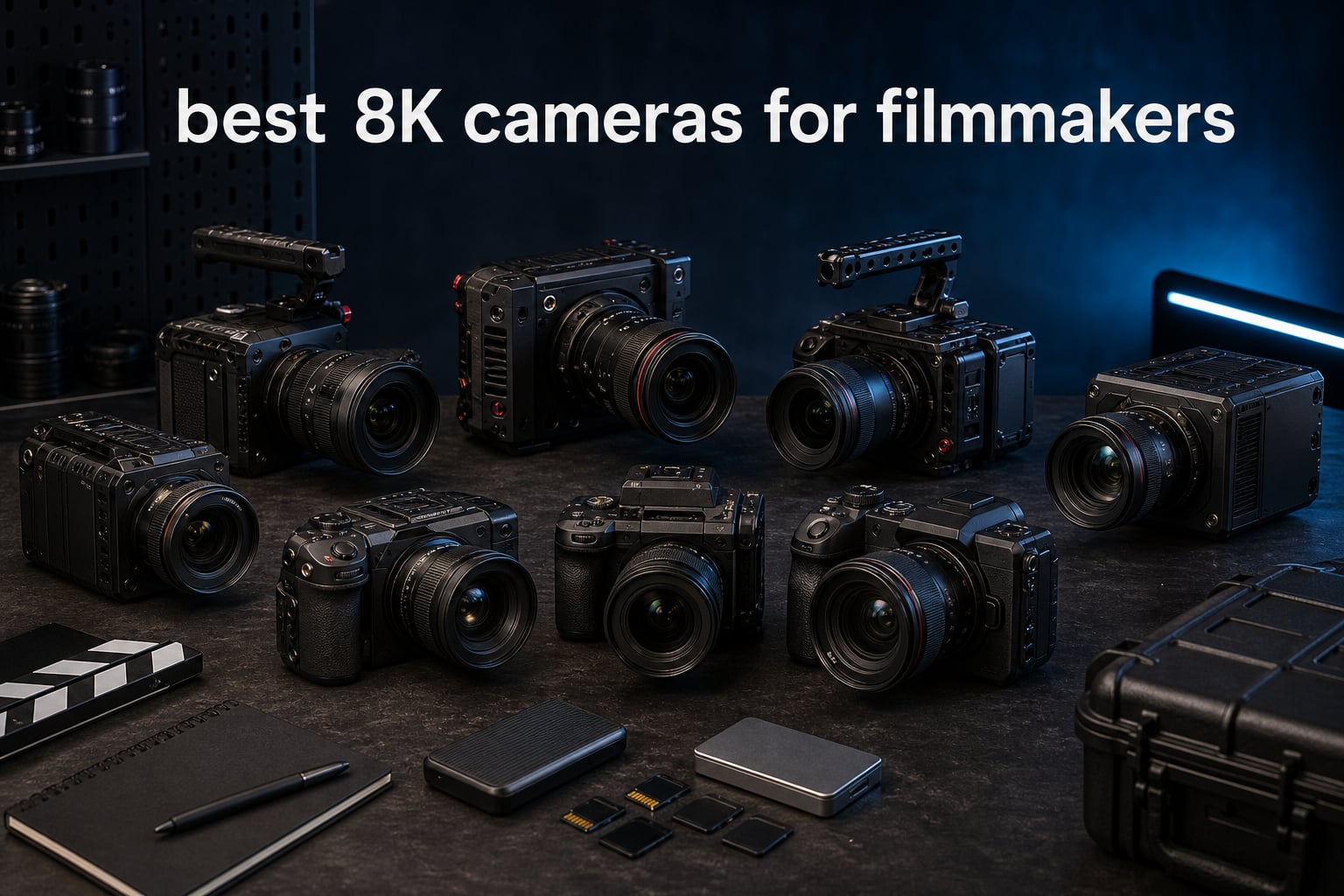
The best 8K cameras for filmmakers are not automatically the ones that make the most sense for every shoot. An 8K image gives you a 7680 by 4320 capture frame, or four times the pixel count of 4K, which can be a major advantage when a client needs a reframed shot, a stabilized crop, or several deliverables from one take.
For most hybrid shooters, I would begin with the Canon EOS R5 because it pairs internal 8K RAW with 4K up to 120fps, a 45-megapixel full-frame sensor, five-axis stabilization, and 1,053-point Dual Pixel autofocus. A filmmaker who needs longer continuous 8K sessions should look first at the EOS R5 C, while the Nikon Z 8 makes a persuasive case for internal 12-bit N-RAW and ProRes RAW.
Our list has eight verified models, from APS-C to full-frame bodies, and it does not pretend that 8K is always the delivery format. I have weighed the supplied specifications and customer feedback instead of inventing hands-on results: resolution is only useful when the codec, heat behavior, media, backup plan, lenses, and edit system can support it.
That distinction matters in 2026. Filmmakers in community discussions repeatedly make the same sensible point: 4K RAW or 4:2:2 LOG may serve a project better than 8K with a restricted recording format, and visual-effects work can value bit depth more than extra pixels. Treat 8K as room to work in post-production, not as a requirement for every timeline.
Table of Contents
Canon EOS R5, Canon EOS R5 C, and Nikon Z 8 Are the Top 3 Picks (September 2026)
Here is the short answer. Pick the EOS R5 for a balanced stills-and-video kit, the EOS R5 C for fan-cooled 8K/60p RAW work, and the Z 8 for a weather-sealed hybrid body with 8K/60p plus internal N-RAW and ProRes RAW.
These badges describe fit, not an absolute hierarchy. The right camera is the one that records the file your editor can finish, stays practical for the length of the take, and fits the way your crew focuses and supports a lens.
These Are the Best 8K Cameras for Filmmakers in 2026
The overview below includes every camera reviewed in this guide. I would use it to narrow the field by sensor format, peak 8K mode, recording format, and handling priorities before reading the fuller notes.
| Product | Specifications | Action |
|---|---|---|
 Canon EOS R5 Canon EOS R5 |
|
View Details |
 Canon EOS R5 C Canon EOS R5 C |
|
View Details |
 Nikon Z 8 Nikon Z 8 |
|
View Details |
 Nikon Z 9 Nikon Z 9 |
|
View Details |
 Sony Alpha 1 Sony Alpha 1 |
|
View Details |
 Sony Alpha 7R V Sony Alpha 7R V |
|
View Details |
 FUJIFILM X-H2 FUJIFILM X-H2 |
|
View Details |
 LUMIX S1RII LUMIX S1RII |
|
View Details |
1. Canon EOS R5 Is the Best All-Around Hybrid 8K Camera
- Internal 8K RAW
- 4K 120fps
- Dual Pixel AF
- dual card slots
- No built-in flash
- 1.6-pound body
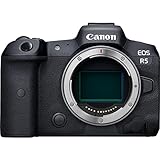
The Canon EOS R5 is the most rounded option here for a filmmaker who alternates between a stills assignment and a video call sheet. Its full-frame CMOS sensor is listed at 45 megapixels, while the DIGIC X processor supports internal 8K RAW and 4K capture up to 120fps.
I like the practical pairing of those modes. You can capture a high-resolution master when reframing matters, then move to 4K slow motion for inserts without changing bodies. The supplied feedback is unusually strong too: it holds a 4.7 rating from 781 reviews, with 89 percent of the recorded rating distribution at five stars.
Its 1,053-point Dual Pixel CMOS autofocus and subject tracking cover people, animals, and vehicles. That makes this camera especially appealing to small crews where the operator may need help holding focus during a moving shot, rather than treating autofocus as a substitute for a planned focus pull.
The R5 also has five-axis sensor-shift stabilization, a CFexpress Type B slot alongside an SD UHS-II slot, Wi-Fi, Bluetooth, and a 3.2-inch tilting touchscreen. I would reserve the fast CFexpress media for demanding recording modes and plan the card-offload process before shooting, because 8K files can fill a card and a backup drive quickly.
The EOS R5 Fits Hybrid Commercial and Documentary Crews
This is the strongest fit when one compact body must cover polished interviews, detail shots, event cutaways, and high-resolution stills. The ISO range is listed as 100 to 51,200, expandable to 102,400, which gives a broad exposure range to work from when location lighting changes.
Its 20fps electronic stills burst and 12fps mechanical burst add real value for crews whose deliverables include photography. A dedicated cinema body will present a different operating experience, but the R5 asks fewer compromises of a creator who works across both disciplines.
The EOS R5 Workflow Needs Deliberate Heat and Media Planning
The verified listing makes no claim of an integrated cooling fan, so I would not assume that every extended 8K setup behaves the same way. Record a rehearsal in the actual ambient conditions, give the camera breaks where the schedule permits, and have a 4K fallback framed in the shot plan.
Its 10-bit video specification and 8K RAW mode are substantial files, not a casual capture format. Build time for copies, verification, proxies, and at least two backups into the production day; this protects the footage and keeps the edit from becoming a surprise.
2. Canon EOS R5 C Is the Best Choice for Extended 8K Recording
- 8K 60p RAW
- Cooling fan
- 4K 120fps
- HDR recording
- No in-body stabilization
- SD media only
The EOS R5 C answers one of the hardest practical questions in 8K filmmaking: how do you make extended recording less dependent on thermal guesswork? Canon lists an internal cooling fan, 8K/60p internal RAW, Cinema RAW Light, and 4K 120fps without a crop in a compact full-frame body.
For a long interview, performance, or carefully repeated scene, that fan is a meaningful design distinction from a body that relies on passive heat management. The camera has a 4.7 rating from 60 reviews, and the supplied user summary specifically praises its continuous recording capability along with its professional video functions.
The camera records 12-bit video and supports internal 8K HDR in HLG and PQ formats. It also offers MXF-based XF-AVC and MP4, plus simultaneous dual-file recording, so a crew can select a format that fits the post-production request instead of treating every project as a RAW project.
There are tradeoffs. The listing specifies optical stabilization rather than in-body stabilization and one SD memory slot, so handheld work benefits from stabilized RF lenses, a rig, or external support. I would confirm the exact card specification and sustained-write requirement for the chosen mode before assigning this camera to a one-take scene.
The EOS R5 C Fits Controlled Sets and Long Takes
Choose the R5 C when continuous 8K capture is central to the job and you want a body designed around an internal cooling fan. It has Dual Pixel CMOS autofocus with ITR AF X and touch autofocus, useful tools for a solo operator or a small team working with moving subjects.
The 45-megapixel full-frame sensor also leaves this camera credible when a stills frame is requested during a production. Its compact mirrorless form makes it easier to place on a gimbal or in a confined location than a larger cinema rig, while the cooling approach speaks directly to longer record runs.
The EOS R5 C Requires Lens-Based Stabilization and Card Discipline
Without in-body stabilization, the movement plan matters more. A stabilized lens can help, but it is not the same decision as a camera with sensor-shift stabilization; a shoulder rig, tripod, monopod, or gimbal may be the better answer depending on the shot.
One SD slot also changes the data-management conversation. I would designate a data wrangler when possible, label media as it comes out of the camera, and do not erase a card until two verified copies exist in separate places.
3. Nikon Z 8 Is the Best 8K Camera for Internal RAW Flexibility
Nikon Z 8 | Professional Full-Frame mirrorless Stills/Video Hybrid Camera | Nikon USA Model
- Internal RAW formats
- 8K 60p
- 5.5-stop IBIS
- weather sealing
- 1.8-pound body
- No built-in flash
The Nikon Z 8 is the camera I would put at the top of the list for a crew that wants internal RAW choices without moving to the larger Z 9 body. Nikon specifies 8K/60p and 4K/120p internal capture, 12-bit N-RAW and ProRes RAW recording, and a 45.7-megapixel stacked full-frame sensor.
That combination directly addresses a recurring filmmaker concern: resolution alone does not describe the edit latitude of a file. N-RAW and ProRes RAW give a post team identifiable recording options, while the 14-bit RAW specification for stills supports the Z 8’s role as a serious hybrid camera.
The 493-point hybrid phase-detection system includes deep-learning recognition for people, cats, dogs, birds, cars, bikes, trains, and planes. I would see that breadth as helpful for documentary, wildlife, and event work, where the subject changes quickly and a second take might not be possible.
Nikon also lists 5.5-stop five-axis sensor-shift stabilization, dual slots for CFexpress Type B and SD/XQD media, and weather-sealed construction. The 4.6 rating across 198 reviews provides a more substantial feedback sample than several models in this roundup, although ratings cannot replace a codec and lens test for a specific production.
The Nikon Z 8 Fits RAW-First Narrative and Documentary Workflows
The Z 8 makes sense when the edit needs room for grading, reframing, or careful finishing and the team already knows how it will handle N-RAW or ProRes RAW. Its full-frame sensor, 8K/60p ceiling, and 4K/120p option make it flexible for main-camera footage and slow-motion inserts.
I would also consider it for weather-exposed work because the body is described as weather sealed. That does not make any camera carefree around water, dust, or cold, but it is useful production information when the schedule cannot wait for a studio day.
The Nikon Z 8 Requires a Codec Test Before the Shoot
Do not choose an internal RAW format solely because it sounds more advanced. Have the editor open a short test clip, check the grade and proxy path, measure playback on the intended workstation, and confirm that the team can archive the original material reliably.
The 1.8-pound body is still portable, yet a fast lens, cage, monitor, microphone, and CFexpress card will change the balance. I would build the full operating rig before judging whether it is the right handheld package for a full day.
4. Nikon Z 9 Is the Best 8K Camera for a Flagship Production Body
Nikon Z 9 | Flagship professional full-frame stills/video mirrorless camera | Nikon USA Model
- Blackout-free EVF
- 12-bit RAW
- Dual CFexpress
- 2-plus-hour 8K claim
- 3-pound body
- Limited availability
The Nikon Z 9 is the choice for filmmakers who favor a larger flagship body, a blackout-free Real-Live viewfinder, and a layout built around two CFexpress Type B cards. Its 45.7-megapixel stacked full-frame sensor records 8K/30p 12-bit RAW internally and 4K at 120fps.
Nikon lists a recording capacity of 120 minutes and also describes more than two hours of 8K recording. I would read that as useful capability, not as a universal promise: ambient temperature, recording settings, card behavior, and battery state can all alter a real production day.
The 493-point hybrid autofocus system recognizes people, cats, dogs, birds, cars, motorcycles, bikes, trains, and planes. Combined with 20 or 30fps full-resolution stills and a maximum 120fps still mode, the Z 9 is plainly built for crews that might switch from a controlled scene to fast action.
Its connectivity list is unusually complete: Ethernet, GPS, HDMI, USB, Wi-Fi, and Bluetooth are all specified. I would value Ethernet especially when a production has a managed file-transfer environment, while GPS can be helpful when location metadata has a defined purpose in the wider workflow.
The Nikon Z 9 Fits Demanding Sports, Wildlife, and Multi-Role Crews
This camera fits a filmmaker who wants an integrated, weather-sealed professional body rather than the smallest possible rig. The dual CFexpress slots match the needs of high-data-rate recording better than a single-slot design and give a crew more media flexibility on a long assignment.
The blackout-free viewfinder and deep-learning subject detection are also appropriate for subjects that do not wait for a reset. I would favor it when reliable framing and tracking during live movement mean more than shaving every possible gram from the camera bag.
The Nikon Z 9 Rewards a Supportive Rig and Crew Plan
At 3 pounds for the body, the Z 9 is the heaviest option in this guide. That weight can help steady a rig, but it affects handheld endurance, gimbal payload, travel packing, and the kind of support a camera operator needs after several hours.
Its high-efficiency RAW is listed at one-third the size of uncompressed RAW, yet it remains a high-resolution production format. I would calculate recording media, copy time, backup capacity, and proxy generation before the shoot rather than discovering a bottleneck in the edit suite.
5. Sony Alpha 1 Is the Best 8K Camera for Fast Autofocus and Action
- 50.1MP sensor
- 759-point AF
- 30fps stills
- dual media slots
- No built-in flash
- Limited availability
The Sony Alpha 1 brings the strongest stated autofocus point count in this group: 759 Fast Hybrid AF points with Real-time Eye AF for humans and animals. Its 50.1-megapixel full-frame stacked Exmor RS sensor records 8K/30p and 4K/120p, making it a notable option for filmmakers who shoot movement as well as high-resolution video.
For a fast-changing scene, the blackout-free 30fps still shooting and 240fps-refresh 9.44-million-dot OLED viewfinder can be as important as the 8K setting. I would not buy this camera on a point count alone, but those specifications point to a body designed to keep up with action rather than only static compositions.
It offers five-axis in-body image stabilization and two slots that accept CFexpress Type A or SD UHS-II media. That lets a crew separate demanding recording work from lighter capture, but it also means the media list should be written into the prep sheet rather than left to guesswork.
The supplied customer result is a 4.6 rating from 87 reviews. Feedback highlights the advanced viewfinder and autofocus, while noting that availability can be limited. I would confirm the exact body, lens, card, and firmware package that will be on set well before a shoot day.
The Sony Alpha 1 Fits Action-Heavy Hybrid Productions
Choose the Alpha 1 when sports, wildlife, events, or quick-moving commercial scenes share the brief with 8K capture. The full-frame 50.1-megapixel sensor and 30fps blackout-free stills give a stills shooter a serious reason to carry the same body as the video operator.
Its Eye AF can be useful when the subject moves toward or away from camera, particularly with a solo operator. A manual focus plan remains wise for marks, rack-focus storytelling, or scenes where the intended subject is not the most obvious object in frame.
The Sony Alpha 1 Works Best With a Clear Media and Lens Plan
CFexpress Type A and SD UHS-II are not interchangeable solutions for every recording mode. I would check the required card class, bring labeled spares, and test sustained recording with the exact media that will travel to location.
The 726-gram body keeps the base package lighter than the Z 9, though a fast lens and rig accessories can erase that difference. Match the lens choice to the shot list; a high-resolution sensor exposes focus and lens-performance mistakes that a softer capture may hide.
6. Sony Alpha 7R V Is the Best 8K Camera for Detail and AI Recognition
- 61MP sensor
- AI tracking
- 693 AF points
- 5-axis stabilization
- No lens included
- No batteries included
The Sony Alpha 7R V is the detail-first choice in this roundup, with a 61-megapixel full-frame back-illuminated Exmor R CMOS sensor. It captures 8K at 24p or 25p and 4K at 60p, a profile that fits deliberate, composed filmmaking more naturally than a need for 8K high-frame-rate capture.
Sony lists a dedicated AI processing unit for Real-time Recognition autofocus and 693 phase-detection autofocus points. I would consider that a useful pairing for interviews, portraits, small commercial crews, and documentary work where a person must remain recognized while the composition changes.
Five-axis stabilization and a body weight listed at 1 pound make the A7R V easier to keep compact than the heavier flagship bodies here. It holds a 4.5 rating from 284 reviews, which is the largest review sample among the Sony entries supplied for this guide.
The tradeoff is clear in the video modes. There is no stated 8K/60p or 4K/120p mode, so I would not pick it when slow-motion coverage is a central deliverable. It is better understood as a high-resolution hybrid camera that adds 8K 24p or 25p to an image-focused toolkit.
The Sony Alpha 7R V Fits Composed, Detail-Led Productions
This model fits controlled interviews, fashion, product work, architectural scenes, and other projects where resolution supports a carefully framed image. The 61-megapixel sensor gives generous detail for stills, and 8K capture can preserve options for a modest reframe after the shoot.
I would pair it with a lens that resolves well and a support system suited to precise framing. High resolution is less forgiving of minor focus errors, subject movement, and vibration, so a well-set tripod or stabilized rig may have more impact than the headline pixel count.
The Sony Alpha 7R V Has a Deliberate Motion-Capture Ceiling
Use the stated 8K 24p or 25p mode for a cinema-style cadence, not for a high-frame-rate plan. If the schedule calls for frequent 120fps slow motion, the Alpha 1, R5, R5 C, Z 8, or Z 9 has a stated 4K/120p option that better matches that need.
The body is supplied without a lens and without batteries, so the operational kit is larger than the body alone suggests. I would build the complete kit list before deciding how lightweight this camera will feel during an actual production day.
7. FUJIFILM X-H2 Is the Best APS-C 8K Camera for ProRes Recording
- Internal ProRes
- 7-stop IBIS
- 8K 30p
- 4K 120fps
- APS-C sensor
- Limited availability
The FUJIFILM X-H2 proves that an 8K-capable professional filmmaking camera does not need a full-frame sensor. Its 40-megapixel APS-C X-Trans CMOS 5 HR sensor records 8K/30p, 4K/120p, and Apple ProRes 10-bit 4:2:2 internally.
That internal ProRes capability is the headline I would focus on. It gives the filmmaker a named, edit-friendly format in the supplied specifications, which can matter more than a larger sensor when the post-production team already has a reliable ProRes workflow.
The X-H2 also lists seven-stop in-body image stabilization, 425-point intelligent hybrid autofocus, and 15fps mechanical or 20fps electronic still shooting. It has a 4.5 rating from 81 reviews, and the product data identifies the sensor as the world’s first 40-megapixel APS-C sensor.
Its listed recording capacity is 240 minutes, but length is never the only planning variable. I would still test the selected 8K mode in the expected environment and watch battery behavior, media performance, camera temperature, and the lens’s stabilization during a full rehearsal.
The FUJIFILM X-H2 Fits ProRes-Centered Small-Crew Work
The X-H2 is an attractive fit when the editor wants ProRes 10-bit 4:2:2 and the crew values a smaller sensor format. For YouTube content, music videos, branded work, and documentary inserts, that combination can be easier to plan around than a data-heavy RAW format.
Its 7-stop IBIS is also a strong stated stabilization figure for handheld sequences. Stabilization is not a replacement for careful operating, but it can make a practical difference when a shot has to move quickly from tripod to handheld coverage.
The FUJIFILM X-H2 Needs APS-C Lens and Battery Expectations
An APS-C sensor changes focal-length planning and depth-of-field behavior compared with full frame. I would select lenses for the intended framing rather than assume an existing full-frame shot list will translate directly, especially in tight interiors or for shallow-focus portraits.
The supplied feedback mentions limited battery life, and the body weight is listed at 1,650 grams. Bring enough charged batteries, build the rig first, and decide whether the stated long recording capacity fits the chosen lens, screen use, and production temperature.
8. LUMIX S1RII Is the Best 8K Camera for 8.1K Capture and False Color
- 8.1K capture
- False Color
- AI autofocus
- Dual card slots
- No lens included
- Not water resistant
The LUMIX S1RII brings the highest stated resolution in this group: 8.1K at 8128 by 4288 from a 44.3-megapixel full-frame sensor. It is also the only model here whose supplied feature list explicitly names a False Color function, a practical exposure aid that a video crew can use on set.
Panasonic lists phase-hybrid autofocus with Advanced AI human recognition, five-axis sensor-shift stabilization, and 399 autofocus points. Its AFC 40fps burst rate adds another hybrid dimension, while L-Mount compatibility gives a filmmaker a defined lens-mount ecosystem to assess.
The S1RII has dual CFexpress and SD card slots, a valuable feature for organizing demanding capture and lighter recording modes. It has a 4.2 rating from 26 reviews, the smallest review sample in this guide, so I would put greater weight on a rental or workflow test for a mission-critical production.
At 2.75 pounds, this is not a featherweight camera. I would see that as a cue to evaluate the complete handheld build, especially once a lens, monitor, microphone, and support rig are attached.
The LUMIX S1RII Fits Exposure-Conscious 8.1K Productions
Choose the S1RII when 8.1K acquisition, full-frame capture, and a direct false-color exposure tool meet the needs of the project. False color can speed exposure communication between an operator and a director of photography, provided the crew agrees on its interpretation before the first setup.
The 44.3-megapixel sensor and AI human recognition should appeal to commercial, portrait-led, and controlled narrative work. I would test autofocus behavior with the actual lighting, subject distance, and lens, since every production places different demands on recognition performance.
The LUMIX S1RII Requires a Measured Field-Test Decision
The listing says the body is not water resistant, so it is a less natural choice for an exposed wet-weather schedule without suitable protection. That limitation should be part of location planning rather than an afterthought when weather changes.
The smaller customer-review sample does not make the camera unsuitable; it means the available feedback offers less breadth than the higher-volume models. I would record a short 8.1K test, grade it, create proxies, and confirm media behavior before assigning this body to a nonrepeatable take.
8K Helps Most When Reframing and Finishing Need It
8K is worth using when the production has a clear post-production reason for it. A 7680 by 4320 source lets an editor crop into a 4K delivery, stabilize without giving away as much detail, make a second framing from one locked-off angle, or keep a higher-resolution master for future use.
It is not automatically better for every project. If the finished piece is 4K or HD, the crew may get more meaningful image improvement from a stronger codec, more bit depth, controlled lighting, accurate exposure, and a lens that fits the scene than from switching on the highest resolution.
I would make the decision at the treatment stage. Ask whether the edit truly needs reframing, whether VFX or a high-resolution master is part of the brief, and whether the production can support the card, backup, proxy, and finishing load of the selected mode.
Sensor, Codec, and Bit Depth Set the Image Before Resolution Does
Resolution describes how many pixels a camera captures; it does not tell the whole story of how a file holds up in a grade. The Canon EOS R5 records 8K RAW, the EOS R5 C records 8K/60p RAW and Cinema RAW Light, and the Nikon Z 8 lists both 12-bit N-RAW and ProRes RAW.
The FUJIFILM X-H2 specifies Apple ProRes 10-bit 4:2:2, while the R5 C also lists 4:2:2 10-bit recording and HLG or PQ HDR. Those names are useful only if your editor, colorist, storage system, and delivery requirements are ready for them.
Before choosing a camera, shoot a thirty-second test in the intended profile. Import it on the edit workstation, make the expected grade, generate a proxy if needed, and export a sample delivery. That modest test is more informative than a spec sheet when a deadline is close.
Heat, Recording Duration, and Media Determine Whether 8K Is Practical
Long 8K takes put sustained demands on a camera. The R5 C has an internal cooling fan, which makes it the clear first model to examine for extended 8K/60p sessions, while the Z 9 is listed with 120 minutes of recording capacity and a claim of more than two hours of 8K recording.
Those figures belong in planning, not blind assumptions. Test the precise mode, card, battery, ambient conditions, lens, screen configuration, and rig you will use. Keep a 4K alternate in the call sheet when the shot is important and cannot be repeated.
Media is part of the camera decision. CFexpress Type B appears on the R5, Z 8, Z 9, and S1RII; the Alpha 1 accepts CFexpress Type A or SD UHS-II; and the R5 C listing specifies one SD slot. Each system needs tested cards with known sustained performance and a clear on-set labeling routine.
Backups and Proxies Keep an 8K Edit From Slowing the Production
8K media creates a chain of work after the take: transfer, checksum verification, duplicate backup, proxy creation, editing, grading, and archive. Community discussions correctly flag storage and backup demands as one of the most common hidden constraints, so do not leave them out of the production plan.
I recommend two verified copies before formatting any card, stored separately when possible. The editor can work with proxies while the camera originals remain protected, then reconnect the high-resolution files for grade and final output.
Give the data task an owner. On a tiny crew that may be the camera assistant or producer; on a one-person shoot, it may mean scheduling a protected offload break. The key is to treat data protection as a scheduled production task rather than something done after everyone is tired.
Autofocus, Stabilization, and Audio Need a Shot-Specific Choice
Autofocus strengths vary across these bodies. The R5 lists 1,053 Dual Pixel AF points, the Alpha 1 lists 759 Fast Hybrid AF points with Eye AF, the A7R V lists AI recognition with 693 phase-detection points, and the Z 8 and Z 9 use 493-point hybrid systems with broad subject recognition.
For an operator working alone, that can make a difficult moving shot more achievable. For narrative scenes, manual focus tools, rehearsal, marks, and a dedicated focus puller may still be the better route because the storytelling choice is not always the most easily recognized subject.
Stabilization deserves the same honest assessment. The X-H2 lists seven-stop IBIS, the Z 8 lists 5.5-stop five-axis stabilization, and the R5, Alpha 1, A7R V, and S1RII also list sensor-shift or five-axis systems, while the R5 C depends on optical stabilization. None replaces support, sound planning, or a lens chosen for the shot.
Your Production Brief Should Choose the Camera, Not the Resolution Label
For a balanced hybrid kit, choose the Canon EOS R5. For continuous 8K/60p sessions, choose the Canon EOS R5 C. For internal RAW format flexibility, choose the Nikon Z 8; for a heavier flagship build and dual CFexpress workflow, choose the Nikon Z 9.
Pick the Sony Alpha 1 for fast action and stated autofocus speed, the Sony Alpha 7R V for detail-led 8K 24p or 25p work, the FUJIFILM X-H2 for APS-C capture with internal ProRes, or the LUMIX S1RII for 8.1K and false color. Then verify the chosen mode from camera through edit before the first important day.
These Answers Resolve Common 8K Filmmaking Questions
What is the best 8K camera for professional filmmaking in 2026?
The Canon EOS R5 is the broad hybrid recommendation because it combines a 45MP full-frame sensor, internal 8K RAW, 4K up to 120fps, five-axis stabilization, and 1,053-point Dual Pixel autofocus. Choose the EOS R5 C for fan-cooled 8K/60p RAW or the Nikon Z 8 for internal N-RAW and ProRes RAW.
How much does a professional 8K cinema camera cost?
The amount varies by body, lens system, recording media, batteries, support gear, storage, and post-production needs. Compare the complete working kit and the data workflow rather than judging a camera body in isolation.
What features should I look for in an 8K camera for filmmaking?
Prioritize the recording codec and bit depth, sensor size, frame rates, tested heat behavior, card requirements, autofocus, stabilization, audio path, lens options, and edit compatibility. A 4K RAW or 4:2:2 LOG workflow may suit a project better than 8K when reframing is not needed.
Is 8K worth it for filmmaking or should I stick with 4K?
8K is worthwhile for reframing, stabilization crops, high-resolution masters, and some multi-output productions. Stick with 4K when delivery, storage, edit hardware, and the creative brief do not benefit from the added resolution; codec quality, bit depth, exposure, and lenses may matter more.
What is the difference between 8K and 4K cameras for cinema production?
An 8K frame measures 7680 by 4320 pixels and has four times the pixel count of 4K, allowing greater crop and reframe room. It also requires more capable media, storage, backups, and computing, so the practical benefit depends on the production workflow.
The Canon EOS R5 Is the Most Balanced Starting Point
Among the best 8K cameras for filmmakers, the Canon EOS R5 remains the most balanced starting point for hybrid production, while the R5 C and Nikon Z 8 make more specific cases for cooling and internal RAW flexibility. Choose from the demands of the shoot, not the biggest resolution number.
In 2026, a successful 8K production begins with a tested camera mode, compatible media, a reliable backup routine, and an edit workflow that the team can repeat. Select the body that makes those steps realistic, then put your attention back on light, sound, performance, and the story.