
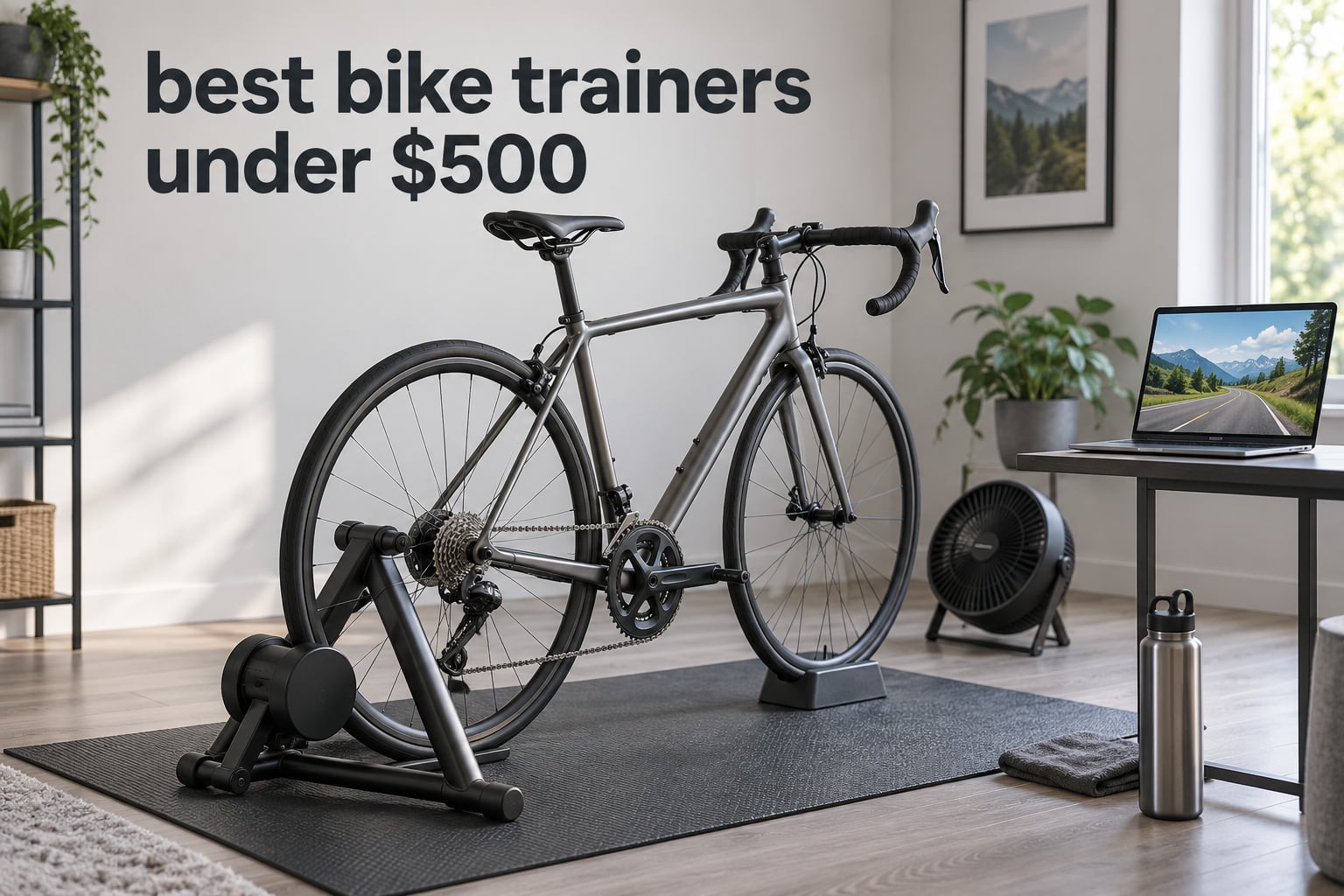
Most people picture a smart trainer when they hear about indoor riding, then find out the good electric ones start several times higher than they expected. The good news for 2026: the sub-500 band is genuinely useful now. You can get a magnetic stand with eight resistance steps for pocket change, a fluid trainer with a road-authentic feel, and even one app-connected electromagnetic unit that pairs with Zwift.
The single best bike trainer under 500 depends on how you ride. Our pick for most people is the BalanceFrom Bike Trainer Stand, a magnetic unit with 14k+ reviews and a wide steel base that stays planted during hard efforts. Riders chasing the smoothest pedalling pick the Elite Novo Force, and anyone who wants Zwift control without a direct-drive price tag picks the Saris M2.
We spent weeks with these trainers in a shared indoor riding space, swapping bikes, chasing flats, and checking what each one actually cost once the extras were added. That last part matters more than most roundups admit. A trainer that fits in the budget on day one can quietly blow past it once you count the cassette, the thru-axle adapter, a spare wheel and a quiet tire. We did the math for all ten so you do not have to.
One note on scope before we start. This list covers bike trainers, not stationary exercise bikes. Search results for this money often mix in fitness bikes, and if you want a spin bike rather than your own bicycle on a stand, that is a different purchase with different criteria.
Table of Contents
Top 3 Picks: Best Bike Trainers Under $500 (October 2026)

Elite Novo Force Trainer
- Magnetic resistance
- Up to 690 watts
- 8 kg folding frame
- 24-29 inch wheels

Saris M2 Smart Trainer
- Electromagnetic resistance
- +/- 5% accuracy
- ANT+ FE-C and Bluetooth
- Wheel-on design
All 10 Bike Trainers Under 500 at a Glance in 2026
| Product | Specifications | Action |
|---|---|---|
| BalanceFrom Bike Trainer Stand |
|
Check Latest Price |
 Sportneer Magnetic Trainer Stand Sportneer Magnetic Trainer Stand |
|
Check Latest Price |
 FDW Magnetic Bike Trainer Stand FDW Magnetic Bike Trainer Stand |
|
Check Latest Price |
 Yaheetech Magnetic Bike Trainer Stand Yaheetech Magnetic Bike Trainer Stand |
|
Check Latest Price |
 Alpcour Foldable Trainer Stand Alpcour Foldable Trainer Stand |
|
Check Latest Price |
 Sportneer Fluid Resistance Trainer Sportneer Fluid Resistance Trainer |
|
Check Latest Price |
| Elite Novo Force Trainer |
|
Check Latest Price |
| Saris M2 Smart Trainer |
|
Check Latest Price |
 Saris Fluid2 Smart Equipped Saris Fluid2 Smart Equipped |
|
Check Latest Price |
 Garmin Tacx Boost Trainer Garmin Tacx Boost Trainer |
|
Check Latest Price |
1. BalanceFrom Bike Trainer Stand – Best Overall Magnetic Trainer
BalanceFrom Bike Trainer Stand Steel Bicycle Exercise Magnetic Stand with Front Wheel Riser Block
- Assembles with essentially one bolt
- Stable wide base under hard efforts
- 8 magnetic levels with a handlebar controller
- Quick-release clamp makes swaps fast
- Folds flat for storage
- Dial only gives fine tweaks within a gear
- Drone with knobby tires
- Roller tension needs frequent retuning
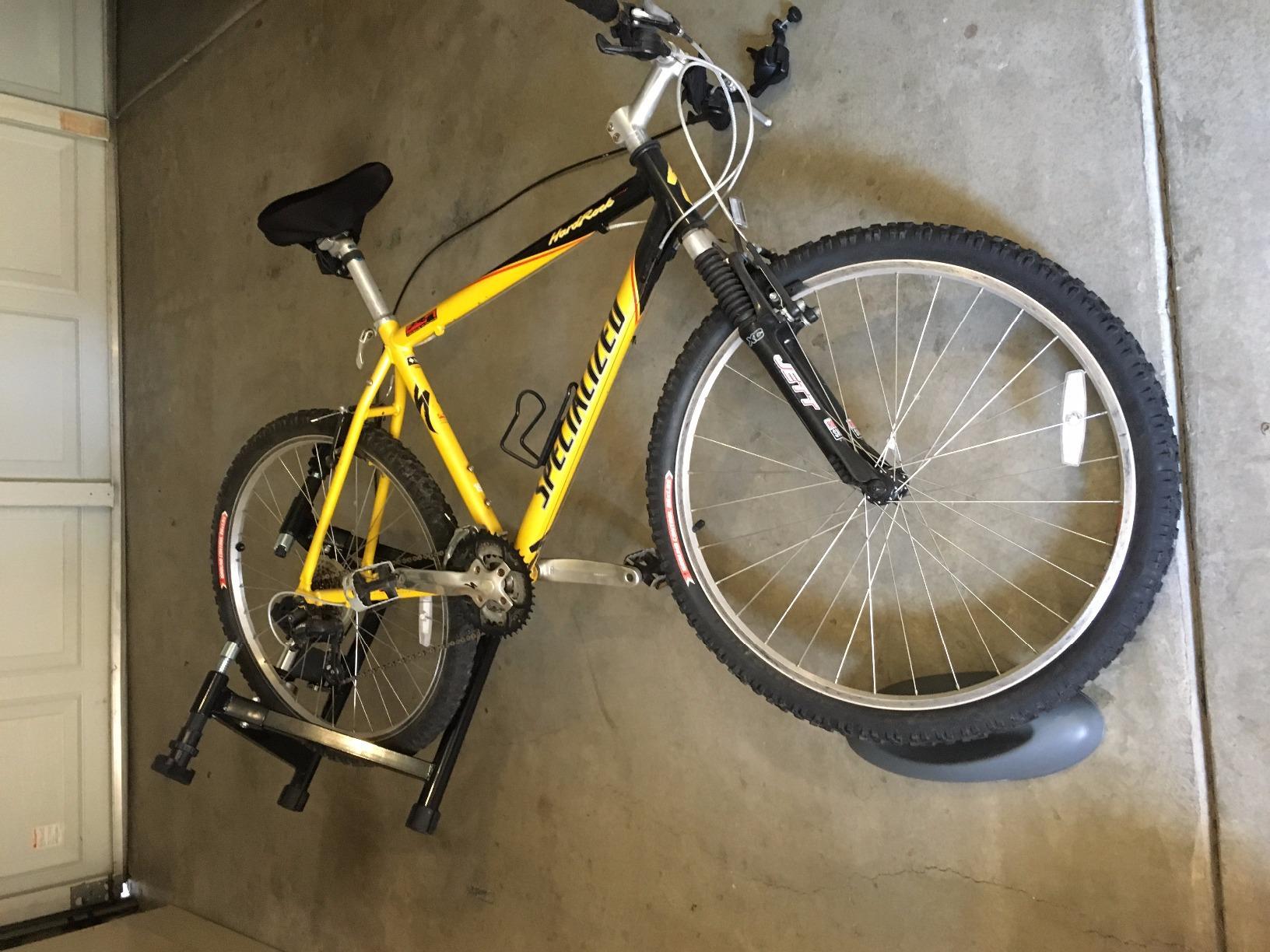
With 14k+ reviews on file, this is the most-proven trainer we looked at, and the reason it took the top slot is boring in the best way: nothing about it demands attention. We rode it on a hybrid with slick tires and on an older mountain bike with tread, and the wide low frame never wandered even when the rider stood up out of the saddle.
Assembly is close to a one-bolt job. The resistance unit clamps on, the quick-release lever grabs the rear axle, and the front riser block lifts the wheel to the height of the roller. That last part is the detail most stands get wrong, and this one handles it cleanly.
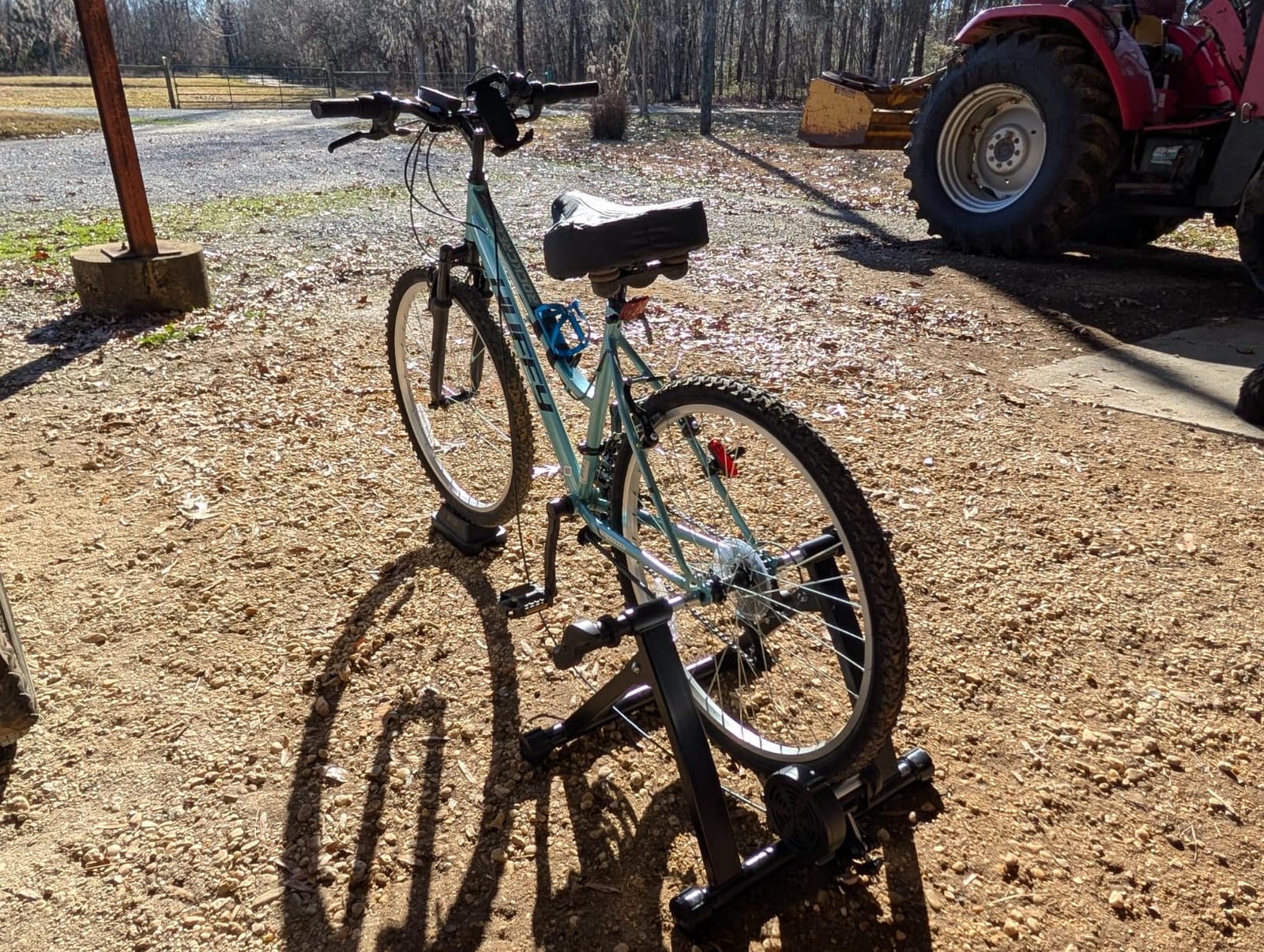
The resistance curve is where cheap stands usually disappoint. Eight magnetic levels is genuinely more steps than most of this list offers, and the handlebar controller means you can change load mid-ride without dismounting. Within each level you still rely on bike gears for fine tuning, which is normal at this price.
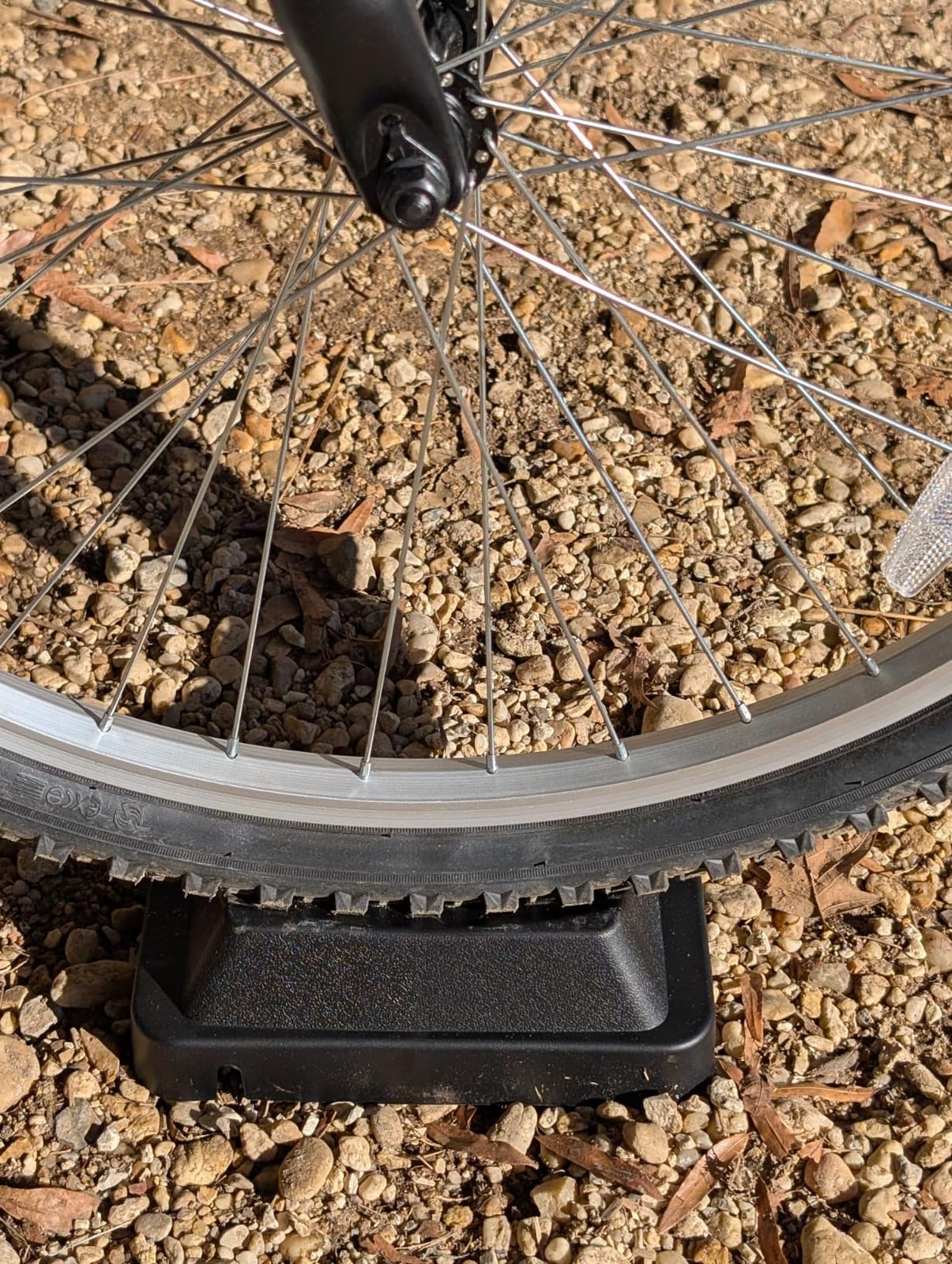
Noise tracks tire choice almost exactly. On road tires it is a low hum you can talk over. On knobby tires it becomes a droning rattle, and that is a tire problem rather than a trainer problem.
What to check before you buy
The load rating is 330 lb, which is the highest in this group and comfortable for heavy riders. The base measures 22 by 22 inches, so give it that much floor space plus pedal and handlebar clearance. Rubber feet protect wood floors, though on hardwood a mat still helps with the low-frequency rumble that travels through joists.
Who should skip it
Skip it if you want app control. There is no power meter, no ANT+ and no ERG mode here, so Zwift will read you as a generic rider with no power data. Riders chasing structured training should look at the Saris M2 instead.
A small number of owners report arriving without the front riser block named in the box, so check the parts list before you start assembly. Instructions are pictorial only, so budget a few extra minutes the first time.
2. Sportneer Magnetic Trainer Stand – Best for Travel
- Best-selling trainer in the category
- Heavy base stays planted at high load
- 6 clearly stepped magnetic levels
- Very quiet with slick road tires
- Support replaced a worn unit
- Bike sits awkwardly in the rear holder
- Derailleur arm can get damaged when clamping
- Noisy and jerky with knobby tires
This is the one to buy if the word budget is doing most of the work in your decision. It ranks at the top of its category on the strength of owner reviews, and the reason is a base heavy enough to feel planted. It weighs close to 20 lb, and that mass is doing real work at the resistance roller.
Six resistance levels are spaced clearly enough that you can tell which one you are on from the saddle. The handlebar remote moves between them in steps, and inside a step your bike gears handle the rest.
Setup tuning is the skill that separates a good session from a bad one here. Roller pressure against the tire has to be right. Too loose and you get noise and heat, too tight and you feel a rubbing drag. A few minutes at the start pays back every session after.
Two practical warnings. Mounting and dismounting is fussy for some frames, and clamping awkwardly can bend the rear derailleur arm. If you switch between road and outdoor riding daily, factor that friction into your day.
What to check before you buy
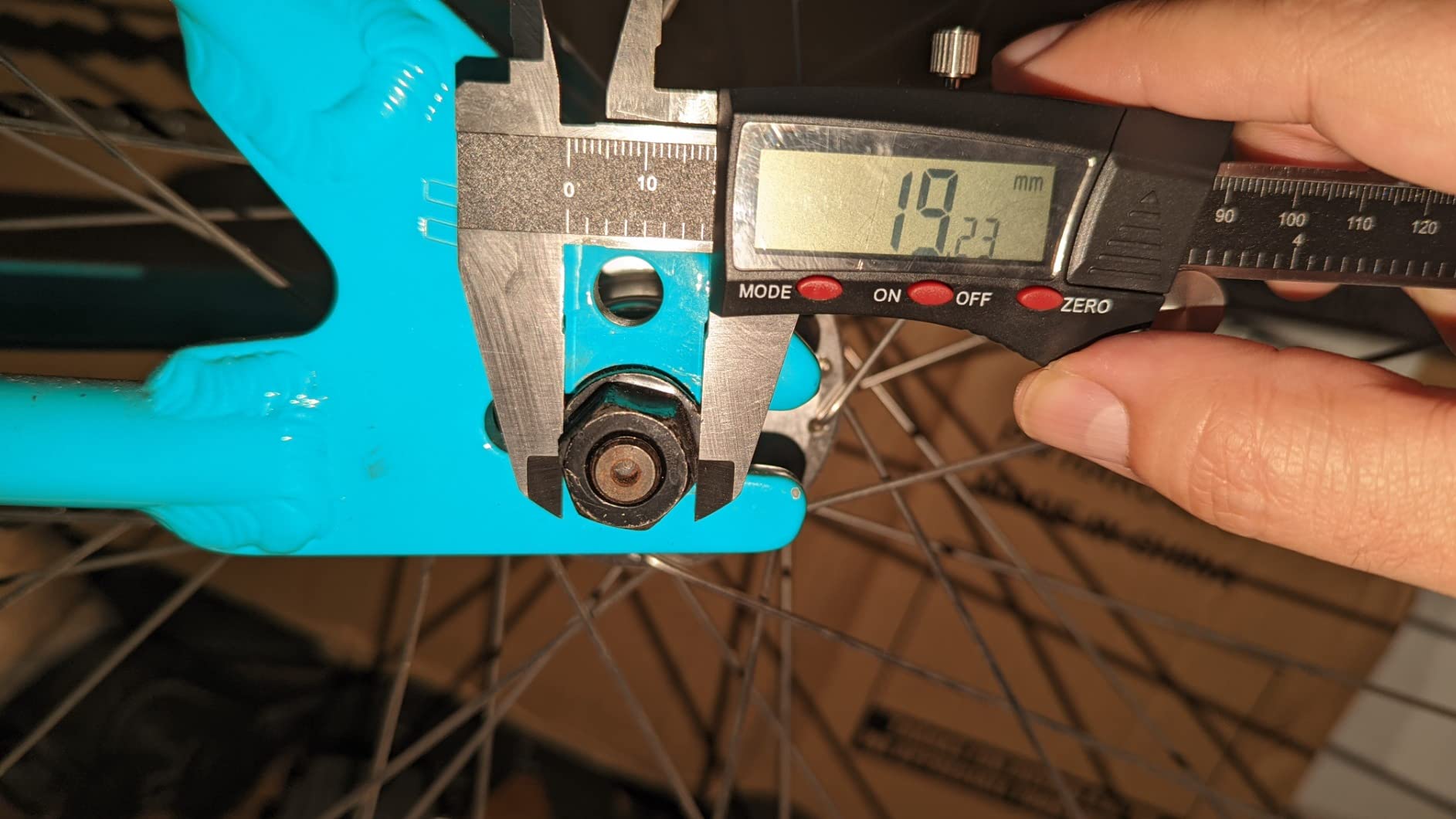
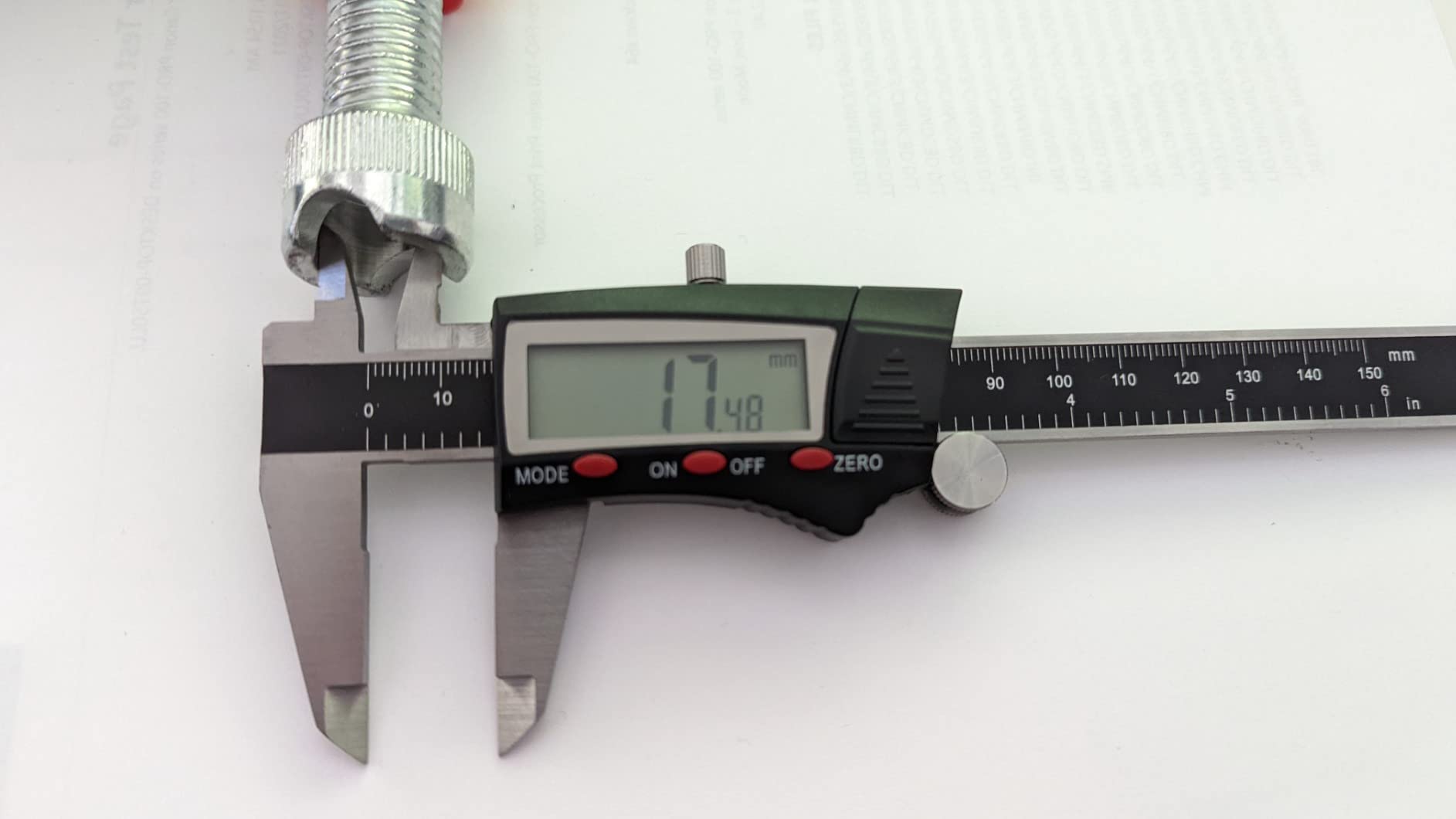
Rear axles from 4.92 to 6.57 inches cover the common road and mountain widths, and 26-28in plus 700C wheels all fit. The box includes a resistance remote, a front wheel block and a skewer, so nothing else is needed for a standard quick-release bike. Load capacity is 300 lb.
Who should skip it
Skip it if your bike uses a thru-axle, since no adapter is included. Owners also report the resistance roller bearings wearing after a few hundred miles, with support replacing the unit quickly. That is a fair trade at this price, but plan on the possibility.
3. FDW Magnetic Bike Trainer Stand – Budget Pick and Storage
- Assembles in about 15 minutes
- Folds flat for the car boot or a corner
- Five levels from flat road to hill feel
- Carbon steel frame rated to 300 lb
- Adjusts from 66cm to 700C wheels
- 90-day warranty is the shortest here
- Five levels and no handlebar controller
- Ride feel less refined than larger trainers
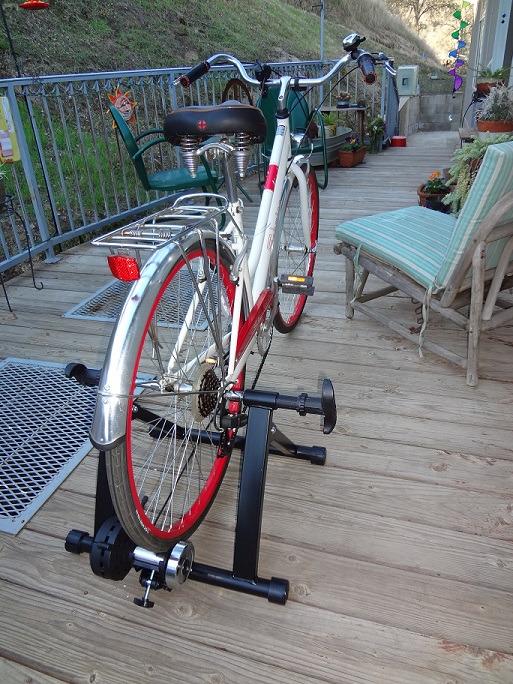
This is the lowest-cost trainer in the list, and it exists for a specific situation: small apartment, limited floor space, and a rider who rides a few times a week rather than training seriously. It folds flat enough to disappear behind a door, which no stand in this group matches.
Five resistance levels map to a rough progression from flat road to climb. There is no handlebar controller, so changes happen by spinning a dial on the unit, which means stopping to adjust while riding. Owners compensate with bike gears, and for light conditioning work that is fine.
Carbon steel construction carries a 300 lb rating, and wheels from 66cm through 700C fit. At roughly 17.6 lb it is heavy for what it is, but that weight is what stops the frame walking when you stand up.
Noise sits around 60 decibels at lower settings according to the listing, and that figure assumes sensible tuning. Push it hard and you will hear the roller more clearly.
What to check before you buy
Measure your storage spot first. Folded dimensions are listed at roughly 19.6 by 17.7 by 21.6 inches, which is a tall narrow shape rather than a shallow one. The frame also needs a full footprint of floor space while in use.
Who should skip it
Skip it for anything structured. The 90-day warranty is the shortest here by a wide margin, so a frame problem means a full replacement rather than a repair. Riders who care about power data or virtual riding get nothing at all from this unit.
4. Yaheetech Magnetic Bike Trainer Stand – Best for Small, Uneven Spaces
Yaheetech Magnetic Steel Bike Trainer Stand for Indoor Riding, 26-28in/700C
- Quiet magnetic operation with slick tires
- Toothed leveling feet for uneven floors
- Shock-absorbing mount fittings buffer resonance
- Fits 26-28in and 700C wheels
- Thru-axle bikes need a separate adapter
- Lower 265 lb load rating
- Resistance not adjustable while riding
The thing that separates this stand from cheaper ones is the floor problem. Basements, garages and converted bedrooms are never level, and a stand that rocks turns every ride into a battle. The toothed leveling feet here vary in thickness so you can dial the frame flat on a slope.
The second detail is the shock-absorbing plastic fittings at the mounting point. They buffer the high-frequency resonance that otherwise travels up the frame and into the floor. Combined with quiet magnetic operation on slick tires, this is the least intrusive stand we rode.
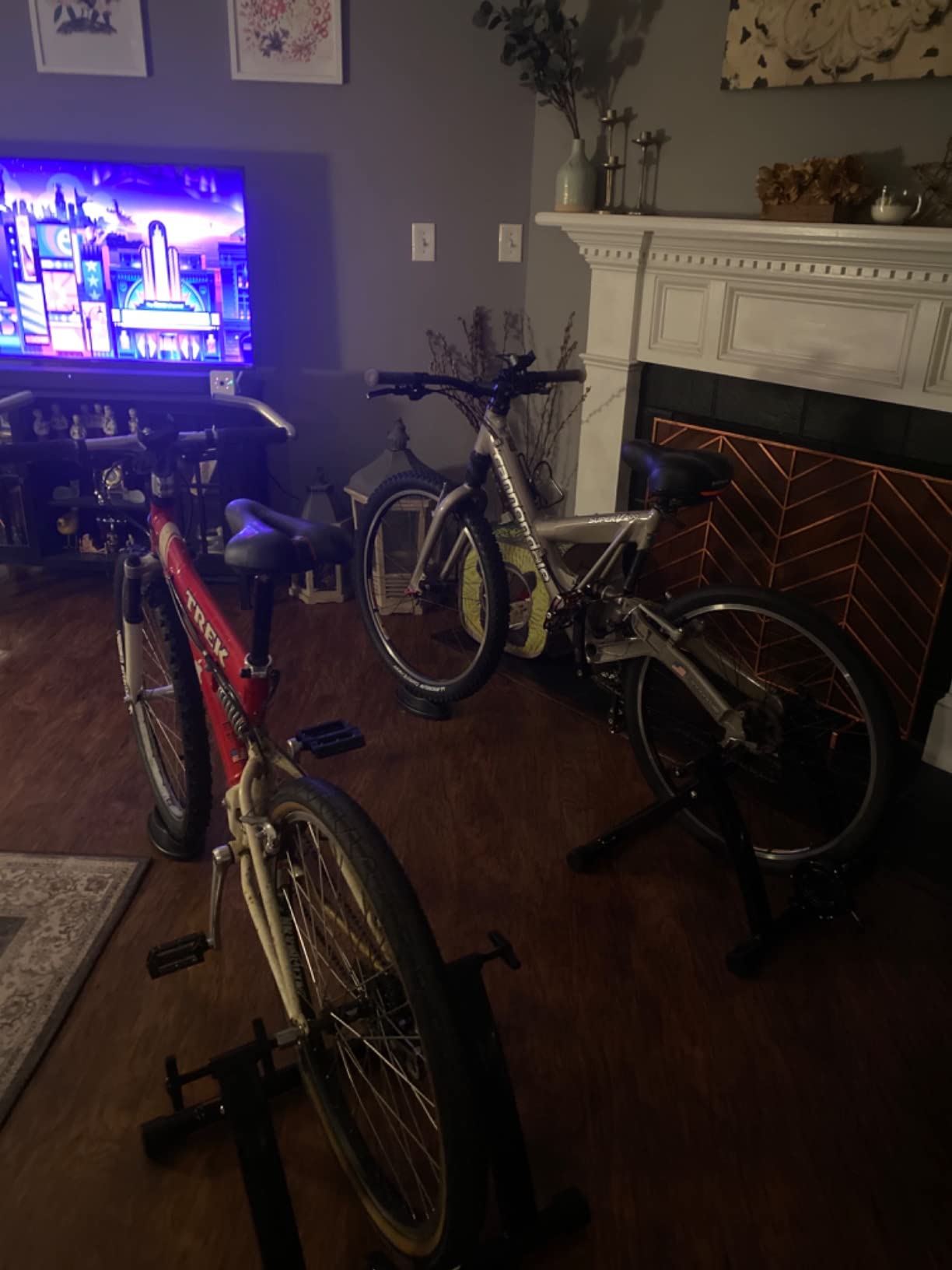
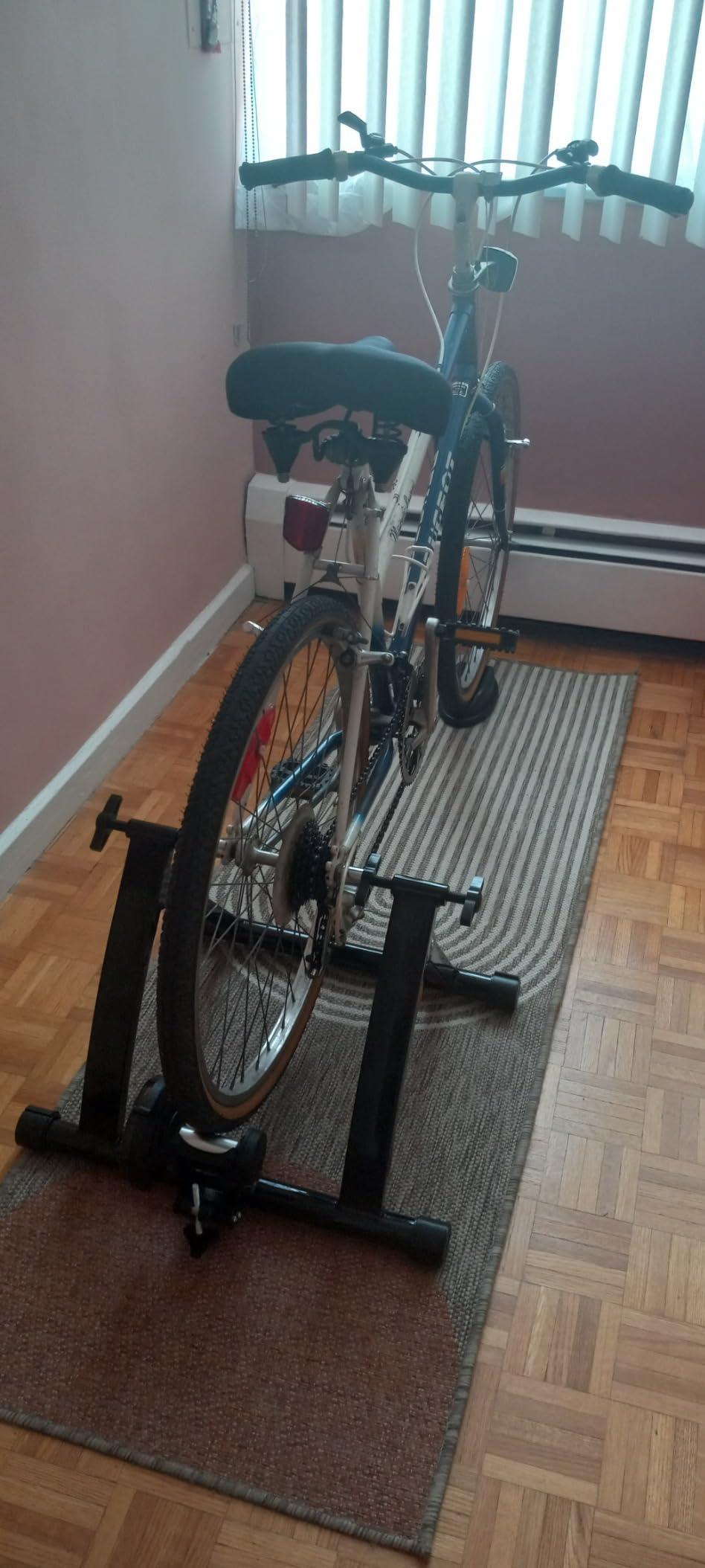
Everything else is straightforward. It fits 26-28in and 700C wheels, includes a quick-release skewer, and uses a universal mounting system. At 13.8 lb it is lighter than most in the group without feeling unstable.
The catch is that resistance is set at the unit and cannot be changed while you ride. For steady-state sessions that is a non-issue. For interval work you will be reaching down or stopping.
What to check before you buy
Measure your rear axle. This design is quick-release only, so a thru-axle bike needs an adapter sold separately. That adapter cost is the single most common reason owners end up over budget on this type of stand.
Who should skip it
The 265 lb load rating is the second lowest here, which matters for heavier riders. Also skip it if you ride outdoors often and dislike swapping the rear skewer back and forth for every session.
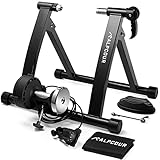
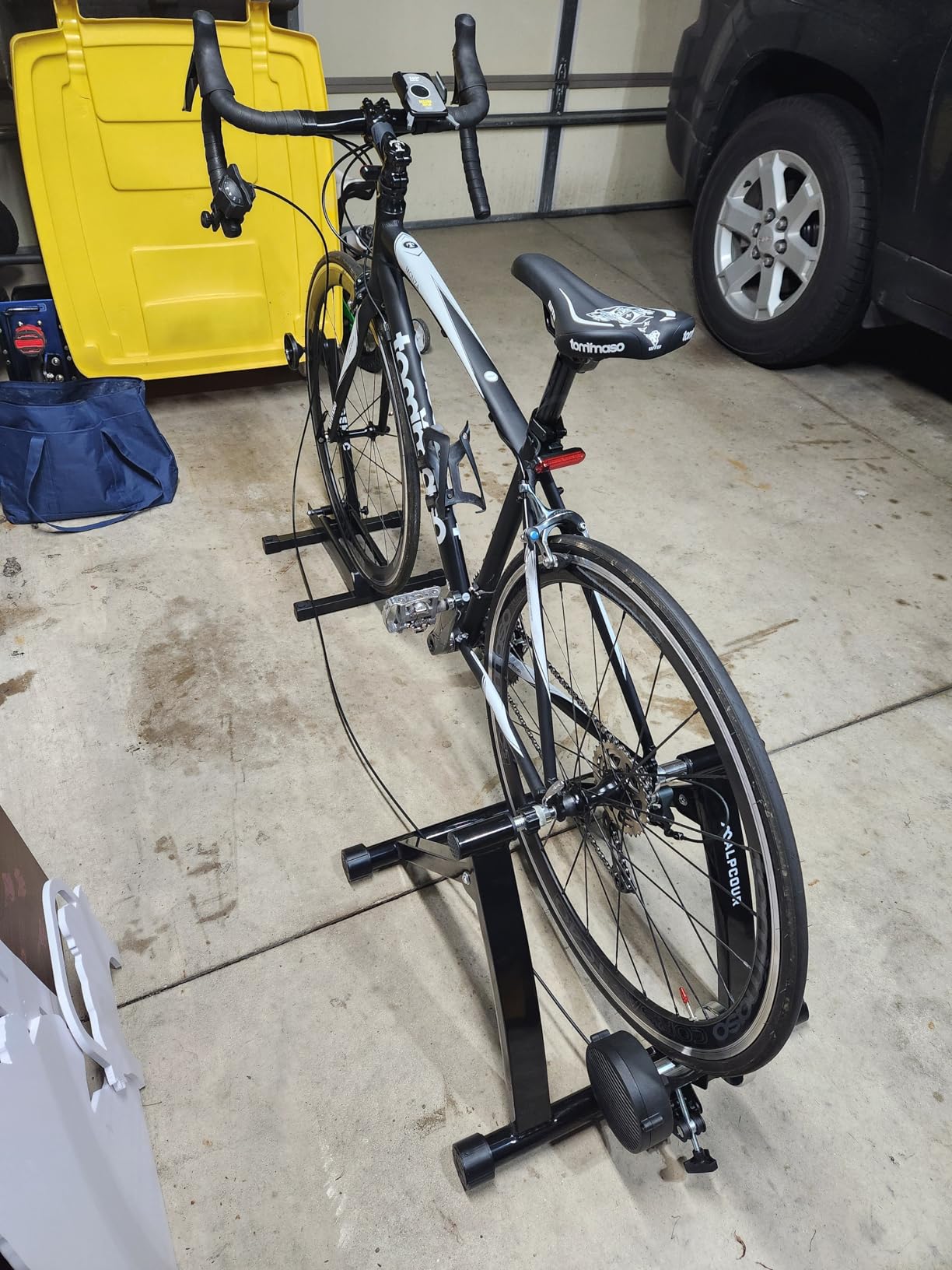
5. Alpcour Foldable Trainer Stand – Best for Build Quality
- Stainless steel frame praised for sturdiness
- 6 handlebar-controlled resistance levels
- Quick lever clamp releases in seconds
- Folds flat and includes a carry bag
- Silent on smooth road tires
- Louder with knobby mountain-bike tires
- Rear wheel sits high so a stool helps
- Rocks when standing out of the saddle
Alpcour built this one out of stainless steel rather than the alloy steel most stands use, and owners notice. It feels more substantial than its weight suggests, and the 4.4 average is the second-highest rating in this roundup. The foldable frame and included carry bag also make it the easiest to move between rooms.
The lever clamp releases the bike without tools, which matters more than it sounds if you train early and often. Six handlebar-controlled levels work well in combination with bike gears, giving finer control than a fixed-step stand.
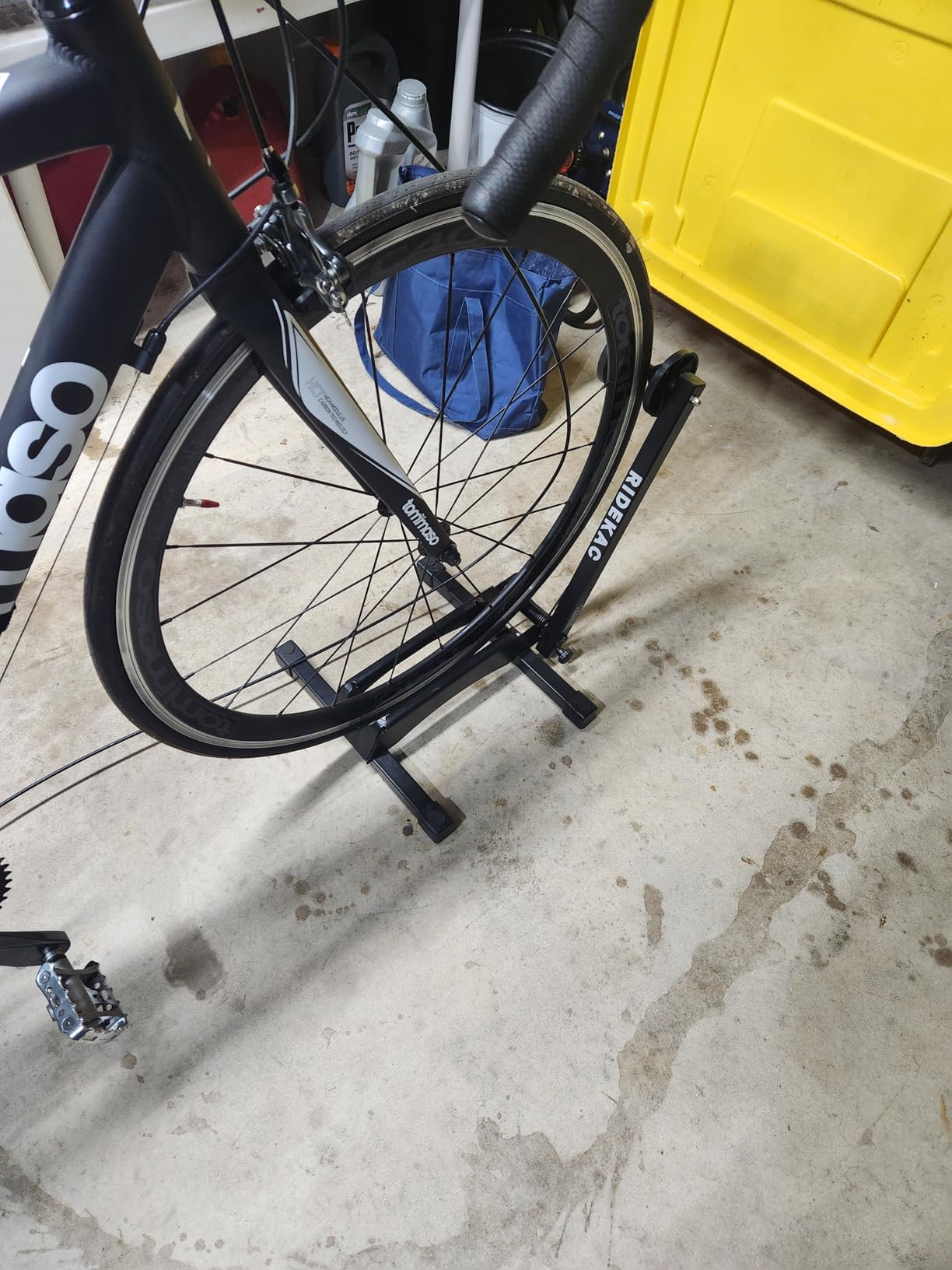
Two things to plan around. The rear wheel sits high in this design, so a stool makes mounting and dismounting much easier, especially for shorter riders. And the frame can rock when you ride out of the saddle, which is not a problem for seated work but shows up during hill repeats.
The handlebar controller clamp is small and awkward on drop bars, so check it fits your cockpit before you commit.
What to check before you buy
The load rating is 250 lb, so heavier riders should look elsewhere in this list. Wheel compatibility covers most 26-28in and 700C bikes, and a front riser block and anti-slip rubber pads are included. The built-in noise-reduction flywheel is the reason it stays quiet on smooth tires.
Who should skip it
Skip it if your bike uses a thru-axle, because the supplied skewer will not fit. Owners also report that the included skewer can seize against the bike’s skewer nut and need pliers to free, which is annoying but not dangerous.
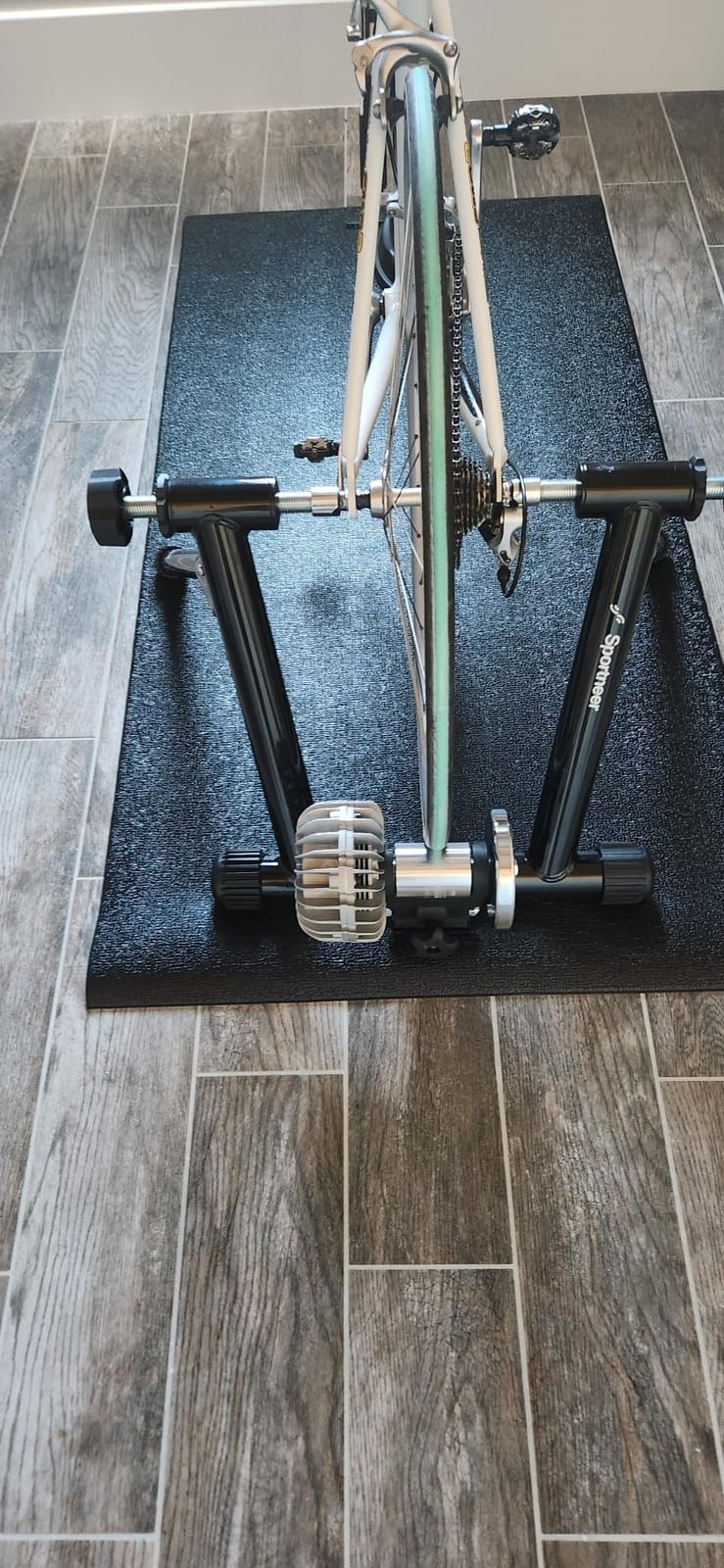
6. Sportneer Fluid Resistance Trainer – Best Road Feel Under 500
- Fluid resistance gives a road-like feel
- Quieter than magnetic units on road tires
- Fits 26-29in and 700C wheels
- Folds to a compact package
- Solid steel frame
- Assembly directions are sparse
- 29er clearance is tight at full extension
- Rough hole in the resistance wheel
This is where the upgrade from magnetic to fluid becomes obvious. A fluid resistance wheel ramps up smoothly instead of stepping, so pedalling feels continuous rather than notchy. The 4.4 rating reflects that, and riders consistently describe it as the closest to real road feel in this price band.
Eight resistance settings give more range than the magnetic stands here, and it handles 26-29in and 700C wheels, the widest range in the roundup. At 24.3 lb it is heavy, but that mass is part of why it feels stable at speed.
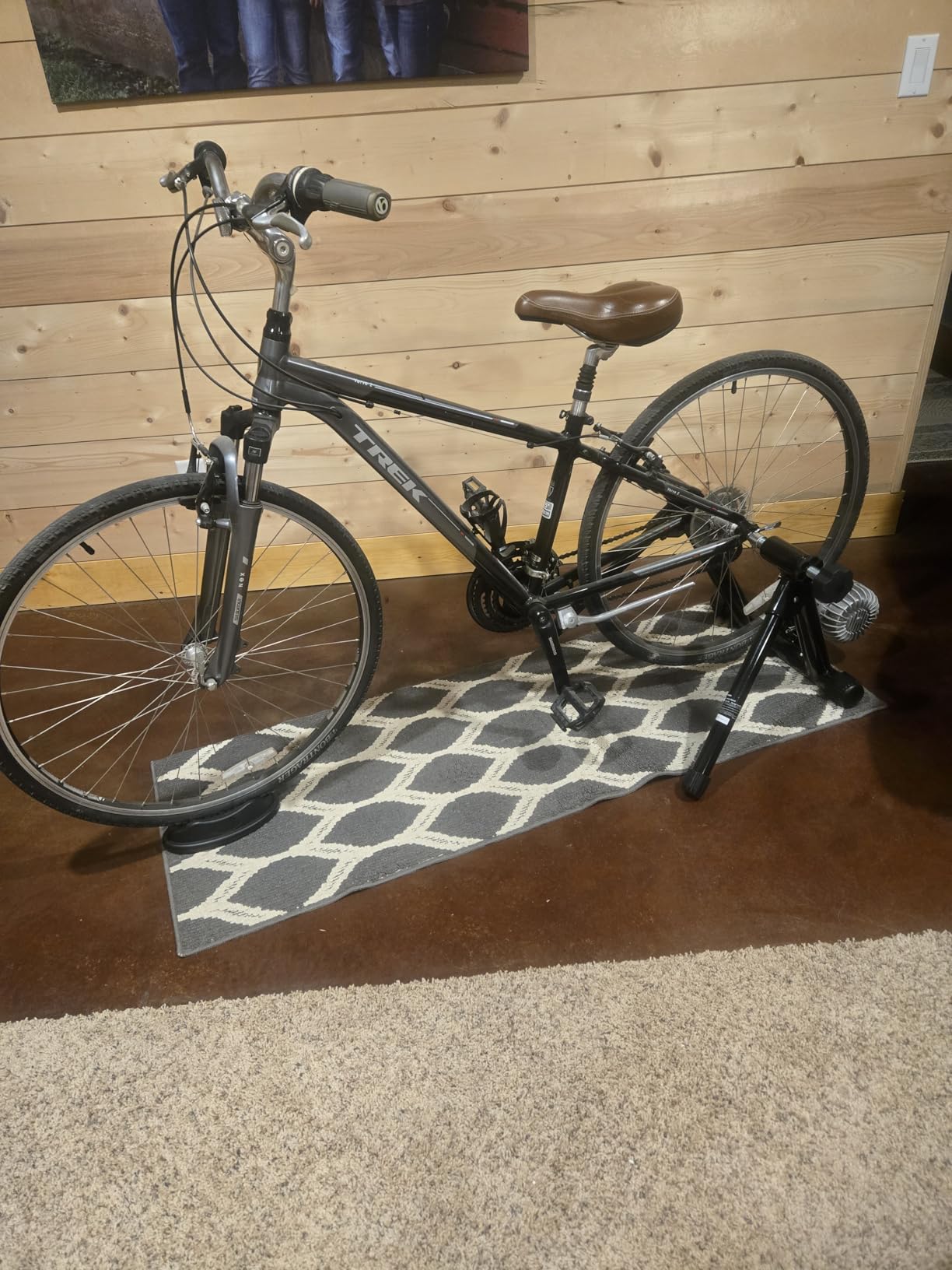
It folds to roughly 24 by 7.9 by 25.2 inches, which is a tall but genuinely compact package for a hallway or closet. A dual locking system and the front wheel riser block keep the bike upright while you ride.
Two fit issues to check first. On 29-inch wheels the front legs cannot extend fully, and they can end up contacting your mat. Internal gear hubs are not supported, and thru-axle bikes need an adapter.
What to check before you buy
Owners flag a rough hole at the center of the resistance wheel as a tire hazard on wide tires. Check your tire width against the roller opening before a long session, and inspect the hub area before your first ride.
Who should skip it
Skip it if you ride wide 29er tires and use a thick mat, since the leg extension conflict is real. Assembly documentation is sparse, so budget time for setup rather than assuming a quick unpack.
7. Elite Novo Force Trainer – Best Rated and Best Power Output
- Best-rated trainer in this roundup at 4.5 stars
- Progressive magnetic road feel
- Up to 690 watts at 40 km/h
- 8 kg frame that folds for storage
- Works with 24-29 inch wheels
- App features need a separate Misuro B+ sensor
- Thru-axle kit sold separately
- White finish shows road grime
The Novo Force has the highest average rating of anything we tested, at 4.5 stars across more than 4,000 reviews, with 71 percent of ratings at five stars. That consistency matters in a category where satisfaction usually depends on what tire you fit and how much floor you have.
The resistance is progressive rather than stepped, so it feels like a road. Rated up to 690 watts at 40 km/h, it has enough headroom for genuine interval work, which is unusual in a magnetic unit at this level.
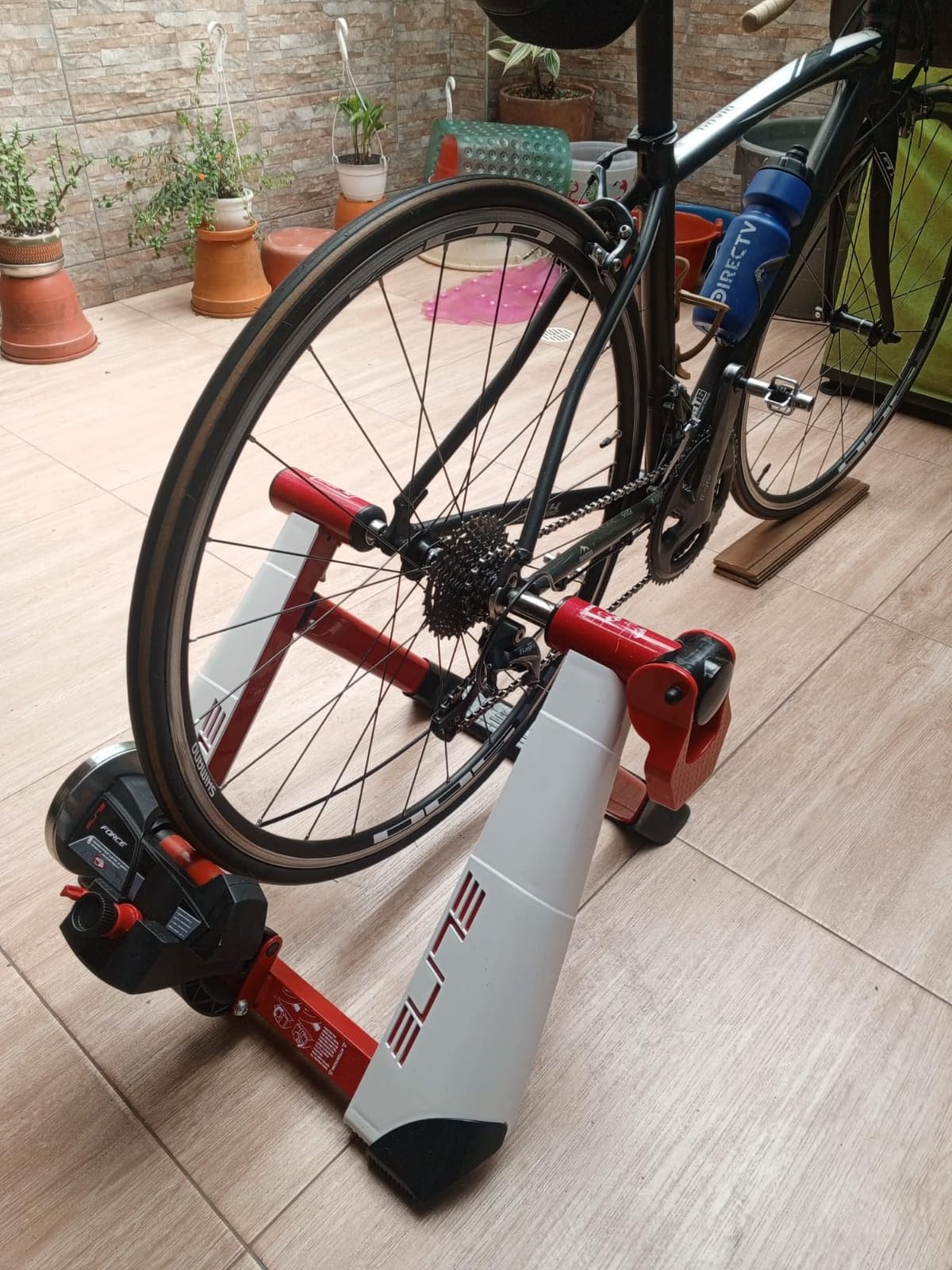
At 8 kg it is the lightest thing here by a wide margin, and it folds into a compact footprint you can actually carry between rooms. Wheel compatibility runs from 24 to 29 inches across road, gravel, MTB and city bikes, with a QR adapter included.
The limitation is virtual riding. App connectivity depends on a Misuro B+ sensor bought separately, which opens Rouvy, Kinomap and My E-Training. Without it, you ride it as a plain magnetic trainer with a good feel and lots of power.
What to check before you buy
Decide early whether you want app features, because the sensor changes the total cost. Also check your axle: some frames need the optional thru-axle kit, which is an extra purchase rather than an included item.
Who should skip it
Skip it if you want turnkey Zwift or TrainerRoad out of the box. That is a real gap, and the cheapest way to close it still leaves you spending meaningfully more than this stand costs.
8. Saris M2 Smart Trainer – Best for Zwift on a Budget
Saris M2 Smart Indoor Bike Trainer, Compatible with Zwift App, Black, Made in the USA
- Electromagnetic resistance with +/- 5% accuracy
- Dual ANT+ FE-C and Bluetooth
- Wheel-on so no wheel removal
- About 69 decibels at 20 mph
- Limited lifetime warranty
- No handlebar resistance lever
- Heavier than magnetic stands at 20 lb
- Steel skewer only limits thru-axle bikes
This is the only unit in the list that gives you app control without a direct-drive price tag. Electromagnetic resistance is measured rather than guessed, which is why the accuracy figure lands at plus or minus 5 percent, and that is accurate enough for FTP testing and structured workouts.
It broadcasts over both ANT+ FE-C and Bluetooth, and it is Zwift certified. The wheel-on design means you never remove a wheel or touch your drivetrain, so you can swap between your race bike and your commuter in under a minute.
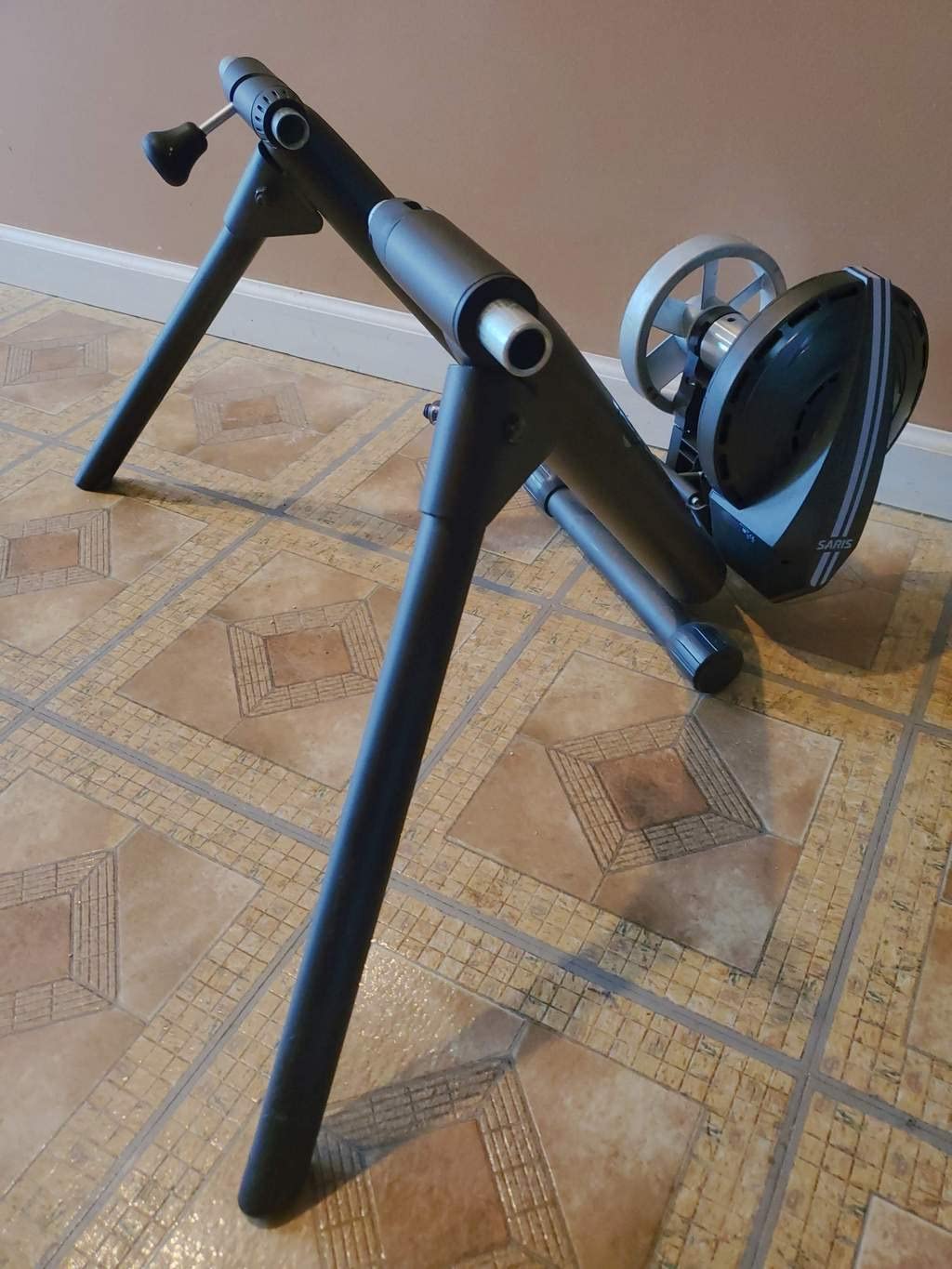
Rated at about 69 decibels at 20 mph, it is not the quietest thing here, but electromagnetic resistance avoids the roller contact noise that makes magnetic stands drone. A limited lifetime warranty is unusual at this price and worth something.
There is no handlebar lever, so every resistance change happens in software. That is fine inside an app and useless if the app closes.
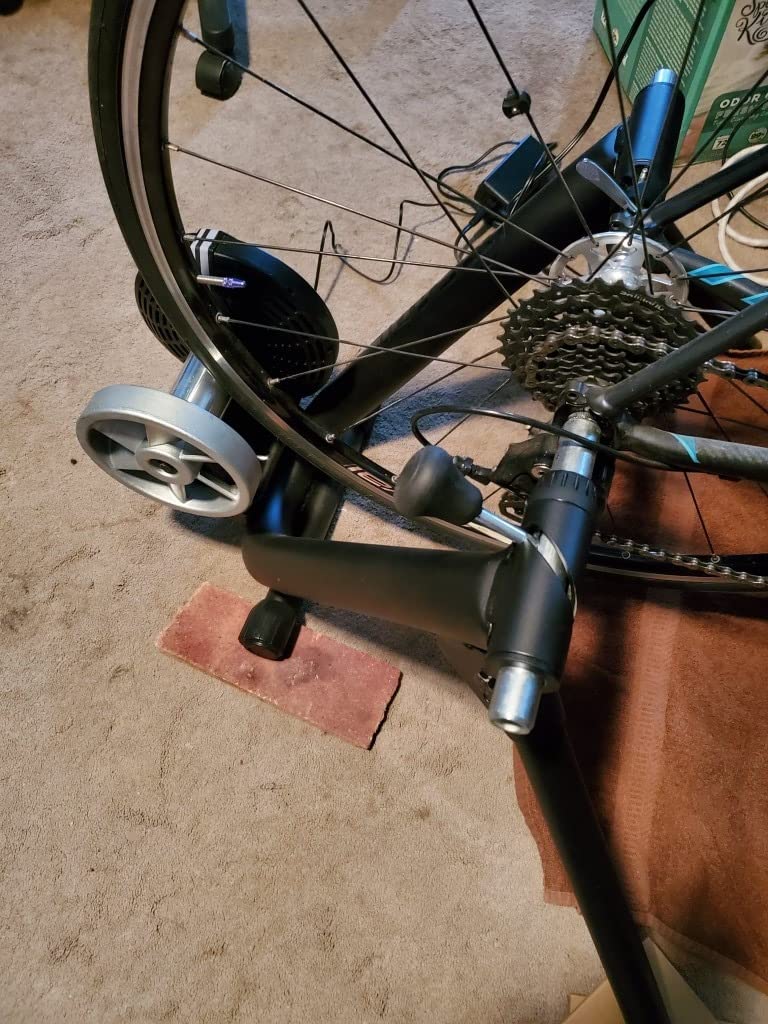
What to check before you buy
Only a steel quick-release skewer is included, which limits you to quick-release frames. Budget for a thru-axle adapter if your bike needs one, and check that before buying rather than after.
Who should skip it
Reviewers report durability and fit complaints in a meaningful share of one-star reviews, and at under 500 reviews this has a shorter track record than the budget favorites. Riders who cannot tolerate app dependency should look at the Elite Novo Force instead.
9. Saris Fluid2 Smart Equipped – Best Quiet Fluid Resistance
Saris Fluid2 Smart Equipped Indoor Bike Trainer, Includes Speed Sensor, Made in The USA
- Widest fluid resistance range in this roundup
- About 69 decibels at 20 mph
- Speed and cadence sensor included
- Limited lifetime warranty
- Folds flat with a leveling block
- Assembly is tight and can need a mallet
- Thru-axle adapter sold separately
- Sensor sometimes missing from the box
The Fluid2 is the platform most riders in this country have actually lived with, and the smart-equipped version adds a speed and cadence sensor in the box. That sensor is what turns it from a spinning wheel into something Zwift and Rouvy can read.
Fluid resistance gives the widest and most road-like range in this roundup, and at about 69 decibels at 20 mph it stays consistent rather than droning. Long-term owners report hundreds of miles with no leaks or failures.
At 7.3 lb for the listed unit weight and 21.25 by 20.25 by 7 inches packed, it stores flat in a closet. A cooling airflow path keeps the fluid working at sustained efforts.
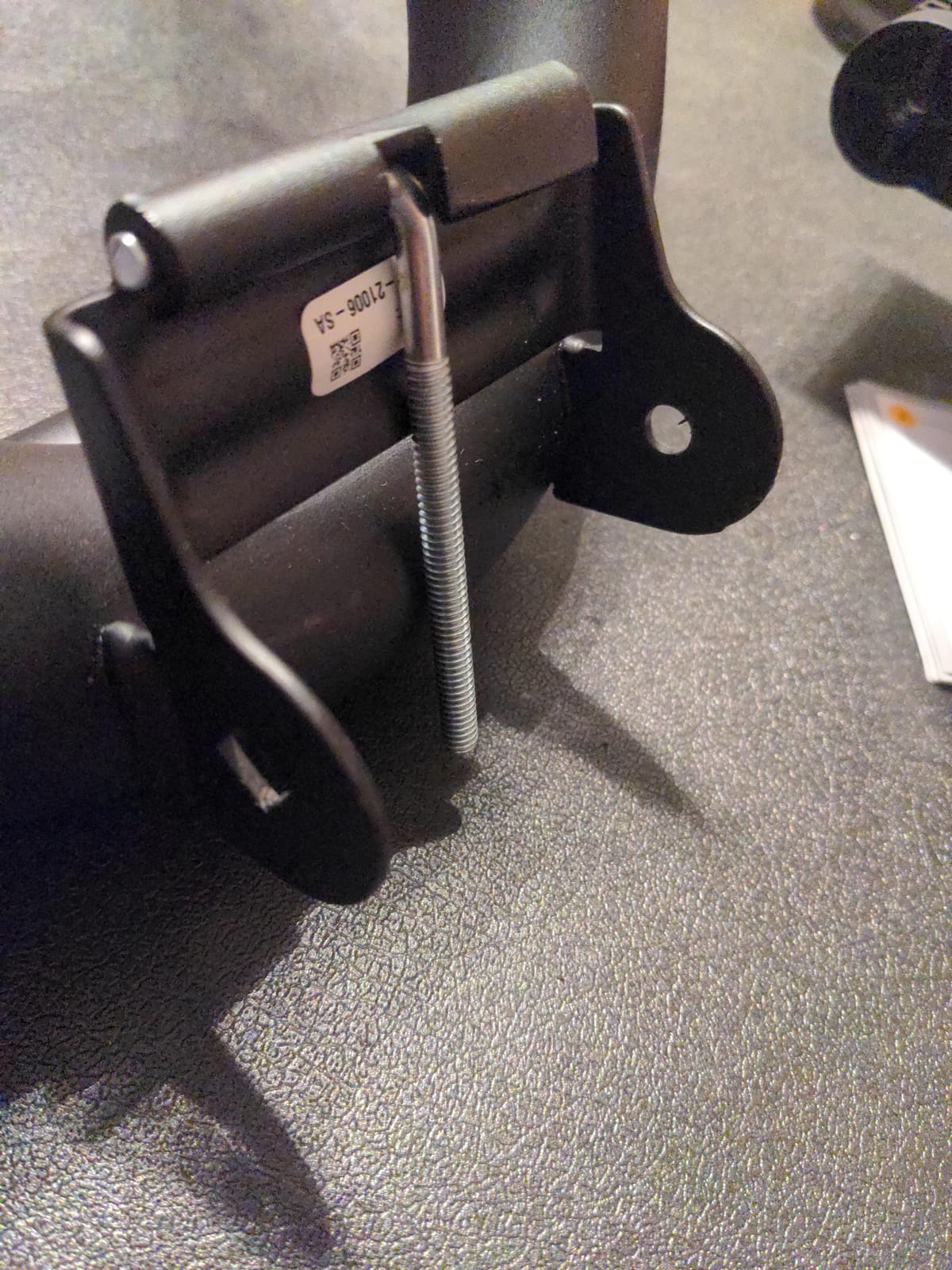
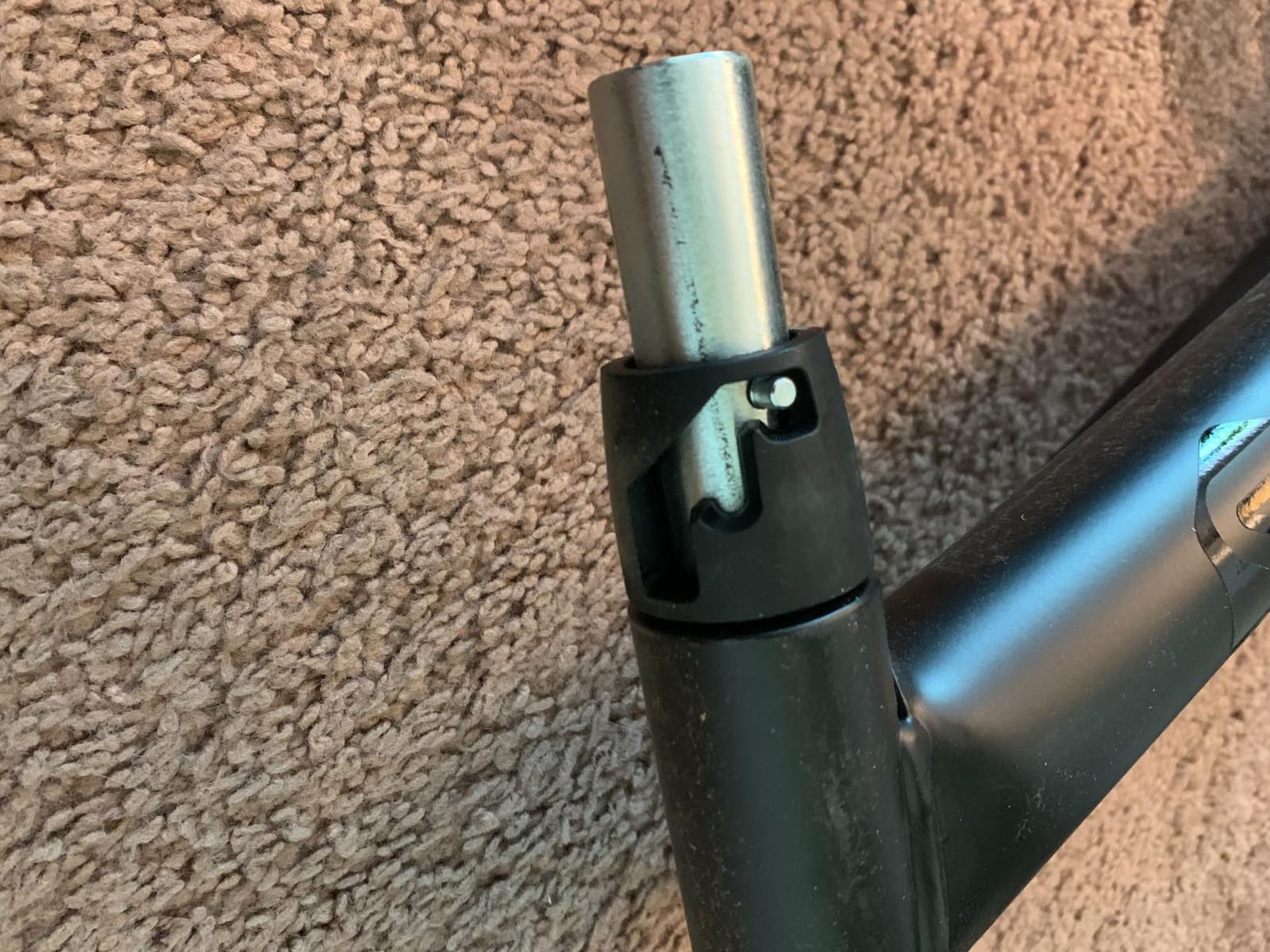
Assembly is the sticking point. Owners report the action bolt and L bolt being very tight, with some needing a mallet and lubricant. Plan thirty minutes for the first build.
What to check before you buy
Thru-axle bikes need a separately sold adapter, and some owners report the sensor arriving separately or missing from the box. Verify the contents immediately so you can address it quickly.
Who should skip it
The bundled front wheel block is low, which can strain arms and wrists on taller frames. If you are tall or have mobility limits, budget a taller riser block as an add-on. Fewer than 250 reviews also means less long-term data than the stand-only versions.
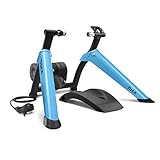
10. Garmin Tacx Boost Trainer – Best Raw Watts
Garmin TacX Boost Trainer, Indoor Bike Trainer with Magnetic Brake
- Real 1.65 kg flywheel for road feel
- Closed resistance unit is quieter than open rollers
- Manual lever with 10 levels up to 1050 watts
- Two-click mounting
- Front wheel support doubles as a handle
- Tire slippage appears above level 5
- Thru-axle adapter needed on many frames
- Flywheel stops abruptly with no glide
The Boost is the outlier in this roundup, and that is why it earns a place. It has a real 1.65 kg flywheel inside a closed housing, which produces a ride feel and a noise profile nothing else here matches. The front wheel support doubles as a carry handle, and the two-click setup is the fastest mounting in the group.
Power headroom is its other argument. A handlebar lever offers 10 stepped levels reaching 1050 watts, far beyond anything else on this list, and it stays stable at full output.
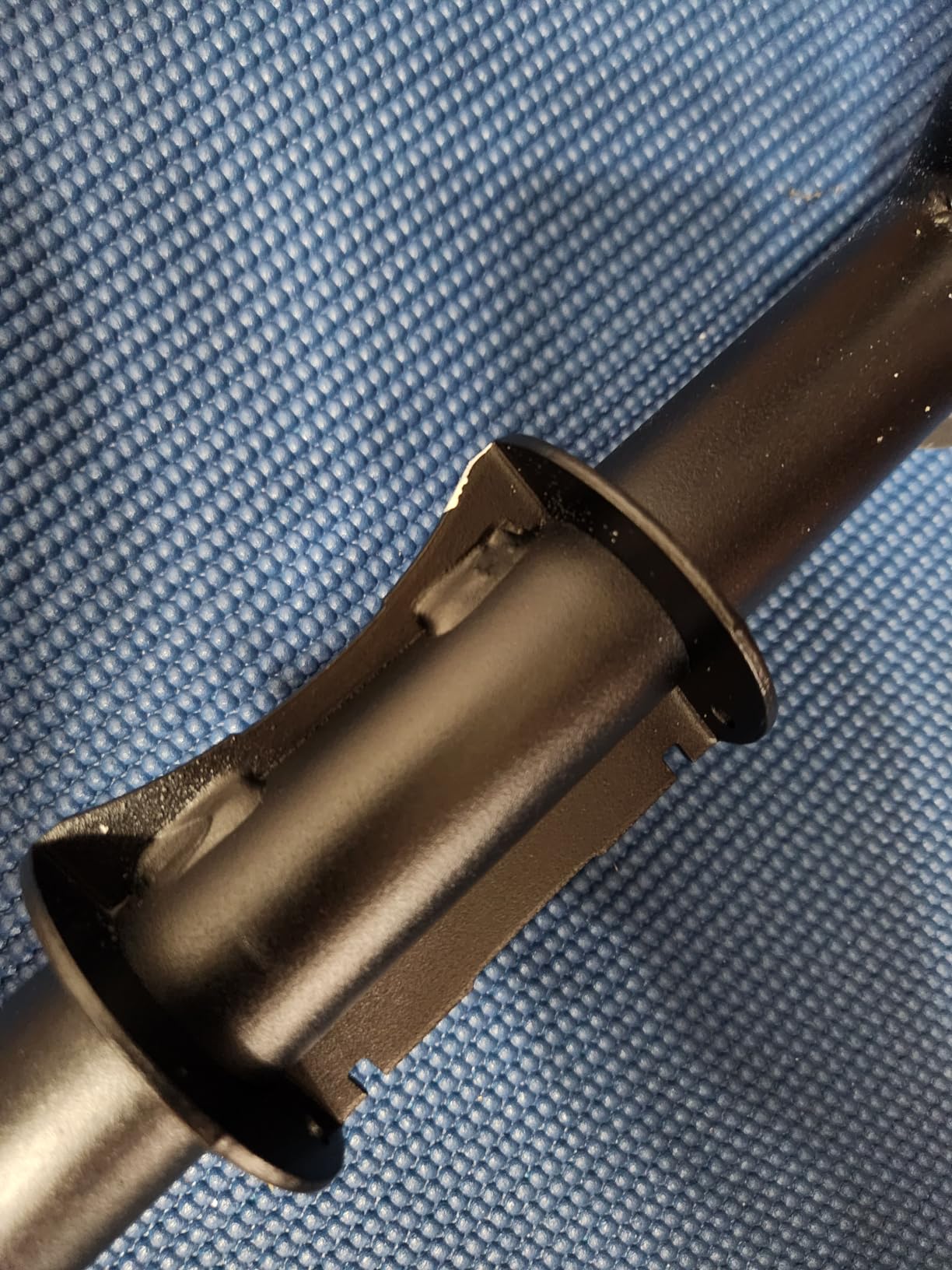
Here is the catch. This is the most expensive trainer in the roundup by a wide margin, and it is not a smart trainer. There is no power data, no app control and no structured training capability. It is a very good indoor ride machine.
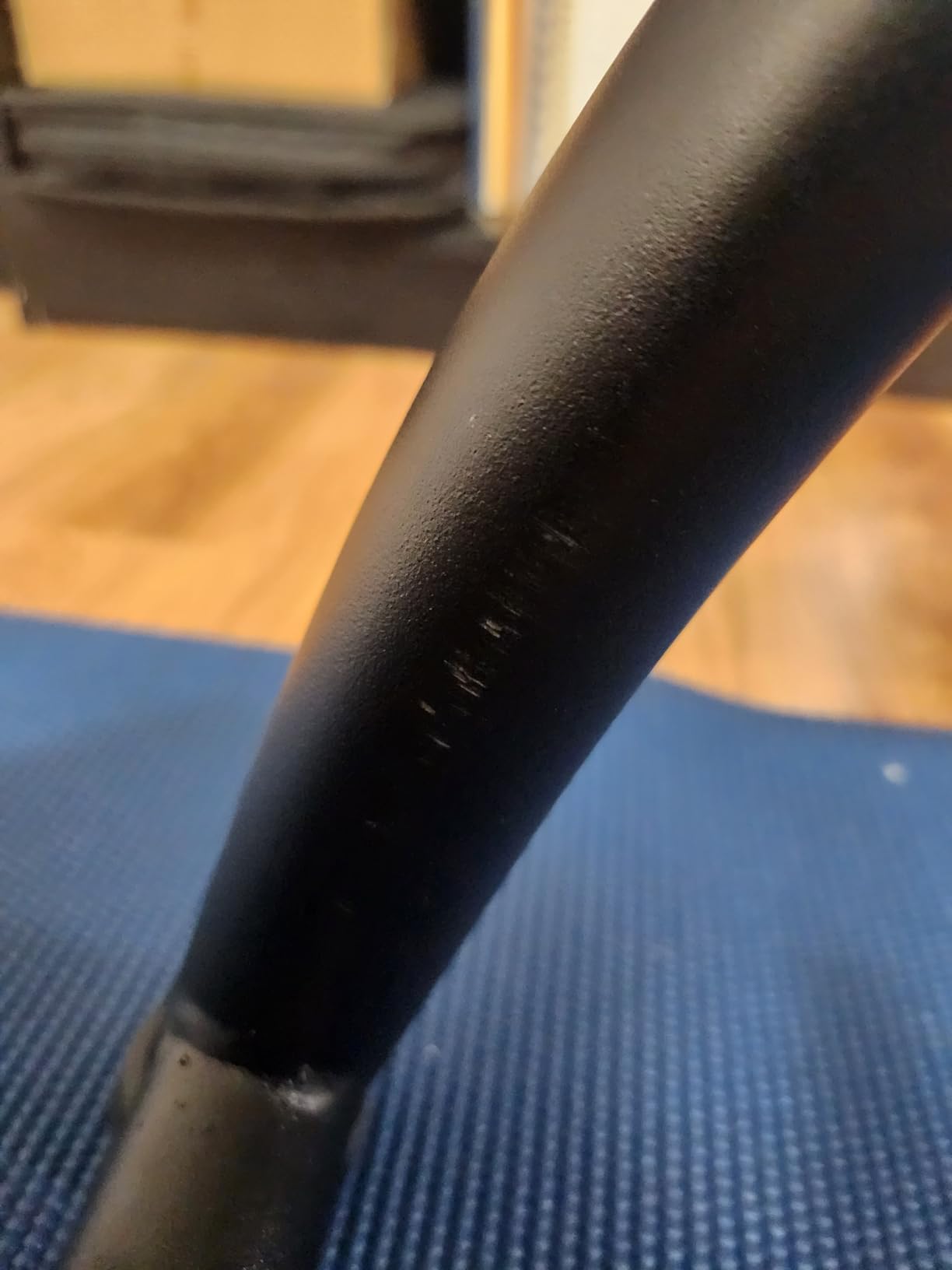
Enthusiasts report tire slippage above resistance level 5 and a flywheel that stops abruptly with no natural coast-down glide. Recreational riders and winter-commute users are far happier with it.
What to check before you buy
Modern thru-axle frames need an adapter that is not included, and that cost is significant relative to the trainer. Check the frame compatibility before you commit, and confirm the wheel size fits, since the listing shows a 24-inch figure that does not match what most riders bring.
Who should skip it
Skip it if you want Zwift, FTP testing or power accuracy of any kind. At 4.0 stars from 259 reviews it also has the thinnest evidence base in the roundup, so weigh the manual feel against better-documented options.
How to Choose a Bike Trainer Under 500
Every trainer in this list is wheel-on, because that is what the budget dictates. Direct-drive trainers, where the rear wheel comes off and the unit connects to your cassette, start several times higher. That single fact shapes the whole buying decision, and experienced riders on the TrainerRoad forum repeatedly advise factoring in the extra costs and headaches of wheel-on ownership before settling.
Within wheel-on, the choice is magnetic or fluid. Magnetic uses a permanent magnet against a roller: cheap, light, steppy. Fluid uses a sealed fluid-filled wheel: smoother, quieter, heavier, and more road-like. Electronic or electromagnetic sits in a third category, controlling resistance by measurement instead of friction, which is what makes app control possible.
Non-smart dumb trainers give you no data and no ERG mode, so they suit general fitness riding. Smart trainers broadcast power, cadence and speed over ANT+ FE-C or Bluetooth FTMS, which is what lets Zwift, TrainerRoad and Rouvy change resistance to match a climb. If boredom is the reason you avoid indoor riding, that feature matters more than any spec sheet.
Work out your use case before you shop. If you want social rides and general cardio on a hybrid, a solid magnetic or fluid stand covers it. If you want FTP tests, structured blocks and accurate intervals, you need a smart unit with measured resistance. Buying a dumb trainer and adding a speed sensor later is the route veteran forum users take, and it is cheaper but messier.
If you want similar budget guidance for other corners of the home gym, we have roundups covering functional trainers for small home gyms and suspension trainers for home use.
Bike Compatibility: Thru-Axle, Boost Hubs and Wide Tires
This is where budget trainers quietly generate returns. Most of the stands here ship with a steel quick-release skewer only, which excludes every modern thru-axle frame until you buy an adapter. Check your rear axle format before you order, because the adapter is the most common hidden cost in this category.
Boost hub bikes, meaning the wider 148 mm rear spacing on modern mountain bikes, are a related issue. Wheel-on magnetic stands clamp at the axle, and some need an extra adapter to reach the wider spacing. Riders on forums report that boost-spaced MTBs work fine on a wheel-on smart trainer once a dedicated slick tire on a spare wheel is fitted.
Tire width matters more than buyers expect. Knobby MTB tires generate noise, wear and eventually bald spots. The practical fix is a dedicated trainer tire, mounted on a spare wheel so your outdoor tires stay intact.
Heavy riders and e-bike owners should check load ratings carefully. Ratings in this list run from 250 lb to 330 lb, and e-bike weight plus rider weight can exceed the lower end. If your combined weight approaches the figure, budget for a higher-rated unit instead of gambling.
Wheel-On Tire Damage and Trainer Tires
Yes, wheel-on trainers wear tires. The resistance roller presses against the tread under load for thousands of revolutions, and rubber wears from the inside out where you cannot see it. Road tires survive far better than knobby MTB tires.
The fix is straightforward and it is the accessory most budget buyers skip. Fit a dedicated trainer tire, or better, a cheap spare wheel with a slick tire mounted on it. That removes the tire question entirely and means you can switch bikes without any ceremony.
Forum veterans also flag the exposed roller and flywheel as a safety concern in homes with small children. Direct-drive units are safer because the spinning mass is enclosed, but a wheel-on stand still has an exposed wheel. Keep the area clear and treat the resistance unit as something to keep fingers away from while pedalling.
Noise Levels and Apartment Living
Most of the noise comes from three sources: tire tread, roller contact and floor transmission. Tire choice is the biggest lever, and a slick tire on a spare wheel solves more complaints than any trainer purchase. Roller contact noise drops as you tune pressure correctly.
Floor transmission is the part neighbours hear. A rubber anti-vibration mat under the trainer reduces the low-frequency rumble that travels through floor joists, and on the fluid units listed here it also stops the extended legs from contacting the mat surface.
The reported figures cluster in the high 60s decibels for the smart and fluid units at 20 mph, and near 60 decibels at lower settings for the cheap magnetic stands. The Elite Novo Force and Tacx Boost sit quieter still thanks to closed housings and real flywheels. If noise is your top priority, put a mat on your shopping list before you pick the trainer.
Do You Need a Power Meter or Speed Sensor?
With a smart trainer, no. The trainer reports your power and speed itself, so a separate power meter is redundant and buying one is a common expensive mistake. Forum consensus is the same: you only need a separate sensor for a dumb trainer, so you can get power data into an app.
For the non-smart stands in this roundup, the choice is a speed and cadence sensor. The Saris Fluid2 smart-equipped version includes one, which is part of why it earns its place despite a shorter review history.
One accuracy caveat worth stating plainly. A plus or minus 5 percent figure, like the Saris M2 advertises, is fine for training but it is not laboratory-grade, so treat an FTP test on it as a good estimate rather than a lab result. Calibrate before you test and keep the same trainer for repeat tests if you want comparable numbers.
What You Actually Spend Under 500
Sticker price is the least interesting number in this category. For every smart pick above, add the thru-axle adapter if your frame needs one, a dedicated trainer tire or spare wheel if you ride outdoors on the same wheel, and an anti-vibration mat. That stack is the most commonly reported budget surprise in owner communities.
The rough order of the extras is worth planning for: a thru-axle adapter is the cheapest and most common, a trainer tire is a modest addition, a spare wheel adds real cost, and a mat is inexpensive and the best noise fix available. Riders who budget for these up front stay inside the ceiling. Riders who do not, do not.
Used is worth a look if you want a direct drive. Discontinued premium models show up in the second-hand market well below what new premium trainers cost, and that is the most reliable route to a cassette-based trainer inside this budget. The trade-off is warranty support and unknown wear on the resistance unit, so inspect it carefully.
If you are simply spending the same ceiling on other home equipment, our pellet smoker roundup under the same budget covers the equivalent all-in-cost thinking.
Frequently Asked Questions
What is the best affordable bike trainer?
The best affordable bike trainer for most riders is the BalanceFrom Bike Trainer Stand, a magnetic unit with 8 resistance levels, a 330 lb load rating and more than 14k owner reviews. Riders wanting the smoothest pedalling prefer the Elite Novo Force, and anyone wanting Zwift control should look at the Saris M2 smart trainer.
What is the best cheap bicycle trainer?
For the lowest-cost reliable option, the FDW Magnetic Bike Trainer Stand folds flat, carries a 300 lb load rating and adjusts from 66cm to 700C wheels. Its 90-day warranty is short, so it suits light indoor use rather than heavy training blocks.
What is the most effective type of bike trainer?
A direct-drive trainer is the most effective type because it connects to your cassette, measures resistance directly and never touches your tire. Under this budget ceiling, the closest option is a wheel-on trainer, with fluid or electromagnetic units giving the smoothest resistance and measured power data.
Do bike trainers ruin tires?
Wheel-on trainers do wear tires over time, and knobby mountain-bike tread wears fastest because the resistance roller presses into the rubber under load. The fix is fitting a dedicated trainer tire on a cheap spare wheel, which protects your outdoor tires and cuts noise at the same time.
Do I still need a power meter with a smart trainer?
No. A smart trainer reports your power and speed itself over ANT+ FE-C or Bluetooth, so a separate power meter is redundant. You only need an external speed and cadence sensor when using a non-smart trainer and you want power data to appear in a training app.
How loud is a smart trainer?
The smart and fluid trainers here report around 69 decibels at 20 mph with slick tires, while cheaper magnetic stands sit nearer 60 decibels at lower settings. Tire choice matters as much as the trainer, and a rubber anti-vibration mat cuts the floor rumble that neighbours actually hear.
Can you use a smart trainer without an app?
You can ride any trainer without an app, but the Saris M2 has no handlebar resistance lever, so its resistance is controlled entirely in software. If your app closes or you ride without a phone, you lose the ability to change resistance while pedalling on that model.
What are the best fitness bikes under 500?
Fitness bikes under this budget are stationary spin bikes with a weighted flywheel, which suit riders who want a simple workout rather than riding their own bicycle. Bike trainers are the better buy if you already own a bike you want to keep training on outdoors.
Final Pick for 2026
If you want one answer, buy the BalanceFrom Bike Trainer Stand. It carries the highest load rating and the deepest review history in this roundup, it assembles in minutes, and it costs nothing in add-ons for a standard quick-release bike on slick tires.
If you want smoother pedalling, move up to the Elite Novo Force for its 4.5 rating and 690 watt headroom. If you want Zwift, the Saris M2 is the only affordable pick that gives you measured resistance and app control without changing your drivetrain.
Whichever you choose for 2026, budget the thru-axle adapter, the trainer tire and the mat before you order. That is how these bike trainers under 500 actually stay inside the ceiling. Our functional trainer roundups cover the strength side of the same home setup if you train with weights too.