
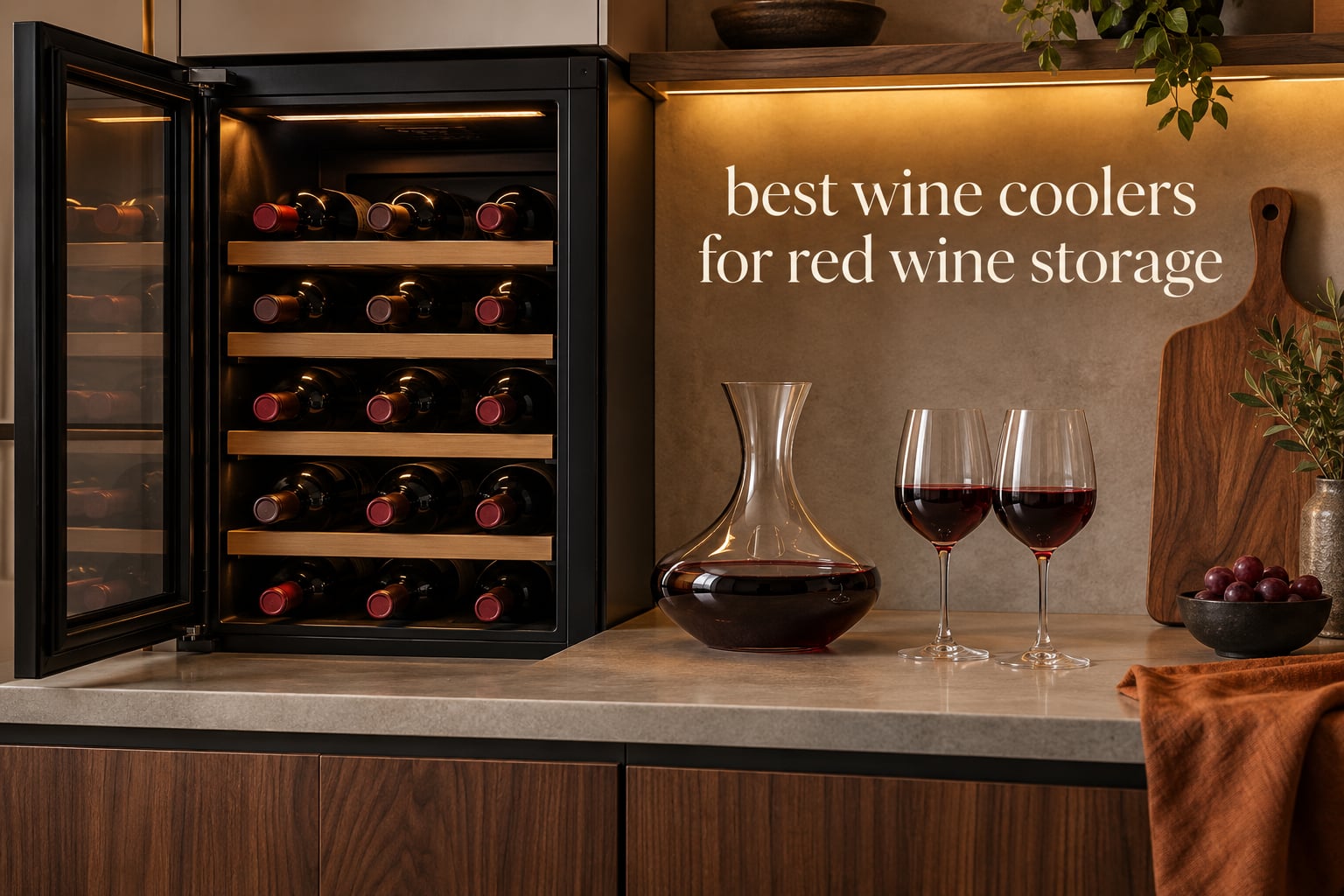
Yes, you should store red wine in a wine cooler, and the number to dial in is 55 to 65F (12 to 18C) for anything you plan to keep for more than a few months. For short-term holding and pre-dinner serving, 60 to 68F (15 to 20C) is the working band. The best wine coolers for red wine storage hold that setpoint tightly, keep the air humid enough that the cork does not shrink, block light, and do not shake sediment off the walls of the bottle.
A kitchen fridge is the wrong tool. It runs cold enough to chill reds below what they want, it dries corks out over time, and its compressor cycles hard enough to keep sediment in suspension. A cool dark cupboard is fine if you drink what you buy within a few weeks, and that is the honest consensus on r/wine. Once you are holding bottles across seasons, temperature control stops being a luxury.
We compared 10 wine coolers built for red-heavy collections, weighing setpoint range, capacity, cooling technology, humidity behaviour, shelf geometry, noise and installation demands. Below is what actually matters for reds, which units earn their place, and where the compromises hide. This guide was updated in 2026.
Table of Contents
Top 3 Picks: Best Wine Coolers For Red Wine Storage (October 2026)
Ivation 12-Bottle Compressor Cooler
- Compressor cooling
- 41-64F range
- UV-resistant glass door


ROVSUN 33-Bottle Dual Zone
- Independent dual zones
- 33-bottle capacity
- Stainless steel frame
The Ivation 12-bottle compressor takes the top slot on the strength of the deepest review history in this group paired with a 41 to 64F range that comfortably covers the entire red band. The Ivation 18-bottle is the same engineering in a slightly larger cabinet. The ROVSUN 33-bottle earns its place for anyone who wants two genuinely independent zones rather than one zone for everything.
All 10 Wine Coolers for Red Wine Compared in 2026
| Product | Specifications | Action |
|---|---|---|
| Ivation 12-Bottle Compressor Wine Cooler |
|
Check Latest Price |
| Ivation 18-Bottle Compressor Wine Cooler |
|
Check Latest Price |
| ROVSUN 33-Bottle Dual Zone Wine Fridge |
|
Check Latest Price |
 Koolatron Urban Series 12-Bottle Dual Zone Koolatron Urban Series 12-Bottle Dual Zone |
|
Check Latest Price |
 BLACK+DECKER BD60336 12-Bottle Thermoelectric BLACK+DECKER BD60336 12-Bottle Thermoelectric |
|
Check Latest Price |
 BODEGA 46-Bottle Built-In Dual Zone BODEGA 46-Bottle Built-In Dual Zone |
|
Check Latest Price |
 Cuisinart CWC-800CEN 8-Bottle Cellar Cuisinart CWC-800CEN 8-Bottle Cellar |
|
Check Latest Price |
 EUHOMY 45-Bottle Wine Cooler EUHOMY 45-Bottle Wine Cooler |
|
Check Latest Price |
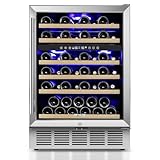 ORYMUSE 52-Bottle Dual Zone ORYMUSE 52-Bottle Dual Zone |
|
Check Latest Price |
 BLACK+DECKER BD61536 26-Bottle BLACK+DECKER BD61536 26-Bottle |
|
Check Latest Price |
Two patterns jump out of that table. Every compressor model here reaches well below the red band and stays there when the kitchen is hot, while every thermoelectric model tops out higher and works by pulling heat out of the cabinet rather than pumping it away. And the two units that split their zones at or above 55F are the ones built for serious long-term holding.
How We Picked Wine Coolers for Red Wine Storage
Seven criteria shaped this ranking, and each one traces back to something that damages a bottle or frustrates an owner.
1. Setpoint range that fully covers 55 to 65F. A unit whose minimum is above 65F cannot store a red collection at all. A unit that overshoots below 55F forces a manual compensation offset, which is exactly the fudge factor that causes temperature swing.
2. Temperature consistency, not just range. The number on the display is the number the compressor is chasing. Reviewers repeatedly describe a small offset between setpoint and shelf temperature, so we weighted units with circulation fans and documented evenness top to bottom.
3. Cooling technology matched to how long the wine stays. Compressor units hold a setpoint regardless of ambient kitchen heat. Thermoelectric units run silently and cheaply but can only cool a few degrees below the room around them.
4. Humidity behaviour and cork safety. The most common objection on r/wine is that fridges dry corks out. A sealed glass door, a carbon filter or a humidification tray all help, and we noted which units make life harder than it needs to be.
5. Bottle geometry and shelf spacing. Bordeaux, Burgundy, Champagne and magnum all occupy different depths. Wire racks with tight spacing that look fine empty can reject half a case once magnums go in.
6. Noise in living space. Anything measured at or under 38dB can live in an open-plan kitchen or living room. Compressor kick-in is normal, but a low steady hum is not.
7. Installation reality. Clearance on the sides, back and top, the weight to move, and whether the door swing works in your space decide whether a cabinet you like actually gets installed.
1. Ivation 12-Bottle Compressor Wine Cooler IVFWCC121LB for Compact Red Storage
Ivation 12 Bottle Compressor Wine Cooler, Freestanding Fridge w/Lock, Black
- Compressor holds temperature regardless of ambient heat
- Built-in circulation fan evens out the cabinet
- UV-resistant double-paned thermopane glass
- Key lock plus a clear LCD display
- Compact 10-inch width suits a nook or wet bar
- Runs a few degrees warmer than the setpoint
- Narrow interior limits larger bottle formats
- Needs generous clearance on sides and back
- Some reports of compressor or power-train failure
Best for: a small red collection in an apartment or home bar where cabinet depth is the real constraint.
This is the unit I keep coming back to, because 1992 reviews is far more owner history than anything else in this group, and the pattern across those reviews is consistent. Compressor cooling is unaffected by outside heat sources, and the built-in fan keeps the air moving through the cabinet rather than letting the top shelf run warm.
The 41 to 64F range covers the whole red band with room to spare on both sides. The UV-resistant double-paned thermopane glass does its job quietly, and the soft LED lighting means you can look at bottles without swinging the door and letting cold air spill out. Six removable wire racks let you change the layout as your collection changes.
The honest flaw is a temperature offset. Owners consistently report the cabinet running slightly warm against the set point, so if you want a true 57F you set the panel a few degrees lower and accept that mental adjustment. It is a mild calibration quirk, not a failure, and the alternative units in this list are not free of it either.
Size is the second constraint. At 9.92 inches wide and 31.18 inches tall it fits where a 20-inch-wide unit will not, but the interior is narrow, so larger bottles need shelf rearrangement and can end up touching the door glass. Clearance matters more than the manual suggests; this unit wants air on the sides and back.
Why this one suits a red collection best
Compressor cooling is the deciding factor. For reds stored more than a year, the swing above 3F that a thermoelectric unit produces in a warm kitchen accelerates chemical ageing, and the fan keeps that swing small. UV glass, a key lock and a readable display cover the other three storage threats at once.
Who should skip it
Skip it if your reds are magnums or Champagne bottles, because the narrow interior will not take them without frustration. Skip it if the cupboard you have in mind has no side clearance, since airflow is not optional on a compressor unit. And skip it if you need more than a dozen bottles on hand at once.
2. Ivation 18-Bottle Compressor Wine Cooler IVFWCC181LB for Bigger Red Holdings
- Holds 18 standard bottles in a compact footprint
- Cools from room temperature in roughly ten minutes
- Very low compressor and fan noise
- Mirrored glass door with a key lock
- Adjustable racks fit 750ml bottles easily
- Displayed temperature runs above the setpoint
- Top and bottom shelves can drift apart
- Frost builds on the back panel in humid conditions
- Some owners report first-year compressor failures
Best for: a couple or a small family who want a case or more of reds stored at once without giving up floor space.
This is the same compressor platform as our top pick, scaled up to 18 bottles at 1.8 cubic feet. Reviewers call the value strong, and the reason is simple: you get compressor-grade temperature stability from a cabinet that still fits beside a kitchen island rather than against a wall.
Cool-down time is a genuine advantage. Owners report pulling the cabinet down from room temperature to target in roughly ten minutes, which matters when you bring home a case of Bordeaux that has sat in a hot car. Noise is low enough for an open kitchen, with both compressor and fan contributions staying unobtrusive.
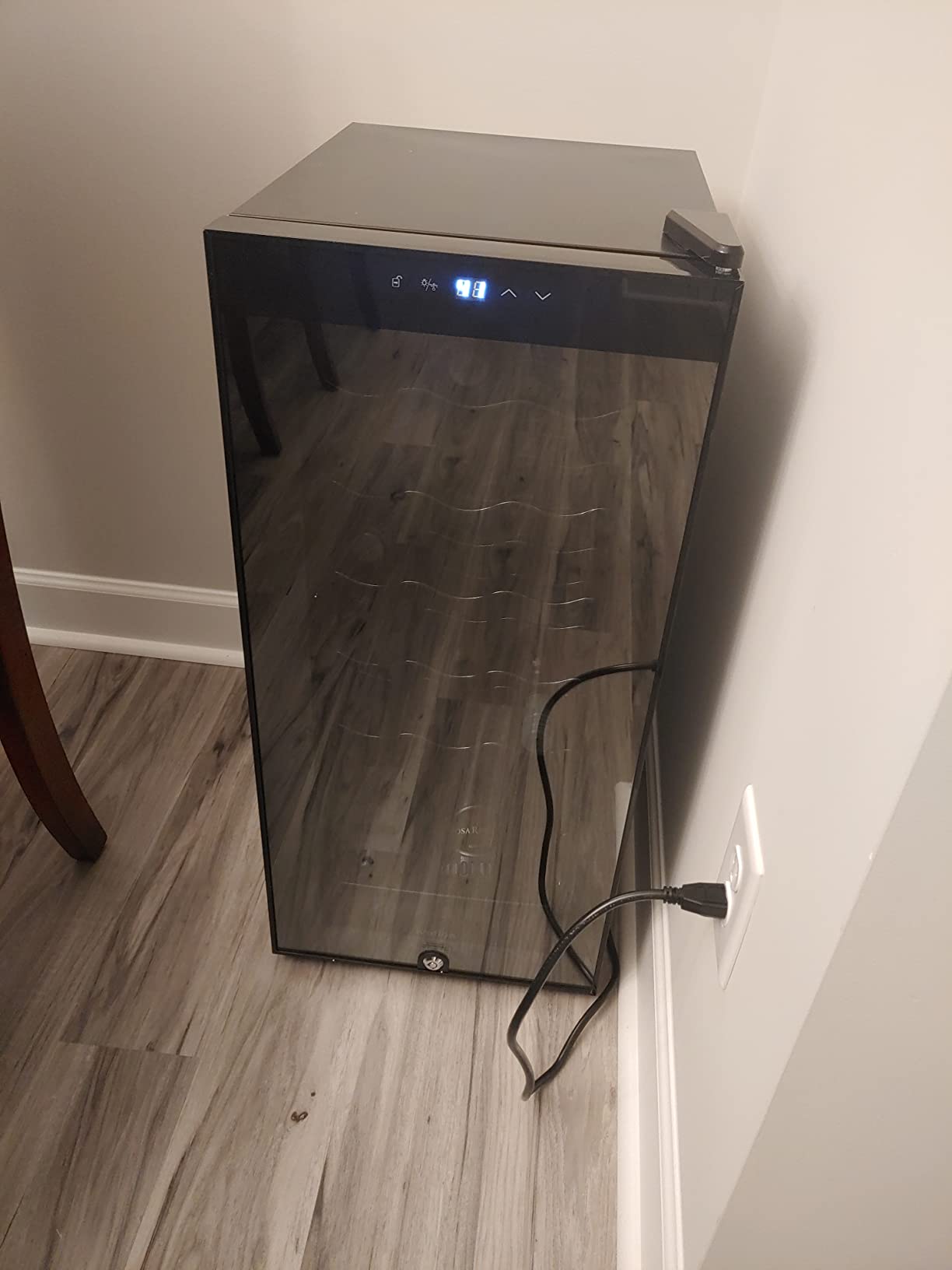
Two complaints repeat. First, the displayed temperature runs a few degrees above the set point, with more variance between the top and bottom shelves than the fan specification suggests it should. Second, in hot humid conditions frost can build on the back panel and needs occasional manual defrosting, which is a real chore in a damp basement.
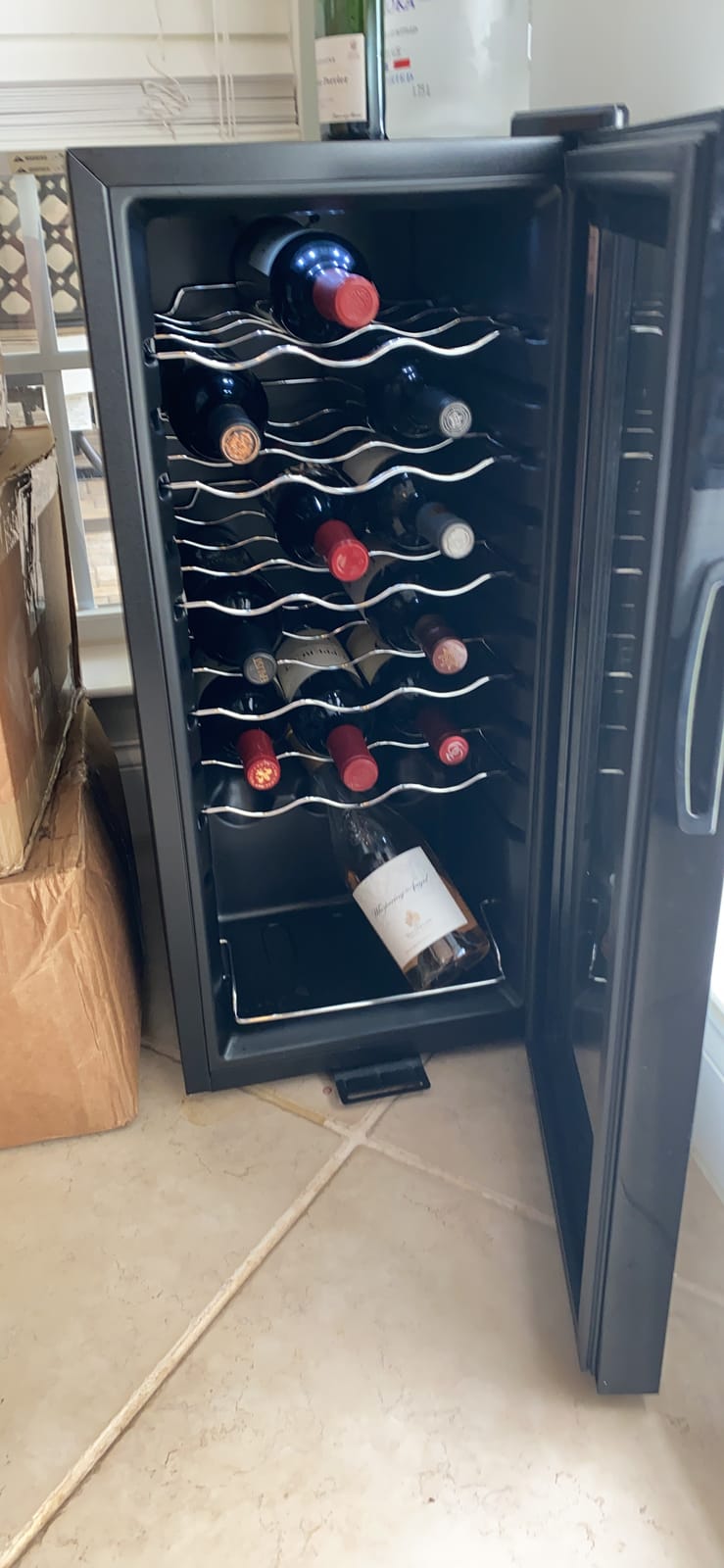
The circulation fan also disappoints more than a few owners expected, adding little to the difference between shelves in practice. Treat that as the cost of buying capacity at this price: you get more bottles, not more evenness than the 12-bottle model.
What 18 bottles actually buys you
Eighteen bottles is roughly two cases, which is the point where a cupboard stops being enough. Once reds accumulate across vintages, the storage problem becomes heat and light exposure rather than short-term drinking. A sealed cabinet with UV glass and stable compressor control solves both, and the mirrored door with a key lock handles the display side of it.
Where the compromise sits
Pick the 12-bottle model instead if your space is tight, since the difference is about 3.5 inches of width. Choose the 18-bottle if your space is hot, since frost on the back panel is a symptom of ambient humidity rather than a defect. Avoid either if you plan to age bottles past three years on a fixed budget, because first-year compressor complaints, while not universal, do appear in both listings.
3. ROVSUN 33-Bottle Dual Zone Wine Fridge for Split Red and White Collections
- Two independently controlled zones
- Adjustable shelving plus a stand-up bottom row
- Digital touch panel with fine control
- Leveling feet handle uneven floors
- Good value for a compressor unit of this size
- Low hum and occasional gurgling from the compressor
- Control lock is not intuitive to operate
- Some temperature buttons have failed and ice formed behind
- Capacity claims vary with bottle size
Best for: a collector who drinks red and still keeps some whites cool, and wants genuine independent control of both.
Most dual-zone coolers give you two zones with a shared cooling system and one shared compressor cycle. This one gives you two separately controlled zones across a 41 to 64F span, which means the red side can sit at 57F while the sparkling side sits far lower without either side fighting the other.
The chassis is more serious than the compact units. A stainless steel frame, double-layer tempered glass and a 240-degree door opening angle make loading easier than on the slim models, and the 20-inch width gives you a bottom row you can stand bottles upright in, which is genuinely useful once you start opening bottles instead of finishing them.
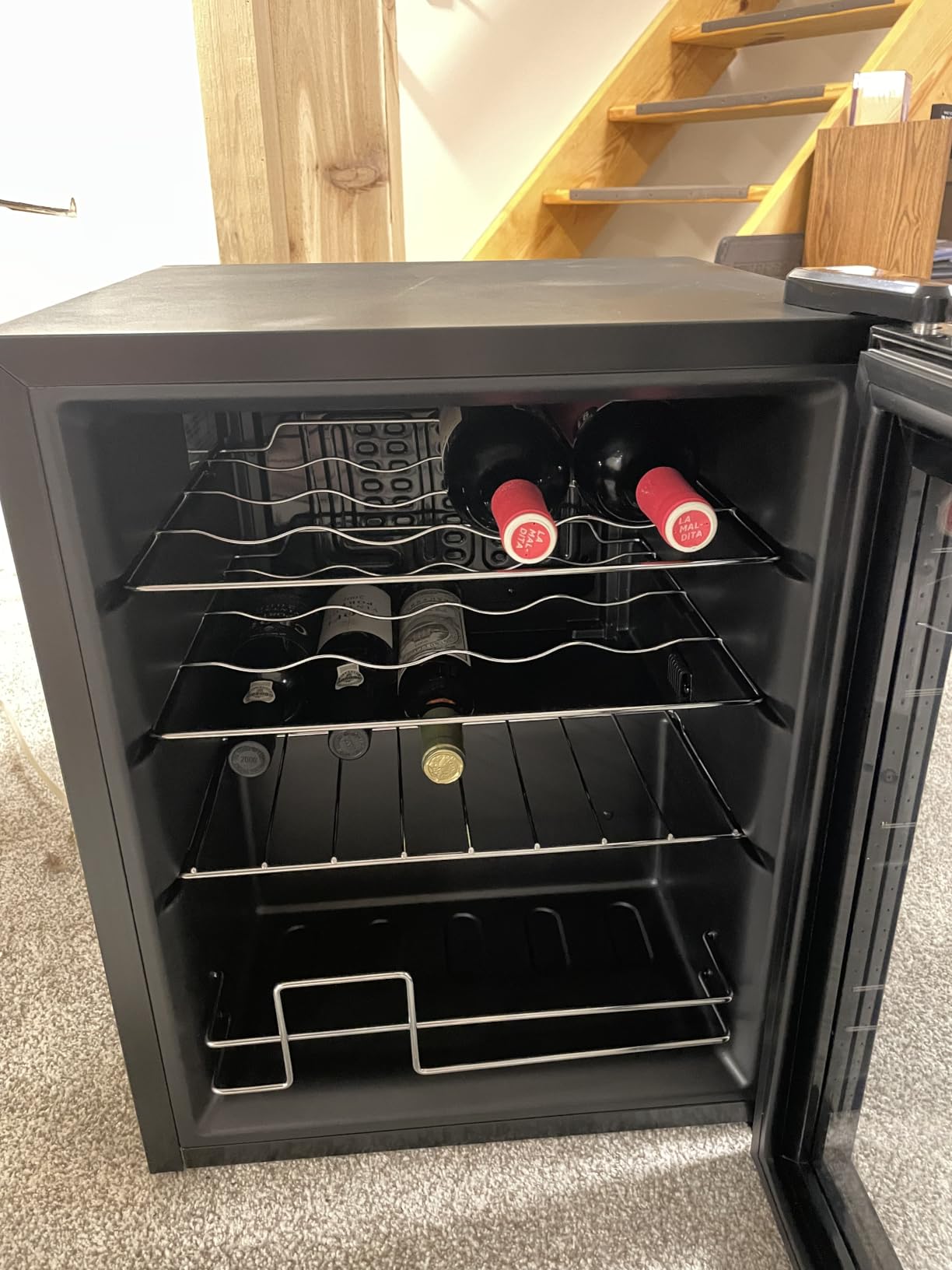
For a red-only collector this is the unit the research says to be careful about, and we agree. You are paying for a second zone you may never use. The compromise is that you can set both zones to the same temperature and gain a larger cabinet, which is a defensible reason to buy it, but not the reason most people buy it.
The digital touch panel gives finer control than a warmer-and-colder dial, but the temperature lock is not intuitive. You must unlock before setting, and if you skip that step nothing changes. Low hum and occasional gurgling from the compressor cycle are audible in a quiet room, though not in a working kitchen.
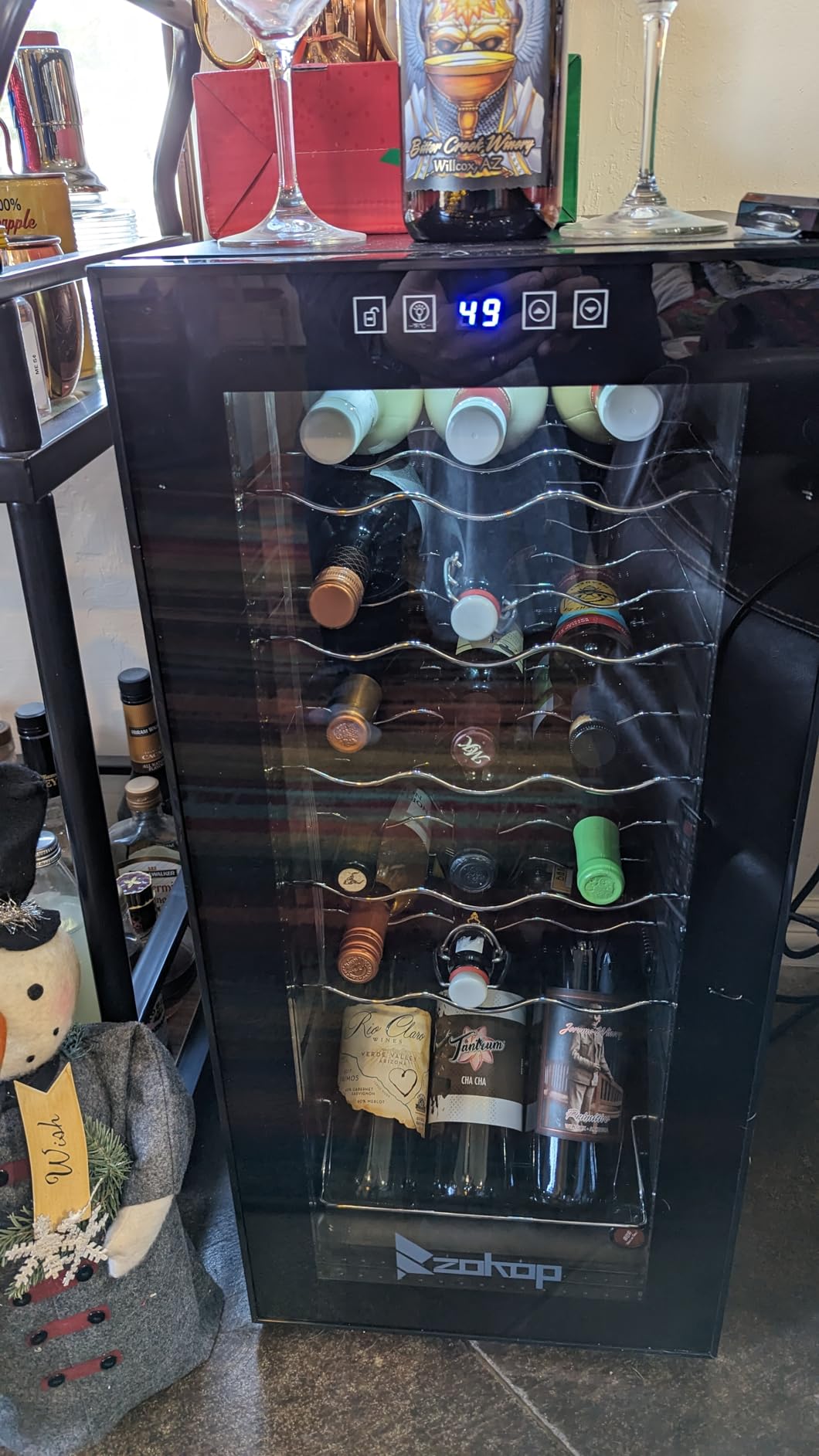
A minority of owners report the temperature buttons failing and ice forming at the back after roughly two years, so treat the electronics as the part most likely to disappoint. Capacity claims also vary with bottle shape, so read the 33-bottle figure as a Bordeaux-shaped number rather than a universal one.
When a second zone earns its cost
Two zones pay for themselves when you are opening a bottle of red on Saturday and still want a crisp white on Monday. That is a mixed-drinking pattern, not a red-only one. If your collection is 90 percent red, read the dual-zone format as extra capacity with flexible zoning rather than as a serving feature.
Who should skip it
Skip it if you want true silence in a living room, because a compressor hum is part of how this class works. Skip it if your reds are all one shape and you need maximum shelf depth, since the stand-up bottom row trades bottle slots for convenience. And skip it if a red-only setup is what you actually want, in which case a single-zone compressor at the same capacity is the better buy.
4. Koolatron Urban Series 12-Bottle Dual Zone for Apartment and RV Red Storage
- Two separately controlled zones holding six Bordeaux bottles each
- No compressor vibration to disturb sediment
- External touch controls with a digital display
- Fits a kitchen
- apartment or RV
- Very quiet in a living room
- No temperature memory
- so a power surge resets both zones
- Some units lost cooling in the upper zone
- Keypad can become unresponsive
- Short 90-day parts and labor warranty
Best for: a small red reserve in an apartment, an RV or a bedroom where compressor noise would be a deal breaker.
Thermoelectric cooling is the whole story here. There is no compressor, so there is no kick-in, no low hum and no vibration transfer through the cabinet. That matters more than it sounds for reds, because a cabinet that never shakes leaves sediment settled against the glass where it belongs.
The zone split works well for red storage. The upper zone runs 55 to 66F, which is exactly the long-term red band with a little headroom, and the lower zone reaches down to 42F for anything sparkling. Six Bordeaux bottles per zone is a sensible split for a personal reserve rather than a collection.
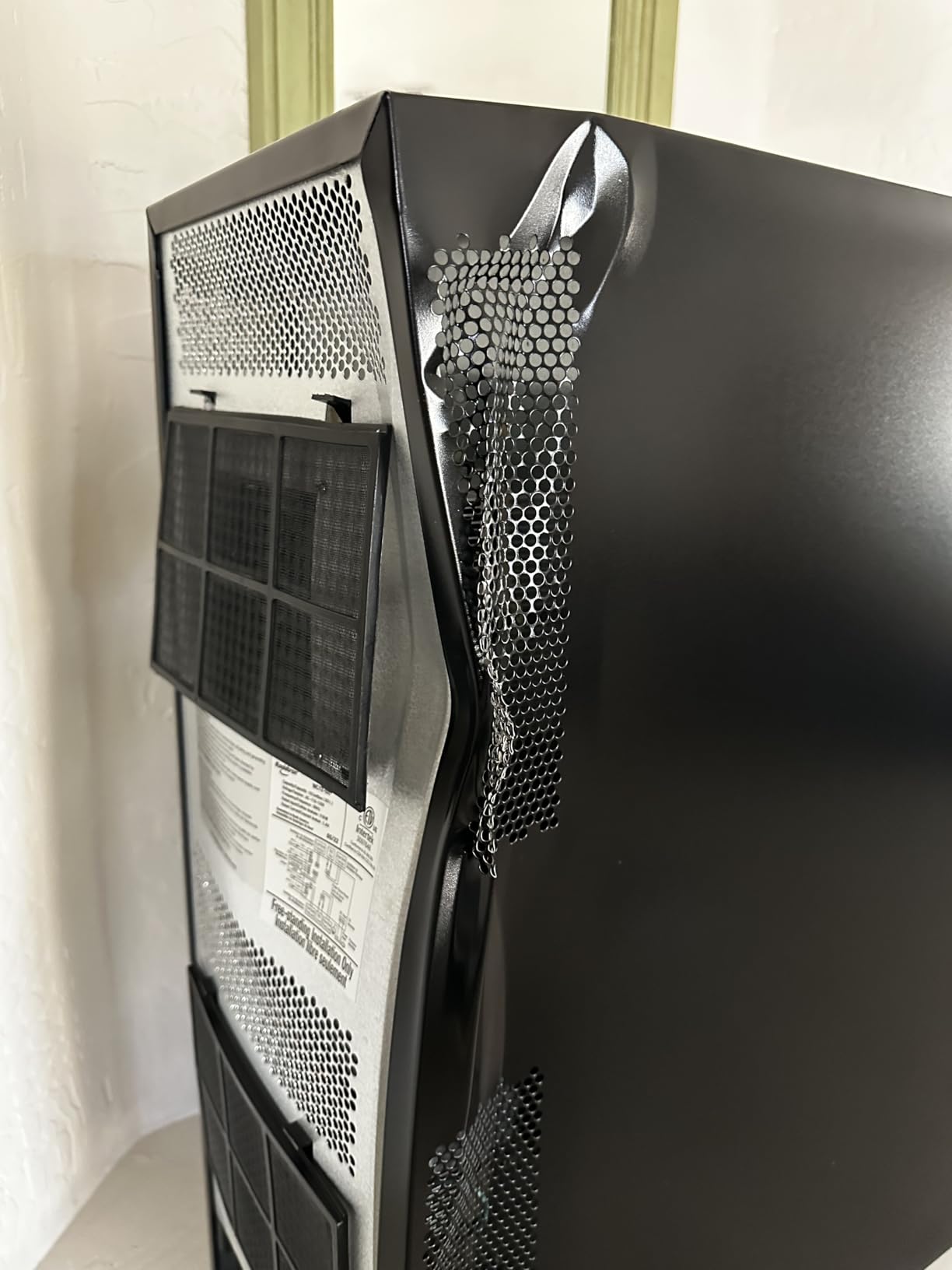
Where thermoelectric units earn their keep is summer. This one runs on R-290 refrigerant and holds 12 bottles in a 10 by 20 by 26-inch footprint, which is small enough for a countertop in a kitchen, an apartment or an RV without the clearance demands a compressor cabinet brings.
The weaknesses are electronic, and they are not trivial. There is no temperature memory, so a brief power surge resets both zones to their defaults, which in a collection you are ageing is a real problem. Some owners also report the upper zone simply stopping while the lower zone kept running, and the keypad needing repeated presses to respond.
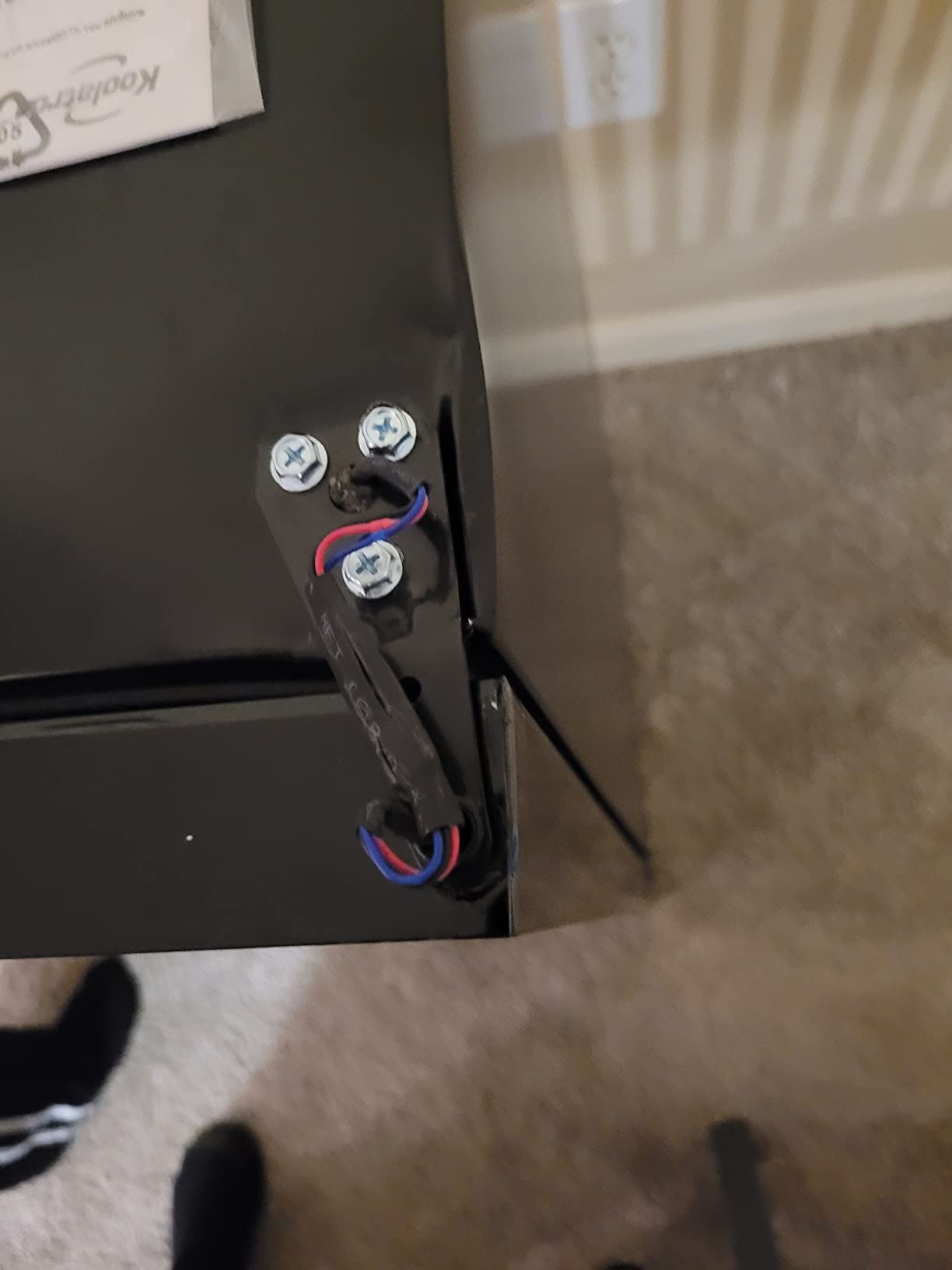
The 90-day parts and labor warranty is the shortest in this roundup and, for a kitchen appliance, the weakest. Reliability concerns cluster around the two-and-a-half-year mark, which is roughly when you would want a red reserve to settle into a long hold.
Why vibration-free beats loud here
For reds held across seasons, no vibration is a genuine advantage rather than a spec-sheet nicety. Sediment disturbed every time the compressor cycles stays suspended, and a thermoelectric cabinet simply does not have that cycle. The external touch controls and digital display also let you check the setpoint without opening the door and letting cold air out.
Where the limitations bite
Thermoelectric units pull heat out of the cabinet rather than pumping it away, so they can only cool a few degrees below the room they sit in. In a kitchen that regularly runs above 70F the upper zone will struggle to hold 55F. Skip this one for a room that regularly runs above 70F, for long-term ageing beyond a couple of years, or for anyone who wants a warranty longer than three months.
5. BLACK+DECKER BD60336 12-Bottle Thermoelectric Wine Chiller for Silent Small Collections
BLACK+DECKER 12-Bottle Thermoelectric Wine Chiller, BD60336, Mirrored Door
- Compressor-free design runs completely silently
- Mirrored door looks clean on a counter
- Five full-length chrome racks remove for flexible loading
- Interior light lets you see bottles without breaking the cold chain
- Compact 10-inch depth suits small rooms
- Only 12 bottles of capacity
- Tight spacing for larger bottle formats
- Some units failed electronically within a few months
- Upper end of the range is not as cold as a compressor
Best for: a first red cooler for a small collection where silence matters more than capacity.
This is the quietest thing on the list, and it still does the job properly for reds. Thermoelectric cooling means no compressor at all, so it runs completely silent. Owners mention the mirrored door as often as they mention the cooling, which tells you where the appeal sits for anyone putting one on a counter in view.
The 46 to 66F range is the weak point for this use case. It covers the red band, but the lower end reaches colder than reds want, so you will set it in the middle and leave it there. Five full-length chrome racks remove entirely, and the interior light lets you check the collection without opening the door.
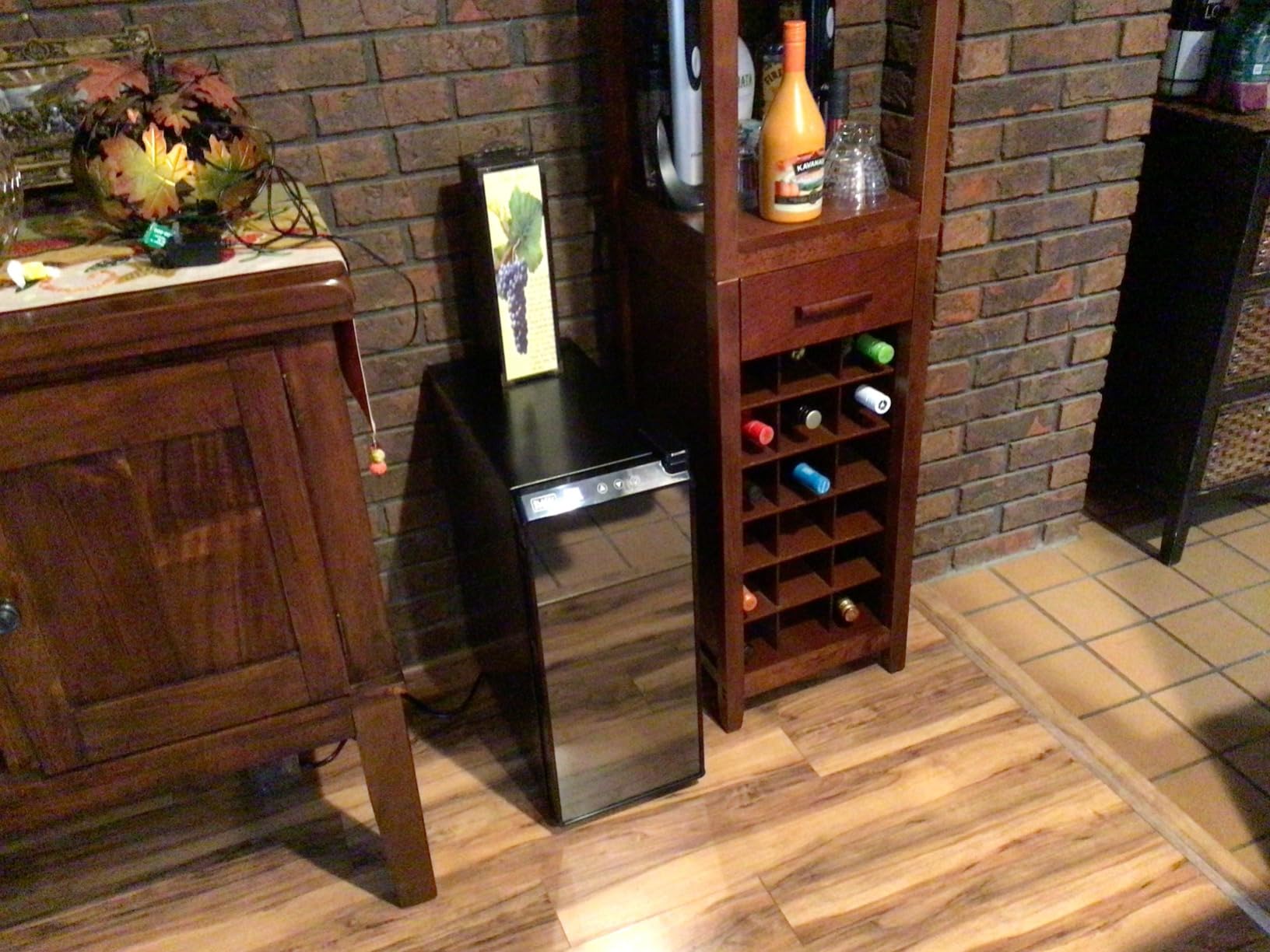
The trade-off is capacity. Twelve bottles in a 1.17 cubic foot cabinet is thin on bottle count, and reviewers say so directly. If you are building a collection rather than holding a weekend reserve, this size becomes a first appliance rather than your last one.
Rack spacing is tight, so larger formats fit awkwardly between the chrome racks. That matters for anyone who buys magnums or Champagne, because the clearance you can see in the photographs is narrower than the measurements suggest once a magnum is involved.
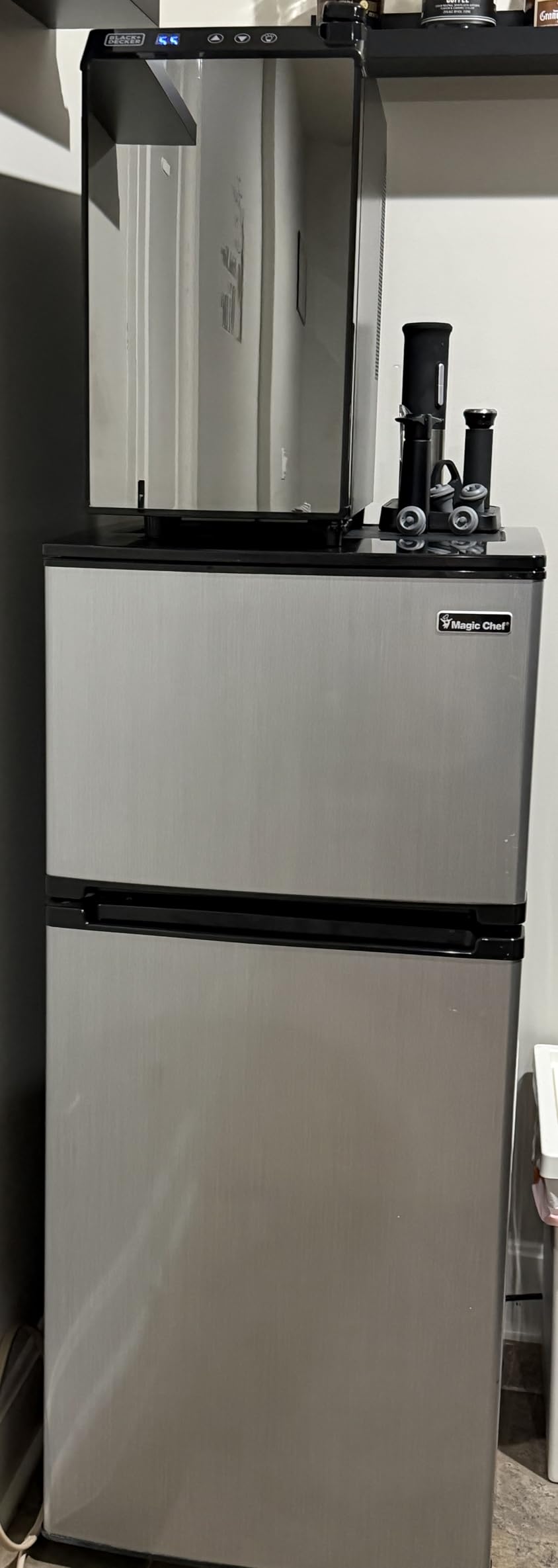
Electronic failures within a few months appear in a small number of reviews, and the upper temperature range is not as cold as a compressor unit manages. Annual energy consumption is listed at 155 kilowatt hours, which is high for a thermoelectric cabinet this size. The one-year parts and labor warranty is standard for the category.
What you give up for silence
You give up the ability to cool below ambient conditions and you give up capacity. In a quiet living space or a bedroom, that trade is worth making. In a warm kitchen where summer regularly pushes past 75F, a thermoelectric cabinet working against that gradient will not hold a cellar temperature reliably.
Who should skip it
Skip it if your reds will be stored past a year, because temperature drift in an unpowered-room scenario is exactly the condition that ages a bottle quickly. Skip it if you are collecting rather than consuming, since twelve bottles is barely one case. Do choose it if the unit lives in a quiet corner and the collection is a personal reserve.
6. BODEGA 46-Bottle Built-In Dual Zone Wine Cooler for Large Red Cellars
- True dual zone with 1F digital touch adjustment
- Beech wood slide-out shelves damp vibration better than wire
- Front ventilation supports built-in or freestanding placement
- Power-outage memory restores zone settings
- Double-glazed glass blocks 99 percent of UV rays
- Needs clearance at the top and back for ventilation
- Large and heavy footprint limits where it can go
- Lock and settings run through the digital touch panel
Best for: a serious red collection that needs real capacity and a built-in kitchen installation.
This unit is built around a dedicated red zone. The lower zone runs 53 to 72F, which covers reds from a cool cellar hold through to pre-dinner serving, and the upper zone runs 41 to 53F for whites. For a red-heavy collection you can simply set both zones to the same temperature and use the cabinet as a 46-bottle cellar.
The shelving is the standout feature. Five slide-out beech wood shelves absorb vibration better than metal wire racks, and sliding drawers make loading a full cabinet far less annoying than reaching into the back of a fixed shelf. That matters when you are handling 46 bottles rather than 12.
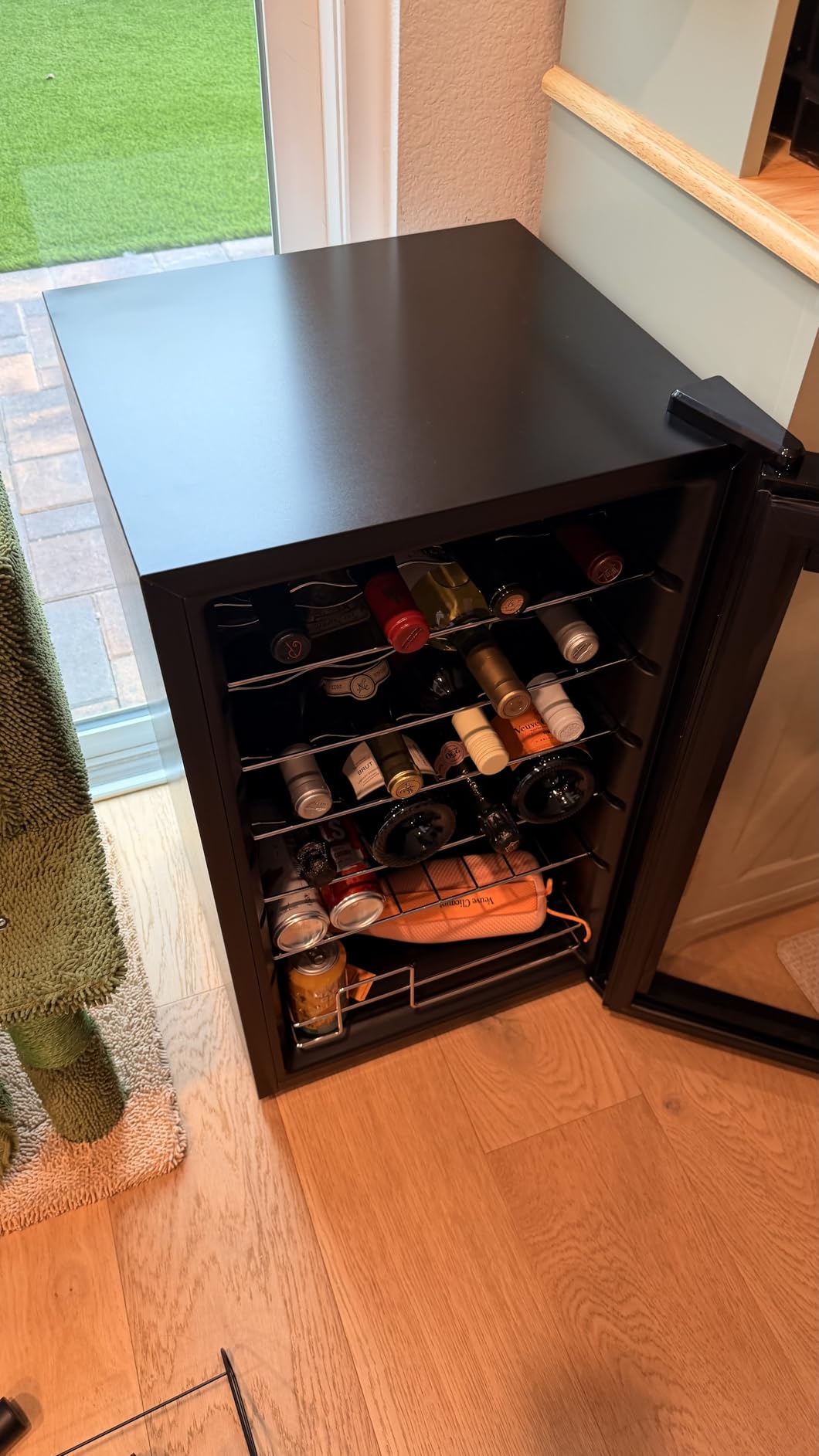
Compressor cooling here is stable in warm kitchens where thermoelectric units fall short, running at 35dB or lower, which is quiet enough for an open-plan space. Front ventilation means it can be built in under a counter or left freestanding without changing the cooling performance, and the power-outage memory chip restores your zone settings after an interruption.
The practical catch is space. At 22.4 inches deep, 23.4 inches wide and 33 inches tall in 5.3 cubic feet, this is a cabinet, not an appliance you tuck away. It still needs clearance at the top and back even with front ventilation, and reviewers consistently flag the size as the reason some buyers returned it.
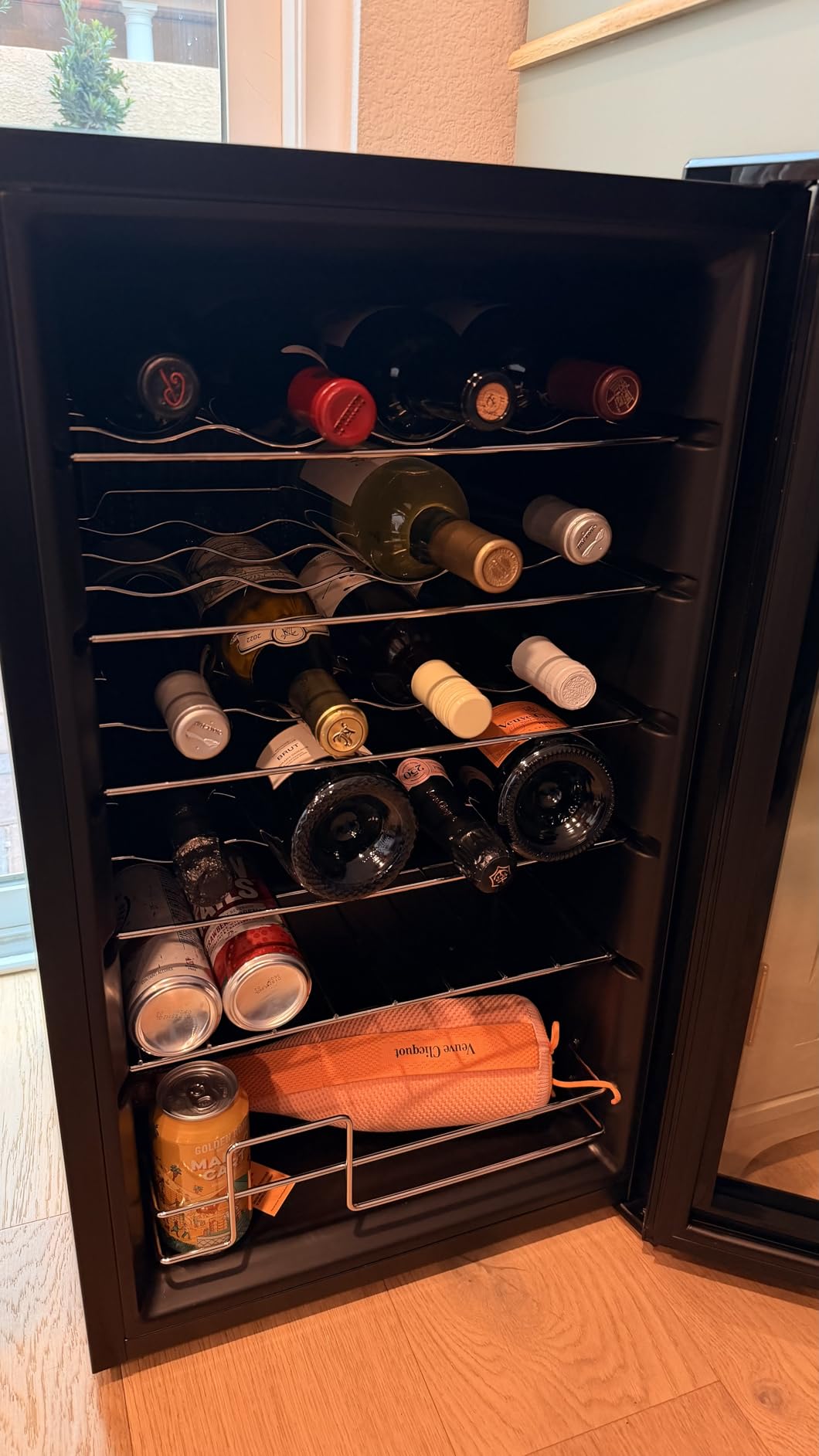
One more irritation worth naming: the lock and settings are managed through the digital touch panel rather than a physical key or dial, so anyone in the household can change a setpoint if they press the right sequence. The 304 stainless steel frame and 12-month warranty are solid for the price band this sits in.
Why beech shelves matter for red ageing
Wire racks transmit cabinet vibration straight to the bottle, and a bottle that is shaken daily keeps its sediment in suspension, which is exactly what you do not want in a bottle you intend to age. Beech absorbs that energy, so the shelves work for you quietly. The 99 percent UV blocking in the double-glazed door handles the other long-term threat.
Who should skip it
Skip it if you have a small kitchen or a rental where a 23.4-inch-wide cabinet is a negotiation. Skip it if you have under-counter clearance problems, since the required top and back gaps catch people out. Choose a smaller single-zone compressor instead if you are storing fewer than 30 bottles, because this cabinet is wasted on a small collection.
7. Cuisinart CWC-800CEN 8-Bottle Cellar for a Personal Red Reserve
Cuisinart CWC-800CEN 8-Bottle Private Reserve Wine Cellar
- Quiet and energy efficient thermoelectric system
- Touchscreen controls for temperature and light
- LED temperature display is easy to read
- Soft interior lighting without harsh glare
- Three-year warranty is longer than most competitors
- Only 8 bottles of capacity
- Thermoelectric ceiling is higher than compressor units
- A 6-liter interior suits a reserve
- not a collection
Best for: someone who keeps one bottle of something special open to a proper red drinker who wants no noise.
This carries the highest average rating of any unit in this group. Owners attribute that to three things rather than to features: it is genuinely silent, the touchscreen makes the controls obvious, and the limited three-year warranty is longer than anything else on this list.
It is also the smallest. Eight bottles in a 6-liter interior is a private reserve, not a collection, and that framing matters because the same three-year warranty that reassures you also means there is little room to grow.
The thermoelectric system is efficient and quiet, with soft interior lighting that highlights bottles without glare, and an LED temperature display you can read from across a counter. Touchscreen controls handle both temperature and the light, which removes the two adjustments people make most often.
The limitation is the same one that makes it attractive. A thermoelectric ceiling means it cannot reach the low temperatures a compressor unit manages, which for red storage is arguably a feature rather than a flaw. If you ever want to chill something properly cold in the same cabinet, this is not the unit.
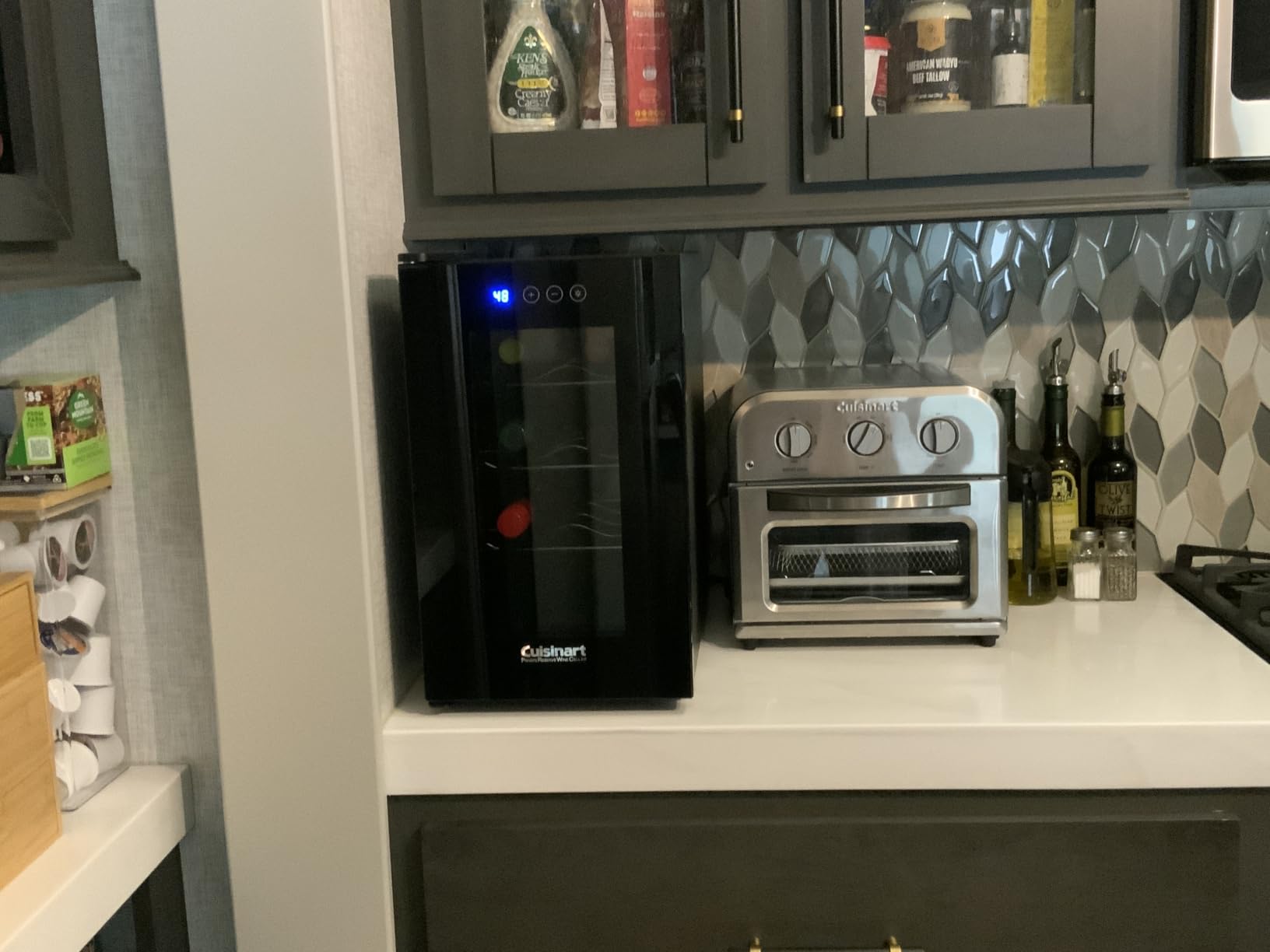
Automatic defrost and a compact freezerless configuration keep maintenance low, and 26 pounds makes it the easiest unit here to reposition when you move house. Three racks come included. This is a gift-scale purchase that works hardest when it sits next to a proper red drinker’s chair.
What a three-year warranty tells you
Warranty length is a rough proxy for how a manufacturer expects the electronics to hold up, and three years on a kitchen appliance is a real signal. Owners cite the warranty explicitly when recommending the unit. Nothing else in this roundup commits to that length.
Where it falls short
Skip it if you are storing more than a handful of bottles, because eight will not hold a case. Skip it if you want one cabinet to handle reds and properly chilled whites, because the temperature ceiling will not reach. Buy a larger compressor model instead if your collection is growing, and treat this one as the reserve cabinet it was designed to be.
8. EUHOMY 45-Bottle Wine Cooler FWC002-20 for Wide-Range Red and White Control
EUHOMY 45 bottle Wine Cooler Refrigerator, Wine Fridge Glass Door, Black
- Wide 32F to 61F range covers reds and whites
- Compressor with circulating air gives stable cooling
- Six removable shelves fit varying bottle shapes
- Runs quietly at 38dB with 0.44 kWh per day
- Lock on the touchscreen prevents accidental changes
- A 4.2 average rating suggests mixed experiences
- Footprint is wider than slim counter units
- Heavy at 68.5 pounds to move
Best for: a large red collection that occasionally needs to hold whites at a genuinely cold serving temperature too.
The temperature range here is among the widest in the roundup, reaching from 32F to 61F on a single compressor zone. The red band sits comfortably inside that, and if you keep a few whites alongside the reds you have real room to work with rather than a compromise.
Forty-five bottles across six removable shelves makes this one of the larger cabinets here, and reviewers cite the capacity and broad range as the two reasons to buy. Circulating air delivers stable cooling described as vibration-free, and the shelves fit bottles of varying shapes without the tight chrome-rack problem.
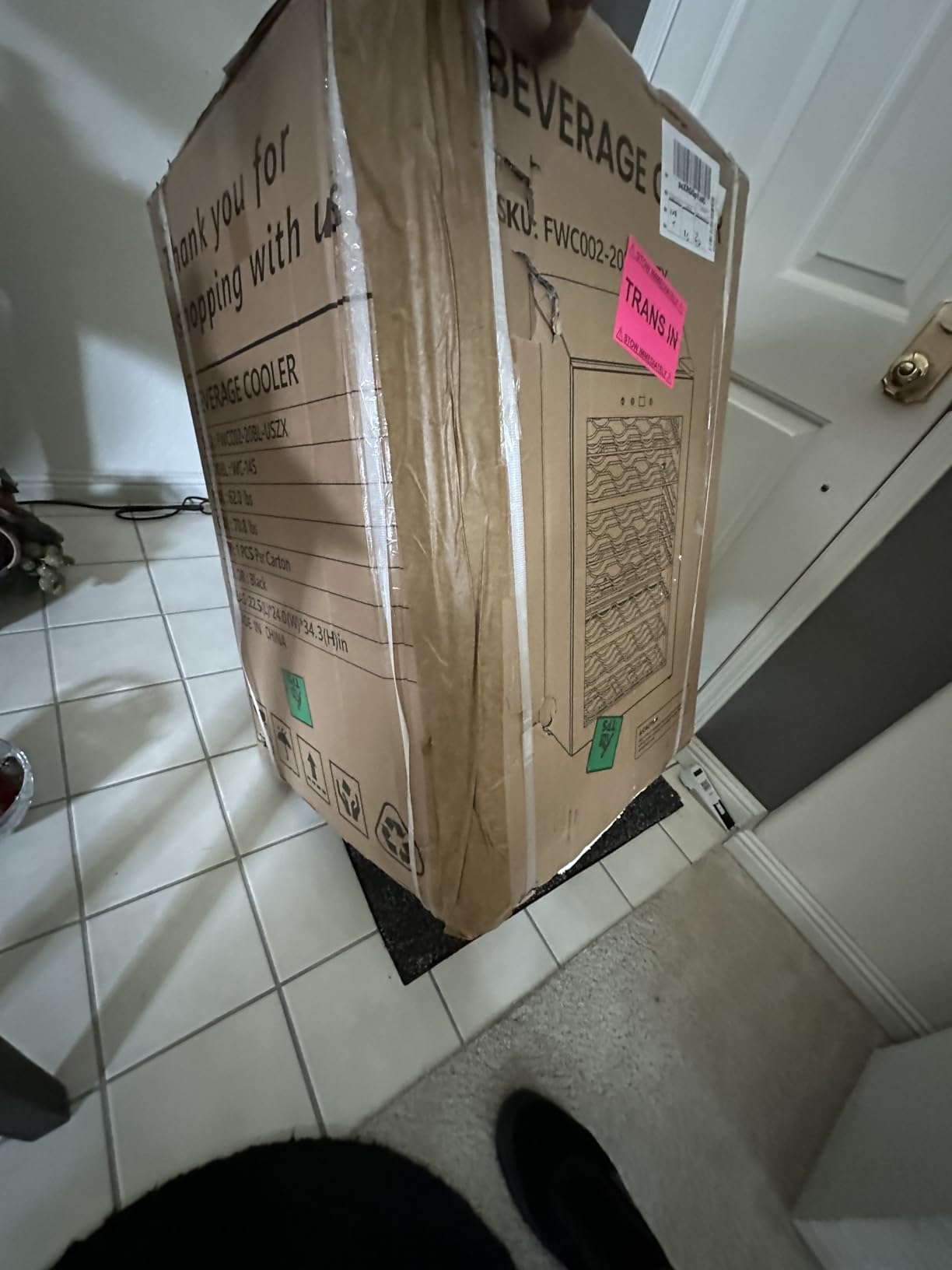
Running quietly at 38dB puts it in acceptable territory for an open kitchen, and annual energy consumption is listed at 160 kilowatt hours. Adjustable leveling legs handle uneven floors, and the touchscreen lock stops household members from knocking your setpoint out of place.
Its category demand is strong, ranking first in freestanding wine cellars, yet the 4.2 average rating is the third lowest of the ten units here. That gap between popularity and satisfaction is worth taking seriously: buyers like the capacity and reach, and they notice the size.
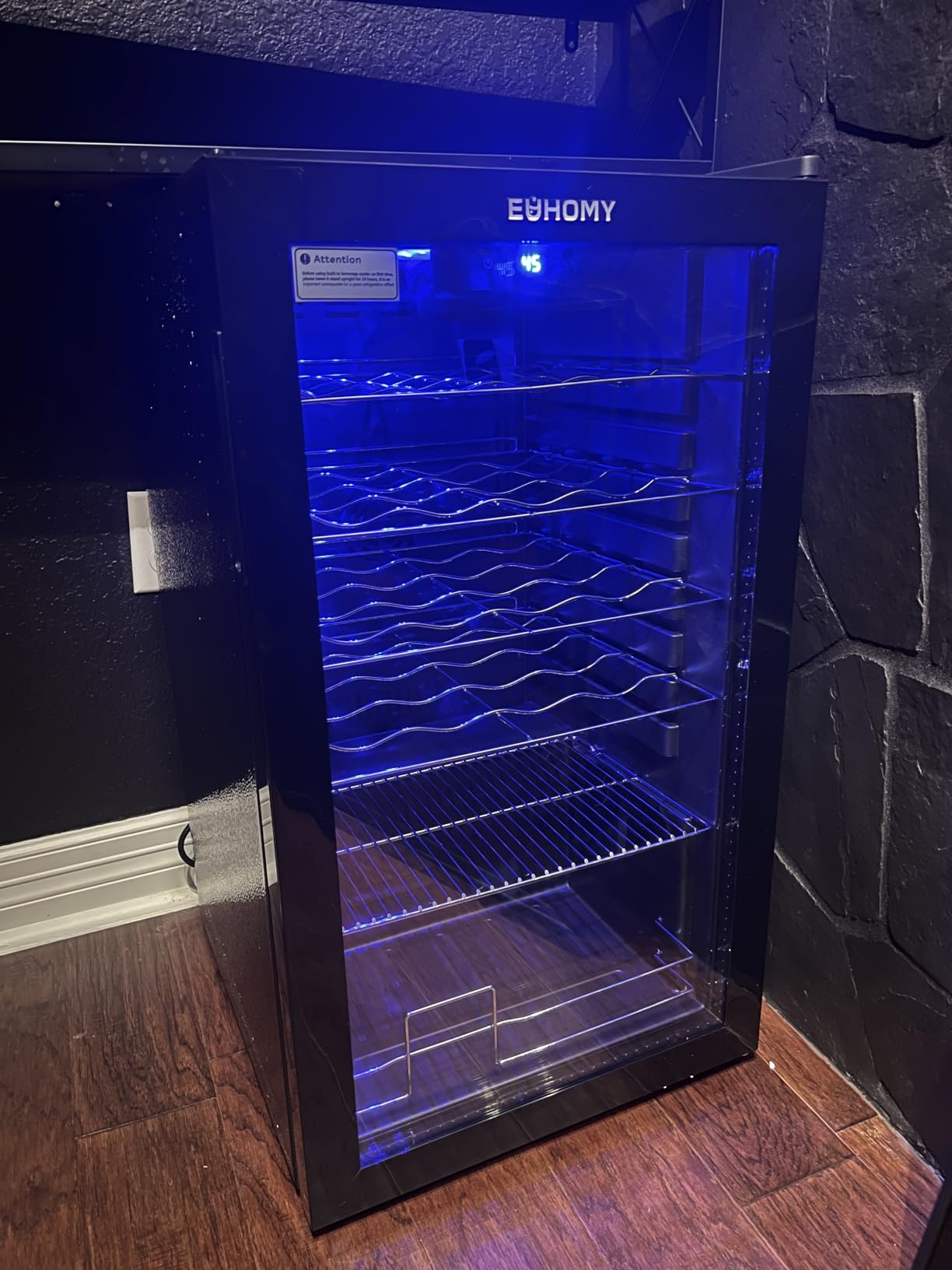
At 20.3 inches wide, 21.7 inches deep, 31.49 inches tall and 68.5 pounds, this is a heavy unit in more than one sense. Moving it needs two people and a planned route, and the footprint rules out most countertops. Spare part availability is listed at seven years, which is a genuine plus for a long-term red hold.
When the extra range earns its weight
Range only matters if you use both ends. If your reds live permanently at 57F, the 32F capability is dead weight you paid for. If you want one cabinet to cover reds, whites and beer across a full year, this is the only unit here that does it without a second zone being involved.
Who should skip it
Skip it if you need a slim unit for a counter or a narrow gap between cabinets, because 20 inches wide rules both out. Skip it if moving the appliance alone is part of the plan. Consider a lighter compressor cabinet instead if capacity matters but the 45-bottle figure will never be reached, because the weight follows the size.
9. ORYMUSE 52-Bottle Dual Zone Built-In Cooler for Cellar-Scale Red Storage
ORYMUSE 24 Inch Dual Zone Wine Cooler, 52 Bottle Built-In Wine Fridge
- Lower zone holds 55-65F
- exactly the red storage band
- 52 bottles on six smooth-gliding beech shelves
- Front ventilation allows built-in or freestanding placement
- Power-loss memory restores setpoints after an outage
- Digital touchscreen with a built-in lock
- At 88 pounds and over 34 inches tall it needs a clear 24-inch opening
- Listing details vary between 46- and 52-bottle configurations
Best for: a collector who has outgrown a countertop cooler and wants a dedicated red cellar built into the kitchen.
Here is a unit whose zones split precisely at the red band. The lower zone is specified at exactly 55 to 65F, which is the long-term red storage band stated rather than approximated. The upper zone runs 40 to 55F for whites and sparkling. Set both zones to 57F and you have a 52-bottle red cellar.
Capacity is the headline. Fifty-two bottles on six smooth-gliding beech wood shelves is the largest here, and the sliding shelves make a full cabinet manageable in a way fixed wire racks never are. Soft blue LED lighting and a digital touchscreen keep the day-to-day adjustments simple.
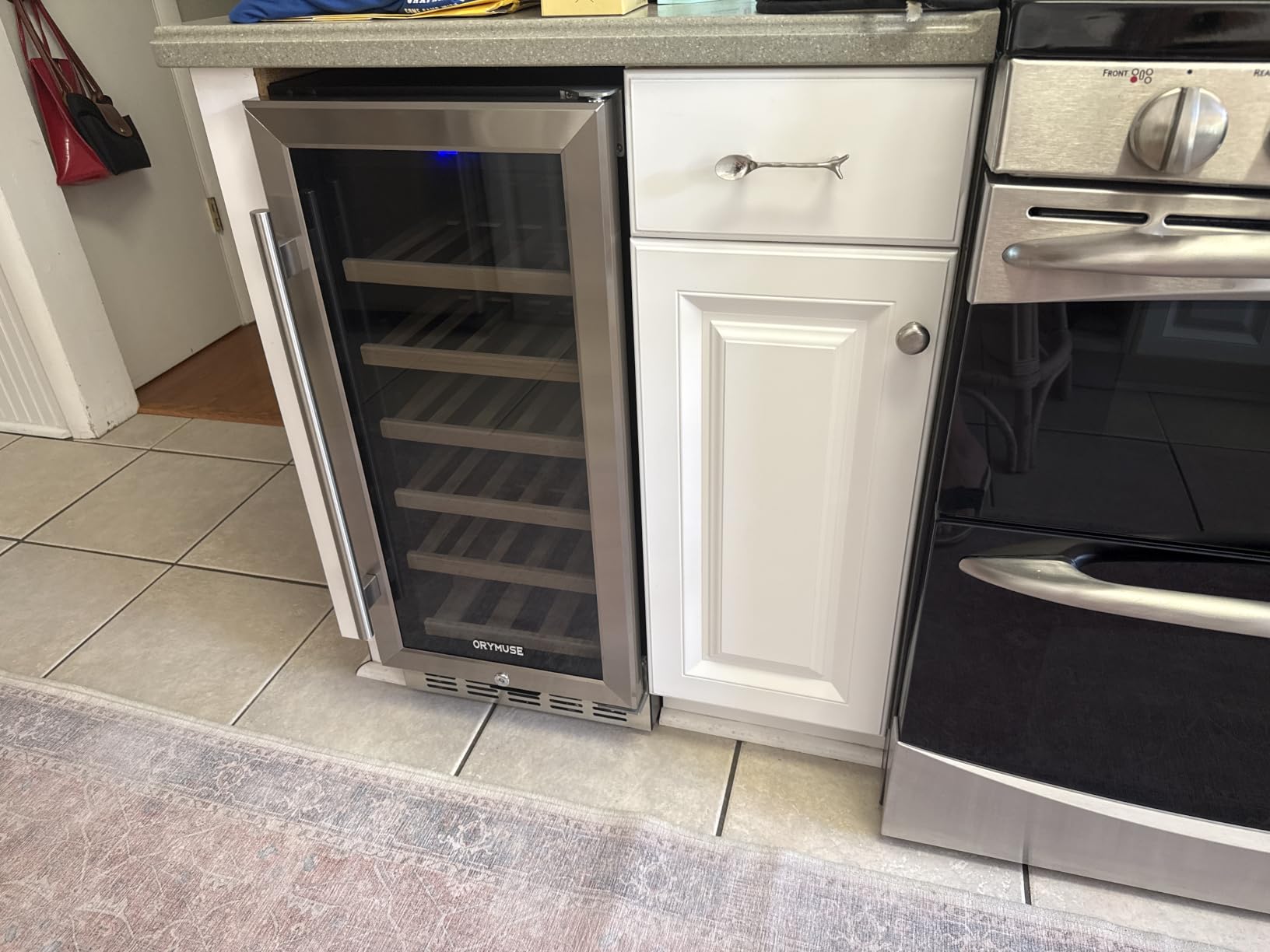
The mechanical side is competent rather than remarkable. Upgraded compressor and fan-assisted circulation give even, frost-free cooling, double-pane glass handles light, and front ventilation supports built-in, under-counter or freestanding installation within a 24-inch fit. Power-loss memory restores temperature settings after an outage, which matters more in a cellar than in a weekend cooler.
Annual energy consumption is listed at 170 kilowatt hours, which is high in this group. That is partly a function of size, since you are cooling 4.8 cubic feet, but it is worth pricing into any decision about running one continuously.
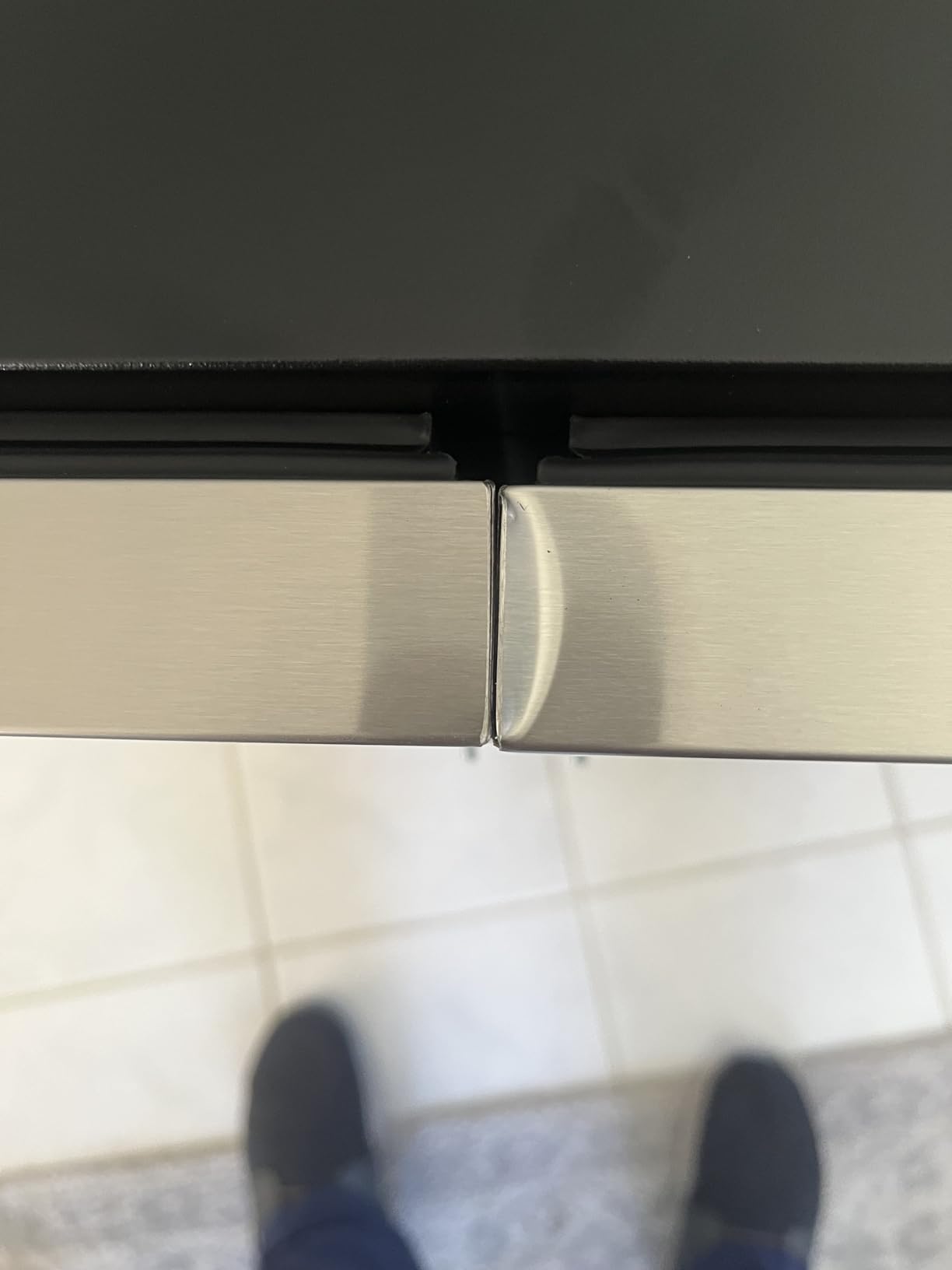
The practical constraint is installation. At 88 pounds and 34.25 inches tall, this needs a clear 24-inch opening and a deliberate plan for moving it into place. Owners also note that listing details vary between 46- and 52-bottle configurations, so confirm the shelf count before you plan a layout around it.
Why the red zone specification matters
Most dual-zone coolers split the range somewhere near 50F because that is convenient for the manufacturer. This one splits at 55F, which puts the entire red band in a single zone with its own controller. That means the reds you are ageing are not sharing a cooling cycle with bottles you want served cold, which is the argument r/wine regulars make for setting both zones equal instead.
When this is the wrong amount of cooler
Skip it if you drink what you buy within a few months, because a cellar-scale cabinet is wasted on a turnover of weeks. Skip it if the kitchen cannot take a 24-inch opening with proper clearance, since built-in ventilation needs room. Consider the BODEGA 46-bottle instead if you want the same class of install at slightly lower capacity and a lighter build.
10. BLACK+DECKER BD61536 26-Bottle Wine Fridge for Magnums and Champagne
BLACK+DECKER 26-Bottle Wine Fridge, Compressor Cooling, BD61536
- 26 bottles is generous for the cabinet size
- Compressor covers 40F to 64F
- suitable for reds
- Dedicated bottom compartment fits champagne or magnum bottles
- Flat back with leveling legs suits basements and offices
- Clear double-pane door with stainless steel trim
- Mechanical temperature control is less precise than digital panels
- Manual defrost needs periodic attention
- Lowest average rating here with 12 percent one-star reviews
- Energy use listed at 180 kilowatt hours per year
Best for: a red collection that includes magnums and Champagne bottles needing dedicated clearance.
The reason to look at this unit is its bottom compartment. Four chrome full-width racks, one flat shelf and a dedicated bottom compartment mean large formats get a place where slim cabinets simply do not offer one. That is a real advantage over the 12-bottle units on this list if you buy magnums.
Compressor cooling across a 40 to 64F range handles reds properly, and the flat back with adjustable leveling legs suits kitchens, basements and offices where a curved or protruding back would be awkward. The double-pane glass door and stainless steel trim look more considered than the price tier suggests.
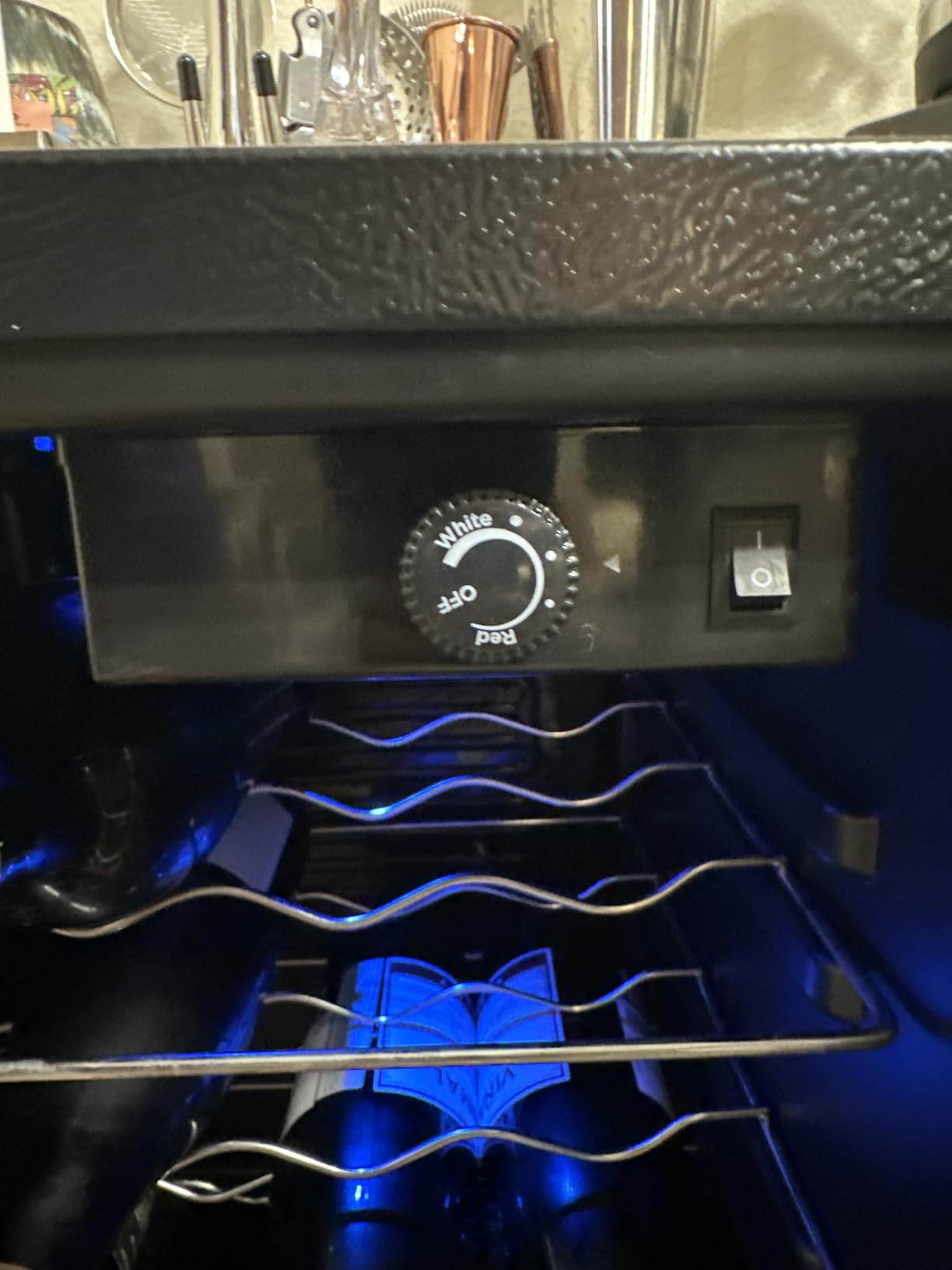
The weak point is control. Mechanical temperature controls are less precise than the digital panels on every other compressor unit here, and that precision is the whole basis of the red storage recommendation. It takes adjustment to hold a steady cellar temperature rather than dialing a number and walking away.
Manual defrost means periodic maintenance, which is the single most common reason wine cooler owners report temperature problems in appliance forums. Energy use is listed at 180 kilowatt hours per year, the highest figure of any unit in this roundup, and the 4.1 average rating is the lowest here, with 12 percent of reviews at one star.
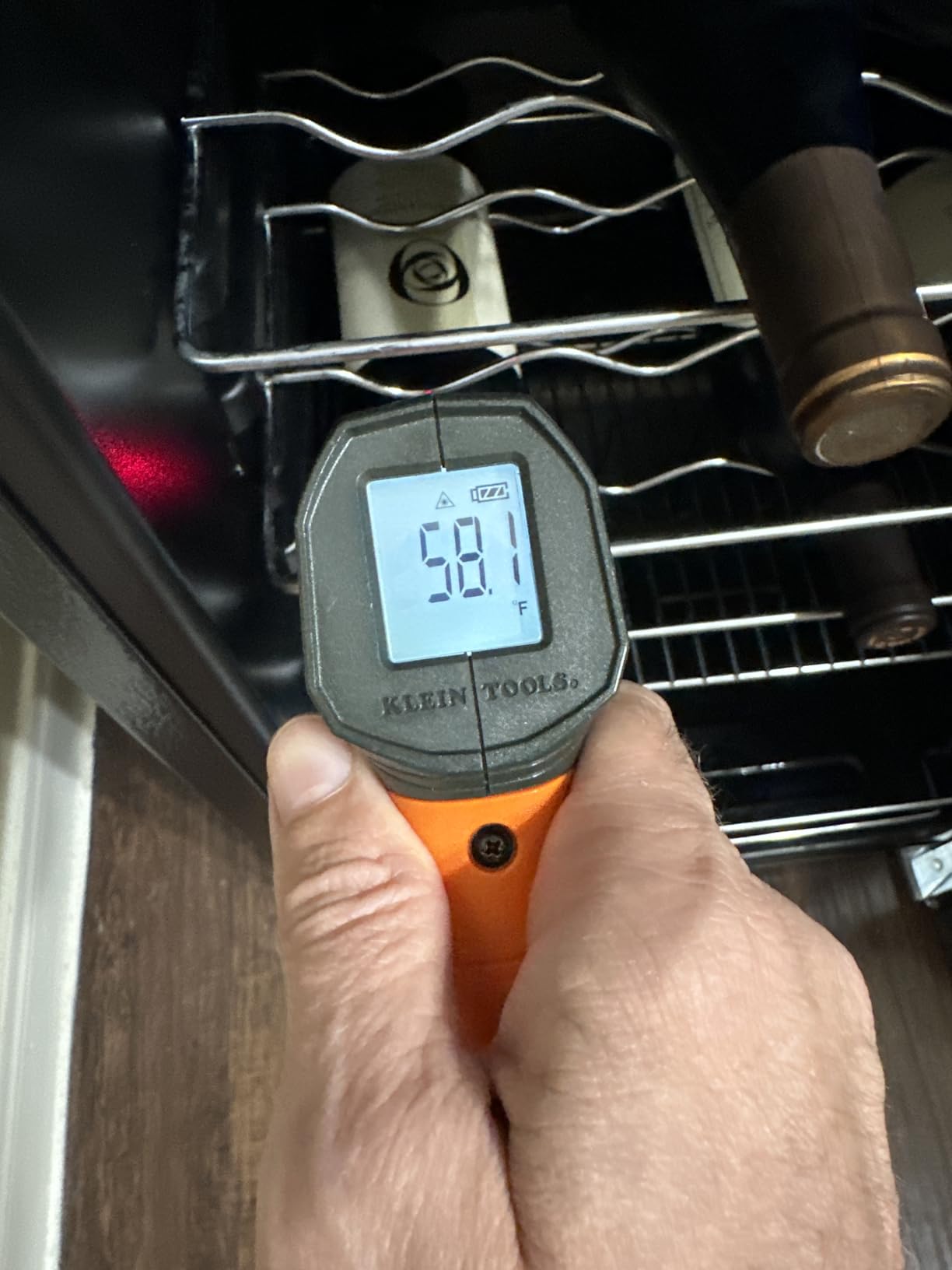
That rating is not a rejection. Owners consistently praise the bottle count for the money and the bottom compartment for large formats, and the complaints cluster around precision rather than around whether the wine survives. If you can live with a mechanical dial, the trade is defensible. If you cannot, spend the difference on a digital compressor unit.
Where mechanical controls cost you
Temperature swing is what ages a red bottle quickly, and a mechanical control reacts later and more coarsely than a digital thermostat with one-degree adjustment. In a stable kitchen that is a minor issue. In a room that heats up in the afternoon and cools down at night, the swing compounds and the case for digital control gets strong.
Who should skip it
Skip it if you are ageing reds over more than a year, because precision is the whole game at that horizon. Skip it if you care about energy use, since 180 kilowatt hours is the highest figure here. Buy it anyway if your collection is full of large formats and no slim unit on this list will take them.
How to Choose a Wine Cooler for Red Wine Storage in 2026
Seven decisions matter more than the badge on the box. Work through them in order and the model choice makes itself.
1. Size the capacity to your real collection, not your ambition. Add up what you currently hold, then add 30 percent for a year of buying. Capacity claims assume Bordeaux-shaped bottles, so a Burgundy-heavy or magnum-heavy collection loses a fifth of the nominal count once loaded. A shelf count is a more honest number than a headline figure.
2. Decide single zone or dual zone honestly. For a red-only collection, a single strong zone beats two mediocre ones. If you buy a dual-zone unit, set both zones to the same temperature rather than leaving one at its default, because the lower zone of a unit like the Koolatron Urban Series bottoms out at 42F, which is sparkling wine territory and too cold for ageing a red.
3. Match cooling technology to ambient heat. Compressor units cost more, use more power and hold temperature in a hot room. Thermoelectric units are silent and cheap but only cool a few degrees below the surrounding air, so they belong in a basement, a bedroom or a cool kitchen, not a sunlit one. If you want to cover reds and whites properly, our guide to the best dual zone wine coolers sets out where the second zone is worth paying for.
4. Protect the cork. The most common objection on r/wine is that fridges dry corks out, and it deserves an answer. Dry air shrinks cork until air leaks in and the wine oxidizes. Look for a sealed glass door, an insulated frame, a carbon filter and a humidification tray. Do not open the door repeatedly to browse, because every opening replaces the cabinet air with warm dry room air.
5. Check shelf geometry against your bottles. Bordeaux bottles are the narrowest, Burgundy bottles wider and taller, Champagne bottles long, and magnums roughly twice the volume. Any unit claiming 30 bottles with wire racks may accept 24 Burgundy bottles or 18 magnums. If you buy large formats regularly, look for slide-out shelves or a dedicated bottom compartment.
6. Consider where the noise will land. Compressor kick-in is normal and lasts a minute or two. A steady low hum is not, and it is what people complain about in appliance forums. Units rated at 38dB or below work in an open-plan kitchen; treat anything louder as a bedroom-basement product. Vibration isolation matters as much as volume if sediment is part of why you are ageing.
7. Plan the installation before you buy. Compressor units need air on the sides and back, and front-ventilated models still need clearance at the top and back. Leave at least 3 inches behind a conventional compressor cabinet, and measure the door swing against your wall and counter. Our picks for built-in wine coolers cover the fit questions in more detail, and the kitchen wine cooler picks cover placement in cooking spaces.
One more thing worth saying plainly. If the temperature in your kitchen regularly sits above 68F, a cupboard is actively damaging reds and a cooler is not optional. If your kitchen stays cool and you drink through a case in six weeks, you are spending money on a problem you do not have. If you have already opened a bottle and want to know how to serve it rather than store it, the wine aerator guide is the more useful read.
Frequently Asked Questions
Should you store red wine in a wine cooler?
Yes, if you are keeping red wine for more than a few weeks. Hold it at 55 to 65F (12 to 18C) for long-term storage, which slows chemical ageing and keeps corks from drying out. For serving rather than storing, 60 to 68F (15 to 20C) is the working band. A cool dark cupboard is fine only if you drink what you buy within a few months.
Is there a difference between a wine fridge and a wine cooler?
There is not a meaningful technical difference. People use the terms interchangeably for the same appliance: a temperature-controlled cabinet built for bottles. What separates them from a kitchen fridge is the wider setpoint range, higher humidity inside, UV-filtered glass, vibration isolation and shelving sized for bottle shapes. What separates them from a wine cellar is scale and cost.
What is the 20 minute rule for red wine?
The 20 minute rule is a serving convention, not a storage rule. It means standing an older, sediment-heavy red upright for around 20 minutes before opening it so the sediment settles and the wine reaches roughly cellar temperature naturally. It has nothing to do with the temperature you store at, which remains 55 to 65F (12 to 18C).
Do I need a dual zone wine cooler if I only drink red?
Usually not. A red-only collection is better served by a single zone with strong capacity and steady temperature than by two zones where one sits unused. If you buy a dual-zone unit anyway, set both zones to the same temperature, usually 57F (14C). Leaving the lower zone at its default minimum is too cold for ageing red wine.
Why isn’t the compressor running in my wine fridge?
Check four things in order. First, the setpoint may already be satisfied, in which case the compressor cycles off until temperature rises. Second, blocked air vents or a stuck damper stop airflow even though the compressor is fine. Third, ambient temperature may be below the unit minimum, which stops it pulling down far enough. Fourth, a thermostat or start capacitor fault needs a technician.
The Best Wine Cooler for Red Wine Storage in 2026
The Ivation 12-Bottle Compressor Wine Cooler IVFWCC121LB is the best of the best wine coolers for red wine storage, because compressor cooling holds a setpoint that a thermoelectric cabinet cannot in a warm room, and its review history is deep enough that the weaknesses are known rather than suspected. The Ivation 18-bottle is the same idea with more capacity for the same money logic.
Go bigger only when you have to. The BODEGA 46-bottle and ORYMUSE 52-bottle dual zones are the right call for a collection that has outgrown a cabinet, and the ROVSUN 33-bottle covers a mixed red-and-white household better than anything else at that size. For large-format reds specifically, the BLACK+DECKER BD61536 with its bottom compartment is the one that fits bottles the others reject.
Whatever you choose, set it between 55 and 65F, give it the clearance its manual asks for, and stop opening the door to browse. Those three habits do more for your reds than the badge on the front.