
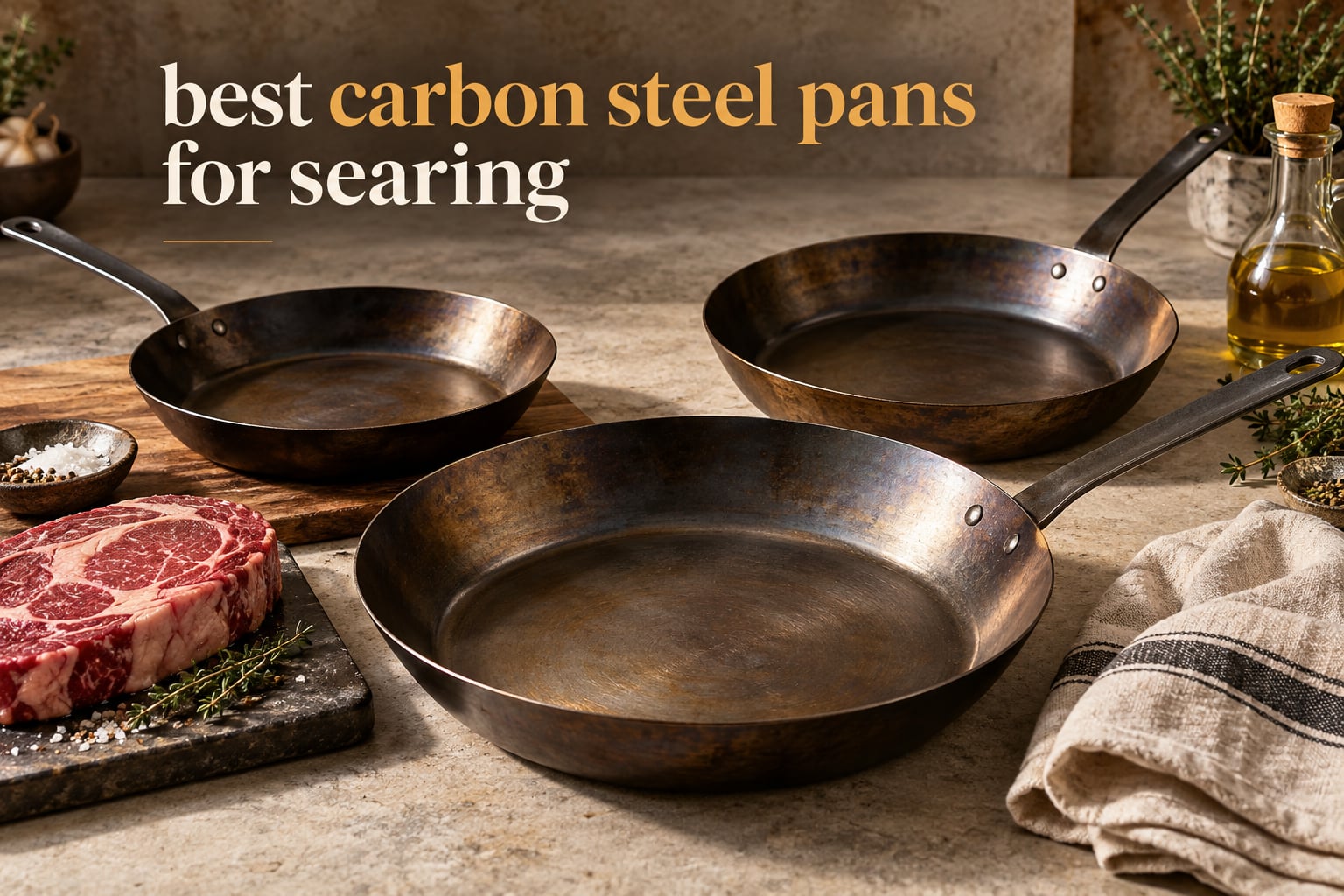
If you only read one line: the de Buyer MINERAL B 12.5 inch is the best carbon steel pan for searing overall, the Merten & Storck 12 inch is the best value pick for most home cooks, and the Matfer Bourgeat 11-5/8 inch is the pro-grade pick that takes a searing hot oven finish. All three hold heat through a steak drop better than anything else we tested.
A sear is a heat-transfer problem before it is a flavor problem. The Maillard crust only forms when the pan surface stays above roughly 400F the instant wet meat touches it, and thin pans that collapse the moment cold protein lands will steam the steak instead of browning it. That single fact is why the best carbon steel pans for searing are not simply the lightest or the cheapest ones.
We spent weeks moving these twelve pans through the same routine: dry pan on high heat until the oil shimmers, a salted ribeye or strip laid down and left alone, then a finish in the oven. The differences that mattered were heat retention, how much steel is under the food, and whether the handle survives the oven step. Our full infrared grill guide covers the other side of the searing problem, if you want the heat source instead of the pan.
Table of Contents
Top 3 Best Carbon Steel Pans For Searing (October 2026)


Merten & Storck 12 inch Pre-Seasoned
- Pre-seasoned out of the box
- Oven safe to 600F
- Induction ready
All 12 Carbon Steel Pans Compared in 2026
| Product | Specifications | Action |
|---|---|---|
| de Buyer MINERAL B 12.5 inch |
|
Check Latest Price |
| Matfer Bourgeat 11-5/8 inch |
|
Check Latest Price |
| Merten & Storck 12 inch Pre-Seasoned |
|
Check Latest Price |
 Mauviel M’Steel 11 inch Mauviel M’Steel 11 inch |
|
Check Latest Price |
 Lodge Carbon Steel 10 inch Lodge Carbon Steel 10 inch |
|
Check Latest Price |
 YOSUKATA 11.8 inch YOSUKATA 11.8 inch |
|
Check Latest Price |
 stackbear Nitrided 12 inch stackbear Nitrided 12 inch |
|
Check Latest Price |
 Tramontina 10 inch Tramontina 10 inch |
|
Check Latest Price |
 STRATA 12.5 inch Carbon Clad STRATA 12.5 inch Carbon Clad |
|
Check Latest Price |
 de Buyer Blue 12.5 inch de Buyer Blue 12.5 inch |
|
Check Latest Price |
 de Buyer Lyonnaise 12-1/2 inch de Buyer Lyonnaise 12-1/2 inch |
|
Check Latest Price |
 Restaurantware 8 inch Restaurantware 8 inch |
|
Check Latest Price |
1. de Buyer MINERAL B 12.5 inch – the best carbon steel pan for searing
- Largest flat searing surface in the roundup at 9 inches
- Excellent heat retention from heavy solid steel
- Works on induction
- gas and electric
- No artificial coating
- Comes with a lifetime manufacturer warranty
- Ships with a beeswax coating that must be removed by hand before first use
- Oven limit of 400F for 10 minutes blocks long oven finishes
- 2.88 kg makes one-handed tossing tiring
This is the pan I reach for when I am cooking two ribeyes and I do not want to babysit them. The 9 inch flat cooking surface inside a 12.5 inch frame leaves real margin around the meat, so the crust forms on the steak and the fat cap renders without the sides crowding it.
Heat retention is the whole argument. At 2.88 kg there is enough steel in the pan to keep its temperature when a cold steak hits the middle of it, and that is exactly what separates a crust from a grey sear. It takes longer to preheat than a thin stamped pan, which reads as a flaw until you understand that the preheat time is the feature.
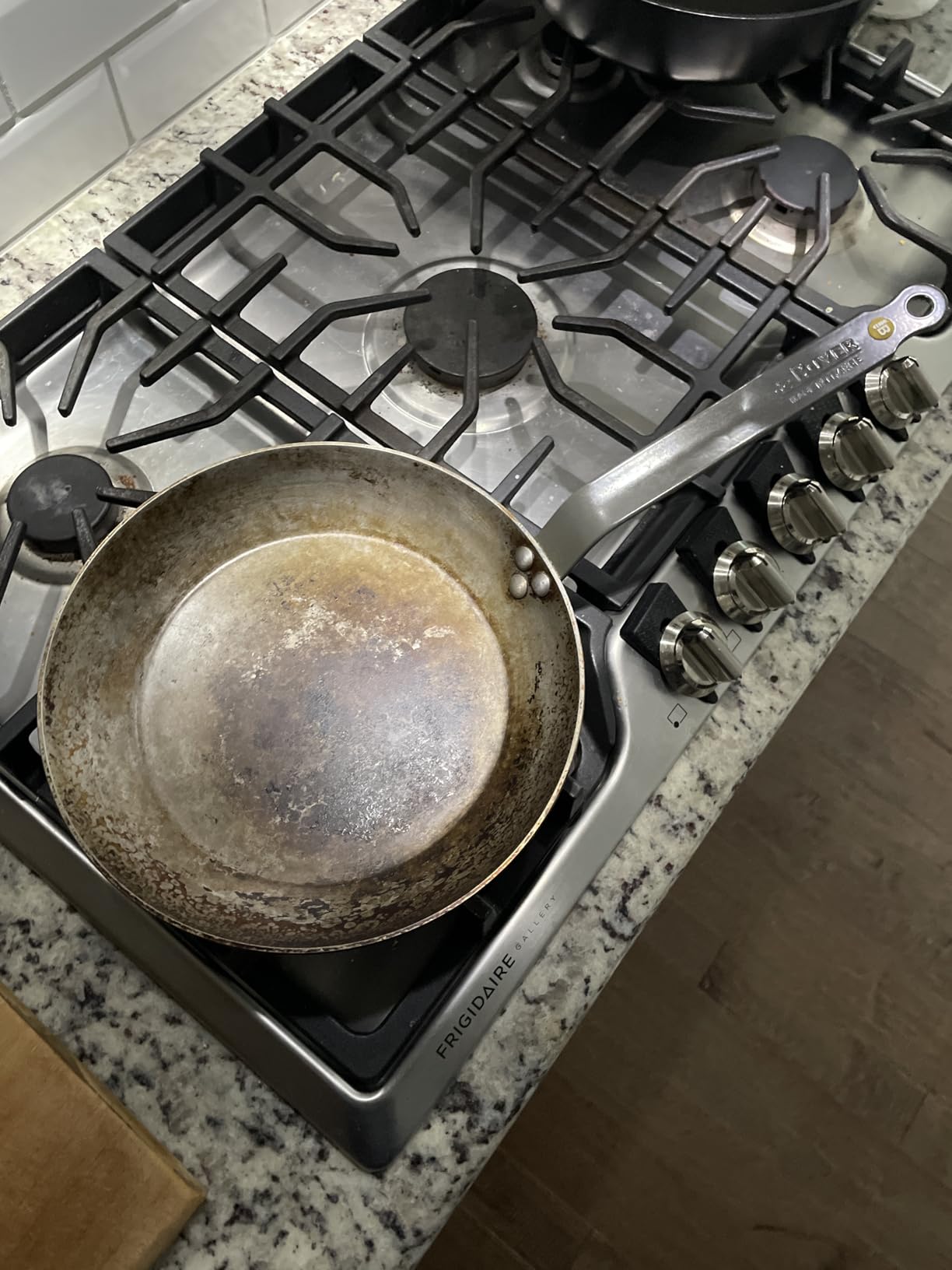
It also happens to be the most-reviewed pan here by a wide margin, at more than 15000 reviews, and the pattern in those reviews is remarkably consistent: owners like the even heating and the surface release that develops over time, and they grumble about the beeswax ritual and the hand-wash-only care rule.
The one thing to plan around is the handle rating. Oven safe to 400F for ten minutes means this is a stovetop sear pan first and a roaster second. If your reverse sear needs a 450F finish, look at the Matfer Bourgeat below.
Who this pan suits?
Cooks searing one to two thick steaks who want the largest flat surface available and who will do the ten-minute beeswax strip once at the start. At that weight you want two hands on it, so plan your sear around a countertop rather than a shaky one-handed flip.
Who this pan does not suit?
Anyone finishing a thick cut in a hot oven. A 400F ceiling for ten minutes is not enough for a reverse sear on a ribeye, and the 2.88 kg is punishing if you like to toss a pan of vegetables over the flame.
2. Matfer Bourgeat 11-5/8 inch – the professional oven-finish pick
- Handles stay hot and dry well at 800F oven temperatures
- Welded handle has no crevices for rust or burnt food
- Riveted-free construction is the easiest to clean
- Works on gas
- electric and induction
- French-made professional standard
- Arrives bare and needs a full seasoning cycle first
- Not suited to acidic ingredients like vinegar or tomato
- 4.1 pounds is heavy for one-handed tossing
- Hand wash only
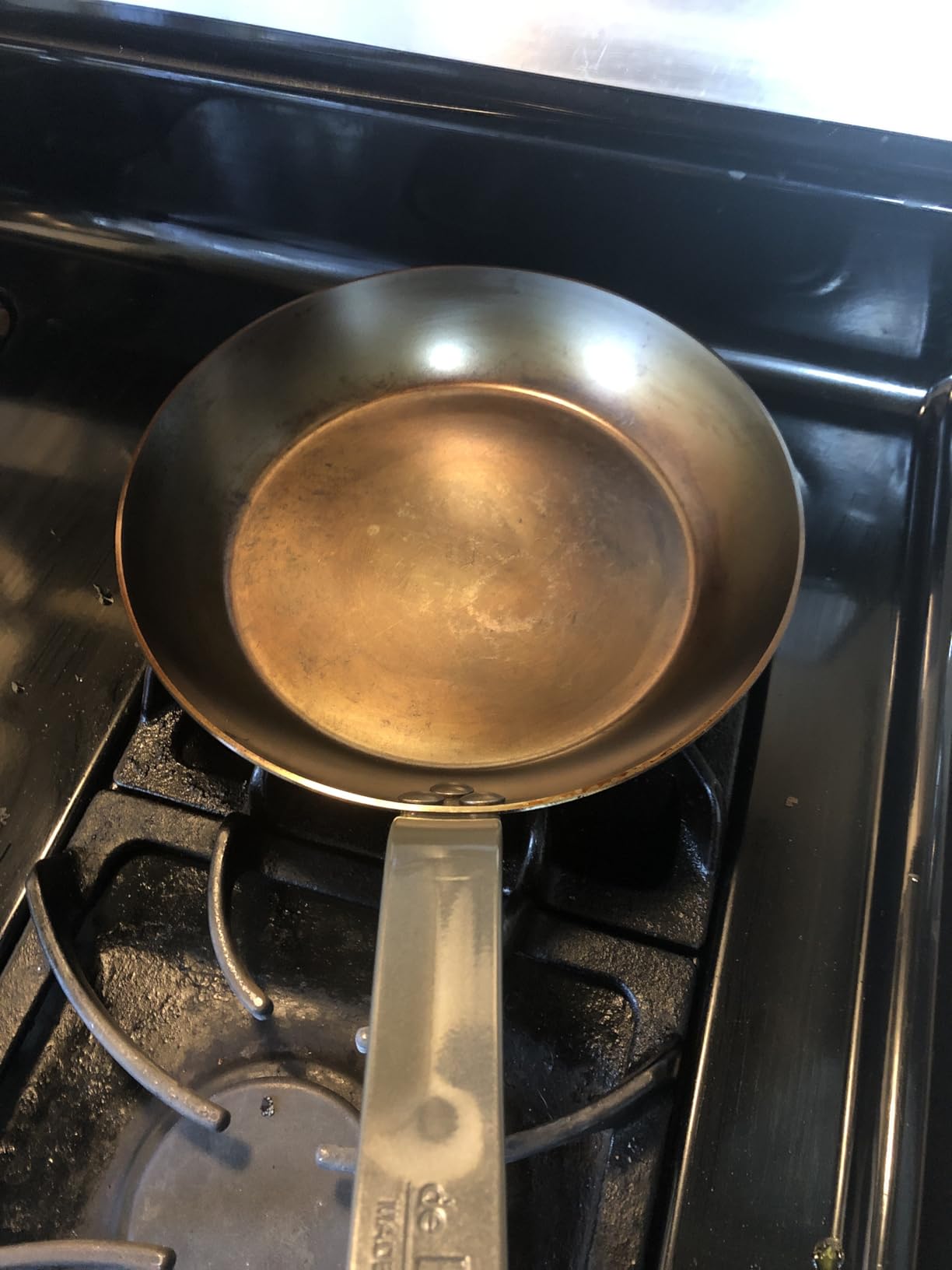
Matfer has been the professional kitchen reference point in carbon steel for decades, and the reason shows up most clearly in the handle. It is welded to the pan body with no rivets, which means there is no crevice for burnt onion to hide in and nothing to loosen over twenty years of service.
That handle is also rated to 800F, which is the number that matters for searing. You can take a steak from a screaming hot burner straight into a 450F oven without switching to another pan, and the pan will not become a liability by the door of the oven.
At 4.1 pounds it is one of the heavier pans here, and buyers consistently report that. That is a fair trade if you are cooking over high heat for extended sessions, and a poor one if you want to pan-toss stir-fry.
The care discipline is stricter than most. It ships uncoated with no chemical finish, so it needs a real seasoning routine before it releases anything, and acidic ingredients like lemon juice or tomato sauce will strip the layer. Cook it with fat and it will run for decades.
Who this pan suits?
Cooks doing oven-finished and reverse-seared steaks where the 800F handle rating is the whole point. It also suits anyone who wants a pan with no rivets to scrub and who cooks fatty proteins as a matter of habit.
Who this pan does not suit?
Cooks making tomato or wine-based sauces, and anyone who wants to be cooking within ten minutes of opening the box. The bare steel will not release until you have built the seasoning yourself.
3. Merten & Storck 12 inch Pre-Seasoned – the best value pick
- Works out of the box with factory seasoning that improves with use
- Weighs half what a cast iron skillet of the same size does
- Triple-riveted steel handle stays manageable in normal use
- Nests with the 8 and 10 inch versions for storage
- Induction and outdoor cooking ready
- Thin steel can warp on glass or smooth-top electric burners
- Limited thermal mass for long high-heat sears
- Ships with a silicone coating that must be scrubbed off
- Acidic ingredients strip the seasoning
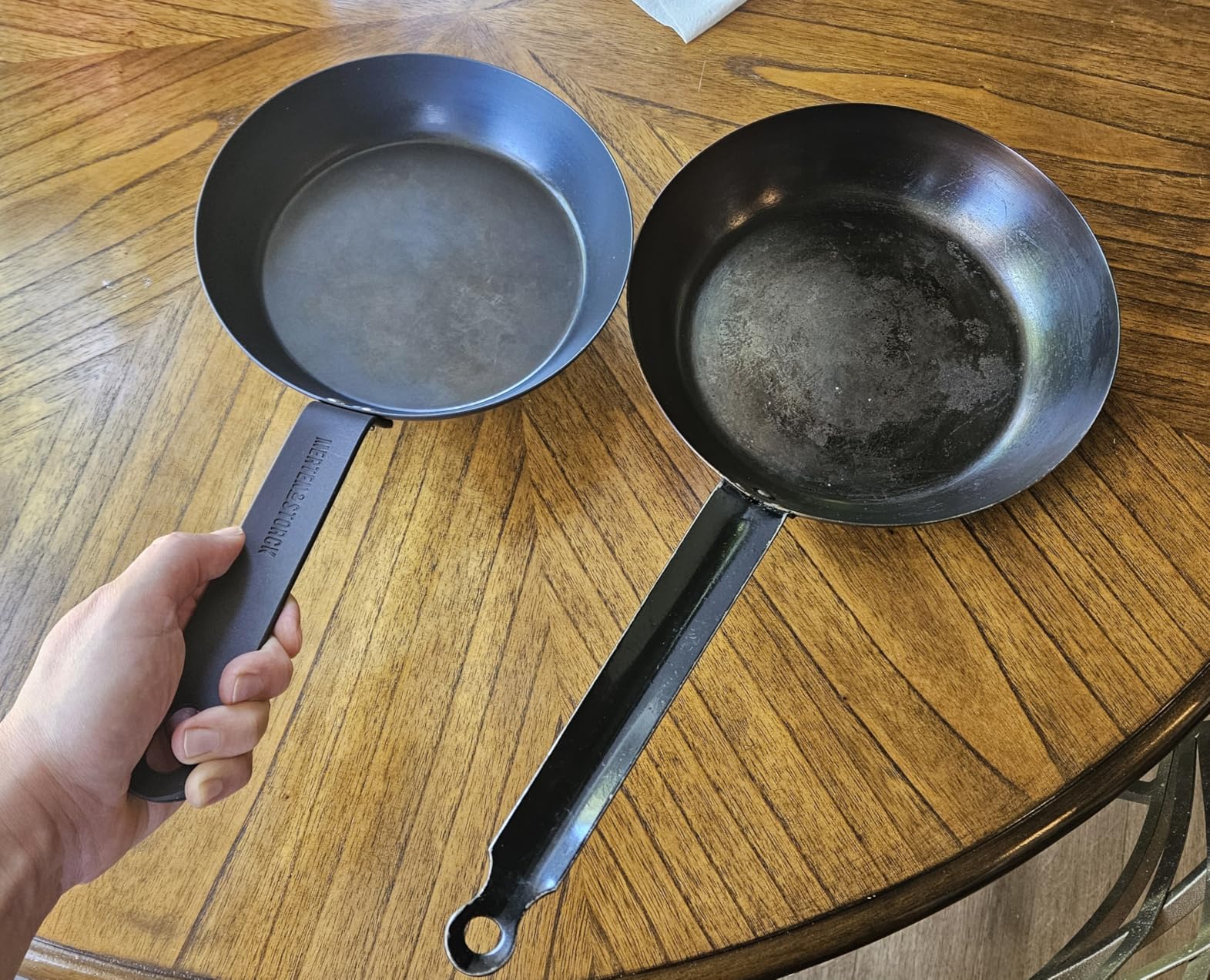
This is the one I recommend to friends who are nervous about carbon steel. It arrives seasoned, it weighs half a cast iron skillet, and it is the best-selling skillet in this entire group by category rank. For a first sear on a Friday night that is a strong package.
The trade is thermal mass. At 1.5 kg this pan heats fast and cools fast, which is a virtue for thin proteins and a liability when you sear two cold steaks back to back and want the second one to hit the same surface temperature as the first.
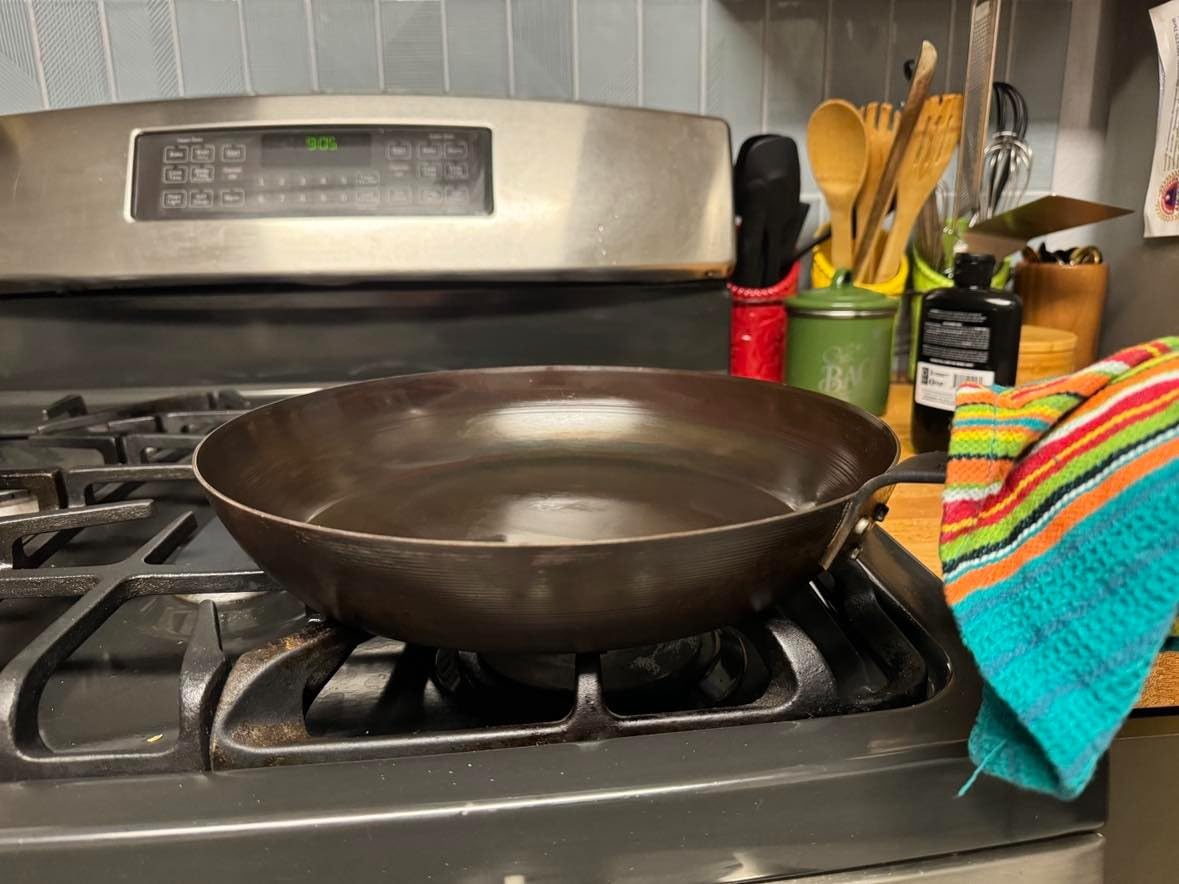
Reviewers split clearly on warping. On gas it holds up fine. On glass or smooth-top electric at full blast, the thin steel can flex enough to rock, and several long-term owners describe re-flattening the base with a rubber mallet after it cools.
Acidic food is the second dividing line. Tomato, vinegar and wine will pull at the seasoning on any carbon steel, but with a light factory layer there is less to lose and it comes back faster with regular cooking.
Who this pan suits?
Home cooks moving from nonstick who want to try high-heat cooking without a commitment ceremony, and anyone who wants three sizes that nest. It is also the most practical pick for searing fish fillets where you are moving the food constantly.
Who this pan does not suit?
Cooks on smooth-top electric who blast the burner and expect a perfectly flat pan afterward. If warping on glass is a deal breaker for you, pick one of the heavier solid pans instead.
4. Mauviel M’Steel 11 inch – the biggest flat surface for its size
Mauviel M’Steel Black Carbon Natural Nonstick Frying Pan With Iron Handle, 11-in, Suitable For All Cooking Surfaces, Made in France
- Unusually wide cooking surface for an 11 inch pan
- Rises to searing temperature very quickly
- Plain steel handle stays cooler and can go in the oven
- Responsive enough for eggs and for tossing vegetables
- 18/10 stainless rivets for commercial durability
- Beeswax coating is genuinely hard to remove with hot tap water alone
- Thinner and lighter than other 11 inch carbon steel pans
- Manufacturer advises heating slowly at around 60 percent power
- Warps on flat electric and induction if blasted from cold
Mauviel is a French stainless steel house, and the M’Steel line is where it went into carbon steel. What stands out in the cooking is the ratio of flat surface to overall diameter. The flat cooking area is generous for an 11 inch pan, which matters more than the headline number when you are laying down a steak.
It is also genuinely quick to temperature. That responsiveness is what makes it good for eggs and for searing delicate fish, where you want control rather than a thermal brick sitting on the burner.
The beeswax is the honest complaint. Multiple buyers report that hot tap water alone will not shift it, and several describe a melt-off approach in a 300F oven. Plan for that fifteen-minute job before you plan your first steak.
Heat it slowly. Mauviel’s own guidance is roughly 60 percent of cooktop power and a gradual warm-up, and owners who ignore that are the ones reporting warping on flat electric and induction surfaces.
Who this pan suits?
Cooks who want a responsive pan with a lot of flat surface and who will follow the heat-up guidance. It is a strong pick for pan-searing fish, searing small steaks, and for finishing in the oven since the handle handles heat well.
Who this pan does not suit?
Cooks who want maximum heat retention in a small pan. It is lighter than competing 11 inch models, and if your searing plan involves multiple thick cuts back to back, the heavier pans will serve you better.
5. Lodge Carbon Steel Skillet 10 inch – the forgiving first pan
- Heavy 12 gauge steel holds heat well for a 10 inch pan
- Factory seasoned for an easy-release surface out of the box
- Included silicone handle holder protects hands up to 500F
- Made without PFOA or PTFE with a lifetime warranty
- Works on induction cooktops
- Protective coating must be washed off before first use
- The included silicone handle holder does not fit every Lodge handle
- 500F oven limit is lower than several competing pans
- Hand wash only
Lodge has been making cookware in the American South for generations, and the carbon steel skillet is the same philosophy in a lighter material. Twelve gauge steel in a 10 inch pan is genuinely heavy for the size, and that mass is what keeps the surface temperature up under a cold steak.
The handle holder is the detail I like most. Most pans send you into the oven with a bare steel handle and a pair of mitts, and Lodge includes a silicone sleeve rated to 500F. It is a small thing that shows the maker understands the actual sear-then-finish workflow.
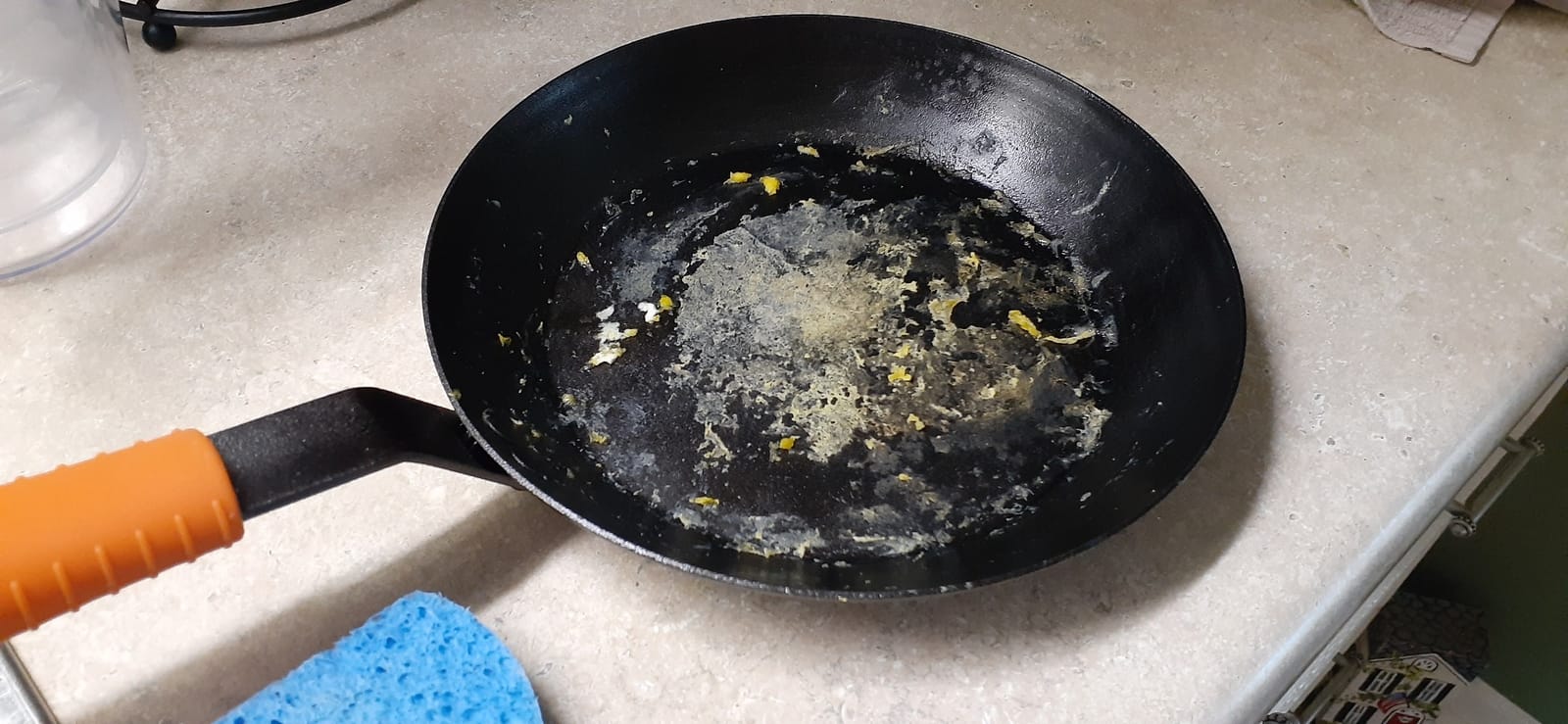
Buyers rate the value highly. The most common practical complaint is not performance at all but the silicone holder, which several reviewers say does not sit correctly on the handle and has to be repositioned every time.
At 10 inches you are cooking for one or two people. That is the right pan for a single ribeye or two pork chops, and it is the wrong pan if you routinely sear four steaks at once.
Who this pan suits?
New cooks who want a pan that is hard to ruin, and single-person households who want real heat retention in a small footprint. The lifetime warranty and the included handle holder make it a low-anxiety first purchase.
Who this pan does not suit?
Cooks who need to sear for a crowd, and anyone whose oven finishing routine goes past 500F. The 10 inch surface also limits you to two good-size steaks at a time.
6. YOSUKATA 11.8 inch – the wok-style pan for campfire cooking
- Removable wooden handle stays cool and detaches for oven use
- Works on gas
- electric
- induction
- grill and open flame
- Doubles as a camping pan and a wok
- No synthetic coatings
- Resists warping better than lighter pans
- Sits at 4.0 with a 12 percent one-star share which is the weakest distribution here
- Only 389 reviews so limited long-term data
- Wooden handle is not oven safe and must be removed before baking
- Hand wash only
This pan is built around a detachable wooden handle, and that changes what you can do with it. The wood stays cool on a campfire burner or a camp stove, and when you take the handle off you have a bare pan you can put in the oven up to 600F.
Because it has sloped walls and no fixed handle, it also behaves like a shallow wok. Our carbon steel wok guide covers that technique in more depth if stir-frying is your main use.
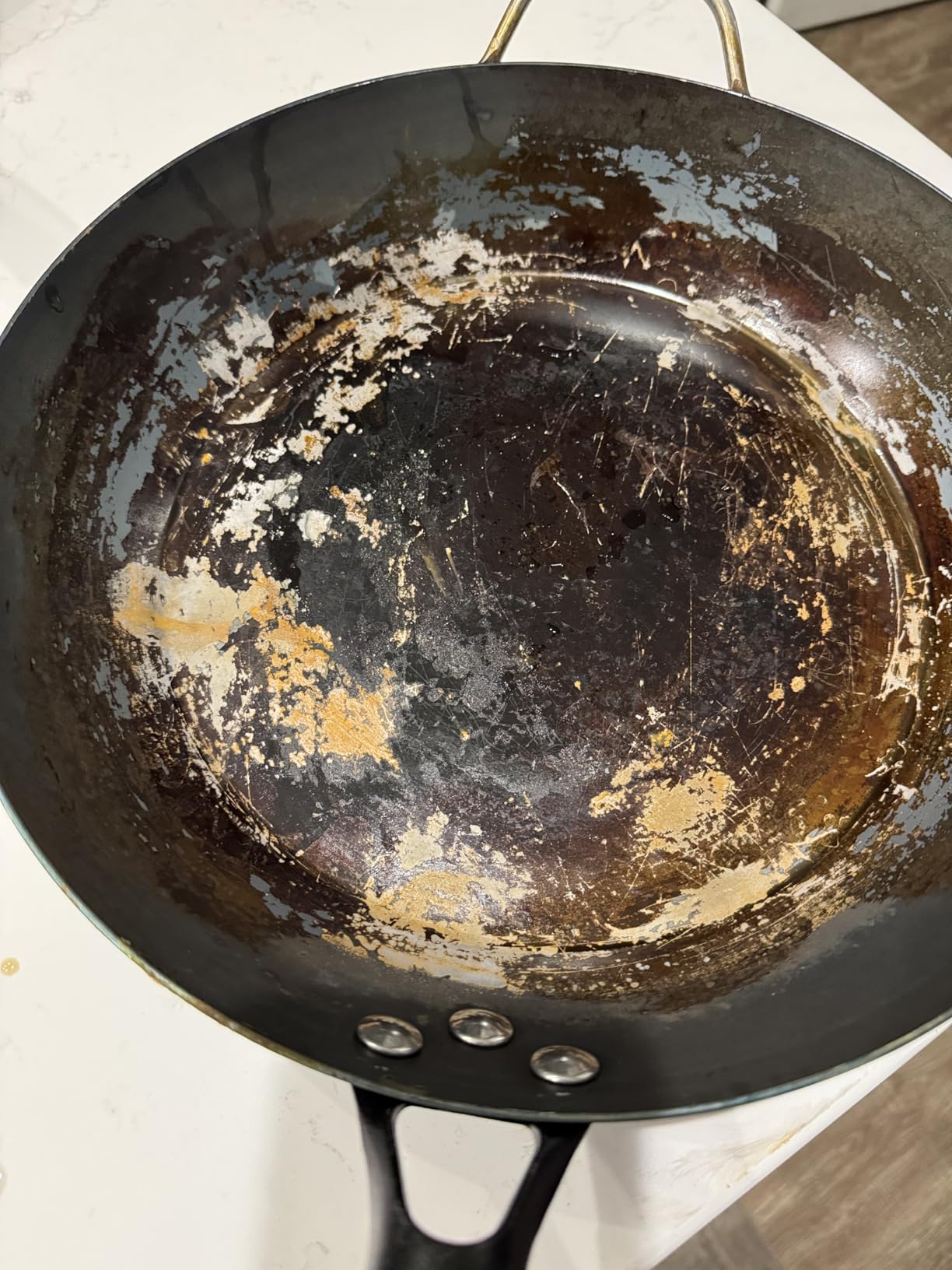
Be aware of the rating profile. It sits at 4.0 with a 12 percent one-star share, which is the weakest distribution in this group, and the small review base of 389 means there is less long-term durability data behind it than the French-made pans have.
The pattern behind the lower scores is predictable: the seasoning is less forgiving for cooks who skip the preheat. Pan dry, let it heat, then add oil and the food, and this pan performs well. Skip a step and it will punish you.
Who this pan suits?
Campers, overlanders and anyone cooking on a grill or open flame who needs a handle that stays cool. It is also a good stir-fry pan because the sloped walls move food easily.
Who this pan does not suit?
Cooks who want the strongest track record of long-term ownership, or anyone who wants a riveted steel handle they can hang over a burner without thinking about it. The one-star share points at first-use seasoning friction.
7. stackbear Nitrided 12 inch – the rust-resistant entry
12 IN Carbon Steel Frying Pan, Pre-Seasoned Nitrided Preseasoned Skillet
- Nitriding strengthens the surface and resists rust and corrosion
- Arrives preseasoned with food-grade oil and cooks immediately
- Thick steel base spreads heat evenly with fewer hot spots
- Removable silicone handle cover for oven use
- Sold in single sizes and multi-pan sets
- Some units ship without the advertised silicone handle grip
- Only 157 reviews so the least proven track record
- Shallower side walls limit sauce and stir-fry capacity
- Reported to rust relatively easily if left wet
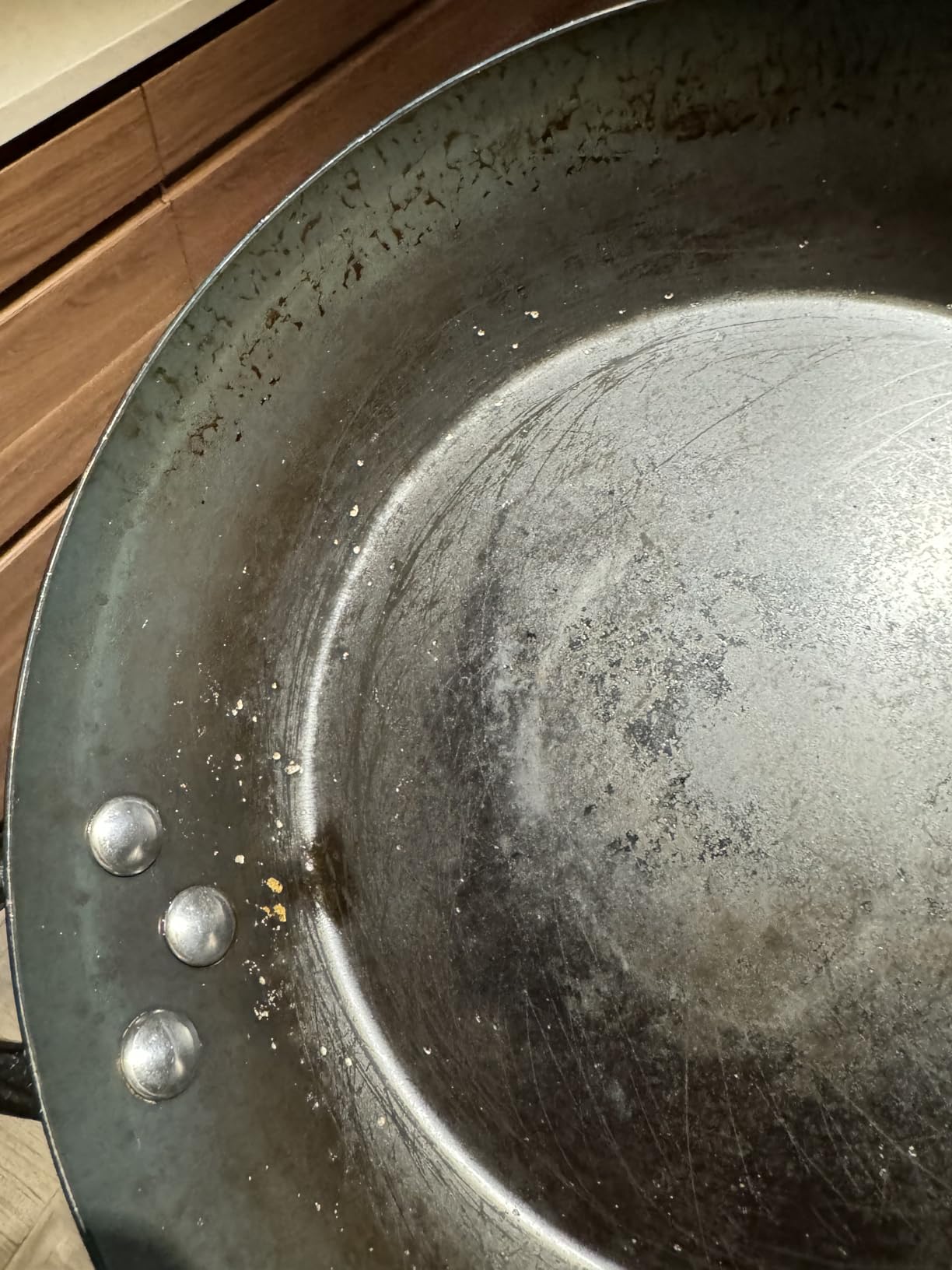
The idea here is a chemical treatment rather than a thicker pan. Nitriding infuses nitrogen into the steel surface, which hardens it and slows corrosion, and the practical effect is a carbon steel pan that tolerates a wet sink better than most of its category.
It arrives preseasoned with food-grade oil and ready to cook, and owners report eggs sliding with very little effort once the surface is hot. The thick base distributes heat evenly, which reduces hot spots under a single steak.
The defect to know about is packaging variance. Several buyers received pans without the advertised silicone handle cover, leaving a bare steel handle that gets dangerously hot on the hob, and that has driven a number of returns.
Side walls are shallower than most, so it is a searing pan rather than a sauce pan. If you want to toss vegetables with liquid in the same vessel, look at the taller options.
Who this pan suits?
Cooks who are careless with drying, who live somewhere humid, or who simply want the least rust anxiety in the category. The nitriding is a real treatment, not marketing language, and the preseasoned finish removes the first-use variable.
Who this pan does not suit?
Cooks who want deep walls for sauce work, and anyone who needs a large body of long-term reviews behind the design. The handle grip shortfall is worth checking as soon as the pan arrives.
8. Tramontina 10 inch – thick steel that skips induction
- Nitro carbonized surface becomes more nonstick with use
- Nearly 1/8 inch thick walls that resist deforming
- Superior heat retention and distribution for the size
- NSF-certified with a lifetime warranty
- Exceptional value against premium pans
- Not compatible with induction cooktops
- Low 350F oven limit from the non-heatproof handle
- Weighs about as much as a cast iron skillet so tossing is hard
- Long handle with no heatproof sleeve
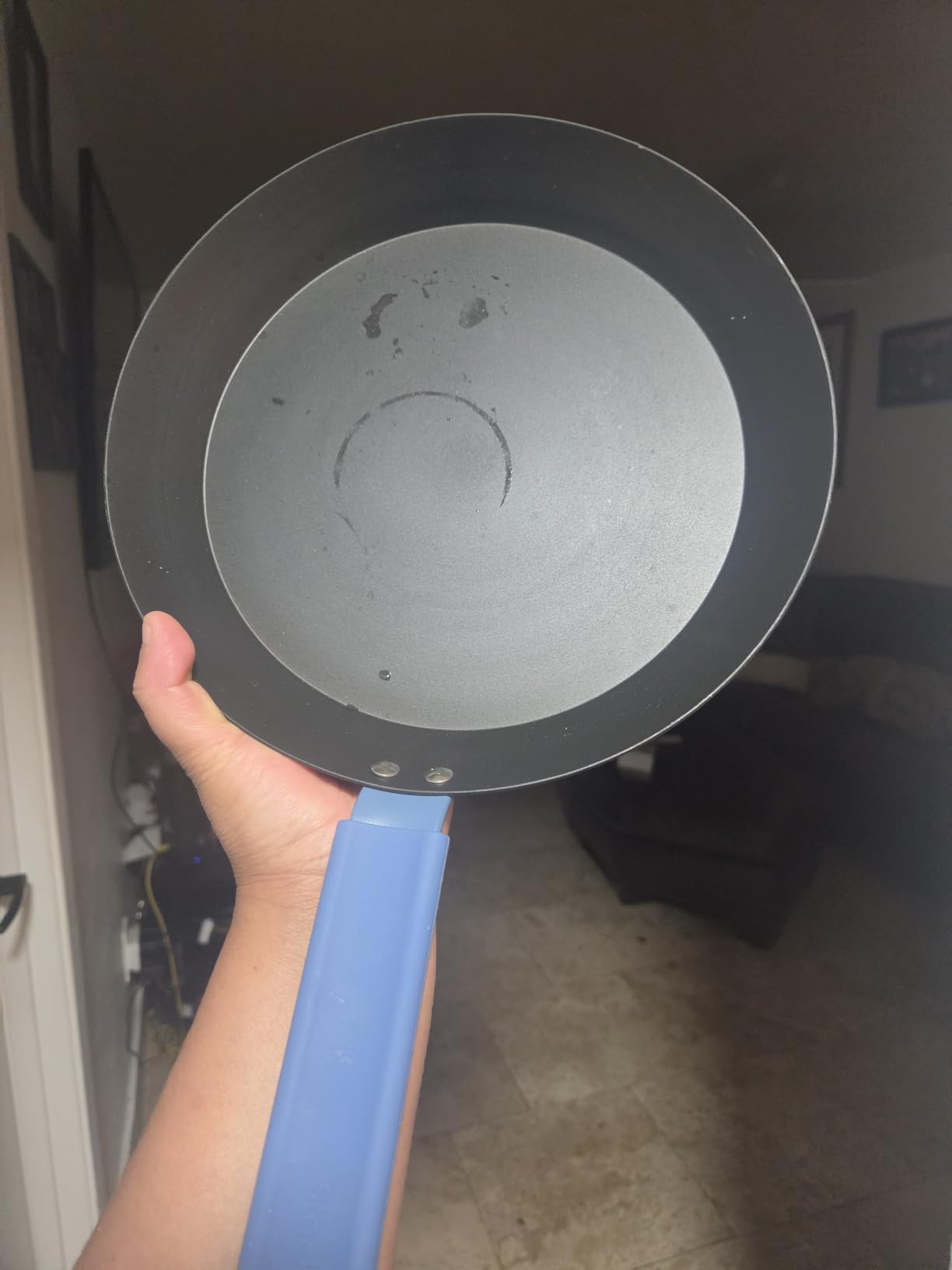
Tramontina builds this one in Brazil and certifies it NSF, and the build quality shows up in the walls. They are close to an eighth of an inch thick, which is why owners report it sears well and resists deforming over gas.
The nitro carbonizing process gives it a natural oil finish that gets slicker with use rather than flaking off. That makes it a good long-term pan if you cook fatty proteins often.
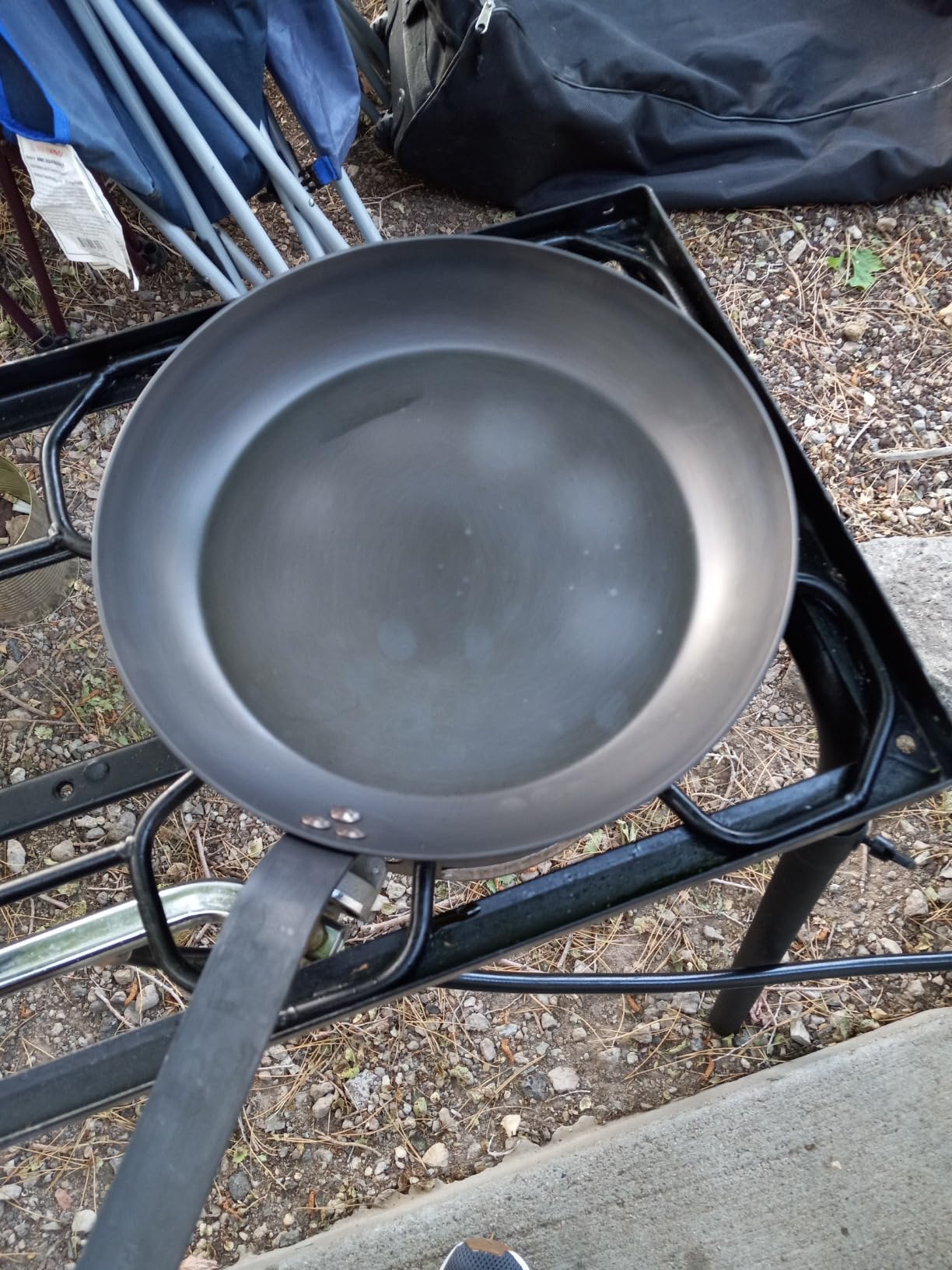
Two limitations are worth stating plainly. It is not induction compatible, which rules it out for a lot of modern kitchens, and the handle caps oven use at 350F, so an oven finish is off the table.
The handle itself is the other friction point. Reviewers call it uncomfortable and note that it lacks any heatproof sleeve, so a long stovetop session means grabbing a mitt.
Who this pan suits?
Gas and coil cooktop users who want thick, warping-resistant steel and a lifetime warranty at a fraction of the cost of the French pans. It is a strong value pick for searing on gas.
Who this pan does not suit?
Induction owners, full stop. It is also the wrong tool for reverse sear, since 350F is below almost any oven finishing temperature you would use.
9. STRATA 12.5 inch Carbon Clad – even heating in a light pan
STRATA 12.5″ Carbon Clad® Classic – Carbon Steel Frying Pan – Gen 1
- Aluminum core spreads heat evenly with no hot spots
- Light and easy to maneuver and flip
- Metal utensil safe and endlessly re-seasonable
- Oven safe to 600F for finishing dishes
- No PTFE or PFOA coatings
- Ships unseasoned so stick resistance takes 10 to 30 cooks
- Hand wash only
- Advises avoiding high heat on an empty pan to prevent warping
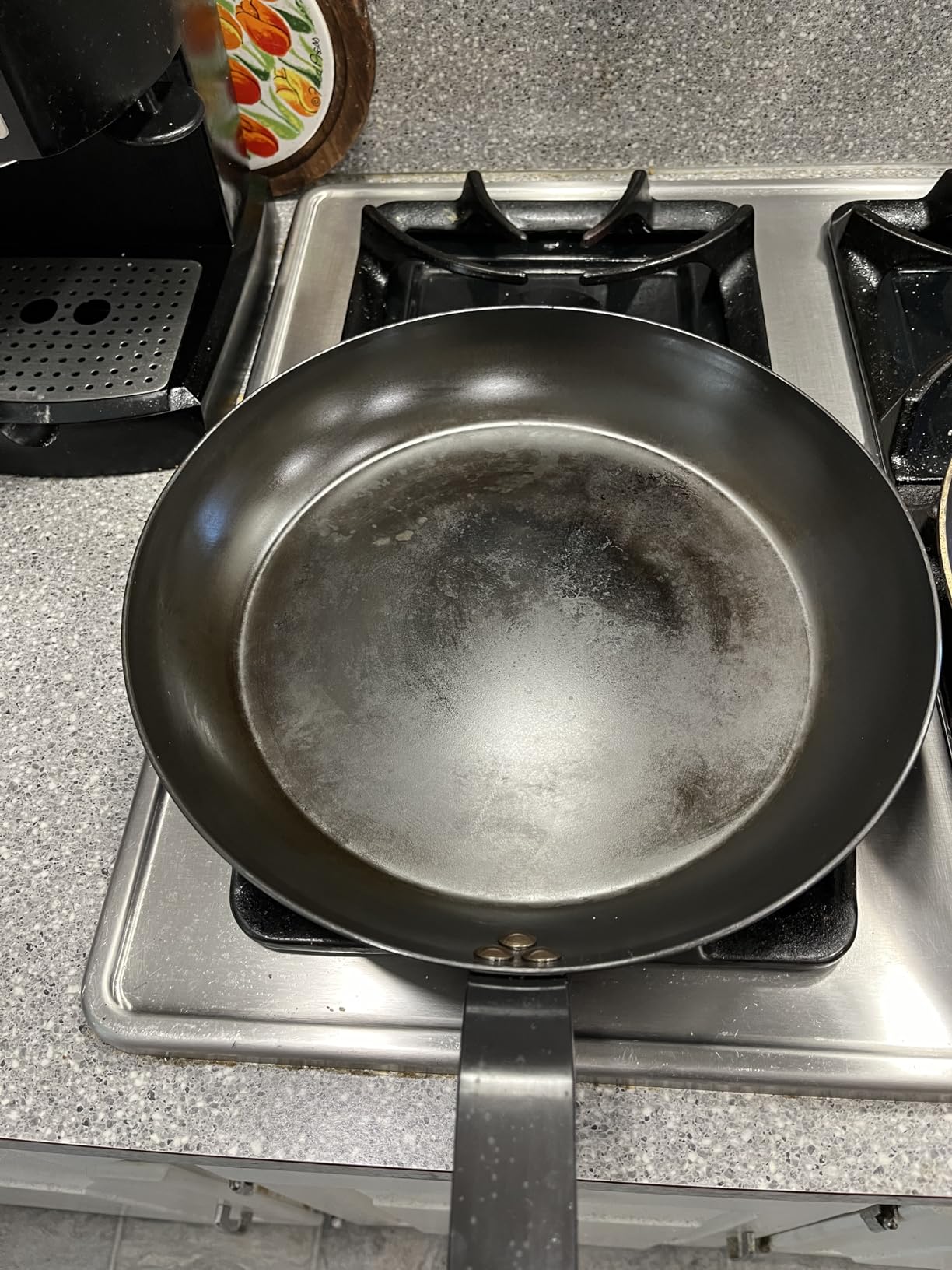
STRATA took a different approach. Rather than one thick slab of steel, it bonded carbon steel to an aluminum core in a three-ply build, so heat moves through the pan evenly instead of pooling in the middle.
That shows up as the absence of hot spots. A steak placed off-center still meets the same temperature, which is a real advantage when you are cooking several cuts in sequence and want consistency rather than a thermal brick in the center.
The catch is that it ships unseasoned. The manufacturer puts stick resistance at 10 to 30 cooks, and this pan has the smallest review base in the roundup at 87, so there is limited long-term data behind the build.
The brand also advises against blasting an empty pan at high heat, because the lighter clad construction is more prone to flex than a solid forged pan. Preheat steadily and it holds up well.
Who this pan suits?
Cooks who sear multiple cuts in sequence and care about consistency across the whole surface. It is also a good pick if you want carbon steel that still takes an oven finish at 600F without going heavy.
Who this pan does not suit?
Anyone who wants to cook tonight. Unseasoned means the first several cooks will stick, and if that is not a project you want to take on, pick a preseasoned pan instead.
10. de Buyer Blue 12.5 inch – the lightest French pan
de Buyer – Blue Carbon Steel Fry Pan 2mm Thick – 12.5” Diameter, 9.13” Cooking Surface – Oven Safe – Naturally Non-Stick Finish – Made in France
- Lighter and more responsive than cast steel for quick sears
- No artificial coating on bare steel
- Welded handle means no crevices to clean
- Easy maintenance with hot water and a brush only
- Induction compatible and oven safe
- Not preseasoned so it needs several cycles before release
- The blue finish can make seasoning take longer
- Prone to rusting quickly if left wet
- Hand wash only
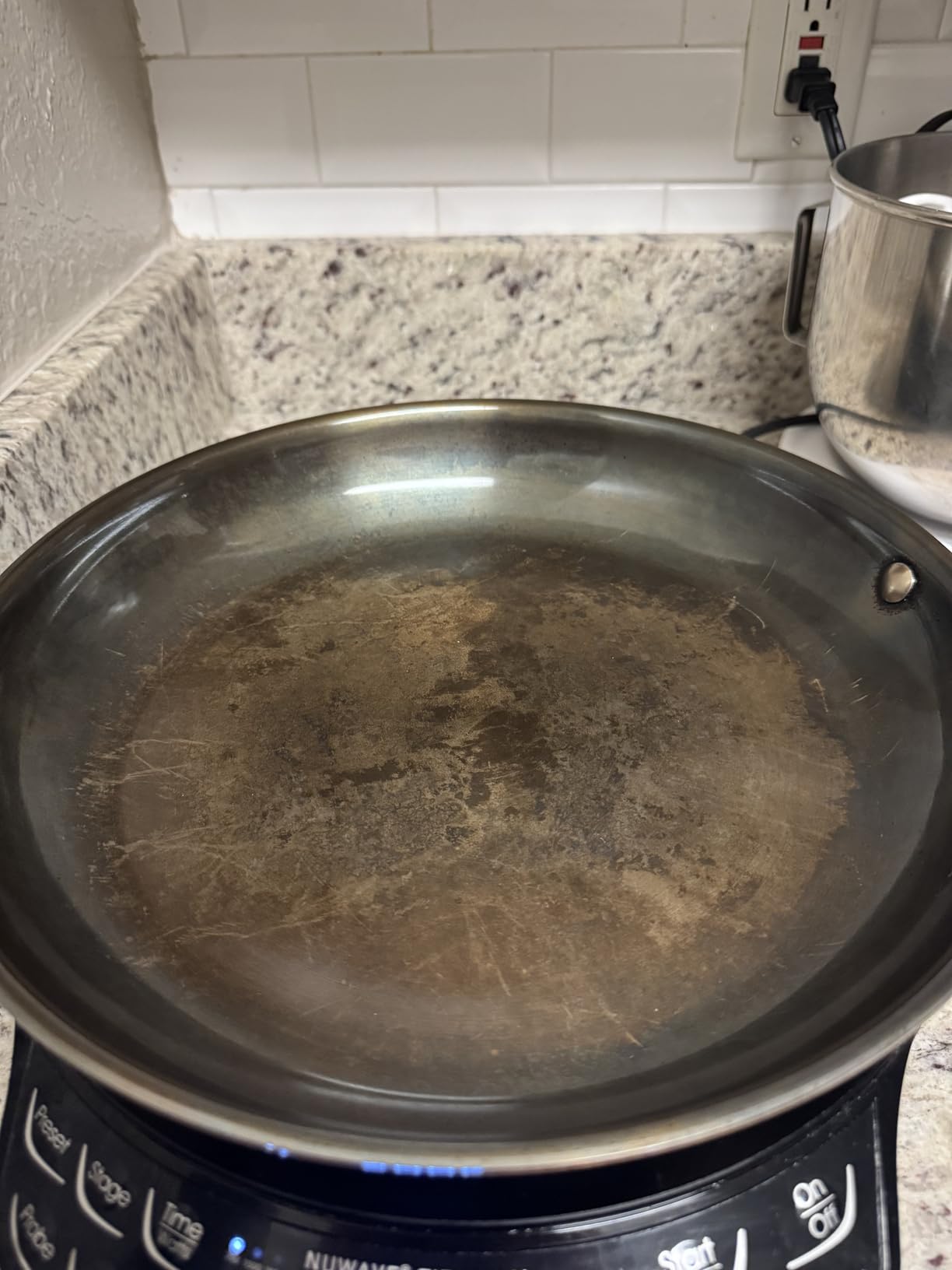
The blue finish is the distinguishing feature here. de Buyer reaches it through heat treatment, which gives initial corrosion resistance and helps seasoning grip, and it also means the pan is noticeably lighter than the Mineral B line at the same diameter.
Lighter means more responsive, and responsive means you can control the cook fast. For thin steaks, fish and a quick egg, that is the more useful behavior. Experienced cooks who own this pan tend to call it lighter than cast iron and buy it once.
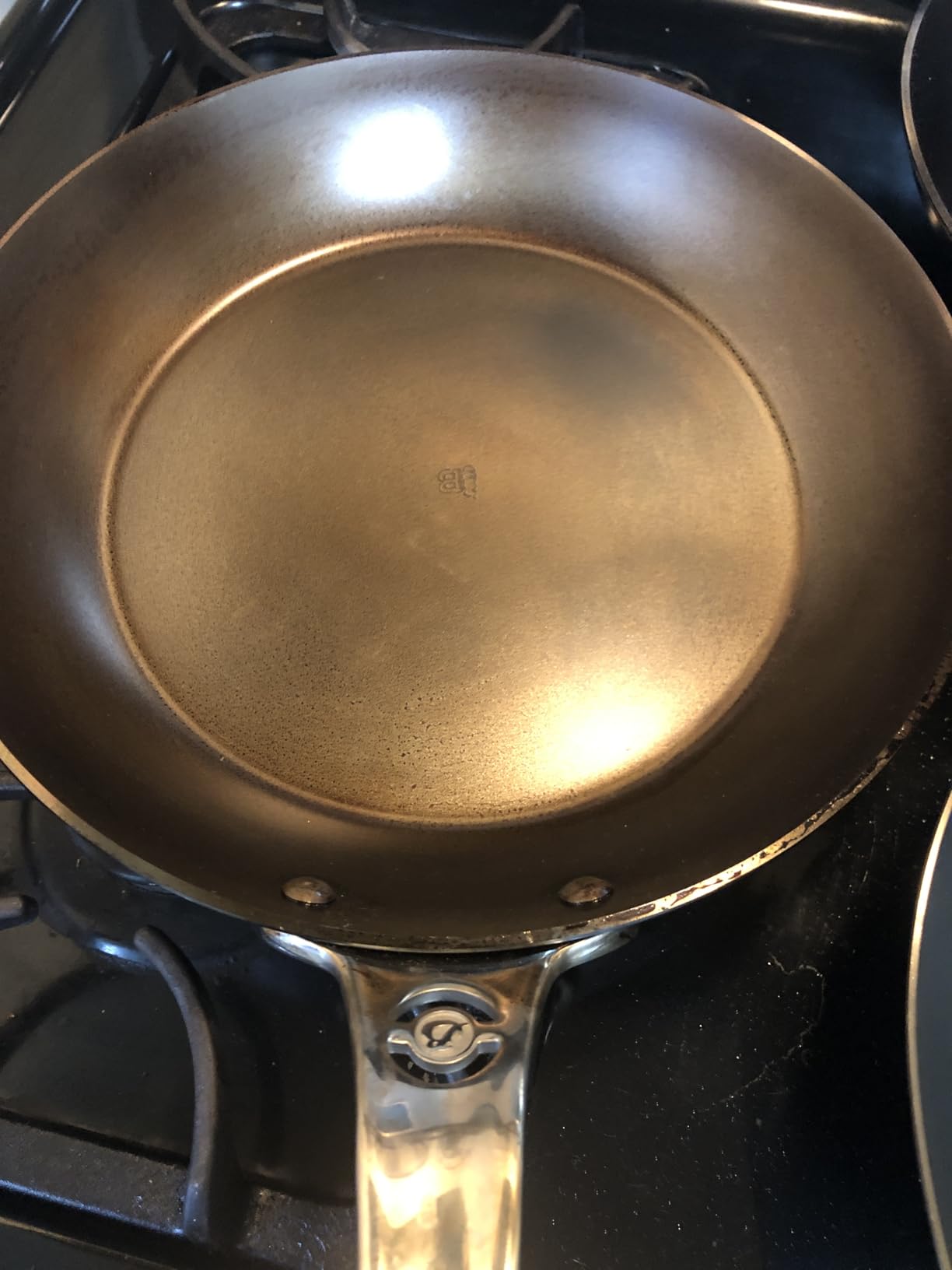
The complaint from owners is that the box instructions understate the seasoning effort. It is not preseasoned, several users report sticking during the early cooks, and any layer that does form can strip back to bare metal.
It also rusts quickly if left wet, so treat the drying step as non-optional. Maintenance is otherwise simple: hot water and a brush, no soap needed, re-oil after drying.
Who this pan suits?
Cooks who already know how to season a pan and want a responsive one. It suits pan-searing fish and thin cuts, and anyone who wants French construction without the weight.
Who this pan does not suit?
First-time carbon steel owners, and anyone who tends to leave a pan soaking. The seasoning effort and the rust sensitivity make it a poor match for a casual dishwasher-adjacent routine.
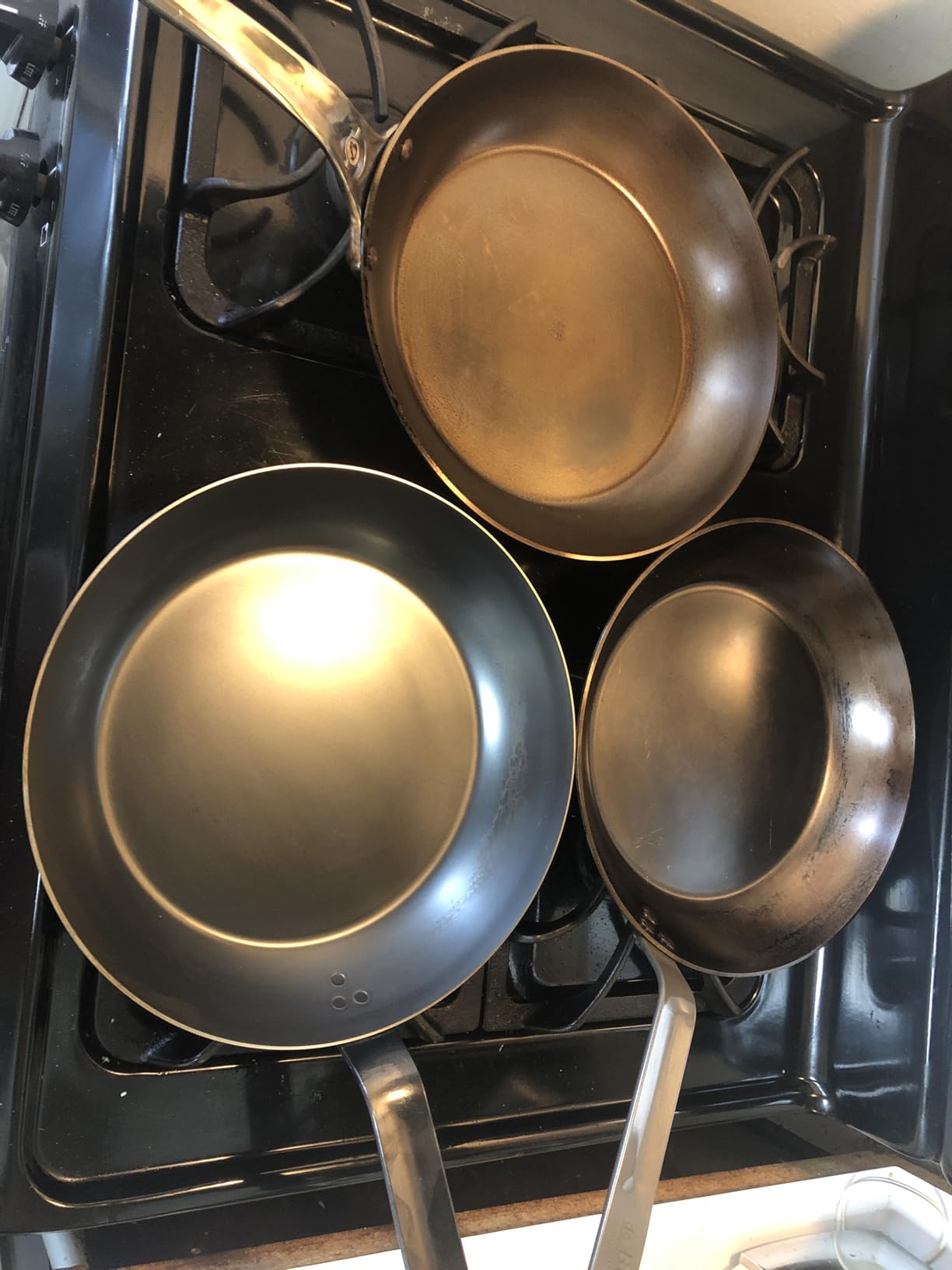
11. de Buyer Lyonnaise 12-1/2 inch – two handles and 3 mm steel
- Thick 3 mm steel gives serious heat retention
- Higher flared curved skirt slides food out cleanly
- Two riveted handles give secure control on heavy loads
- Handles searing
- grilling and oven cooking equally well
- Large 76 percent five-star share across reviews
- Nearly 6 pounds which is demanding one-handed
- Requires hand washing and regular re-seasoning
This is the heaviest pan in the roundup at roughly 6 pounds, and at 3 mm of steel that weight is a feature rather than a flaw. Nothing on the burner is going to drop its temperature because cold steak landed on it.
The lyonnaise profile has a high flared curved skirt with no sharp angles, so a seared steak slides straight out onto a board without a spatula fighting the corner. Two riveted handles, one long and one helper, give you real control when you are lifting that much steel.
Buyers rate the build very highly, with more than 3500 reviews and a 76 percent five-star share. The recurring note is durability: this is the kind of pan people describe as something they will pass down.
The only complaint worth naming is weight. One-handed maneuvering at nearly 6 pounds is a genuine effort, and if you sear frequently with a single hand on the handle you will want a lighter pan.
Who this pan suits?
Cooks searing large cuts who want maximum thermal mass and who like two hands on the pan anyway. The flared skirt also makes it a strong choice for anyone plating a seared protein straight from the pan.
Who this pan does not suit?
Anyone who wants to pan-toss or flip with one hand. At nearly 6 pounds this is a countertop pan, not a tossing pan, and it needs both hands every time you lift it.
12. Restaurantware 8 inch – the small-pan saute option
- An inexpensive entry into carbon steel cookware
- Light at 2.5 pounds for its class
- Handles high-heat searing without fuss
- Compatible with gas
- electric and induction
- Oven safe for finishing
- An 8 inch pan is small for most family searing
- The natural non-stick description refers to seasoning rather than a ready surface
- Hand wash only
An 8 inch carbon steel pan is a niche tool and this fills the niche properly. It is light at 2.5 pounds, it takes high heat, and it works on gas, electric and induction. If you are searing a single chicken breast or a fillet of fish, the small surface concentrates heat exactly where you need it.
Buyers rate it as a solid workhorse. The 58 percent five-star share reflects a pan that does its job without drama, which for a straightforward entry-level piece is what you want.
Read the natural non-stick description carefully. It refers to seasoning you build, not a surface that releases out of the box. Treat it as a bare pan and you will not be surprised in week one.
It is also simply too small for a family sear. Two people can make it work with one steak at a time, but any more than that and you are back to the 12 inch options.
Who this pan suits?
Cooks searing a single portion of fish or chicken, and anyone who wants a low-cost way to experiment with carbon steel without committing to a large pan. The light weight also makes it easy to control.
Who this pan does not suit?
Family cooks and anyone searing more than one thick cut at a time. The 8 inch diameter leaves almost no flat surface for a full-size steak.
How to Choose a Carbon Steel Pan for Searing?
Heat retention comes first, and it is the single criterion that separates a pan that sears from a pan that browns slightly. The mass of steel under the food is what keeps the surface above 400F when a cold, wet steak hits it. The de Buyer Lyonnaise at 3 mm and the MINERAL B at 2.88 kg both sit at the heavy end of this list, and that is why they head the roundup.
Heat responsiveness is the opposite trait, and it is not a defect. A responsive pan climbs and falls quickly, which is what you want for eggs, fish and thin cutlets. The YOSUKATA and the de Buyer Blue are the most responsive pans here because they are the lightest.
Steel gauge and mill thickness
Gauge is the useful number cooks can actually verify, and thicker is better for searing up to a point. Lodge uses 12 gauge in a 10 inch pan, the Lyonnaise is 3 mm, the Blue is 2 mm. Once you are past roughly 3 mm you are buying durability rather than searing performance, and the weight starts to fight you.
The Merten & Storck at the thin end of this roundup is the clearest example of why gauge matters. It sears fine on gas, and owners document warping on glass and smooth-top electric when the burner is blasted from cold.
Weight and one-handed handling
Roughly 1.5 kg is a one-hand pan. Roughly 3 kg is a two-hand pan that will hold heat through a double sear. The Tramontina at 16 ounces is light on paper but owners describe it as cast iron weight for the size, because the thin-but-dense steel adds up.
Handle type and oven rating
This is where most buyers get the wrong pan for a reverse sear. The handle rating gates the technique: Matfer at 800F and Merten & Storck at 600F support a hot oven finish, while Tramontina at 350F and the MINERAL B at 400F for ten minutes do not. A welded handle like Matfer’s also has no crevice for burnt food to lodge in.
Pre-seasoned versus bare steel
Preseasoned pans cook tonight, and bare pans reward patience. Lodge, Merten & Storck, stackbear and Tramontina ship seasoned. Matfer, the STRATA and the de Buyer Blue do not. The blue finish on the Blue pan and the nitriding on the stackbear both shorten the seasoning runway compared with a bare surface.
How to Sear in Carbon Steel Without Sticking?
Sticking is a technique problem far more often than it is a product problem. The most repeated fix in the r/carbonsteel community is the simplest one: pat your proteins dry before they go in. A wet surface creates a vapor barrier, the vapor lifts the food off the pan, and the Maillard browning never starts.
Dry the pan, then preheat
Heat the empty pan dry and high for four to five minutes until it just begins to show a faint haze. This dry-burn step, sometimes called a wok-hai, is what bakes off the last moisture and gets the steel to a searing temperature. Skipping it is the most common reason a seasoned pan suddenly sticks.
Use the oil cue, not the clock
Add a high smoke point oil such as avocado, grapeseed or flaxseed, and watch it rather than timing it. When the oil moves like it is dancing and slides toward the edges, the pan is ready. Lay the meat down away from you and do not touch it for two full minutes.
Set induction power sensibly
Induction delivers power faster than a gas burner, and thin carbon steel dishes flex under an aggressive setting. Heat a thin pan at a medium-high setting rather than boost, and expect slightly longer preheat times. Warping is the complaint that comes up most often on glass and smooth-top surfaces in this category.
Four steps after every cook
Wash with hot water and a brush, dry on the burner for a minute, wipe a very thin film of oil over the surface, and store it uncovered. That routine takes two minutes and it is what separates a carbon steel pan that lasts decades from one that rusts in a cupboard.
Frequently Asked Questions
What brand makes the best carbon steel pans?
de Buyer makes the strongest all-round carbon steel pans, and the MINERAL B 12.5 inch is our top pick for searing because of its 9 inch flat cooking surface and heavy 2.88 kg body. Matfer Bourgeat wins for oven finishing with an 800F handle rating, and Merten u0026amp; Storck wins for value with a pre-seasoned 12 inch pan that weighs half a cast iron skillet.
Which pans are best for searing?
For searing, the deciding factors are heat retention, a wide flat cooking surface and a handle that tolerates oven heat. Heavy pans such as the de Buyer MINERAL B and the Lyonnaise hold temperature through a cold steak drop, while lighter responsive pans like the de Buyer Blue suit fish and thin cutlets. Stainless steel needs more oil control, and cast iron takes longer to heat but holds more.
What are the disadvantages of carbon steel pans?
The main drawbacks are that carbon steel needs hand washing and a two-minute dry-and-oil routine after every use, that acidic ingredients such as tomato, vinegar and lemon strip the seasoning, that most pans are not dishwasher safe, and that handle temperatures are high enough to need a mitt. Thin pans can also warp on glass and smooth-top electric burners.
Which carbon steel skillet did America’s Test Kitchen recommend as the best?
Matfer Bourgeat was the historic America’s Test Kitchen pick for carbon steel and remains a strong professional choice, particularly for its welded rivetless handle rated to 800F. It has since been joined by de Buyer Mineral B and Merten u0026amp; Storck as widely recommended options, with the Matfer holding its place for oven-finished steaks.
Are carbon steel pans really the best?
Carbon steel is the best balance of the three big pan materials for searing. It heats faster than cast iron so you waste less energy preheating, it tolerates high heat better than stainless, and it is lighter to maneuver while still seasoning into a natural release surface. Cast iron wins on raw heat retention and stainless wins on out-of-the-box convenience with no seasoning required.
Which grade carbon steel is best?
There are no meaningful carbon steel grades to compare the way there are stainless or aluminum grades. What matters is gauge and mill thickness. For searing, roughly 2 mm to 3 mm of solid steel is the sweet spot: thick enough to hold temperature under a cold steak, light enough to still maneuver. Lodge uses 12 gauge in its 10 inch pan and de Buyer uses 2 mm to 3 mm depending on the line.
The Best Carbon Steel Pans for Searing in 2026
The de Buyer MINERAL B 12.5 inch takes our top slot because the 9 inch flat surface and 2.88 kg of steel do the one job a searing pan exists to do. If you need the oven step, take the Matfer Bourgeat with its 800F handle. If you want to cook tonight and stay under two pounds, take the Merten & Storck 12 inch.
Whichever you choose, the pan is half the result. Dry the pan, let it get properly hot, add oil until it moves like it is dancing, and leave the steak alone for two minutes. That routine works every bit as well as any of these twelve pans. For the heat source instead of the pan, our charcoal grill roundup and kamado grill guide go deeper on live fire.