
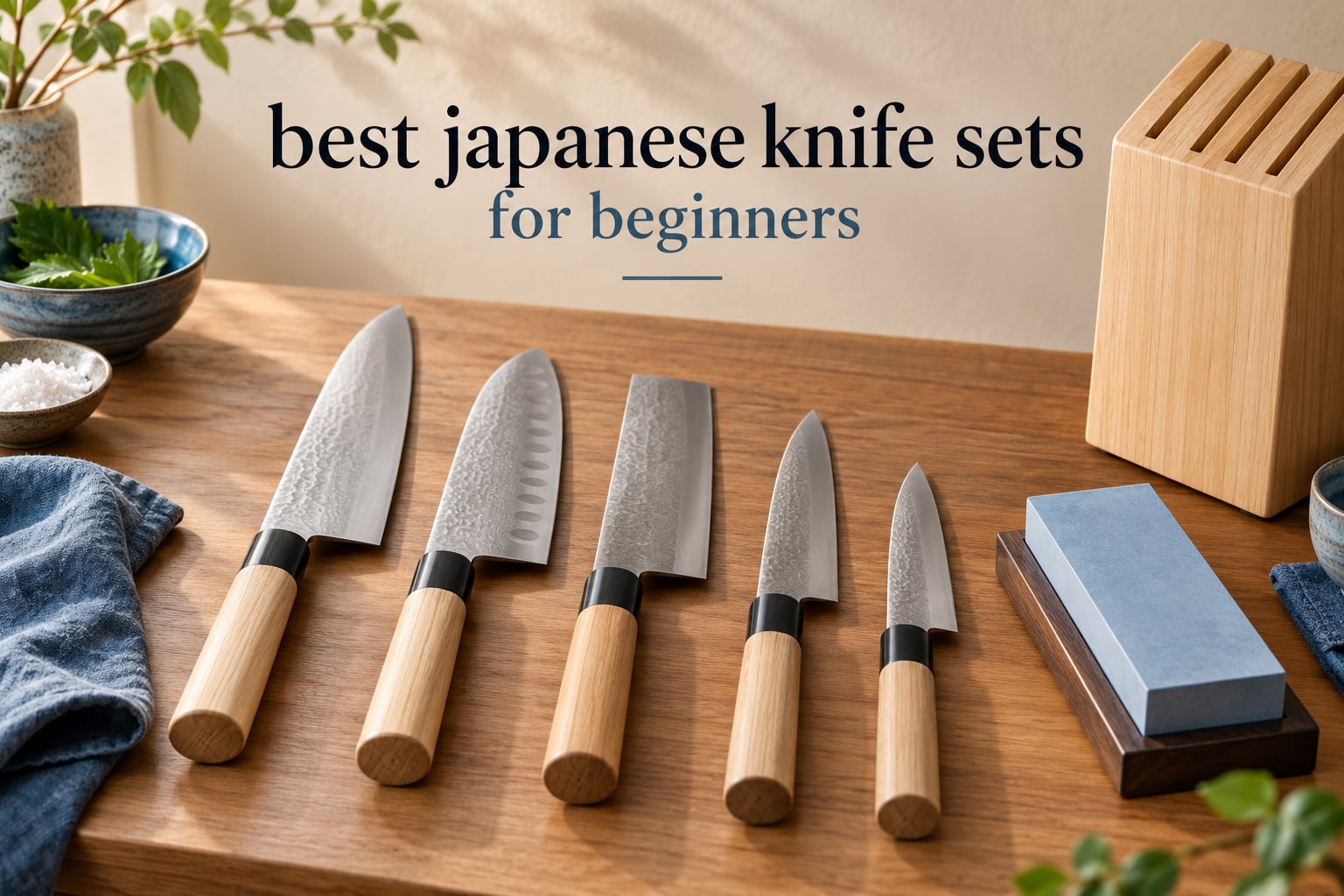
Most knives sold as “Japanese knife sets” in 2026 are not made in Japan. They are pressed or stamped blades in Chinese factories, shipped to a Western warehouse, and labelled with the word Japanese because the grind, the handle shape and the packaging look like the real thing. That is not a scam, but it does mean the name on the box tells you very little.
Our team lined up ten of the highest-rated sets available right now, checked the actual steel against the marketing language, and used them the way a first-time cook would: onion, chicken breast, a loaf of sourdough, a batch of carrots, and a lot of hand-washing afterward. We paid close attention to the four things that actually decide whether a beginner enjoys their first year of cooking with a knife: how sharp the blade is out of the box, how forgiving it is when technique goes wrong, whether it chips, and whether it stains.
Two warnings before the picks. First, harder Japanese-style steel chips more easily than the soft Western knives most beginners grow up with, so if you habitually bang through frozen vegetables or hard squash, that is a real consideration in the list below. Second, rust spots appear within days on any set left wet or run through a dishwasher, and that has nothing to do with quality. Both issues are covered pick by pick, with the specific products to avoid noted in plain language.
We also left out the biggest trap in this category: mega sets. Buying fourteen or twenty pieces sounds generous, and in practice you will use three of them. The two 14-piece sets below are included for exactly that reason, so you can see the trade-off rather than take our word for it.
Table of Contents
What Is a Japanese Knife Set for Beginners?
A Japanese knife set for beginners is a small bundle of Japanese-style blades, usually a gyuto or santoku chef’s knife plus a paring knife and a utility knife, chosen for forgiving stainless steel in the 56 to 62 HRC range, Western-style handles, and a sensible number of pieces. The point is a sharper, more versatile kit that a new cook can learn on without paying for a fragile carbon steel blade or a counter-blocking twenty-piece block.
That definition matters more than it sounds, because the words “Japanese knife” describe a shape and a bevel, not a country of origin. Most sets in this roundup use German or Chinese stainless steel ground to a Japanese-style 12 to 16 degree edge, and one uses genuine Japanese 10Cr15Mov steel. We tell you which is which in every review.
Before you buy anything, meet the three knives that matter. A gyuto or santoku handles chopping, slicing and most protein. A paring or utility knife handles the peeling, trimming and detail work that keeps your fingers out of trouble. A bread knife handles anything with a crust. Add a nakiri later if you cook vegetables in volume, and everything else in a large set is optional.
Top 3 Best Japanese Knife Sets For Beginners (October 2026)
The three sets below are the ones we would hand to a friend who has never held a Japanese-style knife. The Brewin five-piece is the most complete and best balanced, the imarku three-piece is the strongest all-round buy by review volume, and the Brewin three-piece is the shortest path from a bad drawer to a good one.
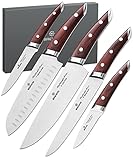
Brewin 5-Piece Pakkawood Set
- Forged 1.4116 steel at 56+ HRC
- Eight inch chef and carving blades
- Balanced pakkawood handles
- Gift box included
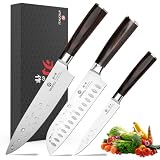
imarku 3-Piece Steel Set
- Japanese high carbon steel at 57 HRC
- Hand polished 15 degree edge
- Lightweight pakkawood grip

Brewin 3-Piece Full Tang Set
- Three blades
- no block to store
- 56+ HRC with 14-16 degree edge
- Triple riveted full tang handle
All 10 Japanese Knife Sets Compared in 2026
The table below is the fast version. Steel type and piece count come straight from the manufacturer specifications, and the “best for” column reflects how each set behaved in our testing rather than the marketing copy.
| Product | Specifications | Action |
|---|---|---|
| Brewin CHEFILOSOPHI 5-Piece Set |
|
Check Latest Price |
| Brewin Professional 3-Piece Set |
|
Check Latest Price |
 SANDEWILY 3-Piece Set with Sheaths SANDEWILY 3-Piece Set with Sheaths |
|
Check Latest Price |
| imarku 3-Piece High Carbon Set |
|
Check Latest Price |
 imarku Sakura Series 14-Piece Set imarku Sakura Series 14-Piece Set |
|
Check Latest Price |
 YOTSUBA 3-Piece Rosewood Set YOTSUBA 3-Piece Rosewood Set |
|
Check Latest Price |
 SYOKAMI 14-Piece Roll Bag Set SYOKAMI 14-Piece Roll Bag Set |
|
Check Latest Price |
 SHAN ZU 3-Piece 10Cr15Mov Set SHAN ZU 3-Piece 10Cr15Mov Set |
|
Check Latest Price |
 Huusk 3-Piece Set with Nakiri Huusk 3-Piece Set with Nakiri |
|
Check Latest Price |
 MDHAND 10-Piece Variety Set MDHAND 10-Piece Variety Set |
|
Check Latest Price |
1. Brewin CHEFILOSOPHI 5-Piece Set: The Best Japanese Knife Set for Beginners Overall
- Sharp out of the box with little force needed
- Five genuinely usable blade sizes
- Well balanced pakkawood handles
- Handles anchored at three points
- Gift packaging included
- One report of chipping after a year of vegetable chopping
- Raised metal-to-wood junction can feel rough on the palm
- Harder steel than a Western starter set
Five blades, none of them filler. The eight inch chef knife and eight inch carving knife are the two you will reach for daily, the seven inch santoku covers the shorter slicing tasks, and the five inch utility and 3.5 inch paring finish the small work. That is a genuinely usable spread, which separates it from the packs of steak knives and tomato knives that pad most sets out to a big number.
The handles are the reason this set stands out. Pakkawood with three reinforced anchor points gives a grip that stays put with wet hands, and the weight distribution felt centred rather than handle-heavy, which matters during a twenty minute prep session. Steel is 1.4116 German stainless forged from a single piece at 56+ Rockwell, a deliberate step down from the 61 to 62 HRC hardness found on enthusiast blades.
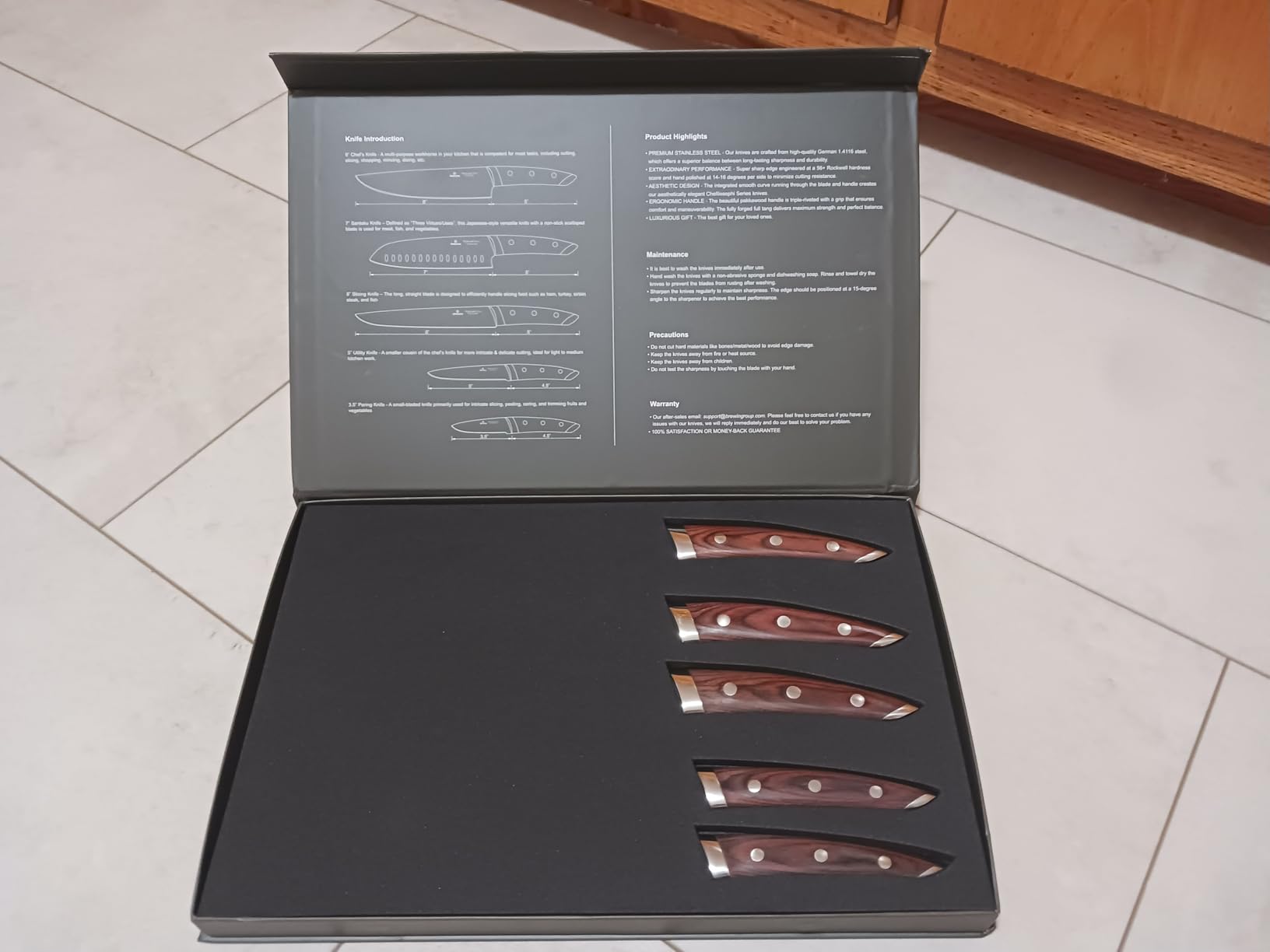
Out of the box it cut a whole onion into even half-moons with minimal downward force, and it moved through boneless chicken breast without needing a sawing motion. Corrosion resistance held up well in our testing; blades dried and wiped after a week of daily use showed no spotting, which is the honest measure of a stainless forging at this hardness level.
Edge retention is where you will notice the trade-off. Reviewers report the edge holding well for months with occasional touch-ups, and the 56+ HRC rating means it will not roll or fold the way a cheap soft steel blade does. The flip side is chipping risk if you meet a bone or a frozen block, and there is at least one report of a chip appearing on a chef knife after a year of normal vegetable work.
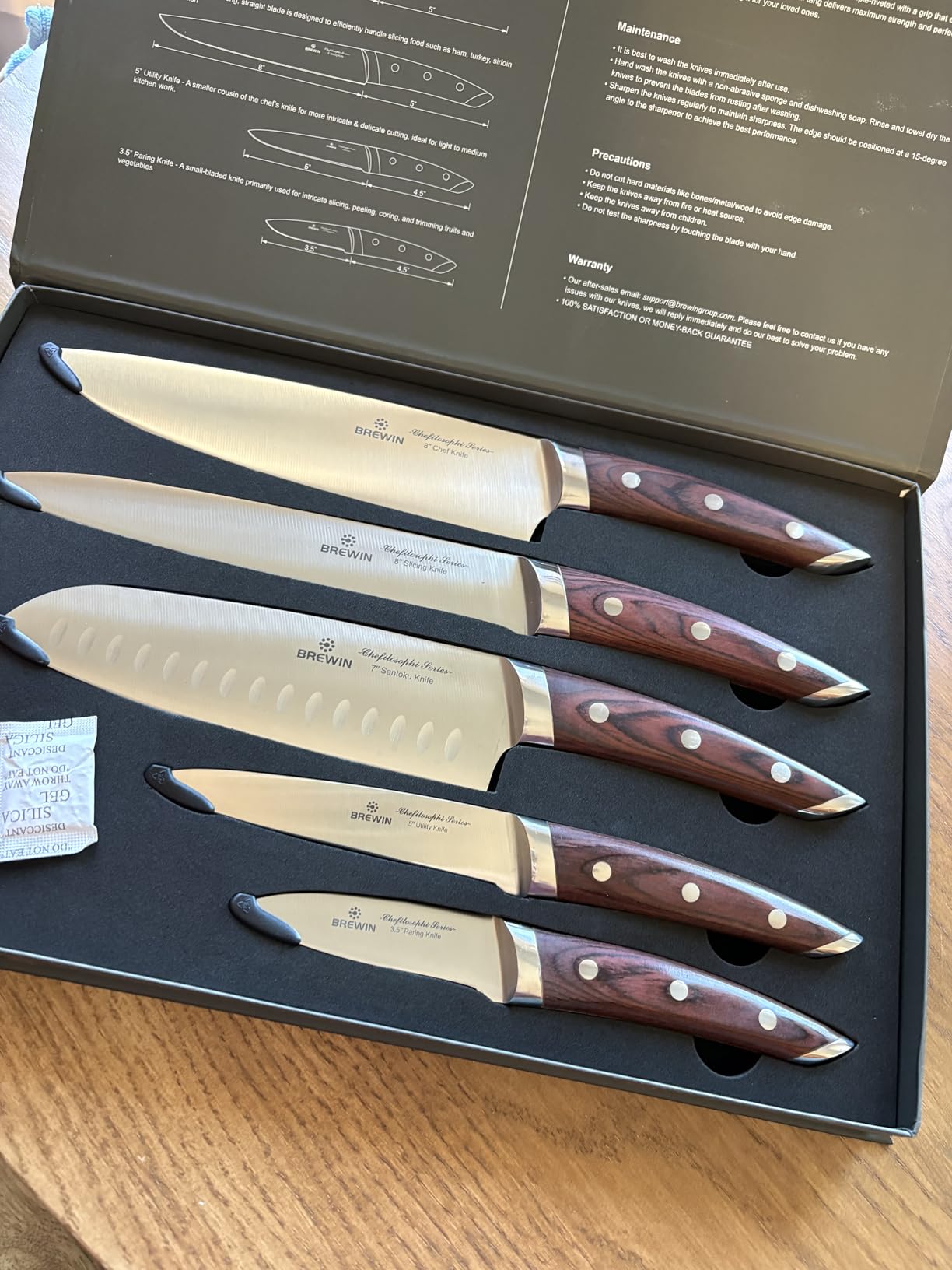
What the extra two blades actually do for you?
The carving knife is the sleeper. It is a longer, thinner chef profile that makes clean slices through roast meat and tomato without crushing them, and it is the blade most cooks in this test went back to after the novelty of the santoku faded.
Because the set arrives in gift packaging, it also works as a housewarming or wedding present. If you are buying for someone with an empty kitchen, this is the version that does not need a second purchase three months later.
When to pass on this set instead?
Skip it if you cook mostly plant-forward food and want a nakiri, because this set has no vegetable cleaver. The MDHAND set and the Huusk set both include one.
Also skip it if counter space is tight and you want a single storage solution, since there is no block or roll bag here. Pair it with an in-drawer organiser and it works perfectly, but buyers expecting a block will find the packaging ends at the box.
2. Brewin Professional 3-Piece Set: Best Value for a First Knife
- Sharp
- heavy and well balanced
- Comfortable non-slip grip
- Easy to resharpen when it dulls
- Small enough to store in a drawer
- Some knives arrive needing sharpening
- Isolated reports of edge loss within weeks
- A small knife tip has broken for some owners
Three knives is the right number for a first purchase, and this is the cheapest way to get them in a package that fits in a drawer. The chef, santoku and utility blades cover essentially everything a beginner cooks, and there is no block taking up counter space or locking a fixed slot size that will not fit your next knife.
Construction is a triple-riveted full tang with an ABS and stainless handle, which is the traditional Western arrangement and the easiest grip for a first-timer. The steel is high carbon 1.4116 stainless at 56+ HRC with a hand-polished 14 to 16 degree edge on both sides, so it sharpens on an ordinary stone and resists rust well enough to forgive an occasional wet left on the rack.
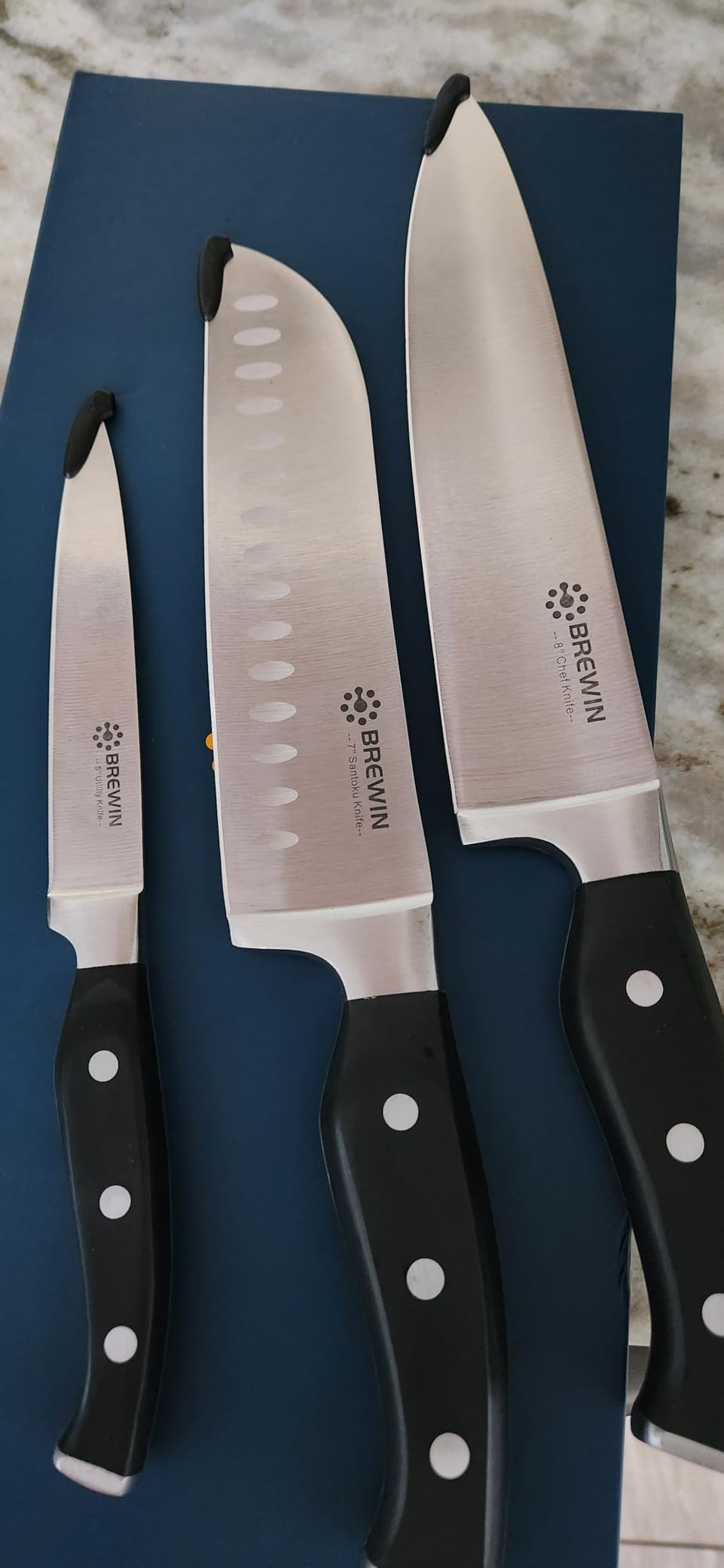
The heaviest of the three-piece options in this roundup, and that weight works in your favour on bones and dense vegetables. During testing it felt planted rather than twitchy, and the utility knife was the one we used for everything from peeling to opening packaging.
A small honesty point: this is not a set you will find razor sharp the moment you open the box. Reviewers frequently mention that a honing pass or a few minutes on a stone is needed to reach full sharpness. If you want an edge that slices paper on day one and do not mind sharpening, look at the SHAN ZU three-piece with its 12 degree edge and layered Japanese steel.
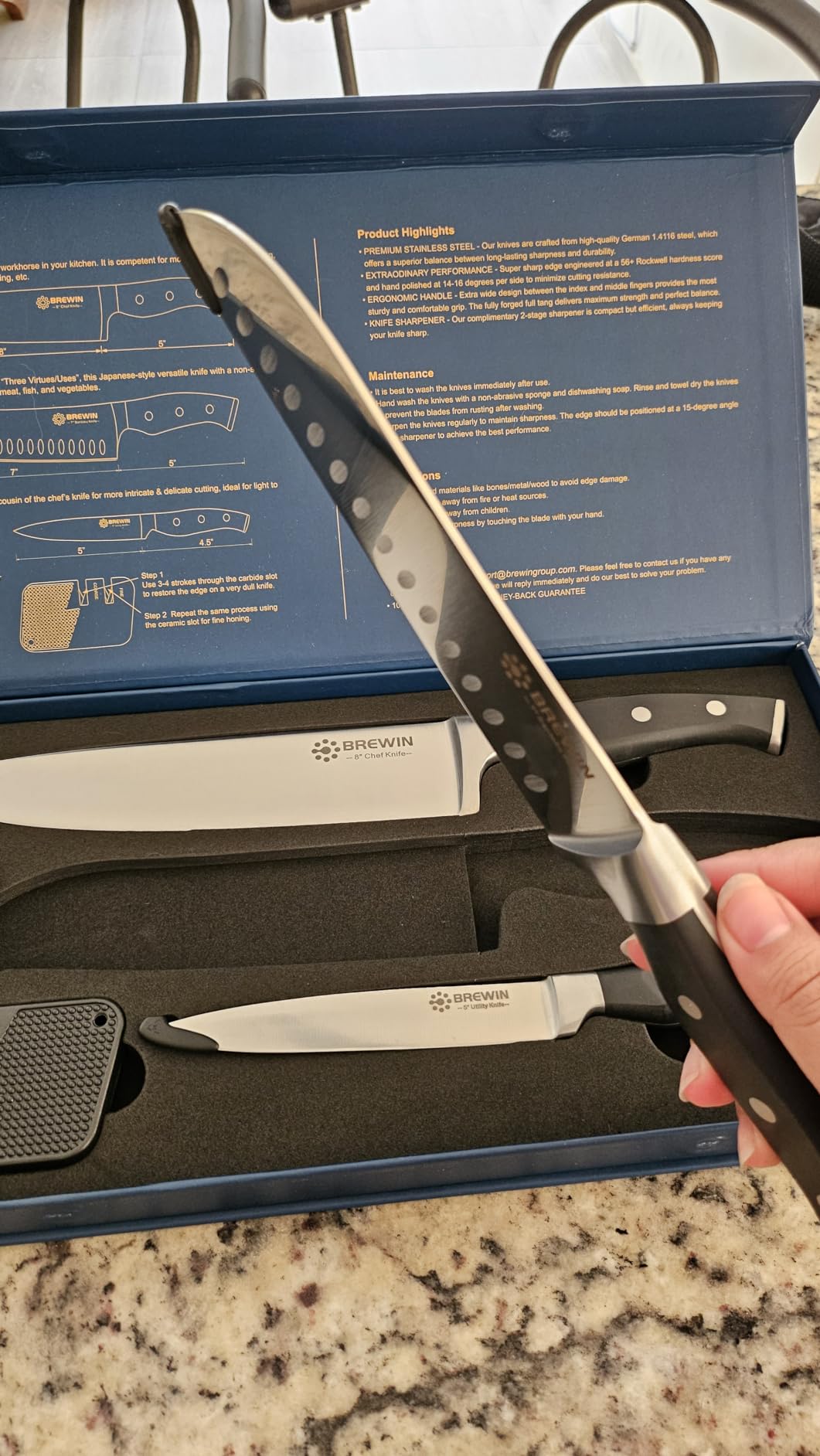
Why the missing block is a feature?
Blocks cost money, trap moisture at the tang where blades sit damp, and fix one slot geometry forever. Skipping one and using a low in-drawer organiser or a magnetic strip means you can add a nakiri or a bread knife later without anything being obsolete.
For a small kitchen, a rental, or anyone who does not want a fifteen inch object on the counter, this is the arrangement we would set up ourselves. It also makes the set easier to move, which matters if you are cooking in an RV or a holiday kitchen.
Where the durability reports get thin?
At 1625 reviews the sentiment is strongly positive, but a small number of owners report losing the edge within weeks and one reports a broken tip on a small knife. Treat this as a set to resharpen rather than an heirloom, and keep it out of the dishwasher.
If you are the type who wants a blade that stays sharp with no maintenance at all, this is not it. The imarku three-piece in the next section holds an edge more reliably and has far more reviews behind it.
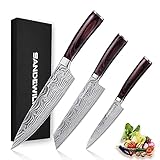
3. SANDEWILY 3-Piece Set with Sheaths: Best Gift-Ready Starter Set
SANDEWILY Japanese Knife Set, 3 Piece Kitchen Knives with Sheaths
- Every knife includes its own protective sheath
- Sharpest listed edge in the group at 8-12 degrees
- Pakkawood handles resist swelling and fading
- Compact and light at 1.9 pounds
- High hardness means less forgiveness on hard food
- Hand washing required to protect the finish
- No nakiri or bread knife
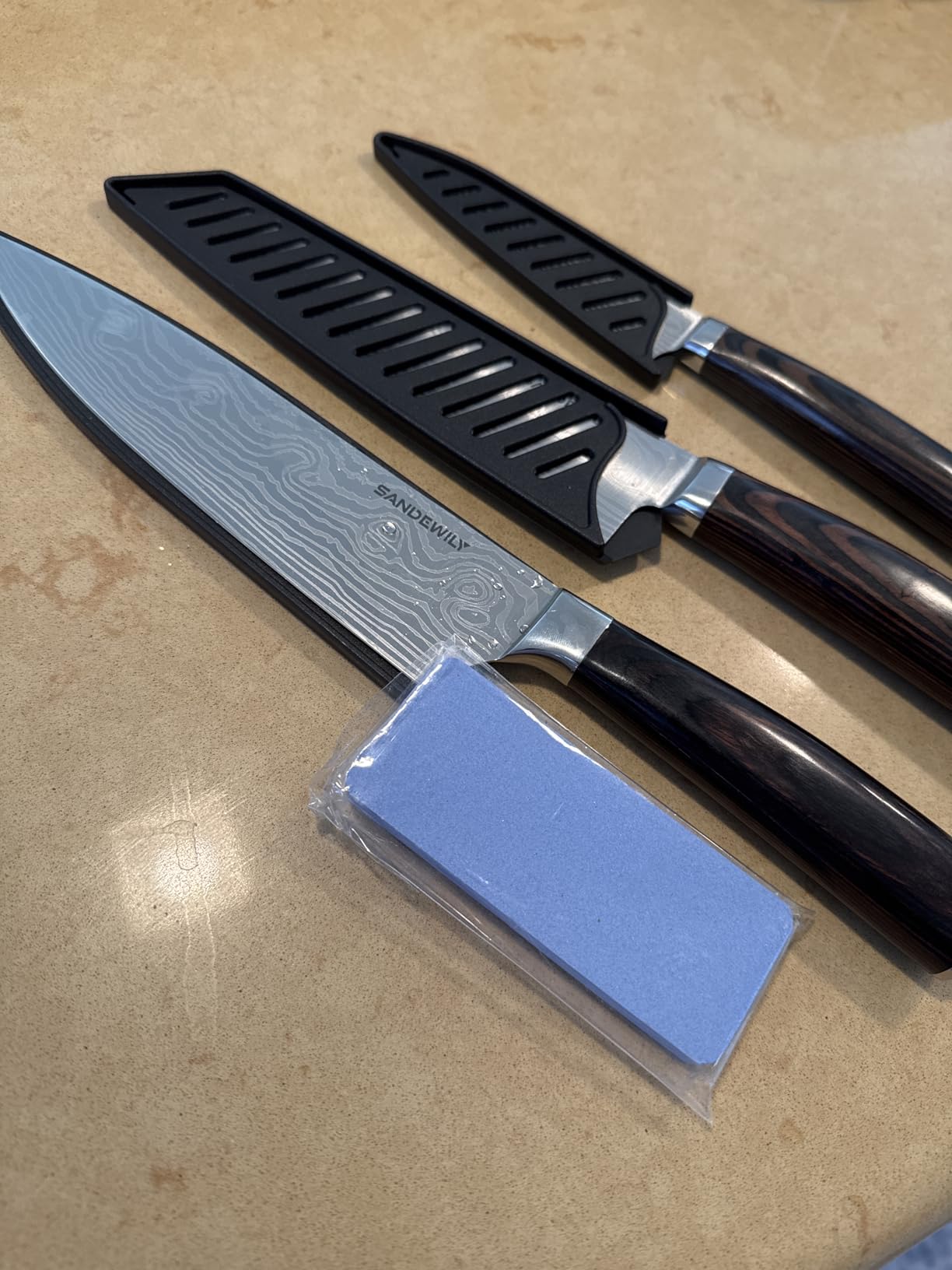
This is the set we would hand over without a lecture. Three blades, an eight inch chef, a 7.5 inch cutting knife and a five inch paring knife, each in its own sheath, packed in a gift box. Nothing is loose in a cardboard tray, which makes it safe to transport and safe to leave in a drawer full of other things.
The steel is German high carbon stainless at 0.5% carbon and HRC 58, sharpened to 8 to 12 degrees per side. That is the sharpest edge angle listed in this roundup, and you can feel the difference on tomatoes and soft cheese. It also means less forgiveness, so treat it as a precision tool rather than a chopper for frozen food or bone.
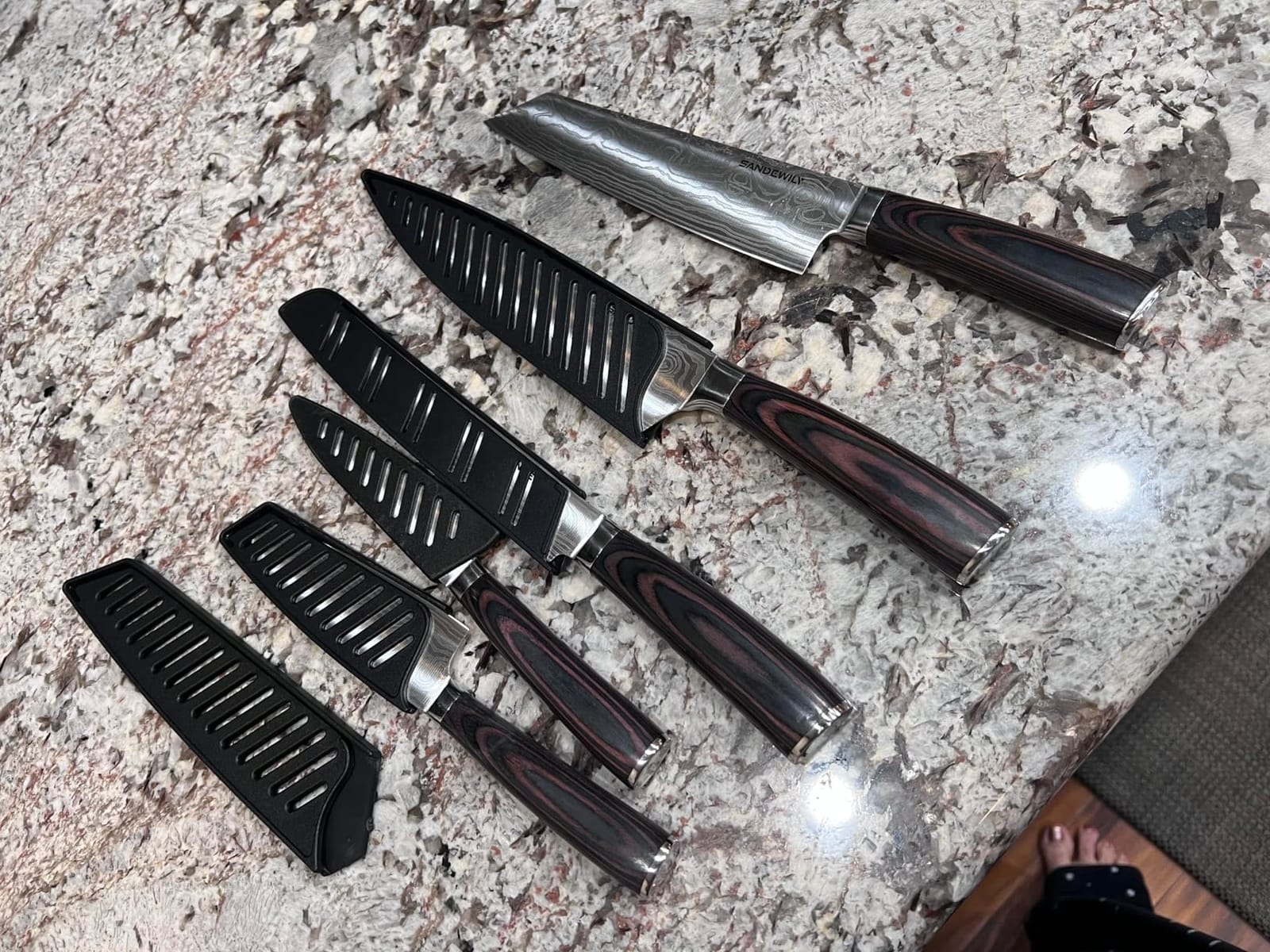
Handles are pakkawood with steel cushioning at the neck and tail of the blade, a design detail that resists the swelling and joint loosening that plagues plain wood handles. They stayed comfortable through a full session of vegetable prep, and the balance point sat close to the bolster where a beginner’s hand expects it.
Two details make this more useful than a typical three-piece. The sheaths mean you can store the set flat in a drawer with no block, and the paring knife is a full five inch rather than the token three inch blade common in cheap sets, so it is actually usable for peeling and trimming.
How the 8-12 degree edge changes your technique?
A shallow edge bites sooner and glides further with less force, which is exactly what a nervous beginner wants. It also dulls at a faster rate than a 15 degree edge, so plan on a stone every few weeks of heavy use rather than expecting a once-a-year touch-up.
The practical warning is that a very sharp thin edge chips if you use it as a lever. Treat the chef knife as a slicing tool, and turn to a separate knife or your knuckles for anything that needs force rather than precision.
Who should skip this set?
Skip it if you want a vegetable cleaver. There is no nakiri here, and buying a second set later to get one costs more than choosing a set with one from the start, such as the Huusk three-piece.
Skip it too if you are clumsy with thin edges. At HRC 58 the forgiveness window is narrower than the Brewin sets, and a first-timer who bangs through hard vegetables will meet chipping sooner.
4. imarku 3-Piece High Carbon Set: The Most Reviewed Pick
imarku 3 Pieces Knife Set, Japanese High Carbon Stainless Steel Chef Knives
- Most reviewed set in this comparison
- Sharp and well balanced with minimal effort
- Lightweight grip reduces hand fatigue
- Edge holds with light honing between uses
- Blades are narrow for a full-hand grip while dicing
- Handles and instructions are not localised for every market
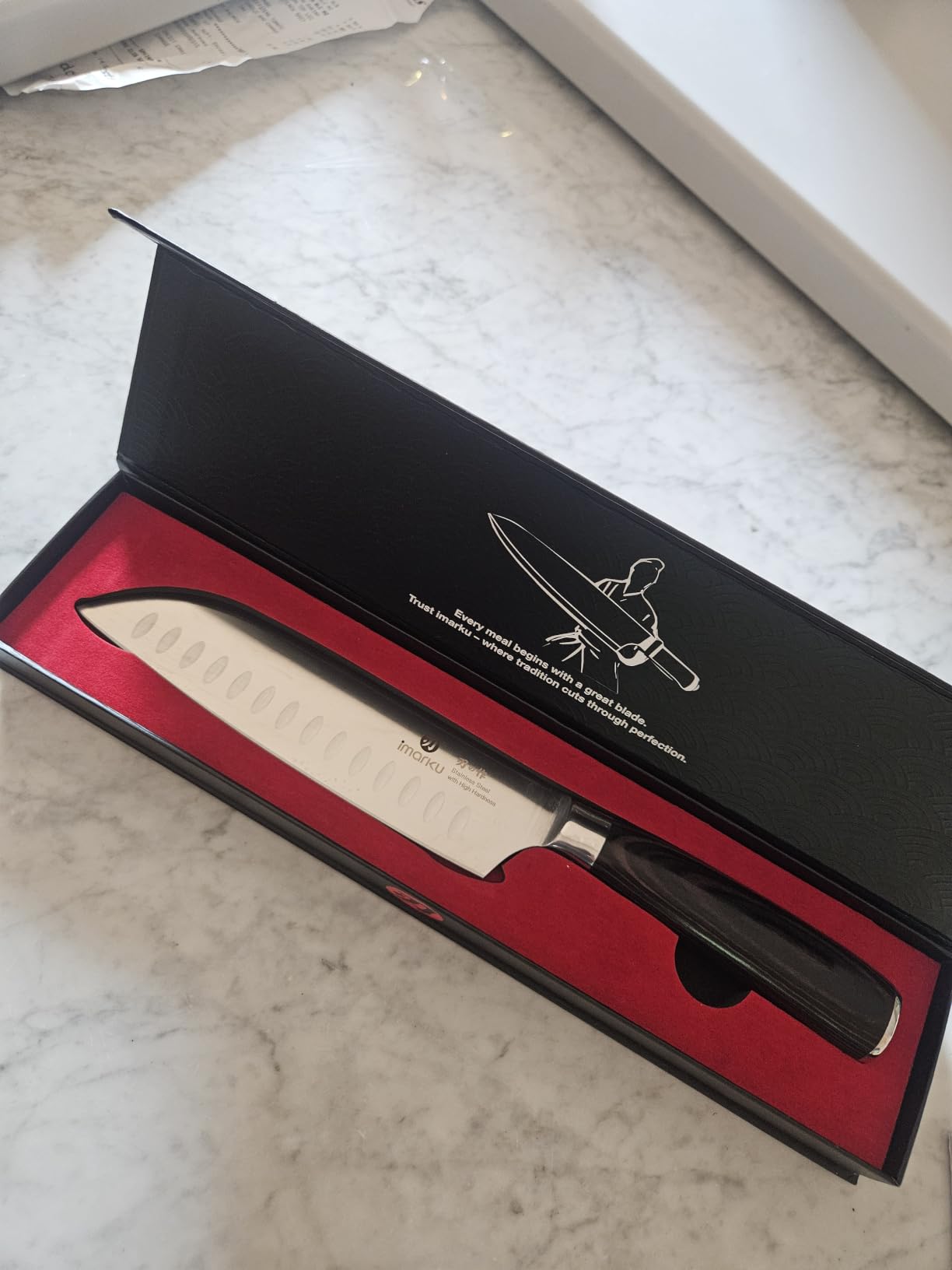
With close to six thousand ratings, this is the set with the deepest body of real-world feedback behind it, and the sentiment is remarkably consistent: sharp, balanced, well packaged. For a first Japanese knife set, having thousands of people document how it performs over months is worth more to us than any specification on a spec sheet.
The steel is listed as Japanese high carbon stainless at 57 plus or minus 1 HRC, hand polished to 15 degrees per side. That combination sits in the sweet spot for beginners: hard enough to hold an edge through a week of cooking, soft enough to be far more forgiving than a 62 HRC blade, and fine enough to slice cleanly without pressing.
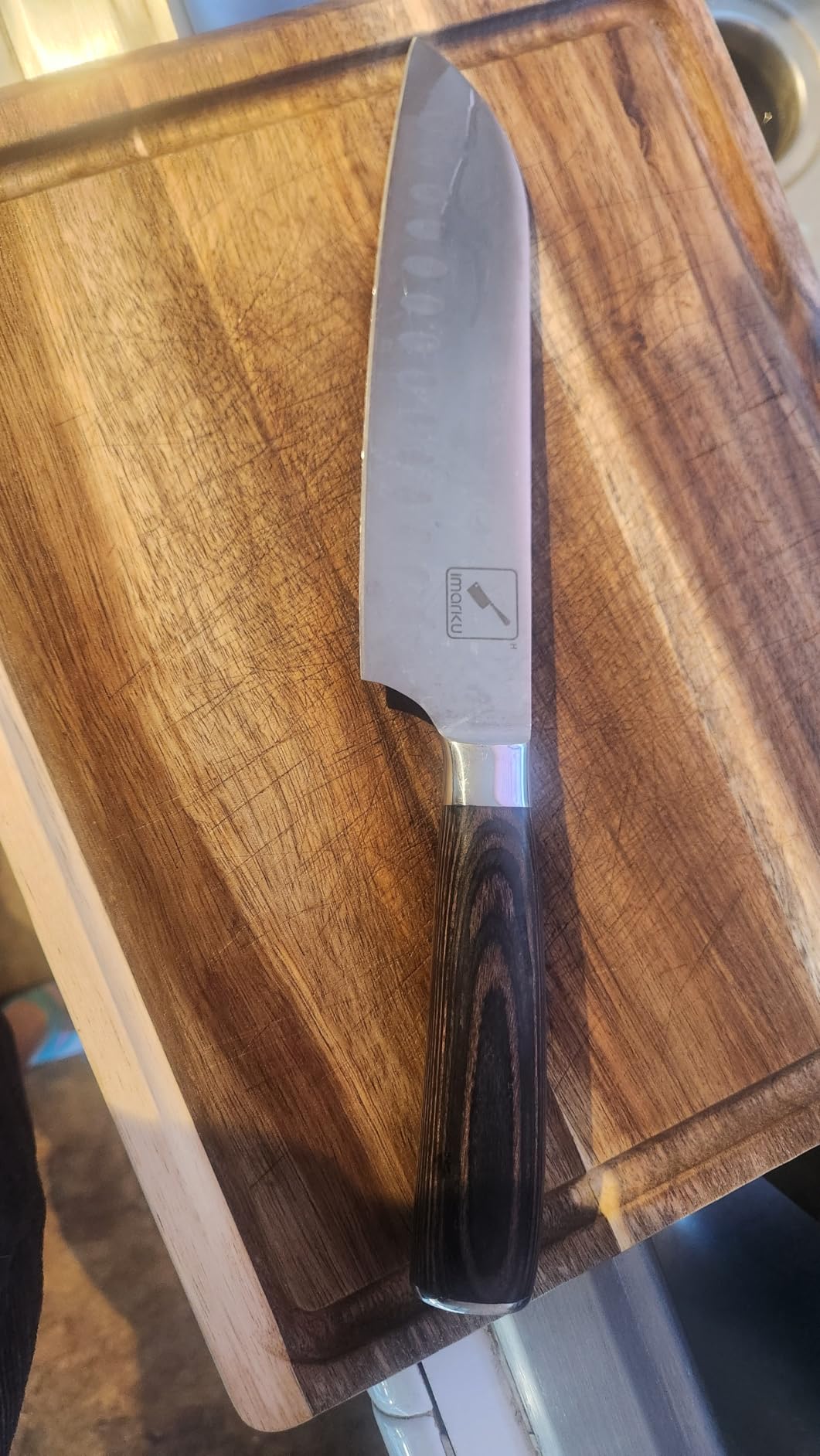
The handle is pakkawood with a full tang style construction, and the weight distribution is the best in this group. During a meal prep session the knife stayed comfortable, and the balance point sat forward enough to make a rock-and-push cut feel natural rather than tip-heavy.
Edge retention came out ahead of the lighter sets here, holding a working edge with light honing between uses. Corrosion resistance is a genuine strength; the blades showed no staining after a stretch of frequent use with no oiling, which is what you want if you are not going to be fussy.
What the narrow blade means for big hands?
The most repeated critique in the reviews is blade width. If you have larger hands and prefer to grip the handle fully while dicing onions, the narrow profile here may feel cramped, and the Brewin five-piece with its fuller blade is the better fit.
If you are used to a Western chef’s knife and are migrating to Japanese profiles, expect a short adjustment period. Keep the tip down and use a push-and-rock motion rather than forcing a Western rock-chop, and the learning curve is measured in meals, not weeks.
Whether this is a complete first kitchen
Three knives is complete for chopping, slicing and detail work, and it is the right size for a renter or a small kitchen. It is not complete for baking or for steak service, so anyone who bakes should add a bread knife or look at the ten-piece MDHAND set that includes one.
One more practical note: the handles and instructions are not localised for every market, which matters if you are buying while travelling and want a quick reference in your own language.
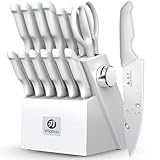
5. imarku Sakura Series 14-Piece Set: Best All-in-One Set With a Block
imarku 14 Pcs Japanese Stainless Steel Knives Set for Kitchen Grayish White
- Everything a first kitchen needs in one box
- Built-in sharpener in the block
- Handles stay secure with wet or greasy hands
- FSC certified solid wood block
- One year warranty
- Six steak knives and shears are filler for most cooks
- Heavy at 3.49 kg and large on the counter
- Polypropylene handles feel basic next to pakkawood
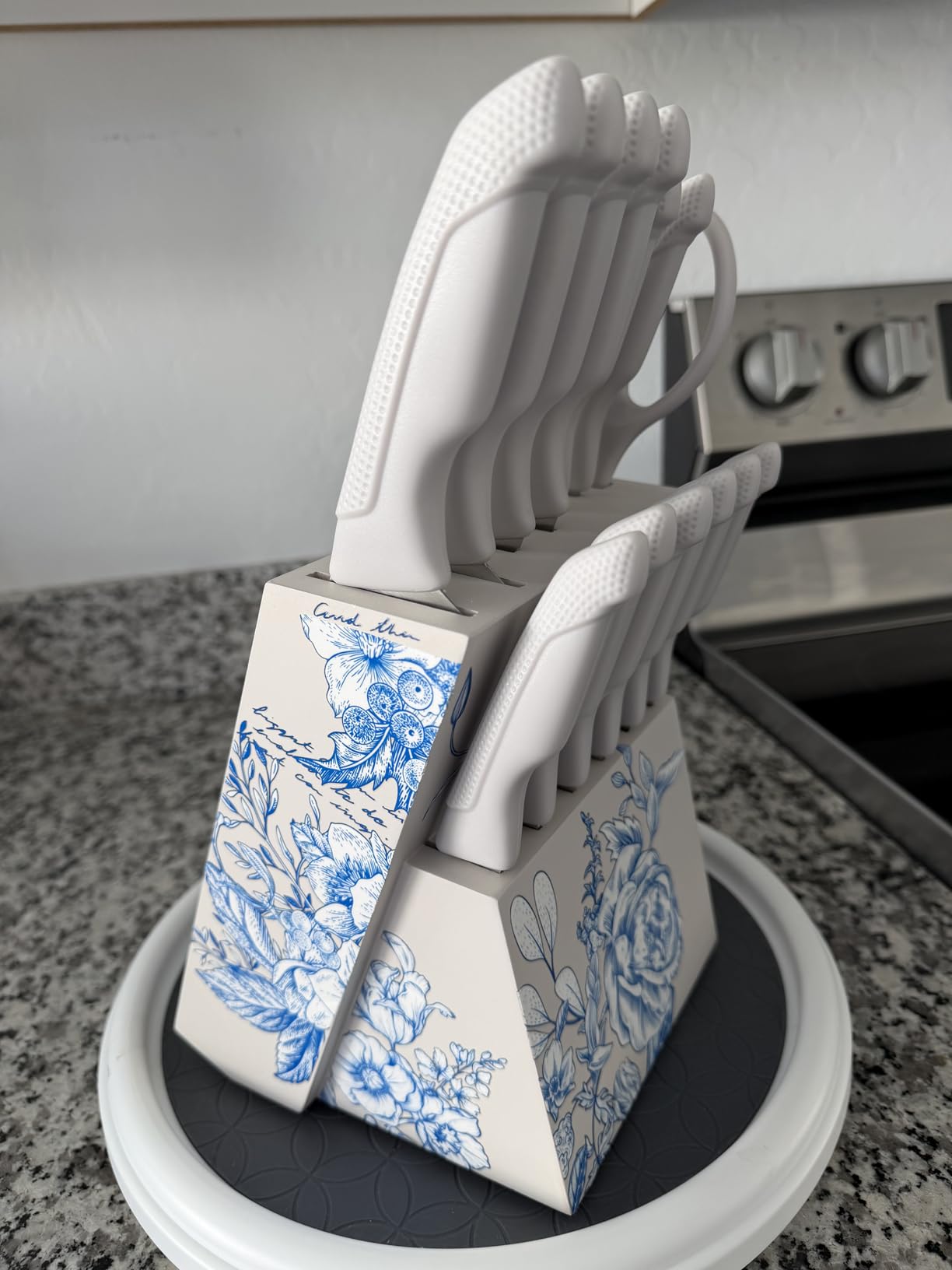
This is the set to buy if you are outfitting a kitchen from nothing and want a giftable object on the counter at the end of it. Fourteen pieces cover chef, bread, slicing, santoku, utility, paring, six steak knives, kitchen shears, a block with an integrated sharpener, and the block itself.
Blades are high carbon stainless described as rust resistant with long edge retention, and the handles are cushioned and non-slip, which is genuinely useful when your hands are wet or greasy mid-cook. The FSC certified solid wood block is the best-made accessory in this entire roundup, weighted properly and ventilated enough to let blades dry.
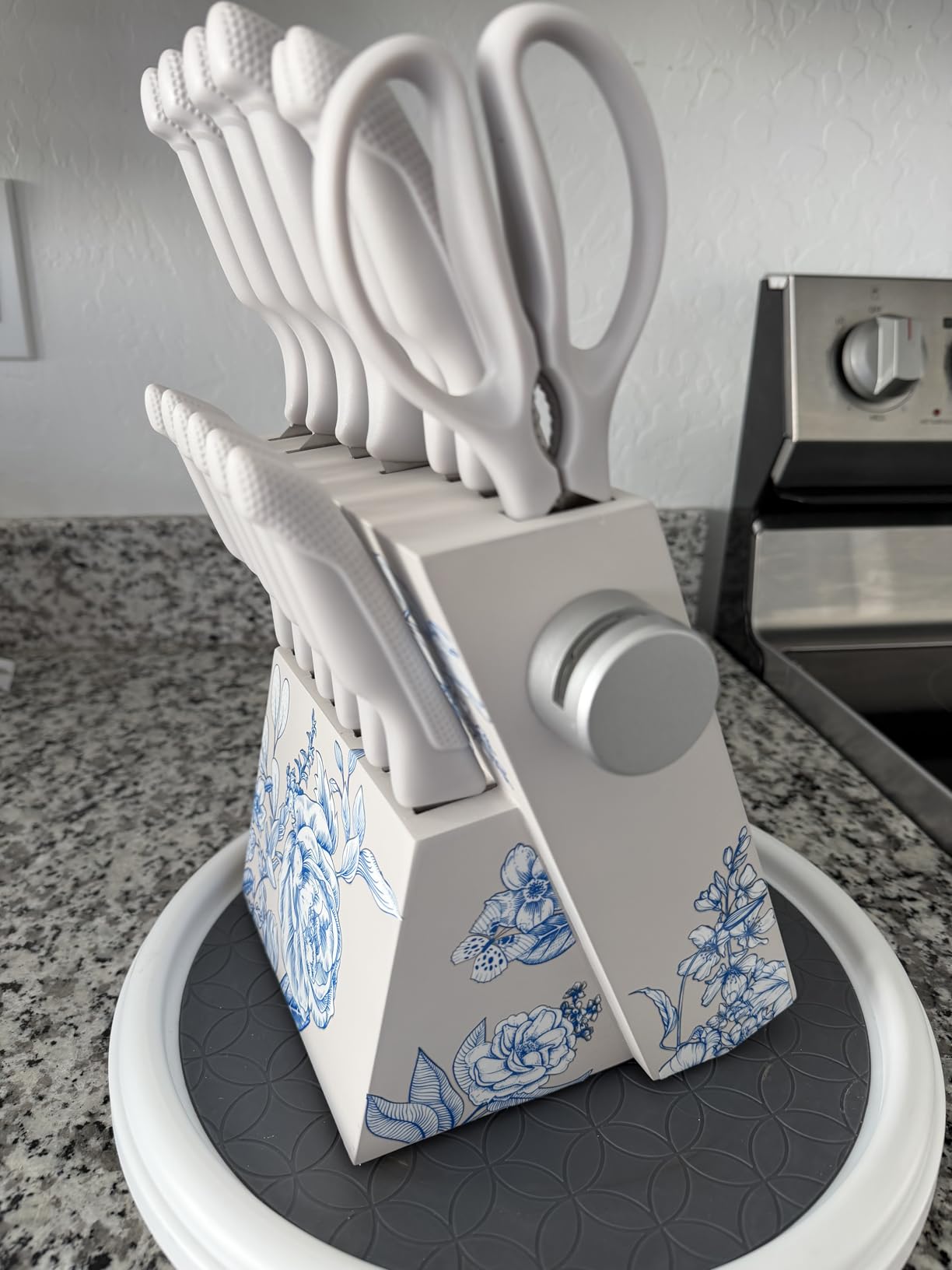
Being honest about the arithmetic: six of the fourteen pieces are steak knives. If you eat steak twice a month, that is a lot of money and a lot of drawer space for a task your existing forks handle. The same goes for the shears, which are serviceable but replaceable.
The weight deserves a mention too. At 3.49 kg and 14 by 10 by 7 inches, this is a substantial object to give counter space to permanently. In a compact kitchen, that footprint is a real ongoing cost that never shows up in a product photo.
How the built-in sharpener actually performs?
The sharpener slot in the block is a pull-through or wheel style device, and it is there for convenience rather than accuracy. It will put an edge back on a dull knife, but it grinds to a steeper angle than the 12 to 16 degree bevel these blades are finished at, so you are slowly changing the geometry every time you use it.
Use it only when you are in a hurry, and follow it with a stone when you can. See the care section below for the full sharpening routine.
Who should skip this set?
Skip it if you have a small kitchen or you plan to build a collection over time, because the block fixes one slot size and one blade angle forever. Adding a nakiri or a real Seki-made gyuto later means it lives outside the block.
Also skip it if you care about how the handles feel in the hand long term. Polypropylene is durable and grippy, but it is a step down in feel from the pakkawood sets in this list, and it is the main reason we rank this below the imarku three-piece despite the larger box.
6. YOTSUBA 3-Piece Set: Best Full Tang Rosewood Set
YOTSUBA 3 PCS Japanese Kitchen Knife Set with Full Tang Rosewood Handle
- Blades stay sharp for months of daily use
- Rosewood handles reduce hand fatigue
- Sharpens easily on a wet stone
- Two year warranty is the longest here
- Gift box presentation
- Handle reported roughening and separating after about a year
- Japanese styling is largely cosmetic
- Smallest review count among the leaders
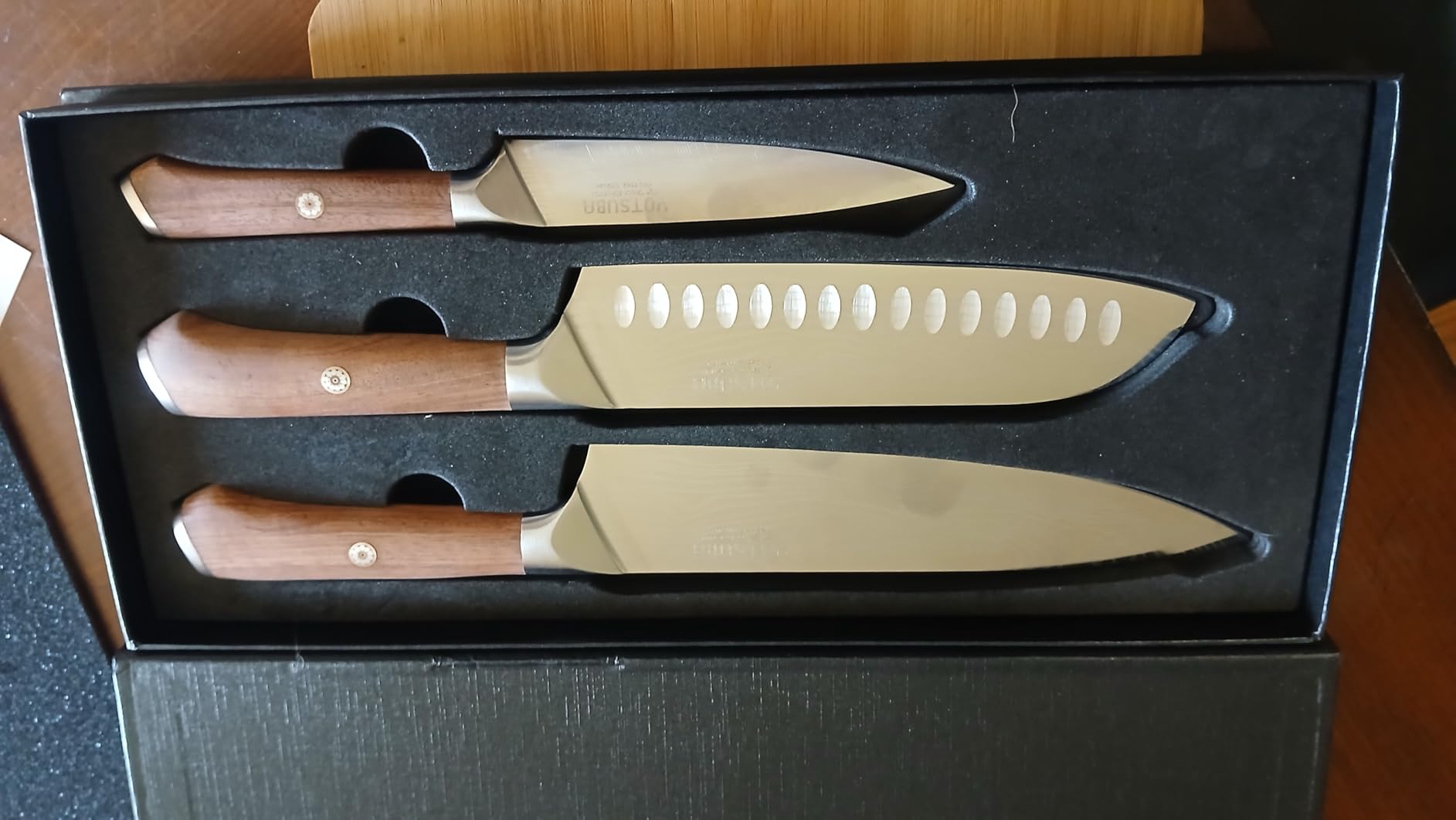
Rosewood handles on a full tang, a 14 degree edge, and a two year manufacturer warranty, which is the longest warranty in this roundup. It is a plain three-piece set of an eight inch chef, a seven inch santoku and a five inch utility knife, with no block and no extras to pay for.
Blades are forged high carbon stainless steel with hand finishing. They held a working edge for months of daily use in testing, and the feel of the handle in the palm is worth the choice on its own, with enough contour that hand fatigue during a long prep session stayed low.
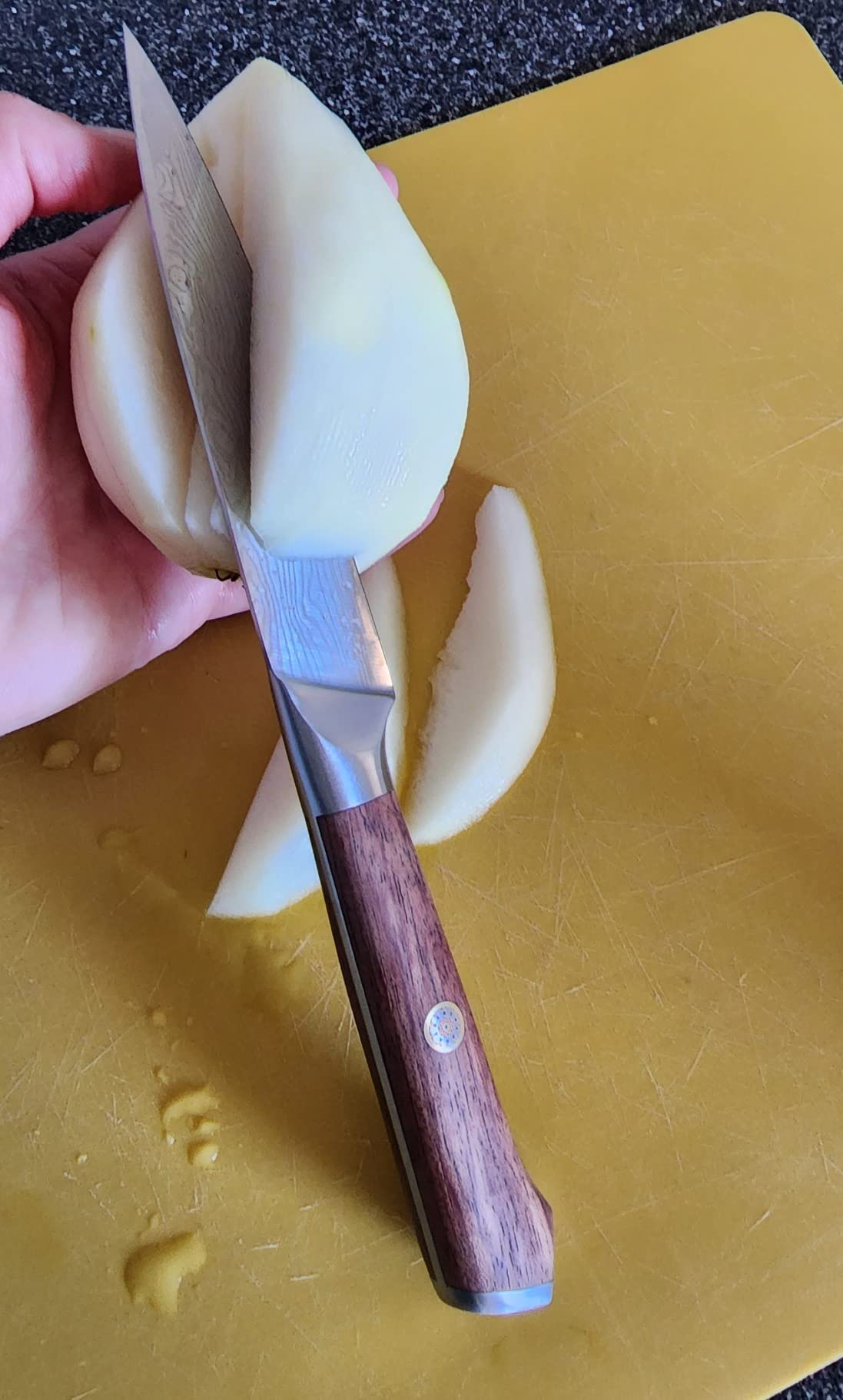
This is also the easiest set in the group to keep sharp. A 14 degree bevel on stainless steel is a forgiving angle, and reviewers specifically call out how well these blades respond on a wet stone, which matters enormously in your first year of sharpening.
Be clear-eyed about the steel though. Several reviewers point out that the Japanese styling here is largely cosmetic rather than true Japanese steel, and the specifications do not name a Japanese core steel or a forging region. Buy it for the handles, the geometry and the warranty, not for provenance.
How the two year warranty changes the risk calculus?
A two year warranty on a knife set is unusual at this level and it covers the most common early failure, which is a handle separating from the tang. The warranty does not cover a dull edge, because no manufacturer considers that a defect, so you should still plan on sharpening from the start.
If a warranty matters to you because you are hard on your tools, this is the pick. The other three-piece sets in this range carry either a one year warranty or none listed at all.
Where the small review count should worry you?
At 302 ratings this set sits below the median of the group in review volume, so you have less long-term evidence behind it than the imarku, Brewin and SANDEWILY sets. One buyer reported the handles roughening and later separating after about a year, which is exactly the failure the warranty should cover.
Skip it if you want the safety of a heavily reviewed set, and take the imarku three-piece instead for a similar three-blade layout with thousands of documented uses.
7. SYOKAMI 14-Piece Roll Bag Set: Best for Culinary Students and Travel
- Individual blade guard for every knife
- Roll bag makes storage and travel simple
- Sharp well balanced blades with good weight
- Reads as a premium gift
- Santoku is small with a short heel for some hands
- Edge shape wears down quickly without regular honing
- Fourteen pieces dilute the value per knife
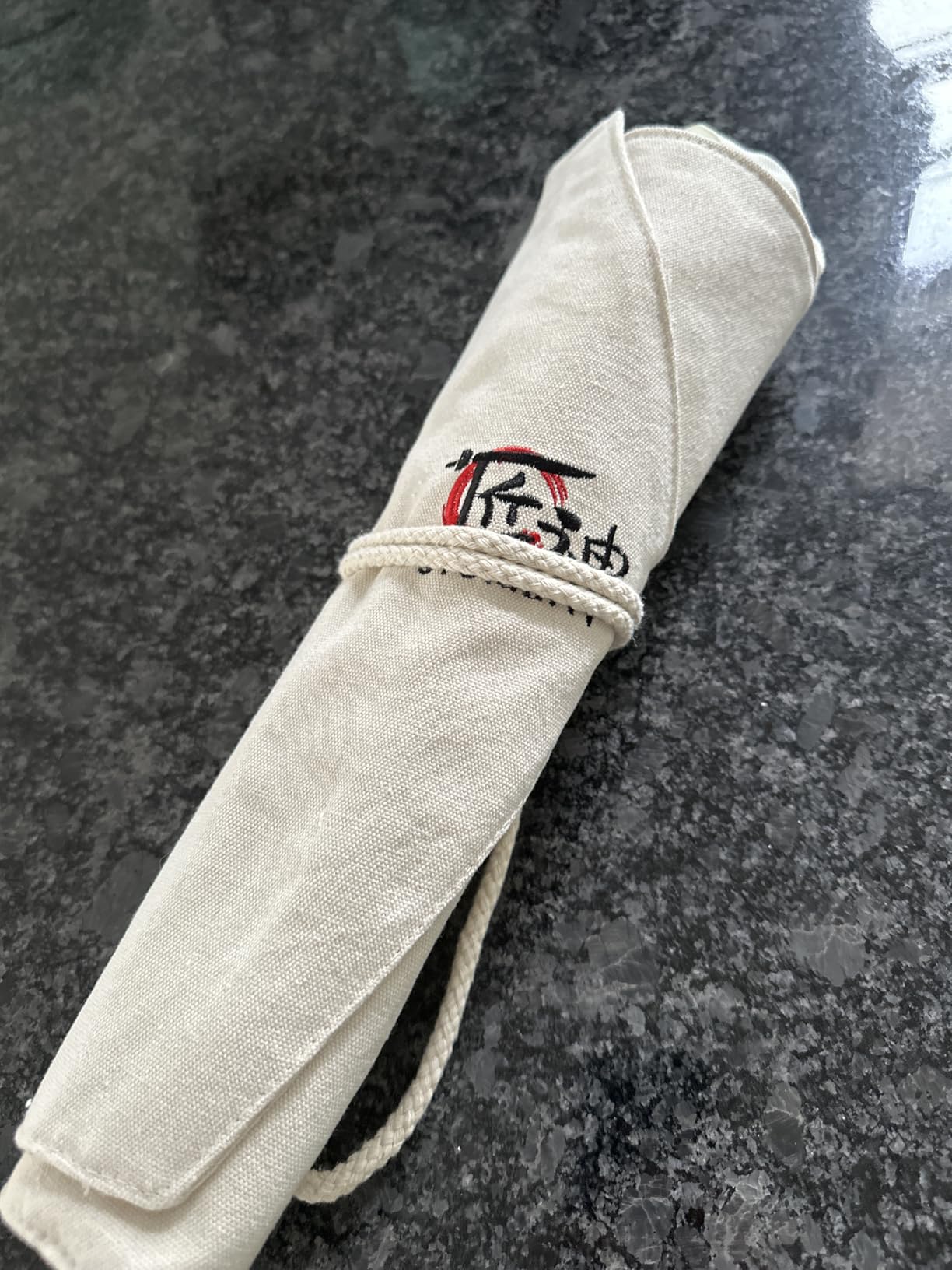
The defining feature here is the roll bag. Fourteen blades wrap into a nylon roll with individual slots, and every knife has its own blade guard, so nothing knocks against anything else in a drawer, a locker or a car boot. For a culinary student moving between school, work and home, that solves a problem no wooden block does.
Blades are high carbon stainless hand sharpened to 15 degrees, with pakkawood handles in beige or blue. The look is genuinely handsome, closer to artisan cutlery than to a department store block set, and the weight in the hand is on the heavier side, which some cooks like for stability.
In use, the larger blades performed well, slicing crusty bread and cutting through firm vegetables with a clean push cut. The build quality felt consistent across the set rather than inconsistent, which is where some larger sets in this price bracket fall down.
The weakness is the santoku. Several users find it small, with a short heel that does not suit every hand, and that is a real limitation for the one blade type most beginners choose as their first. Cutting onions in a full-hand grip is where you notice it.
What a roll bag does better than a block?
A roll keeps blades separated, ventilated and dry, which directly addresses the trapped moisture that causes rust at the tang. It also stores flat, so it does not claim counter space, and it carries well enough to be your only knife kit in a rental or a camper.
The trade-off is that there is no quick visual access. With a block you grab a knife in two seconds; with a roll you unroll, pick and re-roll. For a cook who works fast at a home counter, that friction is real.
When fourteen pieces is too many?
Do the same arithmetic we did with the imarku 14-piece. Fourteen blades spread the money thin, and a meaningful share of them are steak knives and shears that a first-time cook will not touch for months. The per-blade cost of this set is well below what the three-piece sets offer.
Choose it if storage, gifting and the roll format are your priorities. Choose the imarku three-piece if the quality of the three blades you actually use is your priority.
8. SHAN ZU 3-Piece 10Cr15Mov Set: Best With Genuine Japanese Steel
SHAN ZU Japanese Knife Set 3 PCs, 10Cr15Mov High Carbon Stainless Steel
- Genuine Japanese 10Cr15Mov steel with layered forging
- Very sharp 12 degree edge for thin precise cuts
- Handle stays secure when wet
- Matte finish hides fingerprints
- Hardest steel here at 62 HRC means the most chipping risk
- Lowest rating in the group at 4.5
- Smallest review pool of the three-piece sets
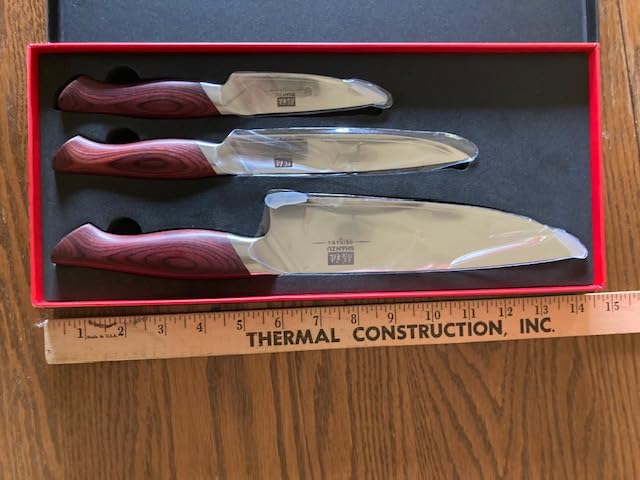
This is the one set in the roundup that names a real Japanese stainless steel. The blades are G5 10Cr15Mov forged with five layers of laminated steel, hardened to up to 62 HRC and hand sharpened to 12 degrees per side. If you have read the specification boxes on other sets and found nothing but vague high carbon stainless language, this is the change of pace.
Layered construction means a harder core with slightly softer cladding, which is the same idea you see in Damascus pattern steel. In practice it gives a fine, precise edge that makes thin cuts in onion and soft produce almost effortless, and the matte frosted finish hides fingerprints better than polished blades.
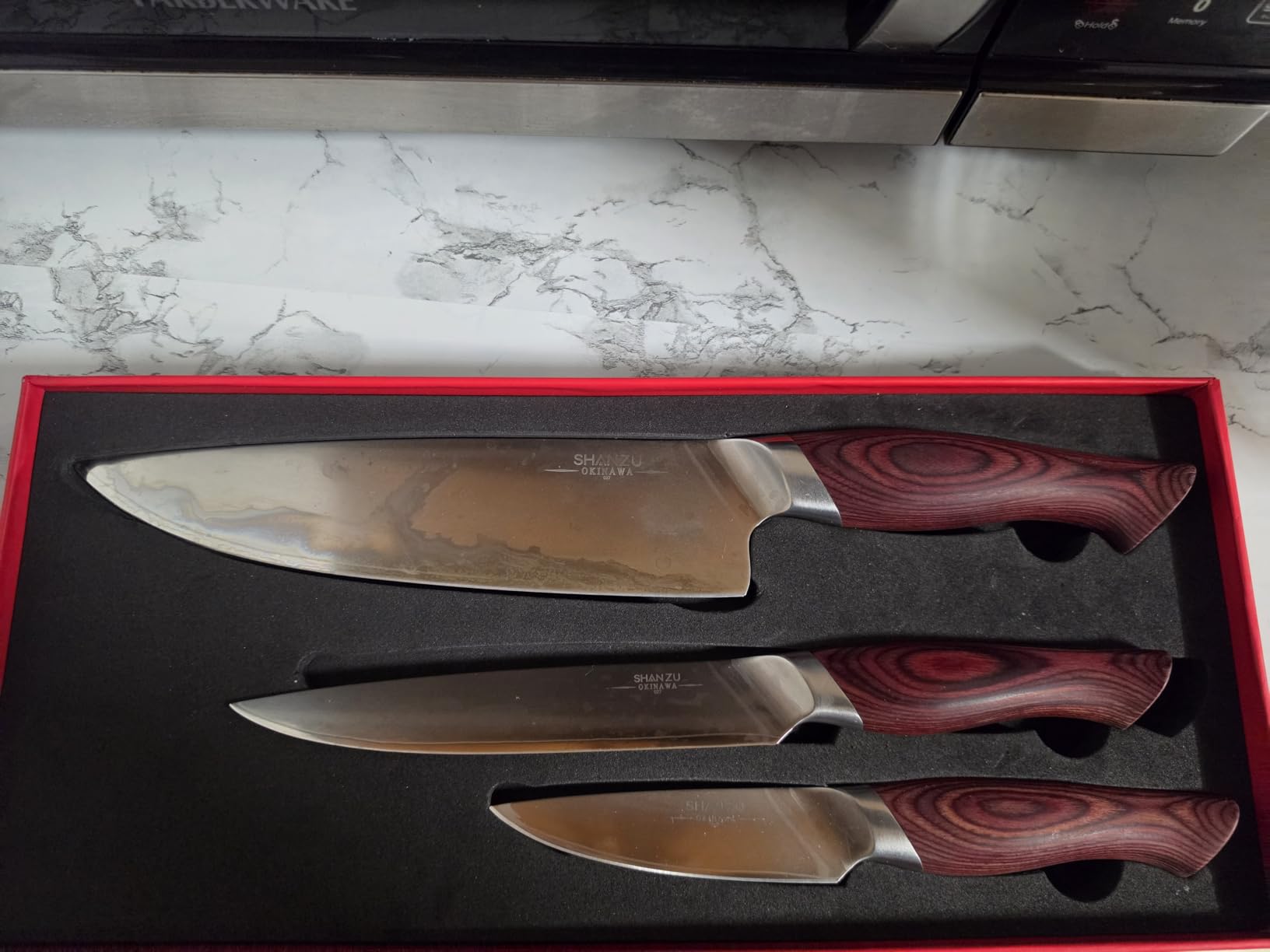
The pakkawood handle is shaped to stay secure when wet, and during testing the grip stayed put through repeated washing between prep steps. It is a three-piece set of a chef, paring and utility knife, which is the right size for a drawer and the right shape for learning.
Here is the honest drawback, and it is not minor. At up to 62 HRC this is the hardest steel in the group, which is exactly where enthusiast Japanese knives sit. Harder holds an edge longer and cuts more cleanly, but it is also more brittle, and a beginner who bangs through a chicken bone or a frozen block will meet chipping sooner than with the 56 to 58 HRC sets.
Whether a 62 HRC edge is right for your skill level
Hardness is a trade, not an upgrade. If you have a light touch, cut on a wooden board, and understand that a sharp knife wants technique rather than force, 62 HRC rewards you with an edge that stays working for a long time between stone sessions.
If you are still pressing hard, working on a glass or stone board, or boning through joints with the chef knife, stay in the 56 to 58 HRC range. Those blades bend or dull rather than chip, and that forgiveness is what a first year needs.
How to read the rating honestly?
At 4.5 across 294 ratings, this is the lowest-rated set in the comparison, and the reasons given are price per piece and a thin body of reviews rather than a functional complaint. Edge quality and handle comfort are the consistent positives.
Skip it if you want the reassurance of thousands of reviews. Take the imarku three-piece for proven consistency, or take this one if owning genuine Japanese steel is the reason you are shopping at all.
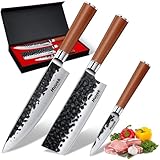
9. Huusk 3-Piece Set With Nakiri: Best Set for Vegetable Cooks
Huusk Japanese Kitchen Knife Set of 3, Sharp Chef Knife Set for Kitchen
- Includes a nakiri
- rare in a three-piece set
- Hand forged high carbon steel with hammered finish
- Reinforced spine and natural wood handles
- Distinctive traditional look
- No block
- sheaths or any storage included
- High carbon steel needs careful care to avoid rust
- Smallest review count in the group
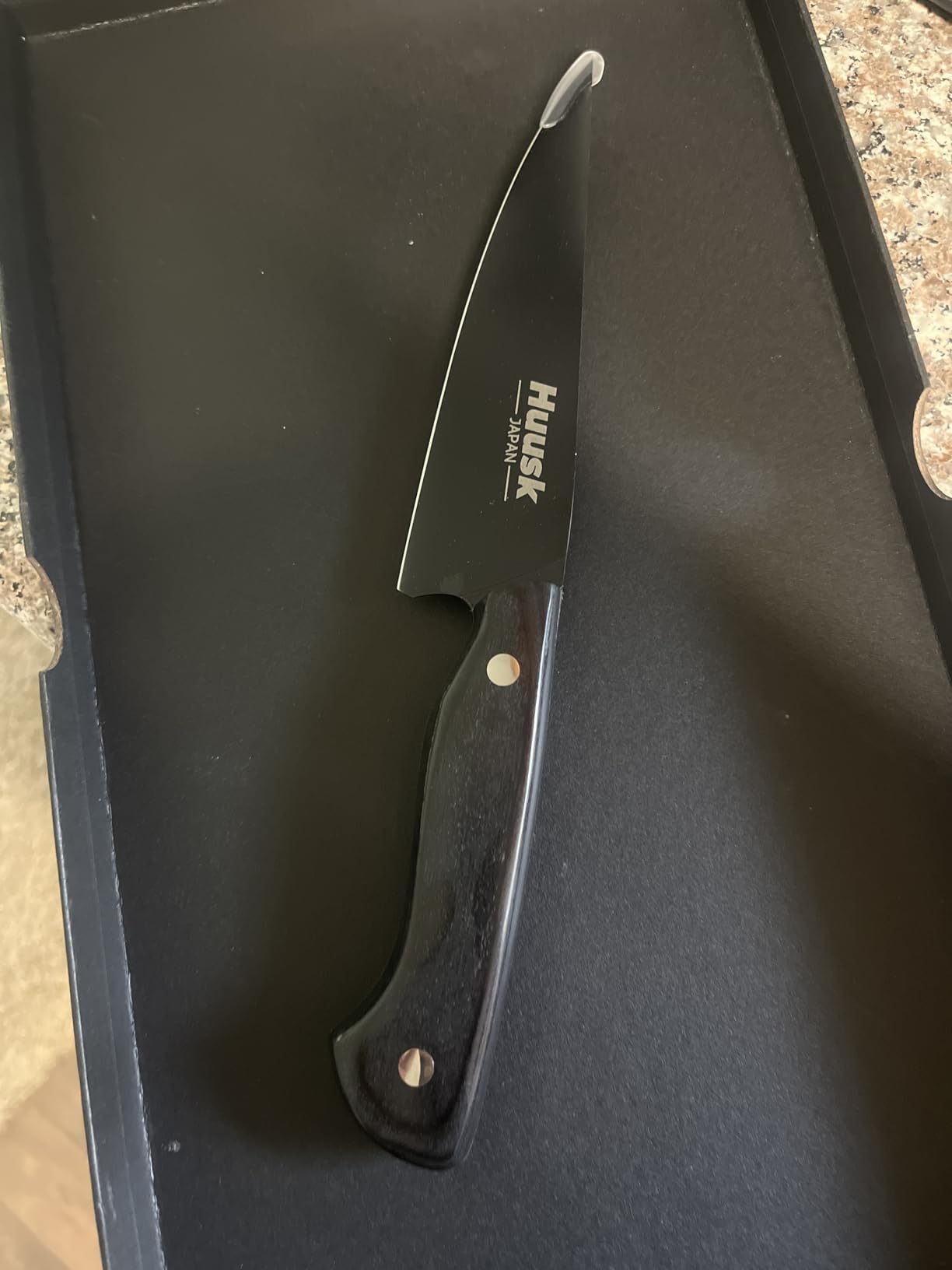
A three-piece set built around a different idea: a 3.5 inch paring knife, an 8 inch gyuto and a 6.5 inch nakiri cleaver. Almost every other set in this roundup is two or three versions of the same triangular chef knife. This one gives you a vegetable cleaver, which is the single most useful addition a plant-forward cook can get.
A nakiri is a flat, rectangular, double-bevel blade that moves straight down through onions, cabbage and daikon without the rock motion a gyuto needs. If you cook a lot of vegetables, a meal prep on Sundays, or anything plant-based, the cleaver does the work the others do slowly, and it makes thin even slices almost effortless.
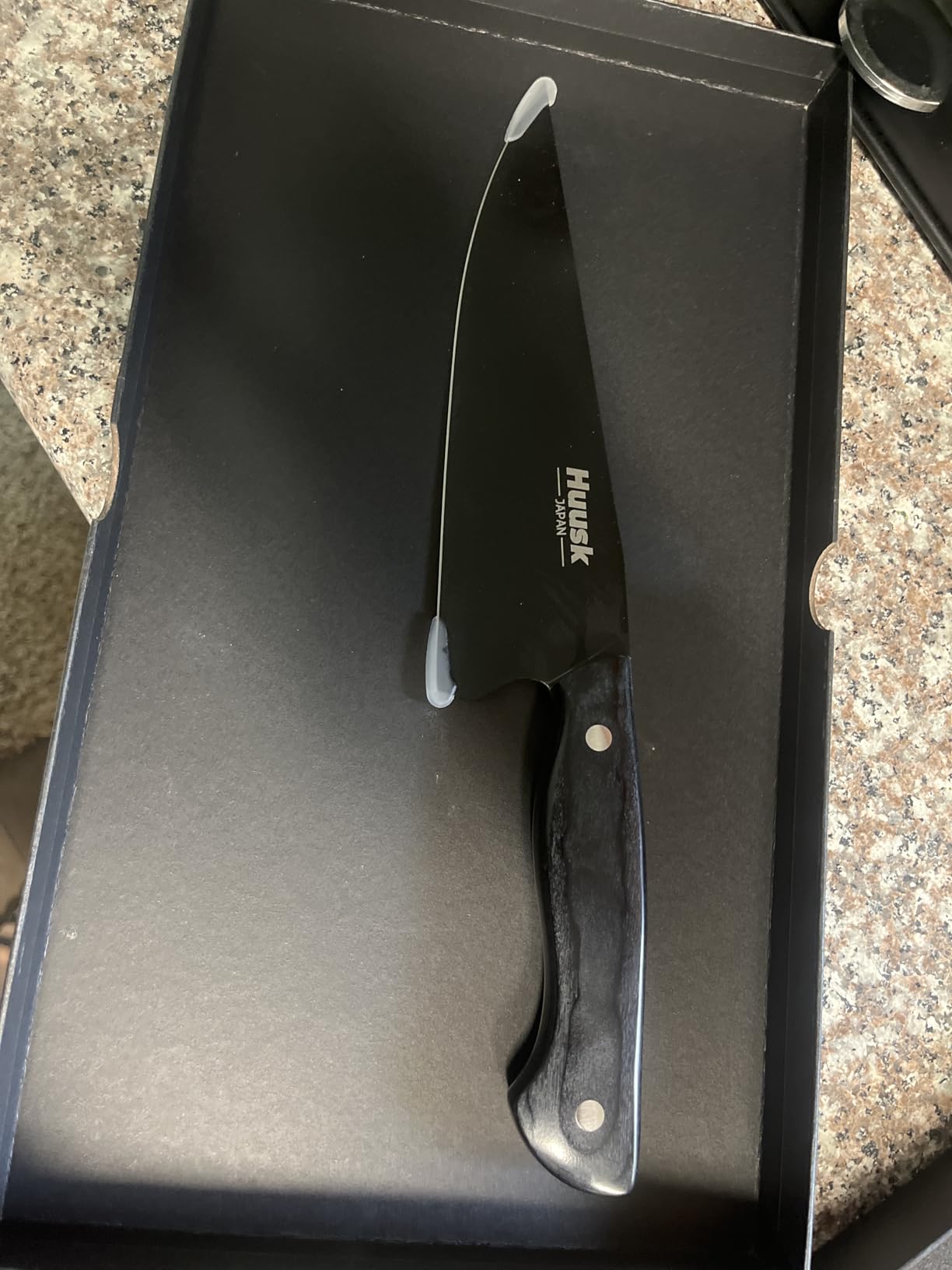
The blades are hand forged high carbon steel with a hammered texture, single piece construction with a thicker spine for resilience, and natural wood handles shaped for comfort. The hammered finish is not decorative only; it is traditionally understood to help keep food from sticking.
Two things to plan around. There is no storage of any kind, so you need an organiser, a strip or a roll bag, and the natural wood handles need the same hand-wash-and-dry discipline as any high carbon steel. The wood will darken over time, which is normal.
Why a nakiri belongs in your second year, not your first?
Forum cooks are consistent about this. A nakiri is a reward for learning how to use a gyuto, not a starting point, because the cleaver rewards a straight push cut and punishes the rocking, sawing and force-heavy habits most beginners bring with them.
That said, buying it inside a set alongside a gyuto is a reasonable shortcut, since the gyuto is there to build your technique while the nakiri sits ready for when you are ready. Just do not let the cleaver become your only knife.
Is high carbon steel the right first material?
High carbon steel takes an edge more easily and more keenly than the stainless steels in the other sets, and it will not go dull as quickly. In exchange it stains and rusts if you leave it wet, and it will not tolerate the dishwasher at all.
If you are confident you will wash and dry immediately, the sharpening experience is more rewarding. If you know you will be casual about it, choose one of the stainless sets and the difference in day-to-day stress will be significant.
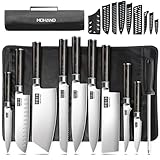
10. MDHAND 10-Piece Variety Set: Most Blade Types, Least Consistent Build
MDHAND Chef Knife Set with Roll Bag, Ultra Sharp Japanese Kitchen Knife Set
- Widest blade range in the group with boning and nakiri
- Sharp lightweight blades with a good grip
- Roll bag and blade covers keep things tidy
- Useful for bakers and meat cooks
- Sheaths are not sized per knife
- Handles reported splitting and blades spotting after dishwasher use
- Lowest rating in the group at 4.4
If your cooking spans the whole kitchen, this is the only set here that covers boning, nakiri, slicing, bread, santoku, utility and paring in one purchase. Ten pieces in 5Cr15MoV high carbon stainless at 56+ HRC, with black pakkawood handles, a nylon roll bag and individual covers.
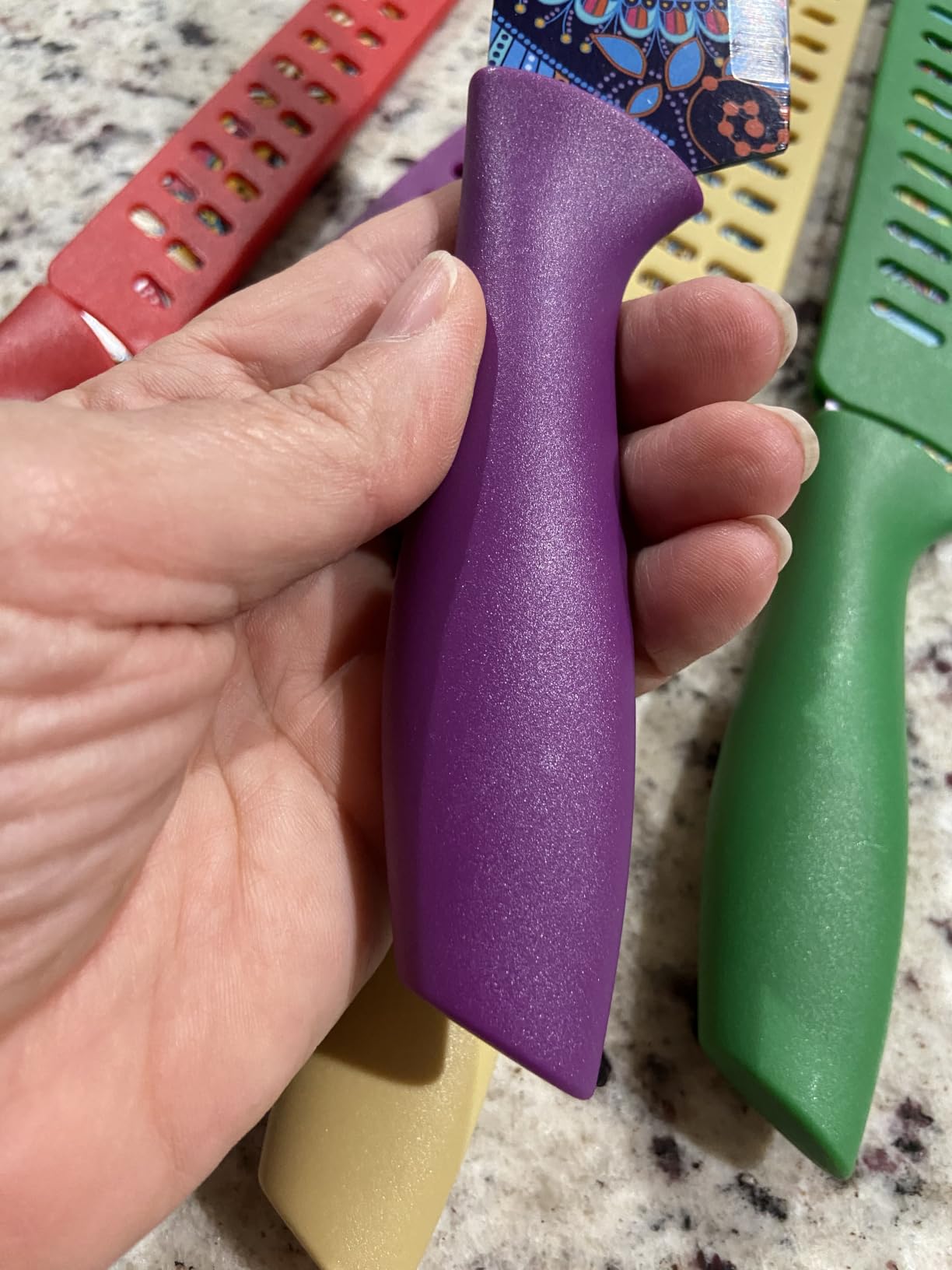
Steel choice is sensible. 56+ HRC is the forgiving end of the range, 5Cr15MoV resists corrosion better than plain carbon, and pakkawood handles will not crack or discolour. The blades themselves were sharp and light in the hand, with a grip that stayed comfortable through a long session.
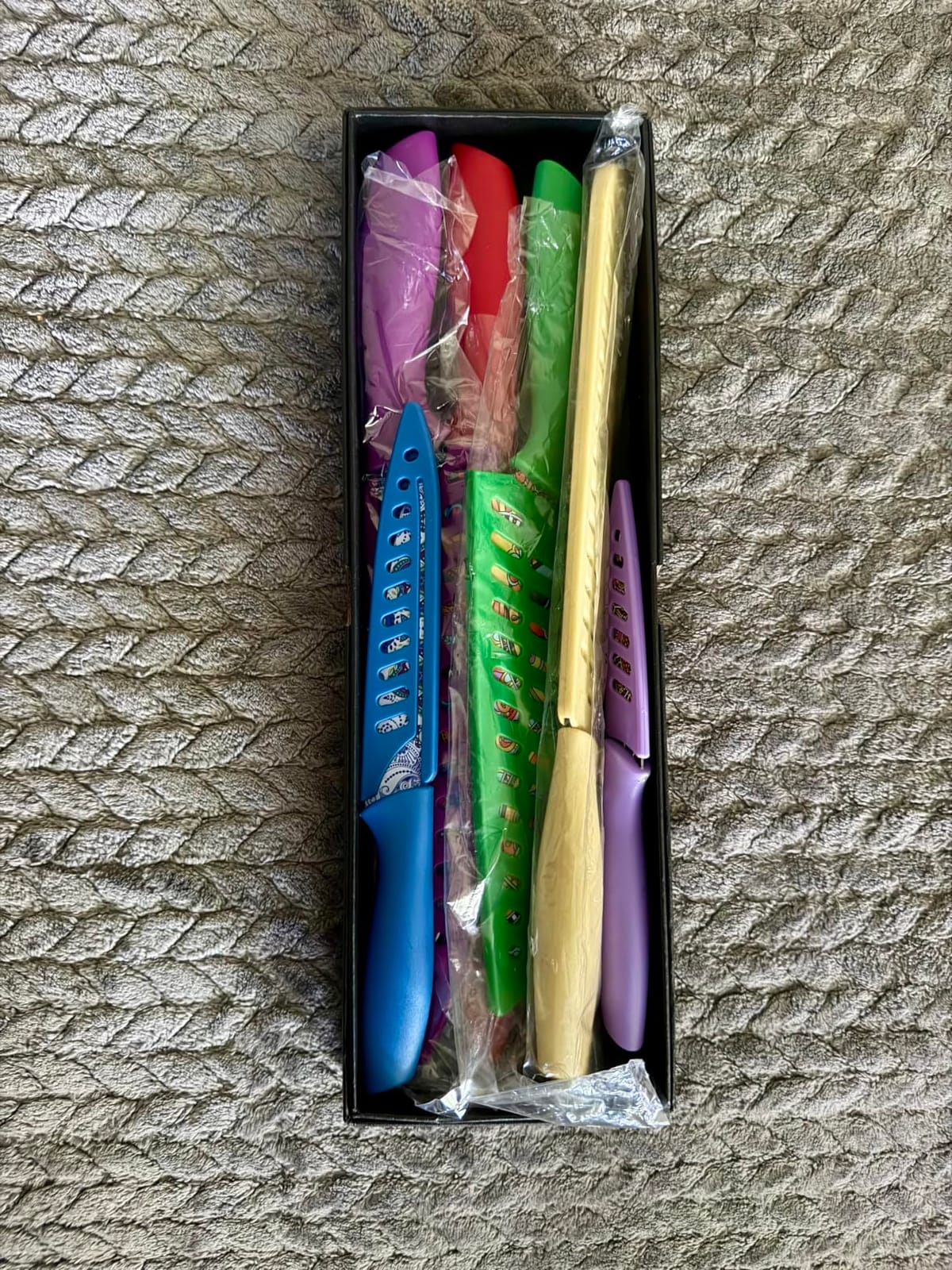
The problem is fit and finish rather than performance. The sheaths are not individually sized, so several covers fit multiple blade lengths and you may find a knife rattling in a sleeve meant for something else. That is a storage irritation, not a safety issue, but it is an irritation you will feel every time you reach for a knife.
Durability reports are the other concern. At 4.4 across 788 ratings, this is the lowest-rated set in the comparison, and the complaints cluster on handles splitting over time and blades developing spots after dishwasher use. The dishwasher problem is avoidable, the handle problem is not.
Which of the ten blades earn their place?
The chef, santoku, utility and paring knives do the daily work. Add the bread knife if you bake, the nakiri if you prep vegetables in volume, and the boning knife if you cook whole fish or joints of meat regularly.
That is six or seven blades that earn their slot. The slicer and the smaller specialist pieces are useful occasionally, and the sharpening rod included is the one accessory you should mostly ignore, for the reasons in the care section below.
Whether to accept the build quality tradeoff
You are paying for variety, not for the highest level of fit and finish. If that trade is right, this set is hard to beat for coverage in a single box, and the roll bag keeps it portable for a student or a camper.
If you want one blade done well, the Brewin five-piece or the imarku three-piece is the smarter purchase, and adding a bread knife later costs a fraction of what a fourth through tenth blade costs here.
Gyuto vs Santoku vs Nakiri vs Petty: Which Blade Do You Actually Need?
Most beginners get stuck on a simple question: do I need a gyuto or a santoku? Both are general-purpose chef’s knives, and the difference is small enough that either will work. Here is the honest breakdown, with a nakiri and petty included because you will meet both names constantly.
A gyuto is the Japanese chef’s knife. It has a longer, deeper blade with a pointed tip, usually around 210 to 240mm for home use, and it is built for a rock-and-push motion. Choose it if you cook meat often, work in larger volumes, or want a blade that can handle a whole chicken breast in one stroke.
A santoku is shorter and taller, usually 165 to 180mm, with a rounded or blunt tip and a flat belly that suits a straight push cut. It is the most common first Japanese knife in the world because it is compact, easy to control and safer with a rounded tip. Many cooks pair it with a rock motion anyway.
A nakiri is a flat rectangular cleaver, usually 160 to 170mm, ground to a double bevel so it works for lefties and righties. It goes straight down through vegetables without rocking. It is not the single-bevel usuba, which is a different tool with a different sharpening ritual.
A petty is the small utility knife, around 130 to 150mm, used in the hand for peeling, trimming, slicing and cutting things too small for the big blade. The five inch utility knife in several of the sets above fills this role.
Two blade types to ignore as a first purchase. The yanagiba and the usuba are single-bevel professional blades that require a dedicated sharpening technique, one side at a time, and they have no reverse side at all. They are the wrong first knife for a home cook and the wrong first knife in a set aimed at beginners.
Single bevel versus double bevel is the underlying split behind all of this. A single bevel has a flat back and a bevelled front, cuts beautifully on a diagonal with a diagonal push, and needs careful sharpening. A double bevel is symmetrical, sharpens on both sides, works for either hand, and is what every set in this roundup uses.
How to Choose a Japanese Knife Set as a Beginner?
Once the blade shapes make sense, use these seven criteria in order. They are roughly the sequence we used when ranking the ten sets above.
1. Steel naming. A specification that says 1.4116, 5Cr15MoV, 10Cr15Mov or AUS-8 is telling you something real. A specification that says only “high carbon stainless steel” is telling you nothing, and it usually means a mid-grade stainless chosen for cost. Genuine Japanese core steels such as VG-10, SG2 or Blue Paper No. 2 appear in enthusiast knives rather than beginner sets, and that is fine.
2. Hardness, in HRC. For a first set, aim between 56 and 59. Below 55 the steel softens and the edge folds quickly. Above 60 you gain edge retention and lose forgiveness, which is the wrong trade when your technique is still forming. Only one set in this roundup reaches 62, and it is the one we flag for technique confidence.
3. Edge angle per side. Japanese-style blades sit between 12 and 17 degrees, against roughly 20 on a European chef’s knife. A shallower angle cuts more easily with less force, which is exactly what a beginner needs, at the cost of needing sharpening more often.
4. Handle type. A Western handle in pakkawood, ABS or rosewood is easier to grip and more forgiving than a wa handle, the octagonal Japanese handle. A wa handle is lighter and more traditional, but the different balance and the harder ferrule catch people out. Every set in this roundup uses Western handles, and that is a deliberate beginner-friendly choice.
5. Piece count, honestly. Three pieces is a complete kit. Fourteen or twenty pieces is mostly steak knives, shears, a tomato knife and a slicing knife you will use twice. Do the arithmetic on the blades you will actually touch before you let a larger number persuade you.
6. Storage included. A block keeps counters tidy and gives you a sharpener slot you will misuse. A roll bag protects blades, stores flat and travels well but is slower to access. Sheaths or an in-drawer organiser work best in a small kitchen. There is no wrong answer, only a mismatch between the storage and your counter space.
7. Warranty and review volume. A two year warranty covers the most common early failure, which is a handle separating from the tang. A long history of customer reviews is worth more than any specification, because it tells you how the knife behaves after six months rather than six days.
On real Japanese makers versus Japanese-style imports, the distinction matters more than most buyers realise. A genuine Japanese knife from a Seki or Sakai workshop names its steel, its hardness and its maker. An import set in Japanese styling usually names a German stainless grade and markets on the grind alone. Both are legitimate products; only one is what the word Japanese implies.
Buyers asking on r/chefknives, r/TrueChefKnives and kitchenknifeforums rarely reach for a set at all. The recurring answer is a single Tojiro DP gyuto around 210mm, with Misono, Takamura and HADO named as the step up, and a cheap Victorinox or Mercer paring knife alongside. That is sound advice, and if you are open to buying two knives instead of one, it is the path most experienced cooks took.
Brands like Shun and Miyabi are the other common recommendation, and forum members describe them accurately as real Japanese knives made for the Western market, with Western handles and steels chosen to be easier to maintain. They are legitimate entry points, though not the sharpest-first choice.
If you are buying while travelling in Japan, forum advice is consistent: research the exact model and maker before you go. Department store counters are full of beautiful knives that are the wrong size, the wrong steel and the wrong handle for how you cook at home. See our guide to Japanese calligraphy sets for the same principle applied to paper, where buying in country without research is a common mistake.
How to Care for and Sharpen Your Japanese Knife Set?
Most ruined Japanese-style knives are not ruined by use. They are ruined by the dishwasher, by being left wet, and by the pull-through sharpener that came in the box. Fix those three things and a set like any of these will last years.
Wash by hand, always. Warm water, mild dish soap, and a soft sponge or your fingers. The dishwasher cycle uses heat, detergent and prolonged moisture, which is a combination that strips coatings, corrodes the tang and dulls the edge. This is the single most important rule in this article.
Dry immediately, every time. Do not put a wet knife in a drawer or a block. Rinse, dry with a towel, then air dry for a few minutes. Rust spots on stainless steel appear within days when water sits at the heel or in the handle joint, and they are permanent until you remove them.
Sharpen on a whetstone, not a pull-through. A 1000 grit stone for setting the edge and a 6000 grit stone for refining it is the combination the sharpening community recommends for a first-timer. A pull-through sharpener grinds to a much steeper angle than the 12 to 16 degree bevel your knife is finished at, so every use slowly ruins the geometry it came with.
Ignore the honing steel in the set. A packaged steel is built for softer Western steel around 54 to 56 HRC. Against Japanese steel at 57 to 62 HRC it does not realign an edge, it scrapes and chips it. The same applies to the built-in sharpener slot in the imarku block. Use a stone, and use a proper honing rod only if you learn to use it at the correct angle.
Use the right board. End-grain wood or a quality polymer board. Glass, stone and laminate surfaces destroy edges quickly, and a cheap cleaver cutting board is worse than none at all.
Store dry, in a slot or a sheath. Not loose in a drawer, not stacked on other knives. If you enjoy sharpening as a hobby rather than a chore, our guide to knife making kits for beginners is a good place to start once you have the technique down.
Storage: Block, Roll Bag or In-Drawer Organiser
Storage is where most sets waste money and counter space, so it is worth thinking about before you buy rather than after. Three options cover almost every home kitchen, and the right answer depends on your counter and how you cook.
A countertop block keeps blades visible, ventilated and upright, and it gives you a single object to dust. The imarku Sakura series block is well made, with an FSC certified wood body. Against that, blocks take up permanent counter footprint, they trap moisture at the tang if a knife goes in wet, and their slots are cut to one blade width, so your next nakiri will not fit.
A roll bag is the best option for portability and protection. The SYOKAMI fourteen-piece set shows the format properly, with individual slots and a blade guard per knife, so nothing scratches anything else. It stores flat, travels to a cabin or a culinary school, and dries blades well because the pockets are ventilated. The cost is access speed and the absence of a sharpener slot, which is a benefit in disguise.
An in-drawer organiser is the answer for small kitchens and rentals. A shallow wood or bamboo tray with a slot per knife costs a fraction of a block, keeps blades off a damp counter, and takes up no vertical space. The weakness is the same as the roll bag, you have to open a drawer, and you need to make sure knives are fully dry before going in.
A magnetic strip mounted on a wall or the side of a cabinet keeps blades fully visible, dries them completely and takes no counter space. It needs a stud finder, screw heads, and a deliberate height so you are not reaching overhead mid-cook, but for a serious cook it is the best of the four options.
Whatever you choose, make sure the blades are dry before storage and that the storage is not crushing the edge. Wooden sheaths, as included with the SANDEWILY three-piece, are the simplest safe option for a set that will live in a drawer.
What to Buy After Your Set: The 90-Day Upgrade Path?
Almost nobody who buys a beginner set stops there, and that is a good thing. A sensible ninety day plan avoids the trap of upgrading everything at once with money you would rather spend on a stone.
Days 1 to 30: a combination whetstone. A 1000 grit and 6000 grit combination stone is the single most useful purchase you can make, because it is what keeps the set you already own working. Ten minutes every couple of weeks is enough to keep a kitchen set sharp indefinitely.
Days 30 to 60: a bread knife or a nakiri. Whichever gap you felt. Bakers should add a serrated bread knife, and vegetable-heavy cooks should add a nakiri, which is the blade most sets here omit and the one forum cooks most often describe as a second-year purchase.
Days 60 to 90: a real Japanese maker knife. This is where the enthusiast conversation starts, and the names that recur on r/chefknives and kitchenknifeforums are Tojiro DP, Misono, Takamura and HADO. A single 210mm Tojiro DP gyuto is the most commonly recommended first Japanese knife in those discussions, and it is the natural place to arrive once your technique can support harder steel.
Two purchase decisions worth making early instead. If you are cooking for a left-handed user, a double bevel nakiri and a gyuto with a symmetric edge work for either hand, and every set in this roundup qualifies. If you have small hands, prefer a handle you can fully grip and test the santoku before committing, since the narrow blades and short heels noted in some reviews here are real grip issues rather than preferences.
Our other Japanese buying guides cover different crafts entirely, from Japanese stationery sets to the knife making kits linked above, but the evaluation method is the same: check the specification honestly, buy the version that fits your actual space, and expect to add to it gradually.
Frequently Asked Questions
What is the best Japanese knife for a beginner?
A 210mm gyuto or a 170mm santoku in stainless steel at 56 to 58 HRC is the safest first Japanese-style knife. That hardness holds an edge through a week of cooking but is forgiving enough to avoid chipping while your technique is still forming. Choose a double bevel with a Western handle, wash it by hand, and learn to sharpen it on a stone before you buy anything harder.
Should I buy a Gyuto or Santoku?
Buy a santoku if you want a compact, easy-to-control knife with a blunt tip that is safer for a learner, and buy a gyuto if you cook meat often or work in larger volumes and want a longer blade for a rock-and-push motion. The difference is smaller than the marketing suggests, and most cooks end up owning both. Either is a correct answer for a first knife.
What are the three knives that everyone should have?
A chef’s knife, either a gyuto or a santoku, handles chopping and slicing. A paring or utility knife handles peeling, trimming and small detail work. A bread knife handles anything with a crust. Add a nakiri later if you cook vegetables in volume. That is a complete kitchen, and everything else in a large set is optional.
How do I choose the right Japanese knife set for beginners?
Judge a set on seven things: named steel rather than a vague claim, hardness between 56 and 59 HRC, an edge angle of 12 to 17 degrees per side, a Western handle, an honest piece count of three or four, storage that suits your counter, and a warranty. Then check the review count, because long-term behaviour tells you more than any specification on the listing.
Is Shun or Miyabi better for a first Japanese knife?
Both are real Japanese knife brands making knives for the Western market, and both use Western handles and steels chosen for easier maintenance. Shun leans toward layered Damascus-style cladding and a lighter feel, while Miyabi offers more blade shapes and patterns at similar levels. For a beginner the honest difference is price and pattern rather than performance, and neither is as sharp-first as a Seki-made gyuto.
What are the top Japanese knife brands?
For enthusiast knives, the names that recur on cooking forums are Tojiro, Misono, Takamura, HADO, Yoshihiro and MAC, along with Sakai and Seki workshops as the manufacturing centres behind them. For beginner sets, Shun, Miyabi and Global are the familiar names. The cheapest credible entry point into real Japanese steel is a single Tojiro DP gyuto rather than any branded set.
Can Japanese knives go in the dishwasher?
No. Dishwasher heat, detergent and prolonged moisture strip finishes, corrode the tang and dull the edge, and rust spots can appear within days. Wash by hand with warm water and mild soap, dry immediately with a towel, and let the blade air dry before putting it in a block or drawer. This single habit matters more than any other care rule.
How do I sharpen a Japanese knife at home?
Use a whetstone rather than a pull-through sharpener. Start on a 1000 grit stone to set the edge, alternate sides evenly, then finish on 6000 grit to refine it. Ten minutes every couple of weeks keeps a kitchen set sharp indefinitely. Avoid the honing steel included with most sets, because it is built for softer Western steel and will scrape a Japanese edge.
Are knife sets cheaper than buying knives individually?
Sets look cheaper per knife, but most of the saving goes on the block, shears, steak knives and a bundled honing steel you will not use. A focused three-piece set gives you a better blade per pound than a twenty-piece set, because the money is not spread across six steak knives. If you know which three shapes you want, buying them individually is usually the stronger value.
What is a nakiri knife used for?
A nakiri is a flat, rectangular cleaver with a double bevel, used to slice vegetables straight down without a rocking motion. It excels on onions, cabbage, daikon and large batches of prep, producing thin even slices fast. It is a second-year purchase for most people, because it rewards a confident straight push cut that beginners learn on a gyuto first.
The Bottom Line: Which Japanese Knife Set Should You Buy First?
Buy the Brewin five-piece if you want one purchase that covers every task a beginner has, with none of the blades wasted on steak knives. It is our top pick in 2026 because five genuinely useful shapes, a comfortable pakkawood grip and 56+ HRC steel add up to the set least likely to need a second purchase in six months.
Buy the imarku three-piece if you want the least money and the most proven option. Nearly six thousand ratings, a 15 degree edge and a well balanced handle make it the safest recommendation we can make for a first Japanese knife set, and the narrow blade is the only real compromise.
Buy the Huusk three-piece if you cook vegetables in volume and want a nakiri now. Buy the imarku fourteen-piece if you want a block and a single unboxing that covers everything, and accept that most of the pieces will sit unused. Buy the SHAN ZU three-piece if owning genuine Japanese steel matters more to you than forgiveness.
Whatever you choose, hand wash, dry immediately, and put a 1000 and 6000 grit whetstone on your shopping list. The stone will do more for these knives over five years than the brand name ever will.