
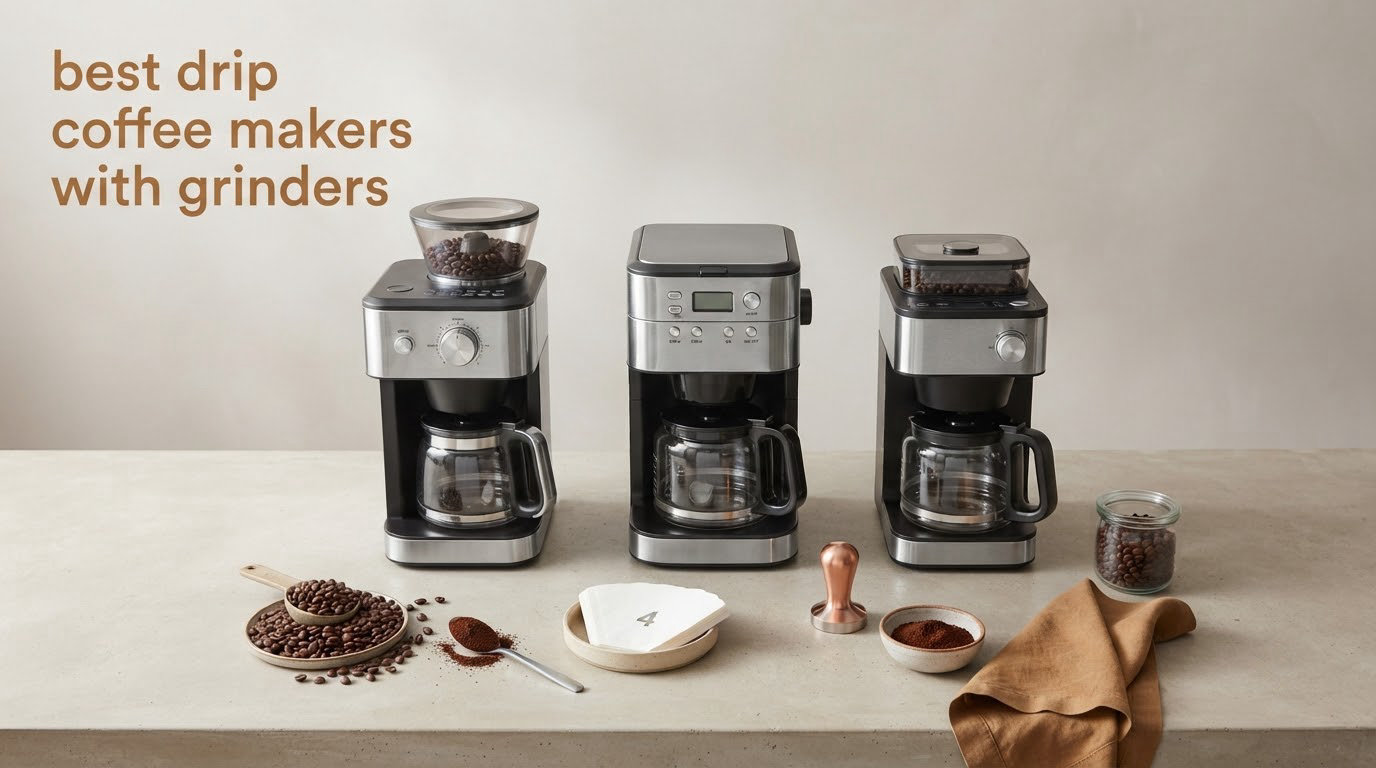
Coffee is at its best in the minutes right after it is ground, and that single fact drives everything in this guide to the best drip coffee makers with grinders. A machine with an integrated grinder grinds whole beans into the filter basket seconds before water hits them, so a single countertop appliance replaces your brewer, your grinder and the bag of pre-ground coffee that goes stale on the shelf. Our team spent six weeks running eight of these machines side by side, and what we learned about grind consistency, chute maintenance and counter clearance is more useful than any spec sheet.
This list is drip only. Several roundups on this topic quietly pad their lineups with espresso machines, which is a different purchase with different costs and a different skill curve. Everything here brews a carafe or a filter cup. Two entries make espresso as a side feature, and we flag that plainly rather than pretending otherwise. Every pick below was judged on four things: how consistent the grind was, how the cup tasted across batch sizes, how much maintenance the grinder demanded, and whether the machine actually fit on the counter you have.
We also published broader guides to drip coffee makers and burr coffee grinders if you want to understand the parts before you buy the combination.
Table of Contents
How We Tested These Grind and Brew Machines?
Each machine went through the same routine for about a week of daily use, plus a second pass with a different roast to see how the grinder handled it. We brewed a full carafe, then repeated at the smallest batch the machine allows, because small-batch brewing is where cheap machines give themselves away.
Grinder consistency. We ran each grinder on the same medium roast, spread the output on a sheet, and looked for boulders alongside dust. Blade grinders produced both in every pass. Burr grinders produced mostly even particles, with the 8 and 25-setting machines visibly tighter than the single-setting ones.
Extraction and taste. We compared against the same beans brewed the same afternoon on a plain non-grinding drip machine with a separate burr grinder. That is the honest baseline, and it is where the gap between a machine with real burr adjustment and one without becomes obvious in the cup.
Maintenance burden. We counted the cleaning steps after a normal brew and after a week of daily use. Clogging, chute access and how long the carafe took to wash mattered more than any feature on the box.
Counter fit. We measured each unit and checked the listed dimensions against a standard cabinet overhang. Four of these machines are 16 inches tall or more, which is a real problem in kitchens with a lowered cabinet over the sink.
Top 3 Best Drip Coffee Makers With Grinders (October 2026)
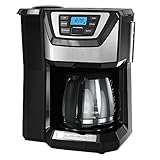
BLACK+DECKER 12-Cup Grind and Brew
- Integrated grinder
- Reusable filter
- Programmable
- 12-cup carafe


Quick Overview: Eight Grind and Brew Machines in 2026
| Product | Specifications | Action |
|---|---|---|
| BLACK+DECKER 12-Cup Grind and Brew |
|
Check Latest Price |
| Cuisinart Grind and Brew 12-Cup |
|
Check Latest Price |
| Ninja Luxe Cafe Premier 3-in-1 |
|
Check Latest Price |
 Gevi 10-Cup Grind and Brew Gevi 10-Cup Grind and Brew |
|
Check Latest Price |
 VEVOR 10-Cup Grind and Brew VEVOR 10-Cup Grind and Brew |
|
Check Latest Price |
 ecozy 12-Cup Drip Maker with Grinder ecozy 12-Cup Drip Maker with Grinder |
|
Check Latest Price |
 xBloom Studio xBloom Studio |
|
Check Latest Price |
 Electactic 10-Cup Grind and Brew Electactic 10-Cup Grind and Brew |
|
Check Latest Price |
Why a Burr Grinder Beats a Blade Grinder?
A blade grinder is a spinning propeller that chops beans until you decide it is done. It cannot know when to stop, so it produces boulders and dust in the same batch. Dust brews into bitter sediment at the bottom of the carafe, and boulders extract unevenly, which is why blade-ground coffee tastes thin no matter how much coffee you use.
A burr grinder crushes beans between two hardened surfaces at a set distance apart, so the particle size is decided by a mechanical setting rather than by time. That is why burr machines taste more like a good cafe cup and why they cost more. Of the eight machines here, the BLACK+DECKER, Gevi, Electactic, VEVOR and xBloom use burr grinding. The Cuisinart uses a blade, and the Ninja uses a 25-setting conical burr.
That distinction also decides the separate-grinder question. If you already own a burr grinder you like, a combined machine is a downgrade on the one part that matters most, and you are better off pairing your existing grinder with one of the plain brewers in our drip coffee maker guide. If you do not own a grinder, a combined machine is the cheapest path to fresh coffee, since one purchase replaces two.
One exception is worth naming. The ecozy set pairs a 12-cup brewer with a separate electric grinder rather than integrating them. That sounds like a downgrade, but owners consistently report that its grinder is quieter and more capable than the blades found in integrated budget machines, and pulse-grinding by hand gives control over coarseness.
1. BLACK+DECKER 12-Cup Grind and Brew – Best Overall
- Grinds beans and brews a full carafe in one machine
- 6700+ customer reviews give the longest ownership history here
- Reusable permanent filter means no paper filters
- Dishwasher-safe removable parts
- Compact footprint for a 12-cup output
- Single basic grind setting with no size adjustment
- All-plastic body feels light next to stainless competitors
- Entry listing carries a generic espresso note that confuses first-time owners
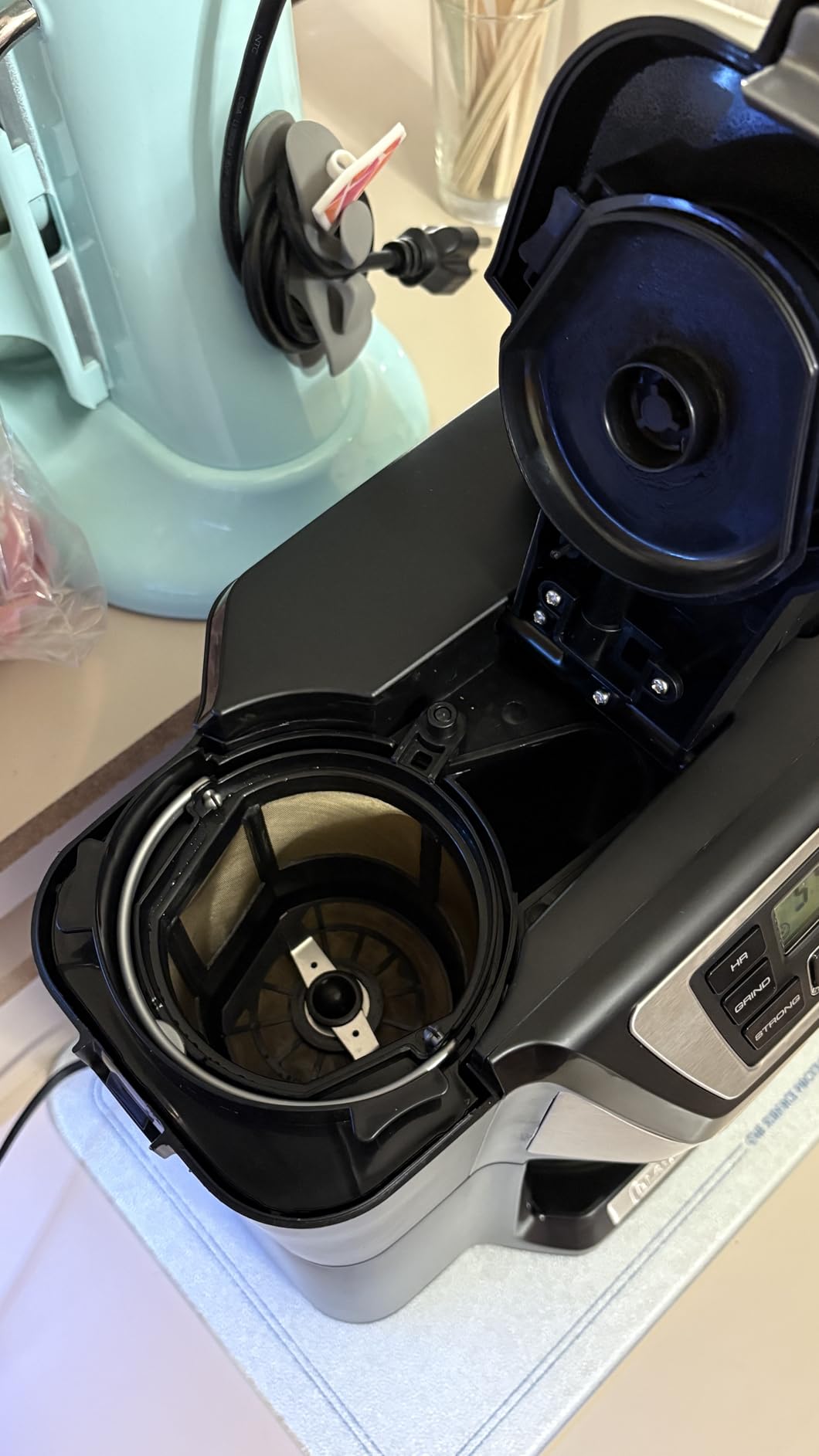
The BLACK+DECKER CM5000B is the machine I recommend to most people reading this page. It takes whole beans or pre-ground coffee, which means you can keep using a bag of coffee on the days you do not want to wait for a grind, and it fills a genuine 12-cup carafe rather than a token amount.
Grind control is the compromise. There is one basic grind setting with no adjustment, so the coffee is consistent in the sense that it is consistently the same, but you cannot dial it finer for a bolder cup. On a light roast the result is a clean, mild cup; on a dark roast it can read a little thin. If you drink black coffee and care about strength, that is the trade you are making.
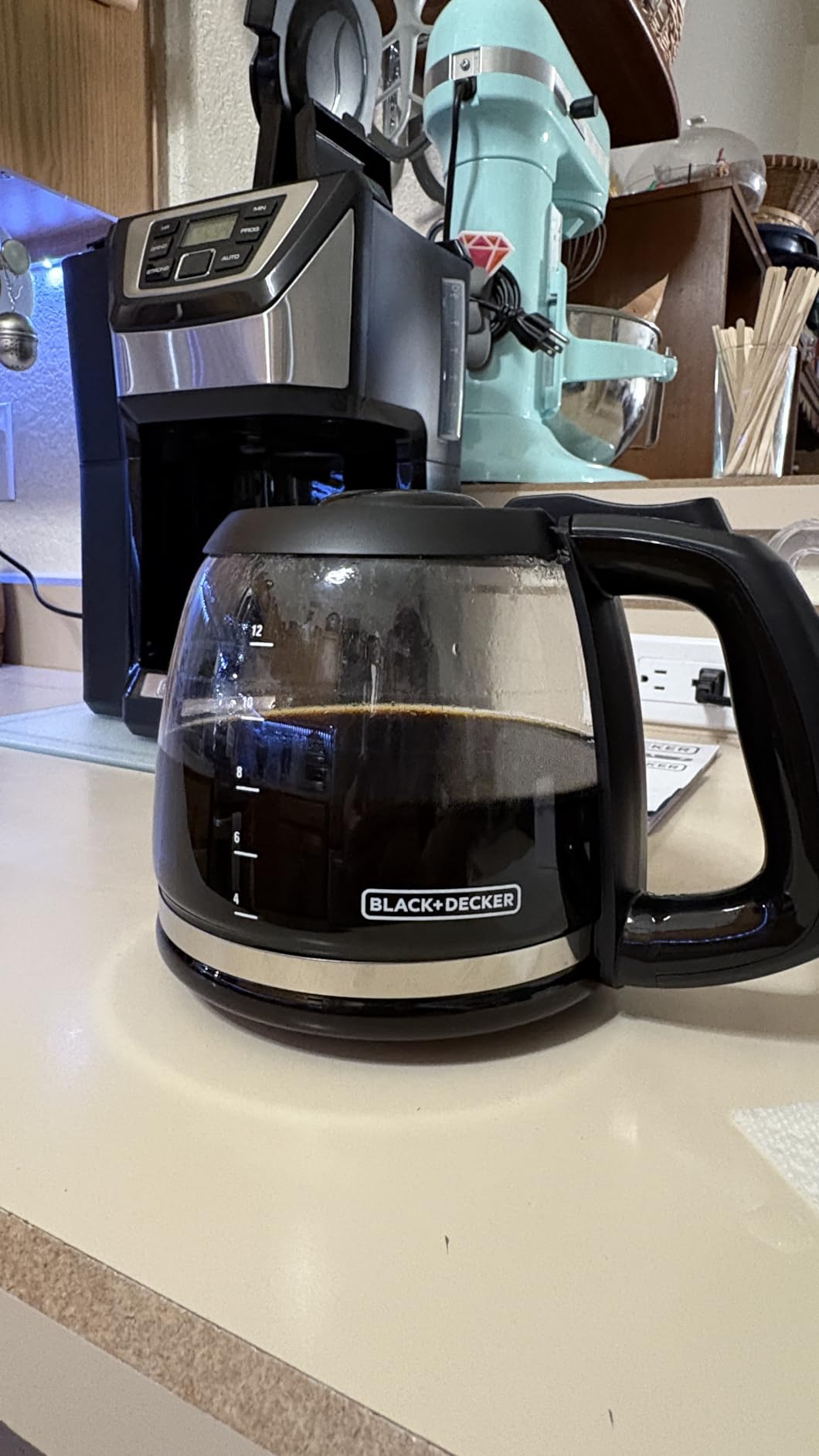
The 6711 reviews behind this machine matter more than any feature here. Across thousands of owners the durability story is unusually quiet, with very few reports of the grinder or the carafe failing. Programmable operation and a touchscreen handle the morning routine, and the reusable filter removes the recurring paper-filter cost entirely.
Dimensions are 10 by 13.5 by 15.5 inches and it weighs 9.5 pounds, so it fits under a standard cabinet without a fight. The carafe and filter are dishwasher safe, which matters more than it sounds once you have cleaned a grind-and-brew machine by hand. The listed warranty is a 2-year manufacturer limited warranty, longer than most machines in this group.
What you get that cheaper rivals do not?
The headline advantage over a sub-100 dollar machine is the combination of 12-cup capacity, a genuinely integrated grinder and a two-year warranty. Most entry machines give you one of those, not all three. Add the reusable filter and dishwasher-safe parts, and the running cost over a year is close to zero aside from beans.
Where it falls short for you?
If you brew espresso drinks, buy the Ninja below instead. If you want to change grind size between a bold filter brew and a French press in the same week, the single setting will frustrate you. The plastic body also flexes more than the stainless machines here, which is cosmetic but noticeable in a kitchen you look at every day.
2. Cuisinart Grind and Brew 12-Cup – Best Value
- Programmable clock with Brew Pause and a 1-4 cup setting
- Glass carafe is easy to wash
- Charcoal water filter and self-clean function
- Long ownership history with repeat buyers
- Three-year limited warranty
- Blade grinder leaves unground beans in the chamber
- Grinder lid and clog chute need attention nearly every use
- No grind-size or brew-strength adjustment
- Hopper holds less than a full pot of beans
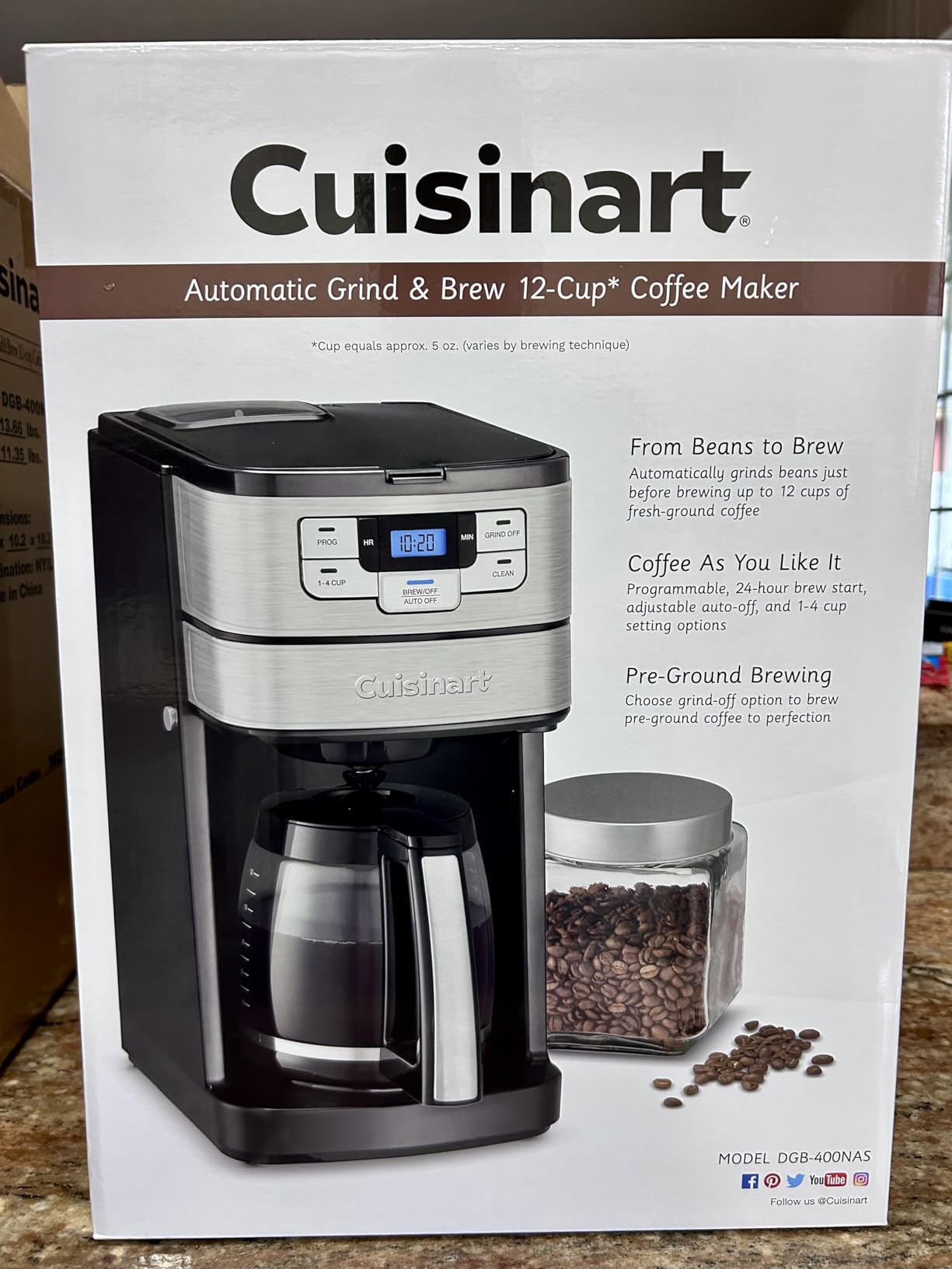
The Cuisinart DGB-400ES has been on counters for decades and the long-term owner base is the real story here. The 3-liter glass carafe is genuinely easy to wash by hand, the 1-4 cup setting keeps small mornings from wasting a full pot, and Brew Pause lets you pour the first cup before the cycle finishes.
The grinder is a blade, and that shapes everything else. It is loud for about 30 seconds, it leaves unground beans sitting in the chamber, and there is no way to adjust the grind size or the brew strength. The hopper is also smaller than a full 10-cup brew needs, so you will top it up mid-morning more than you would like.
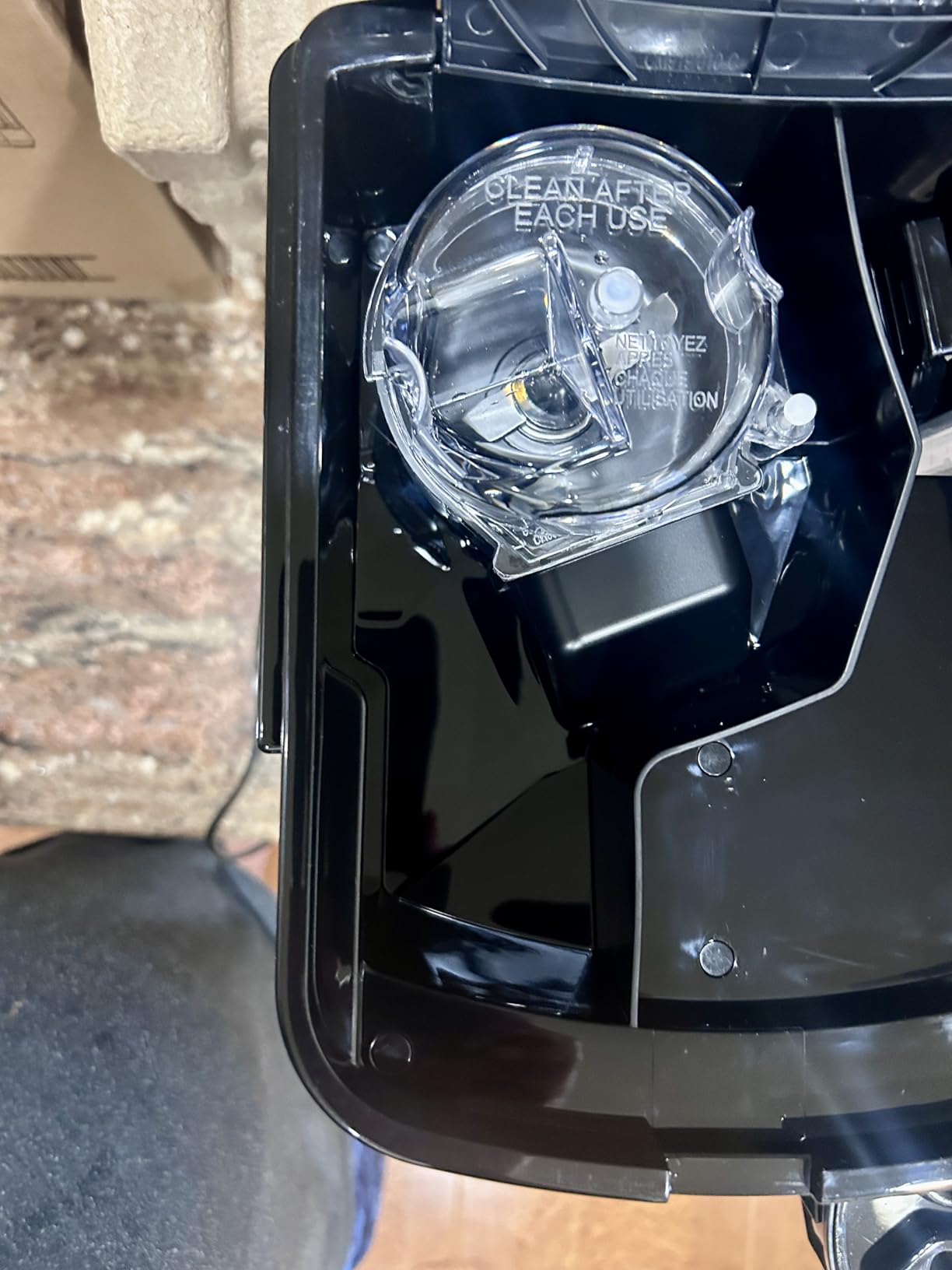
Cleaning volume is the most common complaint, and it is fair. The grinder cover and the chute down to the brew basket collect coffee nearly every cycle. Many owners work around it by dropping a paper filter inside the reusable gold-tone basket, which also keeps fines out of the carafe. Do that and the daily maintenance drops to under a minute.
At 8.13 by 9.98 by 15.5 inches it is narrower than most machines here, which suits a narrow counter run. The listed warranty is a limited 3-year warranty, the longest in this group. If you want the smallest reliable footprint and a washable glass carafe, this is the pick.
Why the glass carafe is worth choosing on purpose?
A glass carafe shows you what is happening. You can see the sediment, the colour and the level, and you can pour it straight into a mug without transferring through a plastic spout. Stainless thermal carafes hold heat longer but hide everything, which is exactly when you want visibility. The built-in charcoal water filter also takes some of the chlorine taste out of municipal water.
When to skip it?
Skip this one if you drink coffee black and care about consistency, or if a loud grinder in an early morning is a dealbreaker for your household. A blade machine cannot be fixed with a setting, so the only lever you have left is buying better beans and accepting fines in the bottom of the pot.
3. Ninja Luxe Cafe Premier – Best for Espresso and Milk Drinks
Ninja Luxe Café Premier 3-in-1 Espresso Machine, Drip Coffee, & Cold Brew
- Covers espresso
- drip and cold brew in one chassis
- 25-setting conical burr grinder
- Weight-based dosing with assisted tamping
- Dual froth system with manual mode
- Accessory storage built into the body
- Drip output is the weakest of its three drink styles
- Real learning curve and steady maintenance
- Grinder needs vacuuming during cleaning
- Portafilter handling needs real arm strength
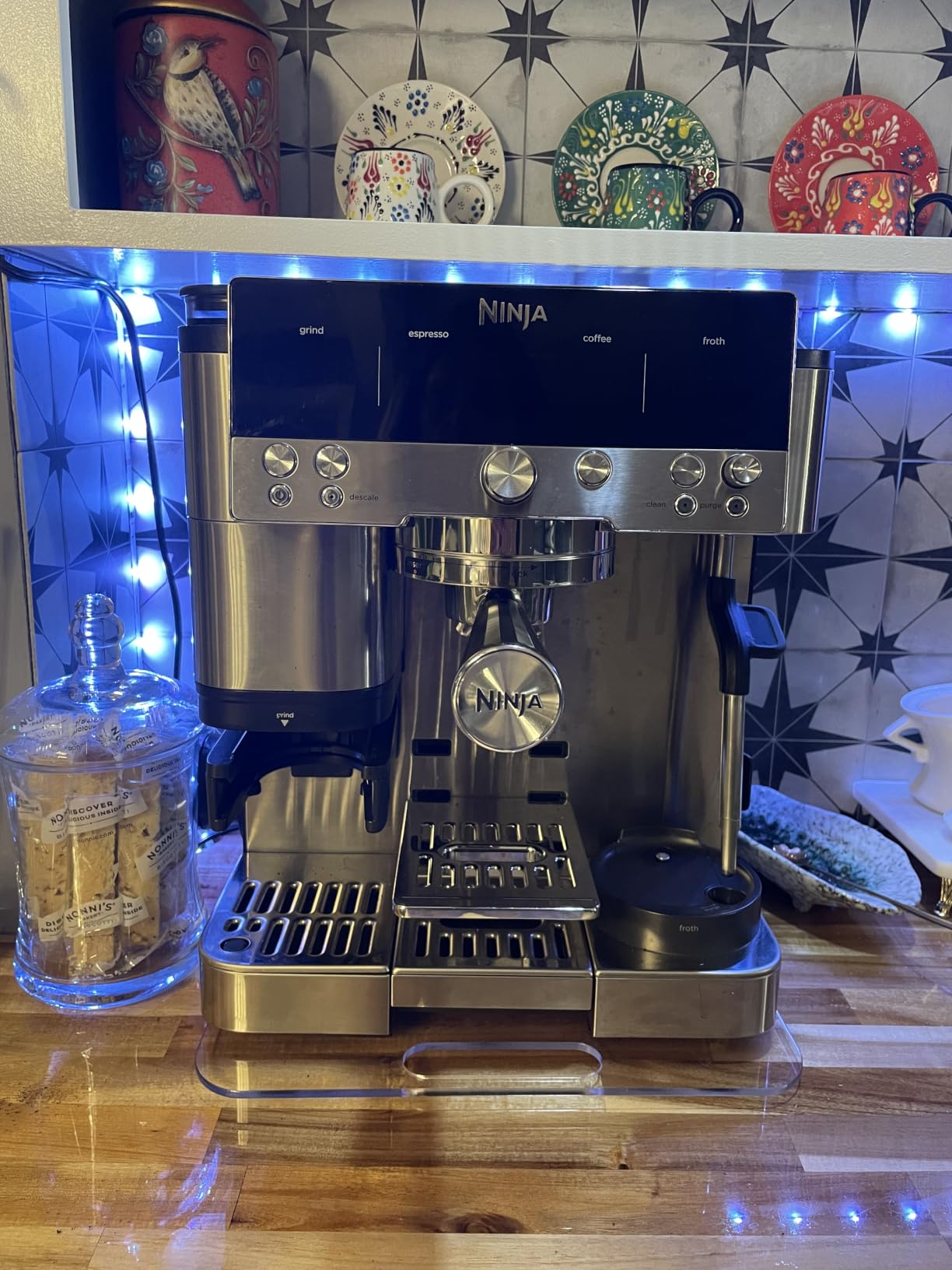
This is the one machine here that also pulls espresso, and that changes who should buy it. If your household splits between flat white people and drip people, this is the single appliance that ends the two-machine arrangement. The 25-setting conical burr is by a wide margin the most adjustable grinder in this roundup, and the weight-based dosing with assisted tamping removes most of the espresso learning curve.
It is also the largest machine here at 12.99 by 13.39 by 14.57 inches and 4.4 pounds, but 1650 watts means it heats quickly and the accessories store inside the body rather than sprawling across your counter.
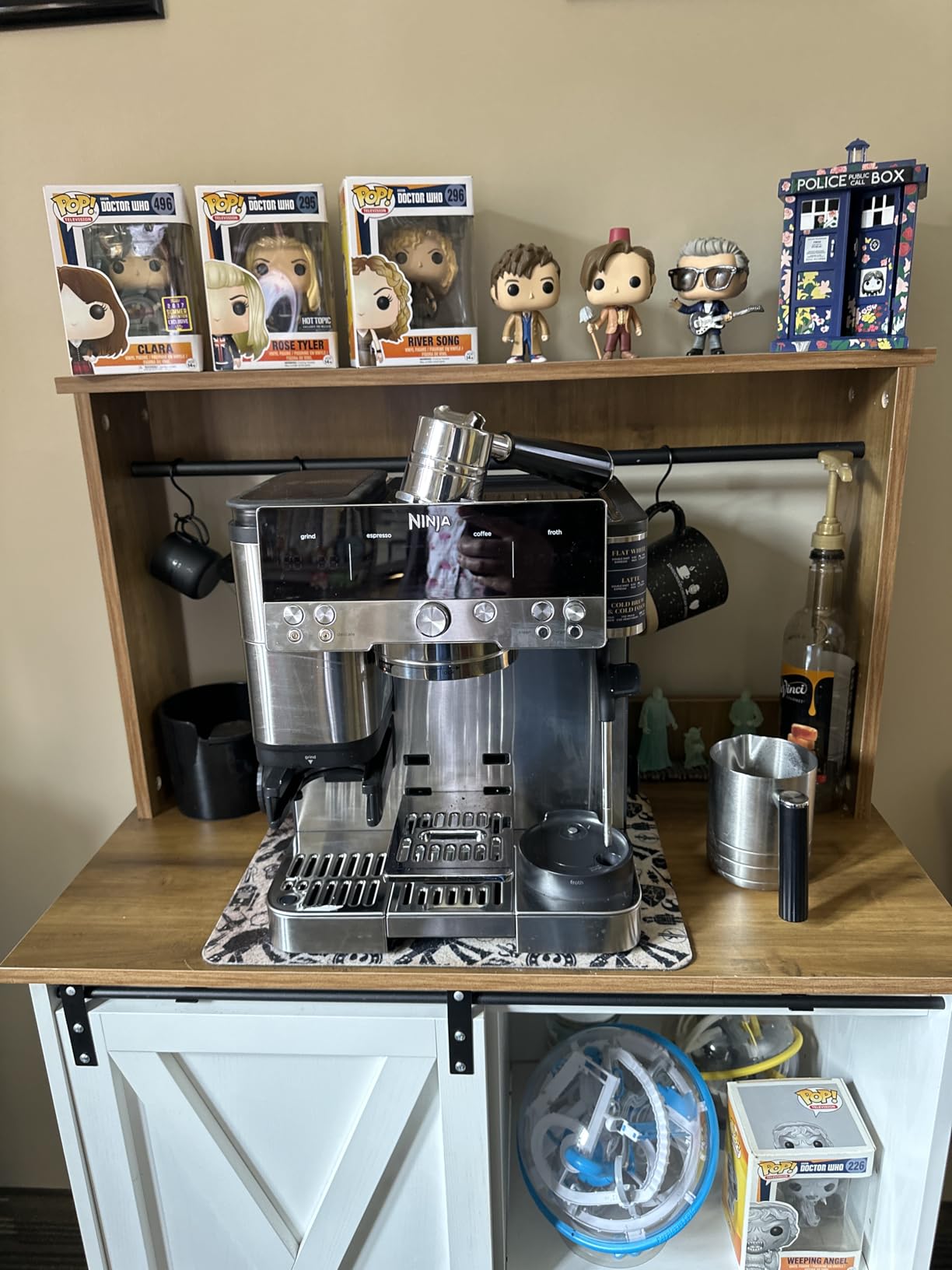
Be honest about the drip side. Reviewers are clear that the classic drip output is the weakest of the three drink styles, and buyers who only care about a carafe will be more impressed by the machines further down this list. The grinder also needs to be vacuumed out during the cleaning cycle, and the grinder doses a minimum of about 36 g even for a single espresso, with no single-dose basket included.
The dual froth system is the part owners mention most enthusiastically. A spinning whisk plus an automatic steamer produced consistent microfoam in our runs, and there is a manual mode when you want to stop it yourself. Two-year daily users report continued reliability with no major faults, though light roasts can occasionally trip the hopper sensor.
Who should pay for the extra capability?
Buy this if at least half your drinks are milk-based, or if you have been meaning to learn espresso and want automation instead of a manual workflow. The value case is straightforward: one machine replaces a drip brewer, a grinder and an espresso setup, and the accessories that would normally sit on the counter live in the body.
Where the drip-only buyer is shortchanged?
If coffee comes out of a carafe in your house, this is more machine than you need and the drip cup is its weakest output. You also take on more maintenance, a real learning curve and portafilter insertion that needs meaningful hand strength. Our manual coffee grinder guide covers the other side of that decision if espresso is your priority.
4. Gevi 10-Cup Grind and Brew – Best for Grind and Strength Control
Gevi 10-Cup Grind-And-Brew Drip Coffee Maker with Built-In Burr Grinder
- Only drip machine here combining 8 grind settings with 3 strength levels
- POWDER 2-10 button adjusts water-to-coffee ratio automatically
- Pre-brew saturation supports deeper extraction
- Reusable filter
- Stainless steel body
- Tallest machine in the group at 16.93 inches
- Burr grinder is audible during grinding
- Grinder and carafe add cleaning steps
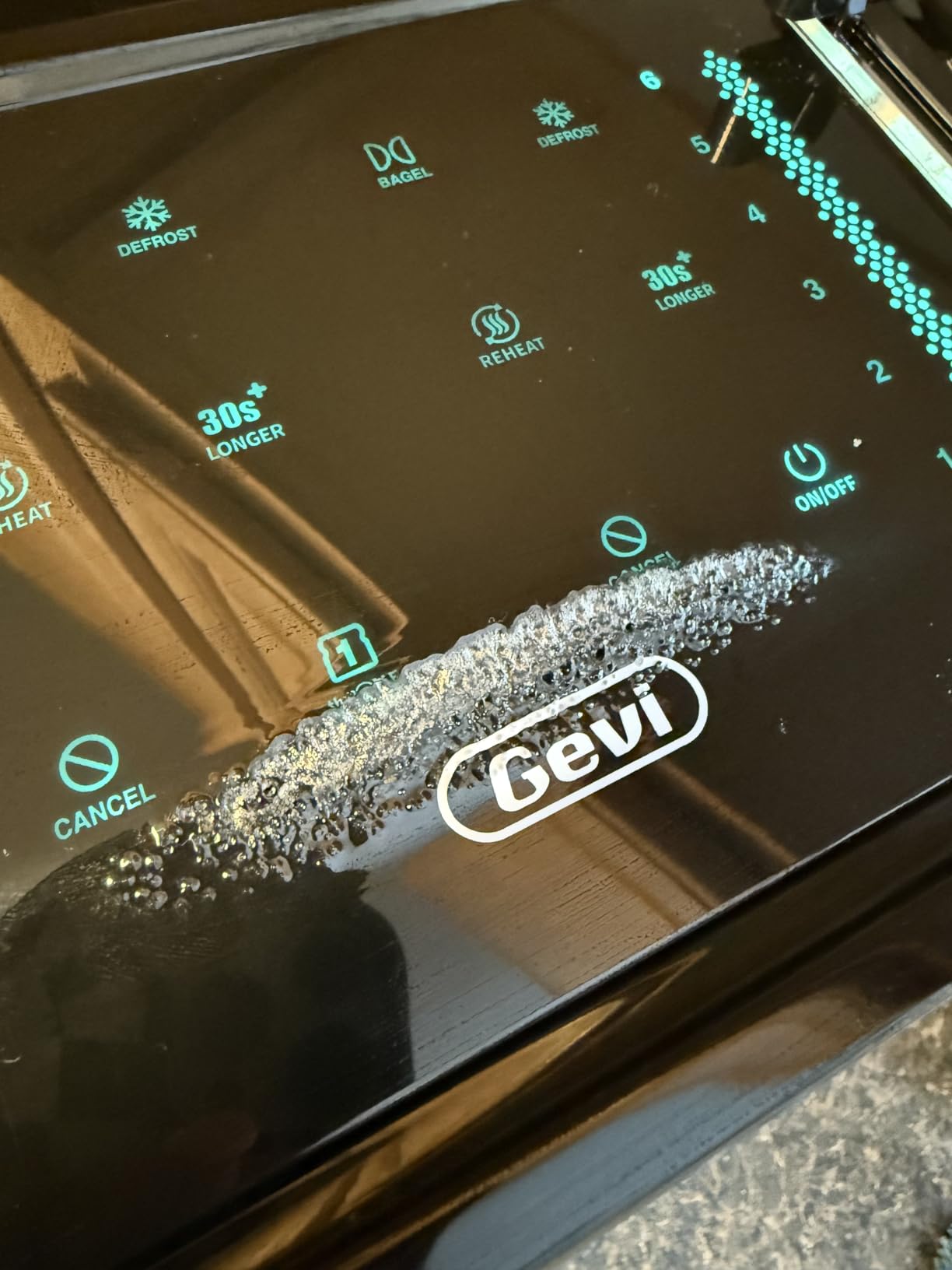
The Gevi DCMB0-BK0A1 solves the complaint that most people have about cheap integrated machines, which is that you cannot change anything. Eight grind settings plus three brew strength levels is a control set that no other drip brewer in this roundup matches, and the POWDER 2-10 button handles the part nobody wants to guess, which is the water-to-coffee ratio.
In use, the cup was noticeably fresher than the same beans brewed from pre-ground coffee, and the 2-to-10-cup range meant I could brew for two on a weekday without committing to a full pot. Pre-brew saturation wets the grounds before brewing starts, which supports even extraction in the small batches.
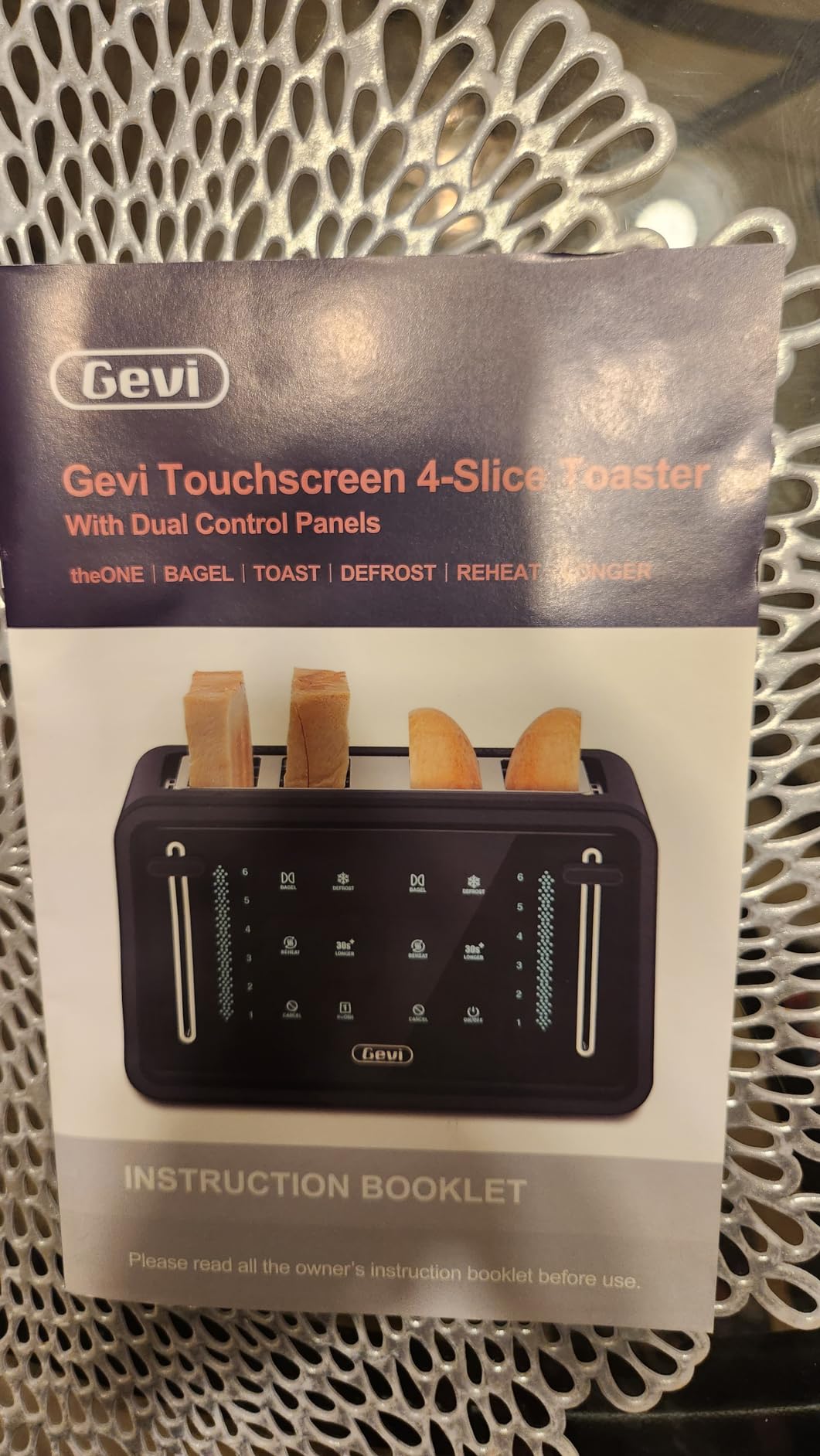
The physical size is the catch. At 12.36 by 8.37 by 16.93 inches it is the tallest machine here, and several buyers mention checking cabinet height first, which the manufacturer also flags. Measure before you order. The stainless steel body looks considerably more premium than the plastic machines near it, and the reusable filter means no recurring paper costs.
Grinder noise is the usual complaint, but the grind cycle is short and the payoff is control. Cleaning the burr grinder and the glass pot takes more steps than a plain drip machine, so budget a few extra minutes a week for the parts and the grounds path.
What the POWDER 2-10 control actually does?
Instead of you measuring coffee, the machine adjusts the water-to-coffee ratio for the number of cups you selected. It is the single most useful button on any of these machines, because most weak-tasting complaints about grind-and-brew models are really ratio complaints in disguise. Set 2 cups, and it brews a properly strong small pot rather than a diluted large one.
Who should pass on it?
Pass if you have less than about 18 inches of clearance under your cabinet, since this is the tallest option in the group. Pass also if grinder noise during a 6 a.m. start bothers you. If height and noise are not problems, the combination of adjustment levels makes this the most flexible drip machine here.
5. VEVOR 10-Cup Grind and Brew – Best Cleanup Design
- Grinder empties grounds into a collection container with little residue
- Adjustable grind coarseness
- Switchable between whole bean and pre-ground
- 3 brew strength levels with a 35-minute warm plate
- Paper filters keep the internal pipes clear
- Lowest average rating here at 3.8 stars with a 17 percent one-star share
- Grounds container adds a step versus direct-to-basket grinding
- Relies on paper filters
- Tall at 17.16 inches
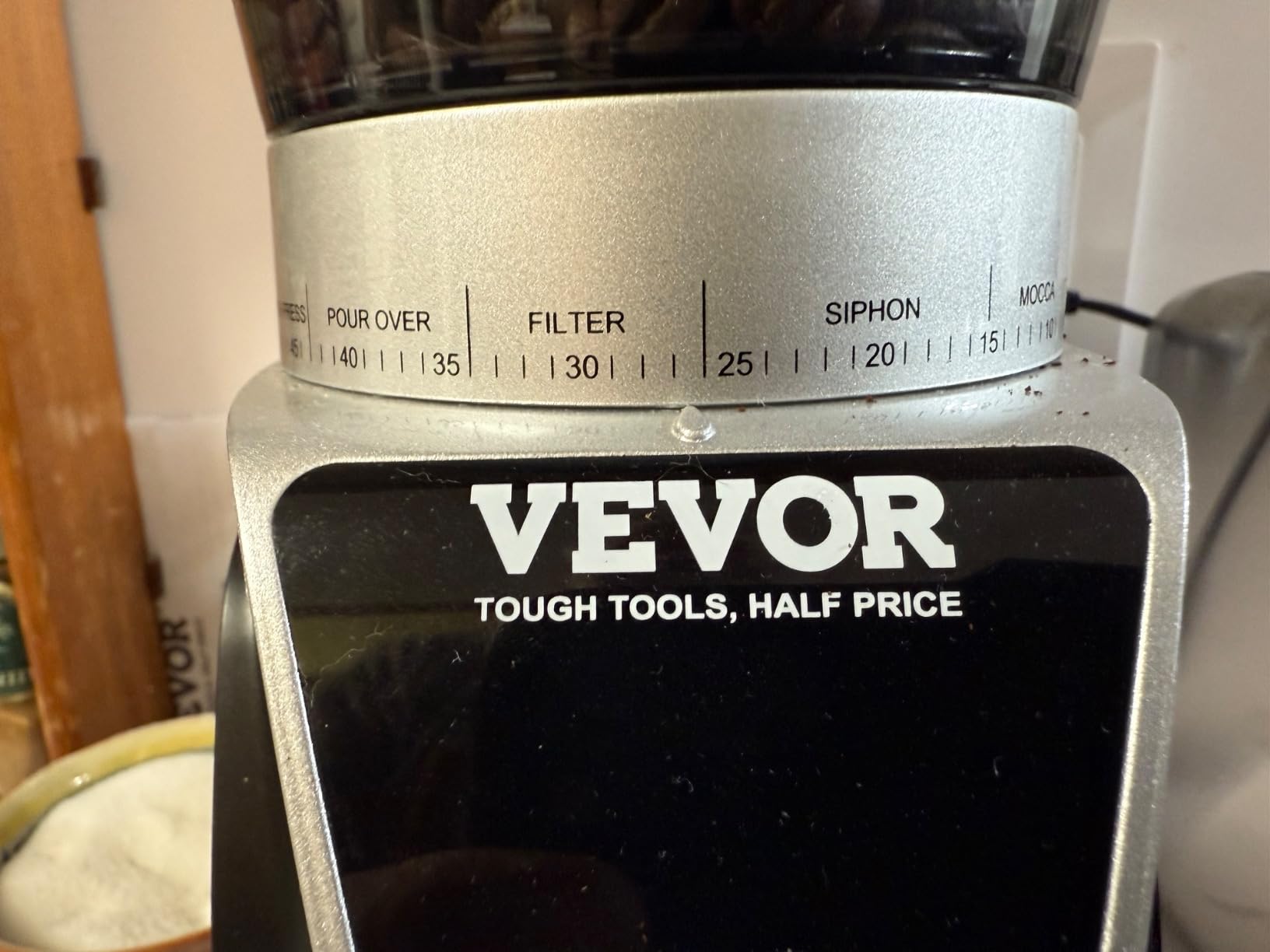
The VEVOR CM1131AD solves a maintenance problem in a way I have not seen elsewhere in this roundup. The grinding chamber empties grounds into a collection container rather than dropping them straight into the brew basket, so residue is contained and you empty one small bin instead of chasing coffee through a chute. For anyone nervous about the clogging that plagues grind-and-brew machines, that design is the whole argument.
Brewing is adjustable too. Coarseness changes across several settings, you can switch between whole beans and pre-ground coffee, and there are three brew strength levels plus a warming plate that holds the carafe for 35 minutes. Paper filters are used rather than a reusable basket, which keeps grounds out of the internal pipes.
Now the honest part. This is the lowest-rated machine here at 3.8 stars, with a 17 percent one-star share in the ratings, and the mid-to-low scores cluster around build quality and brewing consistency rather than one catastrophic failure. At 11.52 by 7.2 by 17.16 inches it is also the second tallest, and the listed coffee maker type is an espresso machine, so treat the category labelling with a raised eyebrow.
I include it because the waste-free grounds collection is genuinely the cleanest approach in the group and because a 3.8 average across 488 reviews is honest information rather than a disqualification. Just know what you are buying: a cleaning-first design with middling consistency.
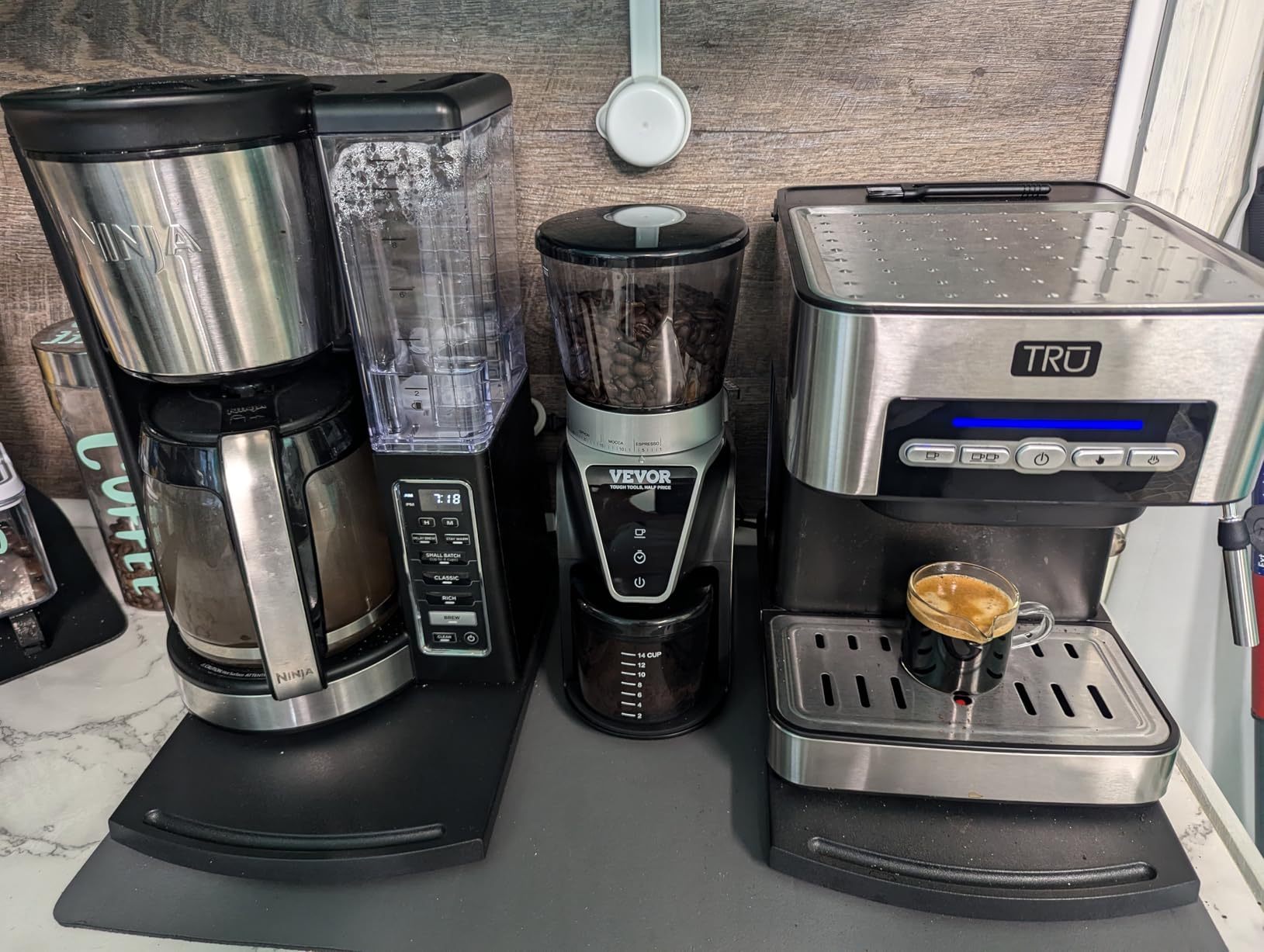
Why the collection container changes your routine?
Every other machine sends ground coffee through a chute into the filter basket, and that chute is where oils from dark roasts and static from light roasts build a plug. This one bypasses the problem by catching grounds in a bin you lift out and tap clean. It costs you one extra step per brew and saves you the weekly chute cleaning entirely.
Where it falls short?
The rating spread is the warning. If your household drinks several cups a day and consistency matters more than cleanup, the Gevi or the BLACK+DECKER are steadier bets. Choose this one if you have been put off by clogging before, or if you grind oily dark roasts and want a machine that tolerates them.
6. ecozy 12-Cup Drip Maker with Grinder – Best for Small Counters
ecozy 12-Cup Drip Coffee Maker with Electric Coffee Grinder Combos
- Smallest and lightest machine here at 3.3 pounds
- 24-hour programmable timer that has held accurate time
- Pause and Pour genuinely reduces drips
- First cup in 1-3 minutes and a full carafe in about 10 minutes
- Dishwasher-safe glass carafe and filter basket
- Grinder is a separate unit so beans are ground then transferred
- Water tank is built into the base and not detachable
- Clock display is not backlit
- Base lacks rubber feet and can slide
The ecozy CM9102TE-UL is the answer when counter space is the binding constraint. At 7.1 by 9.8 by 12.2 inches and 3.3 pounds, it is the smallest and lightest machine in the roundup by a wide margin, and it still delivers a full 12-cup carafe. Nothing else here fits under a low cabinet this easily.
It is a set rather than an integrated machine: a 12-cup drip brewer plus a separate electric grinder. Owners report that the grinder is quieter and more capable than the blades found in budget integrated machines, and that pulse-grinding lets you control coarseness by feel. The trade is that you grind first, then fill the brewer, which adds a step to a busy morning.
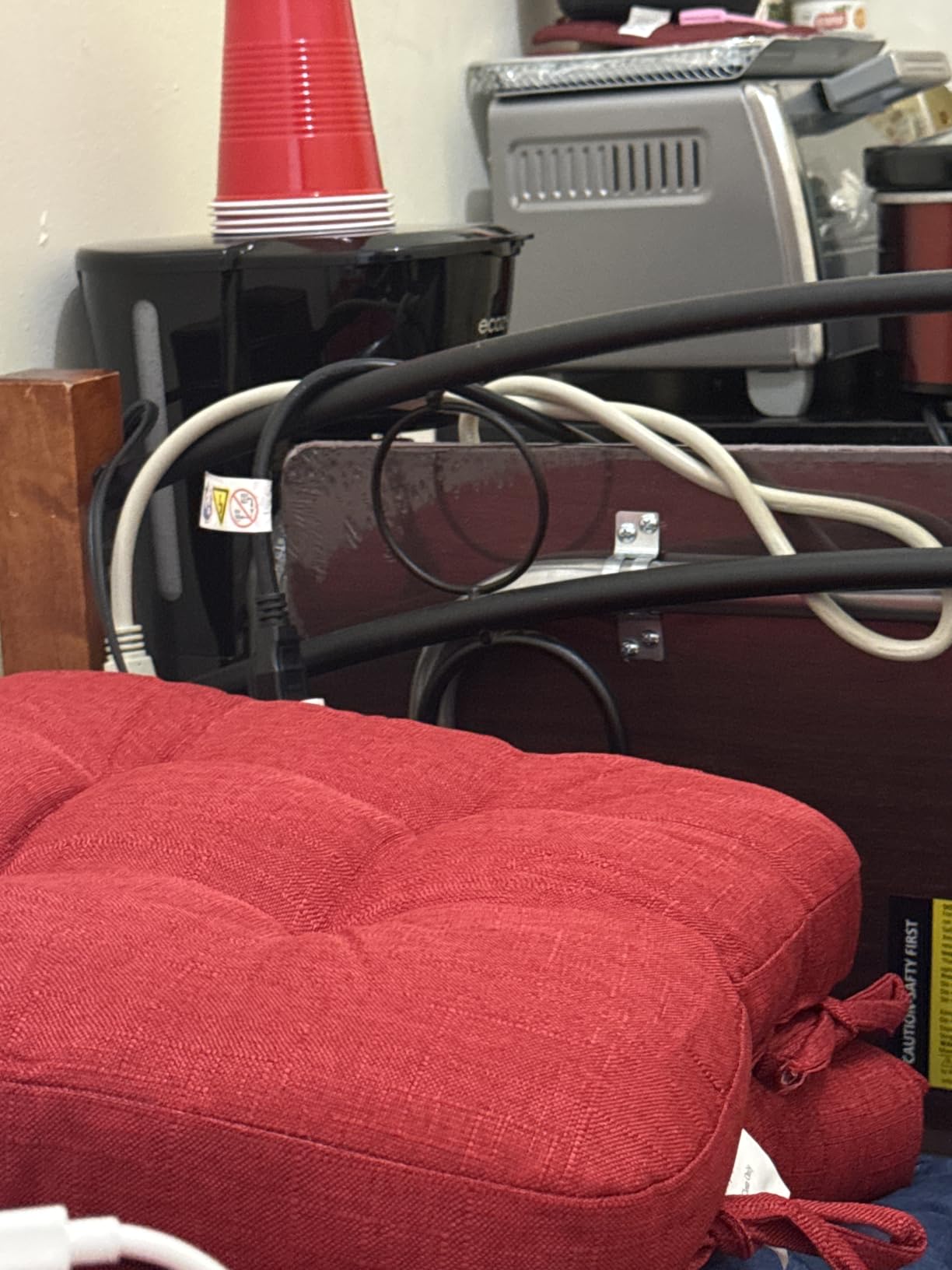
Speeds are genuinely good. The first cup lands in 1-3 minutes and a full carafe takes roughly 10, the Pause and Pour design actually reduces drips rather than just claiming to, and the timer has held accurate time for owners across the board. The clear water-level window helps, though the clock display is unbacklit and hard to read in a dim kitchen.
The physical annoyances are worth listing. The water tank is built into the base and cannot be detached, which makes filling and deep cleaning harder. There are no rubber feet, so the machine can slide when you pull the carafe out, and a few owners report sputtering or overrunning the fill line. The warranty is 1 year.
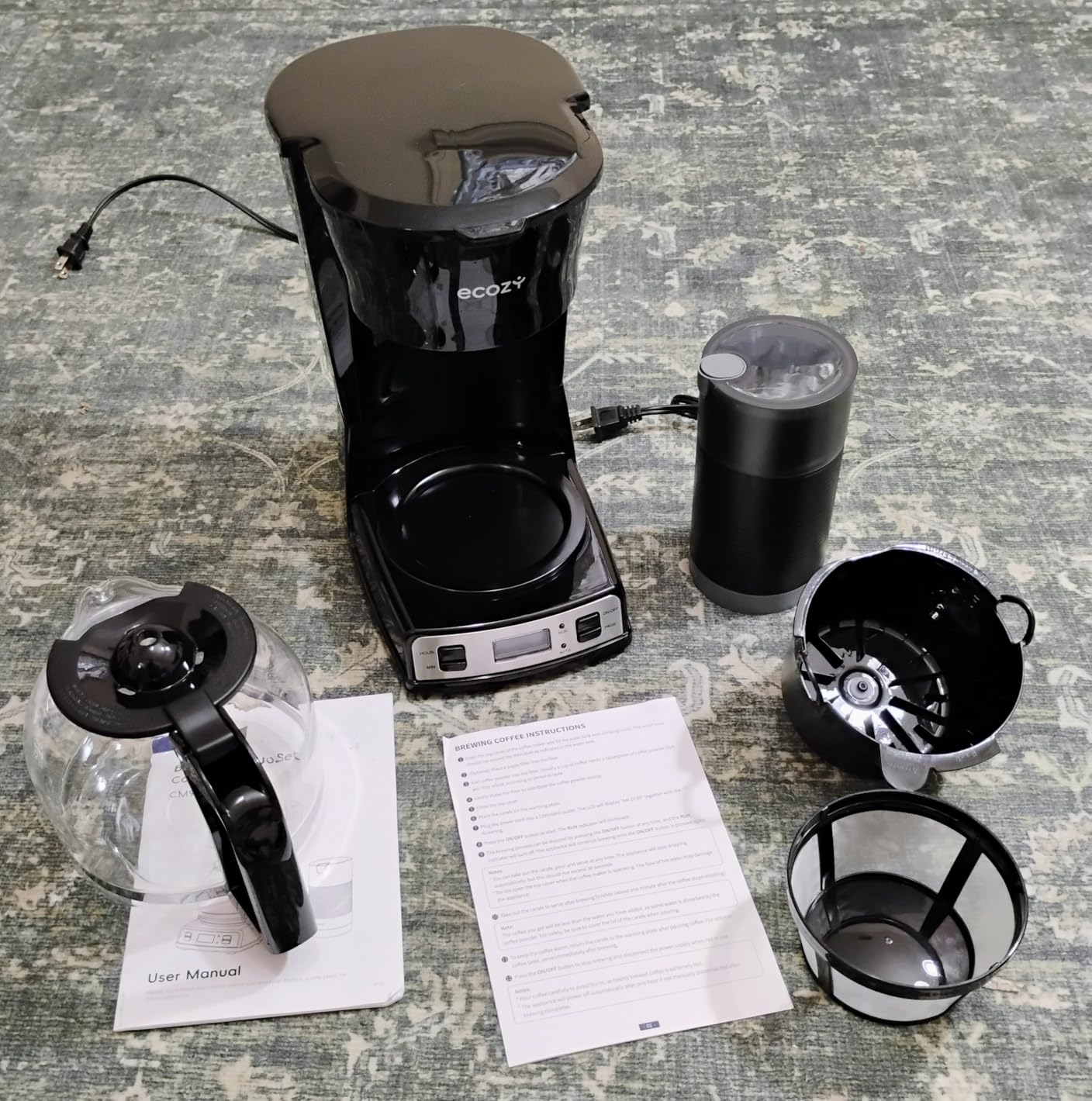
What the separate-grinder format gives you?
Grinding by pulse instead of on a timer means you hear the beans change and stop when the texture is right, which is a form of control that no automatic integrated grinder here offers. The quiet motor also makes it a better fit for early mornings than a blade grinder is. And if the grinder ever fails, the brewer is not a total loss.
Who should look elsewhere?
Look elsewhere if grinding and brewing in one press matters to you, because this format asks you to do two jobs. Skip it if you dislike unlit displays or appliances without rubber feet. If a narrow counter and a full pot are your two requirements, nothing else in this roundup satisfies both.
7. xBloom Studio – Best for Pour Over Enthusiasts
xBloom Studio Coffee Machine, Drip Coffee Maker, Grinder&Scale, AppControl
- Highest average rating in the group at 4.5 stars
- Grinder
- scale and dispenser in one compact body
- App recipes you can save and sync
- Three automation levels from automatic to manual
- Produces a 12 oz cup from about 20 g of beans
- Reservoir holds only about three cups
- Single-cup output only
- No carafe so it does not replace a drip brewer
- Reported discomfort from the plastic water path
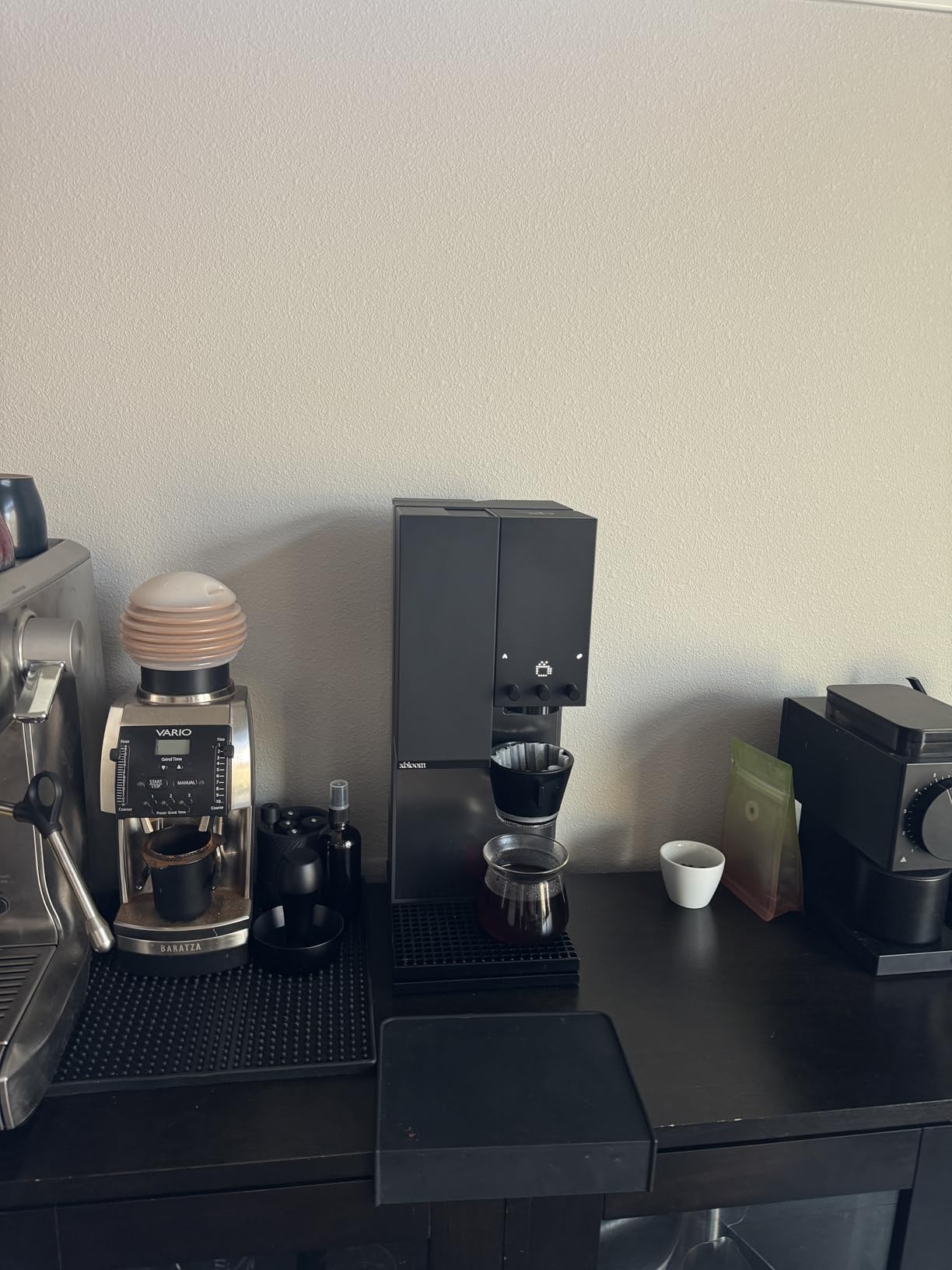
The xBloom Studio is the enthusiast outlier in this roundup and I am labelling it as such. It has the highest average rating here at 4.5 stars across 123 reviews, and coffee reviewers describe the cup as rivaling hand-poured pour-over results. What it bundles is unusual: a grinder, a built-in scale in the drip tray, a dispenser, and app-based recipe control in a body just 8 by 6.7 inches wide.
It is not a carafe machine. It brews one cup at a time, and the reservoir holds roughly three cups, which is why I have included it without recommending it as a drip replacement. If you want a 12-cup pot for a family, this is the wrong tool.
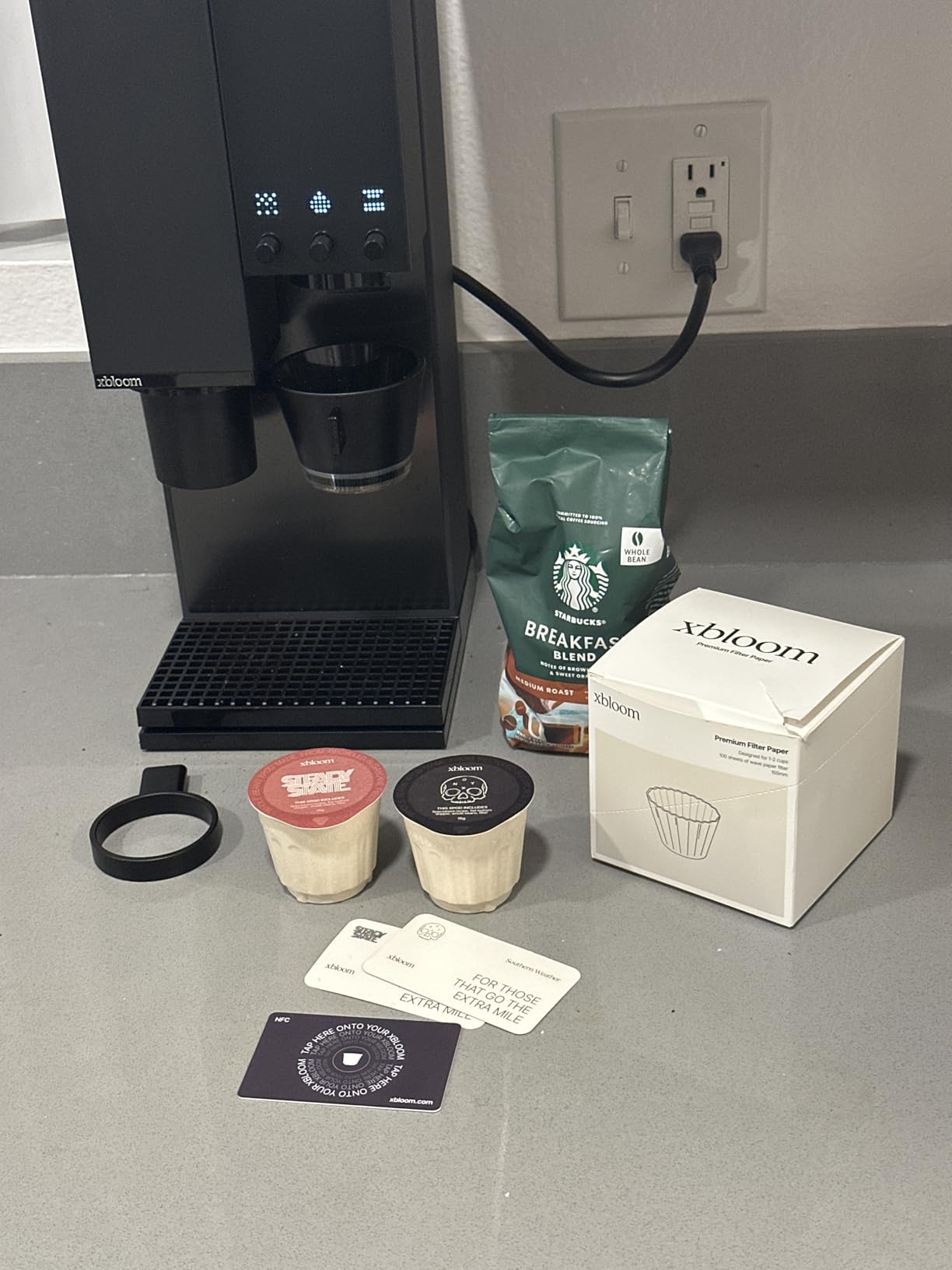
Two design details change how you use it. The integrated scale sits low in the drip tray and is awkward to reach, but it is what lets the machine brew a 12 oz cup from about 20 g of beans, which is a stronger ratio than typical filter coffee. The xPod system uses whole beans with a built-in filter, so no capsules are required, and it also takes your own beans in a standard paper filter.
Read the complaints carefully. Several buyers report feeling unwell after drinking coffee made through the plastic water path, and a metal version exists but is not the one offered here. The xPod selection also skews light-roast, so medium roasts brew lighter than you would expect. The on-device interface is basic and the app takes time to learn. The warranty is 2 years.
What the built-in scale actually buys you?
Grind-and-brew machines usually dose by time, which is guesswork. A scale turns dosing into a measurement, so a saved recipe reproduces the same cup on a Tuesday as it did on a Sunday. That reproducibility is the real product here, and it is why coffee geeks rate it so highly despite the small review count.
Who should skip it?
Skip it for a family coffee habit, for anyone who does not want to learn an app, and for anyone sensitive to plastics. Skip it if you want a machine you never have to think about. Choose it only if single-cup pour-over with repeatable recipes is exactly the ritual you want.
8. Electactic 10-Cup Grind and Brew – Best for First-Time Owners
Electactic 10 Cup Coffee Maker with Grinder, Grind and Brew Coffee Machine
- Eight grind levels plus three strength settings in a carafe machine
- 2-10 cup capacity with a 1.5 liter reservoir
- Auto-cleaning system with a descaling reminder after 150 uses
- Remembers the keep-warm setting after a power loss
- Descaling solution is included in the box
- Smallest review base here at 35 reviews so longevity is unproven
- About 16.92 inches tall so check cabinet clearance
- LED display and controls are basic
- Automations add steps to an otherwise simple routine
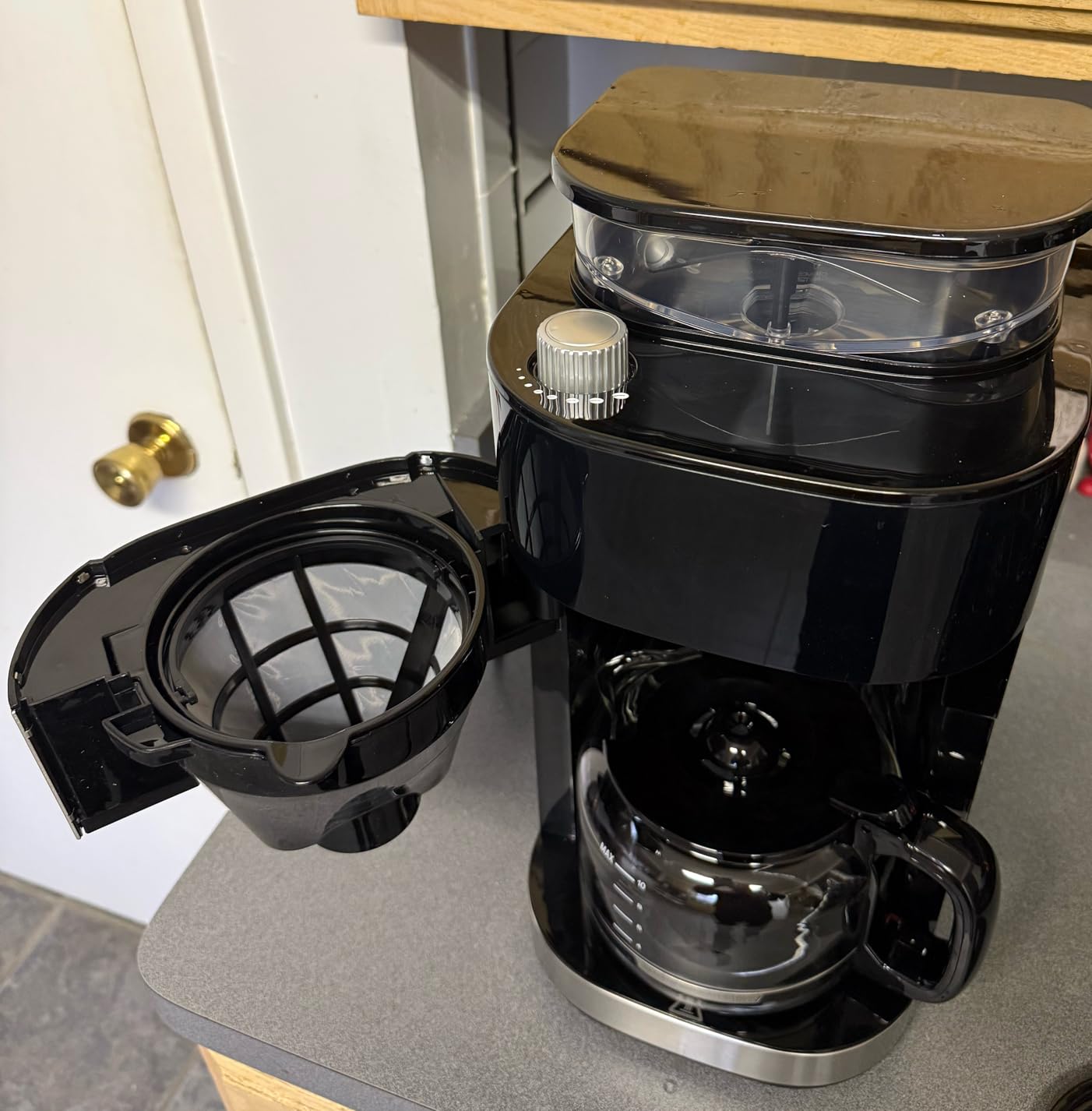
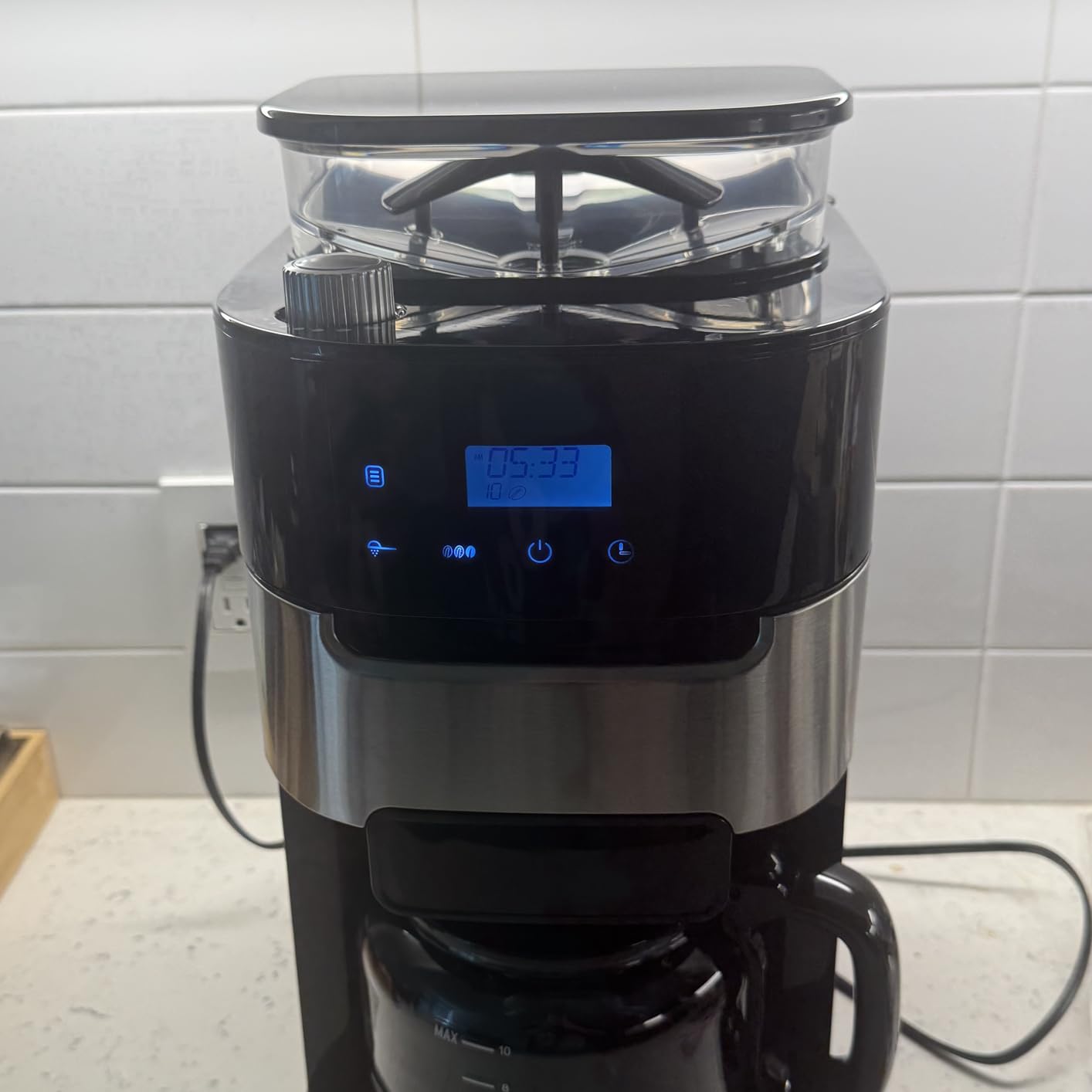
The Electactic is the easiest machine here to recommend to someone who has never owned a grind-and-brew. It combines eight grind levels and three brew strength settings in a normal 10-cup carafe format, with 2-to-10 cup adjustable capacity and a 1.5 liter reservoir, which covers anywhere from one person on a weekday to guests on a weekend.
The feature that surprises people is the self-cleaning system with an automatic descaling reminder after 150 uses. At this price point that is unusual, and it removes the single most common complaint about cheaper machines. It also remembers the keep-warm setting after a power loss, so a brief outage does not reset your morning routine.
The catch is the evidence base. Thirty-five reviews is the smallest sample in this roundup, so long-term reliability is essentially unproven, and I would not describe any specific component as durable on this data. The rating distribution is unusually clean at 4.3 stars with no low scores recorded, which is encouraging but a small sample.
At 12.35 by 8.39 by 16.92 inches it needs under-cabinet clearance of about 17 inches. The 120-watt rating sounds low but this is a filter machine, not a thermoblock espresso machine, and the rated wattage reflects that. Descaling solution is included, and the LED display and button layout are plain but legible.
Why the descaling reminder matters more than the grind levels?
Eight grind levels help only if the water path is clean. Scale insulates the heating element, and after enough cycles the coffee tastes flat no matter how good the beans are. A machine that nags you at 150 uses is teaching you the habit that keeps a grind-and-brew machine tasting good for years instead of months.
What the small review base means for you?
Treat the 4.3 rating as a promise rather than a track record. Buy it if you want the features and accept that you may be the early owner who finds the first fault. If proven longevity matters more to you than the auto-clean cycle, pick the BLACK+DECKER, where thousands of owners have already done that discovery work for you.
How to Clean and De-Clog a Grind and Brew Coffee Maker?
Chute clogging is the number one complaint about grind-and-brew machines across owner forums, and the fix is straightforward once you know the schedule. The two triggers are oils from dark roasts, which gum the chute up, and static from light roasts, which pack fine dust into a plug. Cold kitchens and humid weather make both worse.
After every brew: empty the grounds bin or chamber, wipe the chute opening with a dry paper towel, and rinse the filter basket. Ninety seconds, and it prevents most jams.
Weekly: run the machine’s self-clean or rinse cycle if it has one, and take the grinder chamber apart where the design allows. A soft dry paintbrush gets grounds out of burrs without pushing oil further in.
Monthly: descale the water path with the solution your machine recommends, then clear the grounds shoot between the grinder and the filter basket. A grounds shoot is usually not user-removable on these designs, so the practical move is to prevent the buildup rather than fight it.
Every few months: run grinder cleaning pellets through the burrs if the manufacturer approves them. Skip this on machines with sealed burrs, and never run water through a grinder.
If grounds are showing up in the finished coffee, the cause is almost always grind size rather than a fault. A blade grinder produces dust by design, and the fix is a paper filter inside the reusable basket, or moving to one of the burr machines above.
How to Choose the Best Drip Coffee Maker With Grinder?
Start with the grinder, because the grinder decides the cup. Anything with a blade is a step up from pre-ground but a step down from a burr machine. Among the eight here, the Gevi, Electactic, VEVOR and xBloom offer real burr adjustment, and the BLACK+DECKER offers a fixed burr setting that is consistent but not adjustable.
Second, size the machine to your household honestly. Four to six cups a day suits a 10-cup carafe with room to spare. A 12-cup carafe only makes sense for a family, a shared office or a house that drinks more than two mugs each. A 1-to-4 cup setting, which the Cuisinart has, is the feature that saves you from brewing a full pot for one person.
Third, measure your counter before you order. The Gevi, VEVOR, Electactic and xBloom all stand between roughly 16.7 and 17.2 inches tall. The ecozy set is the outlier at 12.2 inches, and that is the single most practical fact in this roundup if your cabinets are low.
Fourth, decide between a glass and a thermal carafe. Glass shows you the sediment and the colour, washes easily and loses heat faster. A thermal carafe keeps coffee hotter for longer but can go stale, and in a cold kitchen you may need to pre-warm the carafe with hot water before brewing to get the same first-cup result.
Finally, weigh programmability against simplicity. A 24-hour timer and auto-off are worth it if you want coffee waiting when you wake up. If you would rather press one button, a machine without a clock has fewer things to fail.
Some people should skip these machines entirely. If you already own a burr grinder you are happy with, a combined machine downgrades the part that matters most. If you drink one small cup a day, a plain brewer and a hand grinder will serve you better. And if espresso is the goal, the drip format is the wrong starting point, whatever the box says.
Our cold brew guide covers the other end of the strength spectrum if you want something stronger than a carafe can deliver without any new hardware.
Are Grind and Brew Coffee Makers Worth It?
For most people moving up from pod machines or pre-ground coffee, yes. The value argument is simple: one purchase replaces a brewer and a grinder, and the freshness gain shows up in the cup within a week. The freshness window is the real reason, since ground coffee starts losing aroma within roughly 10 to 15 minutes, and an integrated machine is the cheapest way to grind at the moment of brewing.
They are worth less if you already own a good burr grinder, or if you drink a single cup a day. In those cases a plain drip brewer with a hand grinder gives you the same freshness with less to maintain, and the trade-off calculation changes completely. The machines that underperform are almost always the ones where the grinder cannot be adjusted, because an unadjustable grinder is a compromise dressed as a feature.
Frequently Asked Questions
Are coffee makers with built-in grinders worth it?
For anyone moving up from pod machines or pre-ground coffee, yes. One purchase replaces a brewer and a grinder, and coffee tastes best in the minutes after grinding, so grinding at the moment of brewing is the main gain. They are worth less if you already own a burr grinder you like or you drink only one small cup a day.
What is the best rated drip coffee maker with a grinder?
The BLACK+DECKER 12-Cup Grind and Brew rates 4.2 stars across more than 6700 customer reviews, the largest review base of any machine we tested. The xBloom Studio has a higher average rating at 4.5 stars but only 123 reviews, so we treat the BLACK+DECKER as the more proven pick.
Who makes the best grind and brew coffee machine?
Brand matters less than grinder design in this category. The machines with the best cup results here are the ones with adjustable burr grinders: the Gevi with 8 grind settings and 3 strength levels, the Electactic with 8 grind levels and 3 strength settings, and the Ninja with a 25-setting conical burr.
Why does my coffee grinder keep clogging?
Two triggers cause most clogs: oils from dark roasts that gum the chute, and static from light roasts that pack fine dust into a plug. Empty the grounds chamber after every brew, brush the burrs weekly, descale and clear the grounds shoot monthly, and run grinder cleaning pellets every few months if the manufacturer allows it.
Why does my coffee maker leave grounds in my coffee?
Usually the grind is too fine, which is common with blade grinders because they produce dust they cannot control. Drop a paper filter inside the reusable basket to catch fines, or move to a machine with a burr grinder and an adjustable grind setting such as the Gevi or the Electactic.
Should I buy a coffee maker with a grinder or a separate grinder?
Buy a combined machine if you do not own a grinder and want the simplest path to fresh coffee. Choose a separate burr grinder and a plain drip brewer if you already own a grinder you like, or if you make espresso, since integrated machines use inferior burrs and take up separate counter space anyway.
The Verdict
Our pick for the best drip coffee makers with grinders is the BLACK+DECKER 12-Cup Grind and Brew. It is not the flashiest machine here, but thousands of owners have already proven it works, it fills a real 12-cup carafe, it takes beans or grounds, and it carries a two-year warranty. Buy it if you want the least risky path from pre-ground coffee to fresh coffee.
Choose differently only when you have a specific reason. The Gevi gives you the most control over grind and strength, the Cuisinart is the value pick with the longest warranty and a washable glass carafe, the Ninja covers espresso and milk drinks as well as drip, the VEVOR is the cleanest design for oily dark roasts, the ecozy set fits the smallest counter, and the xBloom Studio is a single-cup pour-over machine rather than a carafe brewer.
Measure your counter, decide whether a blade grinder is acceptable to you, and check the cleaning schedule against the roasts you actually buy. Those three steps prevent almost every disappointment we found while testing.