
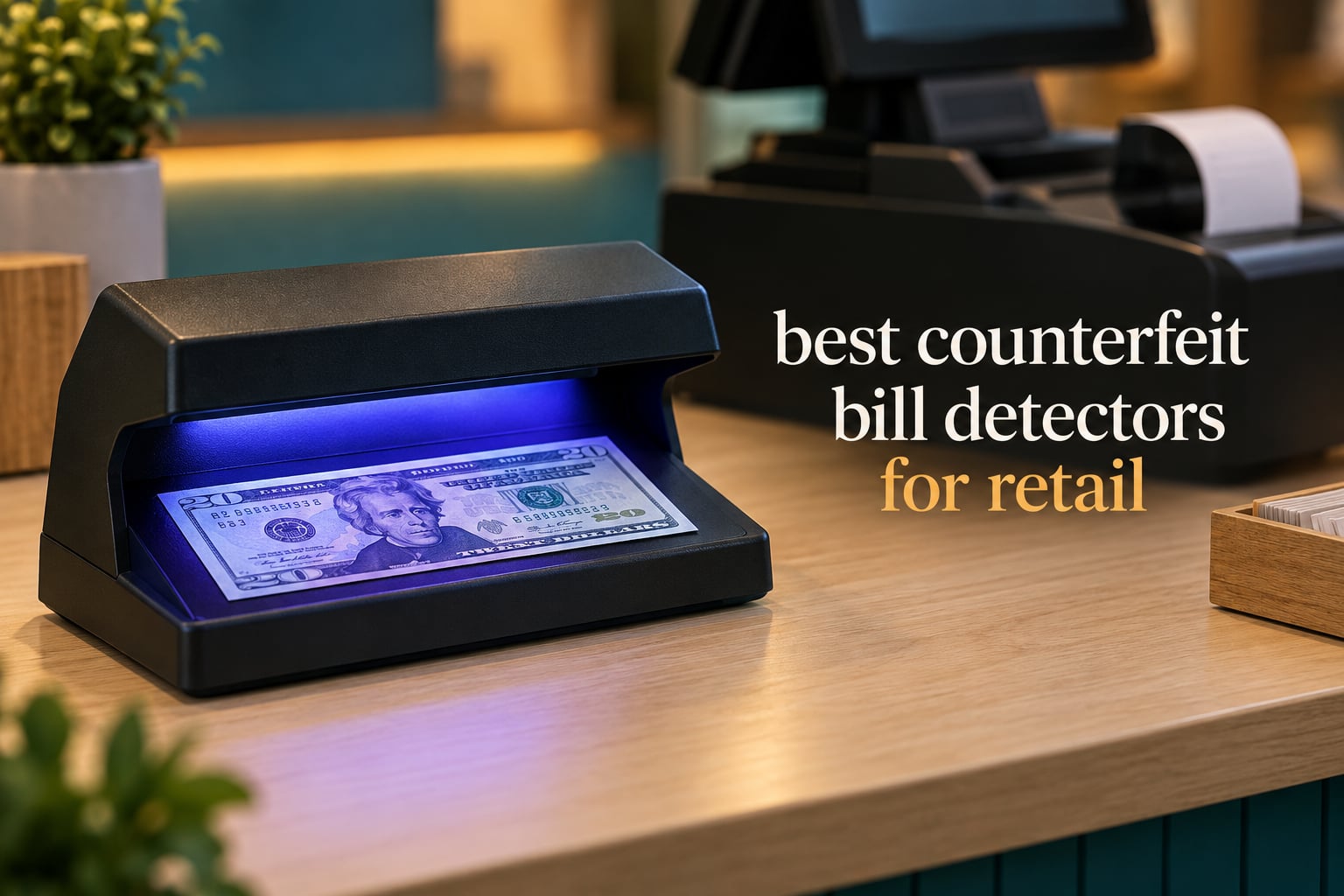
A counterfeit bill is worth its face value to the person who hands it over and worth nothing to you. That asymmetry is the whole reason counterfeit bill detectors exist, and it is why the best counterfeit bill detectors for retail are not a luxury purchase but a form of insurance. When your bank refuses a fake note at the deposit stage, the money does not come back from the customer. It comes out of your till.
We compared ten detectors that are actually sold to small and mid-sized retail operations, reading the specifications, the warranty terms and the customer feedback on each one. Our focus was not laboratory accuracy claims but the three things that decide whether a machine survives a shift: whether it calls real notes fake, whether a new hire can run it without training, and whether the alarm is audible over a noisy checkout. Along the way we also looked at how the machine fits alongside the rest of your counter hardware, from the cash drawer that feeds it to the price labeling guns your staff already keep within reach.
What follows is a ranked list with a clear winner, an honest look at where each device falls short, a plain-English explanation of how detection actually works, a cash-volume framework for choosing the right class of machine, and the store procedure nobody else explains: what to do in the ninety seconds after a bill gets flagged. All of it is updated for 2026 and reflects publicly available specifications, warranty terms and buyer feedback.
Table of Contents
Top 3 Best Counterfeit Bill Detectors For Retail (October 2026)
The three machines below are the ones we would put behind a register right now. The Cassida InstaCheck is the best overall pick for its balance of speed, sensor coverage and a very large review base, the Aneken AL-17 is the budget pick for stores checking a modest number of notes by hand, and the Kolibri KCD-1000 is the premium pick when you want more sensors and four-way feeding in a portable body.

Cassida InstaCheck
- Infrared magnetic and UV sensors
- Sub-second pass or fail result
- Compact 5.1 x 2.75 x 4.2 inch body

Aneken AL-17
- Ultra-bright UV LED
- Four-leaf clover watermark backlight
- Checks IDs passports and cards

Kolibri KCD-1000
- UV MG IR size and double-note sensors
- 4-way orientation feeding
- Verdict in under 2 seconds
Quick Overview: Best Counterfeit Bill Detectors for Retail in 2026
All ten machines below authenticate banknotes in a couple of seconds or less. The main differences are how many independent tests the machine runs, whether it feeds bills automatically, whether it totals value, how many currencies it understands, and how it behaves on worn or creased notes. Products with five or more detection points give you meaningfully better coverage against digital inkjet counterfeits than a single-test UV lamp or a marker pen.
| Product | Specifications | Action |
|---|---|---|
| Cassida InstaCheck |
|
Check Latest Price |
| Kolibri KCD-1000 |
|
Check Latest Price |
 AccuBANKER D450 AccuBANKER D450 |
|
Check Latest Price |
| Aneken AL-17 |
|
Check Latest Price |
 Aneken AL-139 Aneken AL-139 |
|
Check Latest Price |
 DETECK DT10C DETECK DT10C |
|
Check Latest Price |
 Royal Sovereign RCD-3000 Royal Sovereign RCD-3000 |
|
Check Latest Price |
 Better Office Products Detector Better Office Products Detector |
|
Check Latest Price |
 AccuBANKER D500 AccuBANKER D500 |
|
Check Latest Price |
 AccuBANKER D585 AccuBANKER D585 |
|
Check Latest Price |
1. Cassida InstaCheck – Best Overall for a Busy Counter
- Confirms authenticity in under a second with an unmistakable Pass or Fail readout
- Scans against a database of infrared and magnetic and ultraviolet markings rather than a single test
- Small enough to sit beside a cash register or live in a register drawer
- One of the largest review bases of any detector in this class
- 17 percent of ratings are 1-star which is the highest negative share in this roundup
- Pass or fail only with no value counting or denomination display
- Manual bill placement rather than automatic feeding
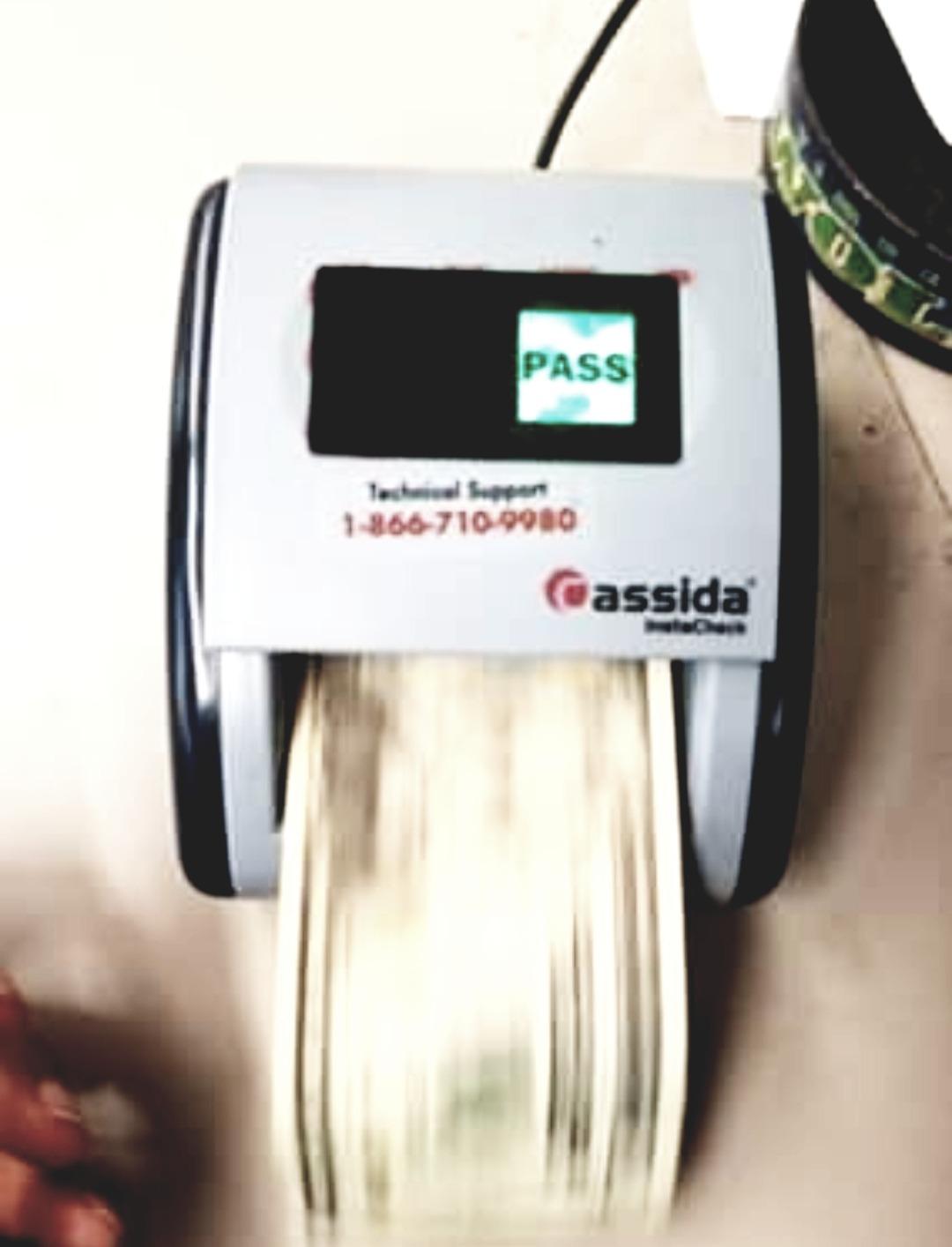
The InstaCheck is the one I would put on a counter without hesitation, and the reason is boring rather than sexy: it has been on sale since 2014, it has accumulated 1558 reviews, and those reviews describe the same behaviour over and over. Staff lift the bill, lay it on the platform, and the machine tells them pass or fail before they have finished putting it down.
It runs three sensor families together, infrared, magnetic ink and ultraviolet, cross-referenced against a database of known markings. That combination is what separates it from a pen or a cheap UV lamp, both of which look for a single property that a digital printer can fake.
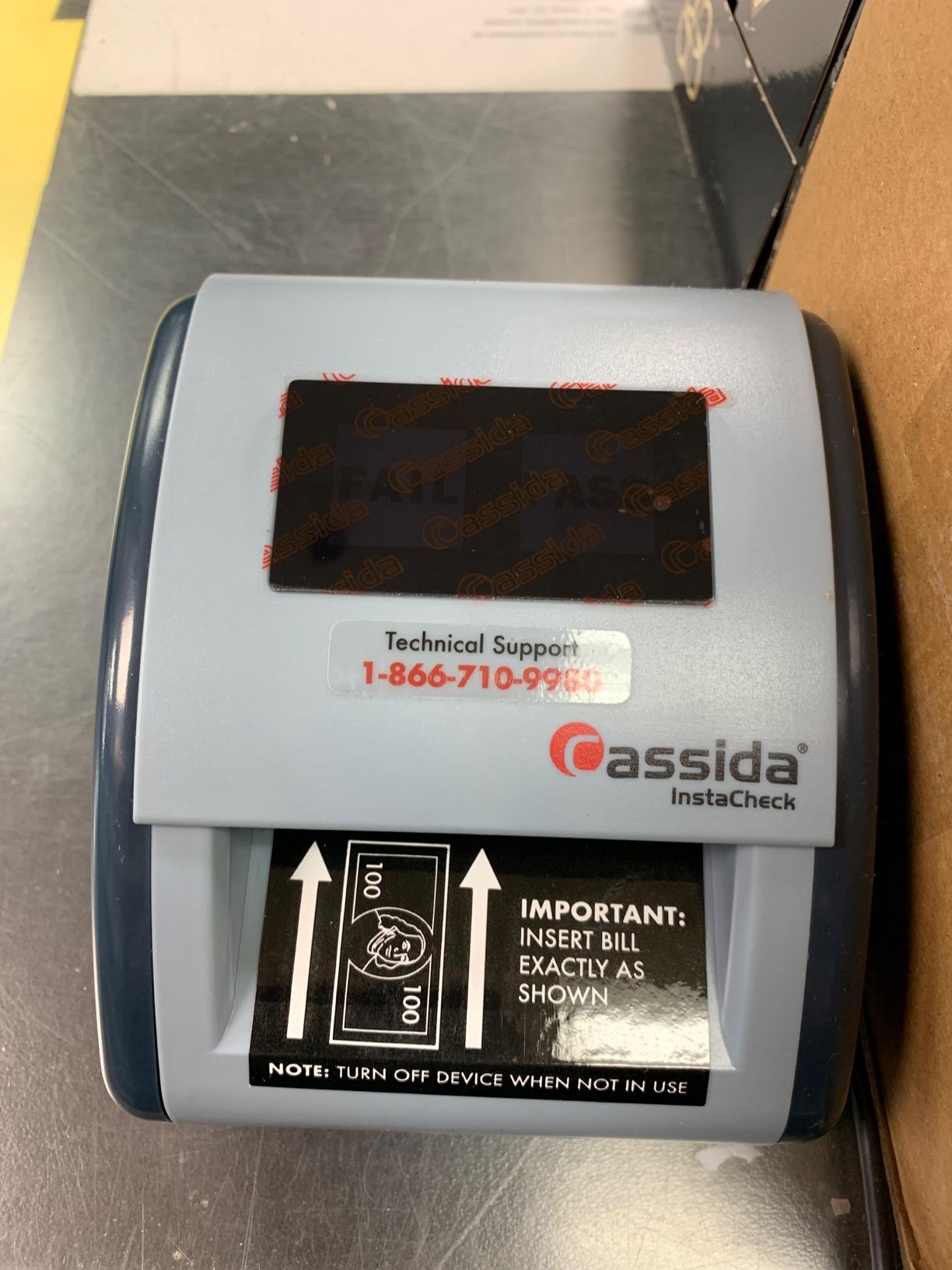
At 5.1 by 2.75 by 4.2 inches and 13.6 ounces, it is genuinely small, and that matters more than it sounds. A machine that will not fit beside the register is a machine that ends up in a back room. Owners also mention the one-year warranty and reachable US-based support, which is worth more than it sounds for a device expected to sit on a counter for years.
The honest drawback is the reliability spread. 17 percent of ratings are one star, which is the highest negative share in this roundup, and the complaints cluster around machines that stopped giving a clear verdict or stopped powering up. It is a large sample, so some of that is normal attrition, but if you are a single-store operator, test it in the first week with a note you know is genuine and buy from a seller with straightforward returns.
What it handles well at the register?
It is built for the single-question case: is this specific bill real. There is no denomination readout, no running total and no multi-currency mode, which means nothing about it is confusing during a rush. One note, one answer, in under a second.
The three-sensor approach also covers the two counterfeit types that defeat cheap devices. A photocopied note fails the magnetic test, and an inkjet-printed note that fakes a glow usually fails on infrared consistency and magnetic response at the same time.
Where it will frustrate you?
If you run a bar, a market stall or a register that takes end-of-day bank runs, you will outgrow it. There is no value counting, so it will not tell you the drawer total, and manual placement means every bill is handled twice, once by the cashier and once by the machine.
On worn or heavily creased currency, expect the occasional false call. That is true of every detector in this roundup, and it is why we cover the handling procedure further down rather than pretending it does not happen.
2. Kolibri KCD-1000 – Five Sensors and Four-Way Feeding
- Five independent checks including size and double-note detection
- Bills feed in from any direction so the counter never slows down
- Field-tested accuracy figure of 99 percent depending on currency and note condition
- Under 2 seconds per bill
- Reads US currency only and will not identify Canadian or other foreign notes
- Some buyers report inconsistent verdicts on 20 dollar bills across repeated runs
- Display could be brighter in dim counter lighting
The KCD-1000 is the pick when a single register handles a steady stream of notes and the person working it changes often. Where the InstaCheck asks you to place a bill precisely, this one accepts a bill in any of four orientations and returns a verdict in under two seconds.
Its sensor stack is broader than the InstaCheck. UV, magnetic, infrared, size and double-note detection means it will flag two notes fed as one, which is the most common accidental fraud pattern in a busy till and the one a cashier rarely sees.
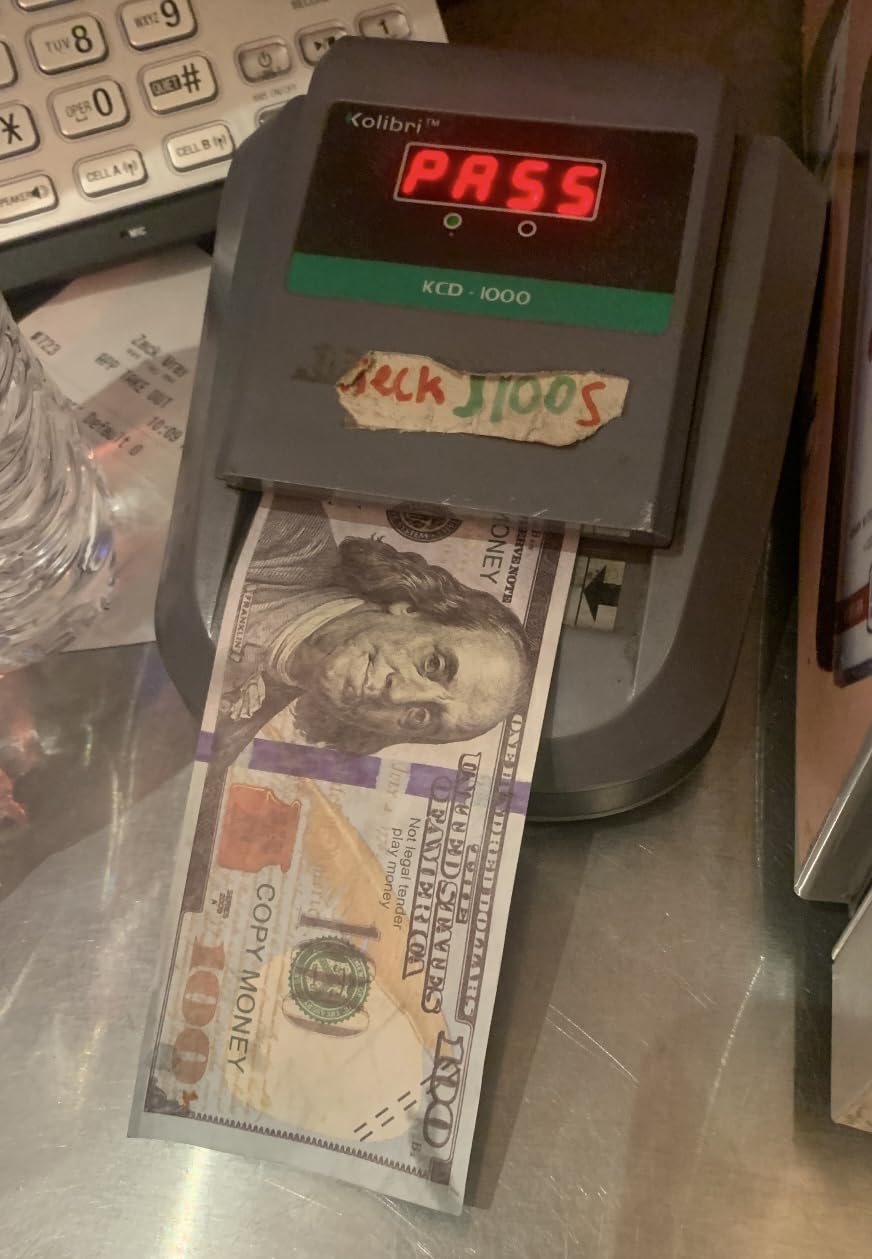
Buyers consistently describe it as easy to train, and the display is a clear pass or fail rather than a numeric score. The manufacturer states field-tested accuracy of 99 percent, with the honest caveat that results vary by currency and by the condition of the note, which is exactly the right caveat to expect from a detector manufacturer.
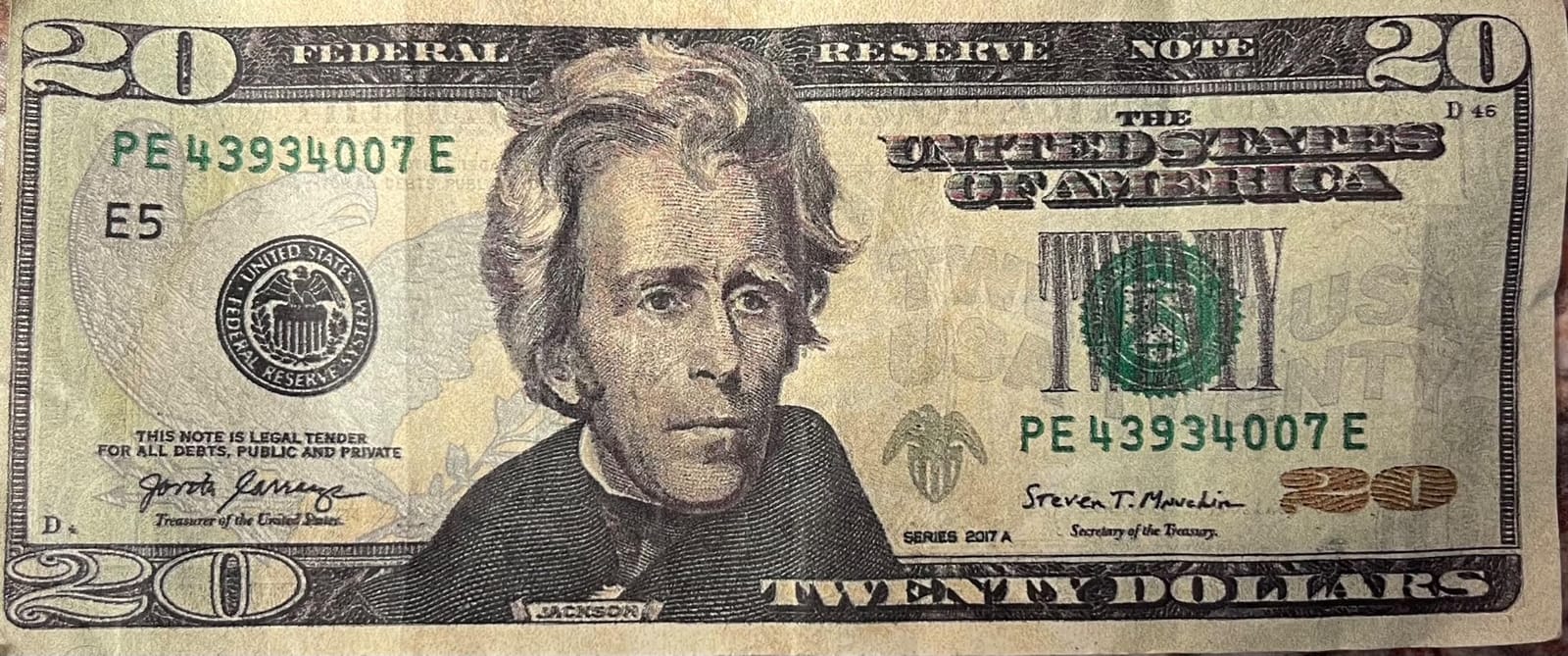
Two limitations deserve attention. It is programmed for US currency only, so a note in a foreign currency will not be identified as such, and a handful of buyers report the same 20 dollar bill passing one run and failing the next. Treat the second issue as a prompt to smooth the note and run it again rather than as a fault.
Where the extra sensors earn their place?
Size and double-note detection are the two you will notice first. Size catches photocopies and printouts that are the wrong dimensions, and double-note detection stops the classic two-for-one substitution, where one real bill covers a larger purchase with a fake left in the pile.
Four-way feeding matters at a counter where the till faces the customer. Nobody has to turn the note around to find the right side, which removes the small hesitation that makes queues build.
Where it falls short?
If your business handles Canadian dollars, euros, or any mixed-currency drawer, this is the wrong unit. There is no upgrade path listed for adding currencies, so you would be verifying notes manually alongside it.
It is also a detection device rather than a counter. It will not add up your deposit, which matters at end of day when someone is squaring the drawer against a report.
3. AccuBANKER D450 – Five Points and a Three-Year Warranty
- Five detection methods in a small body
- Automatic self-feeding with audible and visual pass or fail
- Lightweight enough to move between two registers
- Three-year warranty and the longest coverage in this roundup
- Reports of false positives on genuine 100 dollar bills with results changing on re-runs
- Ejects notes quickly and can tear already-rippled currency
- Creased bills can trigger false negatives
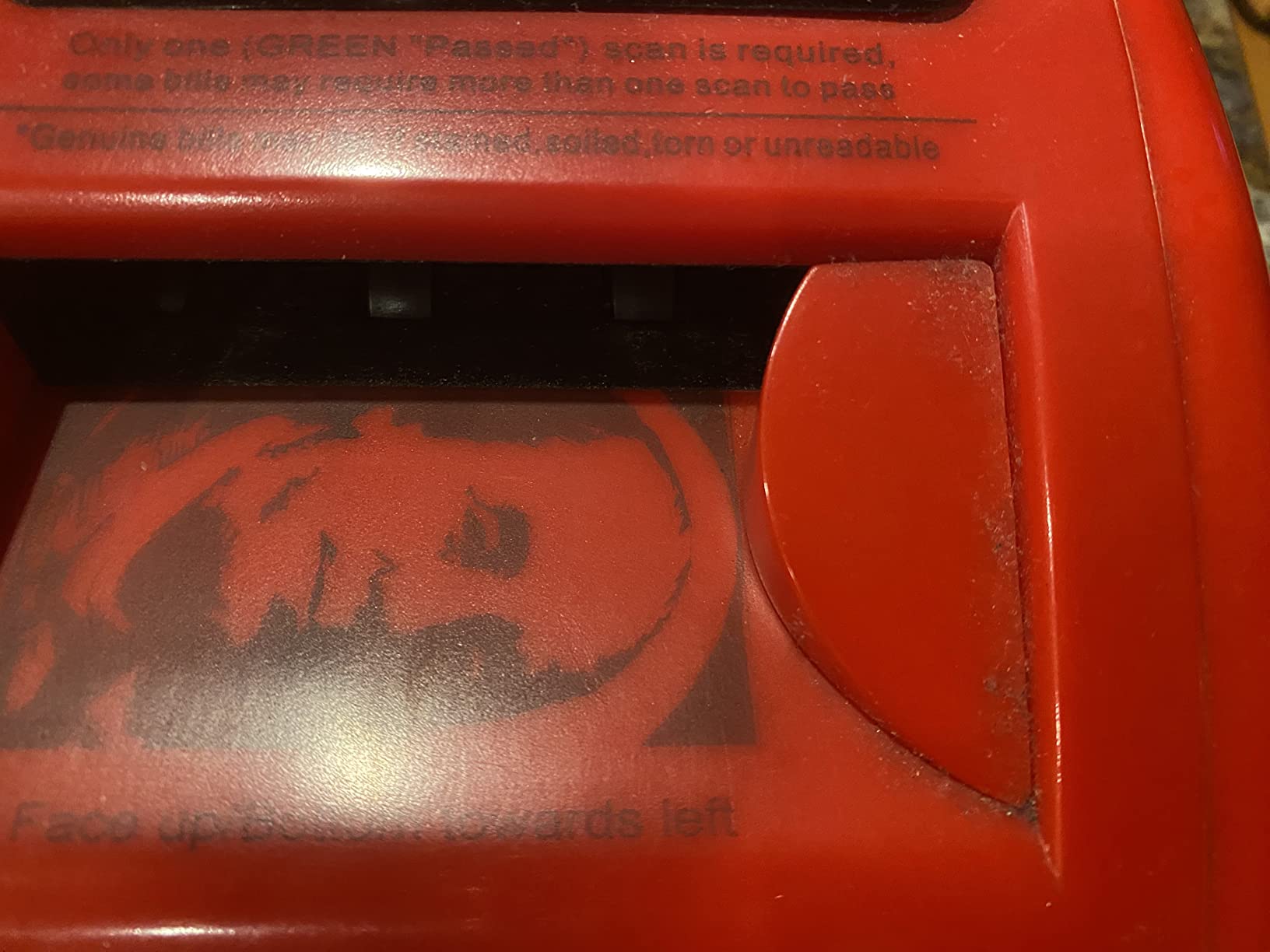
The value argument in this list is the D450. It is a genuine five-point detector with a self-feeding mechanism, and it carries a three-year warranty that matches the longest coverage we found here, which is the part that actually reduces your cost of ownership.
The five checks cover ultraviolet, magnetic ink, infrared, watermark and size. That watermark check is unusual at this level and is worth noting, because many fake notes copied from scans look right under UV light but have no watermark in transmitted light.
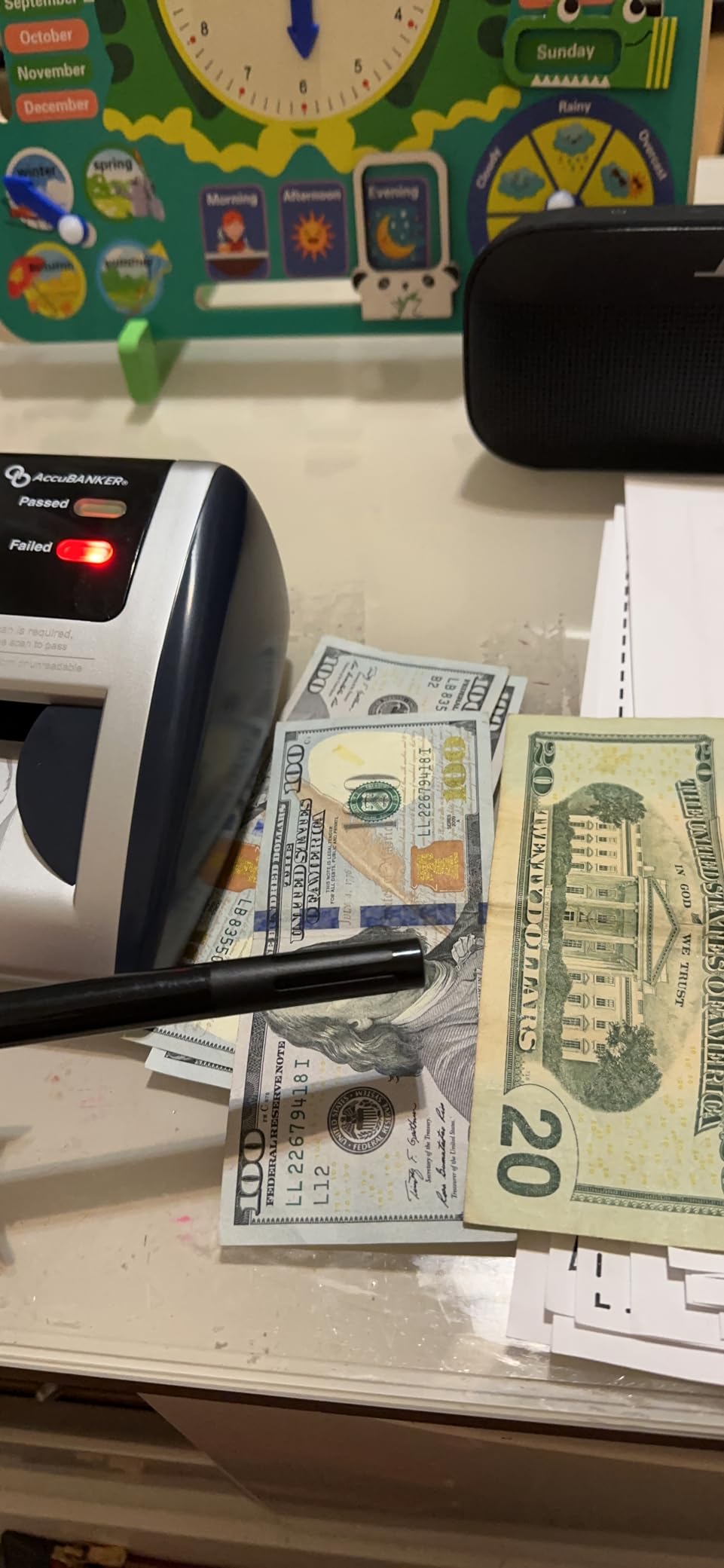
Owners like how little training it takes. The bill goes in, the machine reads it in under a second, and a green or red indicator plus an audible tone tells the cashier the answer, which is the format most easily taught to a part-time weekend hire.
The complaints cluster in two places. There are reports of false positives on genuine high-denomination notes where a second run gives a different answer, and the ejection is aggressive enough that some owners worry about already-rippled notes. Smooth a crumpled bill before feeding it in and both issues mostly disappear.
What the three-year warranty changes?
Warranty length is a retail decision, not a spec-sheet decision. If a detector is going to sit at a counter for three years or more, a longer warranty means the likely failure happens while someone else pays for it.
The watermark and size checks are also the pair that catch the counterfeit type people forget about: a genuine one-dollar bill with the printing chemically stripped and a higher denomination printed over it. That is a bleached note, and it is a different detection problem from a printed fake.
What to watch out for?
Audible prompts are English-only with no language setting. In a store with a multilingual counter team that is an inconvenience rather than a blocker, but it is worth knowing before you buy.
It is US-currency focused with no multi-currency mode, and it does not total value. If you need a drawer total, you are looking at the D500 further down this list.
4. Aneken AL-17 – Best Rated Budget UV Detector
- Highest average rating among the UV detectors here with 79 percent of reviews at five stars
- Ultra-bright LED paired with a four-leaf clover watermark backlight for a double check per note
- Also validates passports
- ID cards and credit cards
- Resists interference from fluorescent lighting and daylight
- Manual visual inspection rather than an automatic pass or fail feed
- Best suited to small numbers of notes rather than end-of-day till checks
- Relies on the reference guide printed on the unit for accurate feature comparison
The AL-17 has the highest average rating in this roundup at 4.6 stars from 313 reviews, with only 3 percent of those reviews at one star. It is a UV and watermark device rather than a multi-sensor machine, and that limit is the entire conversation about it.
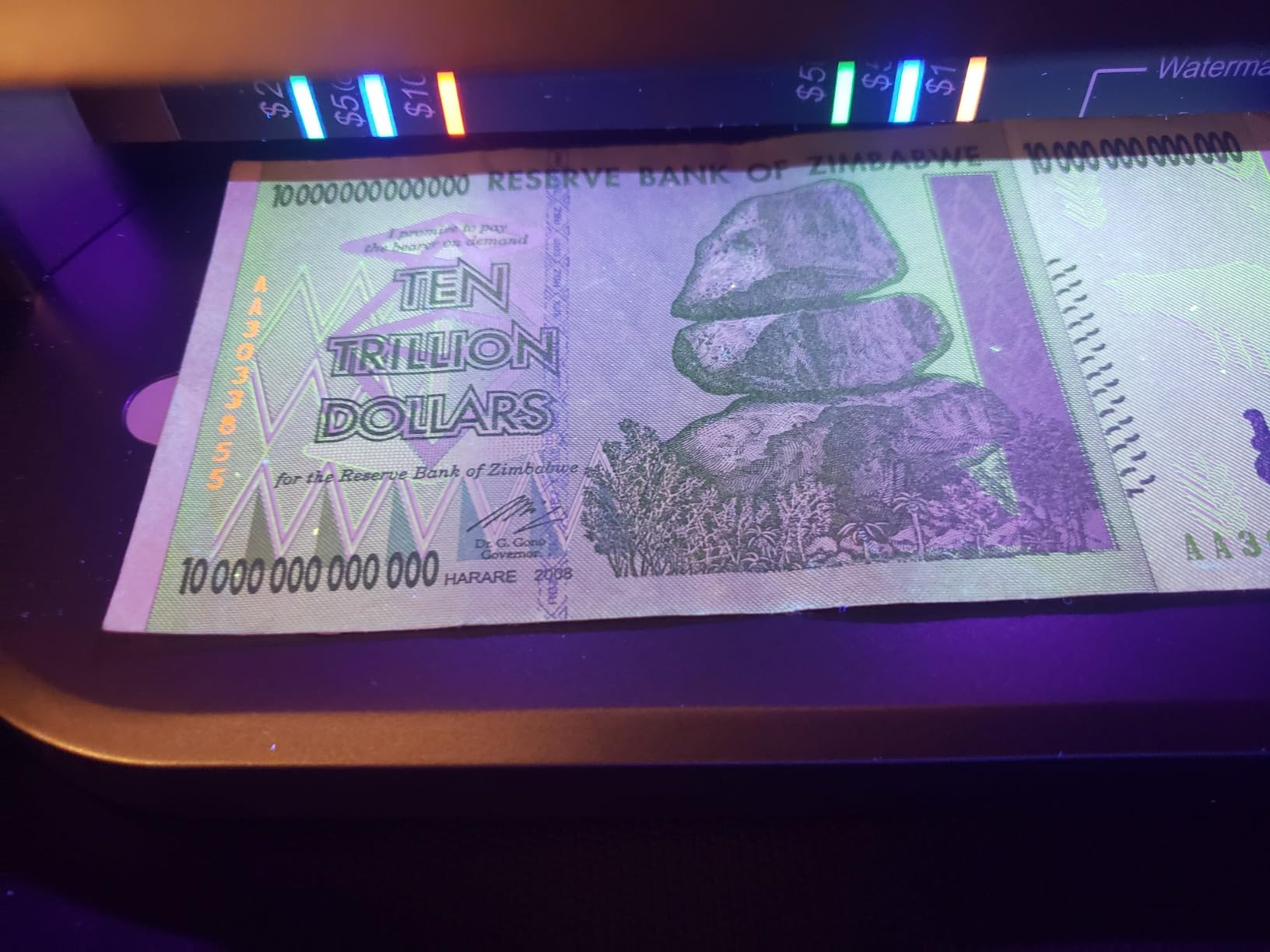
What you get is an ultra-bright UV LED and a four-leaf clover watermark backlight in one housing. The watermark side is the more interesting half, because it lets your staff verify the feature that cannot be added by an inkjet printer, and the US dollar indicator line for the gold line on each denomination is printed right on the unit.
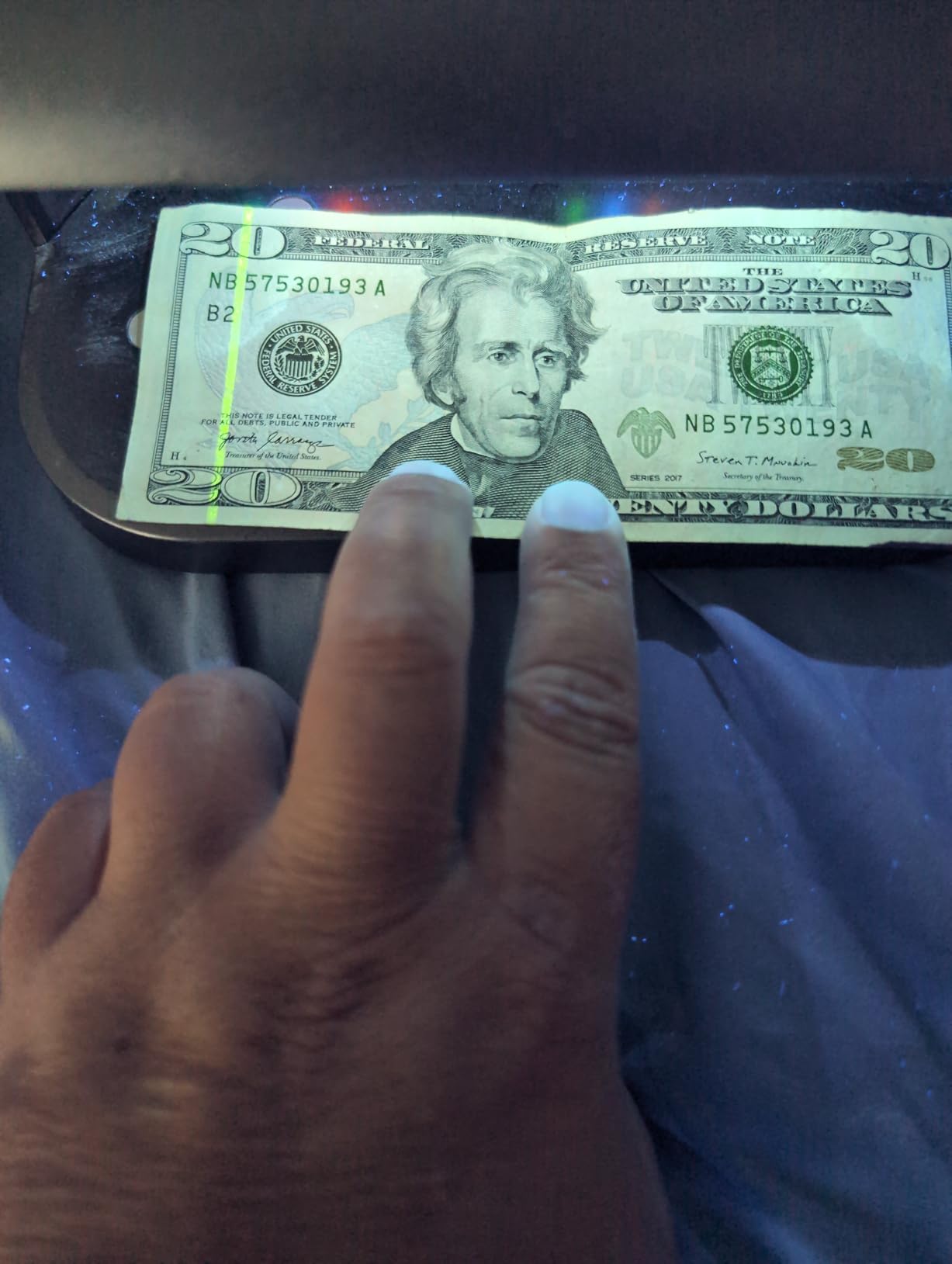
It also checks passports, ID cards and credit cards, a document check that most cash counters in this roundup do not offer. For a small business that sells age-restricted products and takes cards, one device covering three fraud categories is genuinely useful.
The sensor-equipped detecting table is a nice touch: it wakes when a bill is placed and drops back to a dormant state when the unit is idle, which is exactly the behaviour you want from a device that sits on a counter all day. Buyers also note it holds up in brightly lit retail spaces without being washed out by fluorescent light.
Where a UV-only device still earns its place?
At low cash volume, the bottleneck is training and confidence rather than throughput. One person places a note under the light, checks the thread glow and the watermark, and the operator gets a consistent second opinion every single time.
It is also the right tool for spot checks rather than full drawer runs, and for non-cash documents. ID and card validation is a separate fraud category that most cash detectors in this roundup do not address.
Where it is the wrong purchase?
If your till takes more than a few hundred dollars a day, the manual visual inspection step becomes the bottleneck and the answer depends entirely on how attentive the person on the register is at that moment.
It is UV-only, which means it has no magnetic, infrared or size test of its own. Digital inkjet counterfeits are exactly the type that UV-only devices struggle with, so this is a first line rather than a complete answer.
5. Aneken AL-139 – Totals, Records and a Rechargeable Battery
- Display shows total value
- bill count and per-denomination records
- 4-way feeding returns a verdict in about half a second
- Combines UV
- magnetic
- infrared and image detection
- Rechargeable battery plus AC power makes it portable for markets
- Only US dollar and euro pre-installed
- other currencies need a program upgrade
- Some buyers report occasional denomination misreads
- Charges through a proprietary adapter rather than USB-C
The AL-139 is the newest unit in this roundup and the one that behaves most like a small money counter. It runs UV, magnetic, infrared and image detection together, feeds from four orientations and returns a verdict in roughly half a second.
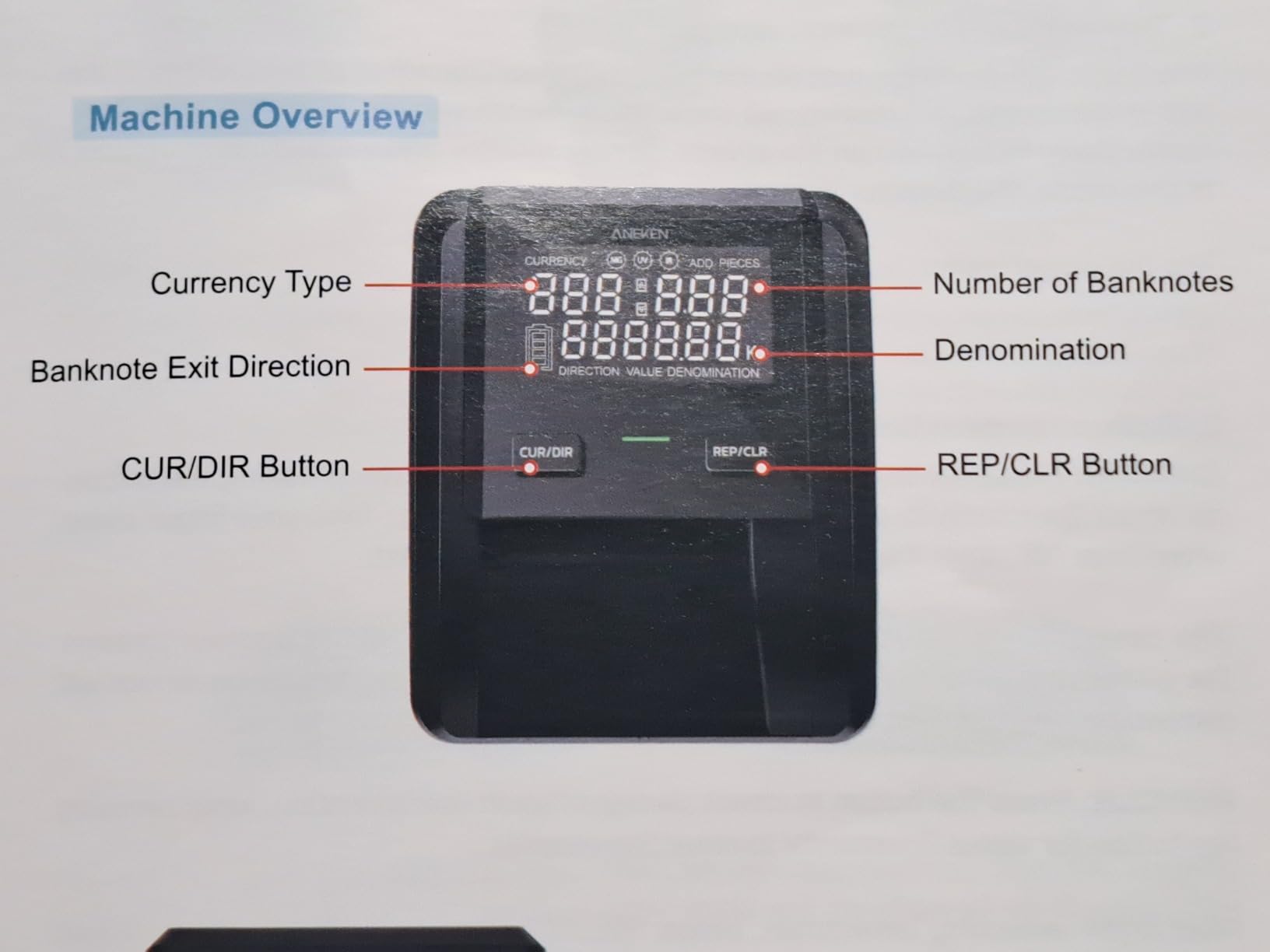
The 2.8 inch high-definition screen is the real differentiator. It shows a running total, a bill count and per-denomination records, which turns the machine into something a manager can use to reconcile a drawer instead of only answering yes or no to one bill at a time.
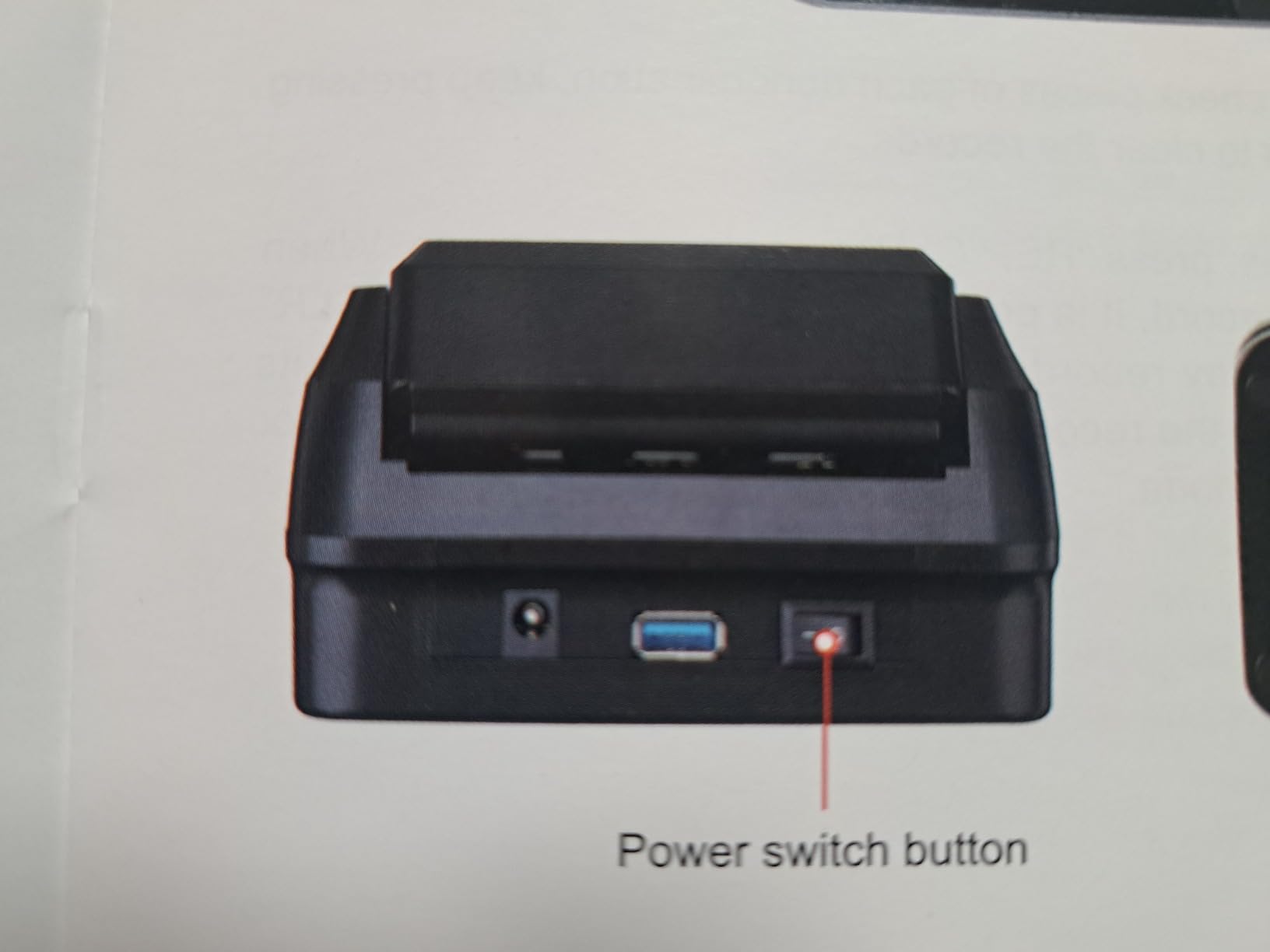
At 1.38 pounds with a rechargeable lithium battery and AC power, it moves between a shop counter and a market or pop-up table without a hunt for an outlet. For anyone who sells at more than one location, that portability is not a small detail.
Two caveats. US dollars and euros are pre-installed and anything else requires a program upgrade from the manufacturer, which is a phone call rather than a setting. And some buyers have reported misreads, including a 50 dollar bill identified as a 5, so totals from this machine are worth a second look before you post them.
What the record-keeping gets you?
Per-denomination records let you spot a pattern over a shift rather than in a single transaction. If a till keeps taking a 100 dollar note that fails and nothing else does, that is worth a conversation with your loss prevention lead.
The CUR/DIR and REP/CLR controls mean switching currency or cycling through denomination records is a single button press, so staff do not need a login or a menu to do the basics.
Where to be careful?
Damaged or badly creased notes can be rejected until they are smoothed out, so keep a flat surface near the machine. Build a habit of feeding flat notes rather than the crumpled ones straight from a pocket.
The charging adapter is proprietary, and one reviewer flagged it as lacking Canadian CSA certification. If you are outside the United States, confirm the adapter before you commit to this unit.
6. DETECK DT10C – Seven Points You Can Carry Between Counters
- Seven detection points for the deepest sensor stack in this roundup
- 0.5 second verdicts with a report broken down by denomination
- Rechargeable battery and 1.9 pound build for moving between counters
- Includes a USB software-update key for new bill releases
- Magnetic sensor can flag old worn genuine notes as fake
- Results can flip between pass and reject on the same wrinkled bill
- A few buyers report units failing after a few months
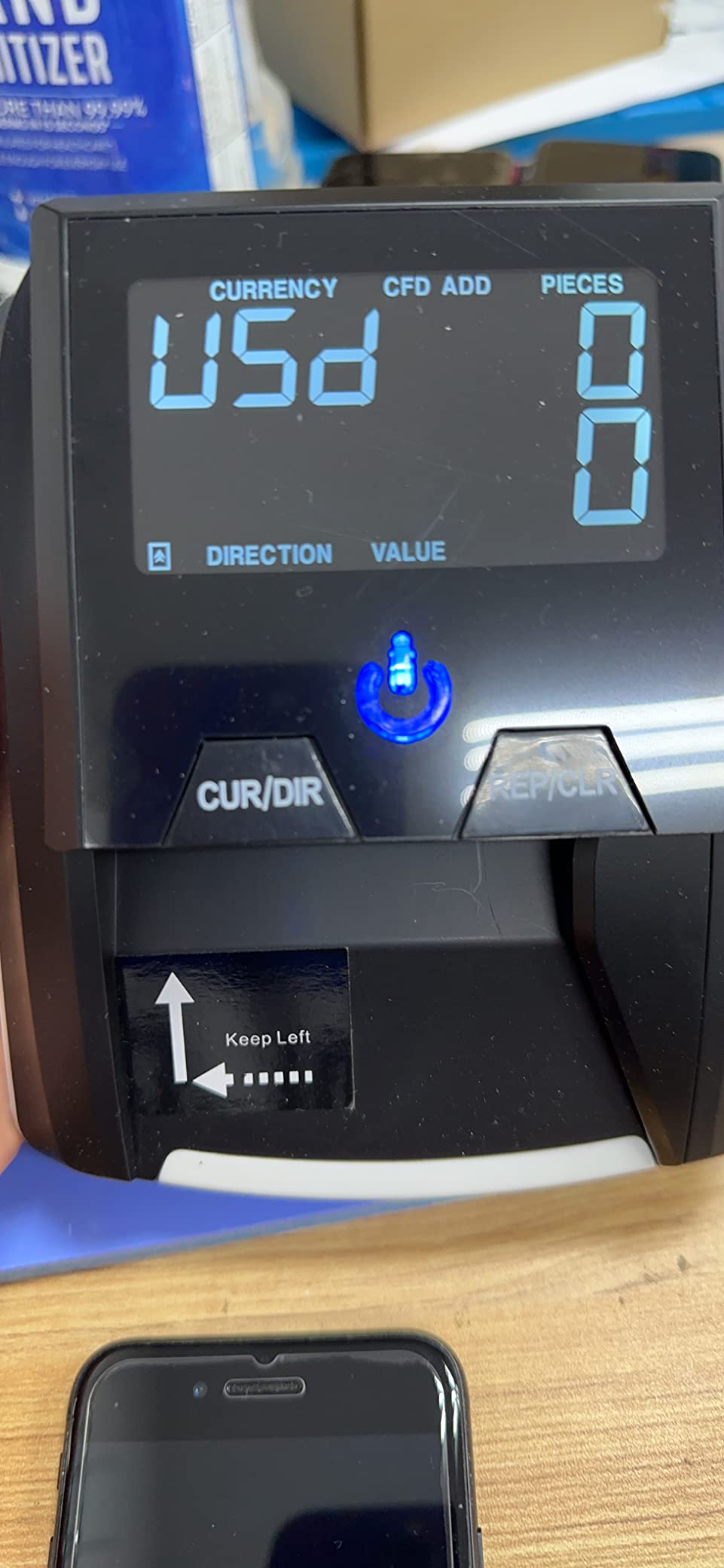
The DT10C runs seven detection points, ultraviolet, magnetic, infrared, double-note, color and watermark, and it is the deepest sensor stack in this list. Multiple owners describe it catching a counterfeit on the first use and effectively paying for itself from that point on.
The on-screen report breaks the session down by quantity and total value per denomination, and the machine counts up to 999 notes or 9999 in value before auto-resetting, which covers a full end-of-day deposit for a small store.
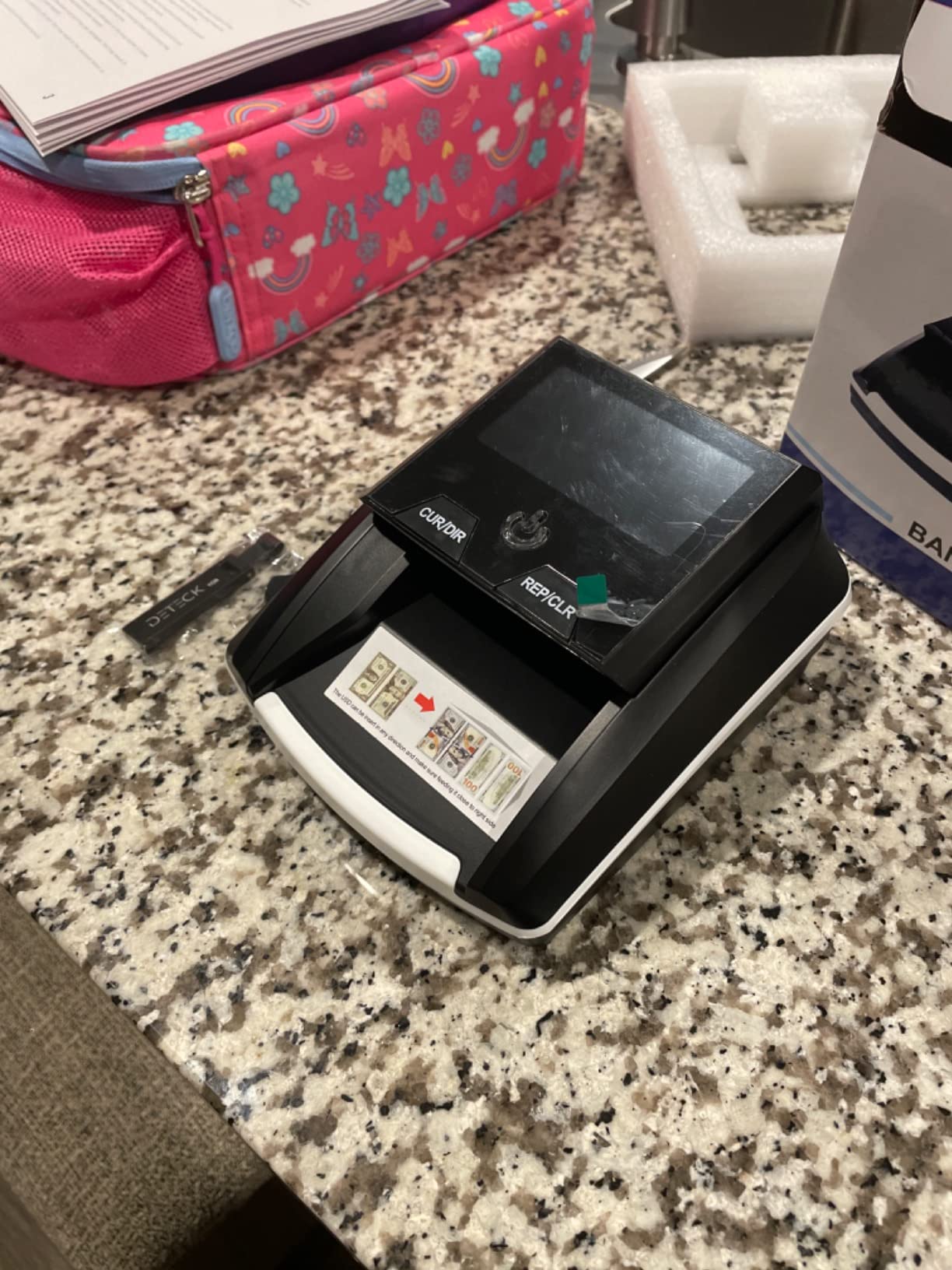
It ships with a rechargeable battery, a 100-240V AC adapter and a USB software-update key. That update key is the part most retail buyers overlook and the part that matters most for a business that expects this machine to still be running several years from now when a new note design reaches circulation.
Owners also point out how quickly a new employee can be taught on it, which for a business with teenage part-time staff is worth more than an extra sensor. The rubber wheels and belt feed are described as smooth and quiet.
What the seventh check catches?
Color detection is the differentiator against the five-point machines. Real currency has a consistent color response across the note, and an inkjet print, a scan-based copy and a genuine bill rarely agree on all of it at once.
Double-note detection is what stops the substitution pattern where a real bill is presented alongside a fake to cover a larger purchase. On a busy counter that pattern is easy to miss by eye.
Where it disappoints?
The magnetic ink sensor is tuned for fresh currency. On old, heavily worn genuine notes it can return a reject, which is why owners report re-runs being common. Smooth and flatten the note first.
There are a small number of durability reports, with one restaurant owner describing two machines failing after about four months of light use. That is a minority pattern, but it is why we would not put this on a counter that cannot wait for a replacement.
7. Royal Sovereign RCD-3000 – Compact Four-Way Metal Detector
Royal Sovereign Four-Way Countertop Counterfeit Detector (RCD-3000)
- Four detection methods including micro-print in a small unit
- 4-way orientation top so it can be used from any side of the counter
- UL certified heavy duty metal construction
- LED display gives a quick visual cue on each check
- Manual placement and visual verification rather than an automatic feed
- Four methods are fewer than the 5 to 7 point machines at a similar outlay
- No value counting
- denomination display or multi-currency handling
The RCD-3000 is a compact metal-bodied detector running four checks, which are ultraviolet, watermark verification, micro-print detection and magnetic ink. Micro-print is the check that gets discussed least and matters quietly, because printing it at a readable size requires a specific press and it is one of the easiest things for a counterfeit to get wrong.
The 4-way countertop orientation is a genuinely useful design choice. The unit can be used from any side of a counter, which matters in a checkout where the cashier and the customer are on opposite faces of the same station.
It is UL certified with a heavy duty construction, and at 7.3 by 3.8 by 4.5 inches it is small enough to sit at the edge of a register without taking space from the keyboard.
What the four checks cover?
Ultraviolet catches the security thread and watermark fibers, magnetic ink catches photocopies, micro-print catches reprints, and the watermark check is the backstop when a note is held up to light. Four independent tests is a meaningful upgrade on a pen.
The LED display gives a quick visual cue on each check so the operator does not have to hold a bill over a lamp and squint.
Where it is limited?
There is no automatic feed, so it slows a busy till rather than speeding it up, and there is no value counting or denomination display. If you need either, you need a different class of device entirely.
With 12 percent one-star ratings in its 191 reviews, the share of unhappy buyers is meaningful, and the complaints concentrate around durability and the fact that four methods is thin against the five to seven point machines available for a similar outlay.
8. Better Office Products Detector – Bench Light for IDs and Cards
Better Office Products Counterfeit Money Detector Machine, Portable Money Checker Machine with UV Light Money UV, Counterfeit Bill Detectors for All Currencies, IDs, Cards, Rechargeable
- UV LED and fluorescent light cover security features and watermarks in one pass
- Color-coded strips match the security thread color of each US denomination
- Works on passports
- credit cards and government-issued IDs
- Auto-start sensor with rechargeable battery and power cord
- Manual UV inspection with no automatic pass or fail feed
- Denomination color strips cover US dollars only
- Good for spot checks rather than high-volume counting
This is the smallest review base in the roundup at 102 reviews, but a 4.5 average with 79 percent of those reviews at five stars. It is a bench light rather than a machine, and the honest way to describe it is as a well-regarded spot-check tool.
It combines a UV LED with a fluorescent light so you can check the security thread and the watermark in a single pass, and it includes color-coded reference strips corresponding to the security thread color for the 5, 10, 20, 50 and 100 dollar denominations. For a new cashier, those strips remove the memorization step.
The UV side works on all currencies and on passports, credit cards and government-issued IDs. That document coverage is the reason to consider it even if your cash volume is small, because counterfeit identification documents are a separate and common fraud vector.
What the denomination strips are worth?
Matching a security thread color to a printed strip removes a common error at the register, which is checking the right feature on the wrong denomination. A cashier remembers the thread color for the notes they see most and simply skips the check on the rest.
The fluorescent side makes the watermark visible, which is a feature counterfeiters using scans cannot reproduce well and which costs nothing extra to verify.
Where it stops?
There is no automatic pass or fail verdict. Every check is a human decision based on what the operator sees, so it is only as reliable as the attention paid to it, and at high volume that attention is the first thing to go.
There is no magnetic, infrared or size test, and the denomination color strips are US-only, so for a cash-heavy or international business this is a supplement rather than a replacement.
9. AccuBANKER D500 – Value Counting With Rejection Reasons
- Five detection methods plus value detection that adds by denomination
- Security icons on the display show the reason a bill was rejected
- Commercial grade UL listed build with auto diagnostics
- Audible and visual alerts with automatic feeding
- Genuine bills are sometimes denied on the first pass and need two or three runs
- Does not support US bills issued before 1990
- AC powered only so it cannot run unplugged
The D500 is the option for a store that wants a detector and a reconciliation tool in one. It runs five detection methods, ultraviolet, watermark, magnetic, infrared and dimension detection, and it adds bills by denomination to a running total on an easy-to-read LCD.
Its best feature for staff training is the rejection reason icons. When a bill fails, the display shows which test it failed, which turns a frustrating beep into a piece of information the cashier can act on.
It is commercial grade and UL listed, with automatic detection in under a second and auto-diagnostic capabilities. Several owners report it paying for itself quickly, which is the pattern you want from a device that only works if staff actually use it.
What the rejection icons change on a counter?
Without a reason code, a failed bill is an argument between the cashier and the customer. With one, the cashier can say that the note failed a machine check and offer an alternative, which is a much shorter conversation.
Dimension detection catches photocopies and printouts that are the wrong size, and the value detection means one pass at the end of a shift gives you a total rather than a stack to count by hand.
What to plan around?
There is a recurring complaint that genuine notes are denied on the first pass and need two or three runs. Budget for that in your workflow rather than treating a first reject as a confrontation with the customer.
It is AC powered only, and the manufacturer states it does not support US bills issued before 1990, pointing buyers to the D450 or D470 for older notes. If your business still handles older stock or accepts notes from customers as payment, that limit matters.
10. AccuBANKER D585 – USD, EUR and GBP in One Unit
AccuBANKER D585 Multi Scanix Counterfeit Detector, USD EUR GBP
- Three currencies programmed into one unit which is unusual at this level
- 4-way insertion recognises denominations from any direction
- Internal rechargeable battery lasts up to 12 hours for mobile use
- High-resolution LCD gives a detailed on-screen report
- Durability complaints with devices failing within weeks or around 18 months
- 90-day return window means later failures fall on the buyer
- Does not support US bills issued before 1990
The D585 is the only unit in this roundup programmed for three currencies, US dollars, euros and British pounds, and that single fact is the whole argument for it if your business touches more than one of them. One owner reports it catching counterfeits that had already passed a UV light.
It has 4-way orientation insertion that recognises denominations from any direction, plus a high-resolution LCD and a detachable magnetic bill guider for smaller notes. The internal rechargeable lithium battery runs up to 12 hours, so it works away from a power outlet at a market, an event or a pop-up.
It counts while detecting, and the manufacturer states it can be updated for new bill releases, which is the right answer to a currency redesign. The 3-year warranty is a genuine plus.
Where three-currency support pays off?
A tourist-area store, a hotel, a restaurant near an airport or a market serving international visitors all handle more than one currency, and those notes are where a single-currency machine gives you the least help. A detector that cannot identify a note is a detector that will not flag it either.
The 12-hour internal battery also means a single device can serve a counter and then go on the road for an event, which spreads the cost across more transactions.
What gives us pause?
Durability is the dominant negative theme. Multiple buyers report devices failing within weeks or around 18 months, and the 90-day return window means anything that fails later is yours to pay for. That is the single most important thing to weigh before choosing it.
Like the D500, it does not support US bills issued before 1990. It also carries the higher outlay of the two, so the multi-currency capability needs to be something you actually use.
How Counterfeit Bill Detection Actually Works?
There are four core methods, and every machine in this roundup is a combination of them. Understanding what each one tests tells you immediately which fake a given device will catch and which one it will let through.
Ultraviolet light makes the security thread and the watermark fibers fluoresce in genuine currency, so a real note glows in a specific and consistent way under UV. Magnetic ink detection registers the iron-oxide ink printed into genuine notes. Infrared detection reads infrared-reactive inks and fibers that are invisible to the eye. Contact image sensor detection, or image detection, scans the printed surface of the note and compares it against stored references of genuine currency, which is the method that catches high-quality digital counterfeits.
Size and dimension detection is the unglamorous one that catches photocopies, which come out the wrong size, and double-note detection catches two notes fed as one.
The number one way to detect counterfeit money
Compare the note against known security features, starting with feel. Here is the four-step order we train staff on.
First, feel the note. Genuine US currency has a distinctive cotton-linen substrate, slightly textured, slightly different in tone when held at an angle. Photocopies feel smooth, thin and warm differently.
Second, tilt the note. Genuine bills carry color-shifting ink on the lower right of the denomination, and the numeral changes color as you move the note from flat to tilted.
Third, hold it to light. The embedded security thread appears as a bright line embedded in the paper rather than printed on top, and the watermark is visible from both sides of the note.
Fourth, check under UV and with the marker pen. The thread and watermark fibers fluoresce, and the magnetic ink registers. On a genuine 100 dollar bill, the portrait watermark sits to the left of the portrait and the security thread sits to the left of the portrait, glowing green under UV, with microprinting around the portrait. The redesign of the 100 dollar note means older security feature guides may no longer match, so check that any printed reference you use is current.
Why the order matters: a machine running all four of these together catches dramatically more than any single test alone, because counterfeiters who defeat one method rarely defeat all of them at once.
Bleached and altered notes
A bleached note is not a printed fake at all. It is a genuine low-denomination note with the printing chemically stripped away and a higher denomination printed over the top. It defeats a pen, it defeats a UV lamp, and it defeats most visual checks, because the substrate is real.
Size and dimension detection is the check that catches it, which is why machines with a physical size test earn their place. If your operation deals in cash-heavy categories, this is the failure mode to think about before you choose a device.
Pen vs UV Lamp vs Standalone Detector vs Money Counter
Match the device class to your daily cash volume, not to the other product’s marketing. The four classes overlap, but each one fails a different counterfeit type.
Under roughly two hundred dollars a day, a UV lamp or a marker pen at the register is proportionate. The risk at that volume is real but small, and the failure mode is a customer being embarrassed rather than a meaningful loss. A pen detects magnetic ink only, so it catches photocopies and does nothing against inkjet printing.
Between two hundred and a thousand dollars a day, a standalone detector with three or more detection methods is the right call. The InstaCheck, the KCD-1000 and the D450 all sit here, and each is sized for a counter rather than a back office.
Between one thousand and five thousand dollars a day, you want automatic feeding, four-way orientation, and value counting so the drawer reconciles itself. The D500, the AL-139 and the DT10C fit, and the value total becomes a loss-prevention tool rather than just a counting aid.
Above five thousand dollars a day, you are in currency discriminator territory. Banks use high-speed discriminators that combine contact image sensor, infrared, ultraviolet and magnetic detection with denomination and value counting. That level of hardware is more than a single retail counter needs.
One honest point about detector pens, because no competitor says it plainly: they work against photocopied counterfeits and they are a useful cheap first line, but they fail against digital inkjet and laser-printed counterfeits, which is precisely the type that is increasing. Treat a pen as a supplement to a machine, never as a replacement for one.
What to Do When You Catch a Counterfeit Bill?
Do not detain the customer, do not call the police on them, and do not physically hold the bill or the person. Corporate policy at most retail chains explicitly forbids employees from apprehending counterfeit passers, and discussions among loss prevention staff make the same point: the store absorbs the loss while the individual who passed the note walks away. Handling the moment calmly and following the reporting chain is the most useful thing your staff can do.
When a bill fails, the first step is to be calm and non-accusatory. A short, neutral script works better than silence or an accusation. Something like, I am sorry, our machine is having trouble reading this one. Would you like to pay another way or take the bill and come back?
Second, run the bill again. Multiple machines in this roundup produce a different verdict on a second pass for genuine but worn or creased notes. Flatten it, smooth it, feed it once more before you say anything to the customer about the result.
Third, if it still fails, note the denomination, the serial number and any other visible identifiers. Do not write on the note and do not damage it, because the serial number is what allows the note to be traced or discounted later.
Fourth, call your bank and ask about its procedure for a suspect note. Banks follow standard guidance for handling counterfeit currency, and the note itself is typically surrendered to the bank or to law enforcement rather than returned to circulation.
Fifth, file a report with the Secret Service, which takes counterfeit reports and is the agency that handles them. Loss prevention staff note that the agency is often already in contact with stores that have recurring problems and may visit later, so keeping your own records of serial numbers and dates helps if that happens.
One thing to plan for: most banks will not reimburse a counterfeit note, which means the store absorbs the full face value. That is a risk-management problem rather than a detector problem, and it is why a machine that catches a fake once a year can still be worth owning.
How to Choose a Counterfeit Bill Detector: Buying Guide?
Cash volume matters more than any other factor in this decision. A store taking two hundred dollars a day and a store taking five thousand dollars a day have genuinely different requirements, and buying the wrong class of device wastes money in both directions.
The first criterion is the number of independent detection methods. Two is a pen plus a lamp. Three covers ultraviolet, magnetic and infrared, which is the point where most photocopies and low-grade fakes start failing. Five or more adds watermark, size or dimension, and color or image detection, and that is where you gain real protection against digital inkjet counterfeits and bleached notes. Every machine with four or more methods in this roundup is a defensible retail purchase; anything below that is a supplement.
The second criterion is false positive rate, and it matters more than buyers expect. A legitimate bill rejected in front of a queue is a customer relationship problem and a staff morale problem, and the practical result in both cases is that staff stop trusting the machine. Look for machines that report the reason for a rejection, and build a double-check step into your procedure so a first reject is a re-run rather than an argument.
The third criterion is feeding and orientation. Manual placement slows a counter. Four-way orientation and automatic feeding remove the hesitation that builds a queue, and for a store with high note volume this is the difference between a device that gets used and one that gets ignored. Automatic bill feeding with an audible and visual pass or fail alert is the format that survives a shift.
The fourth criterion is value counting. If you reconcile a drawer by hand at the end of every day, a machine that adds by denomination and shows a total is doing two jobs. The D500, the AL-139 and the DT10C all do this, and it is worth more than an extra sensor.
The fifth criterion is currency coverage. US-only machines will not identify a Canadian dollar or a euro, and an unidentifiable note is an unverified note. If your customer base or your market involves more than one currency, multi-currency programming is not optional. On a related note, the AccuBANKER D500 and D585 both state that they do not support US bills issued before 1990, so if you handle older stock, check before you buy.
The sixth criterion is firmware and new currency designs. When a new note design is issued, detectors that reference stored note images need an update. The DETECK DT10C ships with a USB software-update key, and the D585 is described as updatable for new bill releases. Ask any vendor what happens to their detector when a redesign reaches circulation, because a detector that silently misreads a new note is worse than no detector at all.
The seventh criterion is warranty and support. The range in this roundup runs from one year on several models to three years on the D450 and the D585, and a longer warranty directly reduces the cost of owning a device for several years. US-based support reachable by phone matters more when the machine is your only line of defence, and total cost of ownership includes consumables and repair turnaround, not just the unit.
The eighth criterion is one device or several. A cash detector that also validates credit cards and identification documents covers more fraud categories than a single-purpose device, which matters when counter space is tight. Our guide to the security tools that sit alongside a counter covers the second category. Choose based on how many fraud categories you are actually exposed to.
So decide whether you want a counterfeit detector or a currency discriminator, because vendors mix the terms. A counterfeit detector authenticates notes and tells you pass or fail, sometimes with the rejection reason. A currency discriminator is a money counter that also authenticates, identifies denominations, totals value, and can run at banking speeds.
Last, train the staff. A detector is only as good as the person pressing the button, and a written one-page procedure is worth more than a sixth sensor. For anyone fitting out a counter, choosing the right register hardware matters too, covered in our guide to the best cash drawers for retail.
Frequently Asked Questions
What is the best counterfeit bill detector?
The best counterfeit bill detector for most retail stores is the Cassida InstaCheck. It runs infrared, magnetic and ultraviolet sensors together, returns a pass or fail verdict in under a second, fits in a small footprint beside a register, and has the largest review base of any detector in this roundup. For a busy counter, that combination of sensor coverage, speed and staff-friendly simplicity is the one we recommend first.
What is the best machine for detecting counterfeit money?
For a store handling over a thousand dollars a day, the best machine is an automatic counter with counterfeit detection built in, such as the AccuBANKER D500 or the DETECK DT10C. They feed bills in four orientations, run five to seven detection methods, and add value by denomination. The key distinction is that a standalone detector only says pass or fail, while a money counter with counterfeit detection also totals your cash.
What is the number one way to detect counterfeit money?
The number one way is to compare the note against known security features, in this order: feel the cotton-linen substrate, tilt it to check for color-shifting ink, hold it to the light to confirm the embedded security thread and watermark, then check the thread and watermark fibers under ultraviolet light and confirm the magnetic ink. No single test is reliable on its own.
How do I spot a fake 100 dollar bill with a marker pen?
Run the pen on the magnetic ink areas and check for the reaction. Then confirm the other features, because a pen alone only tests magnetic ink. A genuine 100 dollar bill has a portrait watermark to the left of the portrait, an embedded security thread to the left of the portrait that glows green under UV, color-shifting ink in the bell-in-inkwell, and microprinting around the portrait. The recent redesign means older security feature guides may be out of date.
What is the best pen for detecting counterfeit money?
A Tri-Test style pen with UV, magnetic and script checks is the best pen for detecting counterfeit money, and it remains the cheapest way to add a second opinion at a register. The honest caveat is what it cannot do. A pen detects magnetic ink only, so it reliably catches photocopies and fails against digital inkjet and laser-printed counterfeits, which is the type that is increasing.
Do counterfeit money detector pens work?
They work well against photocopied counterfeits and make a useful low-cost first line, but they fail against digital inkjet and laser-printed counterfeits, because those carry no magnetic ink. That is why pens are now considered a supplement rather than a replacement. Any store handling more than a couple of hundred dollars a day should pair pens with a multi-sensor machine.
Which money counting machine do banks use?
Banks use high-speed currency discriminators with multi-sensor detection, combining contact image sensor scanning, infrared, ultraviolet and magnetic ink, plus denomination identification and value counting. For a typical retail store that is more hardware than a counter needs, and a five-point or seven-point detector handles the counterfeit risk without the throughput a bank requires.
What should I do if I find a counterfeit bill?
Do not detain the customer and do not call the police on them, since most retail policy forbids it. Re-run the bill in case it is a worn or creased genuine note, then note the serial number and denomination without writing on the bill. Call your bank for its procedure, and file a report with the Secret Service. Know that most banks will not reimburse the note, so the store usually absorbs the full face value.
Final Verdict
The best counterfeit bill detectors for retail are the ones that run at least three independent checks, feed from any direction, and give a verdict fast enough that staff actually use them. The Cassida InstaCheck is our overall pick for a standard retail counter, with the Aneken AL-17 for low-volume spot checks and the Kolibri KCD-1000 when you want a deeper sensor stack in a portable body.
Whatever you choose, pair it with a written procedure for handling a flagged bill and a training session for the whole counter team. The machine catches the note; the procedure is what protects the customer relationship and the store’s standing. Check the current specification and the latest buyer feedback before you commit, and use the 2026 buying guide above to match the device class to your real daily cash volume.