

A record player stand does three jobs at once: it decouples your turntable from floor vibration, it puts your vinyl within arm’s reach, and it gives your cables somewhere to go. That combination is why the best record player stands sell so well in 2026 — the right one changes how a mid-range deck behaves far more than most people expect.
Are record player stands worth the investment? Yes, provided the stand is heavy, level and well damped. Mass absorbs vibration, isolation feet decouple the top from the floor, and solid wood stays dimensionally stable. A modest deck on a heavy stand often beats an expensive deck sitting on thin particleboard.
As for height, the ideal range is 24 to 30 inches, which puts the deck at roughly seated elbow height so cueing a record is comfortable. If you are still choosing the deck itself, our belt-drive turntable guide covers what actually changes the sound. What goes underneath it matters just as much, and that is what this roundup is about.
We pulled 12 stands, checked the real dimensions and load ratings, and read what owners say after living with them. Every pick below lists its honest trade-offs, because a stand that looks right in a listing photo can still be the wrong height or the wrong depth for your deck.
Table of Contents
Top 3 Best Record Player Stands For Turntables (October 2026)
The three stands below cover the most common buyer situations: a compact all-round table, a value pick with built-in power, and a taller stand with a large top for bigger decks.

LELELINKY 3-Tier End Table
- Holds up to 100 albums
- 11.81 x 15.86 x 25.67 in
- Adjustable feet
- Guard rails and dividers

AMHANCIBLE Stand with Charging Station
- 2 AC outlets and USB-C port
- 110 lb load capacity
- Holds 100+ records
- 15.74 x 11.41 x 25.59 in

Lerliuo Record Player Stand
- Holds up to 160 albums
- 18.1 x 15.7 x 33.8 in
- 100 lb capacity
- Cable pass-through holes
All 12 Record Player Stands Compared in 2026
This table puts every stand in the roundup side by side with its top dimensions, capacity and load rating so you can rule out the ones that simply will not hold your setup.
| Product | Specifications | Action |
|---|---|---|
| LELELINKY 3-Tier End Table |
|
Check Latest Price |
| AMHANCIBLE Stand with Charging Station |
|
Check Latest Price |
| Lerliuo Record Player Stand |
|
Check Latest Price |
 Bikoney Record Player Stand Bikoney Record Player Stand |
|
Check Latest Price |
 Joaxswe Record Player Stand Navy Blue Joaxswe Record Player Stand Navy Blue |
|
Check Latest Price |
 2BHOME Wooden LP Record Stand 2BHOME Wooden LP Record Stand |
|
Check Latest Price |
 Sonyabecca 3-Tier Record Player Stand Sonyabecca 3-Tier Record Player Stand |
|
Check Latest Price |
 Cozy Castle Record Player Stand Cozy Castle Record Player Stand |
|
Check Latest Price |
 Astimey Record Player Stand Walnut Astimey Record Player Stand Walnut |
|
Check Latest Price |
 ZEXVIDA 3-Tier Record Player Stand ZEXVIDA 3-Tier Record Player Stand |
|
Check Latest Price |
 LUVIOHOME Large Round Record Stand LUVIOHOME Large Round Record Stand |
|
Check Latest Price |
 Modway Render Record Display Stand Modway Render Record Display Stand |
|
Check Latest Price |
Turntable Fit-Check: Will Your Deck Actually Fit?
Most returns on stands happen because the top is too small or too shallow, and that number is printed in the listing rather than the photos. Measure your deck footprint first, then compare it against the usable top surface, not the overall product dimensions.
A common entry-level deck such as the Audio-Technica LP120 measures about 17.8 x 13.9 inches. The Rega Planar 3 is smaller at roughly 17.7 x 12.2 inches. The Technics SL-1200 is the awkward one at about 26 pounds with a wide chassis, which means it needs a genuinely large top and a stand rated well above its weight.
Reading that against our list: the LELELINKY top is about 15.9 x 11.8 inches, so a belt-drive deck fits comfortably but a full-size all-in-one player may overhang. The 2BHOME is tighter still, with a usable top of 15.5 x 13.0 inches, and owners mention the fit issue repeatedly. The Astimey states it takes decks from 15.6 to 19.7 inches wide, which covers most entry-level and mid-range models.
For the wide chassis, the Bikoney top at 33.07 inches, the Sonyabecca at 30.11 inches, the Cozy Castle at 39.4 inches and the Modway Render at 36.5 x 17.5 inches all clear a large deck with room for speakers beside it. Depth matters too: anything under about 14 inches deep leaves the tonearm overhanging the front edge on many models.
One more check while you have the tape measure out: the stand height relative to your chair. Most of these stands land between 25 and 34 inches, which is the range where the tonearm clears the front lip and your hand reaches the cue lever without stretching.
1. LELELINKY 3-Tier End Table – Best Overall Record Player Stand
- Compact footprint suits apartments and small collections
- Assembly takes about 25 minutes
- Sturdier and more solid than expected
- Guard rails and dividers keep records in place
- Light enough to move between rooms
- Compact top can overhang with larger all-in-one turntables
- Capacity is modest at around 100 albums
- Metal and wood build shows visible fasteners
This is the stand we kept coming back to across our whole list because the combination of build quality, owner feedback volume and footprint works for almost every ordinary room. It is a three-tier unit in brown wood grain over a matte black metal frame, measuring 11.81 x 15.86 x 25.67 inches and weighing 11 pounds.
Owners consistently describe it as a handsome little table that feels sturdier than the listing suggests. One buyer put assembly at around 25 minutes with the included instructions, and the adjustable feet help if your floor is not perfectly flat, which matters more than most people expect.
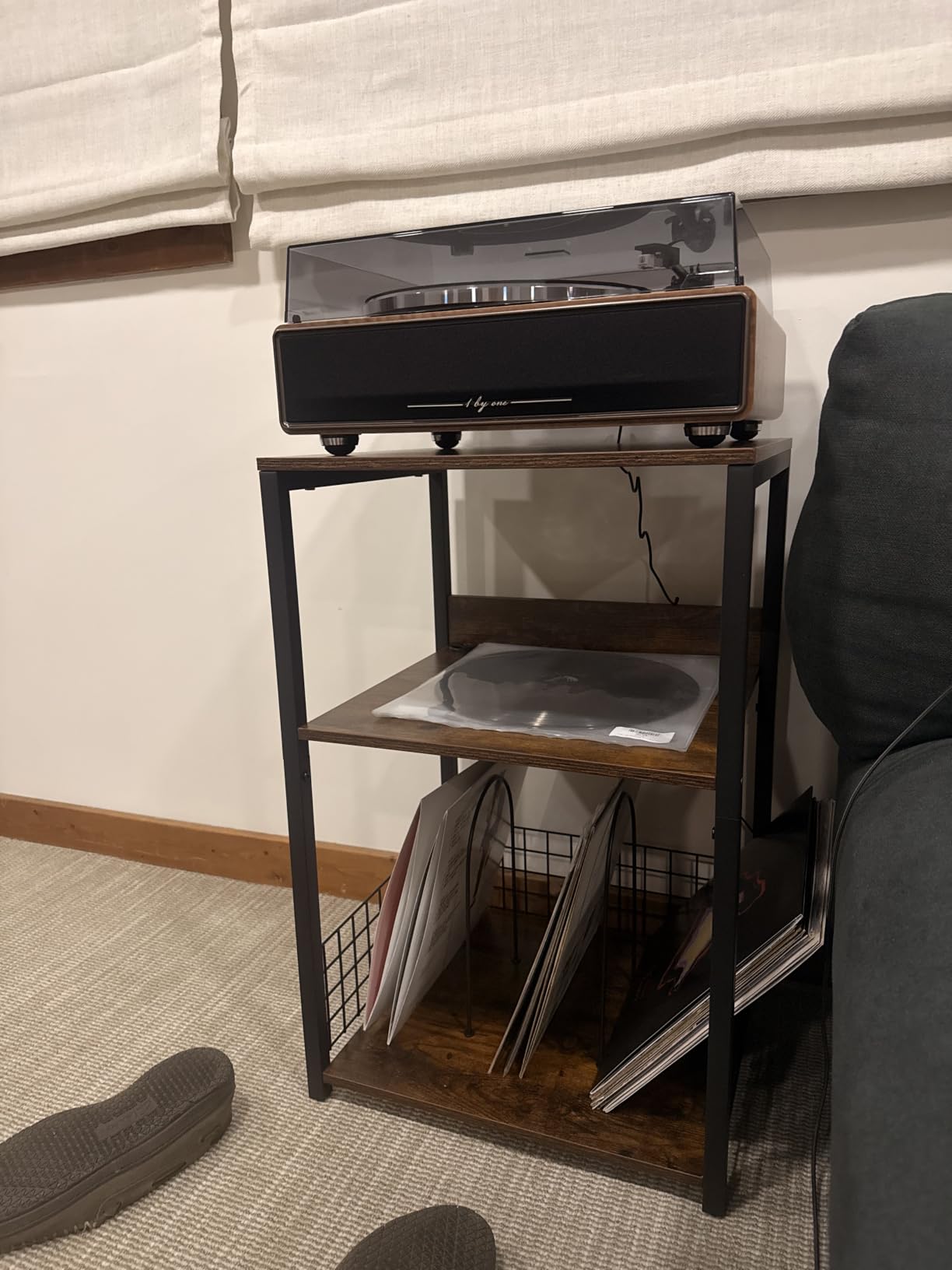
The top is sized for a mid-size belt-drive deck, and the two open shelves below hold roughly 100 albums with guard rails and removable dividers stopping sleeves from sliding off. It also works as a plain end table, which is how it earns its footprint in a small living room.
Weight is the honest limitation. At 11 pounds it is light enough to move between rooms but not heavy enough to act as a genuine vibration mass, so if you live upstairs in a building with heavy foot traffic you will want an isolation mat under the deck as well.

What you get for the footprint?
The 11.81 x 15.86 inch top gives you roughly two inches of clearance either side of a standard belt-drive deck. Speakers fit on the shelf below, which reviewers say works as long as you keep them small bookshelf monitors rather than floorstanders.
Capacity is honest at around 100 albums, which suits a first collection. Plan for about 14 linear inches of shelf space per 100 sleeved LPs, so if your collection is heading past 300 you will outgrow it faster than the headline number suggests.
Where it falls short?
The recurring complaint is overhang with larger all-in-one turntables, the kind with built-in speakers and a wider plinth. If your deck is one of those, measure before you commit and look at a stand with a 19 inch or wider top instead.
The second issue is cosmetic. The metal-and-wood construction shows screws and fasteners, so it reads as assembled furniture rather than a crafted piece. If your room is mid-century or minimalist, the warm wood grain hides that better than a black metal frame would.
2. AMHANCIBLE Record Player Stand with Charging Station – Best Value Pick
AMHANCIBLE Record Player Stand with Charging Station, Vinyl Record Storage
- Built-in charging station with 2 AC outlets and USB-C
- 110 lb load rating for a light stand
- Labelled parts and tools make assembly straightforward
- Divided bottom space stores 100+ records
- Adjustable feet help level the table
- Narrow top crowds larger all-in-one players
- Light metal construction can shift if nudged hard
The feature that separates this stand from its rivals is the charging station built into the top, with two AC outlets and a USB-C port. That solves the cable problem better than any cable channel does, because the plug is simply already where the equipment sits.
It measures 15.74 x 11.41 x 25.59 inches and weighs 7.5 pounds, yet carries a stated load capacity of 110 pounds. Buyers like the labelled hardware and included tools, and several mention customer service replacing a bent part quickly.
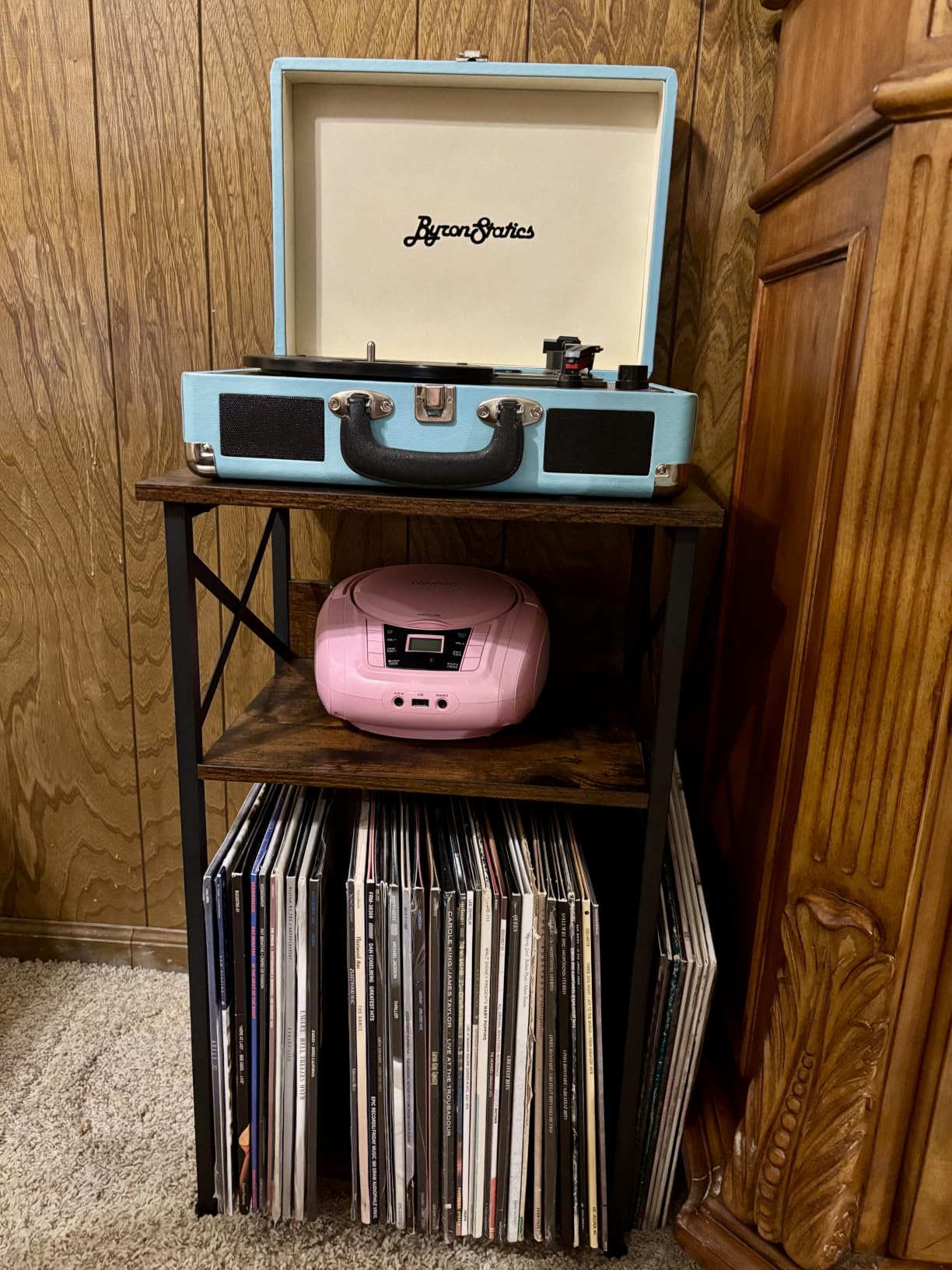
The lower section is divided and holds over 100 records in mixed sizes, with an open middle shelf for accessories or a small amplifier. FSC-certified wood panels sit on the top, middle and bottom shelves over a steel frame.
At 7.5 pounds this is the lightest stand in the roundup, so treat the 110 pound rating as a maximum rather than a sign of acoustic mass. Put an isolation pad between the deck and the top and it behaves far better than its weight suggests.
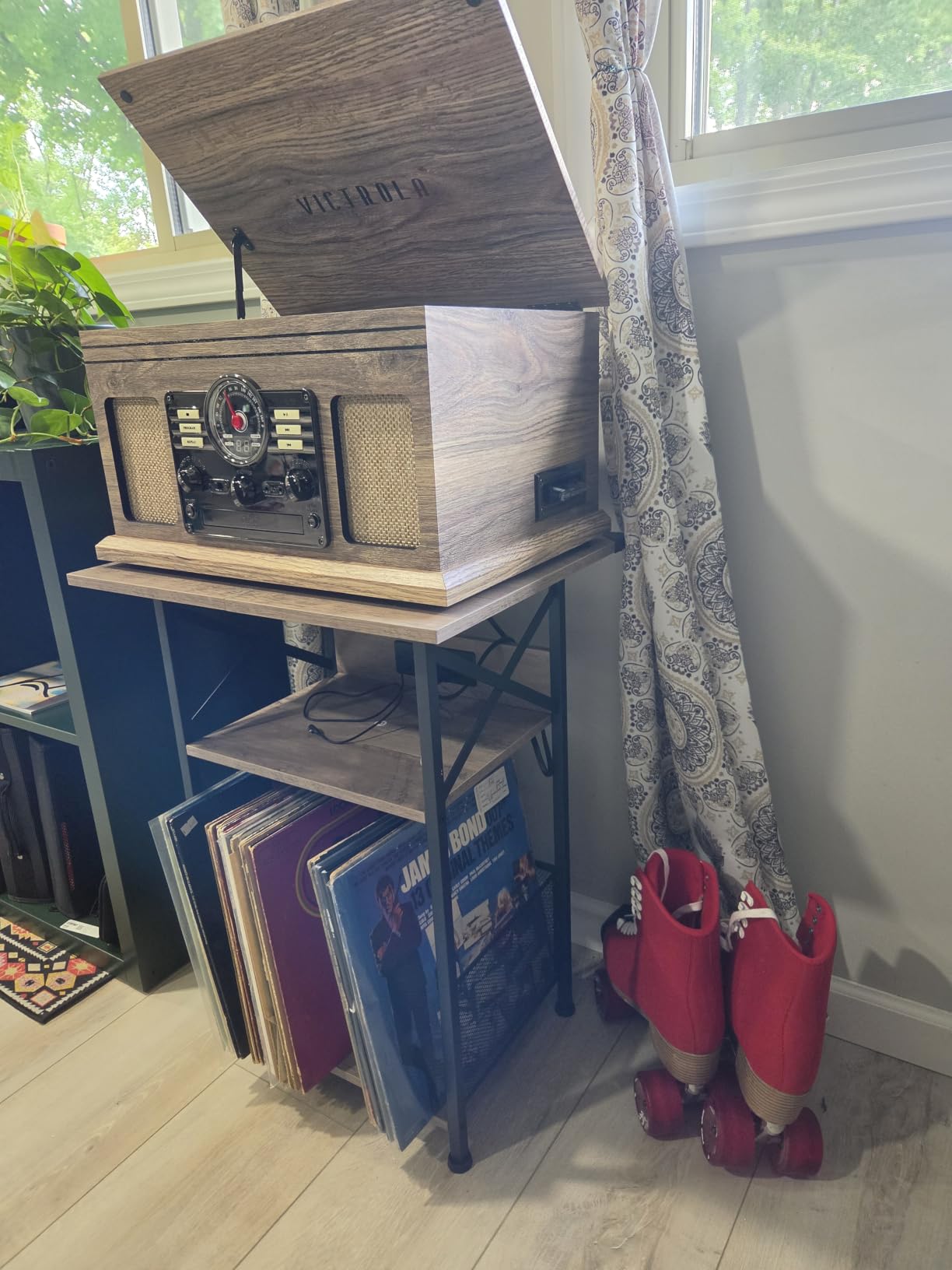
Why the outlets matter more than the shelves?
Most stands solve cable management with holes in the back panel. This one removes the problem entirely by putting power on the furniture itself, so your deck, amp and any accessories all plug in without a strip hanging off the back.
For an apartment setup with a single nearby outlet, that is the single most useful thing in this roundup. It also frees the wall behind, which keeps things looking tidy in a smaller room.
What to watch out for?
The 11.41 inch depth is tight. Owners of larger all-in-one players report the top feeling crowded, and the tonearm on some models sits close to the front edge. A slim belt-drive deck sits comfortably.
The frame is light steel, so if your household has a cat that likes high surfaces, or small children, this is not the piece to leave unanchored. It is also not the stand to choose if your main goal is vibration control.
3. Lerliuo Record Player Stand – Best for Large Decks and 160 Albums
Lerliuo Record Player Stand, Black Turntable Stand Holds up to 160 Albums
- Tall roomy design fits large turntables
- Slanted wood legs feel sturdy and stable
- 10.4 in elevated display area suits audio gear
- Cable pass-through holes in the back panel
- Suits retro and mid-century decor
- Assembly involves a lot of screws and takes patience
- Laminate surfaces can look plasticky
- Some pieces arrive scratched or with damage
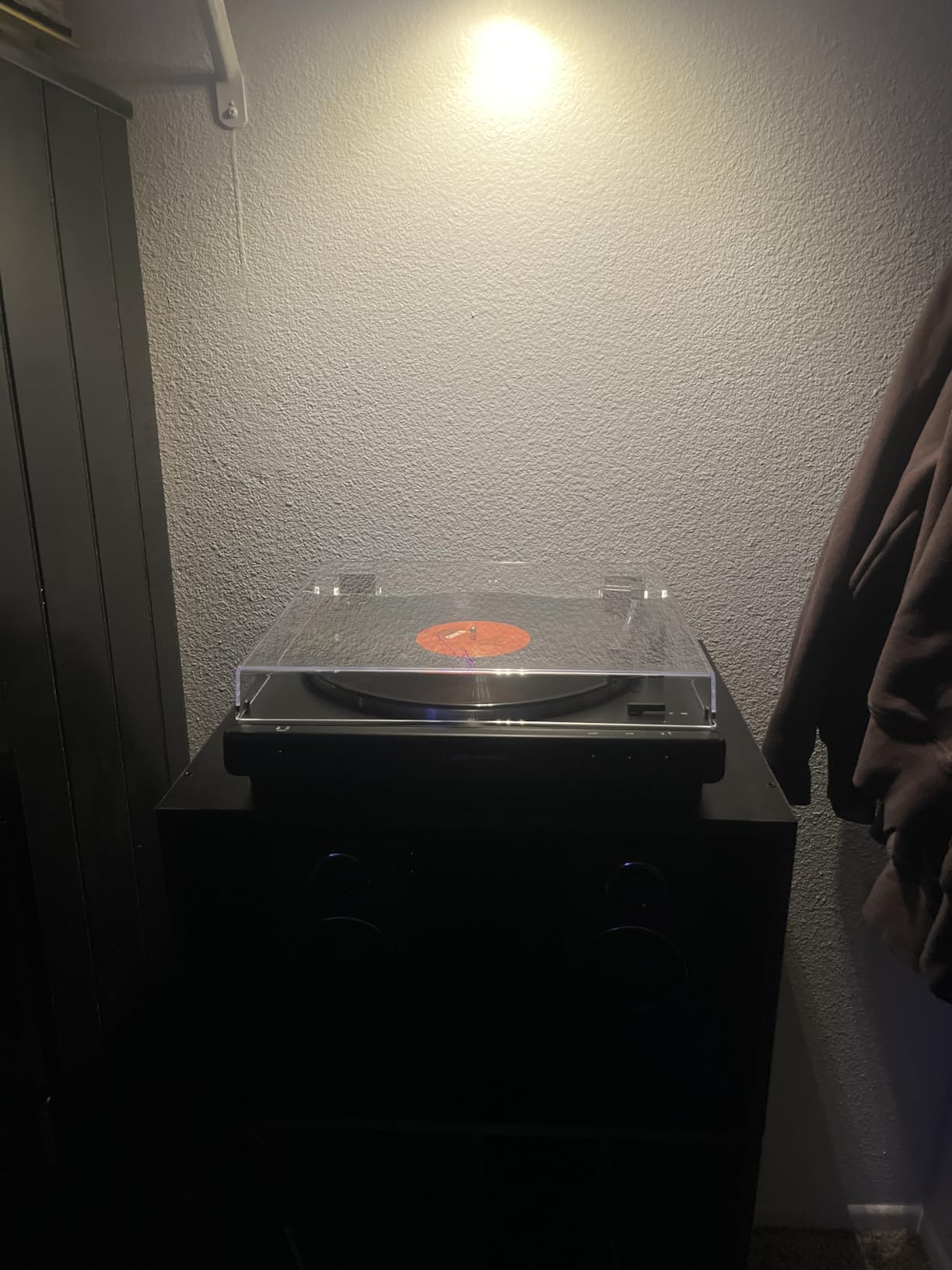
This is the tallest stand in the roundup at 33.8 inches, and that height is the whole point. It gives you an 18.1 x 15.7 inch top with a rated capacity of 100 pounds, which is the combination you want for a wide deck plus two speakers on the same surface.
Owners describe slanted solid wood legs that feel genuinely stable, reinforced with screws at the joints. The black finish with a white top reads well against retro and mid-century decor.
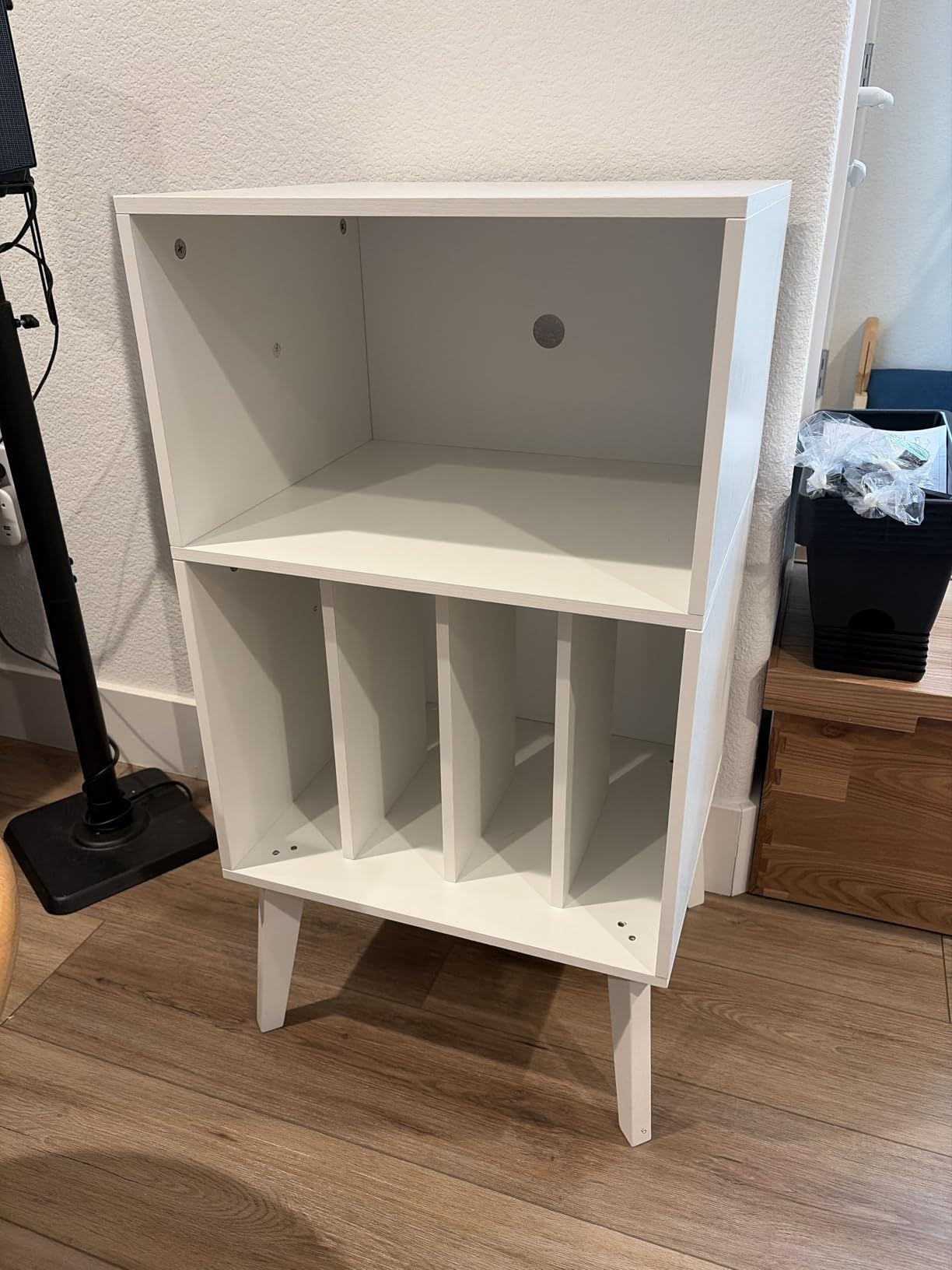
Storage runs to 160 albums, with a 10.4 inch elevated display space in the middle that suits an amplifier or a record collection on show. Circular cable holes in the back panel keep wiring out of sight.
At 34 inches you are working slightly above elbow height when seated. That is fine for most, and it is better if you like to change records standing up, but it is taller than the 24 to 30 inch sweet spot most guides recommend.
Room for a full-size system
The 15.7 inch depth is the second-deepest in the list, which means the tonearm and its counterweight sit fully on the surface with no overhang. If your deck is a full-size model or a DJ-style direct drive, this is one of the few stands here that comfortably takes it.
The 160-album capacity covers a collection that has been growing for a year or two without the shelf dividers. Beyond that, you will need a second unit, and the width means it wants a corner or a long wall rather than a narrow gap.
Build quality in practice
The main complaint is assembly. It takes a lot of screws, and reviewers repeatedly say to allow patience rather than rushing the frame together. Budget an unhurried hour with the manual open.
The second complaint is finish. The laminate can look plasticky up close and the top-facing screw heads are visible. A few buyers also report units arriving with scratched panels, so inspect the box before you start building.
4. Bikoney Record Player Stand – Top Rated Wide Media Console
- Wide 33 in top fits a turntable
- speakers and console gear
- Six storage sections with dividers
- Assembles quickly even for first-time builders
- Adjustable feet
- Compact depth suits small rooms
- Vinyl bin is soft oxford fabric that only holds a few records upright
- Wood grain can read darker than the listing photos
- Real capacity is under the 200-album headline
The Bikoney combines a very wide top with a compact 11.81 inch depth, which is an unusual and useful pairing. At 33.07 inches across it holds a turntable, a receiver and a pair of speakers in one line, and the depth keeps it tight against a wall.
Owners rate it well above the category average on build and value, calling it sturdy without being heavy at 14.6 pounds. Assembly is described as quick even for inexperienced builders, with step-by-step instructions and marked parts.
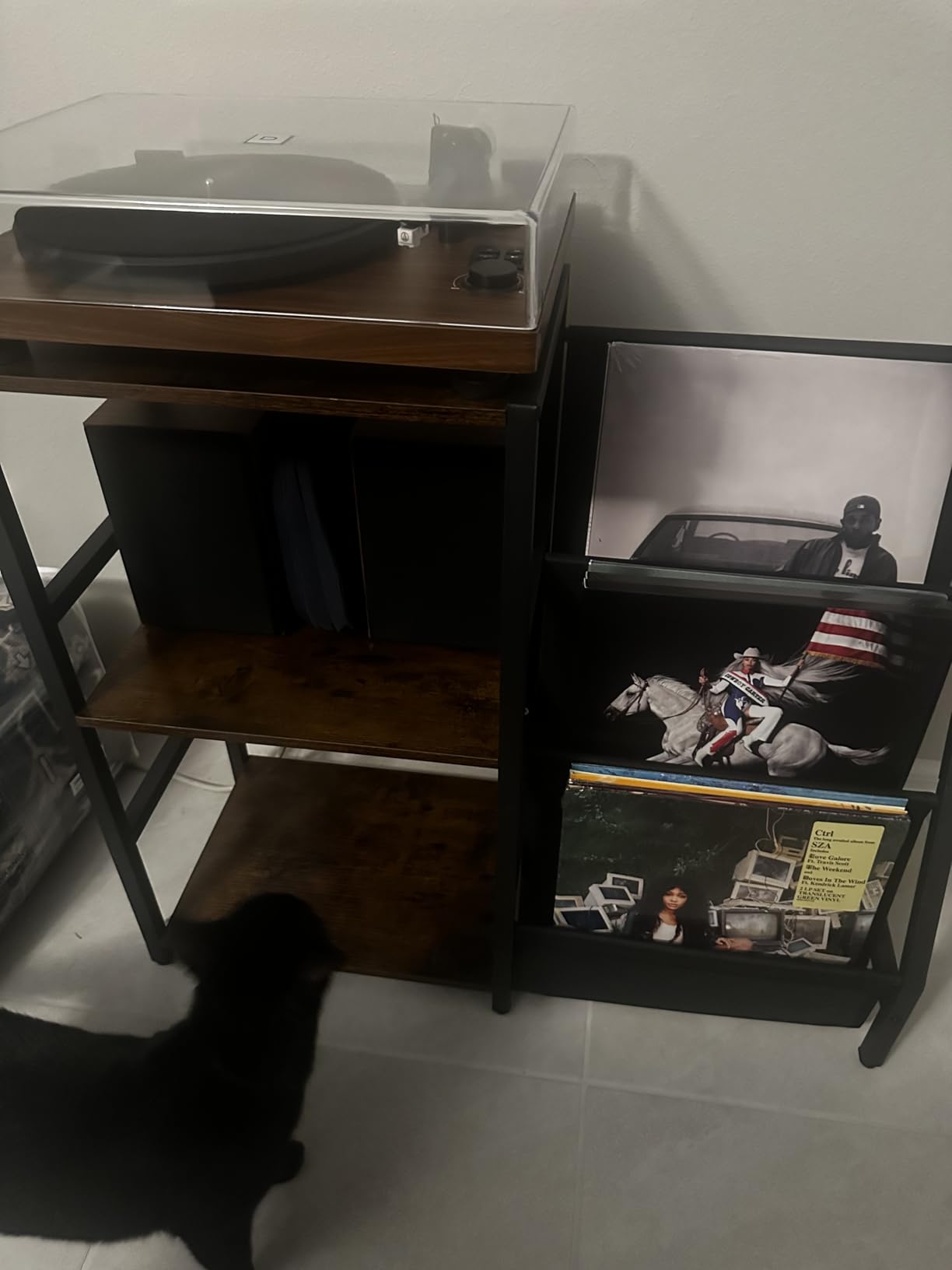
There are six storage sections in total with dividers for sorting and for turning album covers outward. The mid-century styling in brown and black works in most living rooms, and the same unit doubles as a nightstand or side table.
Shelf capacity is rated at 50 pounds each, which is more than enough for records and light electronics. The shelves use a strong wooden board with thicker iron and adjustable feet for uneven floors.
Why the width matters for stereo?
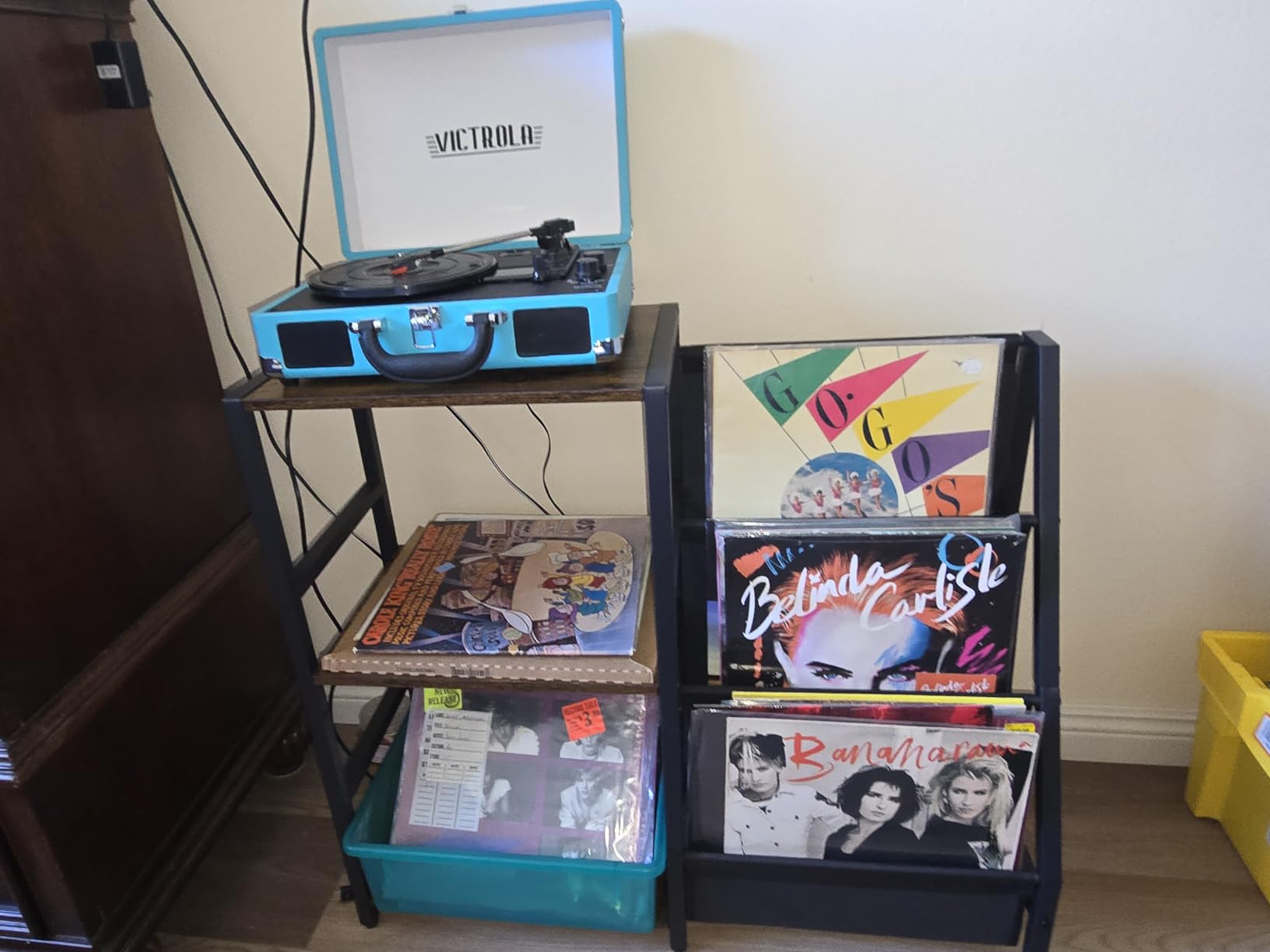
Most stands in this price bracket are narrow end tables that force you to stack a speaker on top of the amplifier. A 33 inch top lets you lay out deck, amp and two monitors on the same level, which is far tidier and keeps cable runs short.
The shallow depth also means it slides into narrow spaces between a sofa and a wall, where a deeper cabinet simply will not go. At 29.13 inches tall it sits inside the comfortable 24 to 30 inch band.
The capacity claim to discount
The advertised 200-album figure is optimistic. Reviewers point out that the vinyl storage section uses a soft oxford fabric bin that only holds a handful of records upright, so the realistic number depends on how you use the open shelves.
A minority also report the wood grain tone reading darker in person than in the listing photos. If the colour is important to your room, this is one to look at carefully before committing.
5. Joaxswe Record Player Stand – Best Heavy All-Wood Build
Joaxswe Record Player Stand with Vinyl Record Storage,Navy Blue
- Holds up to 160 albums in a vintage farmhouse style
- Solid all-wood build with metal corner guards
- 8.26 in display area for audio gear
- Cable hole in the back panel
- Heavy build that resists wobbling
- Bulky at 31.5 lb and wide for a small room
- Only two levels of open shelving
- Bagged sleeves in the tightest bays feel cramped
Mass is the reason this one earns a place. At 31.5 pounds it is the second-heaviest stand we reviewed, and owners single out the way it resists wobbling. That weight is what separates a stand that absorbs floor vibration from one that transmits it.
It measures 15.74 x 19.68 x 29.01 inches and is built from solid wood throughout, in a vintage farmhouse style with metal corner guards on the edges. The navy blue finish is unusual for a record stand and suits a room that is not all mid-century.
Storage is rated at 160 albums across three shelves with one drawer, plus an 8.26 inch display area sized for an amplifier or a small collection on show. A round cable hole in the back panel handles wiring.
The 19.68 inch width gives a top that comfortably takes a large deck with clearance either side, and the depth means nothing overhangs the front edge.
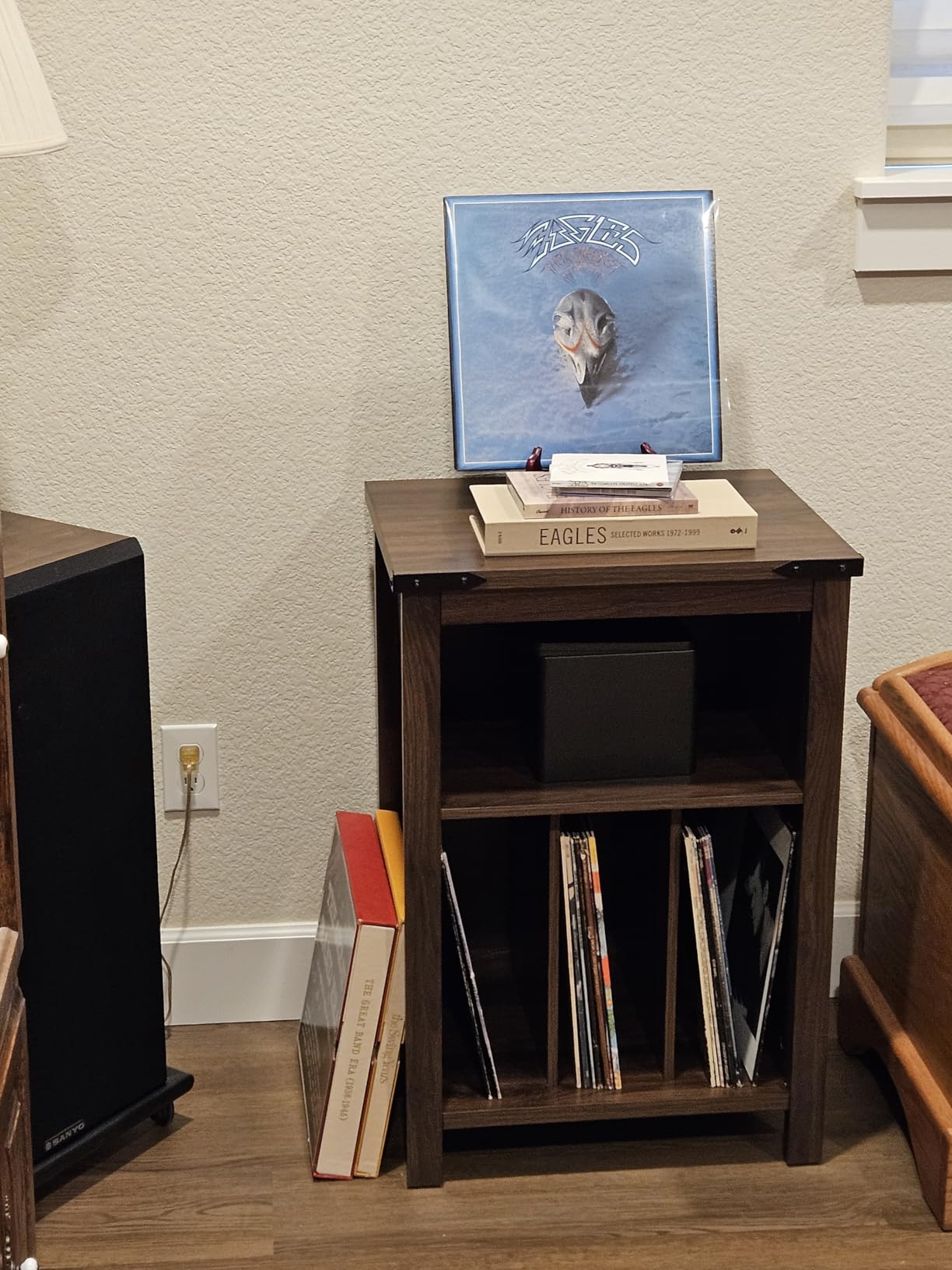
What the weight buys you?
When a footstep lands on the floor, energy travels up a light shelf and straight into the plinth and cartridge. A 31.5 pound cabinet has enough inertia to absorb a good share of that before it reaches the tonearm. This is the difference between an isolation gadget and a piece of furniture.
Owners also note the categorised bottom structure and the dedicated display height as practical details rather than styling. It reads as a genuine cabinet, not a metal frame with shelves bolted on.
Where the bulk works against it?
Thirty-one pounds is genuinely awkward to move, and 19.68 inches wide plus nearly 16 inches deep is a large footprint. In a compact apartment this is the piece that ends up in the wrong room.
With only two levels of open shelving, arrangement options are limited, and reviewers with heavy bagged sleeves find the tightest bays cramped. If you store records in outer sleeves, leave extra room.
6. 2BHOME Wooden LP Record Player Stand – Best Solid Wood Per Dollar
- Real solid acacia wood rather than particleboard
- Assembles in about 10 to 30 minutes
- Anti-slip pads on the legs
- Removable separator reconfigures the bays
- Seller responds quickly about transit damage
- Top surface only 15.5 x 13.0 in
- Wood screws can split if overtightened
- Occasional reports of scuffs or uneven legs
This is one of only two picks built from solid acacia rather than engineered board, and at 17.6 pounds it carries real mass for its size. Buyers consistently say it looks far more expensive than the listing suggests, with a tight, attractive grain in a warm finish.
It measures 13 x 16 x 26 inches with a stated load capacity of 100 pounds. Storage is rated at 100 records, with a removable separator so you can split the bays for books or magazines instead.
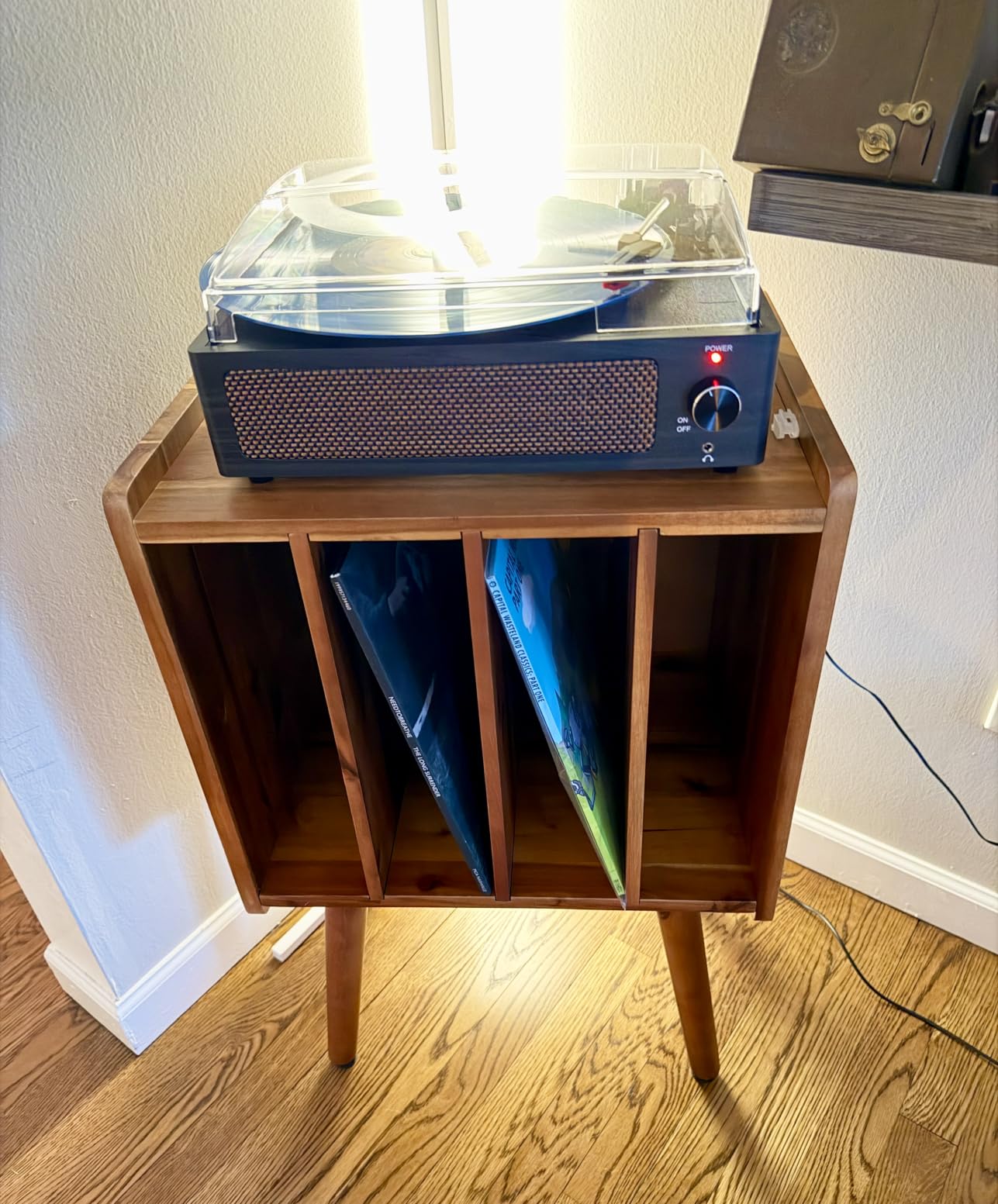
The frame carries anti-slip pads on the legs, which protects both the floor and the finish, and the same piece works as a nightstand or a side table. Assembly runs about 10 to 30 minutes with clearly labelled parts.
Two levels and a clean rectangular shape make it the least fussy design here. There is no built-in power and no cable management, so add a strip behind the unit if your equipment needs one.
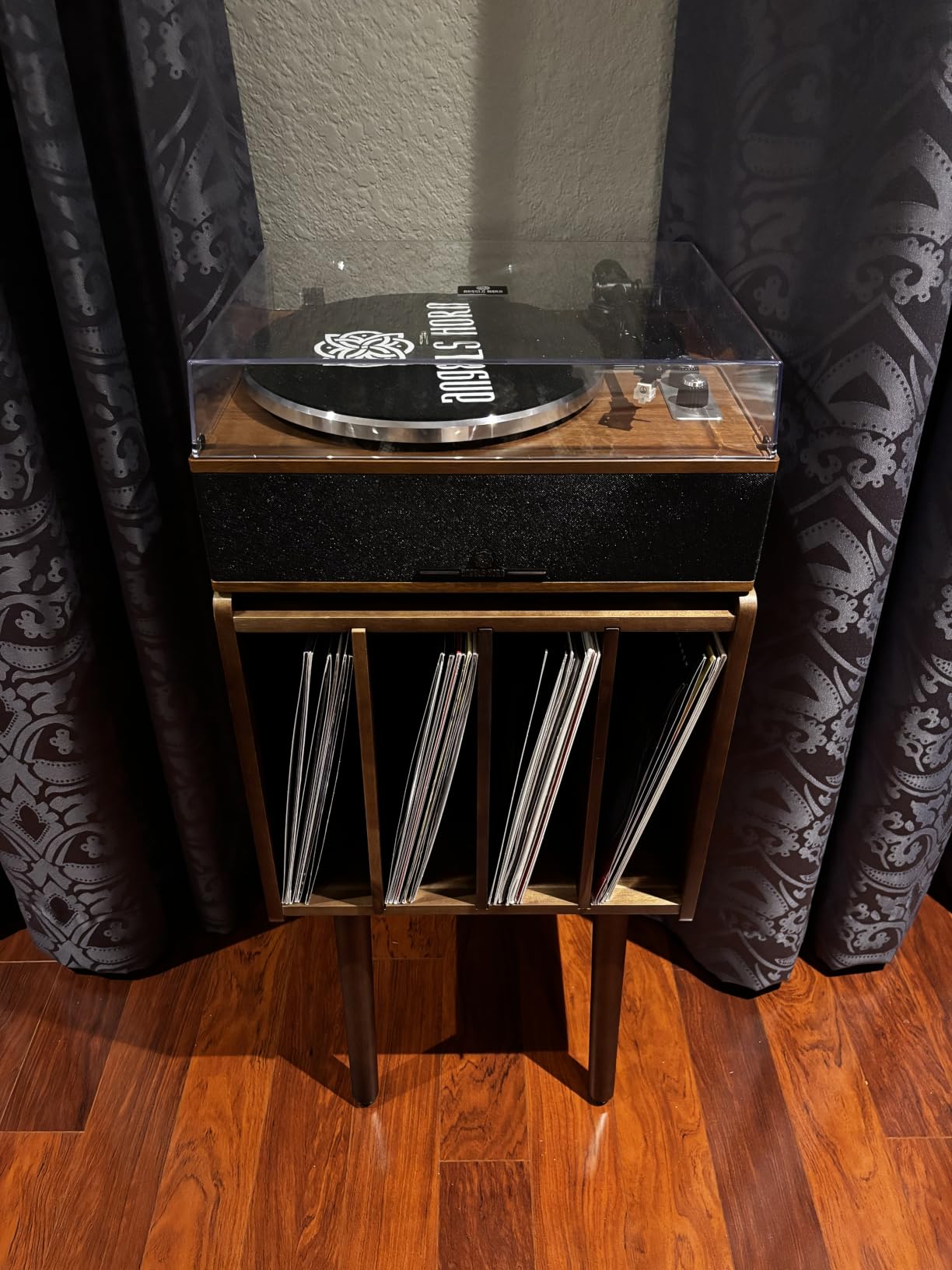
The wood matters more than the price suggests
Solid wood does not flex the way engineered board does, and it does not lose rigidity at the joints after a couple of years of humidity cycles. For a stand that has to hold a deck at a constant height for years, that durability argument is worth more than any styling detail.
It is also the pick we would choose for a bedroom setup, where the piece doubles as furniture and the warm grain softens what would otherwise be a black metal box.
The fit issue you must check
The usable top surface is 15.5 x 13.0 inches, and that is the most common complaint in the reviews. It suits a slim belt-drive deck and it does not suit a wide all-in-one player or anything with a long tonearm overhang.
Reviewers also stress tightening screws only until the gap closes. Solid wood screws can split or strip if you overtighten during assembly, and that is the single most useful thing to know before you build it.
7. Sonyabecca 3-Tier Record Player Stand – Best for Wide Stereo Setups
Sonyabecca 3-Tier Record Player Stand with Adjustable Vinyl Storage, Black
- Very wide 30 in top fits turntables
- receivers and speakers
- Holds up to 350 vinyls across two shelves
- Four movable dividers with preset mounting positions
- Thick panels and powder-coated frame
- Leveling feet protect floors
- Wide 30 in body takes a noticeable wall footprint
- Black wood and metal look is less distinctive than warmer finishes
Capacity is the headline here: up to 350 vinyls across two open shelves, which is far more than any other stand in this roundup at similar dimensions. The 30.11 inch wide by 11.81 inch deep top at 30.64 inches tall also sits neatly inside the comfortable height band.
Owners highlight the four movable dividers with preset mounting positions as the feature they did not expect. They let you build a custom layout for a mixed collection of LPs, singles and magazines rather than fixed bays.
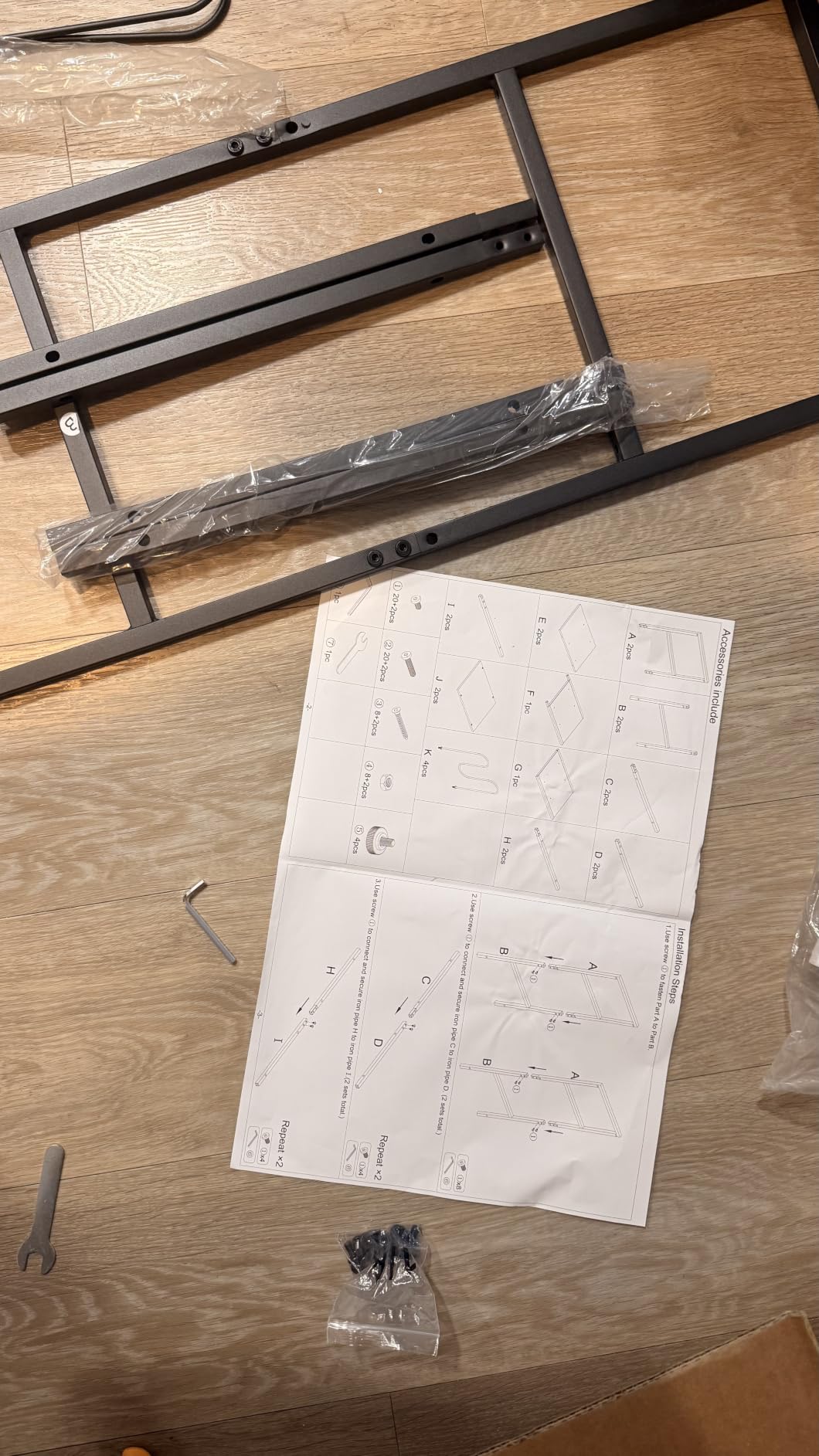
Construction uses thick engineered wood panels on a powder-coated steel frame, weighing 18.1 pounds. The styling is a modern industrial take on mid-century, in black, with leveling feet that protect the floor and help balance on uneven surfaces.
For a growing collection this is the pick that buys you the most time before you need a second piece. If you are already past 250 albums, the shelves here are the reason to look twice.
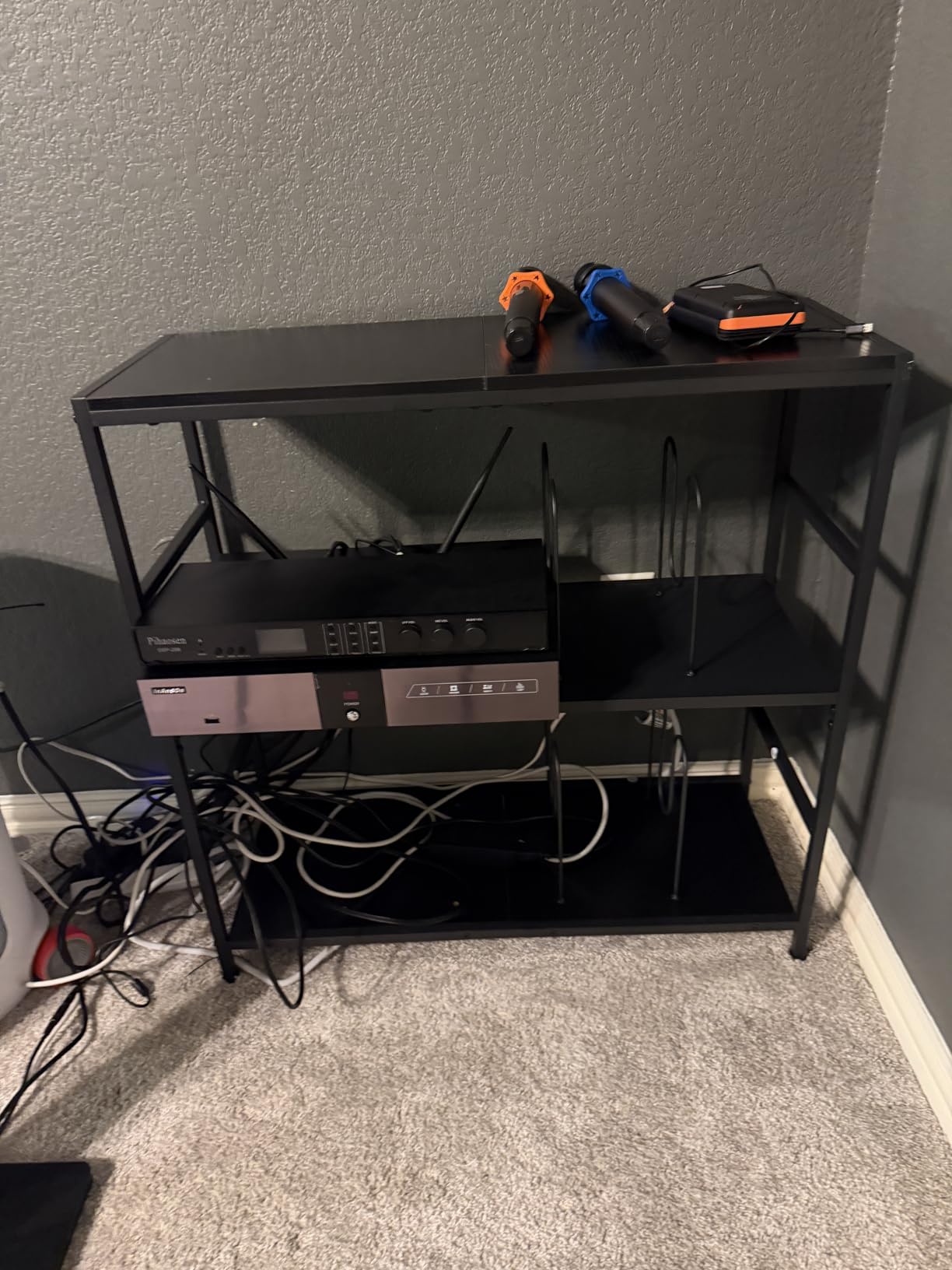
Capacity versus footprint
350 albums sounds enormous until you work out the shelf math. Plan on roughly 14 linear inches of shelf per 100 sleeved 12-inch LPs, which means the number on the listing assumes a particular spacing. Singles and gatefold doubles eat into that fast.
The practical benefit is that you can double up records you are not playing without reorganising. Reviewers treat the adjustable dividers as the difference between the stated capacity and real capacity.
Who should look elsewhere?
A 30 inch body needs a real run of wall. In a narrow room it dominates the space and it is not the piece to buy if your priority is a compact footprint or a warm, furniture-like finish.
It is also engineered wood rather than solid timber, so it will not age the way the acacia or the all-wood cabinet does. Treat it as the high-capacity, high-value option rather than the heirloom option.
8. Cozy Castle Record Player Stand – Best for Large Collections
- Holds up to 350 albums across six cubes
- Deep top also fits stereo speakers
- Built-in 3 AC power strip in a perforated cube
- Anti-tip hardware included
- 39 in console pairs with other units
- Heavy at 54 lb and hard to move once built
- Engineered wood and veneer rather than solid timber
- 39.4 in width needs a large wall
This is the largest and heaviest piece we reviewed. At 54 pounds and 39.4 inches wide, it is not a side table — it is a media console that doubles as a record player stand, and it is the pick for someone whose collection has outgrown shelf stands.
It measures 15.7 x 39.4 x 29.3 inches in engineered wood with a mid-century modern profile. Six storage cubes in two sizes give a stated capacity of 350 albums: roughly 250 LPs in the lower cubbies and about 100 CDs, DVDs or 7-inch EPs up top.
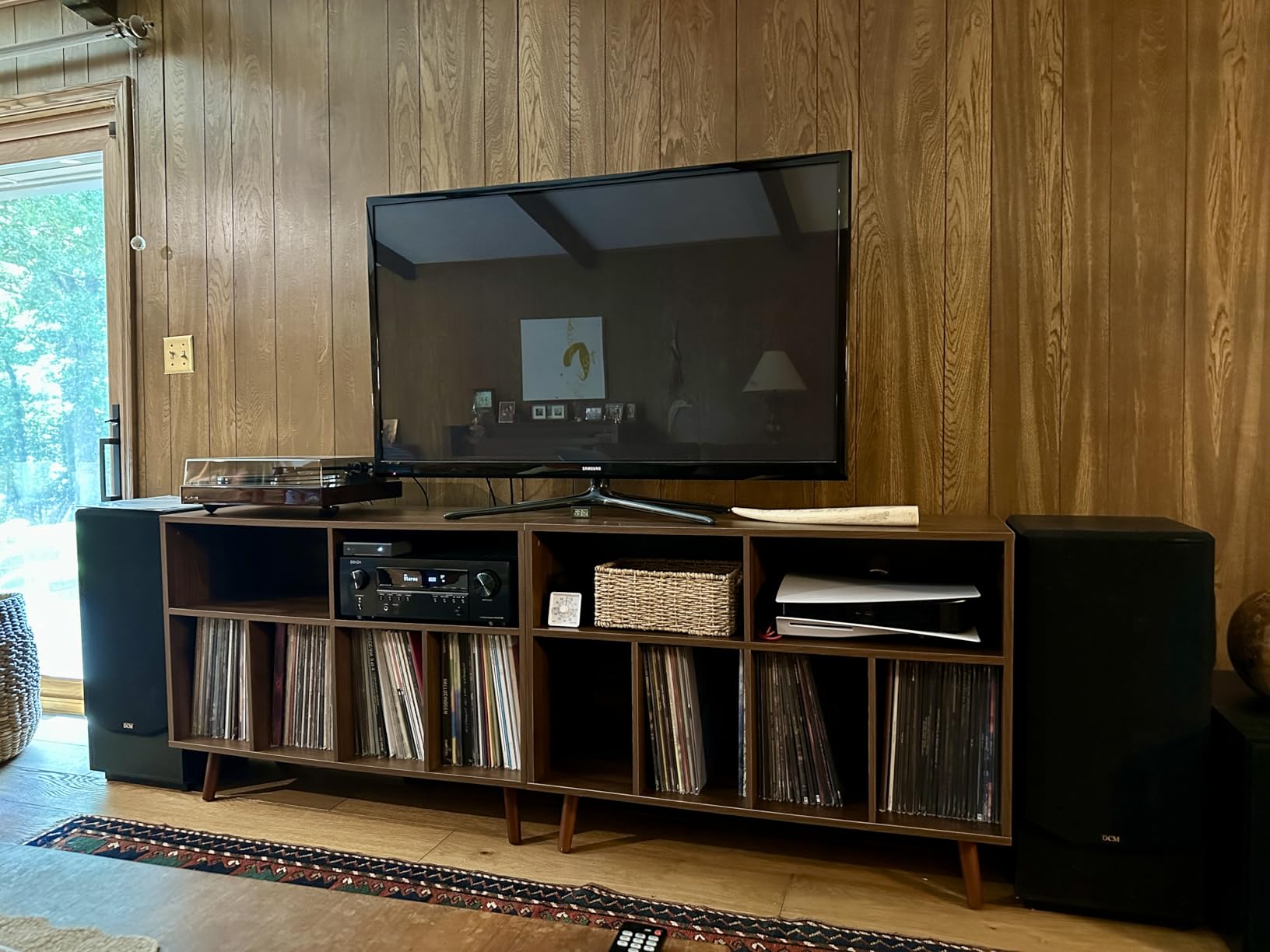
Each cube is rated to 25 pounds and the console top to 100 pounds. The upper right cube has perforated holes and a built-in three-outlet AC power strip, so components can sit in place and plug in without a floor strip.
Anti-tip hardware is included, which matters for a cabinet this tall with children or pets in the house, and owners say the assembly instructions are well illustrated.
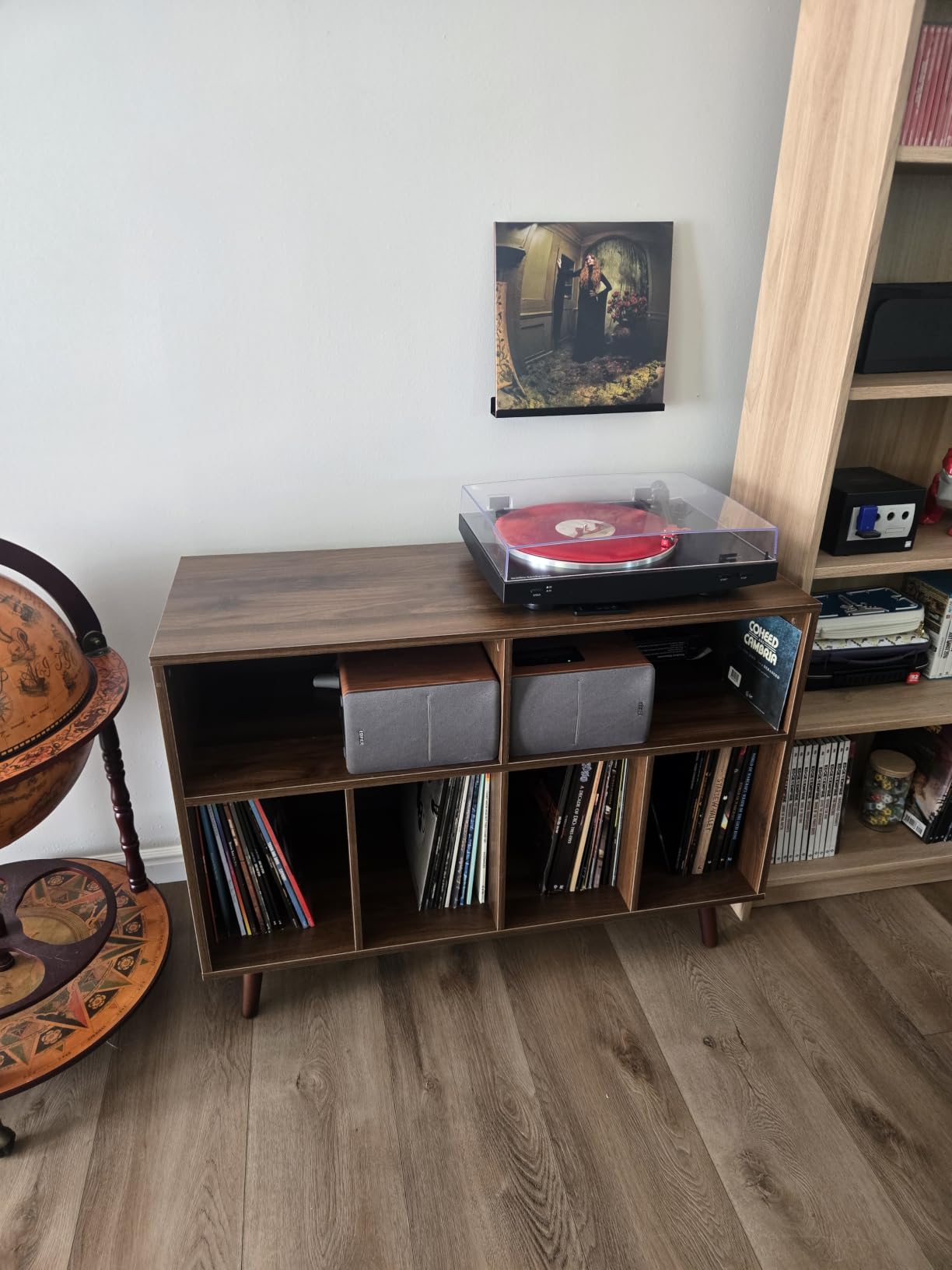
When a console beats a stand?
If you are storing several hundred records, the arithmetic favours one large console. Multiple small stands mean multiple tops competing for floor space, and a single 39.4 inch console can pair with a second identical unit for near-continuous storage along a long wall.
Owners also like that the doors-less cube layout keeps everything visible, which suits a collection you want to browse rather than hide. The perforated power cube is a genuinely smart detail that removes a cable problem.
The trade-offs are real
Fifty-four pounds is heavy. Two people should plan the assembly, and it will stay where you put it. That is also the upside: it will not shift when you lean on it to cue a record.
The construction is listed as roughly 70 percent MDF with paper veneer, plus metal hardware and some pine. That is less premium than solid timber and reviewers say so, and the 39.4 inch width demands a long wall or a corner to itself.
9. Astimey Record Player Stand – Best for Built-In Power and Charging
- Charging station with 2 AC outlets and 2 USB ports built in
- Three storage areas for deck
- accessories and vinyl
- Mid-century black metal divider with solid wood legs
- Fits turntables from 15.6 to 19.7 inches
- Scratch-proof feet for repositioning
- Deep at 15.7 in so it needs a larger nook
- Engineered wood and particleboard rather than solid timber
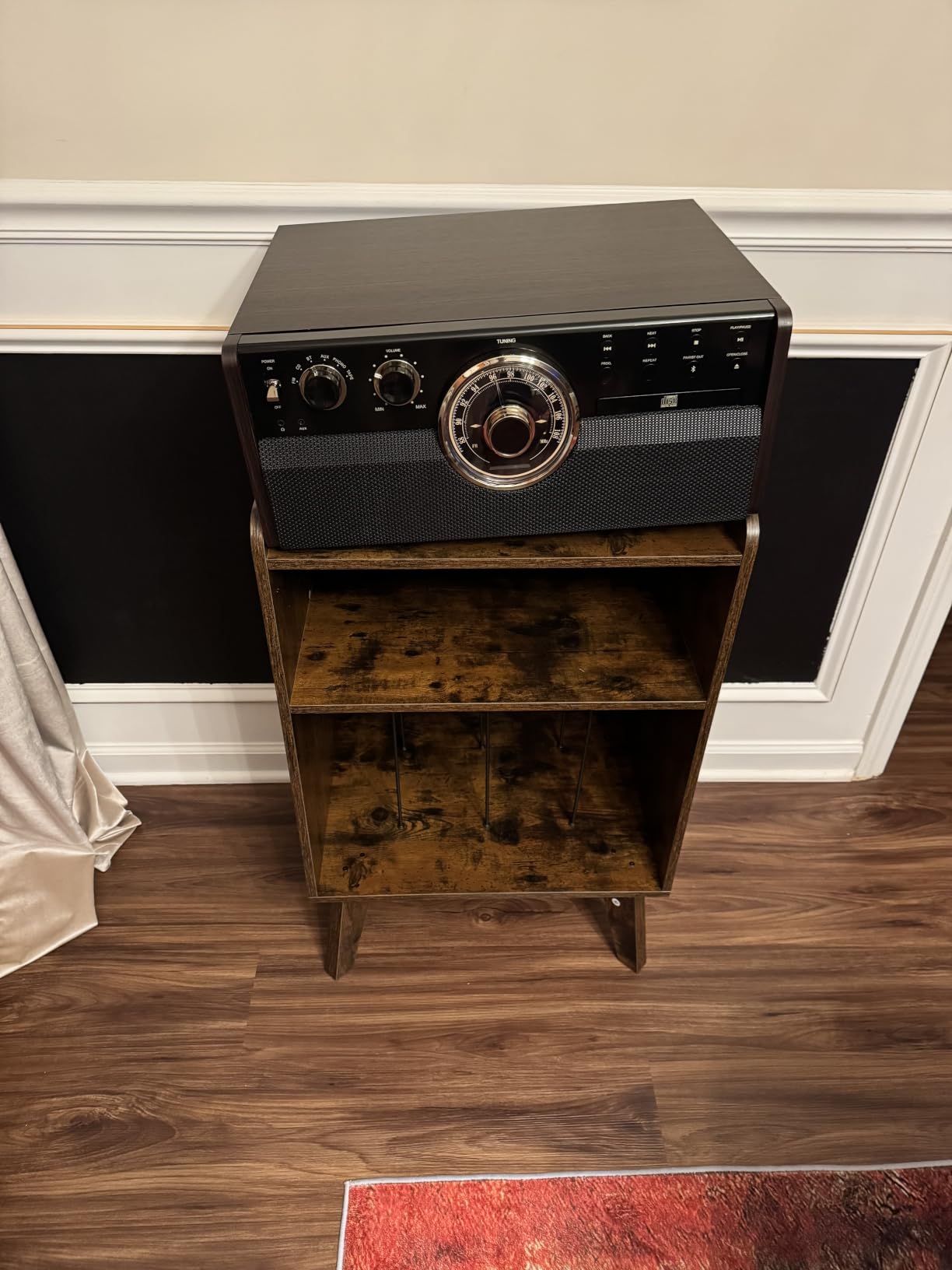
This is the other stand with power built in, and it does more of it: two AC outlets and two USB ports in the top. For a setup where a phone, a lamp and an amplifier all need feeding, that removes the power strip from the floor entirely.
It measures 15.7 x 19.6 x 31.8 inches and weighs 20 pounds, giving a top rated to take turntables from 15.6 to 19.7 inches wide. That published range is unusually helpful when you are buying blind.
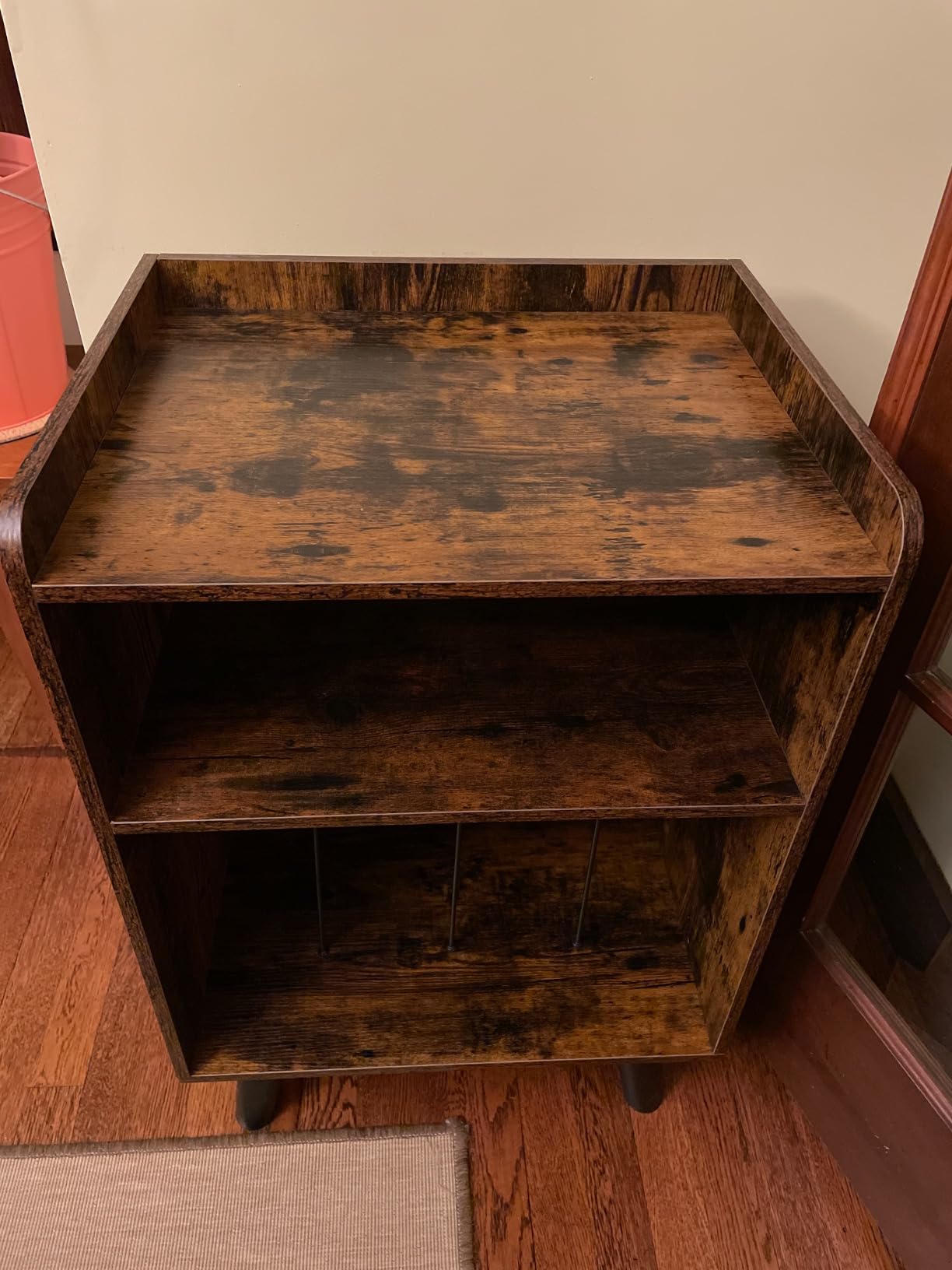
There are three storage areas: the turntable top, an audio accessory shelf and a divided vinyl section rated at up to 160 albums. The styling pairs a mid-century black metal divider with solid wood decorative legs in a walnut finish.
Scratch-proof feet let you drag it across tile or a wood floor without marking it, which owners appreciate when they are rearranging a room. Assembly is reported as straightforward, though two adults are recommended.
Powered furniture versus cable management
Most stands offer a cable hole in the back panel, which is tidier than nothing but still leaves you plugging into a wall. Putting outlets in the top means the equipment plugs in exactly where it sits, and the USB ports cover accessories that would otherwise share a wall adapter.
At 31.8 inches it is a little taller than the 24 to 30 inch band, so test it against your chair height before ordering. Many listeners find it ideal anyway because they change records standing.
What to weigh up first?
The 15.7 inch depth is the main constraint. It is deep enough for any deck to sit fully on the surface, which is good, but it also means this is not a slim end table. It needs a proper nook rather than a gap beside a sofa.
The body is laminated MDF and particleboard with solid wood legs, so it will not age like the all-wood picks here. If you can live with that, the outlet count and the published deck-fit range make it one of the more practical options.
10. ZEXVIDA 3-Tier Record Player Stand – Best for a Comfortable 28 Inch Working Height
ZEXVIDA 3-Tier Record Player Stand, with Storage, 28″ H, Rustic
- 28 in height keeps the deck at a comfortable level
- U-shaped dividers sort albums by genre
- Rustic brown finish on a thick iron frame
- 100 lb capacity per tier
- Adjustable rubberized feet stay stable on carpet
- Bottom bays hold about 15 records each
- Wood shelves and metal frame are on the thin side
- Open sides will not take CDs or 7-inch singles upright
This stand lands almost exactly in the middle of the recommended 24 to 30 inch band at 28 inches, and owners call the working height the standout feature. You cue records sitting down without leaning and without catching the tonearm on the front edge.
It measures 15.7 x 11.81 x 28 inches with an Art Deco-leaning rustic brown finish on a thick iron frame, rated at 100 pounds per tier. At about 12 pounds it is portable enough to move between rooms when you want it elsewhere.
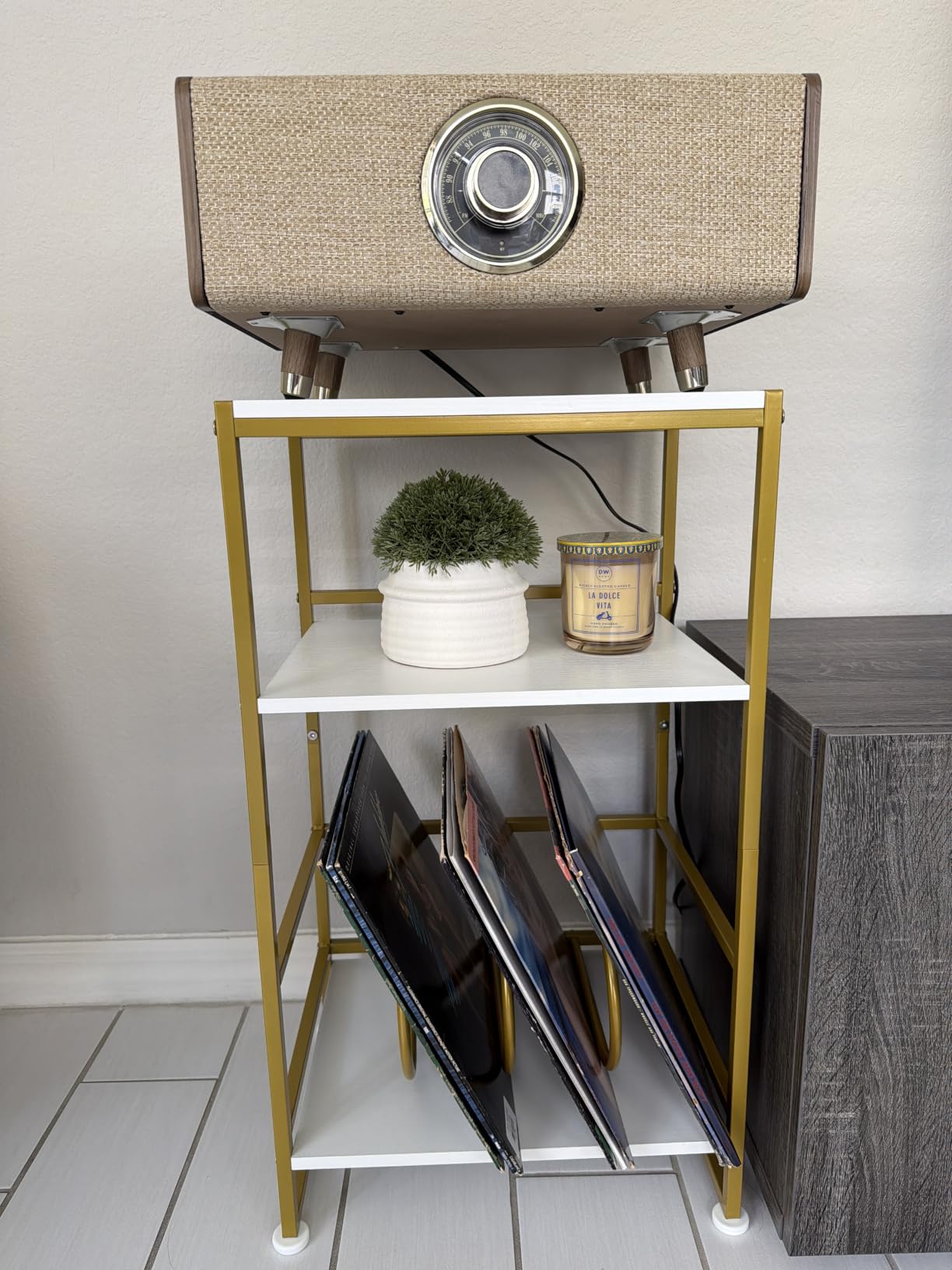
Three U-shaped metal sorting bars on the bottom level let you organise by genre, which reviewers like more than expected. Adjustable rubberized feet protect the floor and, importantly, stay stable on carpet where most stands wobble.
The top is described as extra-large relative to the frame, and compatible with standard and oversized turntables from several of the better-known entry-level brands.
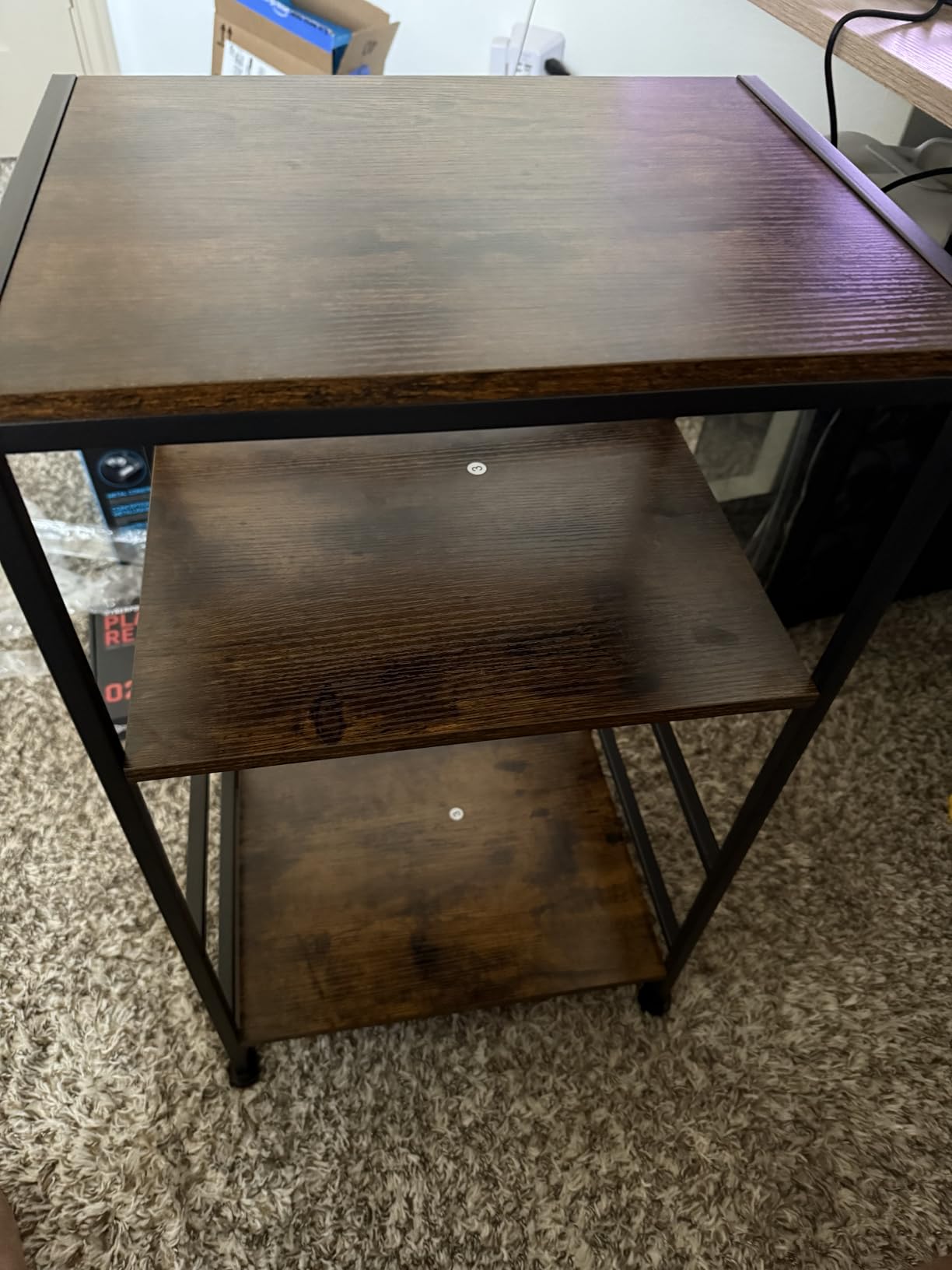
Why height matters more than people expect?
Too low and you are bending over the deck every time you cue a record, which over years is a real annoyance. Too high and you bump the platter with your forearm. Twenty-eight inches avoids both, and it is also tall enough to clear most sofa backs.
The leveling feet are worth a closer look if you are on carpet. Many flat-pack stands sink and rock on pile carpet; adjustable feet of this type keep the frame in contact with the floor and stop the wobble that ruins tracking.
Discount the capacity claim
The headline figure of up to 120 LPs is optimistic. Reviewers report the open-sided bottom bays hold roughly 15 albums each, so a realistic figure is closer to 45 to 60 records unless you use the upper shelves differently.
The open sides also mean CDs, 7-inch singles and thin books will not stand upright on the middle shelf. If your collection is mostly singles, this is the wrong stand regardless of the price.
11. LUVIOHOME Large Round Record Player Stand – Best Style Piece
LUVIOHOME Large Round Record Player Stand with Charging Station & USB Ports
- Curved mid-century silhouette with hairpin leg accents
- Built-in top outlets with 2 plugs and USB ports
- Holds up to 150 records plus books and games
- Cord pass-through cutouts in enclosed sections
- Feels solid while remaining movable
- Advertised storage is optimistic once doors and curved sides are counted
- Black interior dividers can feel wobbly
- Upper shelf is slightly too short for DVDs upright
- MDF can chip during assembly
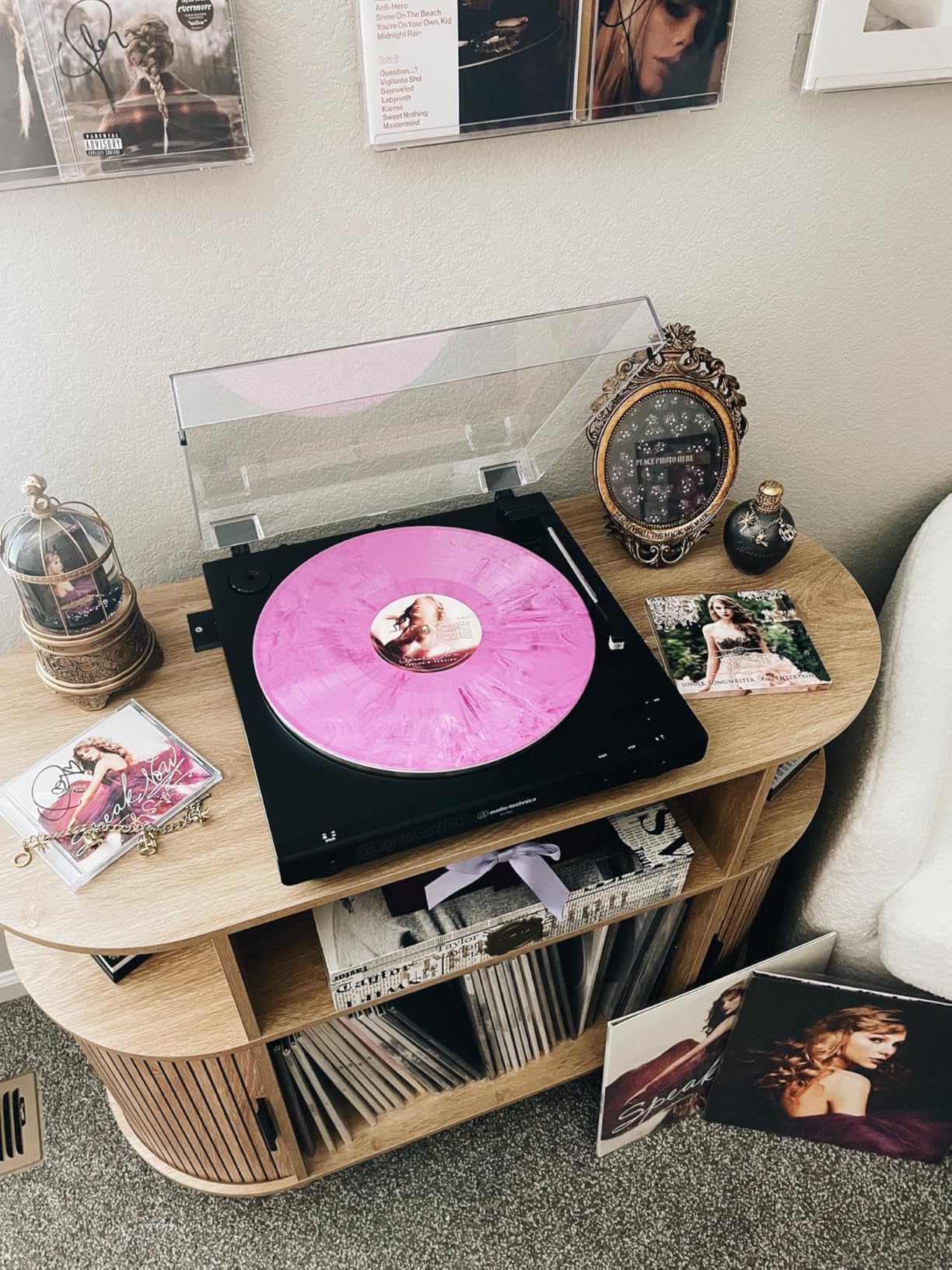
People buy this one for the look. The curved mid-century silhouette with metal hairpin leg accents draws compliments, and several owners describe it as the best furniture piece they have bought rather than simply a record stand.
It measures 55.1 x 15.7 x 30 inches and weighs 25 kg, so it is wide. The top carries a built-in charging station with two standard plugs and USB ports, and enclosed sections have cord pass-through cutouts.
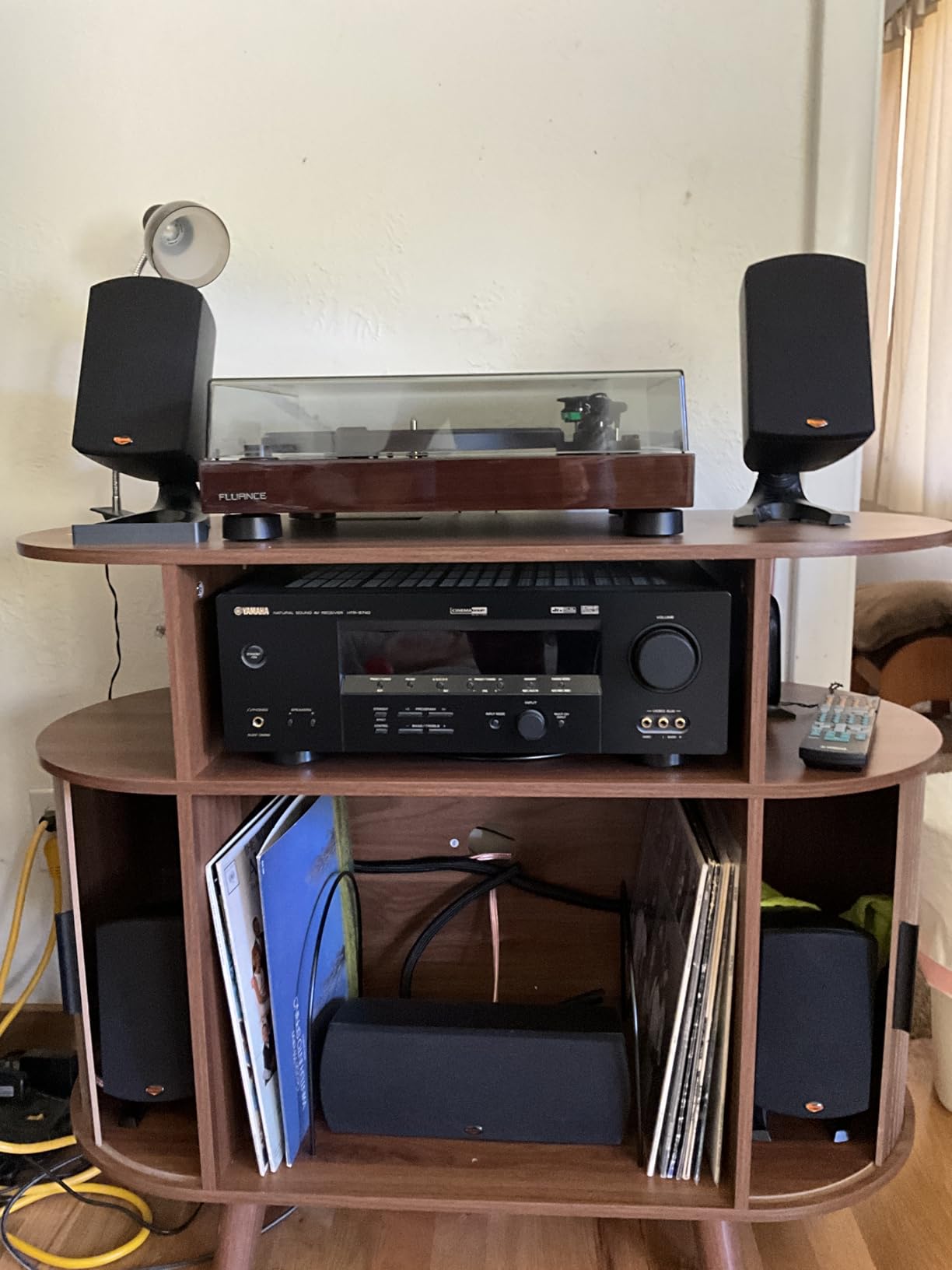
Stated capacity is 150 records with headspace and middle space reserved for speakers or decor. Reviewers typically put real capacity lower once the doors and curved sides are accounted for, so treat the figure as a ceiling.
Assembly runs around 90 minutes for most owners and the unit stays movable afterwards, which is unusual at this width. The wood texture and legs suit a living room, study, bedroom or office.
Style first, storage second
The curve is what makes this piece work in a room where a square cabinet would look like furniture you bought for a record player. It reads as a display piece, and that is exactly why owners forgive some of the storage shortfalls.
The top outlets are a genuine advantage at 55 inches wide, because you are likely to have a lamp, a deck and something else arranged across that span. Having the power where the equipment is beats running a strip along the back.
The honest drawbacks
Reviewers mention slightly wobbly black interior dividers and an upper shelf a little too short for DVDs to stand upright. If your media is mostly DVDs, check those dimensions before buying.
The MDF can chip and crack if handled roughly during assembly, so take your time rather than forcing panels together. At 25 kg, moving it alone is a two-person job.
12. Modway Render Mid-Century Modern Record Display Stand – Best for Dust Protection
Modway Render Mid-Century Modern 37″ Vinyl Record Display Stand in Walnut
- Iconic mid-century silhouette with organic lines
- Sliding slatted door keeps vinyl closed and dust-free
- Internal dividers organise the collection
- Tapered legs and walnut grain laminate
- 36.5 in width gives a generous top
- Only 22 in tall so it is a low cabinet rather than a stand
- Particleboard with laminate is less robust than solid wood
- Sliding door makes far compartments awkward to reach
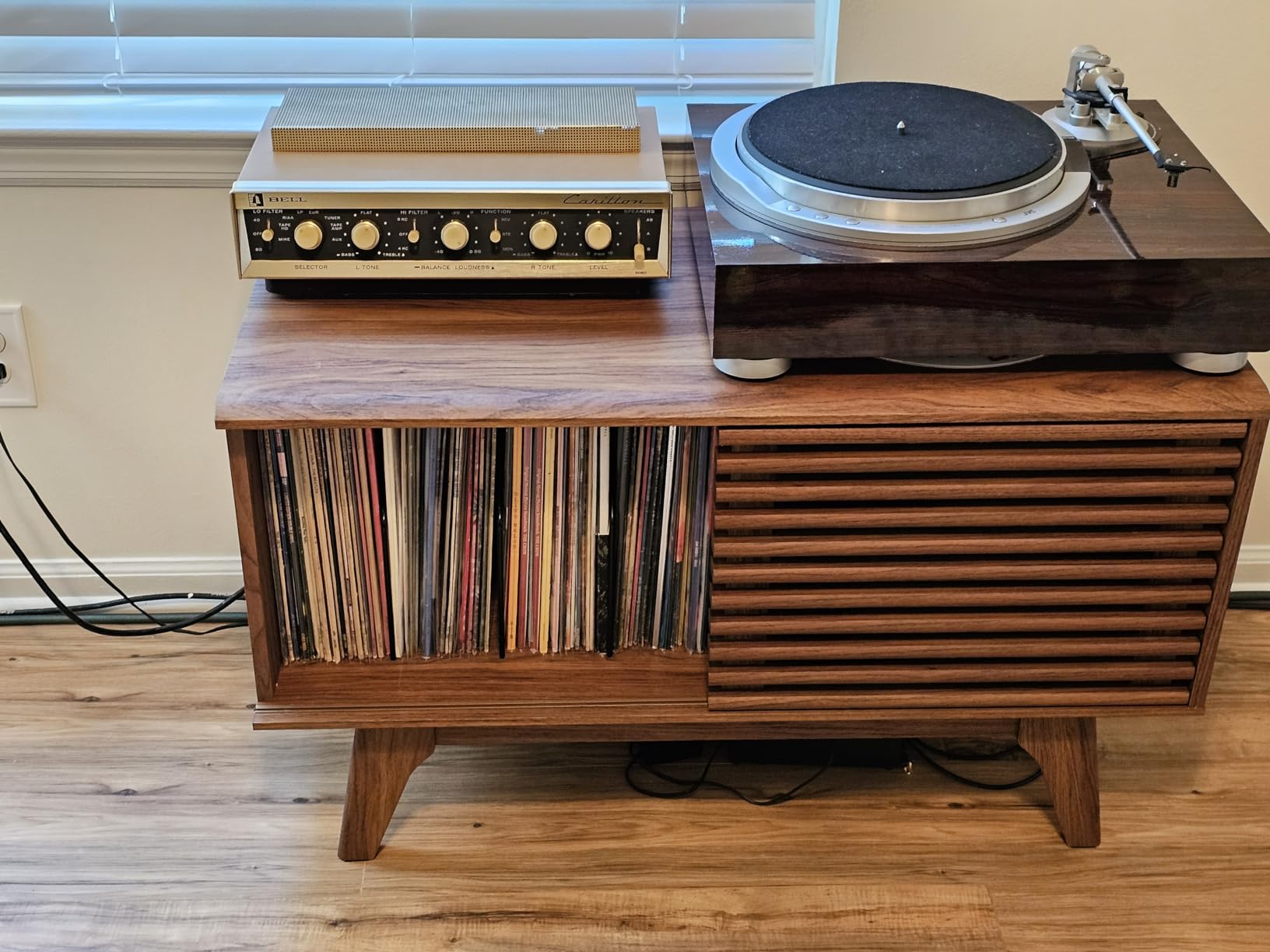
This is the one pick where dust protection is the deciding feature. The sliding slatted door keeps the collection closed and covered, which matters in dry climates or in a home with pets, and the walnut grain finish suits a mid-century room.
It measures 36.5 x 17.5 x 22 inches and weighs 36 pounds, with a stated maximum weight capacity of 50 pounds on the top. Internal dividers organise the vinyl and other media inside.
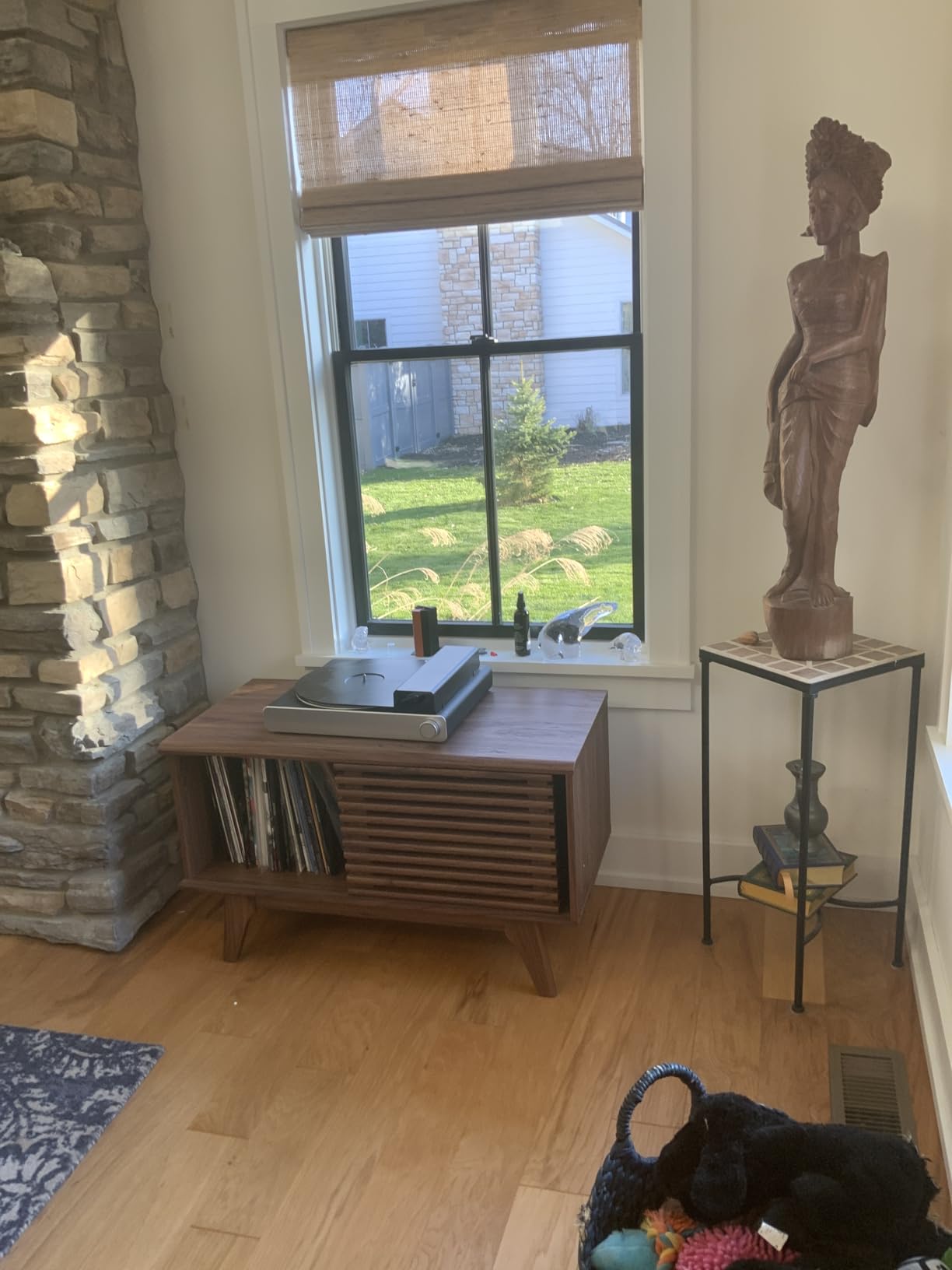
Ratings sit slightly above the category average, and buyers treat it as a display piece first and a storage cabinet second. The tapered legs and flared profile give it the kind of silhouette you do not find in flat-pack furniture.
At 36.5 inches the top is generous, and the 17.5 inch depth is the deepest in the roundup, so even a large deck sits fully on the surface with nothing overhanging.
When a low cabinet beats a tall stand?
Twenty-two inches is below the 24 to 30 inch band, so this is not a working-height stand in the usual sense. It works when the deck sits on top of a low media unit in a living room and you listen from a distance rather than leaning in to cue records.
Owners largely describe the height as a style choice rather than a flaw, which is fair. If you want to sort through records at the cabinet, expect to stand up.
What the door costs you?
A sliding door is a compromise by design. You can reach the near compartments easily, but the far ones mean pulling everything across, and the slats mean dust protection rather than a sealed cabinet.
The frame is particleboard with walnut grain laminate, which is heavier and less robust than solid wood. For a display piece that stays put, it looks the part; for a shelf you plan to load heavily, the solid wood picks hold up better over time.
How to Choose a Record Player Stand: 7 Criteria That Matter?
Weight comes first. Heavier is better for absorbing vibration, and the picks here span 7.5 pounds to 54 pounds. The rule of thumb from the audiophile side of the discussion is 40 pounds for a serious deck and considerably more for audiophile territory, and even if you are nowhere near that, the lightest stands in this list benefit from an isolation mat underneath.
Top size is the second test. Measure your deck’s footprint including the tonearm overhang, then compare it against the usable top surface rather than the overall product width. Anything at least 18 inches wide covers most belt-drive and entry-level direct-drive models; a wide chassis needs 30 inches or more.
Height is the third. The 24 to 30 inch range puts the deck at seated elbow height, which is comfortable for cueing and keeps you from knocking the tonearm. Stands above 32 inches suit standing listening but pick up more vibration from the floor, and stands below 22 inches are really display cabinets.
Fourth, shelf depth and LP spacing. Plan roughly 14 linear inches of shelf per 100 sleeved 12-inch LPs, and check whether the bays accept gatefold sleeves, which are wider than standard inner sleeves. A stand that advertises a large capacity but uses open-sided bays may only hold a fraction of it.
Fifth, materials. Solid wood stays dimensionally stable and ages well. MDF and particleboard are lighter and cheaper but flex more under load, and the printed wood-grain film on some of them has been known to fail at the joints after a couple of years. Metal frames are strong and dimensionally stable but transmit vibration readily if the shelves are thin.
Sixth, storage and power. Built-in outlets, as on the AMHANCIBLE, Astimey and Cozy Castle, remove the power strip from the floor. Cable holes in the back panel are the more common alternative and are tidier than nothing. Anti-tip hardware matters on anything tall.
Seventh, leveling feet. Adjustable feet are what stop a stand rocking on uneven floors or sinking into pile carpet, and a wobbling deck is the fastest route to skipping. Every stand in this roundup except a couple has them, and that is not a coincidence.
Stand Types Compared: Open Shelf, Cabinet, Console and Wall Mount
Open shelf stands are the most common type here and the cheapest. They show off your collection, take less dust-prevention effort if you live somewhere dry, and give you browse-able access, but they offer no protection from dust, sunlight or pet hair.
Cabinet-style units add doors, a plinth base and more mass. The all-wood and MDF cabinets in this roundup, including the Joaxswe and the Cozy Castle, hold more and weigh more, which is exactly the combination you want if vibration is your main concern.
Wide media consoles are the format for a full stereo system rather than a deck alone. A 30 to 39 inch top lets the deck, amplifier and both speakers sit on one level, which keeps cable runs short and looks deliberate.
Wall-mounted shelves fully decouple the deck from floor vibration, which makes them the best answer in an apartment with a bouncy floor or heavy foot traffic. They typically carry a load in the 20 to 35 pound range, hold very few records, and must be bolted into a stud or solid masonry rather than drywall anchors.
Compact end tables round out the formats. They suit small rooms and small collections, and they are the easiest to move. None of them is a substitute for real acoustic mass, so treat them as furniture first.
Materials Compared: Solid Wood, MDF and Metal
Solid acacia, as on the 2BHOME, and all-wood frames, as on the Joaxswe, are the most dimensionally stable options. They do not flex, they hold their joints in changing humidity, and they improve with age. The trade-off is weight and cost, and the fact that visible screw heads can split real wood if you overtighten them.
Engineered board covers a lot of this roundup. The Astimey uses laminated MDF and particleboard with solid wood legs, and the Cozy Castle lists roughly 70 percent MDF with paper veneer. It is cheaper, lighter and consistent to assemble, but it flexes more and the surface film can crack at the joints over time.
Metal frames are genuinely strong and hold screws well, which is why so many stands here pair an iron frame with wood shelves. Metal on its own transfers vibration, though, so a metal-framed stand with thin shelves is the worst combination for isolation and the best combination for durability.
The practical rule: prefer solid wood or a heavy cabinet for mass, engineered board with a steel frame for value and straightness, and avoid anything with a thin shelf and no way to add weight underneath.
Setup and Placement: Levelling, Speaker Separation and Record Care
Start with levelling, because it is treated as non-negotiable in listener communities and it is the cheapest performance gain available. A bubble level under the plinth, then adjust the feet until the deck sits flat in both directions. A deck that rocks will skip on perfectly good vinyl.
Next, speakers. Keep them off the same surface as the deck where you can, and allow at least 18 inches of separation between each speaker and the turntable. That rule gets repeated more than any other in listener threads, and it exists to prevent acoustic feedback from the drivers feeding back into the cartridge.
Fill the lower shelves. This is the least obvious tip in this article and it works because mass anywhere in the cabinet raises its overall inertia. A stand that is empty rings; the same stand loaded with records does not.
Keep it out of direct sunlight and away from heat sources. Vinyl begins to warp above roughly 140 degrees, so a stand next to a radiator or a fireplace is a bad idea even if the room is cosy. Ultraviolet light also fades sleeves, and dust and pet hair get ground into grooves.
Store records vertically. Laying LPs flat stacks weight on the bottom sleeve and warps discs over time, while vertical storage keeps every title visible and easy to browse. This is one of the two answers people most often ask about, and it matters more than any styling choice on the furniture.
Finally, add an isolation layer if your stand is light. A foam or rubber mat under the plinth handles small vibration movements, and it costs far less than replacing furniture. It will not fix serious building vibration — for that, wall mounting into a stud is the real answer.
Common Mistakes That Waste Your Stand
The first mistake is putting the deck and both speakers on the same surface. It is common because the furniture is convenient, and it costs you tracking stability through acoustic feedback. Separate them and the improvement is immediate.
The second is buying a thin particleboard shelf for a heavy deck. The shelf flexes under load, the deck is never truly level, and floor vibration passes straight through. Check the stated load rating against your deck’s weight before you commit.
The third is trusting the advertised record capacity. Several stands in this roundup headline 120 to 350 albums and deliver a fraction of it, because the bays are shallow, the dividers are narrow or the vinyl bin is a soft fabric bin. Ask whether the bays accept gatefold sleeves, and count your actual collection plus what you will add this year.
The fourth is ignoring levelling. Feet included in the box are there for a reason, and a stand rocking on carpet will cause skipping that gets blamed on the cartridge. Adjust the feet before you blame the turntable.
The fifth is leaving tall stands unanchored. Anything over 30 inches with a heavy top should be fixed to the wall if children or pets are in the house, and anti-tip hardware is included with some of the larger units.
The sixth is buying isolation gadgets before buying good furniture. A heavy cabinet with adjustable feet beats an expensive foam pad on a hollow shelf every time, and the pad costs a fraction of the difference.
Frequently Asked Questions
Are record player stands worth the investment?
Yes, if your stand is solid, heavy and level. A stand does three jobs: it decouples the deck from floor vibration, it stores your records within arm’s reach, and it gives cables somewhere to go. A mid-range turntable on a heavy cabinet often performs better than an expensive deck sitting on thin particleboard, because cheap MDF transmits footstep vibration straight into the cartridge.
What is the ideal height for a turntable stand?
The ideal record player stand height is 24 to 30 inches, which puts the turntable at roughly seated elbow height so cueing records is comfortable and you are less likely to bump the deck. Stands above 32 inches suit standing listening stations but pick up more vibration from the floor.
Is it better to store vinyl records flat or standing up?
Store records vertically. Laying LPs flat stacks weight on the bottom sleeve and warps discs over time, while vertical storage keeps every title visible and easy to browse. Plan roughly 14 linear inches of shelf space per 100 sleeved 12-inch LPs, and check that the bays accept gatefold sleeves.
What destroys vinyl records?
Heat is the main enemy. Vinyl begins to warp above roughly 140 degrees, so never place a stand next to a radiator, fireplace or in direct sunlight. Ultraviolet light fades sleeves, dust and pet hair get ground into grooves, and storing records flat causes long-term warping. Keep records sleeved, vertical, in a low-humidity room away from heat sources.
How many records can a record player stand hold?
Most stands hold 100 to 300 records in practice. Open shelf designs average 100 to 250 LPs, cabinet and console stands 250 to 350, and wall-mounted shelves typically hold 50 or fewer. Listed capacity is often optimistic, so budget for the collection you will have in two years rather than today, since the average collector adds 25 to 50 LPs a year.
The Best Record Player Stand for Your Setup
The LELELINKY 3-Tier End Table takes the top spot in 2026 because it does the fundamentals well: a compact footprint, adjustable feet, honest 100-album capacity and the largest body of owner feedback in this roundup. For most people buying their first proper stand, that combination matters more than any styling detail.
If you want built-in power and the shortest path to tidy cables, the AMHANCIBLE is the pick. For a wide deck, the Lerliuo gives you an 18.1 x 15.7 inch top at 33.8 inches tall, and the all-wood Joaxswe is the one to buy if vibration control is your priority and you have the floor space for 31.5 pounds of cabinet.
Whichever you choose, measure the deck first, level it properly, and keep the speakers off the same surface. Getting those three things right will matter more than the furniture. If you are still deciding on the deck itself, our phono preamp guide covers the other half of the system, and our record cleaning kit picks will keep the grooves in better shape than any stand can.