
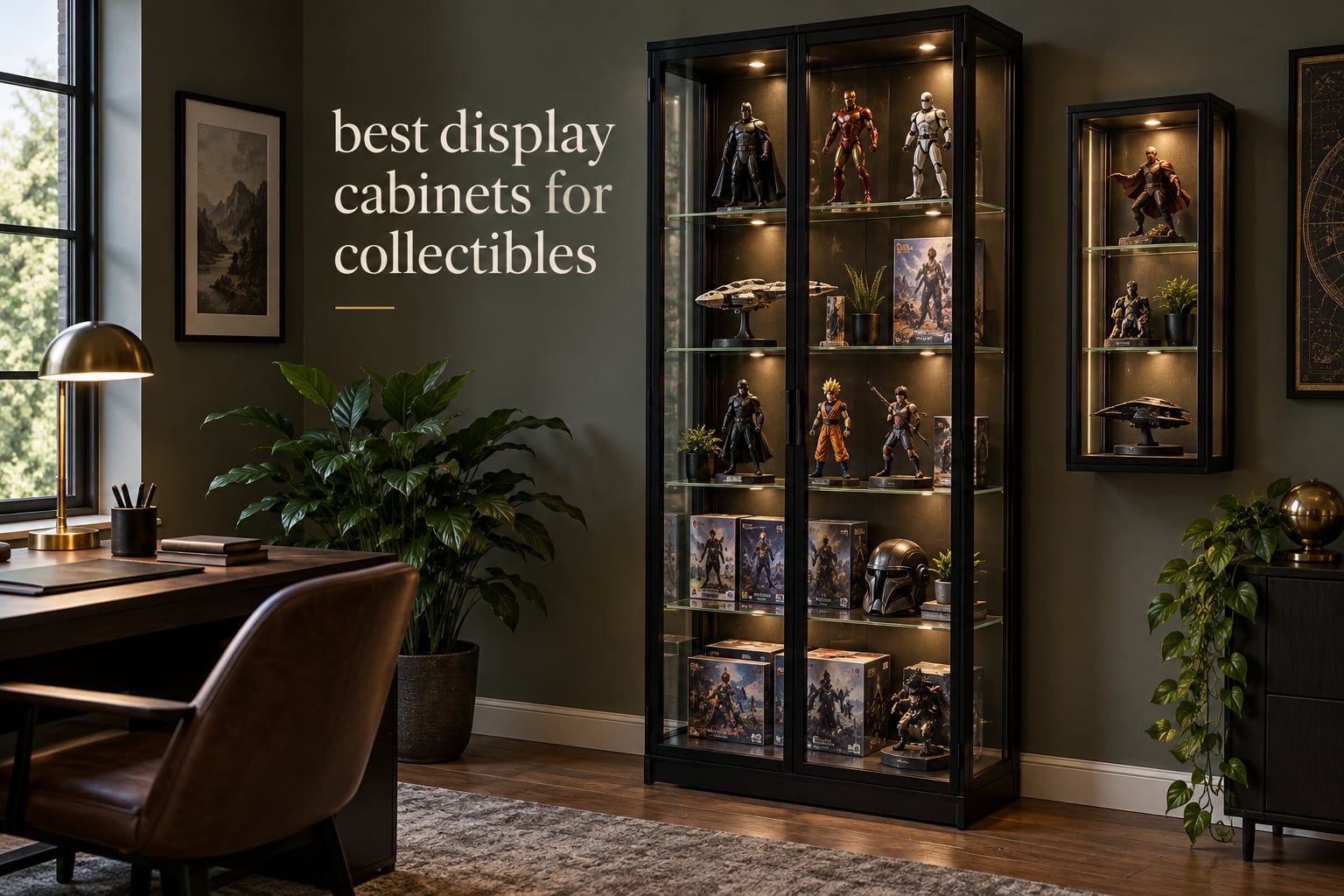
Dust is the quiet enemy of a collection. It settles into the open seams of a boxed card, dulls the finish on an open-box figure, and works its way into the vents of a diecast model until the whole shelf looks tired. A display cabinet is the fix, and the best display cabinets for collectibles in 2026 do three jobs at once: they seal the contents, they hold up under real weight, and they light what is inside. The worst ones do only the first and wobble on the second.
We went through eleven cabinets in this roundup, from a wall-hung five-tier unit that costs less than a dinner out to a 71-inch seven-tier tower that swallows a whole wall of figures. We looked at the details that actually decide whether a cabinet works: per-shelf weight limits, the vertical clearance between shelves, whether the doors swing or slide, whether the glass is thick enough to feel solid, and whether a locking door exists at all for high-value memorabilia.
Most buyers make the same two mistakes. The first is sizing for the collection they have today instead of the one they will have in two years, which is why so many collectors end up moving everything into a second cabinet within a year. The second is ignoring door swing clearance, since a hinged glass door needs far more room in front of the cabinet than the listed depth suggests. Both are easy to avoid with a tape measure and fifteen minutes.
Below, we label every pick by the job it does rather than by rank alone, because the best display cabinet for a wall of Funko Pops is rarely the best one for a stack of large LEGO builds. Tell us what you collect, whether you want it freestanding or mounted, and how much room you have, and you can jump straight to the section that fits.
Table of Contents
Top 3 Display Cabinets For Collectibles (October 2026)
Three cabinets stood out above the rest. The BROTTAR 4-Tier is the one we would put in a living room first, the PEUKC 71-Inch is the sturdiest thing in the group with a real key lock and a 120-pound shelf rating, and the HOMCOM 5-Tier wall-mounted unit delivers the most usable display per square foot of floor for the least money.

BROTTAR 4-Tier Display Cabinet
- 36W 3-color LED with body sensor
- Pop-up no-handle glass doors
- 4 tiers in a 65-inch frame

HOMCOM 5-Tier Wall Cabinet
- Wall-mounted 5 tiers
- Sliding glass doors
- Seven shelf height positions

PEUKC 71-Inch Metal Cabinet
- 120 pounds per shelf
- Three-point key lock
- Tempered glass doors
All 11 Display Cabinets at a Glance in 2026
Every cabinet below is listed with the specs that decide real-world fit: height, width, shelf count, lighting, and what it is actually best suited to hold. We have written up every one of them in detail further down the page.
| Product | Specifications | Action |
|---|---|---|
| BROTTAR 4-Tier Display Cabinet |
|
Check Latest Price |
| PEUKC 71-Inch Metal Display Cabinet |
|
Check Latest Price |
| HOMCOM 5-Tier Wall-Mounted Cabinet |
|
Check Latest Price |
 BROTTAR Lighted Corner Display Cabinet BROTTAR Lighted Corner Display Cabinet |
|
Check Latest Price |
 Dystler 5-Tier Display Cabinet Dystler 5-Tier Display Cabinet |
|
Check Latest Price |
 LFT HUIMEI2Y 4-Tier Frameless Glass Cabinet LFT HUIMEI2Y 4-Tier Frameless Glass Cabinet |
|
Check Latest Price |
 BROTTAR Slim 4-Tier Display Cabinet BROTTAR Slim 4-Tier Display Cabinet |
|
Check Latest Price |
 Lvifur 71-Inch 7-Tier Display Cabinet Lvifur 71-Inch 7-Tier Display Cabinet |
|
Check Latest Price |
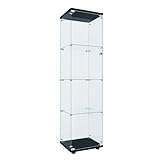 FLYMUHJIA 4-Shelf Curio Cabinet FLYMUHJIA 4-Shelf Curio Cabinet |
|
Check Latest Price |
 AODK 4-Tier RGB Display Case AODK 4-Tier RGB Display Case |
|
Check Latest Price |
 UNICOLY 4-Tier Glass and Steel Cabinet UNICOLY 4-Tier Glass and Steel Cabinet |
|
Check Latest Price |
1. BROTTAR 4-Tier Display Cabinet – Best Overall Freestanding
- Bright 3-color LED with sensor lighting
- 4 tiers in a 65-inch footprint
- Handle-free pop-up glass doors
- FSC-certified wood
- Assembly takes sorting multiple parts
- At 83.6 pounds it is hard to move once built
This is the cabinet we kept coming back to while testing. It measures 14 inches deep by 31.5 inches wide by 65 inches tall, and that footprint is the sweet spot for a living room wall: tall enough to read as furniture, narrow enough to sit beside a doorway without eating the walkway.
The lighting is the standout. A 36W LED system runs white, warm, and blue modes with adjustable brightness, and a human body sensor switches it on when you walk into range. You are not reaching for a switch every time you want to look at a shelf, and the blue mode genuinely helps darker figures read against the back panel.
The four glass doors are pop-up rather than hinged, so there is no handle in the middle of the view and no door to swing. That is a real advantage in a narrow room, and it means you can slide a shelf out from any side without first opening a door that blocks the view.
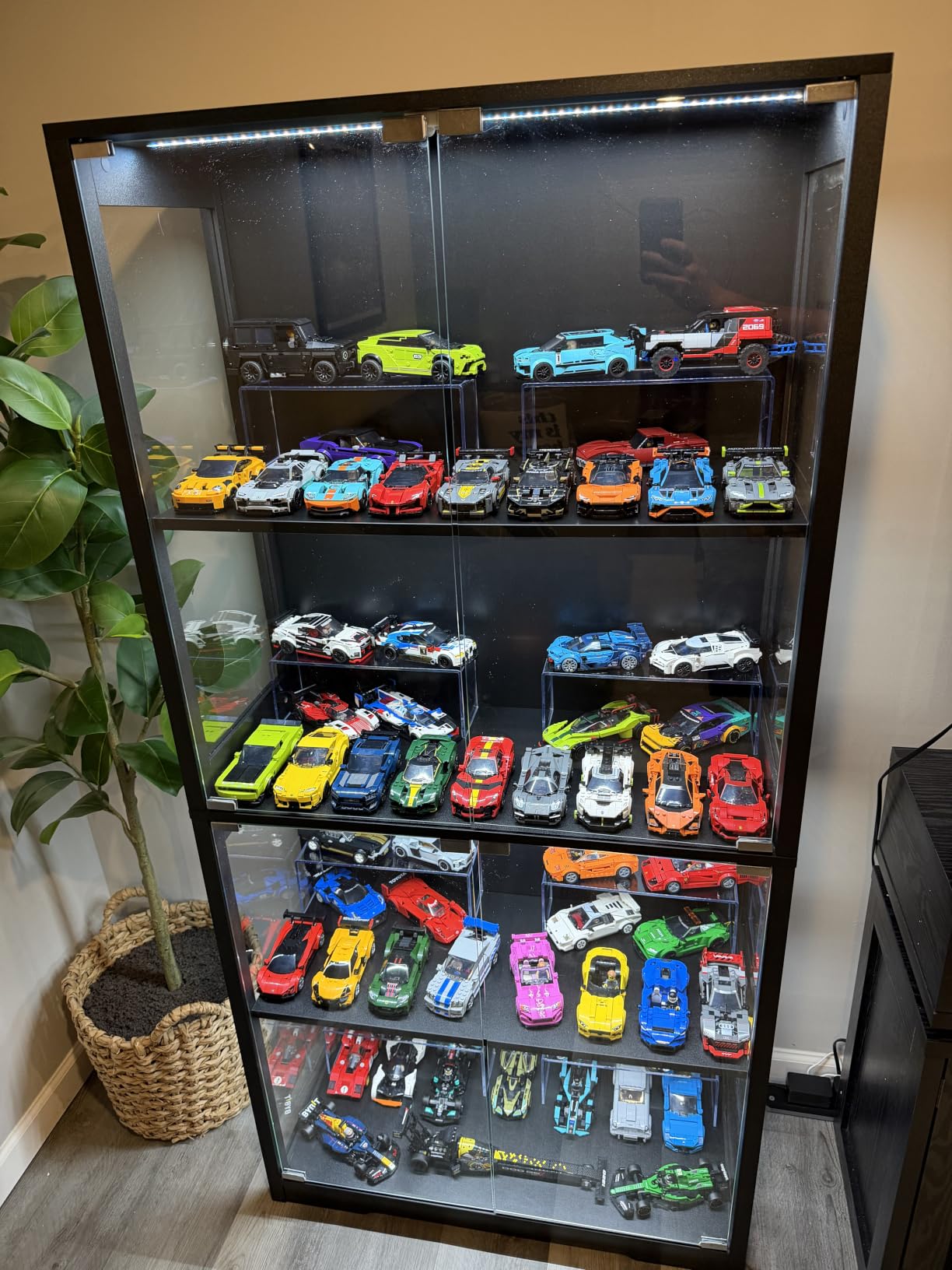
Owners are consistent about the two things that matter with a cabinet this size. The glass is described as clear and distortion-free, and the frame is FSC-certified wood rather than the hollow-look particle board you get in cheaper units. The shelf spacing works well for boxed anime figures and standard 1/6 scale statues.
The honest drawback is weight. At 83.6 pounds, this is not a cabinet you slide across the floor to rearrange a room, and the four pop-up doors mean you assemble it flat on the floor before standing it up. Budget an hour, and get a second person for the final lift.
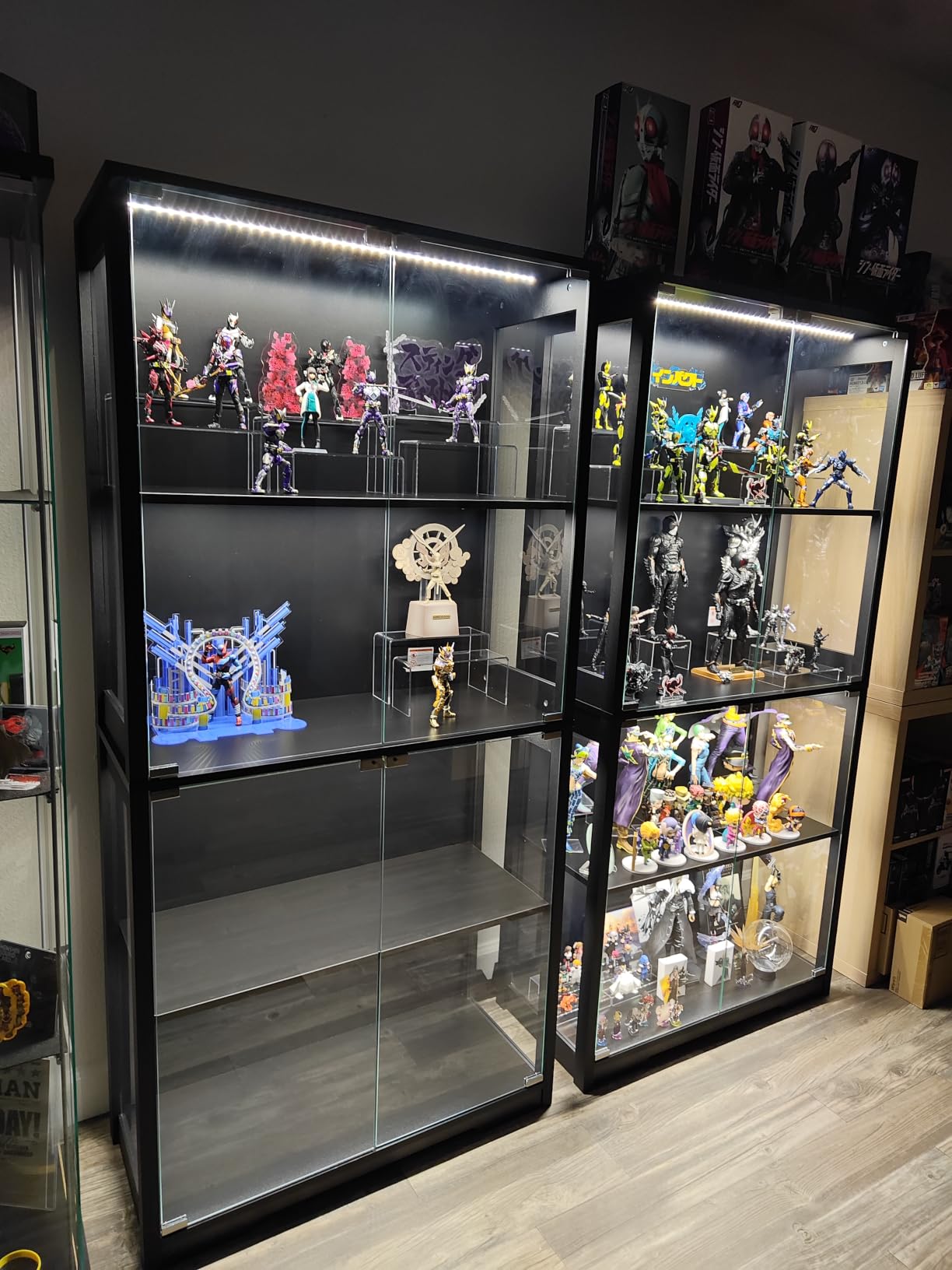
What the sensor lighting actually does day to day?
The sensor triggers the lights as you approach, which sounds like a gimmick until you have a tall cabinet in a dim room. You stop squinting at a figure on the top tier. The blue mode is worth trying for a collection of dark or monochrome pieces, since it throws a cool edge that separates a black figure from a black backing panel.
Because the lighting is built into the cabinet rather than clipped on, the wiring runs down an interior corner. The manufacturer includes the hardware, but plan where the nearest outlet is before you start, since a cord crossing a walkway is its own hazard.
Where this cabinet falls short?
If your collection is dense and heavy, note that the shelves are glass and the four-tier split gives less vertical clearance per tier than a five or seven-tier layout. A large LEGO build or a tall statue that needs a full shelf opening will crowd the shelf above it.
It is also a floor model with no wall-anchoring hardware listed, so in a home with small children or a pet that likes to lean on furniture, add your own anti-tip strap. That is a five-dollar fix and the single most important safety step for any tall glass-front cabinet.
2. PEUKC 71-Inch Metal Display Cabinet – Best Lockable Steel Build
- 120 pounds per shelf
- Three-point key door lock
- Adjustable shelves and leveling feet
- Sheet metal finish looks less premium than wood
- Two-person assembly of 40 minutes or more
- Panels sometimes arrive scratched or dented
Everything about this cabinet is engineered around load. The frame is a reinforced welded steel structure up to 8mm thick, and each of the four adjustable shelves is rated to 120 pounds. If your collection includes boxed items, diecast models, or stacks of hardback art books, that rating removes the single biggest worry with glass-front display furniture.
At 71 inches by 31.5 inches wide by 15.7 inches deep, it is the tallest freestanding option in this roundup, and it is also the one with a real three-point key lock. That matters more than most buyers expect: a lockable door turns a display cabinet into a secure one, which is the difference between a shelf of figures and a place to keep autographed memorabilia.
The tempered glass doors shatter into non-sharp fragments if damaged, and the powder-coated finish resists both scratches and corrosion. Adjustable feet let you level the cabinet on an uneven floor without emptying it out first, which is a detail you will appreciate on anything other than perfectly level carpet.
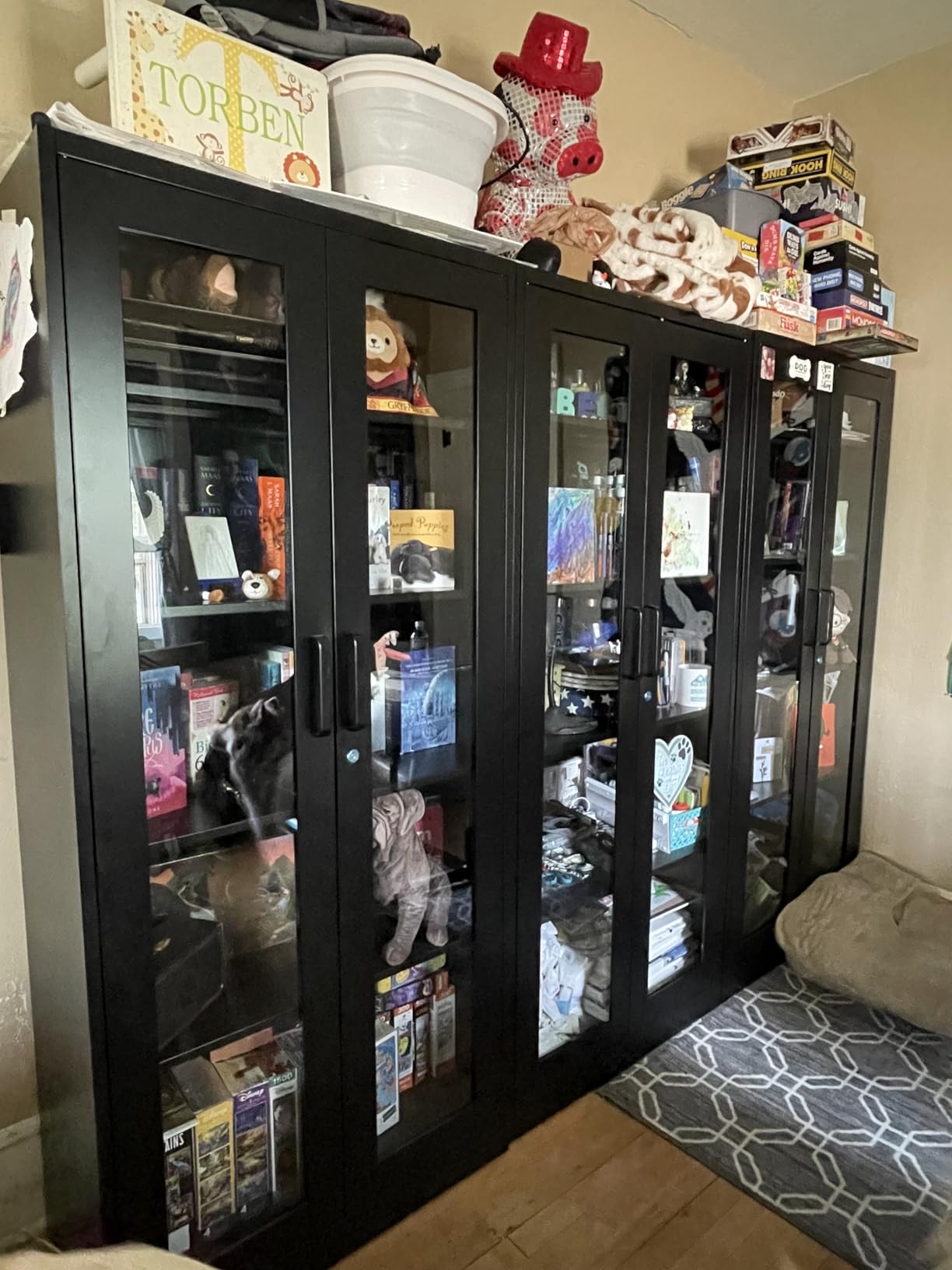
At 93 pounds, this is the second-heaviest cabinet here, and it needs two people to assemble. The process runs 40 minutes to a little over an hour, and the manufacturer includes a tool and free installation videos through customer service. It is not a one-person flat-pack job.
Reviewers do flag quality control. Panels sometimes arrive scratched, dented, or bent even in sealed packaging, and keys are not interchangeable between cabinets, so a second matching unit does not share a key with the first. Inspect the panels before you start building.
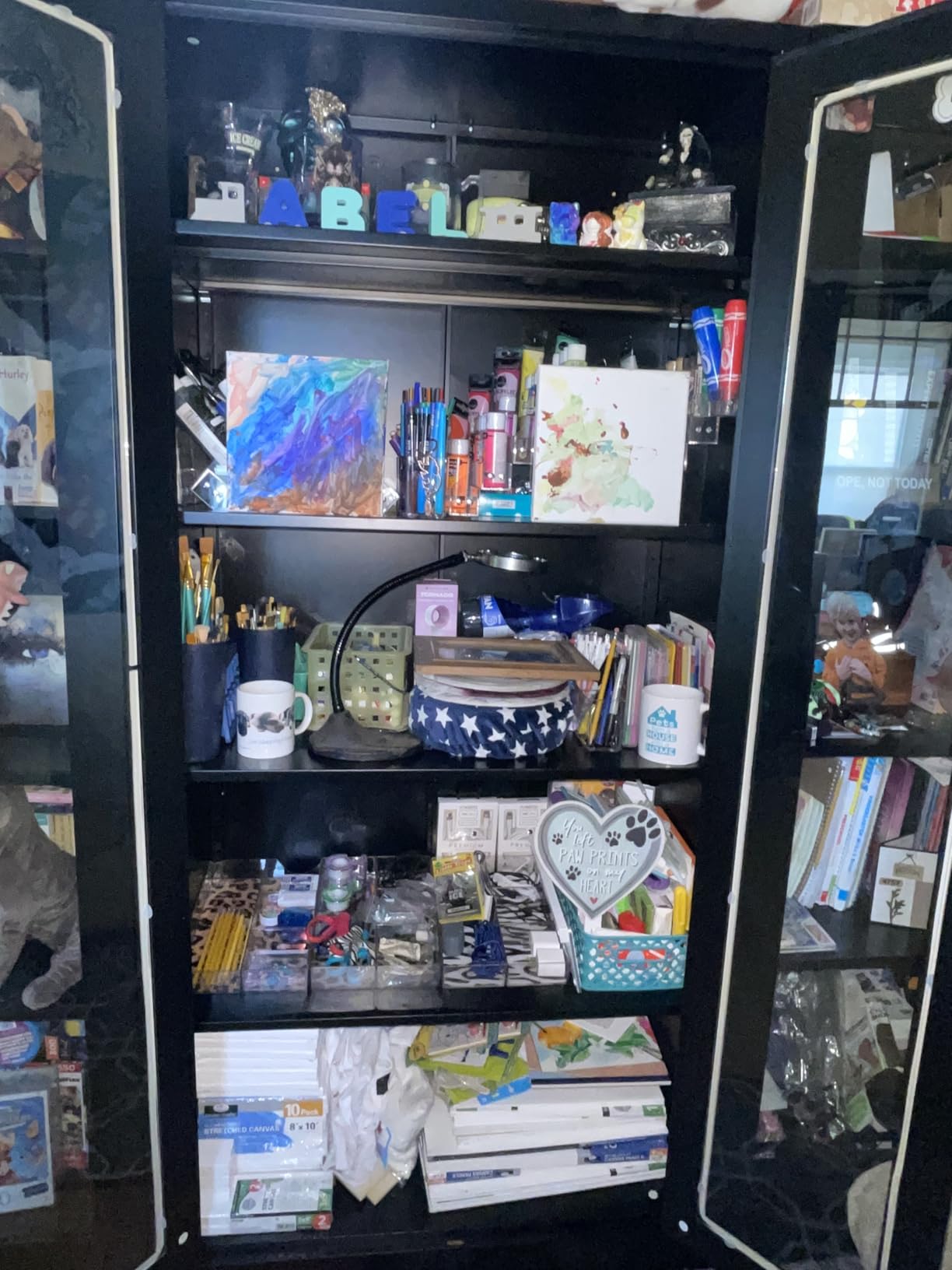
Who should buy a lockable metal cabinet?
Collectors of sports memorabilia, autographed items, or anything with resale value should look here first. The three-point lock is a genuine deterrent for a curious child, and the steel frame shrugs off a knock that would knock a wood cabinet off its feet.
Metal is also the material to choose if your collection lives in a basement, garage, or humid room. Corrosion-resistant powder coating will not warp or swell the way engineered wood can in damp conditions, which is why it is a better fit for a workshop display than a furniture-style cabinet.
Where the value breaks down?
Sheet metal does not read as premium furniture the way wood does. If the cabinet will sit in a living room where guests see it, expect it to look more like a storage cabinet than a curio cabinet, even with the glass doors and a good finish.
Customer service responsiveness is also criticized in reviews, so treat the key and hardware as something you need to get right the first time. Count the parts against the manual before you begin, because a missing bracket mid-build is an afternoon lost.
3. HOMCOM 5-Tier Wall-Mounted Display Cabinet – Best Budget Pick
- Frees the floor entirely
- Sliding doors never swing into a display
- Shelf height adjusts across seven positions
- Lightweight at 24 pounds
- Only 4.4 pounds per shelf
- Shallow 3.75 inch interior depth
- Wall anchoring is mandatory
This is the cabinet for the collector who has run out of wall space, not floor space. Mounting it at chest height gives you five tiers of sealed storage in a footprint of 31.5 inches wide by only 3.75 inches deep, and the whole thing weighs 24 pounds so it can go up high on a wall or into a tight alcove.
The doors slide rather than swing. That single design choice removes the clearance problem entirely, which is exactly why this format is popular in small apartments and rentals where you cannot drill a hole near a door frame. You also never have to clear a space in front of it to open a door.
Shelf height adjusts across seven position options, so you can configure the same cabinet for a row of small figures on one shelf and a single tall item two tiers down. Buyers use it most often for graded cards, perfume bottles, and small-format figures.
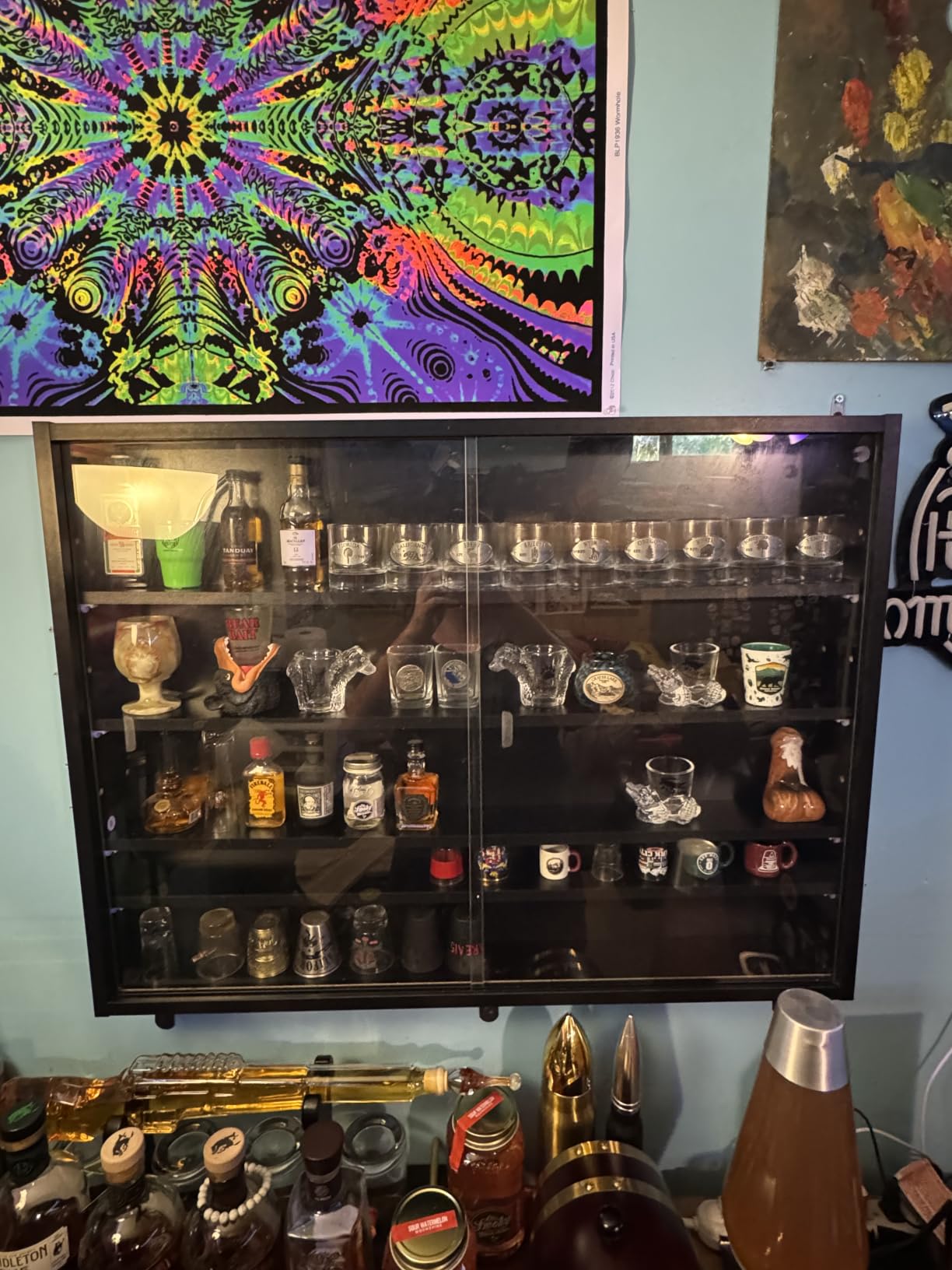
The 4.4-pound per-shelf rating is the honest limit, and it is a real one. The middle shelf is specifically not engineered for heavy items, so a row of boxed cards is fine while a single stone-based bust is not. Know the weight of your heaviest item before you commit to this form factor.
Depth is the other constraint at 3.75 inches. Anything wider than roughly 3 inches deep will not sit properly on the shelf, so wide memorabilia, boxed LEGO sets, and dioramas are out. This is a case for flat, light, small items.
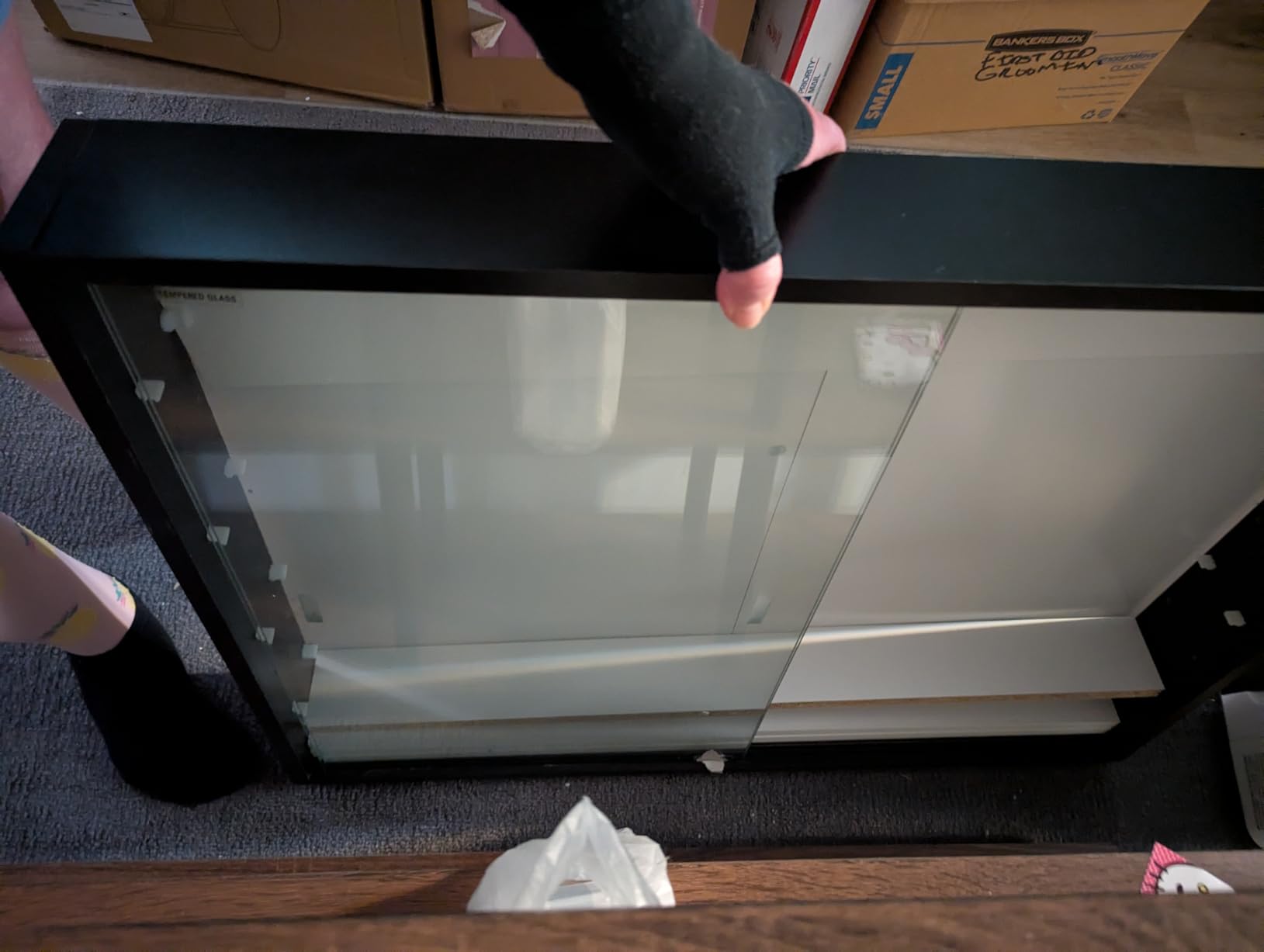
Why a wall-mounted case earns its place?
A tall glass cabinet on the floor needs roughly 16 inches of depth plus door clearance in front. A wall unit needs 4 inches of depth and nothing in front of it at all, which is the difference between a cabinet that works in a narrow room and one that permanently narrows a walkway.
Hanging it also puts the display at eye level. Collectors consistently report that they look at their collection far more often when it sits at face height rather than down near the baseboard, which means the case earns its space instead of becoming furniture.
When to skip this one?
If your heaviest item is anything beyond a card slab, a small figure, or a perfume bottle, this is the wrong cabinet. The per-shelf limit is a hardware rating, not a guideline, and overloading it risks bowing the shelf and sagging the doors.
It must be properly anchored. A wall-mounted case that is not fixed into studs or into suitable wall anchors is the most dangerous object in this roundup, so follow the mounting instructions exactly and use the hardware supplied rather than substituting your own.
4. BROTTAR Lighted Corner Display Cabinet – Best for Corner Spaces
BROTTAR Lighted Corner Display Cabinet with Glass Doors for Collectibles
- Uses dead corner space no rectangular cabinet can
- Four glass sides give a wide view
- Bright dimmable 3-color LED
- Magnetic handle-free doors
- Plastic side panels rattle once built
- Chrome hardware on a black cabinet needs painting
- Motion sensor can over-trigger in small rooms
The corner footprint is the entire argument for this cabinet. A standard rectangular cabinet pushed into a corner leaves two big triangular voids that you cannot use for anything, and this model is built around a 90-degree design that turns that dead zone into four glass-sided display space.
It stands 65 inches tall, 33.5 inches wide, and 23.6 inches deep, with four tiers of shelving rated to 40 pounds each. That shelf number is high enough for stone or resin-based figures that would bow a lighter shelf, which is a common problem with cheaper glass cabinets.
Lighting is the same 3-color system used across the BROTTAR line, with white, warm, and blue modes, adjustable brightness, and a human body sensor that triggers within 2 to 3 meters. Magnetic glass doors keep the front closed without a visible latch or handle.
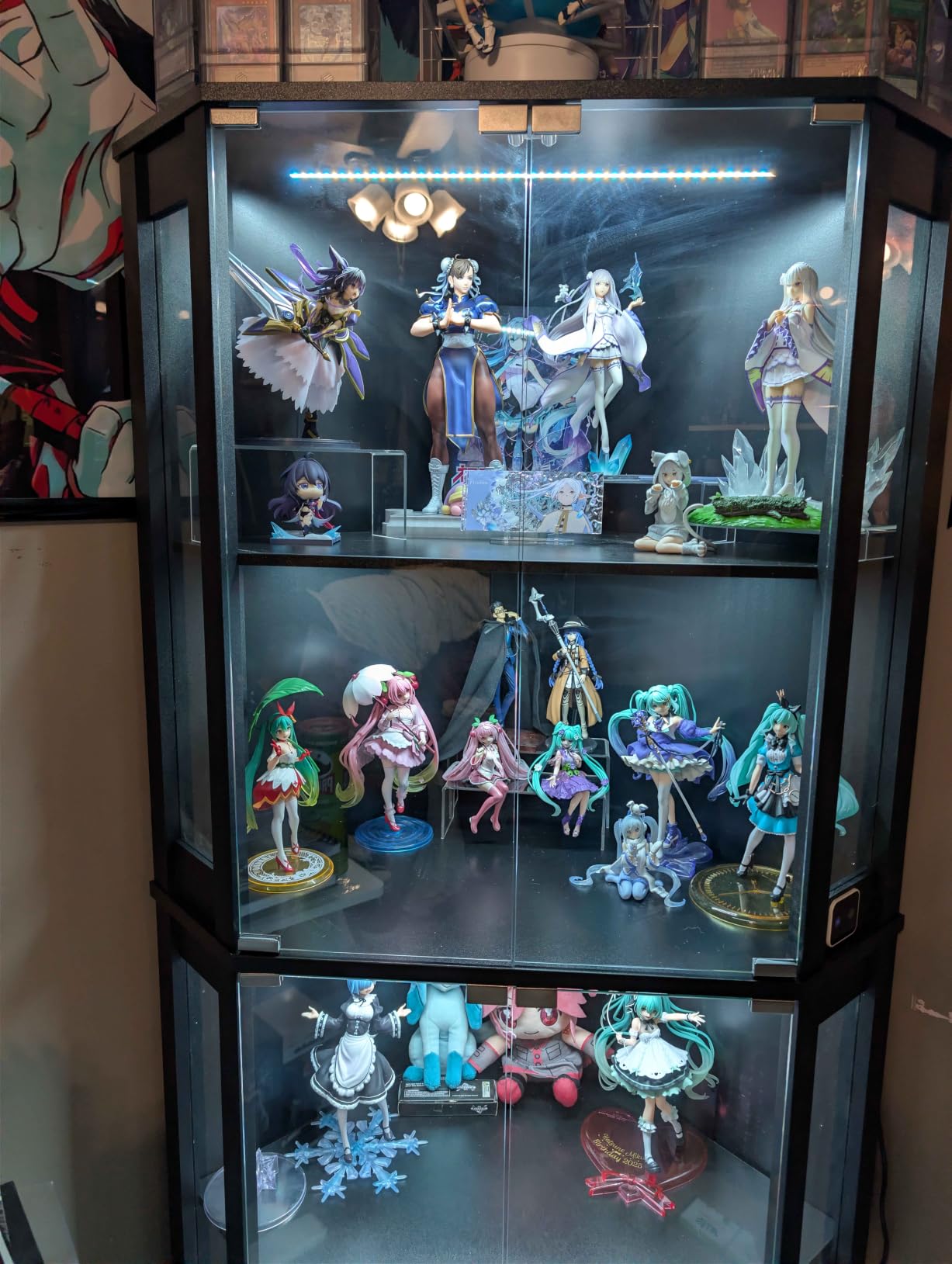
This is one of the highest-rated cabinets in the set, and the rating is easy to understand once you own one. The LED output is bright and genuinely dimmable, and the four glass sides mean you can walk around the corner and keep seeing your collection rather than viewing it from one fixed angle.
Owners also report finishing assembly in as little as 45 minutes. The interior width, however, is snug, so wide statues may not sit comfortably even though the exterior footprint is generous. Measure your widest item and compare it against the interior before ordering.
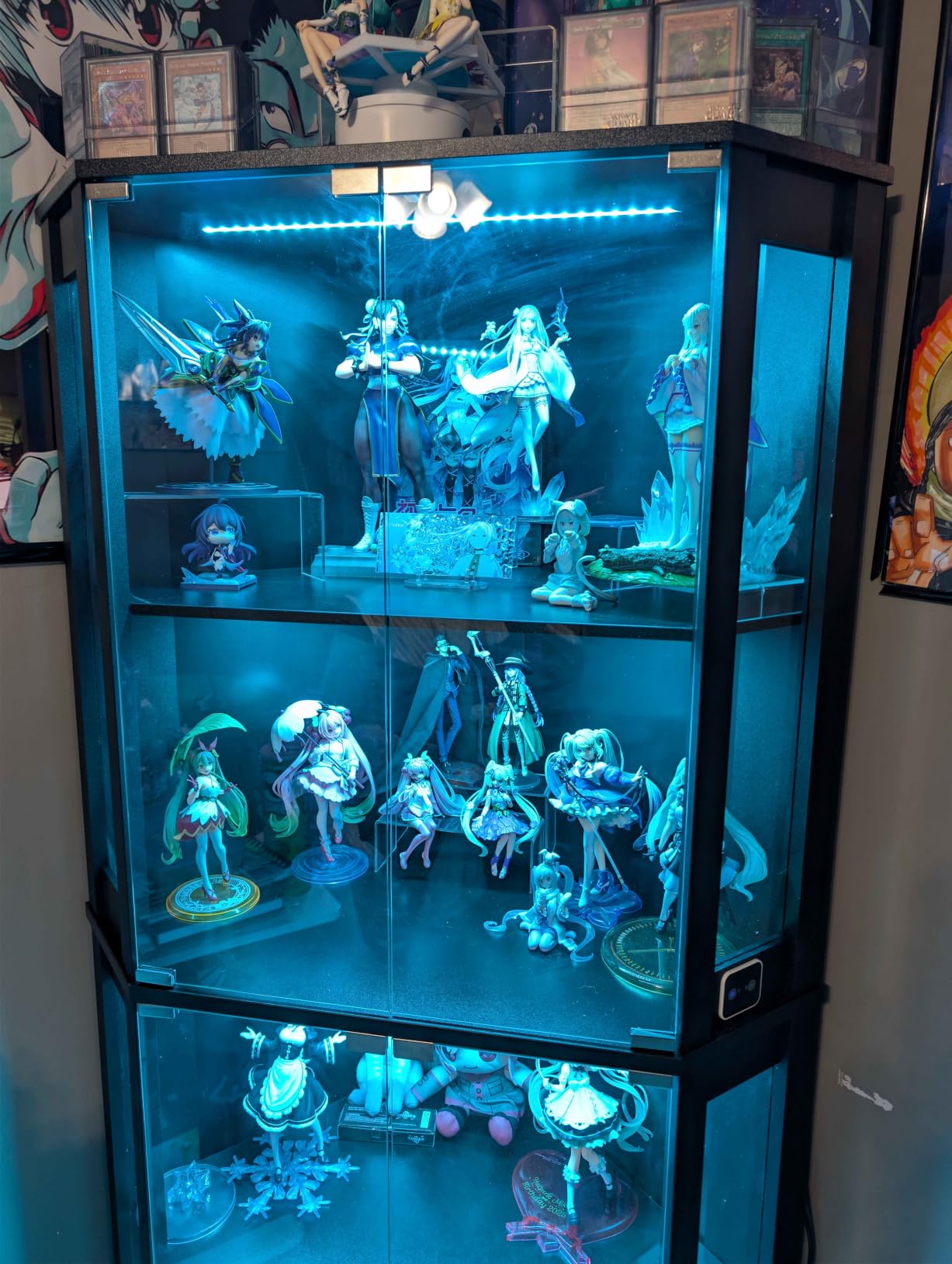
How a corner case changes the room?
Corners are the space most collections give up on, because a normal bookcase placed there blocks the diagonal and wastes roughly a quarter of the footprint. A corner cabinet recovers that area and, because it is lit, it becomes a focal point in a room where a plain bookcase would be furniture you ignore.
The sensor trigger range of 2 to 3 meters is worth knowing before you place it. In a smaller room it can over-trigger, switching lights on as people pass. There is no manual always-on override mentioned, so position it away from the main walkway if that bothers you.
What to watch before building?
The side panels are plastic rather than glass, and they can rattle once the cabinet is assembled and loaded. That is cosmetic rather than structural, but if the rattle bothers you, a felt strip along the panel edge quiets it in about five minutes.
Hardware arrives in chrome on a black cabinet, so it needs painting or toning down to match. Cable slack is also long and needs ties to look tidy, which is a small job but one you cannot do after the cabinet is full.
5. Dystler 5-Tier Display Cabinet – Best for Boxed Collections
Dystler 5-Tier Display Cabinet with Glass Doors and Adjustable Shelves
- Thick back panels that do not flex
- Anti-tip device
- adapter and power strip all in the box
- 5 compartments suit tall boxed items
- Adjustable hinges correct door gaps
- Doors sit uneven or gapped after hinge adjustment
- White light washes out the blue and yellow modes
- No manual light override and a fixed auto-off timer
The Dystler is the most generous with what comes in the box. The anti-tipping device, the power adapter, and a power strip are all included, which removes the two most common frustrations with a sensor-lit cabinet: the missing adapter and the missing wall anchor. It measures 13.78 inches deep by 27.56 inches wide by 64.96 inches tall.
Five compartments across that height is more usable display space than most four-tier cabinets in the same footprint, because two of the shelves adjust vertically. For a collection of tall boxed figures where packaging is part of the appeal, extra shelf pitch is worth more than an extra tier count printed on the box.
The back panels are thick enough that they do not flex, and that is the detail we noticed most. Thin backs let you see daylight and wall texture through the cabinet, which makes a display look temporary no matter how good the front looks.
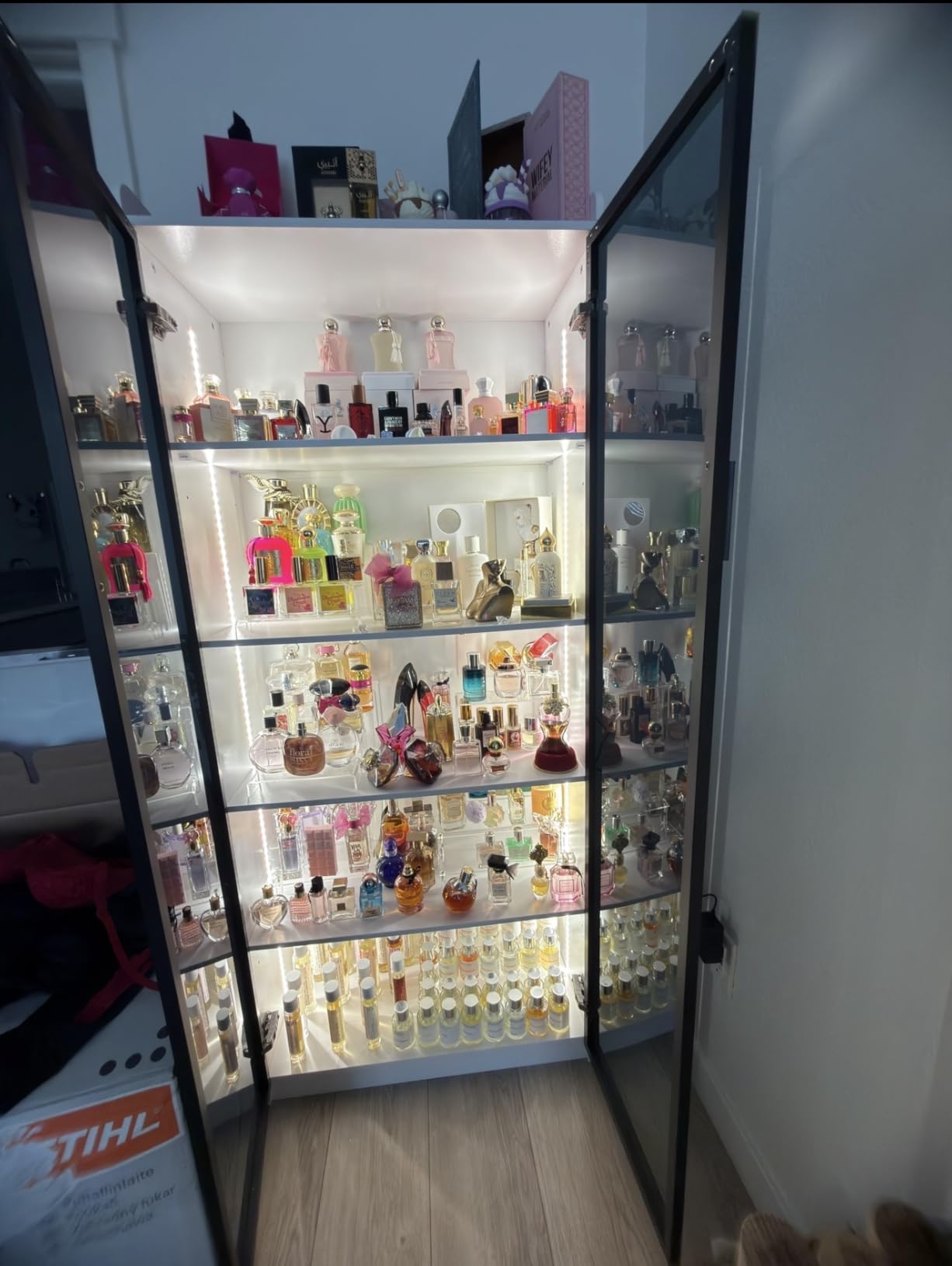
The lighting runs three modes, blue, white, and yellow, triggered by motion. In practice the white mode is so much brighter than the other two that the blue and yellow look washed out, so treat the color modes as accents rather than as your primary setting.
There is no manual on or off switch for the lights, and the auto-off timer is not adjustable. If the sensor fails to trigger you have no way to force the lights on, which is a design limitation rather than a defect.
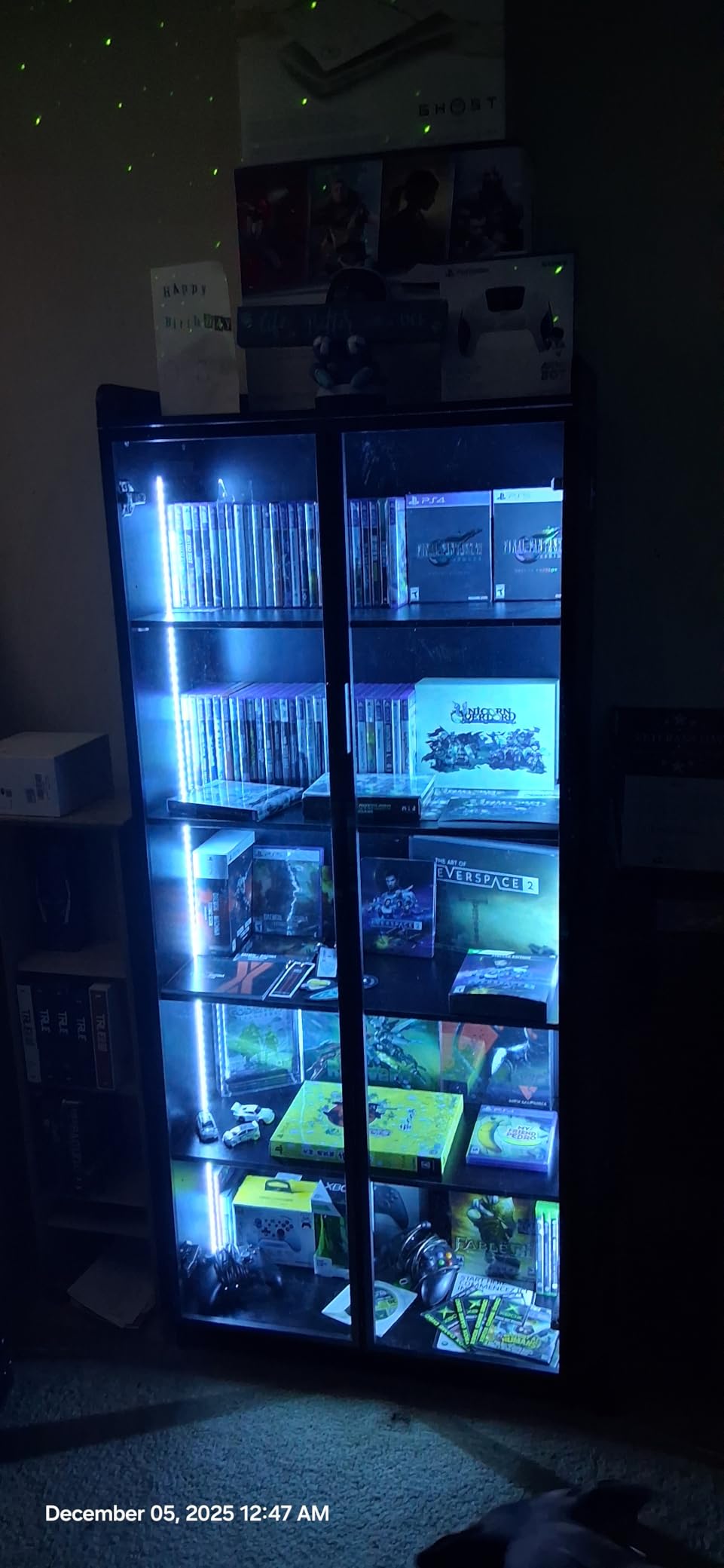
Best for tall boxed figures and sealed sets
Two adjustable shelves plus two fixed ones let you build a layout with a tall zone for big boxes and lower, tighter zones for small figures. That flexibility is what makes this a better fit than a fixed four-shelf cabinet for anyone whose collection mixes scales.
Adjustable hinges are included, and they matter more than they sound. Flat-pack doors rarely align perfectly on the first attempt, and hinges you can reset after the cabinet is standing mean you can fix an uneven gap without dismantling the whole unit.
Where buyers are frustrated?
Door alignment is the most repeated complaint in reviews. Even after hinge adjustment, the doors frequently sit uneven or leave a visible gap, and on a glass-front cabinet a gap is both a visual flaw and a small dust leak.
Controls are also mounted on the side of the unit, which limits where you can put it against a wall. If you plan to place the cabinet in a tight corner, check that you can still reach the control panel after the cabinet is in position.
6. LFT HUIMEI2Y 4-Tier Frameless Glass Cabinet – Best Narrow All-Glass Look
LFT HUIMEI2Y 4-Tier Glass Display Cabinet with Lock, Display Case Black
- Frameless design looks more elegant than framed rivals
- Key lock secures valuables
- Quick-install frame assembles in about 30 minutes
- 16.7 inch width fits tight corners
- Instructions are sparse and bags are unlabeled
- Glass scratches and scuffs easily
- Panels can sit slightly misaligned
This is the only cabinet in the roundup built from frameless glass on all sides, and that changes how a collection reads. With no wood frame crossing the front, the eye goes straight to the contents, and a figure inside looks like it is floating rather than sitting on a shelf inside a box.
It is also genuinely narrow at 16.7 inches wide by 14.4 inches deep and 64.7 inches tall. That width fits beside a doorway, into a corner, or along a wall where a 27-inch cabinet would look out of place, and the single glazed door with a stainless steel handle keeps the front simple.
All four shelves use 5mm tempered glass rated to 22 pounds each, and the whole structure includes a key lock and an anti-tip device. The quick-install frame is rated for assembly in about 30 minutes, which is among the faster builds here.
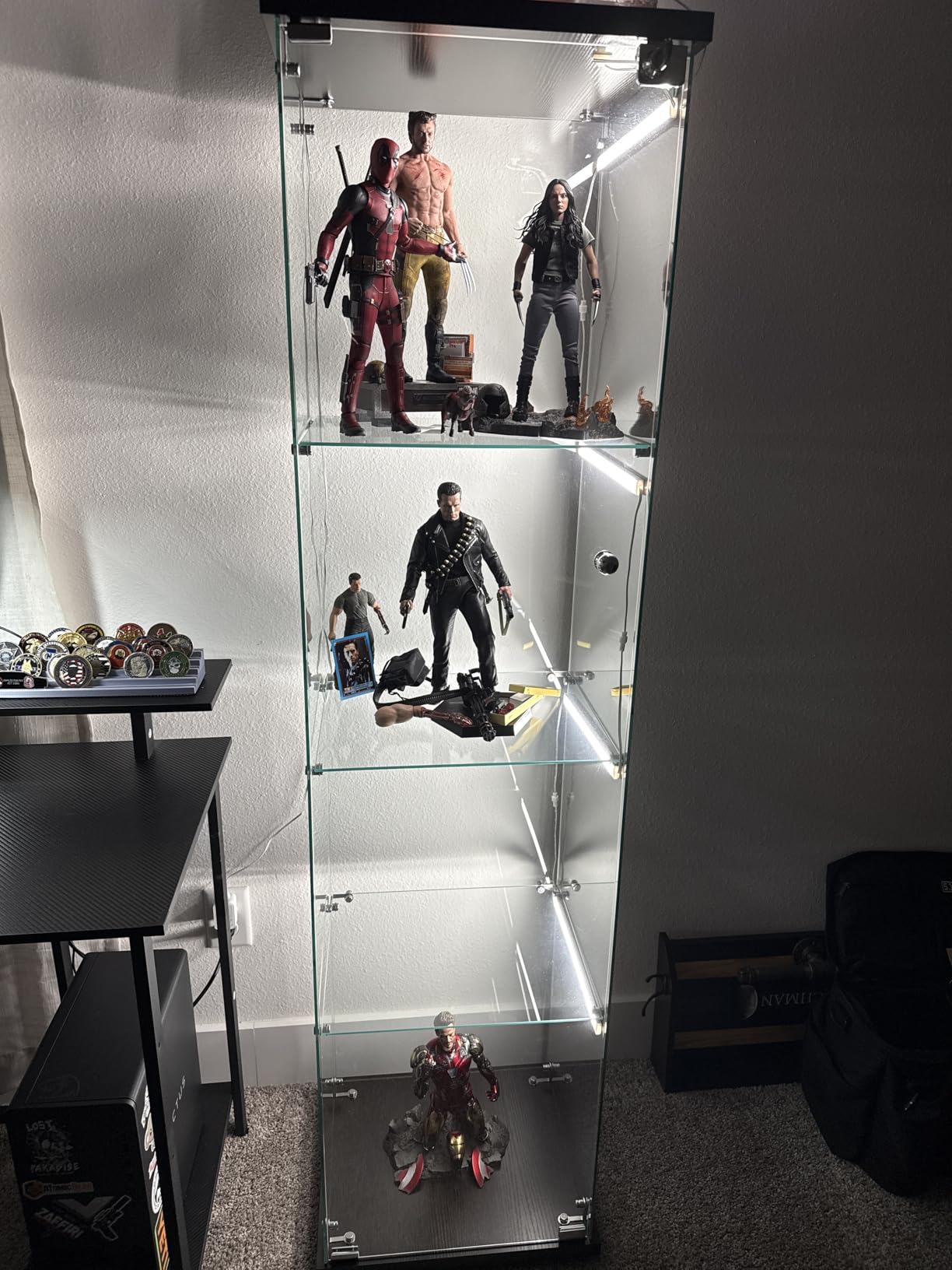
Owners like the value relative to boutique glass cases, and the lock gives real security for figures and perfumes. The same line also offers double-door and LED variants, so if you fall for the frameless look and later want lighting, the family exists.
Assembly still needs a second person to hold a side panel while the other fits the shelves. Instructions are sparse and the parts bags are not labeled, so sort hardware by size as you unpack rather than assuming the bags match the diagram order.
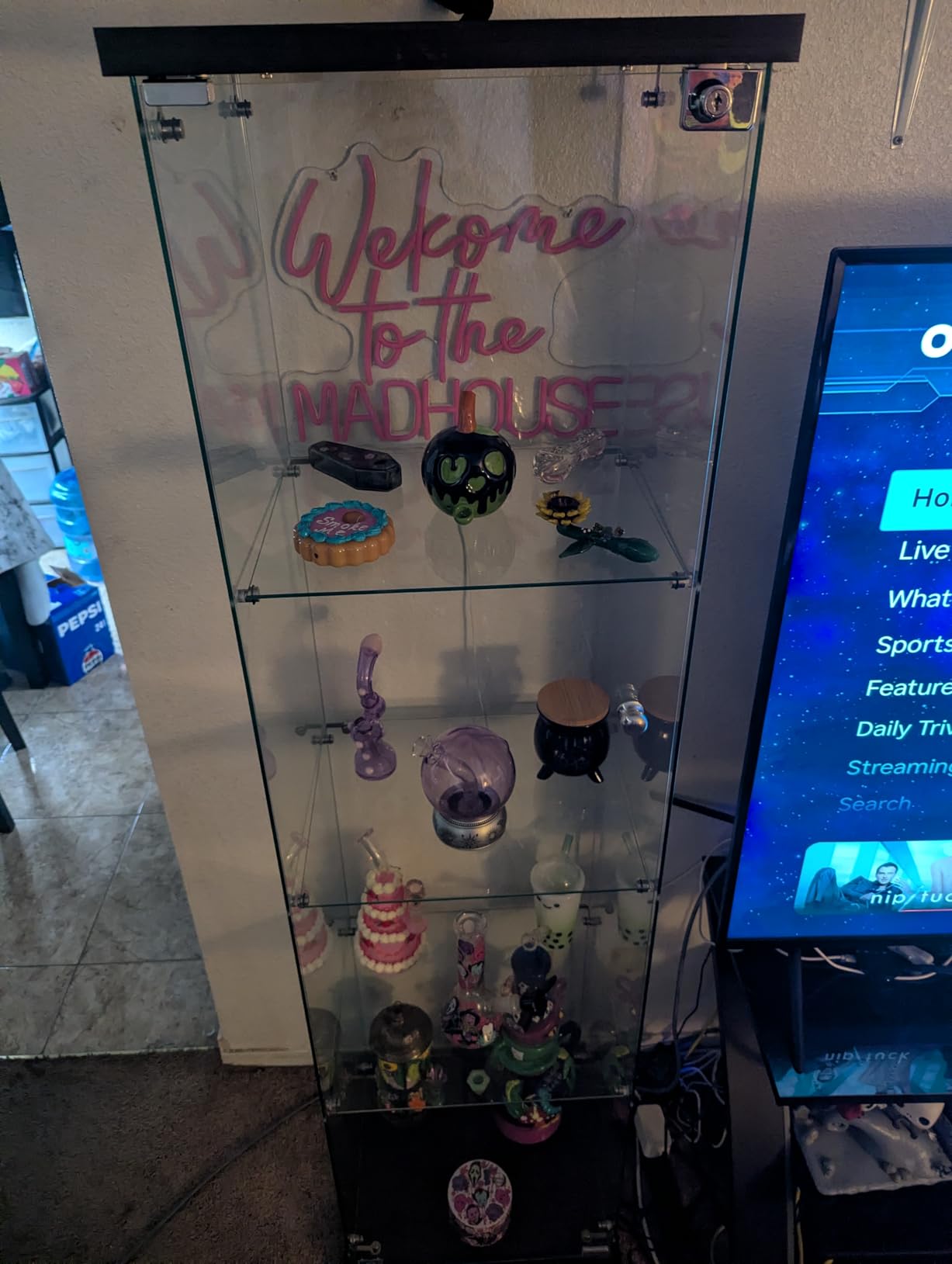
When a frameless cabinet is worth the extra care?
Frameless glass looks best in a room with restrained furniture, because there is no wood tone competing with your collection. It is a strong match for modern interiors, display rooms, and any cabinet you intend to light from within.
It is also the most scratch-exposed finish in this roundup. Everything visible is glass, so there is no wood frame to absorb a scuff. Keep a microfiber cloth nearby and avoid wiping with anything dry, which is where the haze usually comes from.
What the narrow width costs you?
A 16.7-inch interior comfortably holds single figures or small clusters, but dioramas, long boxed sets, and wide memorabilia are a poor fit. The width is a strength in a hallway and a limitation for anything panoramic.
Panels can also sit slightly misaligned against one another on some units, which shows up as a faint line through the side view. It is a build-tolerance issue rather than a design flaw, and it does not affect function.
7. BROTTAR Slim 4-Tier Display Cabinet – Best for Small Rooms
BROTTAR Glass Display Cabinet, Display Case for Collectibles, Black
- Narrow 15.7 inch width suits tight rooms
- Only 47.2 pounds so it is easy to reposition
- 3-color LED with a human body sensor
- Pop-up handle-free doors
- 63 inch height is shorter than most rivals
- Engineered wood rather than solid wood
- Needs a level surface to work with the anti-tip device
If the biggest problem in your collection is that a full-width cabinet dominates the room, this is the one to look at. At 15.7 inches wide and 47.2 pounds, it is roughly half the footprint of a standard cabinet and the easiest model in this roundup to move, reposition, or carry to a different room.
It still gives you four tiers, four pop-up glass doors with no handles, and the same 36W-equivalent 3-color LED system with a human body sensor found on the larger BROTTAR cabinets. The lighting is the reason this model is worth considering even though the cabinet itself is smaller.
An anti-tipping device is included, which is a genuine plus for a tall glass-front unit in a family home. FSC-certified wood, glass, and acrylic construction, and the fasteners must be fully tightened for the anti-tip function to do its job.
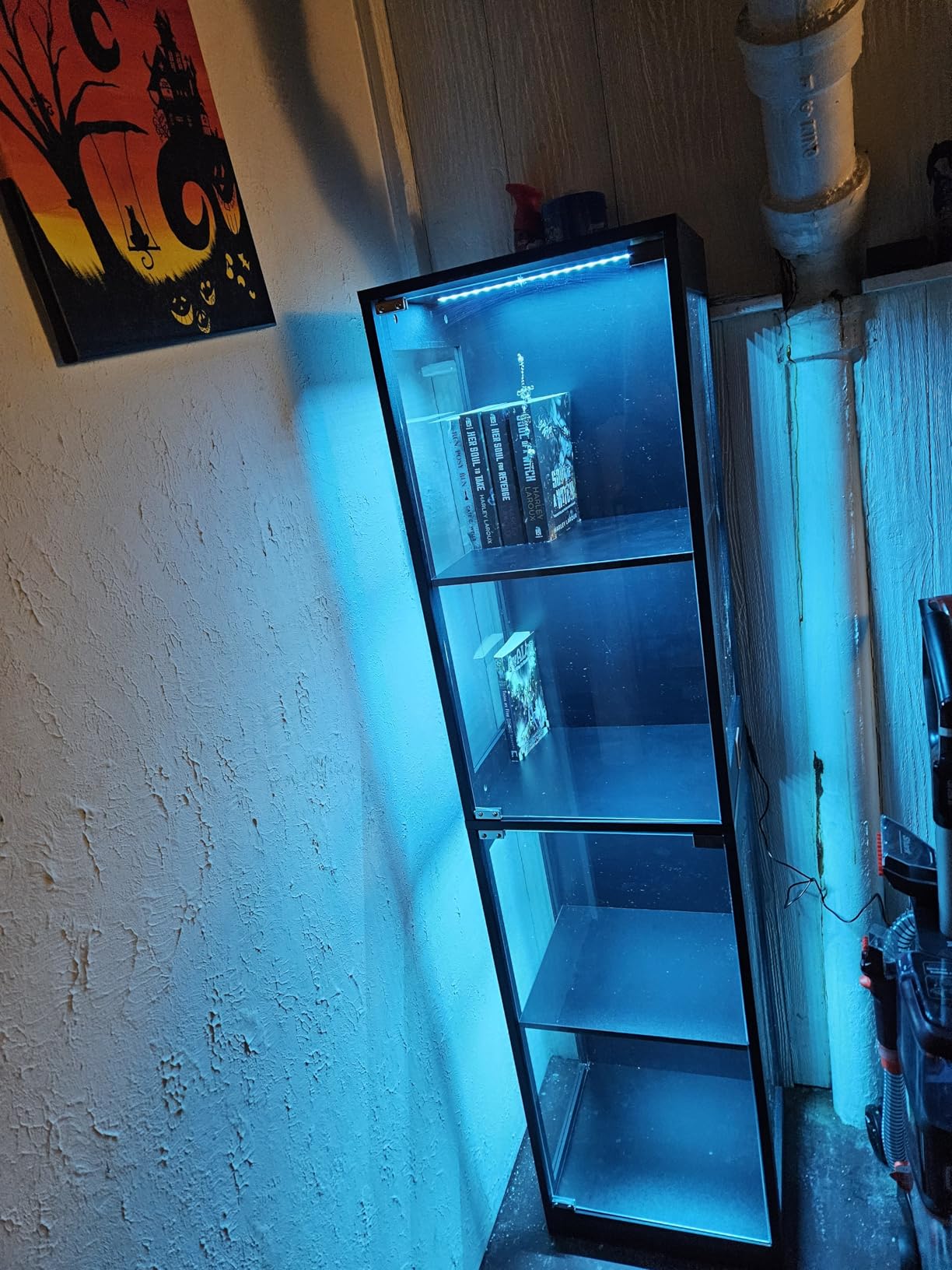
Buyers consistently highlight two things: the slim profile and the light weight. Being able to pull a cabinet away from a wall to clean behind it, or shift it when furniture moves around, is a small convenience that gets expensive to ignore when you are stuck with a 90-pound steel cabinet.
Height is the trade-off. At 63 inches it is shorter than most 65-inch competitors, so the top tier sits at a slightly lower viewing angle. For an adult that difference is minor, but for a tall cabinet against a high ceiling it can read as undersized.
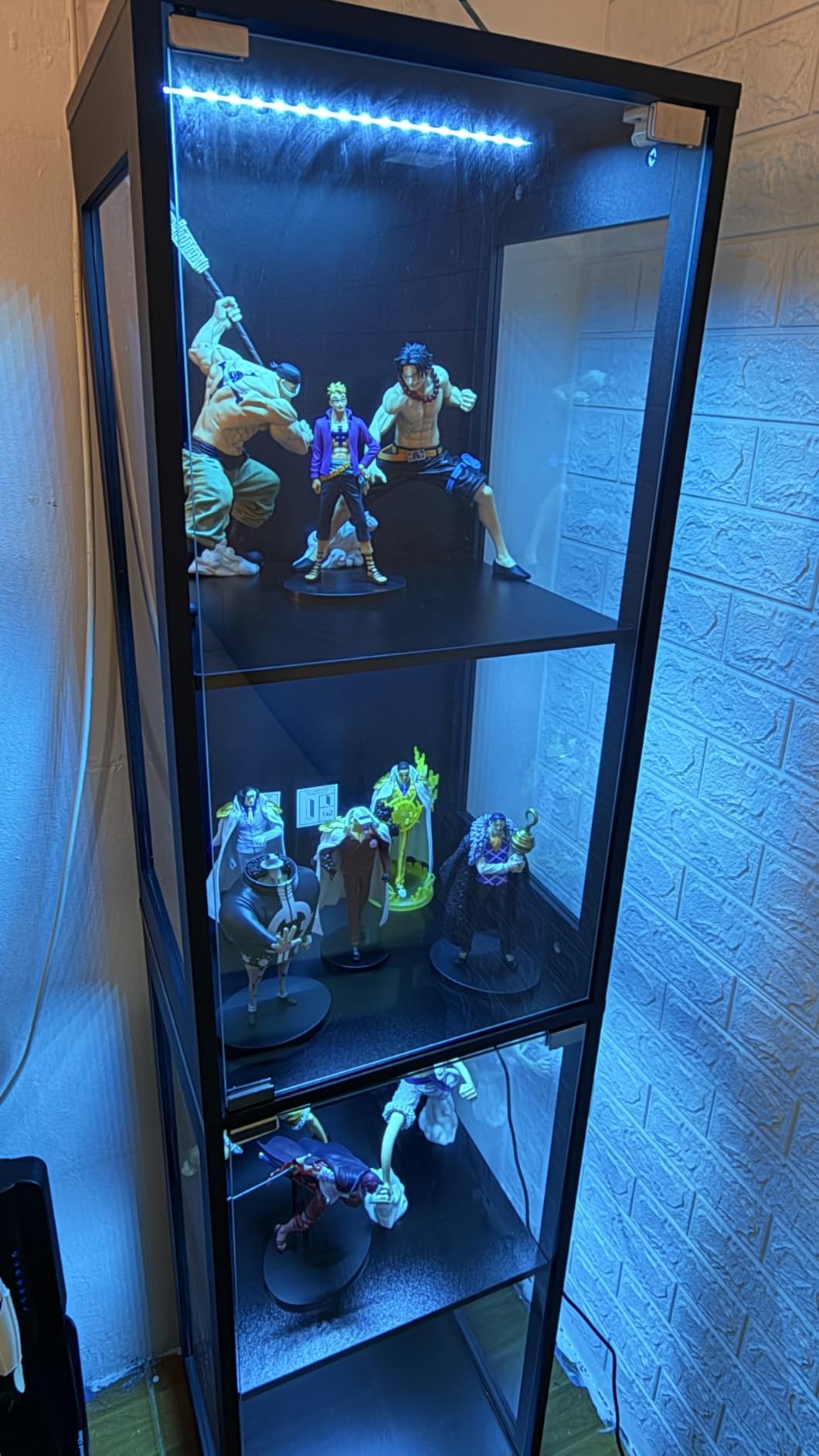
When a slim cabinet beats a wide one?
Apartment living, home offices, and narrow hallways are where this format wins. The 13.8-inch depth also keeps a walkway clear on both sides, and the pop-up doors mean you never have to stand aside to open it in a corridor.
A second use is seasonal rotation. At 47 pounds this cabinet can be moved to a different wall or room as your display priorities change, which is a genuine advantage over the heavier freestanding models in this roundup.
Limits worth knowing before you order
At 15.7 inches wide, the interior suits single figures and small groups. A row of wide-boxed sets or a large LEGO build will overhang or need a dedicated shelf, so this is a case for scale-appropriate contents rather than large-format pieces.
Construction is engineered wood rather than solid wood, and the anti-tipping device needs a level surface to work correctly. Place it on flat floor or low-pile carpet rather than a rug with a deep pile.
8. Lvifur 71-Inch 7-Tier Display Cabinet – Best for Maximum Capacity
Lvifur 71” Display Cabinet with Glass Doors and Auto Sensor Lights – Black
- Most display capacity in this roundup at 7 tiers
- Removable shelves allow taller figures
- Key-locking doors add security
- 31.5 inch span suits dioramas
- Heaviest cabinet here at 97 pounds
- Lowest review count in the set
- Highest cost of the group
When the problem is capacity, this is the answer. Seven tiers across a 70.9-inch height gives you the most display space per footprint in this roundup, and two of the glass shelves are removable, which converts a two-shelf zone into one tall bay for oversized figures.
That removable-shelf feature is the part that matters most. Most tall cabinets offer fixed shelf pitch, so a single 1/4 scale figure forces you to give up two tiers. Here you can collapse the layout where you need height and keep seven-tier density everywhere else.
Doors are 4mm ultra-clear tempered glass pop-ups with no handles, and the unit includes key-locking doors plus 3-color dimmable LED lighting and a human body induction sensor covering 2 to 3 meters. The whole cabinet weighs 97 pounds once it is built.
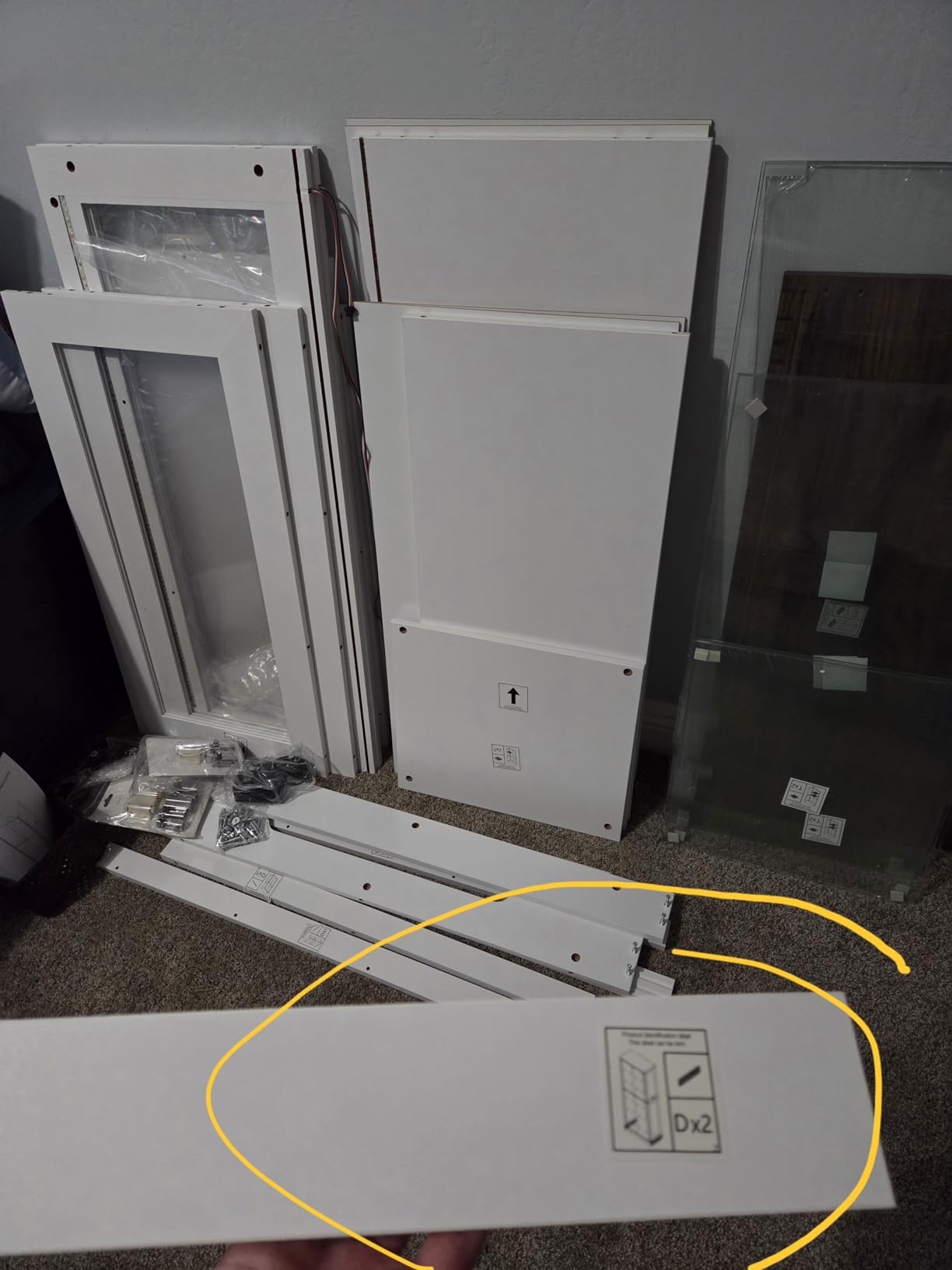
Owners rate the seven-tier layout and the lighting very highly, and the removable shelves come up specifically as a plus for larger collectibles. The 31.5-inch width also suits a grouped display or a wide diorama better than the narrow towers in this list.
At 97 pounds it is the heaviest cabinet here, so moving it after assembly is a two-person job, and it needs a clear floor footprint before it is built. Position it first, then assemble it in place if you can.
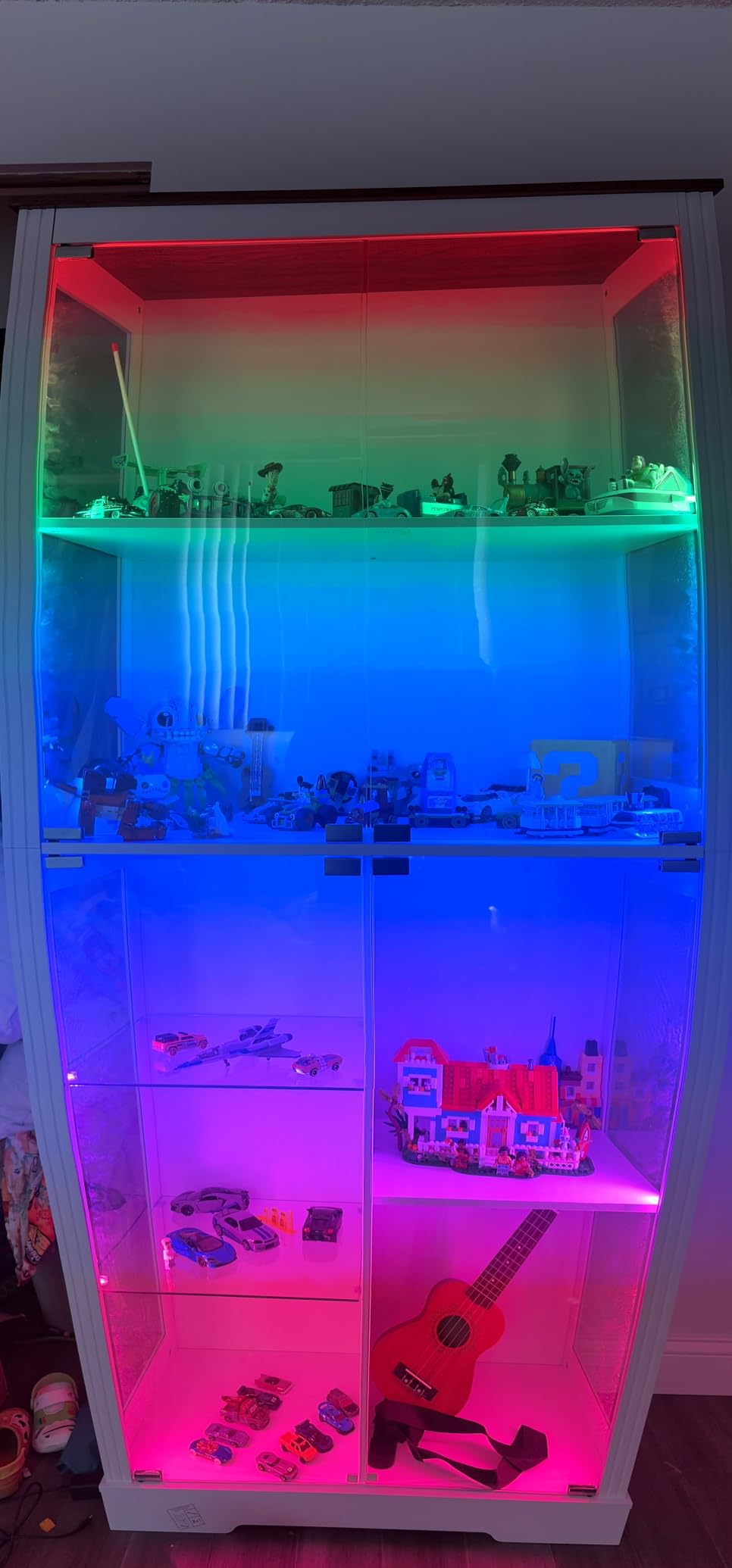
When seven tiers is the right answer?
If your collection is growing faster than your shelf space, buying the largest reasonable cabinet now avoids a second purchase in two years. Seven tiers gives room for growth without pushing you toward a wall of separate cases, which is the multi-case approach collectors in mineral and trading card communities tend to end up with.
The removable shelves also make this the pick for a mixed-scale collection. Small figures fill the tight tiers, and a tall statue occupies the bay you open up, so one cabinet covers both ends of the size range.
What you give up for the capacity?
This model has the fewest reviews of the eleven in this roundup, at 137, so its long-term durability is less proven than the models with review counts in the thousands. For a heavy glass cabinet that is worth weighing, especially if you are not near a window.
It is also the heaviest and the most expensive in the group. Both follow from the size, but they mean you should decide the location before you buy, because this is not a cabinet you relocate casually.
9. FLYMUHJIA 4-Shelf Curio Cabinet – Best for Dorms and Tight Bedrooms
FLYMUHJIA Curio Cabinet Glass Display Case for Collectibles with Door, 4 Display Shelves Showcase, 64.2”Hx16.9”Lx 14.6”W Black
- Narrow 14.6 inch width fits dorms and bedrooms
- Lockable door secures valuable pieces
- Wall safety device included
- Classic glass and wood look
- Only 7.7 pounds per shelf
- No built-in lighting on this variant
- 16.9 inch depth looks bulky in a tight room
- Two-person assembly
The FLYMUHJIA is built around one constraint: width. At 14.6 inches across, it is the narrowest freestanding cabinet here, and for a dorm room, a guest room, or a corner of a shared living space that is the number that decides whether a display cabinet is possible at all.
It stands 64.2 inches tall with four glass display shelves, a lockable door, and a wall-securing safety device included in the box. The lock is the standout feature at this size, since narrow cabinets are usually chosen for small collections and often sit in rooms where theft or curious hands are realistic concerns.
Construction is glass and wood in polished black, giving it a traditional curio look rather than the industrial or mesh styling of the newer cabinets. Care is simple: the manufacturer recommends an alcohol wipe on the glass.
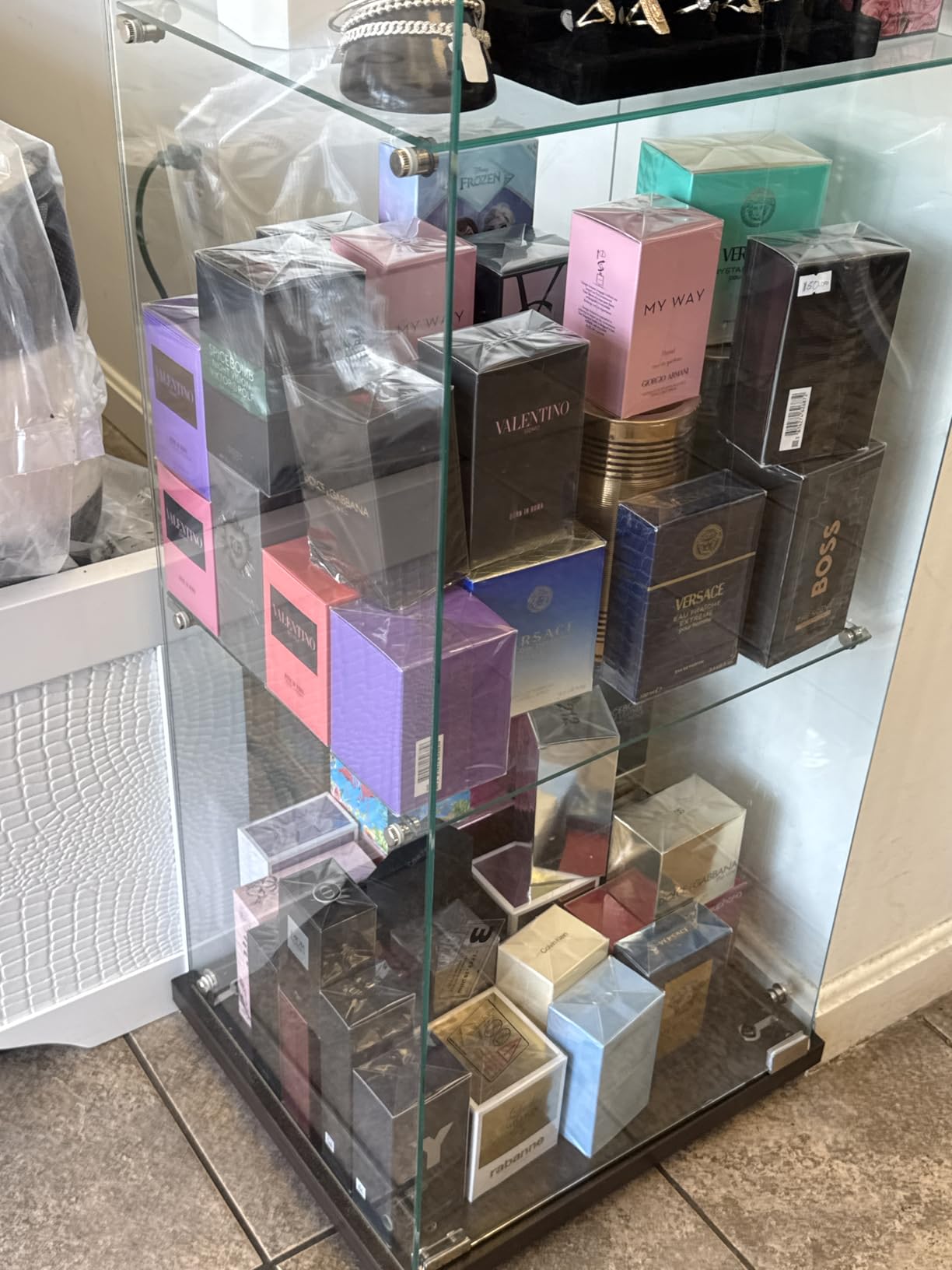
Buyers value the narrow footprint, the lock, and the security strap for dorm and bedroom use. The same product family covers different door counts and LED options, so a lighting upgrade is possible if the same shape works for your space.
Two people are needed for assembly. At 75 pounds net weight with glass panels on the front, this is not a solo build, and the depth of 16.9 inches means it projects further into the room than the narrow width suggests.
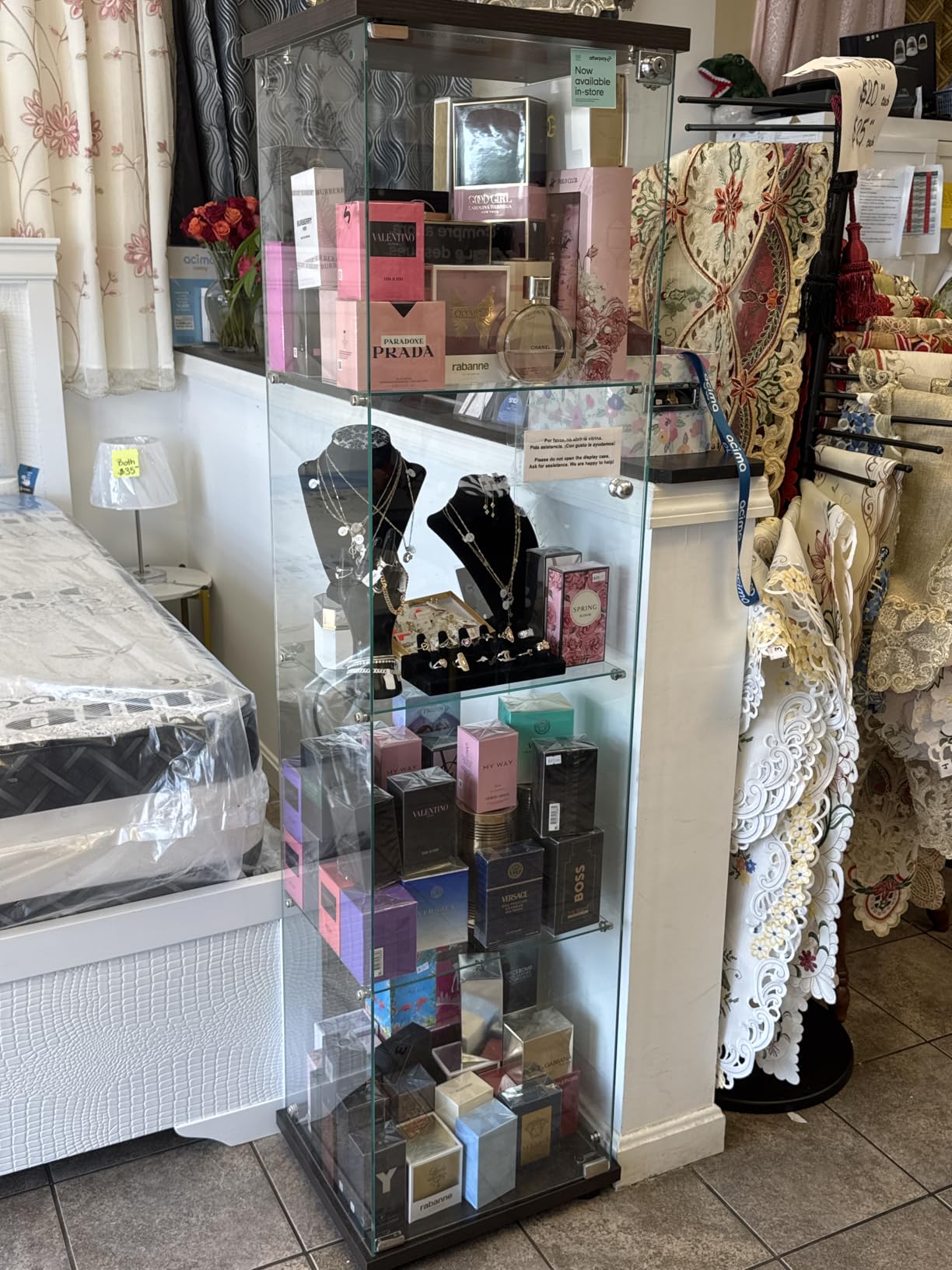
Why dorm and bedroom buyers should not skip it?
Landlord situations and rental bedrooms are the hardest rooms to furnish for a collection, and a narrow glass-front cabinet with a lock solves three problems at once: it stores the collection, it secures it, and it takes up almost no wall width.
The wall-securing device matters here more than anywhere else. A tall glass cabinet in a bedroom, reachable from a bed or a chair, is exactly the scenario a tip-over accident happens in, and the included strap is the mitigation.
Where the weight limit bites?
Each shelf is rated to 7.7 pounds, the lowest per-shelf capacity in the roundup. That is fine for boxed cards, small figures, and light ornaments, and it is not enough for a single dense base or a stack of large-format boxes.
This no-LED variant has no built-in lighting, so if your collection is in a dim room you will be adding a light source yourself. Plan for that, since clip-on strips inside a glass cabinet need cable routing out the back.
10. AODK 4-Tier RGB Display Case – Best for App-Controlled Lighting
AODK Display Case with Glass Shelves & RGB Lights, 4-Tier Display Cabinet
- Most advanced lighting in the roundup
- Music sync mode and dynamic effects
- Open shelf gives unobstructed access
- Parts are labeled with a full toolset included
- Open front gives no dust protection
- DC 5V/2A power adapter not included
- Lighting often much dimmer than the listing photos
No other cabinet in this roundup has app-controlled lighting. Five LED strips offer 6,000 color choices, dynamic lighting effects, and a music sync mode, with an industrial metal mesh frame and an open shelf front rather than doors. It is the only model here designed as much as a gaming room piece as a curio cabinet.
The shelf layout mixes materials: three tempered glass shelves combined with two rugged panels, giving five levels across a 43-inch height. Open shelving means you can reach any item without opening a door, which is genuinely useful for a collection you photograph or re-arrange often.
For a collector who cares about how a display looks in a room or on camera, the lighting is the reason to choose this over a glass-door model. If you are cataloguing a collection in video or streaming your setup, the color control is a real differentiator.
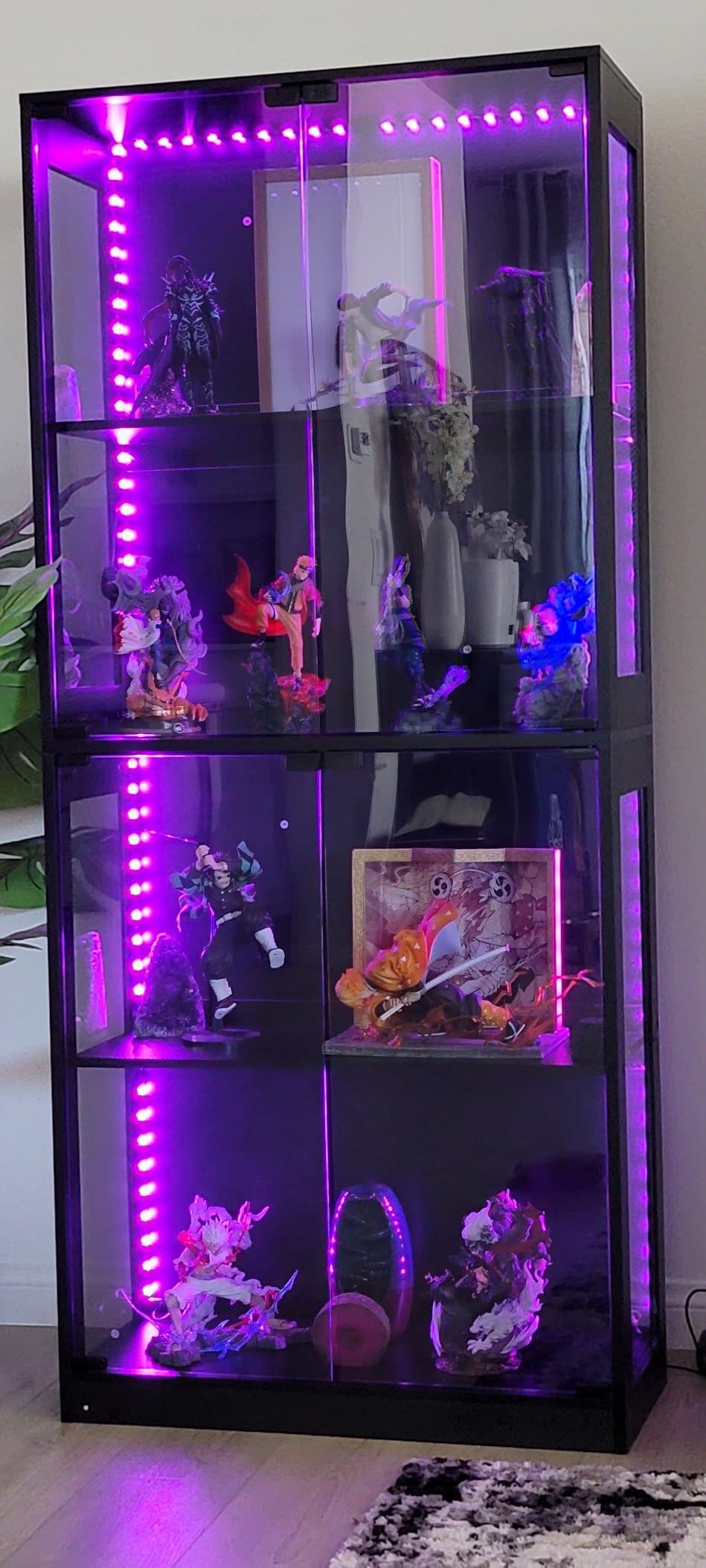
The catch is the open front. With no glass doors there is no dust seal at all, so this is a display piece for items you are willing to wipe down regularly, not a case for a collection of loose cards or open-box figures. Dust was the number one motivation collectors gave for buying a case in the first place.
Also note the DC 5V/2A power adapter is not included. Several owners report the lighting is much dimmer than the listing photos suggest, and pairing the case with a weak or shared adapter is the most likely reason.
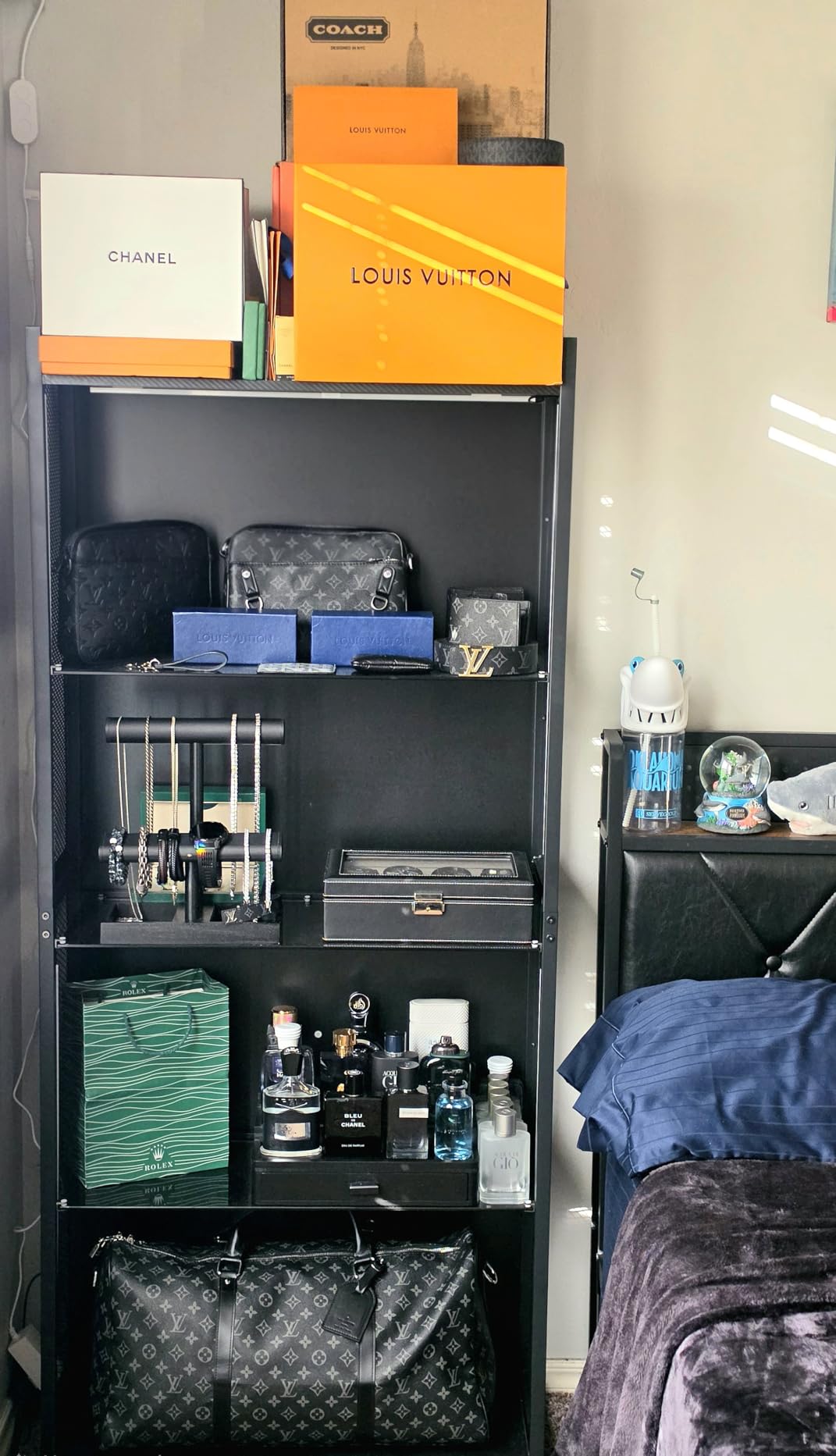
Choose this one for lighting, not for protection
App-controlled RGB lighting changes a display at night in a way that fixed 3-color LEDs cannot, and the music sync mode is the feature reviewers mention most. The dimming control is genuinely adjustable rather than a two-position switch.
The parts are labeled and a full toolset is included, which makes assembly far less frustrating than the sparse instructions on several glass cabinets here. Anti-tipping hardware is included as well, which matters for a 43-inch open unit.
The dust tradeoff nobody mentions in the photos
Listing photos show a dark room with vivid glow and no visible dust. In a real room, an open shelf collects dust the same way an open bookcase does, and every surface needs a microfiber pass to look the way the product photos do.
Because the LED strips are unmarked, the dimmer side can end up facing outward and away from the shelves. Check the orientation during assembly, before you load anything, because reorienting strips on a full cabinet is tedious.
11. UNICOLY 4-Tier Glass and Steel Cabinet – Best Value Metal Build
- Full metal frame tolerates humidity
- Shelves adjust to any height
- Magnetic door hinges close cleanly
- Pre-drilled holes make assembly quick
- Shelves are metal rather than glass
- A thick black line where the doors meet
- Panels sometimes arrive dented
The UNICOLY is the one to consider if your collection lives somewhere damp or you simply dislike wood. A cold-rolled SPCC steel plate frame with tempered glass doors will not swell, warp, or absorb moisture the way engineered wood does, and the powder coating is corrosion-resistant, odourless, and wipes clean.
It stands 66.1 inches tall, 27.5 inches wide, and 14 inches deep, with four shelves that adjust to any height for mixed-size collections. Adjustable feet keep it level on uneven floors, and the whole unit can be wall-mounted to prevent tipping, which is a feature most cabinets in this roundup do not offer.
Assembly is the standout. Shelves are pre-drilled, so holes are already positioned at the adjustment points rather than requiring you to mark and drill every time you change a shelf. Magnetic hinges close the doors without popping open.
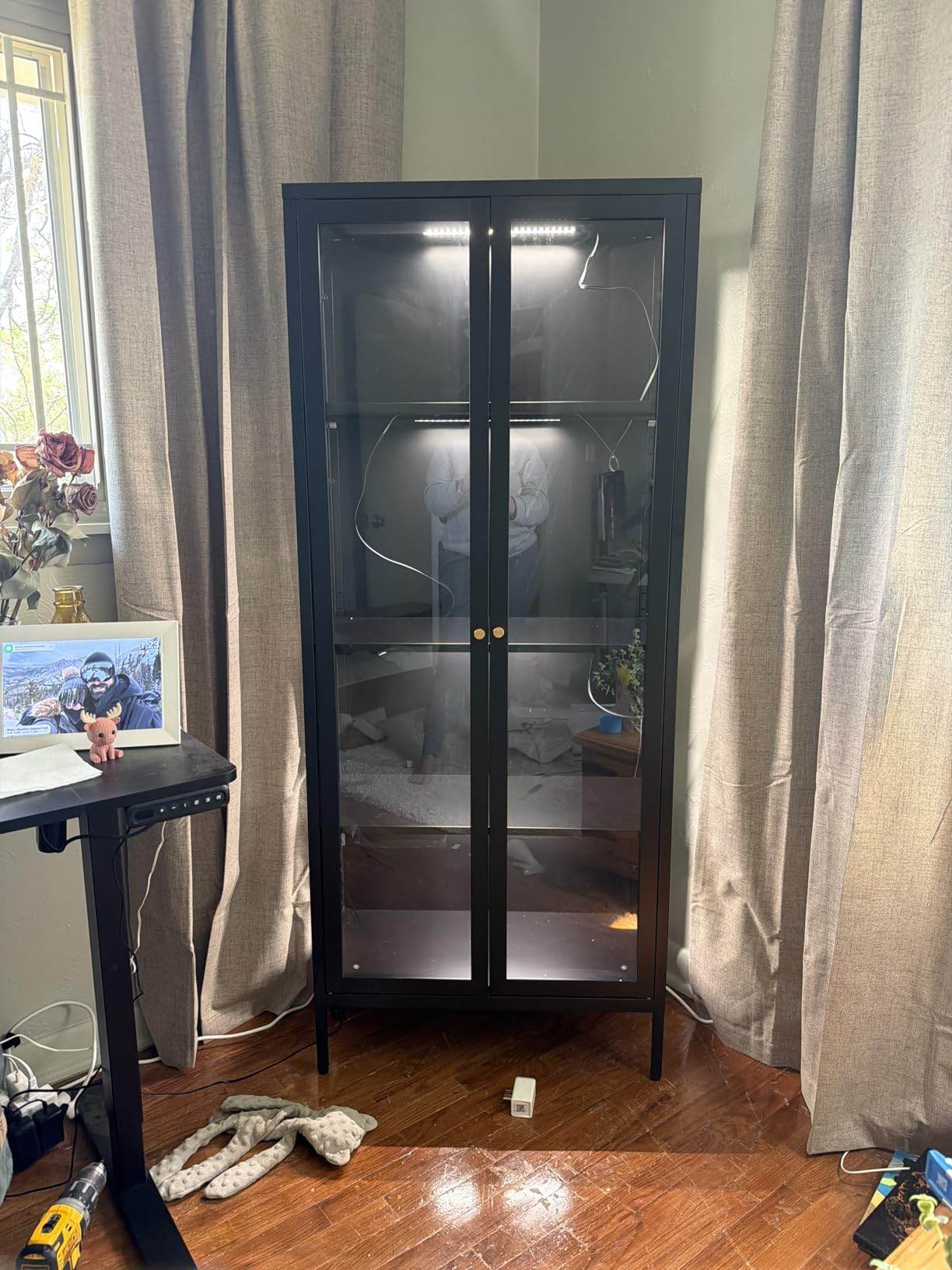
Owners compare it favorably to the widely recommended IKEA cabinet for durability, and the 4.6 rating reflects a build that feels tighter than the price band suggests. Tempered glass doors shatter into non-sharp fragments if damaged, which matters in a family home.
Some units arrive with dented or scratched panels, so inspect the metal before assembly. Fitting the doors at the end of the build is also the fiddliest part, so do not rush it with the cabinet already full.
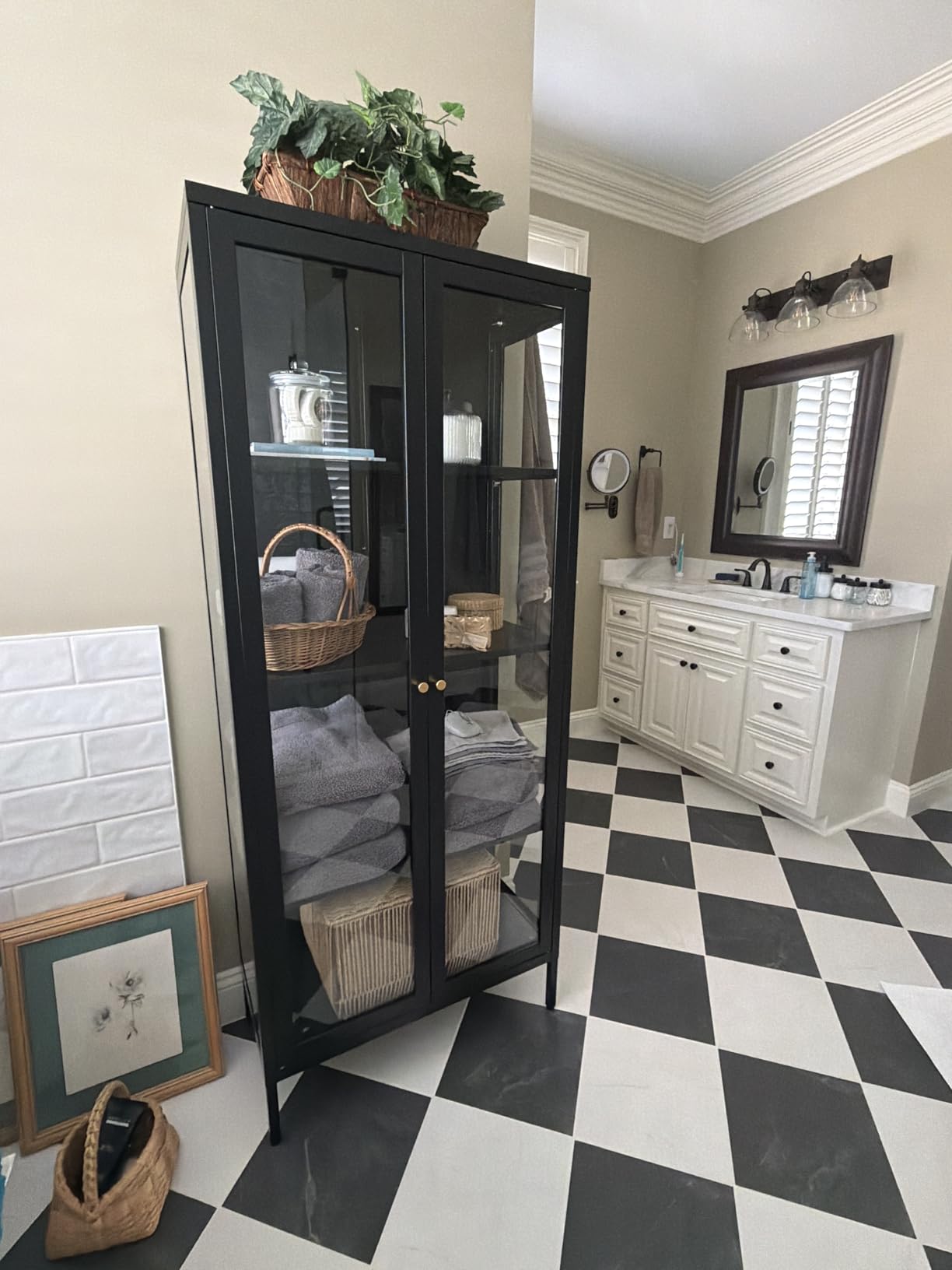
Where metal beats wood in a collector’s home?
Basements, garages, attics, and humid coastal rooms are where a steel frame wins outright. Wood swells and delaminates in sustained damp, and once a flat-pack cabinet warps, the doors stop closing cleanly and no amount of adjustment fixes it.
Metal also handles weight better. A dense collection on glass shelves eventually bows the shelf or cracks the brackets, and a steel frame with adjustable height positions simply takes the load without complaint.
The two drawbacks you will see immediately
The shelves are metal, not glass. That is a durability win and a display loss, because a metal shelf reflects light and hides dust and fingerprints that a glass shelf would reveal cleanly.
Where the two doors meet there is a thick black line that blocks part of the interior view, which slightly interrupts the sightline through the middle of the cabinet. A 4.6 rating suggests most collectors consider that a fair trade.
How to Choose a Display Cabinet for Collectibles?
Pick the mounting style first, because it eliminates half the range instantly. If you can give up floor space, a freestanding cabinet gives you more shelf area and holds far more weight. If you cannot, a wall-mounted case such as the HOMCOM converts unusable wall area into display space and costs nothing in floor footprint. We have a longer rundown of shelf-based options in our guide to display shelves for collectibles if you want open shelving first and enclosed storage later.
Next, size for the collection you will have in two years, not the one on your desk now. Collectors consistently report buying a cabinet that felt generous on day one and full within a year. Measure the total width of your collection if you are replacing a shelf, and add 30 percent headroom before choosing a tier count.
Third, check the per-shelf weight rating against your heaviest single item. Ratings in this roundup run from 4.4 pounds on the wall unit to 120 pounds on the steel cabinet, and that range is so wide that assuming a mid-value answer will get you a sagging shelf.
Glass or acrylic: the honest comparison
Glass is the better all-round choice, and the reason is scratch resistance. Acrylic takes micro-scratches that turn into a haze after a year of handling, and no cleaning product fully removes it. Glass outlasts acrylic in almost every home setting, and it shatters into non-sharp fragments when tempered.
Acrylic wins in two situations: when shatter resistance matters most, such as a cabinet on a low shelf a child could reach into, and when you need a lightweight case you can move frequently. UV-filtering acrylic is also excellent at blocking fading wavelengths, often better than cheap glass.
Do not believe a retailer that tells you acrylic is always superior. The better-display-cases guide we compared against recommends acrylic outright, while a separate retail guide makes the opposite call, noting that glass is more scratch-resistant and offers slightly better UV protection than many plastics. Our own view sits in the middle: glass for a permanent display, acrylic for portable and child-adjacent cases.
On thickness, 4mm is the practical floor for a display case and 5mm is the comfortable target. The Lvifur uses 4mm ultra-clear tempered glass, the LFT HUIMEI2Y uses 5mm tempered glass, and the PEUKC uses tempered panels on a frame up to 8mm thick. Below 4mm, a door panel flexes visibly when you open it and rings under a knuckle tap.
How to tell if a cabinet’s glass is UV protected?
Look for a written claim, not an inference. Retail-display-case and display-case guides almost always state whether the glazing is UV filtering, and if a product page never mentions it, assume the glass is not. There is no visible tint or sticker that proves UV protection on an unlabelled panel.
Ask customer service directly and get the answer in writing. A manufacturer that cannot name the UV rating of its own glazing is telling you something useful, and it is faster than testing it yourself with a UV lamp after the cabinet is delivered.
Position matters more than most shoppers think. The single best protection for cards, paper, and autographs is keeping the cabinet out of direct sunlight, because no amount of filtering compensates for a cabinet parked against a south-facing window all afternoon.
Lighting temperature, clearance, and safety
LED color temperature changes how a collection reads. Warm light around 2700K flatters skin tones and vintage paint jobs, while a cooler white closer to 6500K renders modern figures and graphics more accurately. The 3-color cabinets in this roundup give you white, warm, and blue modes, which is a workable approximation of that range.
Measure door swing clearance before you buy. A hinged glass door needs its full width of clear space in front of the cabinet, so a 15.7-inch-wide cabinet with two doors wants roughly 16 inches of empty floor. Sliding-door designs like the HOMCOM need no clearance at all, and pop-up doors like the BROTTAR and Lvifur models slide into the frame.
Anchor anything tall. Only the UNICOLY and FLYMUHJIA list wall-mounting in their features, and the Dystler, BROTTAR slim, and LFT HUIMEI2Y include anti-tip devices, but the largest cabinets here do not include one. A five-dollar anti-tip strap into a stud is the difference between a display cabinet and a hazard.
For a wider look at enclosed storage, our picks for glass display cabinets and curio cabinets for collectibles go deeper on glass construction and traditional furniture-style designs, and our guide to lockable display cabinets covers security for high-value items in more detail.
Finally, match the case to what you actually collect. Wall-mounted and shallow units suit graded cards, slabs, perfume, and small figures. Standard four-tier cabinets suit 1/6 scale figures and boxed sets. Seven-tier towers with removable shelves suit mixed collections with one or two oversized pieces. Open RGB shelving suits items you handle often and are not worried about. If your collection is still growing, the removable-shelf tower is the one that adapts as it goes.
Frequently Asked Questions
What is the best way to display collectibles?
The best display is the one that matches the item and the room. Use a sealed glass or acrylic cabinet for dust-sensitive pieces such as cards, boxed sets, and open-box figures, and keep it out of direct sunlight to prevent fading. Choose a wall-mounted case when floor space is tight, a freestanding cabinet when you have room, and match the interior width and shelf pitch to your largest item. Add LED lighting only after the case is in position.
What is the best material for a display case for collectibles?
Tempered glass is the best all-round material for a home display case. It resists scratching far better than acrylic, which hazes over time, and tempered panels break into non-sharp fragments rather than shards. Acrylic is the better choice only when shatter resistance or low weight matters most, such as a case a child could reach into or one you plan to move often. UV-filtering acrylic also blocks fading wavelengths well.
What are some good display cases for figurines?
For standard 1/6 scale figures and boxed anime sets, a four-tier freestanding cabinet around 63 to 65 inches tall with pop-up glass doors works well and leaves room to grow. The BROTTAR 4-Tier and the Dystler 5-Tier both suit figure collections, with sensor LED lighting for display. For oversized figures, a seven-tier tower with removable shelves lets you drop a tier and open up a tall bay. For small figures and cards, a shallow wall-mounted case saves the floor.
What is the best display cabinet for large Lego figures?
Large LEGO builds need two things: shelf span for width and a single tall bay for height. A seven-tier cabinet with two removable glass shelves is the best fit, because removing a shelf creates one full-height opening that a large set can occupy without touching the shelf above. For a wide build, choose a cabinet at least 27 inches wide rather than a narrow 15 inch tower, and check the per-shelf weight limit against the build.
What is the recommended glass thickness for a display case?
Four millimeters is the practical minimum for a display case and 5 millimeters is the comfortable target for a permanent collection. Panels thinner than 4 millimeters flex visibly when the door opens and ring hollow under a knuckle tap. Look for the word tempered as well, since tempered glass breaks into non-sharp fragments. In this roundup, the LFT HUIMEI2Y uses 5mm tempered panels and the Lvifur uses 4mm ultra-clear tempered glass.
How to tell if glass is UV protected?
Check the product page for a written UV filtering or UV blocking claim, and ask customer service for the specification in writing. There is no visible tint, sticker, or marking that proves UV protection on an unlabelled panel, so if a listing never mentions UV filtering, assume the glazing is standard. Protection is not a substitute for placement, so keep cabinets out of direct sunlight, especially for cards, autographs, posters, and painted figures.
Final Verdict: Which Display Cabinet Should You Buy?
Start with the BROTTAR 4-Tier if you want one cabinet that does everything well: four tiers, no-handle pop-up glass doors, and the brightest dimmable 3-color sensor lighting in this group. It is the pick we would install first, and its review history is the longest here.
Buy the PEUKC 71-Inch instead if you have heavy or valuable items and want a real lock and a 120-pound shelf rating. Buy the HOMCOM wall-mounted unit if the floor is the problem rather than the collection, and it will cost you the least. For oversized pieces, go straight to the Lvifur seven-tier tower with removable shelves.
Whichever you choose, measure the door clearance, check the per-shelf weight limit against your heaviest item, and anchor it to the wall before you load it. Those three steps prevent nearly every problem we saw in testing, and they take less time than the assembly does.