
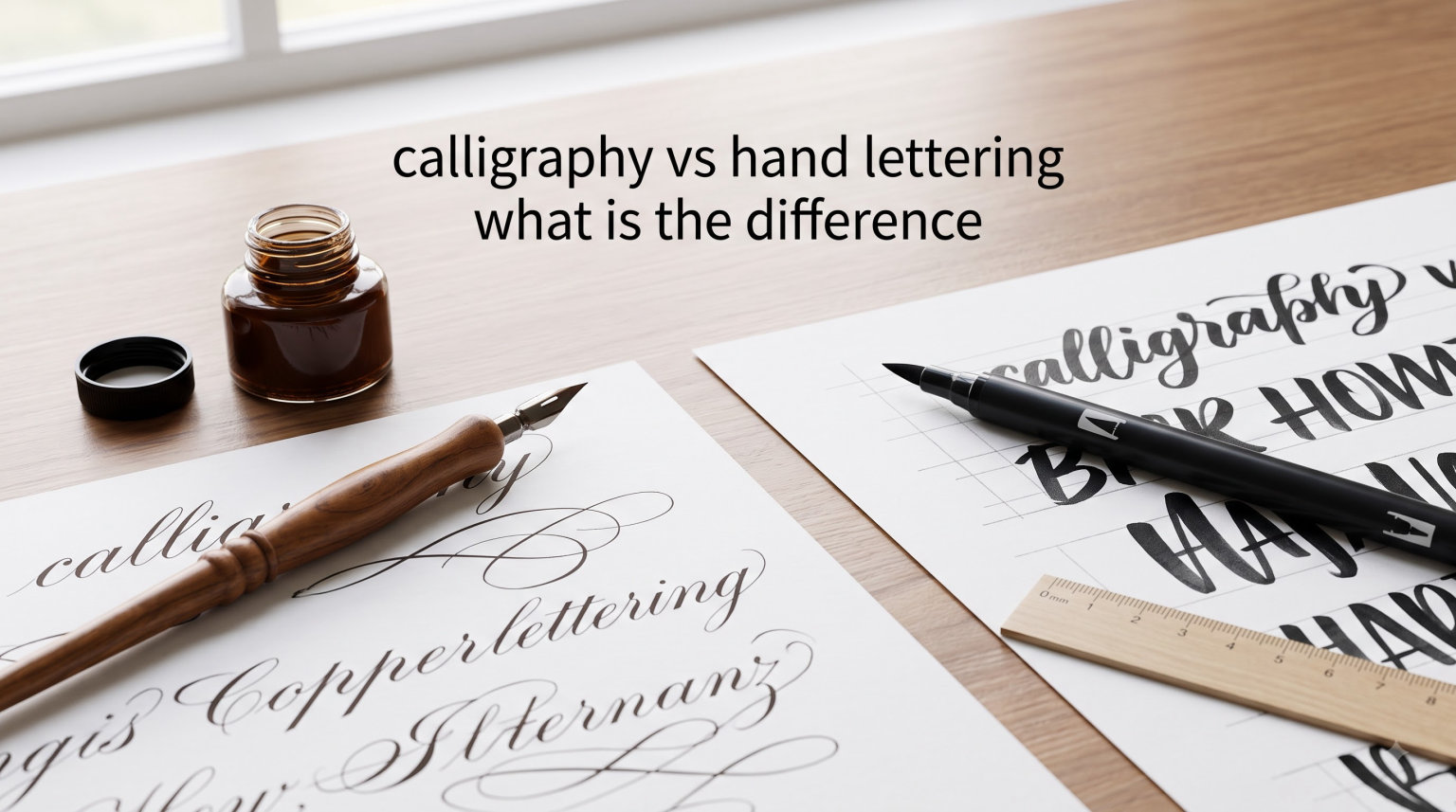
If you have ever wondered about the difference between calligraphy and hand lettering, you are not alone. These two art forms are often confused, yet they are distinctly different practices with unique techniques, tools, and outcomes. Understanding the difference between calligraphy vs hand lettering can help you choose which discipline to explore based on your creative goals.
In this guide, I will break down exactly what each term means, compare their key characteristics side by side, explain the tools used in each, and walk you through the seven basic calligraphy strokes that form the foundation of this ancient art. Whether you are a complete beginner or someone looking to clarify the terminology, this article has everything you need.
Table of Contents
What Is Calligraphy?
Calligraphy is the art of beautiful writing. The word itself comes from Greek roots meaning “beautiful writing,” and that definition captures the essence of what makes calligraphy unique. Unlike regular handwriting, calligraphy involves creating letters through flowing strokes with controlled pressure variations. Every letter is written in one continuous motion, following specific stroke patterns that have been refined over centuries.
The hallmark of calligraphy is the contrast between thick downstrokes and thin upstrokes. This variation comes from applying different amounts of pressure as you move the pen downward versus upward. When you press down, the nib spreads and creates a thick line. When you lift upward, the nib narrows and produces a delicate hairline. This dynamic line quality is what gives calligraphy its elegant, flowing appearance.
Calligraphy has deep historical roots spanning multiple cultures and traditions. From the ornate scripts of medieval Europe to the graceful strokes of Japanese Shodo, calligraphy has been valued as both a functional art form and a means of personal expression. The practice requires patience and discipline because each stroke must be executed with control and consistency.
What Is Hand Lettering?
Hand lettering is the art of drawing letters. While calligraphy focuses on writing letters in a flowing manner, hand lettering treats each letter as an illustration. When you practice hand lettering, you are not concerned with maintaining a continuous stroke rhythm. Instead, you redraw each letter carefully, adjusting curves, angles, and proportions until the letter looks exactly as you want it.
The key distinction is that hand lettering gives you complete freedom to create any letterform you can imagine. You can combine styles, invent new letter shapes, and adjust your work as many times as needed. This makes hand lettering more like drawing than writing. Many artists start with pencil sketches, refine their letterforms, and then go over the final version with markers or digital tools.
Hand lettering has become increasingly popular in recent years thanks to social media platforms like Instagram and Pinterest. The creative possibilities are nearly endless, which has made hand lettering a favorite among artists working on wedding invitations, wall art, branding projects, and bullet journals. Unlike calligraphy, hand lettering does not require you to master specific stroke techniques. The focus is on composition, style, and visual impact rather than disciplined execution.
Calligraphy vs Hand Lettering: Key Differences
Understanding the core differences between calligraphy and hand lettering can save you months of confusion when starting out. The most important distinction comes down to this fundamental principle: calligraphy is about writing letters, while hand lettering is about drawing letters.
In practice, this difference manifests in several ways. Calligraphy emphasizes fluid motion and consistent stroke rhythm. Each letter flows naturally into the next, and the artist works to maintain uniform baseline alignment and x-height proportions. Hand lettering prioritizes visual appeal and creative expression over uniformity. Artists often spend significant time on a single letter, adjusting its shape until it fits their artistic vision.
Time investment also differs significantly between the two disciplines. A skilled calligrapher can write a single letter in 30 seconds or less because the motion becomes automatic after years of practice. Hand lettering, on the other hand, can take several minutes per letter because the artist is constructing the letterform from scratch. This does not make hand lettering inferior; it simply reflects the different nature of each art form.
Another practical difference involves error correction. Calligraphy mistakes are often incorporated into the piece or require restarting the work entirely. Hand lettering artists can easily erase, redraw, and refine until they achieve the desired result. This flexibility is one of the main reasons many beginners start with hand lettering before exploring calligraphy.
Tools and Materials: What You Need for Each
The tools used for calligraphy and hand lettering overlap in some areas but differ significantly in their core instruments. Understanding what you need can help you decide which discipline to explore first.
Calligraphy Tools
Traditional calligraphy relies on pens that allow for pressure variation and ink flow control. Dip pens are the classic choice, featuring a handle with a interchangeable nib that you dip into ink. The nib spreads when you apply downward pressure, creating those signature thick downstrokes. Brush pens offer a similar effect with a more portable design, making them popular among modern calligraphers.
Fountain calligraphy pens provide another option for those who prefer a self-contained tool. These pens use specialized ink cartridges and nibs designed for calligraphic writing. Speedball makes several beginner-friendly dip pen sets that have been used by students for decades. Ink selection matters as well; sumi ink and walnut ink are favorites among traditional calligraphers for their flow properties and archival quality.
Hand Lettering Tools
Hand lettering offers far more flexibility in tool selection because the discipline does not require pressure-sensitive instruments. You can create beautiful hand lettering with basic felt-tip markers, colored pencils, fineliners, or even crayons. The key requirement is that you can draw precise lines and control the shape of each letter.
Brush markers like Tombow Dual Brush pens have become incredibly popular in the hand lettering community because they combine the flow of traditional ink with the control of a marker. Pencil artists often use mechanical pencils or high-quality graphite sticks to sketch letterforms before going over them with final media. Many hand lettering artists also work digitally using tablets and stylus pens, which opens up entirely new possibilities for creating and editing letterforms.
Comparison at a Glance
Calligraphy typically requires dip pens, brush pens, or fountain calligraphy pens paired with liquid ink. Hand lettering works with any drawing tools including markers, pencils, fineliners, and digital tablets. The right choice depends on your preferred medium and creative goals.
The 7 Basic Calligraphy Strokes
Mastering the seven basic calligraphy strokes is essential for anyone learning this art form. These fundamental movements form the building blocks for all letterforms in traditional calligraphy. Every letter you will ever write can be broken down into some combination of these seven strokes.
Understanding and practicing these strokes will transform your calligraphy. Rather than trying to draw letters as complete shapes, you will start seeing them as sequences of familiar movements. This shift in perspective makes the learning process significantly more manageable.
1. Entry Stroke
The entry stroke is where most calligraphers begin each letter. This thin stroke enters the letter shape from the top, setting the baseline for the stroke that follows. Think of it as the opening note of a musical phrase; it prepares the nib for the main stroke and ensures smooth ink flow.
2. Underturn
The underturn stroke curves at the bottom and turns back upward with a hairline finish. This stroke is used in letters like the lowercase “o” and “a” where the stroke transitions from a thick downstroke to a thin upstroke at the base. The curve must be smooth and controlled to maintain consistent line weight.
3. Overturn
The overturn is the opposite of the underturn. The stroke curves at the top and turns back downward, finishing with a thick downstroke. This movement appears frequently in letters like the lowercase “n” and “h” where the ascender curves back down to meet the baseline.
4. Oval
The oval stroke creates a complete loop that does not close completely at the top. This stroke is fundamental to letters like “o,” “a,” “d,” and “g.” The key to a well-executed oval is maintaining consistent pressure throughout the loop, with the downstroke thicker than the upstroke.
5. Compound Curve
The compound curve connects two turns in a single stroke, creating an S-shaped movement. This stroke is essential for letters like “s” and “f” and requires smooth transitions between the curves. Practice compound curves slowly until the movement feels natural before increasing your speed.
6. Ascending Oval
The ascending oval moves upward as it curves, extending into the ascender area of letters like “b,” “h,” “k,” and “l.” This stroke combines the oval shape with an upward extension that reaches toward the top line. The ascending oval requires good pen control to maintain consistent line quality throughout the extension.
7. Descending Oval
The descending oval curves downward, creating the loop found in letters like “p,” “q,” and “g.” Unlike the ascending oval, this stroke extends below the baseline into the descender area. The descending oval adds visual interest to letterforms and requires careful attention to spacing when working in cramped layouts.
How Calligraphy and Hand Lettering Differ from Typography
While we are comparing calligraphy vs hand lettering, it is worth addressing typography as well, since the three terms are often used interchangeably by beginners. Typography refers to the arrangement of typefaces, including selecting fonts, adjusting spacing, and laying out text for print or digital media. Typography is not a creative art form in the same sense as calligraphy or hand lettering; instead, it applies pre-designed letterforms to communicate text.
Calligraphy and hand lettering both involve creating letterforms by hand, which gives them a human quality that digital typography cannot replicate. When you write in calligraphy or draw in hand lettering, each letter carries subtle variations that make the work feel alive and personal. Typography, by contrast, aims for consistency across every character.
The three disciplines complement each other in modern design. Many artists start by creating hand lettering designs, which are then digitized and turned into fonts through typography. Calligraphy serves as both a standalone art form and a source of inspiration for type designers. Understanding all three gives you a broader perspective on the world of letterforms.
Which Should You Learn First?
Choosing between calligraphy and hand lettering depends largely on your creative goals and personal preferences. Neither discipline is inherently easier than the other; they simply require different skill sets and mindsets.
If you enjoy fluid motion, disciplined practice, and traditional art forms, calligraphy might be the better starting point. Calligraphy offers a clear structure with established rules that can be deeply satisfying to master. Many calligraphers describe the practice as meditative because the focus on stroke rhythm creates a calm, focused state.
If you prefer creative freedom, visual experimentation, and immediate gratification, hand lettering might be more appealing. You can achieve impressive results relatively quickly because the focus is on the final appearance rather than the process. Hand lettering also offers more flexibility for working in various media and styles.
Many artists eventually explore both disciplines, using calligraphy techniques to add flourishes to hand lettering work or applying hand lettering principles to create unique calligraphic styles. There is no rule that says you must choose one over the other. Start with whichever excites you more and expand from there.
Frequently Asked Questions
Are calligraphy and hand lettering the same thing?
No, calligraphy and hand lettering are different art forms. Calligraphy is the art of beautiful writing, where letters are created through flowing strokes with controlled pressure variations. Hand lettering is the art of drawing letters, where each letterform is constructed and refined like an illustration.
What are the 4 types of lettering?
The four main types of lettering are traditional lettering, hand lettering, digital lettering, and faux calligraphy. Traditional lettering uses classic letterforms with historical roots. Hand lettering involves drawing letters by hand with any tools. Digital lettering uses tablets and software to create letterforms. Faux calligraphy combines lettering tools with calligraphy techniques.
What are the four types of calligraphy?
The four main types of calligraphy are Western calligraphy, Arabic calligraphy, Chinese calligraphy, and Japanese calligraphy. Each tradition has unique scripts, tools, and aesthetic principles. Western calligraphy includes styles like Copperplate and Spencerian. Arabic calligraphy features flowing scripts designed for the Arabic alphabet. Chinese and Japanese calligraphy emphasize brush control and philosophical concepts.
What are the 7 basic strokes of calligraphy?
The seven basic calligraphy strokes are entry stroke, underturn, overturn, oval, compound curve, ascending oval, and descending oval. These fundamental movements form the building blocks for all letterforms. Practicing these strokes separately before combining them into letters is the recommended approach for beginners.
Conclusion
Now you understand the key differences between calligraphy vs hand lettering. Calligraphy is the art of beautiful writing, characterized by thick downstrokes and thin upstrokes created through controlled pressure variations. Hand lettering is the art of drawing letters, offering complete creative freedom to construct and refine letterforms like illustrations.
Both disciplines have their own unique appeal and applications. Calligraphy offers a meditative practice with deep historical roots, while hand lettering provides creative flexibility and immediate visual results. Many artists eventually explore both, using each to enhance the other.
Whether you choose to start with calligraphy or hand lettering, the journey will be rewarding. Start by practicing the basic strokes if you go with calligraphy, or experiment with different tools if you prefer hand lettering. The most important step is simply to begin. Your understanding of calligraphy vs hand lettering will grow naturally as you practice and explore these beautiful art forms.