
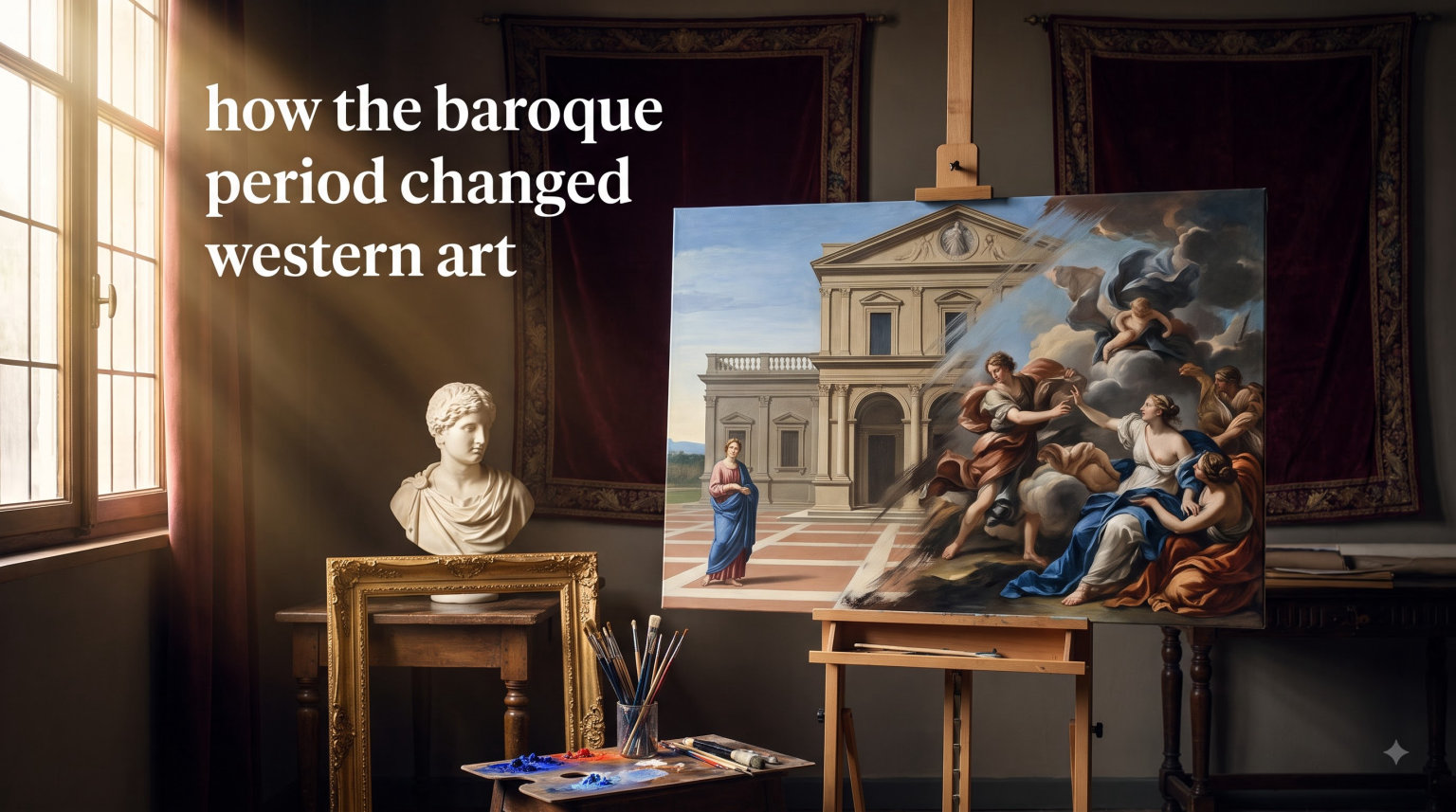
Sometime around 1600, artists in Rome began doing something that would have seemed unthinkable just a few decades earlier. They started painting scenes of saints and biblical figures that looked less like polished marble statues and more like real people caught in moments of extreme emotion. The light in their paintings fell in harsh, theatrical slashes. Bodies twisted and strained. Faces contorted in ecstasy or agony. This was the beginning of the Baroque period, and it fundamentally rewired how Western civilization made and consumed art.
If you want to understand how the Baroque period changed Western art, you need to look at what came before it. The Renaissance had established an ideal of calm balance, mathematical proportion, and restrained beauty. Leonardo da Vinci’s figures posed with serene dignity. Raphael’s compositions unfolded in harmonious symmetry. The Baroque shattered that template. In its place, artists built a visual language of movement, contrast, and raw emotional power that still influences how we create images today — from film cinematography to advertising photography.
Our team spent weeks researching the Baroque period, studying the scholarship of art historians, and examining the specific techniques that made this era so transformative. We looked at primary sources from the Council of Trent, analyzed dozens of masterworks in person and through high-resolution reproductions, and traced the influence of Baroque techniques through to contemporary practice. What follows is a comprehensive guide to the Baroque period’s impact on Western art, including the political and religious forces that drove it, the artists who defined it, and the techniques they invented that we still use centuries later.
The Baroque era roughly spans from 1600 to 1750. It began in Rome as a deliberate tool of the Catholic Counter-Reformation, then spread across Europe and beyond, adapting to local traditions wherever it took root. What makes the Baroque so important is not just that it produced extraordinary works of art. It changed the fundamental relationship between art and its audience. It made art immersive, emotional, and theatrical in ways that Western culture had never seen before. And in doing so, it laid the groundwork for how we experience visual media to this day.
Table of Contents
The Origins of the Baroque Period: How It All Began
The Baroque period did not emerge from a vacuum. It was born from one of the most turbulent moments in European history: the Protestant Reformation and the Catholic Church’s response, known as the Counter-Reformation. When Martin Luther nailed his 95 Theses to a church door in 1517, he set off a chain reaction that split Christianity in two. The Catholic Church lost millions of followers across northern Europe, and by the mid-1500s, it was fighting for its institutional survival.
The Protestant movement attacked Catholicism on many fronts, but one of its sharpest criticisms targeted religious imagery itself. Protestant reformers argued that Catholic churches had become cluttered with paintings, sculptures, and relics that distracted from true faith. They called for a return to the Word alone — scripture, not images. In response, some radical Protestant groups smashed stained glass windows, whitewashed frescoes, and stripped churches of their decoration in waves of iconoclasm that swept through northern Europe.
The Catholic Church answered decisively. In 1545, it convened the Council of Trent, an ecumenical council that met intermittently over the next 18 years to address the Protestant challenge. Among its many decrees, the Council issued specific instructions about religious art in its final session in 1563. The Church wanted images that were clear, emotionally compelling, and doctrinally correct — art that would speak directly to ordinary people and inspire them to return to Catholicism. The Council explicitly rejected the intellectual complexity of Mannerism, the style that had followed the Renaissance. Instead, it demanded art that moved the faithful to tears, to prayer, to renewed devotion.
This was the fertile ground from which the Baroque sprang. The Catholic Church became the single most powerful patron of the arts in Europe, commissioning works for churches, cathedrals, and public spaces across the continent. New religious orders like the Jesuits embraced the arts with particular enthusiasm, building churches designed to overwhelm the senses and inspire conversion. The Gesu, the mother church of the Jesuit order in Rome, became a model for Catholic church architecture across the world.
But Baroque art was not purely a religious phenomenon. Absolute monarchs like Louis XIV of France recognized its propaganda potential. The same theatrical grandeur that could overwhelm a worshipper in a Roman basilica could also intimidate a foreign ambassador at Versailles. The Baroque style became a tool of political power as much as religious devotion, and this dual function — serving both church and state — helps explain its rapid spread across Europe.
The word “Baroque” itself tells us something about how later generations viewed the period. It likely derives from the Portuguese word barroco, meaning a rough or imperfect pearl. Eighteenth-century critics used the term as an insult, implying the style was bizarre, excessive, and lacking in taste. The Enlightenment preference for clarity and rationality made the Baroque’s emotional excess seem distasteful and old-fashioned. It was not until the late 19th and early 20th centuries that art historians, led by the German scholar Heinrich Wolfflin, began to reassess the Baroque on its own terms. Wolfflin’s influential 1888 book “Renaissance and Baroque” argued that the Baroque was not a degeneration of the Renaissance but a distinct and valid artistic system with its own internal logic and beauty.
How the Baroque Period Changed Western Art: The Key Transformations
The Baroque period changed Western art in several fundamental ways, each of which represented a decisive break from Renaissance conventions. Understanding these transformations is key to grasping why the Baroque era matters so much in the history of visual culture. These changes did not happen overnight, and they were not adopted uniformly across Europe. But together they define what makes a work of art Baroque rather than Renaissance or Mannerist.
From Stillness to Movement
Renaissance artists prized compositional stability. Figures were arranged in balanced triangles or symmetrical groupings that conveyed order and permanence. Leonardo da Vinci’s “Virgin of the Rocks” places its four figures in a perfect pyramidal composition that feels stable and timeless. Baroque artists rejected this approach almost entirely. Instead, they built compositions around diagonal lines, spiraling forms, and figures caught mid-action. Bernini’s sculpture of David, for example, shows the biblical hero at the precise moment of releasing his slingshot — muscles straining, body twisted, face contorted in fierce concentration. Compare this to Michelangelo’s Renaissance David, who stands in calm, contemplative readiness before the battle. The shift is from potential energy to kinetic energy, from posed stillness to frozen motion.
This embrace of movement transformed every genre of art. In religious painting, Baroque artists depicted moments of peak drama — the instant of conversion, the moment of martyrdom, the second of divine revelation. In secular painting, mythological scenes exploded with physical action. Rubens painted battles and hunts that seem ready to burst out of their frames. Even portraiture became more dynamic, with sitters turning, gesturing, and interacting with the viewer rather than posing in rigid profile.
From Detached Beauty to Emotional Engagement
Renaissance art asked viewers to admire its beauty from a respectful distance. Baroque art grabbed viewers by the collar and pulled them into the scene. This happened through several strategies working in concert. Figures in Baroque paintings often look directly out at the viewer, breaking the fourth wall and establishing an intimate connection. Space extends from the picture plane toward the audience, creating the illusion that the painted world is spilling into our own. The emotional expressions of the figures — grief, ecstasy, terror, devotion — are rendered so vividly that viewers feel compelled to respond emotionally as well.
This was not accidental. The Counter-Reformation Church specifically wanted art that produced emotional reactions. A painting of the Madonna that left a viewer thinking about compositional balance had failed. A painting of the Madonna that brought a viewer to tears had succeeded. The Baroque developed an entire toolkit for achieving this emotional impact, from the use of dramatic gestures and extreme facial expressions to the strategic placement of figures at eye level or slightly below, creating a sense of intimacy and immediacy.
From Idealized Forms to Dramatic Realism
The Renaissance idealized the human body, presenting it in perfected proportions drawn from classical sculpture. Figures in Renaissance paintings have smooth skin, regular features, and idealized physiques. Baroque artists chose a different path. They painted and sculpted real bodies with all their imperfections: wrinkled skin, dirty feet, worn clothing, visible veins. Caravaggio famously used ordinary people from the streets of Rome as models for his saints and biblical figures. When he painted “The Death of the Virgin,” he reportedly used the body of a drowned woman pulled from the Tiber as his model, giving the Madonna swollen limbs and a bloated face that scandalized his patrons.
This was not a rejection of beauty but a redefinition of it. The Baroque found the sacred in the everyday, the divine in the gritty details of human existence. A saint with dirt under his fingernails was more inspiring than a saint with the features of a Greek god, because the dirty saint was someone ordinary people could identify with. This commitment to dramatic realism — the unflinching depiction of physical reality in service of emotional truth — became one of the Baroque’s most powerful tools.
From Even Illumination to Theatrical Lighting
Perhaps no single change is more closely associated with the Baroque period than its revolutionary use of light. Renaissance painters typically illuminated their scenes with even, diffuse lighting that revealed all details clearly. Every figure, every object, every architectural element received roughly equal attention from the light source. Baroque artists turned light into a dramatic tool, using it to create mood, focus attention, and heighten emotional intensity. They learned to paint as if they had a spotlight — or the hand of God itself — directing the viewer’s gaze to exactly what mattered.
This single innovation — treating light as a narrative and emotional device rather than merely a functional one — may be the Baroque’s most enduring contribution to visual art. It changed how artists thought about illumination forever. After the Baroque, no serious painter could treat light as simply a technical problem of representing the visible world. Light became a storytelling tool, a psychological instrument, and a metaphor for divine presence all at once.
Defining Techniques: Chiaroscuro, Tenebrism, and Beyond
The Baroque period introduced or perfected several artistic techniques that became defining features of the era. Understanding these techniques is essential for recognizing Baroque work and appreciating how it changed Western art. Each of these techniques served the larger Baroque goal of creating art that was more emotionally powerful, more physically convincing, and more immersive than anything that came before.
Chiaroscuro: The Art of Light and Shadow
Chiaroscuro (from the Italian chiaro, meaning “light,” and scuro, meaning “dark”) refers to the use of strong contrasts between light and shadow to create a sense of volume, depth, and drama in a painting. While Leonardo da Vinci pioneered early forms of chiaroscuro in his notebooks and paintings, using it to give his figures a sculptural three-dimensionality, it was Caravaggio who elevated the technique into something extraordinary. In works like “The Calling of Saint Matthew,” a shaft of light cuts across a dark interior, illuminating the faces of the figures at the moment Christ points at the tax collector. The light does not merely reveal the scene; it becomes part of the narrative, symbolizing divine grace breaking into the mundane world.
Chiaroscuro became one of the most widely adopted techniques of the Baroque era, used by artists across Europe. Rembrandt employed it to create psychological depth in his portraits, allowing shadows to suggest inner turmoil or quiet contemplation. Georges de La Tour used it to create meditative scenes lit by single candles, where the warm glow of the flame becomes a metaphor for spiritual illumination. Even landscape painters adopted chiaroscuro principles, using dramatic contrasts of light and dark to give their scenes emotional weight and atmospheric depth.
The technique’s influence extends far beyond the Baroque period. It is foundational to modern cinematography, where directors of photography still use the same principles of light-and-shadow contrast that Caravaggio pioneered. The low-key lighting of film noir, the dramatic side-lighting of contemporary drama, the rim lighting that separates actors from backgrounds — all of these are direct descendants of Baroque chiaroscuro.
Tenebrism: Painting with Darkness
Tenebrism takes chiaroscuro to an extreme. Coined from the Italian word tenbroso (meaning “dark and gloomy”), tenebrism involves painting large areas of canvas in deep black and then pulling forms out of the darkness with focused beams of light. The background is not merely dark; it is a void. Objects and figures emerge from this void as if materializing from nothing, creating an effect of startling dramatic intensity. Caravaggio is again the key figure here. In “Judith Beheading Holofernes,” the background is swallowed by impenetrable blackness, while the three figures at the center are illuminated with almost theatrical spotlighting. The effect is visceral and immediate — viewers cannot look away.
The technique was adopted enthusiastically by Caravaggio’s followers, known as the Caravaggisti, who spread the style across Europe. These were not minor imitators but major artists in their own right. The Spanish painter Jusepe de Ribera brought tenebrism to Naples, where he painted harrowing scenes of martyrdom with figures emerging from total darkness. The French artist Georges de La Tour made it the foundation of his entire practice, creating haunting scenes of figures illuminated by candlelight or torches. Gerrit van Honthorst, working in the Dutch Republic, applied tenebrist techniques to genre scenes of everyday life, proving that the technique was not limited to religious subjects.
Tenebrism’s legacy lives on in the visual language of horror films, noir cinema, and fashion photography, where dramatic pools of light emerging from total darkness remain a standard technique. The next time you watch a thriller where a character’s face is illuminated by a single light source against complete blackness, you are looking at a direct descendent of Caravaggio’s technique.
Quadratura and Trompe L’Oeil: Painting the Impossible
Baroque artists did not limit their illusions to canvas. The period saw the development of quadratura — a technique of ceiling painting that uses forced perspective to make flat surfaces appear to open up into vast expanses of sky. Pietro da Cortona’s ceiling in the Palazzo Barberini in Rome is a masterwork of the form. When viewers stand at the correct spot on the floor, the painted ceiling seems to dissolve, revealing swirling clouds, ascending figures, and a glimpse of divine infinity overhead. The architectural frame of the room appears to continue upward into the painted space, blurring the boundary between real and illusionistic architecture.
Trompe l’oeil (“deceive the eye”) techniques went even further, creating painted architectural elements that were nearly indistinguishable from real ones. Andrea Pozzo’s ceiling in the Church of Sant’Ignazio in Rome is perhaps the supreme example. Pozzo painted an entirely fictitious dome on a flat ceiling, and viewers standing at the correct vantage point see what appears to be a massive architectural structure soaring above them. The illusion is so convincing that visitors sometimes have difficulty identifying which elements are real stone and which are painted plaster.
These techniques transformed the relationship between art and architecture, making the walls and ceilings of churches into immersive environments rather than simple containers for paintings. The faithful who entered a Baroque church were not meant to observe art from a distance. They were meant to be engulfed by it, surrounded on all sides by images that extended the physical space of the building into infinite, divinely populated heavens. This was art as total environment — a concept that would not be seriously revived until the installation art of the 20th century.
Dynamic Composition and Diagonal Movement
Baroque compositions break from the Renaissance preference for horizontal and vertical stability. Instead, they build energy through diagonal lines, spiraling forms, and open compositions that suggest ongoing action. Peter Paul Rubens, the great Flemish Baroque painter, constructed his large-scale works around sweeping curves and cascading diagonals that pull the viewer’s eye through the painting in a continuous flow of movement. In “The Raising of the Cross,” the body of Christ tilts at a dramatic diagonal, creating a sense of physical strain and urgency that a centered, horizontal composition could never achieve.
The spiral composition, sometimes called a serpentinata, became another Baroque hallmark. Figures in motion twist along a spiral axis, creating a sense of three-dimensional rotation that makes static images feel dynamic. This device appears across Baroque sculpture, painting, and architecture. Bernini used it in his “Apollo and Daphne,” where the nymph’s body spirals as she transforms into a laurel tree, and the viewer is drawn around the sculpture to follow the action from multiple angles. In painting, Raphael’s earlier experiments with spiral compositions were taken to new extremes by Baroque artists who understood that a twisting form creates more visual energy than any static pose.
The Artists Who Redefined Western Art
The Baroque period produced some of the most influential artists in Western history. These individuals did not simply create beautiful works; they fundamentally changed the possibilities of painting, sculpture, and architecture. Each brought something unique to the Baroque project, and together they created a body of work that defines the era.
Caravaggio: The Master of Darkness and Light
Michelangelo Merisi da Caravaggio (1571-1610) may be the single most important artist of the early Baroque period. His impact on his contemporaries and successors was immediate and enormous. When his first public commissions appeared in Roman churches in the late 1590s, young artists traveled from across Europe to study them. His combination of radical naturalism (using street people as models) and dramatic tenebrism created a visual language that spread like wildfire through the art world. Within a decade of his first major commissions, Caravaggio had effectively invented the Baroque painting style that would dominate European art for the next 150 years.
Caravaggio’s life was as dramatic as his paintings. Born in the Lombardy region of northern Italy, he arrived in Rome as a young man with little money and no connections. He worked his way up through the competitive Roman art world, winning major church commissions and attracting the patronage of powerful collectors. But he was frequently involved in brawls, spent time in prison, killed a man in a dispute over a tennis match in 1606, and spent his final years as a fugitive traveling through Naples, Malta, and Sicily. He died at 38 under mysterious circumstances while traveling to receive a papal pardon. Despite his short and turbulent career, his artistic innovations — particularly his use of tenebrism and his commitment to painting directly from live models without preparatory drawings — reshaped European painting within a single generation.
Works like “The Supper at Emmaus,” “The Conversion of Saint Paul,” and “The Taking of Christ” demonstrate his ability to make sacred stories feel immediate and real. He placed biblical events in contemporary settings, dressed his figures in modern clothing, and rendered everyday objects — a basket of fruit, a carafe of wine, a torn garment — with startling precision. The result was art that made the divine feel tangible and accessible. His late works, painted during his years of exile, are even more stripped down and emotionally raw, with figures emerging from deeper darknesses and the paint handling becoming looser and more urgent.
Gian Lorenzo Bernini: Sculpture That Breathes
If Caravaggio revolutionized painting, Gian Lorenzo Bernini (1598-1680) did the same for sculpture and architecture. Bernini spent almost his entire career working in Rome under papal patronage, and the city is still filled with his masterworks. His sculptures do something that seems almost impossible in stone: they capture fleeting moments of intense psychological and physical drama. Before Bernini, sculpture was largely a static art. Figures stood in poses that could be maintained indefinitely. Bernini made sculpture temporal, capturing a single charged instant that implies what came before and what will follow.
“The Ecstasy of Saint Teresa” in the Cornaro Chapel of Santa Maria della Vittoria is widely considered his greatest achievement. The sculpture depicts the moment described by Saint Teresa of Avila in which an angel pierces her heart with a golden arrow, producing a vision of divine ecstasy. Bernini captures the saint’s face in an expression that hovers between pain and rapture, her body slumping in the throes of spiritual transport. The folds of her robe cascade and ripple as if caught in a supernatural wind. The entire chapel — sculpture, architecture, hidden windows that bathe the scene in natural light, marble theater boxes housing sculpted spectators — works together as a single, unified artistic experience. This integration of multiple art forms into one immersive environment was a hallmark of the Baroque.
Bernini also designed the massive baldacchino (bronze canopy) over the high altar of St. Peter’s Basilica, the Fountain of the Four Rivers in Piazza Navona, and the colonnades embracing St. Peter’s Square — arms of stone reaching out to embrace the Catholic faithful. His architectural work defined the visual identity of Counter-Reformation Rome and influenced church design across the Catholic world. He worked for eight popes and left his mark on virtually every major project in Rome during the 17th century. When we picture Rome in our mind’s eye, we are largely picturing Bernini’s Rome.
Peter Paul Rubens: The Flemish Master of Movement
Peter Paul Rubens (1577-1640) brought the Baroque style to northern Europe and became one of the most successful and prolific artists of the period. Unlike Caravaggio, whose career was marked by poverty and violence, Rubens was wealthy, well-educated, and moved comfortably in the courts of Europe. He spoke multiple languages, served as a diplomat for the Spanish Netherlands, and operated a large workshop that produced an enormous volume of work. His diplomatic career took him to Spain, England, France, and Italy, and he used these travels to study the art of different regions and incorporate their strengths into his own practice.
Rubens’s paintings are characterized by their energy, sensuality, and sheer physical presence. His figures — especially the muscular, twisting bodies of his mythological scenes — embody the Baroque fascination with movement and physical vitality. Works like “The Descent from the Cross” in Antwerp Cathedral demonstrate his ability to combine emotional depth with technical virtuosity. The limp body of Christ descends diagonally across the composition, surrounded by grieving figures rendered in Rubens’s characteristically rich, warm palette. The painting is simultaneously a devotional object, a demonstration of anatomical knowledge, and a technical tour de force of oil painting.
His influence extended far beyond his own output. Rubens’s workshop trained a generation of Flemish artists, including Anthony van Dyck, who would become the leading portrait painter in England. His diplomatic travels exposed his work to patrons across the continent, and his workshop produced copies and variations of his compositions that spread his style even further. He proved that the Baroque style could thrive outside Italy, adapting itself to local traditions while retaining its core dramatic energy.
Artemisia Gentileschi: A Voice of Power and Pain
Artemisia Gentileschi (1593-1656) occupies a unique and increasingly recognized position in Baroque art history. One of the few women to achieve professional success as a painter in the 17th century, Gentileschi was trained by her father Orazio Gentileschi, himself a follower of Caravaggio. She absorbed the Caravaggisti style — the dramatic lighting, the intense realism, the emotional directness — and made it her own. In recent decades, scholars have argued convincingly that she should be ranked among the greatest painters of the Baroque, not merely among the greatest women painters.
Her personal history profoundly shaped her art. At the age of 17, she was raped by her painting instructor, Agostino Tassi. The subsequent trial lasted seven months and subjected Gentileschi to public humiliation and torture with thumbscrews to verify her testimony. Tassi was eventually convicted but faced minimal punishment. This traumatic experience is reflected in some of her most powerful works, particularly her multiple versions of “Judith Slaying Holofernes.” Where Caravaggio’s version of the same subject shows Judith pulling away from the act in distaste, Gentileschi’s Judith is determined, focused, and physically engaged — a woman doing difficult but necessary work with her own hands. The blood spatters on Judith’s dress and the fierce concentration on her face communicate an authority and physical commitment that male painters rarely gave to their female subjects.
Gentileschi went on to have a successful career, working in Florence, Rome, Venice, Naples, and eventually at the court of Charles I in London. She became the first woman accepted into the Accademia delle Arti del Disegno in Florence. Her other major works, including “Susanna and the Elders” and “Lucretia,” continue the theme of women confronting male violence with courage and agency. Today, she is recognized not just as a notable woman artist but as one of the most technically accomplished painters of the Baroque era. Her use of chiaroscuro is every bit as sophisticated as Caravaggio’s, and her ability to convey psychological depth in her figures ranks among the best of the period.
Rembrandt and Vermeer: Dutch Golden Age Brilliance
The Dutch Golden Age produced a distinctly different flavor of Baroque art. In the Protestant Netherlands, the Counter-Reformation was irrelevant. There were no grand Church commissions, no sweeping ceiling frescoes, no theatrical altarpieces. Instead, Dutch Baroque art found its subjects in everyday life, landscapes, still lifes, and portraits. The result was art that shared the technical innovations of the Italian Baroque — especially the mastery of light — while directing them toward entirely different ends.
Rembrandt van Rijn (1606-1669) was the towering figure of the Dutch Golden Age. His mastery of chiaroscuro equaled or surpassed any Italian painter, but he used it for psychological exploration rather than religious spectacle. His self-portraits, which he produced throughout his life in extraordinary numbers (roughly 80 paintings, etchings, and drawings), chart the progression from confident youth to vulnerable old age with unflinching honesty. In his late self-portraits, the paint surface itself becomes a map of human experience — thickly impastoed in some areas, thin and transparent in others, capturing the play of light across aging skin with a tenderness that borders on devotion.
The light in a Rembrandt painting does not arrive from heaven in a dramatic shaft; it glows softly from within, illuminating the inner life of his subjects. His biblical paintings, such as “The Return of the Prodigal Son,” achieve an emotional depth through quiet intimacy rather than theatrical spectacle. The father’s hands resting on his son’s shoulders communicate forgiveness more powerfully than any amount of dramatic lighting or sweeping gesture could.
Johannes Vermeer (1632-1675) took a different but equally Baroque approach to light. His small, meticulously crafted paintings of domestic interiors capture the effects of natural light filtering through windows with a precision and sensitivity that remains unmatched. Works like “Girl with a Pearl Earring” and “The Music Lesson” transform ordinary moments into events of quiet but intense visual beauty. Vermeer’s use of light to create mood and meaning is pure Baroque, even though his subjects could not be further from the drama of a Roman altarpiece. His paintings demonstrate that the Baroque interest in light as a carrier of meaning was not limited to religious contexts — it could ennoble the most ordinary domestic scene.
Regional Variations: How Baroque Looked Across Europe and Beyond
One of the most remarkable features of the Baroque period is how it adapted to different cultural, religious, and political contexts. The Baroque was never a single, monolithic style. It was a family of related approaches that shared certain core values — drama, emotion, movement, the theatrical deployment of light — while expressing them in ways that reflected local traditions and needs. Understanding these regional variations reveals the extraordinary flexibility and reach of the Baroque visual language.
Italian Baroque: The Epicenter
Italy was the birthplace of the Baroque, and Italian Baroque remains the most familiar version of the style. Rome, in particular, was transformed during the 17th century into a vast outdoor museum of Baroque art and architecture. The popes of the period viewed artistic patronage as a key tool of the Counter-Reformation, pouring enormous resources into churches, fountains, public squares, and palaces. The result was an urban landscape designed to overwhelm the senses and inspire religious awe.
Churches like Il Gesu, the mother church of the Jesuit order, pioneered the integration of painting, sculpture, and architecture into unified spatial experiences that would be replicated across the Catholic world. The broad, barrel-vaulted nave of Il Gesu, flooded with light from hidden windows and decorated with rich frescoes, became the template for Baroque church design on every continent. Architects like Francesco Borromini pushed structural innovation to its limits, designing churches like San Carlo alle Quattro Fontane with undulating facades and complex geometric plans that embodied the Baroque love of movement and surprise.
Spanish Baroque: Mysticism and Realism
Spanish Baroque developed its own distinct character, shaped by the intensity of Spanish Catholic devotion and the influence of the Inquisition. Spanish Baroque art tends to be even more emotionally extreme than its Italian counterpart, reflecting a culture where religious experience was intense, physical, and often tied to experiences of suffering and ecstasy. Francisco de Zurbaran painted monks and saints in stark, isolated light, creating images of intense spiritual solitude that feel almost photographic in their precision. His figures emerge from deep shadows like visions, their white robes glowing with an almost supernatural luminosity.
Diego Velazquez (1599-1660), court painter to Philip IV, combined Baroque technical brilliance with an unprecedented degree of naturalism. His masterpiece “Las Meninas” is a complex meditation on representation, reality, and the act of seeing that continues to challenge viewers and scholars more than 350 years after it was painted. The painting shows the young Infanta Margarita surrounded by her maids of honor, with Velazquez himself at his easel and the king and queen reflected in a distant mirror. The layers of looking — who is watching whom, and from where — create a philosophical puzzle wrapped in a masterpiece of Baroque technique.
Bartolome Esteban Murillo brought a softer, more accessible warmth to Spanish Baroque painting, particularly in his depictions of the Virgin Mary and street children of Seville. Together, these artists created a Spanish Baroque tradition that balanced raw emotional intensity with technical precision and deep religious conviction.
French Baroque: Grandeur and Control
French Baroque walked a careful line between dramatic grandeur and classical restraint. Under Louis XIV, France developed a version of the Baroque that was more ordered and disciplined than the Italian original. The Palace of Versailles, with its Hall of Mirrors, vast gardens, and precisely orchestrated visual effects, represents the pinnacle of French Baroque expression. Here, the style served not the Church but the state, projecting the absolute power and refined taste of the Sun King. Every element of Versailles — from the geometric layout of the gardens to the painted ceilings glorifying the monarch — was designed to communicate one message: the power and glory of France and its king.
In painting, Nicolas Poussin developed a classicizing version of the Baroque that emphasized clarity, order, and intellectual rigor. Poussin spent most of his career in Rome but profoundly influenced French art through his disciplined compositions and his belief that painting should appeal to the mind as much as to the emotions. His work represents the constant tension within French art between the emotional pull of the Baroque and the rational discipline of classicism — a tension that would define French artistic culture for centuries.
Flemish and Dutch Baroque: Commerce and Daily Life
In the Spanish Netherlands (roughly modern Belgium), Rubens established a vibrant Baroque tradition that combined Italian influences with northern European traditions of detailed realism. His pupil Anthony van Dyck became the most sought-after portrait painter in Europe, bringing a Baroque elegance to the courts of England and elsewhere. Van Dyck’s portraits of Charles I of England established a template for aristocratic portraiture that would dominate European painting for generations.
In the Dutch Republic, meanwhile, a booming mercantile economy created a vast market for art among the middle class. Unlike Italy or Spain, where the Church and the aristocracy were the primary patrons, Dutch art was bought by merchants, professionals, and tradespeople who wanted works for their homes. This created demand for new subjects: landscapes, still lifes, genre scenes of everyday life, and group portraits. Painters like Frans Hals, who captured the lively expressions of his subjects with loose, energetic brushwork that anticipated Impressionism by two centuries, and the landscape artists who pioneered new ways of depicting natural light, extended the Baroque sensibility into genres that Italy barely touched.
Latin American Baroque: A Colonial Expression
One of the most underexplored chapters of the Baroque story is its spread to the Americas. As Spain and Portugal colonized Central and South America, they brought the Baroque style with them — not just as an aesthetic preference but as a deliberate tool of religious conversion and cultural domination. Churches in cities like Mexico City, Quito, Cusco, and Ouro Preto feature elaborate Baroque facades and interiors that blend European conventions with indigenous artistic traditions in ways that are unlike anything found in Europe.
The result is a hybrid style that is recognizably Baroque in its dramatic energy and ornamental richness but distinctly American in its motifs, materials, and cultural references. In the churches of colonial Mexico, you can find Baroque altarpieces carved with local fruits and flowers alongside traditional European Christian symbols. In Peru, indigenous artists incorporated Andean textile patterns and local iconography into ostensibly Catholic paintings. Latin American Baroque represents the style at its most globally expansive, demonstrating the reach and adaptability of the Baroque visual language — and raising complex questions about cultural exchange, imposition, and transformation that art historians are still working to untangle.
Baroque vs Renaissance: A Side-by-Side Comparison
Understanding how the Baroque period changed Western art becomes clearer when you place it directly alongside the Renaissance. The two periods shared many values — a respect for technical mastery, an interest in classical subjects, a commitment to naturalistic representation — but they pursued these values in radically different ways.
In terms of composition, the Renaissance favored stability and balance. Its artists arranged figures in symmetrical groupings, used horizontal and vertical axes, and created compositions that conveyed permanence and order. The Baroque threw out that playbook. Its compositions are built on diagonals, spirals, and asymmetrical arrangements that create a sense of movement and instability. Where a Renaissance painting invites you to settle into contemplation, a Baroque painting grabs your eye and pulls it through the scene.
When it comes to light, the Renaissance used even, diffuse illumination that revealed the entire scene clearly. Every figure and object received roughly equal visual attention. The Baroque treated light as a dramatic actor in its own right — concentrated, directional, and deeply shadowed. Renaissance light shows you everything; Baroque light shows you what the artist wants you to see, shrouding the rest in mystery.
The emotional temperature of the two periods could not be more different. Renaissance art is cerebral, balanced, and detached. It invites contemplation and admiration. Baroque art is visceral, emotional, and immersive. It demands a response. Where Raphael’s Madonnas serenely cradle the Christ child, Bernini’s Saint Teresa writhes in ecstatic transport.
The two periods also differed in their relationship to the viewer. Renaissance paintings are self-contained worlds behind a frame. The viewer is an observer looking in on a scene that is complete without them. Baroque paintings reach out into the viewer’s space, breaking boundaries and creating the illusion that the depicted scene is happening right here, right now. Hands reach toward the picture plane. Feet dangle over the edges of ceiling frescoes. This is perhaps the most fundamental change the Baroque introduced: art was no longer something you looked at from the outside. It was something that happened to you.
The shift from Renaissance to Baroque also involved a different understanding of beauty itself. Renaissance beauty was ideal, mathematical, and universal — based on geometric proportions and classical models. Baroque beauty was particular, emotional, and often found in unexpected places: in the weathered face of an old woman, in the physical strain of a laborer’s body, in the terrifying moment of a beheading. The Baroque expanded the range of what art could depict and what viewers could find beautiful, and this expansion permanently enriched Western visual culture.
The Legacy of the Baroque Period in Modern Art
The Baroque period ended in the mid-18th century, giving way to the lighter, more playful Rococo and then to the rational clarity of Neoclassicism. But its influence never truly disappeared. The techniques and principles that Baroque artists pioneered continue to shape how we create and consume visual media in ways both obvious and subtle.
Modern cinema owes an enormous debt to the Baroque. The dramatic lighting techniques of film noir — pools of light in deep shadow, shafts of illumination cutting through darkness — are directly descended from Caravaggio’s tenebrism. Directors like Orson Welles, Ridley Scott, and Gordon Willis (the cinematographer of “The Godfather”) have explicitly drawn on Baroque visual principles. Willis famously described his approach to lighting “The Godfather” as inspired by the dramatic contrasts of Baroque painting, keeping Marlon Brando’s eyes in shadow to create an impression of moral darkness. The use of chiaroscuro in contemporary film is so pervasive that most viewers absorb its influence without realizing they are looking at techniques invented in 17th-century Rome.
Photography, too, is deeply indebted to the Baroque. The dramatic portraiture style that dominates fashion and editorial photography — with its strong directional lighting, deep shadows, and emotional intensity — is essentially Baroque lighting applied to a camera. Photographers like Richard Avedon, Annie Leibovitz, and Platon have all used Baroque-derived techniques to create their most powerful images. The genre of still life photography, with its careful arrangement of objects and dramatic lighting, descends directly from the Baroque tradition of pronkstilleven (ostentatious still life) developed in the Dutch Golden Age.
Even contemporary art continues to engage with Baroque ideas. Installations that create immersive environments, work that blurs the boundary between art and architecture, art that seeks an immediate emotional response from the viewer — all of these have deep roots in the Baroque period. The tradition of art as a total sensory experience, which the Baroque pioneered in churches like Il Gesu and Sant’Ignazio, finds its modern echo in everything from immersive theater to virtual reality. Contemporary artists like Bill Viola have explicitly referenced Baroque emotional intensity and religious themes in their video installations.
The Baroque period also established the idea that art could serve as an instrument of power — religious, political, or cultural. This concept remains central to how we think about art’s role in society. Whether we are analyzing propaganda posters, debating the politics of public monuments, or examining how social media images shape public opinion, we are engaging with questions that the Baroque period first brought into sharp focus. The Baroque showed that visual art could move masses of people, shape their beliefs, and alter their behavior. That insight has never been more relevant than it is in our image-saturated present.
FAQs
How did the Baroque period influence art?
The Baroque period influenced art by introducing dramatic lighting techniques like chiaroscuro and tenebrism, replacing static Renaissance compositions with dynamic diagonal movement, bringing emotional intensity and realism to religious and secular subjects, and creating immersive environments that integrated painting, sculpture, and architecture into unified experiences. These innovations shaped centuries of subsequent art, from Romanticism to modern cinematography.
What is western Baroque?
Western Baroque refers to the artistic style that dominated European art, architecture, and music from approximately 1600 to 1750. It emerged in Rome and spread across Europe and its colonies, characterized by dramatic use of light and shadow, emotional intensity, dynamic compositions, ornate decoration, and a theatrical approach to visual expression that served both religious and political purposes.
Was Caravaggio a Baroque artist?
Yes, Caravaggio (1571-1610) was one of the founding figures of the Baroque period. His revolutionary use of tenebrism (extreme contrast between light and dark), his commitment to dramatic realism using ordinary people as models, and his ability to make sacred stories feel immediate and visceral defined the early Baroque style. His influence on European painting was enormous, inspiring a generation of followers known as the Caravaggisti.
How did Counter-Reformation influence Baroque art?
The Counter-Reformation directly shaped Baroque art through the Council of Trent (1545-1563), which decreed that religious art should be clear, emotionally compelling, and doctrinally correct. The Catholic Church became the dominant patron of the arts, commissioning works designed to inspire devotion and combat Protestant austerity. This led to the dramatic, emotionally charged style that defines Baroque religious art u002du002d works meant to overwhelm the senses and move the faithful to renewed devotion.
How did Baroque art differ from Renaissance art?
Baroque art differed from Renaissance art in several key ways: it replaced balanced, symmetrical compositions with dynamic diagonals and spiraling movement; it substituted dramatic, directional lighting for the Renaissance’s even illumination; it exchanged emotional intensity and theatricality for the Renaissance’s calm detachment; and it broke the boundary between artwork and viewer, creating immersive experiences rather than self-contained compositions. Where Renaissance art invited contemplation, Baroque art demanded emotional response.
Conclusion: Why the Baroque Period Still Matters
How the Baroque period changed Western art is not just a historical question. It is a living one. Every time a photographer uses dramatic lighting to create mood, every time a filmmaker builds tension through pools of shadow and shafts of light, every time an installation artist creates an immersive environment that surrounds the viewer, they are drawing on principles that Baroque artists pioneered four centuries ago.
The Baroque period gave Western art its emotional vocabulary of light, shadow, movement, and drama. It broke down the polite distance between artwork and audience. It proved that art could be a tool of persuasion, devotion, and power. And it produced some of the most thrilling, technically accomplished works in the history of visual expression — works by Caravaggio, Bernini, Rubens, Rembrandt, Gentileschi, and dozens of others that continue to stop viewers in their tracks.
Understanding the Baroque is understanding a pivotal chapter in how we learned to see. It reminds us that art has always been more than decoration. It is a way of shaping perception, stirring emotion, and making the invisible visible. The Baroque artists understood this with a clarity that still has much to teach us.