
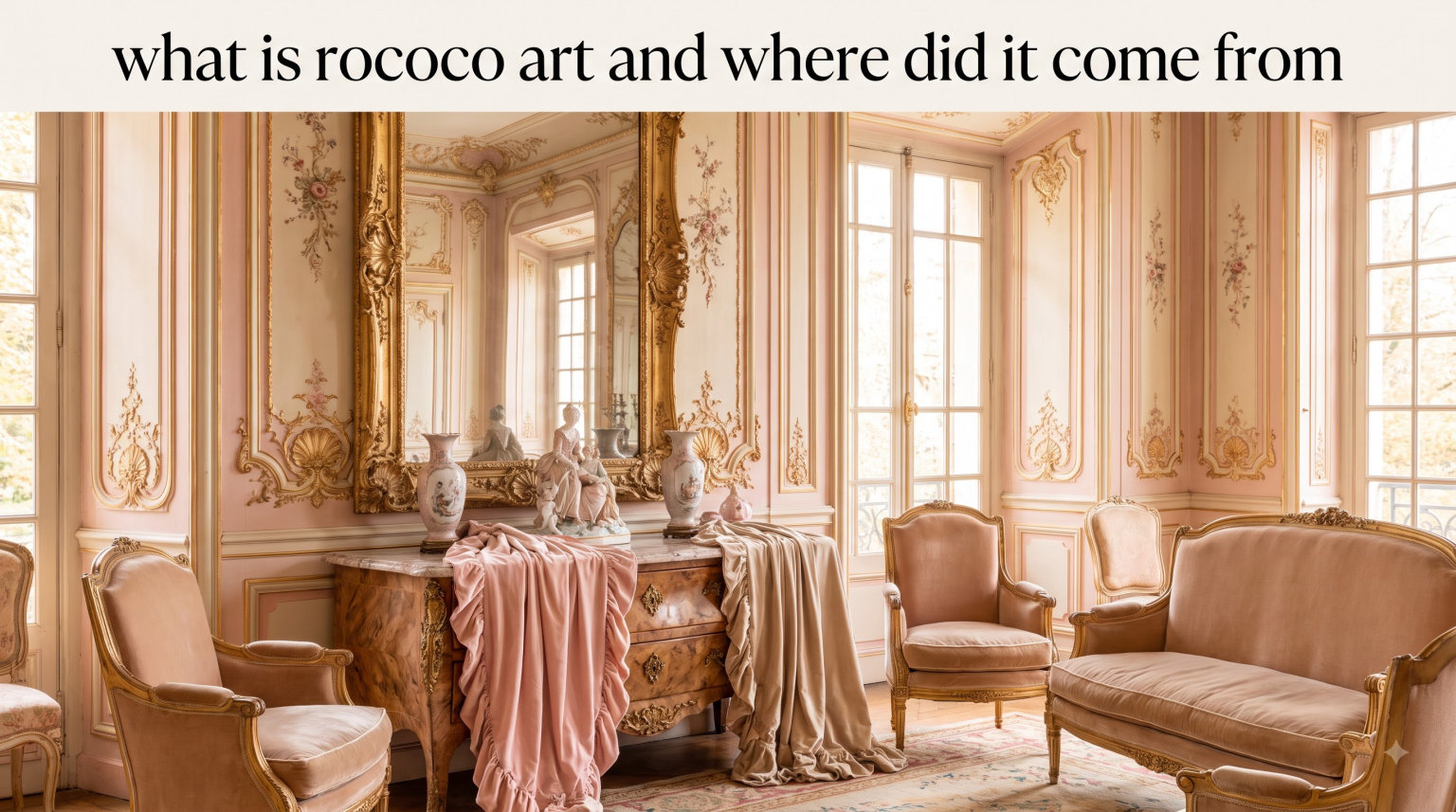
Rococo art represents one of the most distinctive and decorative styles in Western art history. This elegant artistic movement originated in Paris during the early 18th century, emerging as a radical departure from the heavy, formal Baroque style that dominated the reign of Louis XIV. The style encompasses interior design, painting, sculpture, architecture, and decorative arts, characterized by lightness, asymmetrical curves, pastel colors, and elaborate shell-like ornamentation. Understanding what is rococo art requires exploring its unique origins in French aristocratic circles, its distinctive visual language, and its lasting influence on European decorative arts for nearly five decades.
In this comprehensive guide, I will walk you through everything you need to know about Rococo art. We will explore where it originated, how it got its unusual name, the key artists who defined the movement, and why it eventually gave way to Neoclassicism. Whether you are an art history student, a museum enthusiast, or simply curious about this playful and decorative style, this article covers the essential knowledge about Rococo.
Table of Contents
What Is Rococo Art and Where Did It Come From?
Rococo is a style of art, architecture, and decoration that originated in Paris in the early 18th century, flourishing between approximately 1720 and 1770. The term itself comes from the French word “rocaille,” referring to the shell-work and rock-work decorations found in artificial grottoes. This etymology perfectly captures the style’s obsession with natural forms, curves, and ornamental excess. Rococo emerged as a reaction against the grandeur and heaviness of Baroque art and architecture, particularly the formal style associated with Louis XIV and his Palace of Versailles.
The style quickly spread from Paris throughout France and then to other European countries including Germany, Italy, England, Austria, and Spain. While it is most commonly associated with France, each region developed its own interpretation of Rococo aesthetics. The movement represents a significant shift in artistic priorities, moving from the religious and political grandeur of Baroque to the intimate, playful, and decorative concerns of aristocratic private life.
The Meaning Behind the Name: What Is Rocaille?
Understanding the etymology of “Rococo” reveals much about the style’s visual priorities and cultural context. The term derives from the French word “rocaille,” which originally described the decorative rock and shell work used to ornament artificial grottoes in French gardens. These grottoes featured intricate arrangements of stones, shells, and other natural materials, creating fantastical cave-like environments that delighted aristocratic viewers.
The word “rocaille” itself combines “roc” (rock) with the diminutive suffix “-aille,” suggesting something small, delicate, and rocky. As the style developed in Parisian interiors during the 1720s and 1730s, critics and observers began using “rocaille” to describe the elaborate decorative schemes that covered walls, ceilings, and furniture with shell-like motifs, curved forms, and naturalistic ornament. The Italian-derived suffix “-coco” was later added as a playful twist, though some art historians debate whether this addition was meant to be affectionate or mildly mocking.
By the mid-18th century, “Rococo” had become the accepted term for the style, though it was originally used somewhat dismissively by Neoclassical critics who favored the cleaner lines of ancient Greek and Roman art. Today, the term is used neutrally to describe this distinctive period of European art history.
Where Did Rococo Art Originate?
Rococo art originated in Paris, France, during the early decades of the 18th century, specifically around 1720 to 1730. The birthplace of the style was not in grand public buildings or churches, but in the private salons and townhouses of the French aristocracy. These intimate domestic spaces provided the perfect setting for an art form that prioritized comfort, pleasure, and decorative beauty over the imposing grandeur of official state architecture.
The Hotel Soubise in Paris stands as one of the earliest and most important examples of Rococo interior design. Built between 1705 and 1709 but redecorated in the 1730s, the hotel features the Oval Salon designed by Germain Boffrand with paintings by Charles-Joseph Natoire. This space exemplifies the Rococo aesthetic with its curved walls, delicate stuccowork, soft pastel colors, and integration of painting, sculpture, and architecture into a unified decorative scheme.
The emergence of Rococo was intimately connected to a significant shift in French social and political life. When Louis XIV died in 1715, the rigid court etiquette and formal grandeur of Versailles gave way to a more relaxed aristocratic culture centered on Paris. The Regency period (1715-1723) and the early reign of Louis XV saw wealthy aristocrats moving back to private townhouses where they could entertain in intimate settings free from the strict protocols of court life.
Rococo Art Characteristics: Lightness, Curves, and Pastels
The visual language of Rococo art is immediately recognizable once you understand its key characteristics. Unlike the heavy, dramatic Baroque style that preceded it, Rococo emphasizes lightness, elegance, and playful decoration. The style rejects the straight lines and symmetry of classical architecture in favor of asymmetrical curves, shell-like forms, and naturalistic ornament that seems to grow organically across surfaces.
Curved Lines and Asymmetry: The most distinctive feature of Rococo design is its use of C-curves and S-curves that weave across walls, ceilings, and furniture. These curves create a sense of movement and fluidity, breaking away from the rigid symmetry of earlier styles. Asymmetrical compositions allow decorators to create dynamic, surprising arrangements that draw the eye through a space in unexpected ways.
Pastel Color Palettes: Rococo interiors and paintings favor soft, light colors rather than the deep, rich tones of Baroque art. Ivory whites, pale blues, delicate pinks, and soft greens create an atmosphere of lightness and airiness. Gold gilt-bronze accents provide highlights without the heavy opulence of earlier styles.
Shell and Rock Motifs: True to its name, Rococo features abundant shell motifs, along with rocks, flowers, foliage, and other natural forms. These elements appear in carved wood, molded stucco, gilt-bronze mounts, and painted decoration, creating an overall effect of being surrounded by an elegant artificial garden.
Intimate Scale: Rococo works on a human scale, designed for private appreciation rather than public display. Small rooms, delicate furniture, and portable decorative objects characterize the style, emphasizing personal comfort and aristocratic leisure.
Rococo vs Baroque: Understanding the Difference
Understanding the relationship between Baroque and Rococo helps clarify what makes each style distinctive. While Rococo evolved from Baroque traditions, it represents a fundamental shift in artistic priorities and cultural values. The transition from Baroque to Rococo mirrors broader changes in French society during the early 18th century.
Baroque Characteristics: The Baroque style, exemplified by the Palace of Versailles and the art of Peter Paul Rubens, emphasizes grandeur, drama, and power. Heavy gilding, deep colors, strong contrasts of light and shadow, and massive scale serve the interests of absolute monarchs and the Catholic Church. Baroque art often depicts religious subjects, historical events, or mythological scenes with theatrical intensity.
Rococo Characteristics: In contrast, Rococo favors lightness, intimacy, and decorative beauty over power and drama. The style serves the private lives of aristocrats rather than the public image of kings. Where Baroque uses deep reds, golds, and browns, Rococo prefers pastels and ivory. Where Baroque creates overwhelming grandeur, Rococo crafts elegant comfort.
Secular vs Religious: Another key difference lies in subject matter. While Baroque art frequently served religious purposes, Rococo is almost entirely secular. The style depicts aristocratic leisure, pastoral pleasures, mythological flirtations, and decorative beauty rather than spiritual devotion or political power.
Famous Rococo Artists: Watteau, Boucher, and Fragonard
While Rococo encompassed architecture, decorative arts, and design, its painters created some of the most memorable images of the period. Three French artists in particular came to define Rococo painting: Antoine Watteau, Francois Boucher, and Jean-Honore Fragonard. Each contributed distinctive subjects and techniques that captured the essence of Rococo sensibility.
Antoine Watteau (1684-1721): Though he died just as Rococo was emerging as a coherent style, Watteau is often considered the first great Rococo painter. He invented the “fete galante” genre, depicting elegant aristocrats enjoying themselves in pastoral settings. His painting “Pilgrimage to Cythera” shows couples in sumptuous costumes preparing to depart from the island of love. Watteau’s soft, silvery palette and dreamy atmosphere established the visual tone that later Rococo artists would develop.
Francois Boucher (1703-1770): As the favorite painter of Madame de Pompadour, official mistress of Louis XV, Boucher embodied the Rococo establishment. His mythological scenes, such as “Diana Leaving Her Bath,” feature porcelain-skinned nymphs in lush, idealized landscapes. Boucher also produced countless decorative designs for tapestries, porcelain, and theater sets, demonstrating the integration of fine and decorative arts that characterized the period.
Jean-Honore Fragonard (1732-1806): Fragonard created perhaps the most famous Rococo painting: “The Swing.” This delightful image shows a young woman on a swing, kicking off her shoe toward a statue while a hidden admirer watches from the bushes below. The painting exemplifies Rococo themes of playful romance, pastoral setting, and decorative beauty. Fragonard’s “Progress of Love” series, commissioned for Madame du Barry, represents the high point of French Rococo painting before the style fell out of fashion.
Giovanni Battista Tiepolo (1696-1770): While Italian, Tiepolo created magnificent Rococo ceiling paintings that spread the style throughout Europe. His frescoes in the Wurzburg Residence and Madrid’s Royal Palace demonstrate how Rococo could achieve monumental scale while maintaining lightness and elegance.
Rococo Architecture and Interior Design
Rococo architecture represents a radical departure from the classical principles that dominated European building for centuries. Rather than emphasizing structural clarity and geometric order, Rococo architects and designers sought to dissolve boundaries between architecture, sculpture, and painting, creating immersive decorative environments that overwhelm the senses with beauty.
Hotel de Soubise: As mentioned earlier, this Parisian townhouse contains some of the finest Rococo interiors ever created. The Oval Salon, decorated between 1735 and 1740, features curved walls covered with delicate stuccowork, painted panels by Natoire depicting the loves of the gods, and a harmonious integration of all decorative elements.
The Amalienburg: Located in the Nymphenburg Palace Park in Munich, Germany, this hunting pavilion designed by Francois de Cuvillies represents the German interpretation of French Rococo. The circular Hall of Mirrors features silvered stucco against pale blue walls, creating an ethereal atmosphere of refined pleasure.
Stuccowork and Ceiling Painting: Rococo interiors rely heavily on stucco (plaster decoration molded into three-dimensional forms) to create sculptural effects on walls and ceilings. Gilded stucco catches candlelight, creating shimmering surfaces that enhance the sense of movement and luxury. Ceiling paintings, often by masters like Tiepolo, open architectural spaces to painted skies filled with mythological figures.
The Spread of Rococo Beyond France
While Rococo originated in Paris, the style quickly spread throughout Europe, adapting to local tastes and traditions in each country. By the 1740s and 1750s, variations of Rococo appeared in Germany, Italy, England, Spain, and Central Europe. Each region developed distinctive interpretations while maintaining the core Rococo values of lightness, curves, and decorative elegance.
Germany and Austria: German Rococo, sometimes called “Zopfstil” or braid style, produced some of the most exuberant examples of the movement. The Wurzburg Residence, featuring ceiling frescoes by Tiepolo and architecture by Balthasar Neumann, represents the pinnacle of German Rococo. The Zwinger in Dresden and churches throughout Bavaria demonstrate how Rococo could adapt to both secular and religious contexts. German Rococo often features more elaborate stuccowork and brighter colors than French prototypes.
Italy: Italian Rococo developed somewhat differently from French models, building on native Baroque traditions while adopting Rococo lightness. Venetian painters like Tiepolo and Guardi created luminous, atmospheric works that influenced decorative painting throughout Europe. Italian Rococo interiors often feature more elaborate illusionistic ceiling painting than their French counterparts.
England: British Rococo developed through pattern books and the work of immigrant craftspeople, particularly Huguenot refugees fleeing persecution in France. Thomas Chippendale’s furniture designs, published in “The Gentleman and Cabinet-Maker’s Director” (1754), spread Rococo motifs to middle-class consumers. British Rococo tends to be more restrained than French examples, often combining Rococo curves with Gothic or Chinese motifs.
Flanders and Holland: Often overlooked in surveys of Rococo, the Low Countries produced significant contributions to the style. Flemish Rococo painting and decorative arts show strong connections to French models, while Dutch interpretations sometimes incorporated local genre painting traditions.
Rococo Decorative Arts: Porcelain, Furniture, and Silver
One of Rococo’s most significant achievements was the elevation of decorative arts to a status equal to painting and sculpture. The style’s emphasis on beauty, comfort, and ornament found perfect expression in furniture, porcelain, silver, and other luxury goods produced for aristocratic consumers.
Sevres Porcelain: Founded in 1738 at Vincennes and moved to Sevres in 1756, the Royal Porcelain Factory became the premier producer of luxury ceramics in Europe. Soft-paste porcelain bodies supported elaborate painted decoration in Rococo colors, often featuring gilt accents and sculptural forms. Madame de Pompadour was an enthusiastic patron, and the factory’s output reflects her sophisticated taste.
Gilt-Bronze Mounts: French cabinetmakers perfected the art of mounting furniture with chased and gilt bronze ornaments. These mounts provided both decoration and protection for fine furniture, featuring shell motifs, foliage, and asymmetrical curves that echo Rococo architectural ornament.
Furniture: Rococo furniture emphasizes curved forms, cabriole legs, and decorative marquetry. Pieces are designed for comfort as well as beauty, with upholstered seats and backs inviting relaxation. Commodes, consoles, and tables feature elaborate surfaces that serve as platforms for porcelain and decorative objects.
Silver: Rococo silverwork features asymmetrical ornament, shell motifs, and naturalistic forms. French silversmiths like Francois-Thomas Germain created elaborate dinner services and decorative objects that demonstrated the style’s adaptability to precious metals.
The Decline of Rococo and Rise of Neoclassicism
By the 1760s, Rococo had begun to fall out of favor with critics and patrons. The style came under attack for its perceived frivolity, immorality, and excessive ornament. Philosophers like Denis Diderot criticized Rococo painting for abandoning serious moral subjects in favor of decorative beauty. The French Revolution of 1789 dealt the final blow to a style so closely associated with the aristocratic culture it depicted.
Neoclassical Reaction: As early as the 1750s, archaeologists began excavating the ancient Roman cities of Pompeii and Herculaneum, sparking renewed interest in classical art and architecture. Neoclassicism promised moral seriousness, democratic values, and rational order in contrast to Rococo’s aristocratic playfulness. Artists like Jacques-Louis David championed a return to classical ideals, and by the 1780s, Neoclassicism had largely replaced Rococo as the dominant style.
Marie Antoinette: The famous queen, often associated with Rococo excess, actually embraced Neoclassicism toward the end of her reign. The Petit Trianon at Versailles, her private retreat, features relatively restrained decoration that points toward the coming style. Her adoption of simpler fashions and interiors suggests that even Rococo’s greatest beneficiaries recognized the need for change.
Legacy: Despite its fall from favor, Rococo left a lasting impact on European art and design. The style influenced subsequent movements including Art Nouveau, and its decorative vocabulary continues to inspire designers today. Museum collections around the world preserve the finest examples of Rococo art, allowing modern viewers to appreciate the craftsmanship and beauty that characterized this unique period in art history.
Frequently Asked Questions About Rococo Art
Where did Rococo art originate?
Rococo art originated in Paris, France, during the early 18th century, specifically between 1720 and 1730. It emerged in the private townhouses and salons of the French aristocracy as a reaction against the heavy Baroque style of Louis XIV. The Hotel Soubise in Paris contains some of the earliest and finest examples of Rococo interior design.
How did Rococo get its name and where did it originate?
The term Rococo comes from the French word rocaille, meaning rock or shell work, referring to the decorative motifs used in artificial grottoes. The suffix -coco was added later as a playful twist. The name reflects the style’s characteristic use of shell motifs, curved forms, and naturalistic ornament inspired by rocks and seashells.
Why is Rococo so important in history of art?
Rococo represents a significant shift in Western art from the religious and political grandeur of Baroque to the intimate, secular concerns of aristocratic private life. It elevated decorative arts to equal status with painting and sculpture, pioneered new approaches to interior design and architecture, and influenced artistic development across Europe for nearly five decades before giving way to Neoclassicism.
Was Marie Antoinette Baroque or Rococo?
Marie Antoinette lived during the transition between Rococo and Neoclassicism. While she is often associated with Rococo excess, she actually embraced Neoclassical styles toward the end of her reign. Her private retreat, the Petit Trianon at Versailles, features relatively restrained decoration that points toward the coming Neoclassical style rather than the exuberant Rococo of earlier decades.
What are the main characteristics of Rococo art?
Rococo art is characterized by asymmetrical curves (C-curves and S-curves), pastel color palettes, shell and rock motifs, gilt-bronze accents, stuccowork decoration, and an overall emphasis on lightness and elegance. The style favors intimate scale over monumental grandeur, secular subjects over religious themes, and decorative beauty over dramatic power.
When did Rococo art start and end?
Rococo art began in Paris around 1720-1730 and flourished until approximately 1760-1770. The style started declining in the 1760s due to criticism from Enlightenment philosophers and the rise of Neoclassicism. The French Revolution of 1789 effectively ended Rococo as a living style, though its influence persisted in decorative arts and inspired later movements like Art Nouveau.
Conclusion
What is rococo art and where did it come from? Rococo art represents a distinctive moment in European cultural history when artistic priorities shifted from the public grandeur of Baroque to the private pleasures of aristocratic life. Originating in Paris during the 1720s and 1730s, the style spread throughout Europe, influencing painting, architecture, decorative arts, and design for nearly five decades.
The style’s emphasis on lightness, curves, pastel colors, and shell-like ornament created a visual language perfectly suited to the intimate salons and townhouses of the French aristocracy. Major artists like Watteau, Boucher, and Fragonard captured the spirit of the age in paintings that continue to delight viewers with their elegance and charm.
While Neoclassicism eventually replaced Rococo as the dominant style, the movement’s influence persists in decorative arts and design. Today, museums around the world preserve the finest examples of Rococo craftsmanship, allowing us to appreciate this unique artistic moment that bridged the gap between the age of Louis XIV and the modern era. Whether encountered in the Hall of Mirrors at Amalienburg, a Sevres porcelain vase, or Fragonard’s “The Swing,” Rococo continues to captivate with its vision of beauty, pleasure, and refined elegance.