
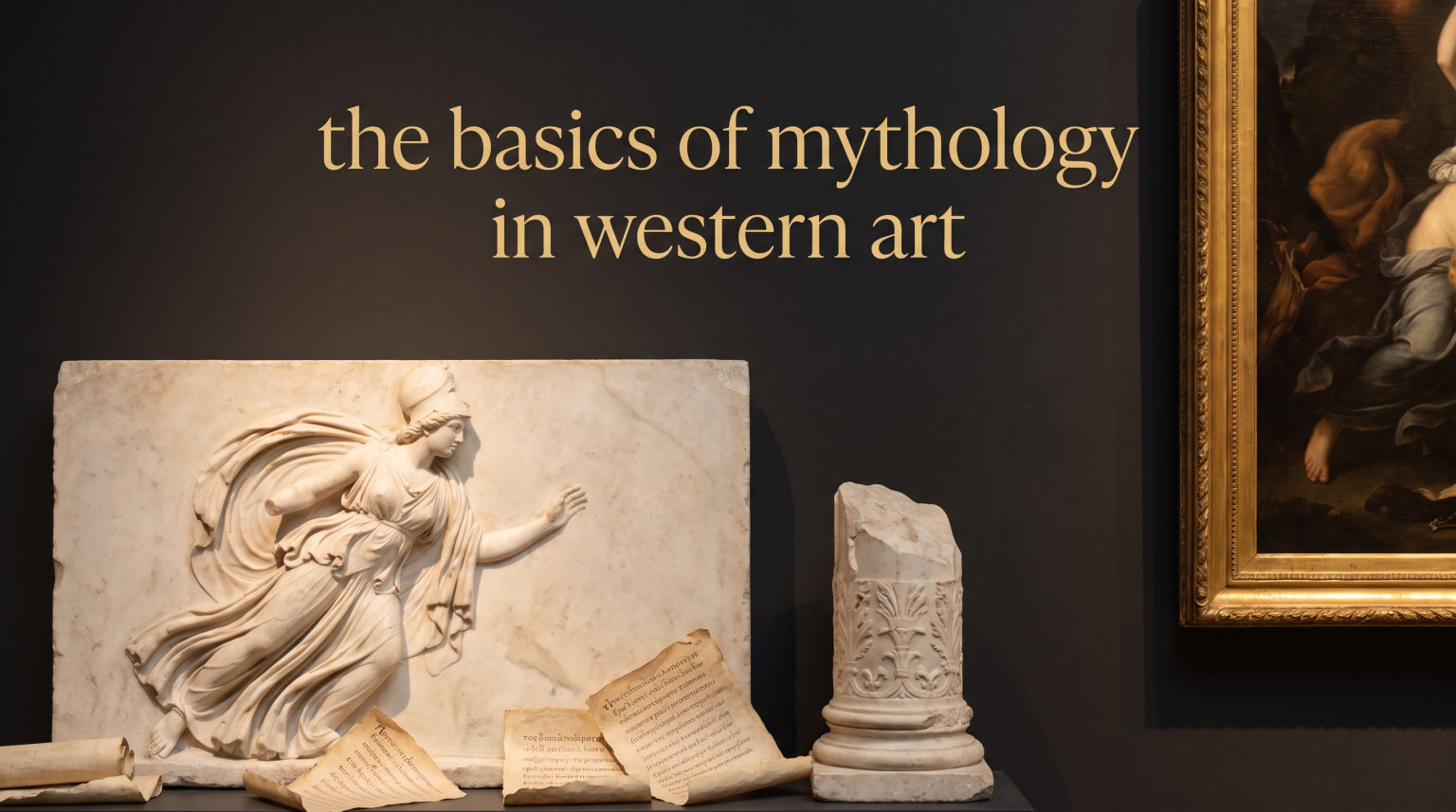
Walk into almost any major art museum in the world and you will see paintings and sculptures filled with gods, heroes, and creatures from ancient stories. Understanding the basics of mythology in western art unlocks an entire layer of meaning that most viewers walk right past. Once you know the symbols and stories, a quiet gallery suddenly becomes loud with drama, betrayal, love, and war.
Greek and Roman mythology provided Western artists with a shared visual language that lasted for over 2,500 years. From painted pottery in ancient Athens to massive canvases in the Louvre, these stories gave artists a way to explore human emotion, political power, and moral questions without painting real people. The myths served as a kind of code that educated viewers could read instantly.
In this guide, I will walk you through the foundational myths that show up most often in Western art, teach you how to identify the major gods and heroes by their symbols, and explain why these ancient stories remained relevant all the way into 2026. Whether you are an art history student preparing for exams, a museum visitor who wants to get more from each visit, or simply curious about the stories behind famous paintings, this guide covers the essentials. And if you want to see how contemporary artists continue to draw from mythological traditions, you will find that these ancient narratives are far from dead.
Table of Contents
Greek and Roman Mythological Foundations
Western mythology in art starts with two civilizations: ancient Greece and ancient Rome. The Greeks built the original stories, and the Romans adopted, renamed, and spread them across Europe. Understanding this relationship is the first step to recognizing mythology in western art.
Greek mythology was originally an oral tradition, passed down by poets and storytellers over generations. Two poets anchored these stories into written form. Homer composed the Iliad and the Odyssey around the 8th century BCE, telling the story of the Trojan War and its aftermath. Hesiod wrote the Theogony shortly after, which laid out the family tree of the Greek gods from Chaos down to Zeus. These two works became the reference texts that artists relied on for centuries.
When Rome conquered Greece in the 2nd century BCE, the Romans absorbed Greek culture wholesale, including its religion. They renamed the Greek gods: Zeus became Jupiter, Athena became Minerva, Aphrodite became Venus. The stories stayed largely the same, but Roman artists added their own visual style. Where Greek art emphasized idealized beauty and calm dignity, Roman art tended toward realism and narrative drama.
This blending created what scholars call classical mythology, a shared body of stories that combined Greek originals with Roman additions. When Renaissance artists in the 15th century rediscovered these stories through Roman copies of Greek texts, they painted them with a fervor that lasted hundreds of years. The fact that we use Roman names for most planets (Mars, Venus, Jupiter) tells you how deeply Rome’s version of Greek mythology permeated Western culture.
One question that confuses many people is why mythological art flourished even in Christian Europe. The answer is that the Church tolerated mythology as allegory. A painting of Venus could be read not as pagan worship but as a meditation on beauty or love. A sculpture of Hercules could represent moral virtue triumphing over adversity. This allegorical reading gave artists permission to paint nude figures and dramatic scenes that pure biblical subjects sometimes restricted. Mythological narratives became the acceptable way to explore the human body, emotion, and desire in art.
Major Olympian Gods and Their Stories in Art
The twelve Olympian gods form the core cast of characters you will encounter in Western art. Each god has specific attributes, symbols, and stories that make them identifiable even without a label. Learning these visual cues transforms how you experience classical and Renaissance art. Let me walk you through the most important ones.
Zeus (Jupiter) – King of the Gods
Zeus rules the Olympian pantheon, and artists signal his authority through several consistent symbols. He carries a thunderbolt, the weapon he used to defeat the Titans. An eagle often perches at his side, representing his dominion over the sky. In many paintings, Zeus sits on a throne or holds a scepter, reinforcing his role as ruler of gods and mortals.
In art, Zeus appears most often in scenes of transformation and seduction. He famously appeared to Leda as a swan, to Europa as a white bull, and to Danae as a shower of golden rain. These stories gave artists license to paint sensual scenes under the cover of mythology. The abduction of Ganymede, where Zeus appears as an eagle carrying off a beautiful youth, appears in countless sculptures and paintings from ancient Greece through the Baroque period.
Athena (Minerva) – Goddess of Wisdom and Warfare
Athena stands out in art because she is almost always shown in armor. She wears a helmet, carries a shield (called the aegis), and often holds a spear. Her breastplate frequently features the head of the Gorgon Medusa, a gift from Perseus. Her constant companion is an owl, the symbol of wisdom, and the olive tree is sacred to her.
According to myth, Athena sprang fully grown and armored from Zeus’s forehead, which artists depicted as a dramatic birth scene. She represents strategic warfare and intellect, in contrast to Ares, who represents brute violence. In Renaissance and Baroque art, Athena often appears as an allegory for wisdom or as a patron of the arts and crafts. When you see a female figure in armor with an owl, you are almost certainly looking at Athena.
Aphrodite (Venus) – Goddess of Love and Beauty
Aphrodite, known as Venus to the Romans, is the single most depicted mythological figure in Western art. Her symbols include doves, roses, myrtle wreaths, and the apple (associated with the Judgment of Paris). She is often shown nude or partially draped, emerging from water or surrounded by attendants.
The most famous depiction of Venus in art is Botticelli’s Birth of Venus, painted around 1485. It shows the goddess standing on a giant shell, blown ashore by wind gods while a figure offers her a flowered cloak. This painting alone has influenced how Venus appears in Western art for over 500 years. Other iconic Venus paintings include Titian’s Venus of Urbino, Giorgione’s Sleeping Venus, and Cabanel’s Birth of Venus. Whenever you see a beautiful woman in a painting surrounded by doves, roses, or water, Venus is the likely subject.
Apollo – God of the Arts, Light, and Prophecy
Apollo is one of the easiest gods to identify in art because he is consistently portrayed as a handsome, athletic young man, usually nude or lightly draped. He carries a lyre (the musical instrument he played), wears a laurel wreath on his head, and is often accompanied by a bow and arrows. The laurel wreath refers to the story of Daphne, a nymph who turned into a laurel tree to escape his pursuit.
Apollo is the twin brother of Artemis (Diana), goddess of the hunt. In art, you will sometimes see them together, both carrying bows, though Apollo’s domain is the sun and Artemis’s is the moon. Apollo also appears as the leader of the Muses, the nine goddesses who inspire artists, musicians, and poets. Paintings of Apollo and the Muses were especially popular during the Renaissance and Baroque periods as celebrations of artistic achievement.
Other Key Deities You Will See in Art
Beyond the major four, several other Olympian gods appear frequently in Western art. Poseidon (Neptune) carries a trident and is associated with horses, dolphins, and the sea. Ares (Mars) appears as a warrior in full armor, often shown in scenes of battle or, ironically, in romantic encounters with Venus. Artemis (Diana) carries a bow and is accompanied by hunting dogs and deer; she wears a short tunic, unlike most goddesses shown in flowing robes.
Hermes (Mercury) is recognizable by his winged sandals, winged hat, and the caduceus, a staff with two intertwined snakes. He often appears as a messenger in mythological scenes, flitting between gods and mortals. Dionysus (Bacchus) is the god of wine and ecstasy, shown with grape vines, a thyrsus (a staff topped with a pinecone), and often accompanied by satyrs and maenads. Caravaggio’s Bacchus is one of the most famous depictions, showing a young man with grape leaves in his hair offering wine to the viewer.
Hephaestus (Vulcan), the blacksmith god, appears less frequently but is identifiable by his forge, hammer, and lameness. Hera (Juno), queen of the gods, is shown with a peacock and a crown. Demeter (Ceres), goddess of agriculture, carries wheat and a cornucopia. Hades (Pluto), though not technically an Olympian since he rules the underworld, appears in abduction scenes, especially the famous story of him carrying off Persephone.
Mythological Heroes Who Shaped Western Art
While the gods dominate many canvases, the heroes of Greek and Roman mythology inspired some of the most dramatic and emotionally powerful artworks in the Western tradition. These mortal or semi-divine figures faced impossible challenges, and painters and sculptors used their stories to explore themes of courage, hubris, love, and fate.
Achilles – The Tragic Warrior
Achilles is the central character of Homer’s Iliad and one of the most painted heroes in Western art. He was the greatest Greek warrior at Troy, virtually invincible except for his heel, the one spot not dipped in the River Styx when his mother Thetis tried to make him immortal. This story gave us the phrase “Achilles’ heel,” which people still use today.
Artists most often depict three scenes from Achilles’s life. The first shows the young Achilles being dipped into the Styx by his mother, his heel exposed. The second shows Achilles among the daughters of Lycomedes, where his mother hid him disguised as a girl to prevent him from going to Troy. In paintings, Achilles is the figure reaching for a weapon while the other “girls” shrink back. The third and most dramatic scene shows Achilles dragging the body of Hector behind his chariot after killing the Trojan prince in rage over the death of his companion Patroclus.
Peter Paul Rubens painted several versions of Achilles scenes, and Franz von Stuck created a haunting depiction of the wounded hero. When you see a muscular male figure in armor with a focus on his heel or a dramatic battlefield scene from Troy, you are likely looking at the story of Achilles.
Perseus and Medusa
Perseus is one of the great monster-slayers of Greek mythology, and his encounter with Medusa inspired some of the most iconic artworks in history. Medusa was a Gorgon whose hair was made of living snakes and whose gaze turned anyone who looked at her to stone. Perseus defeated her by using a reflective shield given to him by Athena, avoiding direct eye contact while he severed her head.
Benvenuto Cellini’s bronze sculpture of Perseus holding Medusa’s severed head, created in 1554, stands in the Loggia dei Lanzi in Florence and is one of the most photographed sculptures in the world. Caravaggio’s painted head of Medusa on a shield is equally famous, showing the moment of death with mouth open in a scream. Artemisia Gentileschi, one of the few prominent female painters of the Baroque era, painted two powerful versions of Judith Slaying Holofernes that draw on the same themes of decapitation and female agency found in the Perseus and Medusa story.
Perseus also appears in art rescuing Andromeda from a sea monster, a scene that gave artists the chance to paint both a heroic male figure and a beautiful nude woman chained to a rock. Titian, Rubens, and Frederick Leighton all painted this dramatic rescue scene.
Odysseus (Ulysses) – The Wanderer
Odysseus represents the clever, resourceful hero who triumphs through intelligence rather than brute strength. His ten-year journey home from the Trojan War, recounted in Homer’s Odyssey, provided artists with some of their most vivid subject matter. Paintings of Odysseus often focus on the encounters he had along the way.
The most frequently depicted scenes include Odysseus tied to his ship’s mast to resist the deadly song of the Sirens, Odysseus blinding the Cyclops Polyphemus, and Odysseus and his men passing between Scylla and Charybdis. Painters also loved the scene where Odysseus returns home in disguise and is recognized by his faithful dog Argos, or when he strings his old bow to defeat the suitors who had taken over his palace.
John William Waterhouse painted several Odysseus scenes in the late 19th century, including his famous painting of Odysseus and the Sirens. Roman mosaic floors frequently depicted episodes from the Odyssey as well. The character of the wandering hero trying to get home became such a powerful archetype that James Joyce based his novel Ulysses on the same journey, proving how deeply these mythological heroes permeate Western culture.
How to Identify Mythological Subjects in Western Art
One of the biggest frustrations people share in art history forums is walking through a museum and having no idea what story a painting tells. I felt the same way for years until I learned a systematic approach. Here is a practical guide to identifying mythological figures in art, drawn from the symbols and attributes that artists used as visual shorthand.
Start with the attributes. Every major god carries specific objects or is accompanied by specific animals. Zeus has the thunderbolt and eagle. Poseidon has the trident. Athena has the owl, helmet, and shield. Aphrodite has doves and roses. Apollo has the lyre and laurel wreath. Hermes has winged sandals and the caduceus. If you learn just these six sets of attributes, you can identify the most common mythological figures in a large percentage of European paintings.
Next, look at the context. A female figure standing in or near water, especially one emerging from foam or shells, is almost certainly Venus. A muscular male figure fighting a monster is likely Hercules, Perseus, or Achilles. A figure on a throne with an eagle is Zeus. A woman with a bow and hunting dogs in a forest is Artemis. Context clues narrow down the possibilities significantly.
Pay attention to clothing and pose. Gods dressed in armor are typically war-related deities (Athena, Ares). Gods shown nude or partially draped in flowing fabric are often associated with beauty, love, or the arts (Venus, Apollo). A figure holding a musical instrument is almost always Apollo or one of the Muses. An older, bearded man with a trident is Poseidon, while an older, bearded man with a thunderbolt is Zeus.
The colors artists used also carry meaning. Venus is often surrounded by blues and greens to evoke the sea. Bacchus appears amid deep purples and reds associated with wine. Apollo is associated with gold and sunlight. These color associations are not as rigid as physical attributes, but they provide additional confirmation.
For practical purposes, I recommend carrying a small reference card or saving an image of Greek and Roman deity attributes on your phone before your next museum visit. Many museums, including the National Gallery of Art and the Metropolitan Museum of Art, also publish free guides to classical mythology in their collections. If you want to visit world-class mythological art collections in person, New York City has several outstanding options with extensive holdings of classical and Renaissance works.
The Evolution of Mythology in Western Art: A Timeline
Mythology did not appear in Western art all at once. The way artists depicted these stories changed dramatically across different periods, influenced by shifting cultural values, new artistic techniques, and changing relationships between religion, politics, and art. Understanding this timeline helps you recognize when and why a particular artwork was created.
Ancient Greece (800-31 BCE): Greek artists told mythological stories primarily through painted pottery and sculpture. Black-figure and red-figure vase painting depicted scenes from the Iliad, the Odyssey, and the labors of Hercules in standardized poses that made the stories immediately recognizable to viewers. Greek sculptors created idealized statues of gods and athletes, establishing the visual conventions that would influence all subsequent Western art. The Greeks believed that depicting the gods beautifully was itself an act of devotion.
Ancient Rome (509 BCE-476 CE): Roman artists adopted Greek mythology wholesale but adapted it to serve imperial propaganda. Emperors were depicted with attributes of gods to suggest divine authority. Roman mosaic floors, wall paintings from Pompeii, and portrait sculpture all drew heavily on Greek mythological subjects. The Romans also excelled at narrative relief sculpture, using mythological scenes on public monuments like the Ara Pacis to communicate political messages through familiar stories.
Medieval Period (500-1400 CE): Mythological subjects became rare in official art during the medieval period as Christianity dominated European visual culture. However, classical imagery survived in two important ways. First, mythological figures appeared as allegorical decorations in manuscripts and architectural carvings, stripped of their pagan meaning and used as ornamental motifs. Second, the classical tradition survived in the Byzantine Empire and in Islamic Spain, where Greek and Roman texts were preserved and studied.
Renaissance (1400-1600 CE): The Renaissance saw the most dramatic revival of mythology in western art. Italian humanists rediscovered classical texts, and artists like Botticelli, Michelangelo, and Titian filled their canvases with gods, goddesses, and heroes. Botticelli painted both Primavera and The Birth of Venus around the 1480s, creating two of the most recognized mythological paintings in existence. Michelangelo included classical sibyls alongside biblical prophets on the Sistine Chapel ceiling. The Medici family in Florence actively sponsored mythological art as a way of displaying their classical education and cultural sophistication.
Baroque Period (1600-1750 CE): Baroque artists pushed mythological scenes to new levels of drama and emotion. Rubens painted massive canvases filled with muscular gods and heroes in dynamic poses. Caravaggio brought brutal realism to mythological subjects, painting Bacchus as a real young man with dirty fingernails. Artemisia Gentileschi used mythological themes to explore violence and female power with unprecedented intensity. The Baroque approach treated mythology as living theater rather than static allegory.
Neoclassicism (1750-1850 CE): The excavation of Pompeii in the mid-18th century triggered a renewed fascination with classical antiquity. Jacques-Louis David, Angelica Kauffman, and Antonio Canova returned to the clean lines and moral seriousness of Greek and Roman art. Mythological subjects were used to comment on contemporary politics, with heroes like Hector and Achilles representing civic virtue and self-sacrifice. Canova’s marble sculptures of Venus and Perseus revived the Greek ideal of serene, perfect beauty in three dimensions.
Why Mythology Still Matters in Contemporary Art
Ancient myths did not stop inspiring artists when the Neoclassical period ended. In fact, mythology has proven remarkably adaptable, serving as raw material for modern and contemporary artists who reinterpret these stories for new audiences and new concerns. If you want to see how today’s artists interpret mythological subjects, you will find that the tradition is very much alive.
The Surrealists were particularly drawn to mythology. Salvador Dali and Max Ernst used mythological imagery to explore the subconscious mind, treating Greek gods and heroes as archetypes from the collective unconscious. Dali’s Metamorphosis of Narcissus directly references the Greek myth of Narcissus falling in love with his own reflection, connecting ancient storytelling to Freudian psychology. The Surrealists recognized that myths operate through the same symbolic logic as dreams.
Feminist artists since the 1970s have reclaimed mythological women as subjects rather than objects. Judy Chicago’s The Dinner Party places mythical and historical women at the center of the narrative. Kiki Smith sculpted Lilith, the mythological first wife of Adam, as a powerful figure climbing upside down on a gallery wall. These artists use mythology to question the patriarchal assumptions embedded in both the ancient stories and the Western art tradition that canonized them.
Contemporary artists like Wangechi Mutu, Kiki Smith, and Matthew Barney create work that remixes mythological narratives with contemporary issues including identity, power, and transformation. The persistence of these stories speaks to something fundamental about how humans understand the world. Myths offer a framework for talking about love, death, power, jealousy, courage, and beauty that resonates across centuries because the underlying human experiences remain the same.
The practical takeaway is simple. When you encounter mythology in art from any period, you are looking at artists using the oldest stories in Western culture to make sense of their own time. That ongoing conversation between ancient myth and contemporary meaning is what makes mythology in western art a subject worth studying, whether the painting was made in 500 BCE or 2026.
FAQs
Why is mythology important to art?
Mythology gave artists a shared symbolic vocabulary to explore complex human emotions, moral dilemmas, and philosophical ideas through established stories and characters. Myths allowed painters and sculptors to depict themes like love, war, jealousy, and heroism through narratives that educated viewers recognized instantly, creating layers of meaning that purely original subjects could not achieve.
What are the 5 key elements of mythology?
The five key elements of mythology are: (1) Characters, including gods, heroes, and monsters with defined personalities and attributes; (2) Setting, usually the ancient Greek or Roman world with connections to real geography; (3) Conflict, often between mortals and gods or between opposing forces like love and duty; (4) Plot, a sequence of events involving quests, battles, or transformations; and (5) Resolution, which typically carries a moral lesson or explains something about the natural world.
Is Greek mythology Western?
Yes, Greek mythology is considered the foundation of Western cultural tradition. It originated in ancient Greece and was adopted and adapted by the Romans, then preserved and revived throughout European history during the Renaissance, Baroque, and Neoclassical periods. Greek mythology is classified as Western because it shaped the literature, philosophy, and visual arts of Europe and later North America, distinguishing it from Eastern mythological traditions like Hindu, Chinese, or Japanese mythology.
What deity is associated with art?
Apollo is the primary Greek deity associated with art, serving as the god of music, poetry, and the visual arts. He is often depicted holding a lyre and wearing a laurel wreath. Athena is also connected to arts and crafts, particularly weaving and sculpture. The Muses, nine goddesses who inspired artists, musicians, and writers, were led by Apollo and are frequently depicted alongside him in paintings celebrating artistic creation.
Why is Greek mythology so prevalent in Western art?
Greek mythology pervades Western art because it provided artists with a universal symbolic language that was flexible enough to convey virtually any theme. The Renaissance revival of classical texts made these stories widely known among educated patrons and artists. Mythological subjects also gave painters and sculptors permission to explore the human body, sensuality, and dramatic emotion in ways that purely religious subjects sometimes restricted, since myths could be read as allegories rather than literal pagan worship.
What contemporary artists work with mythology?
Contemporary artists who draw on mythology include Wangechi Mutu, who remixes classical and African mythological imagery; Matthew Barney, whose Drawing Restraint series references mythological transformation; Kiki Smith, who sculpts mythological women as powerful figures; and Yinka Shonibare, who reimagines classical myths through a postcolonial lens. The Surrealists, including Salvador Dali and Max Ernst, also heavily incorporated mythological archetypes into their exploration of the subconscious mind.
Which two gods are twins?
Apollo and Artemis (called Diana by the Romans) are the twin children of Zeus and the Titan goddess Leto. Apollo is the god of the sun, music, and the arts, while Artemis is the goddess of the moon, the hunt, and wild animals. In art, both are often depicted carrying bows and arrows, though Apollo is shown as a handsome young man with a lyre and laurel wreath, while Artemis appears as a young woman in a short hunting tunic accompanied by deer or hunting dogs.
How did mythology influence Renaissance art?
Mythology profoundly shaped Renaissance art by providing classical subjects that demonstrated an artist’s education and skill. The rediscovery of ancient texts by Homer, Ovid, and Virgil gave painters and sculptors new stories to tell. Artists like Botticelli created iconic works such as The Birth of Venus and Primavera, while Michelangelo included classical sibyls on the Sistine Chapel ceiling. Wealthy patrons like the Medici family commissioned mythological works to display their humanist learning, and the genre of mythological painting became established as one of the highest forms of visual art.
Wrapping Up: What Mythology in Western Art Teaches Us
The basics of mythology in western art come down to this: a collection of stories, symbols, and characters that artists used for over two millennia to communicate ideas about power, love, beauty, violence, and the human condition. Learning to read these symbols transforms every museum visit into a richer experience. You stop seeing random paintings of nude figures and start recognizing Venus emerging from the sea, Athena counseling warriors, and Achilles facing his fate.
The most practical skill you can take away from this guide is the ability to identify the major gods and heroes by their attributes. Start with Zeus and his thunderbolt, Venus and her doves, Apollo and his lyre, and Athena with her owl and armor. Those four alone appear in thousands of paintings and sculptures across every major museum in the world. From there, expand to the heroes and their stories: Perseus with Medusa’s head, Achilles and his vulnerable heel, Odysseus resisting the Sirens.
I encourage you to put this knowledge to work. Visit a museum near you and test yourself on the mythological subjects you can now identify. Pick up a copy of Ovid’s Metamorphoses, which was the single most important source for Renaissance artists working with mythology. And explore the timeline of how these stories evolved from Greek pottery through Renaissance masterpieces to contemporary art. The conversation between ancient myth and human creativity is still going strong in 2026, and now you have the tools to participate in it.