
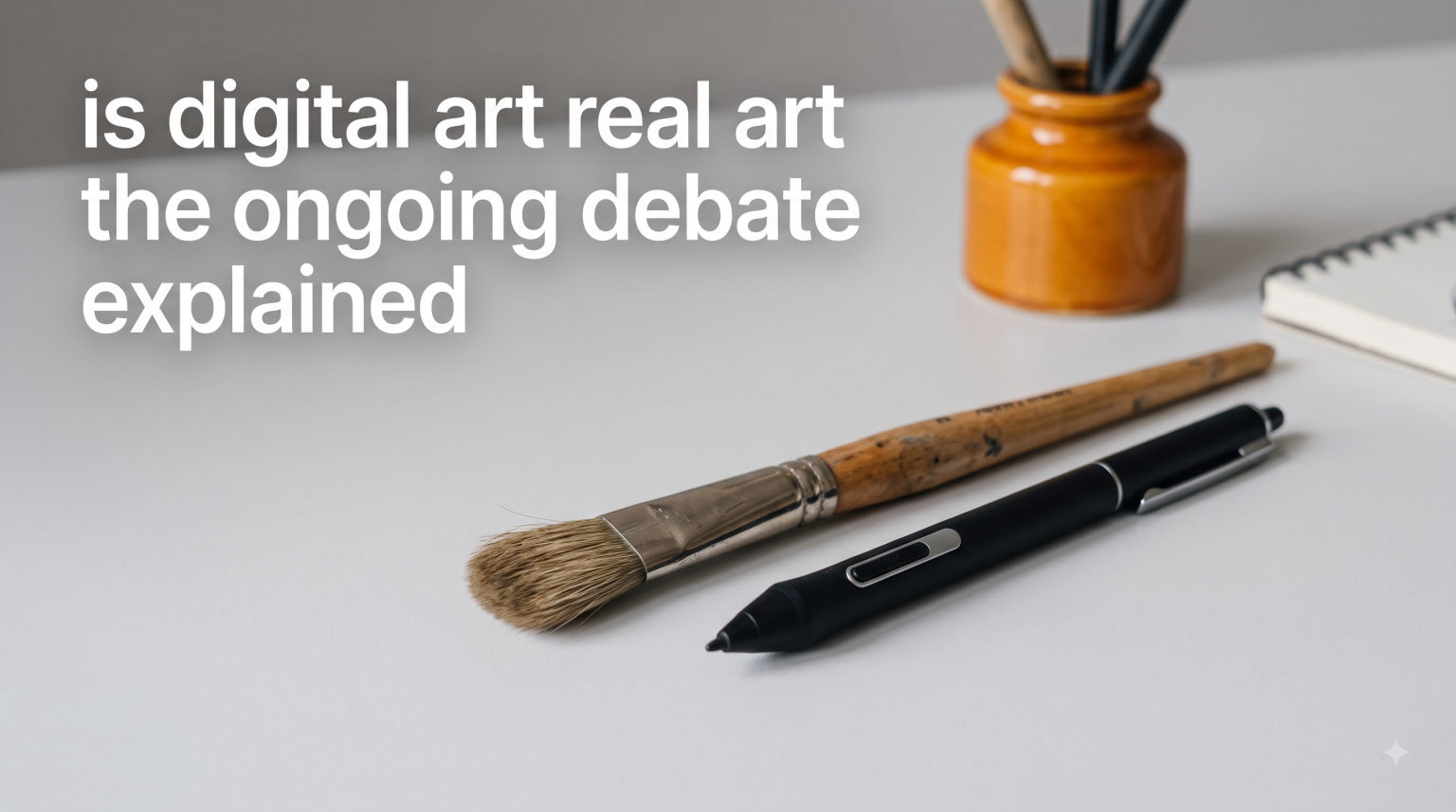
Yes, digital art is real art. That answer might feel obvious if you have spent hours painting on a tablet, but the question still sparks heated arguments at dinner tables, in art classrooms, and across internet forums every single day. The debate over whether digital art is real art has been ongoing for decades, and it touches on something fundamental: what we believe art is supposed to be. In 2026, with museums exhibiting digital installations, auction houses selling NFT artwork for millions, and professional artists building entire careers on iPads, the evidence is overwhelming. Yet skeptics remain. In this guide, I am going to walk through every side of the debate, share the historical context that makes this conversation feel strangely familiar, and give you the tools to understand and explain why digital art is real art.
Table of Contents
What Counts as Art? A Working Definition
Before we can argue whether digital art qualifies, we need a baseline definition of art itself. The Oxford English Dictionary defines art as “the expression or application of human creative skill and imagination, typically in a visual form such as a painting or sculpture, producing works to be appreciated primarily for their beauty or emotional power.”
Notice what that definition does not say. It does not mention canvas. It does not mention paint. It does not require a physical object you can hold in your hands. The core ingredients are human creative skill, imagination, visual expression, and emotional impact. Nothing about that formula changes when the tool is a Wacom tablet instead of a sable brush.
Art has always been defined by the intention and skill of the person creating it, not by the materials they happen to use. A child scribbling with crayons on printer paper and a trained painter working on linen canvas are both engaged in the same fundamental act: translating an idea from their mind into a visual form that others can experience. Digital art fits this definition cleanly, because the creative skill, imagination, and emotional power are all present.
Is Digital Art Real Art? The Debate Explained
The question “is digital art real art” comes up so often because it touches on deeply held beliefs about authenticity, effort, and what makes something valuable. People on both sides feel strongly, and understanding each perspective is the first step toward a productive conversation.
Those who argue against digital art usually point to a few key concerns. They say there is no “original” piece, since a digital file can be copied infinitely. They argue that software tools like undo, layers, and color pickers make the process too easy. Some feel that the lack of a physical artifact, something you can touch and hang on a wall, disqualifies it from being real art. Others worry that presets, filters, and AI-assisted features reduce the artist’s role to pressing buttons.
On the other side, digital artists and supporters point out that the creative decisions, the years of practice, the understanding of color theory, composition, anatomy, and lighting are all identical to what a traditional artist uses. The tool changes, but the thinking does not. A digital painter still has to decide where to place every stroke, how to build form, and how to guide the viewer’s eye through the composition.
The debate often becomes emotional because it is tied to identity. Traditional artists who spent decades mastering physical media can feel that their hard-won skills are being devalued. Digital artists who have faced dismissal from galleries, art shows, and even family members feel invalidated and frustrated. Both feelings are valid, but neither changes the fundamental truth: art is about human expression, and digital tools are simply another way to express it.
History Repeats: Every New Art Form Was Once Rejected
If the arguments against digital art feel familiar, that is because we have heard them before. Almost every major shift in art history was met with the same resistance, the same claims that the new form was not “real” art.
When photography was invented in the 1830s, painters dismissed it as a mechanical process with no artistic merit. The French poet Charles Baudelaire called photography “the refuge of every would-be painter, every painter too ill-endowed or too lazy to complete his studies.” Art academies refused to exhibit photographs. Critics argued that pointing a camera and pressing a button required no skill. Sound familiar? Today, photography is universally recognized as a legitimate art form, and photographers like Ansel Adams and Cindy Sherman are celebrated as important artists.
The Impressionists faced similar rejection. When Monet, Renoir, and their peers first exhibited their work in 1874, critics mocked them ruthlessly. The very name “Impressionism” started as an insult from a critic who thought their paintings looked unfinished. The official Paris Salon refused to show their work. Yet within a few decades, Impressionism became one of the most beloved movements in art history.
Abstract art, ready-mades (Marcel Duchamp’s infamous urinal), performance art, and even video installations all went through the same cycle. Initial rejection, heated debate, gradual acceptance, and eventually recognition as legitimate creative expression. Digital art is simply the latest chapter in this very old story.
The Skill Behind Digital Art: What Skeptics Overlook
One of the most persistent arguments in the debate is that digital art is easier than traditional art, or even that it amounts to cheating. This argument usually comes from people who have not spent much time working with digital tools themselves.
A professional digital artist working in Procreate, Photoshop, or Clip Studio Paint needs to understand the same foundational skills as any traditional painter. Color theory, value relationships, anatomy, perspective, composition, lighting, and texture are all essential. Software does not paint for you. It provides a canvas and brushes, just like an art supply store provides canvas and paint. The artist still has to make every creative decision.
Yes, digital tools offer conveniences that traditional media do not. You can undo a mistake instantly. You can work in layers. You can sample colors from a reference photo in seconds. But these conveniences do not eliminate the need for skill. Knowing when and how to use those tools effectively is itself a learned ability that takes years to develop.
I think of it like word processing versus typewriting. A word processor gives you spell check, copy and paste, and unlimited revision. Nobody would argue that writing a great novel is “easier” on a computer, because the hard part is not the typing, it is the thinking. The same principle applies to art. The hard part is not holding a brush or a stylus. It is seeing, interpreting, and creating something meaningful from your imagination.
Pressure sensitivity on modern tablets means that a digital brush responds to how hard you press, how fast you move, and the angle of your stroke, just like a real brush. Artists spend hundreds of hours customizing their brush settings to mimic the behavior of oil paint, watercolor, charcoal, and ink. The physicality of the gesture is real. The skill is real.
Museums, Galleries, and the Art Market Have Spoken
Institutional acceptance is one of the strongest signals that digital art has arrived as a legitimate form. And in 2026, the evidence is impossible to ignore.
In March 2021, Christie’s auction house sold Beeple’s digital collage “Everydays: The First 5000 Days” for $69.3 million. This was not a painting or a sculpture. It was a purely digital artwork, an NFT, and one of the most expensive works by a living artist ever sold at auction. The sale made headlines worldwide and forced the traditional art world to take digital art seriously.
Major museums have followed suit. The Museum of Modern Art in New York acquired digital works and installed immersive digital art experiences. Refik Anadol’s “Unsupervised,” a mesmerizing AI-influenced digital installation, drew massive crowds at MoMA. The Tate Modern, the Los Angeles County Museum of Art, and the San Francisco Museum of Modern Art have all exhibited digital art prominently.
Dedicated digital art institutions have emerged as well. Artechouse in Washington, D.C. and New York showcases immersive digital art exhibitions. teamLab, the Japanese digital art collective, has permanent installations in cities around the world that attract millions of visitors annually.
The market validation goes beyond NFT hype. Professional concept artists working on films, video games, and television productions use digital tools exclusively. Art directors at studios like Pixar, Naughty Dog, and Industrial Light & Magic rely on digital painting and 3D modeling to create the visual worlds that audiences love. If the art that appears in billion-dollar entertainment franchises is created digitally, dismissing it as “not real art” becomes a difficult position to maintain.
Human Digital Art vs AI-Generated Art: An Important Distinction
One reason the debate has heated up recently is the explosion of AI-generated art. Tools like Midjourney, DALL-E, and Stable Diffusion can produce impressive images from text prompts in seconds. This development has created real confusion about what digital art is and who deserves credit for creating it.
Here is the distinction that matters: when a human artist uses digital tools to create a work, they are making every creative decision. They choose the composition, they control the color palette, they decide where to place every element, and they refine the piece through their own judgment and skill. The software is a tool, like a camera or a paintbrush, not the creator.
When an AI generates an image from a prompt, the creative process is fundamentally different. The human provides a text description, and the algorithm produces the image based on patterns it learned from millions of existing artworks. The human does not control the specific strokes, composition, or details. This is a different category of creation entirely, and it raises genuinely new questions about authorship and creativity.
The concern about AI art devaluing human digital artists is real and worth discussing. Many digital artists worry that their work will be confused with AI-generated content, or that clients will choose cheap AI images over commissioning human artists. These are legitimate fears, and the art world is still figuring out how to address them.
But the existence of AI-generated art does not change the answer to our original question. Human-created digital art is real art. AI-generated images are a separate conversation about technology, authorship, and the definition of creativity. Conflating the two only muddies the waters and does a disservice to both discussions.
Why the Medium Does Not Diminish the Emotional Impact
At its heart, art is about connection. A piece of art succeeds when it makes you feel something, when it communicates an idea or emotion from the artist’s mind to yours. The medium is just the vehicle for that connection.
I have stood in front of digital art installations that moved me to tears. I have seen digital paintings that captured a quality of light so perfectly that I forgot I was looking at a screen. I have watched animated short films created entirely on computers that told stories more powerful than most live-action features. The emotional impact was real. My response was real. The art was real.
Skeptics sometimes argue that physical art has a “soul” that digital art lacks, that the texture of paint on canvas, the visible brushstrokes, the slight imperfections all contribute something essential. And there is something beautiful about that physicality. I am not arguing that traditional art is inferior or that digital art should replace it. Both can coexist, and both have unique qualities worth celebrating.
But the idea that emotion requires physicality does not hold up under scrutiny. A photograph printed on paper can move you deeply, even though the image was captured electronically. A song streamed through headphones can break your heart, even though no one is playing instruments in the room with you. The emotional power of art lives in the creative choices, not the physical substrate.
FAQs
Is digital art considered real art by museums and galleries?
Yes. Major institutions including MoMA, the Tate Modern, and Christie’s auction house have exhibited, acquired, and sold digital artwork. Beeple’s $69.3 million NFT sale at Christie’s in 2021 is one of the most expensive works by a living artist ever auctioned. Museums around the world now regularly feature digital installations and screen-based art.
Is digital art cheating compared to traditional art?
No. Digital art uses different tools, but the core skills are the same: composition, color theory, anatomy, perspective, and lighting. Features like undo and layers are conveniences, not shortcuts that replace artistic skill. A bad artist with Photoshop will still produce bad art. The tool does not create the art, the artist does.
Is digital art easier than traditional art?
Digital art has different challenges and conveniences compared to traditional art. Undo and layers make corrections easier, but digital artists still need the same foundational knowledge of color, form, and composition. Each medium has its own learning curve, and neither is inherently easier than the other.
Can digital art be owned like physical art?
Yes, through NFTs (non-fungible tokens) and blockchain technology, digital art can be verified as unique and owned by a specific collector. The NFT market has created a new framework for digital art ownership, provenance, and resale that parallels the traditional art market.
Why do some people say digital art is not real art?
Common reasons include the lack of a physical original, the perception that software makes the process too easy, confusion between human-created digital art and AI-generated images, and a belief that art must involve traditional materials like paint and canvas. Most of these arguments mirror historical rejections of photography and abstract art.
Do galleries and art shows accept digital art submissions?
Increasingly, yes. Many galleries and juried art shows now accept digital art, though acceptance varies by venue. Some traditional exhibitions still restrict entries to physical media, but the trend is moving toward broader inclusion as the art world recognizes digital art’s legitimacy.
The Bottom Line on the Digital Art Debate
The question of whether digital art is real art has been answered, repeatedly, by history, by institutions, by the market, and most importantly by the artists themselves. Every major art form that we now take for granted was once dismissed as illegitimate. Photography, Impressionism, abstract art, and performance art all went through the same cycle of rejection and eventual acceptance that digital art is experiencing right now.
The skills required are genuine. The creative process is real. The emotional impact on viewers is authentic. And the world’s most respected museums, galleries, and auction houses have validated digital art as a legitimate form of creative expression. None of this means traditional art is less important or that digital art is superior. It means art is bigger than any single medium.
For the digital artists reading this who have been told their work is not “real,” I want you to know that the debate is already settling. The evidence is on your side. For the traditional artists who feel uncertain about digital work, I encourage you to try it. Pick up a tablet, open a drawing app, and see for yourself what the experience is actually like. Understanding both sides of this conversation makes everyone stronger.
The ongoing debate over is digital art real art matters because it shapes how we value creative work and the people who make it. But the answer is clear: digital art is real art, and it is here to stay.