
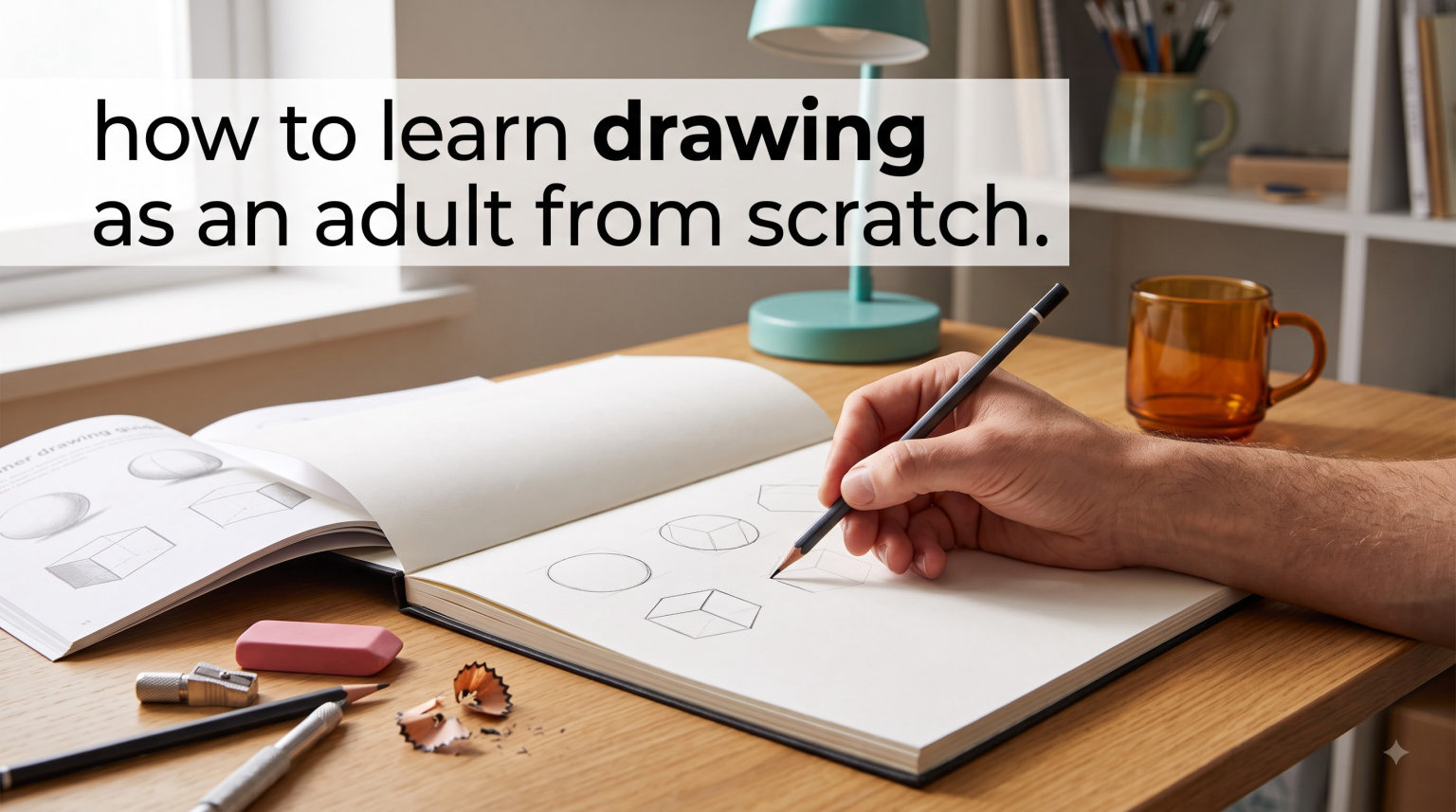
Learning to draw as an adult from scratch is absolutely possible. Your brain retains the ability to build new neural pathways throughout your entire life. Thousands of adults start their drawing journey every year at age 30, 40, 50, and beyond.
This guide gives you a clear, structured path to follow. You will learn exactly where to start, what supplies you need, how to practice effectively, and how to overcome the mental blocks that stop most beginners.
By the end of this article, you will have a complete roadmap for learning drawing as an adult from scratch. You will know exactly what exercises to do, how often to practice, and which free resources to use.
Table of Contents
How to Learn Drawing as an Adult from Scratch: A Complete Beginner’s Guide
Learning to draw as an adult from scratch requires three things: consistent practice, the right fundamentals, and patience with yourself. The process is not about talent. It is about training your hand-eye coordination and building muscle memory through repetition.
Most adults who fail at learning to draw quit because they feel overwhelmed. They try to draw complex subjects before mastering basic shapes. They compare themselves to artists who have practiced for years. This guide prevents that by giving you a step-by-step progression that starts simple.
Debunking the Myths That Stop Adults from Learning to Draw
Three myths prevent adults from even trying to learn drawing. Let us break them down right now.
Myth #1: You Are Too Old to Learn
Your brain maintains neuroplasticity throughout your entire life. Neuroplasticity is your brain’s ability to form new connections and reorganize itself. Adults actually have advantages over children when learning to draw.
You have better focus. You understand abstract concepts like perspective and proportion more easily. You can research and find the best techniques instead of relying on trial and error. Many professional artists started in their 30s and 40s.
Myth #2: You Need Natural Talent
Drawing is a skill, not a gift. Every artist you admire practiced for thousands of hours. Talent might give someone a head start, but it does not determine where you end up. What separates successful adult learners from those who quit is consistent practice, not innate ability.
Myth #3: You Need Expensive Supplies
You can learn to draw with a pencil and paper from any discount store. Expensive materials do not make you draw better. They might feel nicer, but they are not required to build skill.
Getting Started: Essential Supplies for Adult Beginners
You do not need much to start learning to draw. Keeping supplies simple removes another barrier to entry.
Here is what you actually need:
Pencils: A standard HB pencil works fine. Add a 2B for darker lines and a 4B for shading. Three pencils total.
Paper: Standard printer paper works for practice. Upgrade to quality sketchbooks and art supplies when you are ready.
Eraser: A kneaded eraser is best because it does not damage paper. A standard pink eraser works too.
Sharpener: Any basic sharpener keeps your pencil ready.
Workspace: A flat surface with good lighting. Your kitchen table works perfectly.
Total cost: under $15. Do not let supplies become a reason to delay.
The Fundamental Techniques Every Adult Beginner Must Learn
Drawing builds on five core skills. Master these in order, and everything else becomes possible.
Step 1: Line Control and Confidence
Before you draw objects, you must control your lines. Practice drawing straight lines without a ruler. Draw curves. Make your lines flow without sketching back and forth.
Exercise: Fill a page with straight horizontal lines. Then vertical lines. Then curved lines. Focus on smoothness, not speed. Do this for 10 minutes daily for one week.
Step 2: Basic Shapes as Building Blocks
Every complex object breaks down into basic shapes. Circles, squares, triangles, and cylinders form the foundation of every drawing.
Exercise: Draw 50 circles. Not perfect circles. Just round shapes. Then draw 50 cubes from different angles. Then draw 50 cylinders. This builds your ability to construct any object.
Step 3: Form and Three-Dimensional Thinking
Shapes are flat. Forms are three-dimensional. Learn to turn circles into spheres and squares into boxes. This skill separates flat drawings from dimensional ones.
Exercise: Draw a cube. Then draw the same cube rotated 45 degrees. Then draw it from above. Practice until you can visualize and draw a cube from any angle without reference.
Step 4: Understanding Proportion
Proportion means drawing things the right size relative to each other. If you draw a face, the eyes must sit halfway down the head. The ears align with the eyes and nose.
Exercise: Use your pencil as a measuring tool. Hold it at arm’s length and compare widths to heights. Transfer these ratios to your paper.
Step 5: Basic Shading and Value
Value refers to how light or dark something is. Shading gives your drawings depth and form. Start with simple light and shadow, not complex textures.
Exercise: Draw a circle. Shade one side darker to turn it into a sphere. Practice smooth transitions from light to dark.
Building a Practice Routine That Works for Busy Adults
Consistency beats intensity. Twenty minutes daily helps more than three hours once a week. Here is a routine designed for adults with limited time.
The 15-Minute Daily Practice
Minutes 1-5: Warm-up with lines and circles. Get your hand moving.
Minutes 6-10: Practice one fundamental skill. Rotate through line control, shapes, form, proportion, and shading.
Minutes 11-15: Draw something for fun. Apply what you practiced to a simple subject.
The 70/30 Rule in Drawing
The 70/30 rule means spending 70 percent of your time on deliberate practice and 30 percent on drawing what you enjoy. Too much practice without enjoyment leads to burnout. Too much fun drawing without practice leads to slow improvement.
The 80/20 Rule in Art
The 80/20 rule, also called the Pareto Principle, applies to art learning. Twenty percent of the skills give you 80 percent of the results. Focus on line control, basic shapes, and form construction first. These fundamentals matter more than advanced techniques early on.
Weekly Practice Schedule
Monday: Line control and basic shapes
Tuesday: Form construction and perspective
Wednesday: Proportion and measuring
Thursday: Shading and value
Friday: Combine all skills on a simple subject
Weekend: Draw for enjoyment and review your progress
The Best Free and Affordable Learning Resources
You do not need to spend money to learn drawing. Here are the resources adult learners recommend most often.
Drawabox: Structured and Free
Drawabox offers a complete drawing course for free. It focuses on construction and form, which are essential for beginners. The lessons are structured and build progressively. Many adult learners credit Drawabox with giving them the foundation they needed.
YouTube Channels for Adult Beginners
Brent Eviston teaches drawing fundamentals clearly and concisely. His videos focus on the concepts that matter most for beginners. Julia Bausenhardt offers practical sketching advice that works for busy adults.
Search for these specific video titles to start:
“Draw ANYTHING! Beginner Sketching in 7 Easy Steps” by Julia Bausenhardt
“A Head Start for Adult Drawing Beginners” by Stephen Travers Art
“Learn to Draw in Minutes: 5 Essential Principles That Actually Work” by Brent Eviston
Books Worth Your Time
“Drawing on the Right Side of the Brain” by Betty Edwards helps adults overcome mental blocks. “Keys to Drawing” by Bert Dodson gives practical exercises you can do immediately.
Communities for Accountability
Reddit communities like r/learntodraw and r/ArtistLounge connect you with other adult learners. Seeing others at your skill level helps you stay motivated. Getting feedback from peers accelerates your progress.
Common Mistakes Adult Beginners Make
Avoid these pitfalls to learn faster and enjoy the process more.
Starting too complex: Do not try to draw portraits in your first month. Start with simple objects like cups, boxes, and fruit.
Skipping fundamentals: The boring exercises matter. Line control and basic shapes feel unexciting, but they unlock everything else.
Practicing without focus: Mindless doodling does not build skill. Practice with intention and specific goals.
Expecting immediate results: Skill development takes months. Track your progress by comparing drawings week to week, not hour to hour.
Being afraid of mistakes: Every drawing teaches you something. Bad drawings are steps toward good drawings. Embrace imperfection as part of learning.
Frequently Asked Questions
Is it possible to learn to draw as an adult?
Yes, adults can absolutely learn to draw. Your brain maintains neuroplasticity throughout life, allowing you to build new skills at any age. Many successful artists started in their 30s, 40s, and 50s. Adults often progress faster than children because they understand concepts like proportion and perspective more easily.
What is the 70/30 rule in drawing?
The 70/30 rule means spending 70 percent of your drawing time on deliberate practice of fundamentals and 30 percent on drawing for enjoyment. This balance prevents burnout while ensuring you build skills. Too much practice without fun kills motivation. Too much fun without practice slows improvement.
What is the 80/20 rule in art?
The 80/20 rule, also known as the Pareto Principle, states that 20 percent of your effort produces 80 percent of your results. In art, this means focusing on core fundamentals like line control, basic shapes, and form construction gives you the majority of your improvement. Master these basics before moving to advanced techniques.
Is drawing good for dyslexia?
Drawing can benefit people with dyslexia by strengthening visual processing and spatial reasoning skills. It provides a non-verbal outlet for expression and can improve hand-eye coordination. Many dyslexic individuals find drawing helps them organize thoughts and communicate ideas in ways that feel more natural than writing.
How long does it take to learn drawing as an adult?
Most adults see noticeable improvement within 3 months of consistent practice. Basic competency develops in 6 to 12 months. Significant skill takes 2 to 3 years of regular practice. Progress depends on practice frequency, not age. Adults who practice 30 minutes daily often progress faster than younger people who practice sporadically.
Can I learn to draw if I have poor fine motor skills?
Yes, fine motor skills can be developed through practice. Drawing itself builds these skills over time. Start with larger movements and bigger paper. Use your shoulder more than your wrist. As you practice, your control will improve. Many beginners with initially poor motor skills develop excellent control within months.
Your First Week: A Simple Action Plan
Stop researching and start drawing. Here is exactly what to do in your first seven days.
Day 1: Gather supplies. Any pencil and paper works. Draw 100 straight lines.
Day 2: Practice circles. Fill a page with circles of different sizes.
Day 3: Draw 20 cubes from different angles. Do not worry about perfection.
Day 4: Draw a simple object from your kitchen. A cup or fruit works well.
Day 5: Practice shading. Turn a circle into a sphere with light and shadow.
Day 6: Draw the same object from Day 4 again. Compare your drawings.
Day 7: Rest or draw something for fun. Notice how much you improved in one week.
Conclusion: Start Your Drawing Journey Today
Learning to draw as an adult from scratch is absolutely achievable. You have everything you need to start. Your age is not a barrier. Your perceived lack of talent is not real.
Focus on the fundamentals: line control, basic shapes, form, proportion, and shading. Practice consistently for just 15 minutes daily. Use the free resources available. Connect with communities of other adult learners.
The hardest part of learning to draw as an adult from scratch is starting. Once you begin, each drawing brings you closer to the skill you want. Pick up a pencil today and draw your first line.