
I remember standing in the art supply store, staring at two nearly identical watercolor paper pads, completely confused by the labels. One said “cold press,” the other “hot press.” I had no idea what the difference was, so I bought the cheaper one and learned my lesson the hard way when my detailed botanical painting turned into a muddy mess.
Understanding the difference between hot pressed and cold pressed watercolor paper is one of the most important decisions you’ll make as a watercolor artist. The texture you choose affects everything from how your paint behaves to what techniques work best.
In this guide, I’ll explain exactly what makes these papers different, how they’re made, and which one you should choose for your specific projects.
Table of Contents
What Is Watercolor Paper?
Watercolor paper isn’t just thick paper. It’s specially designed to handle large amounts of water without buckling, warping, or falling apart. Regular printer paper or drawing paper would disintegrate under a wet wash.
The best watercolor papers are made from 100% cotton, though cellulose (wood pulp) papers exist for beginners and practice work. Quality paper is also acid-free, which means it won’t yellow or deteriorate over time. This archival quality is essential if you want your paintings to last for decades.
The surface texture, or “tooth,” of watercolor paper is created during the manufacturing process. This is where hot press and cold press come in.
How Watercolor Paper Is Made: The Manufacturing Process
To understand why hot press and cold press papers behave differently, you need to know how they’re made. Watercolor paper starts as a slurry of cotton or cellulose fibers mixed with water. This pulp is formed into sheets using one of three methods: handmade, moldmade, or machine-made.
Handmade paper involves pouring the pulp into a mold and pressing it by hand. Moldmade paper uses a rotating cylinder mold that creates a more uniform sheet. Machine-made paper is produced on a continuous wire belt for mass production.
The critical step that creates hot press vs cold press happens after the sheet is formed. The wet paper passes through rollers to compress it and create the surface texture. For cold press paper, the rollers are cold or at room temperature. For hot press paper, the rollers are heated.
These heated rollers smooth down the fiber texture significantly, creating that slick surface hot press is known for. Cold press rollers preserve more of the natural fiber texture, leaving the characteristic bumpy surface.
Cold Press Watercolor Paper: The Textured Classic
Cold press watercolor paper is the most popular choice among watercolor artists, and for good reason. When you think of traditional watercolor paintings, you’re probably imagining work done on cold press paper.
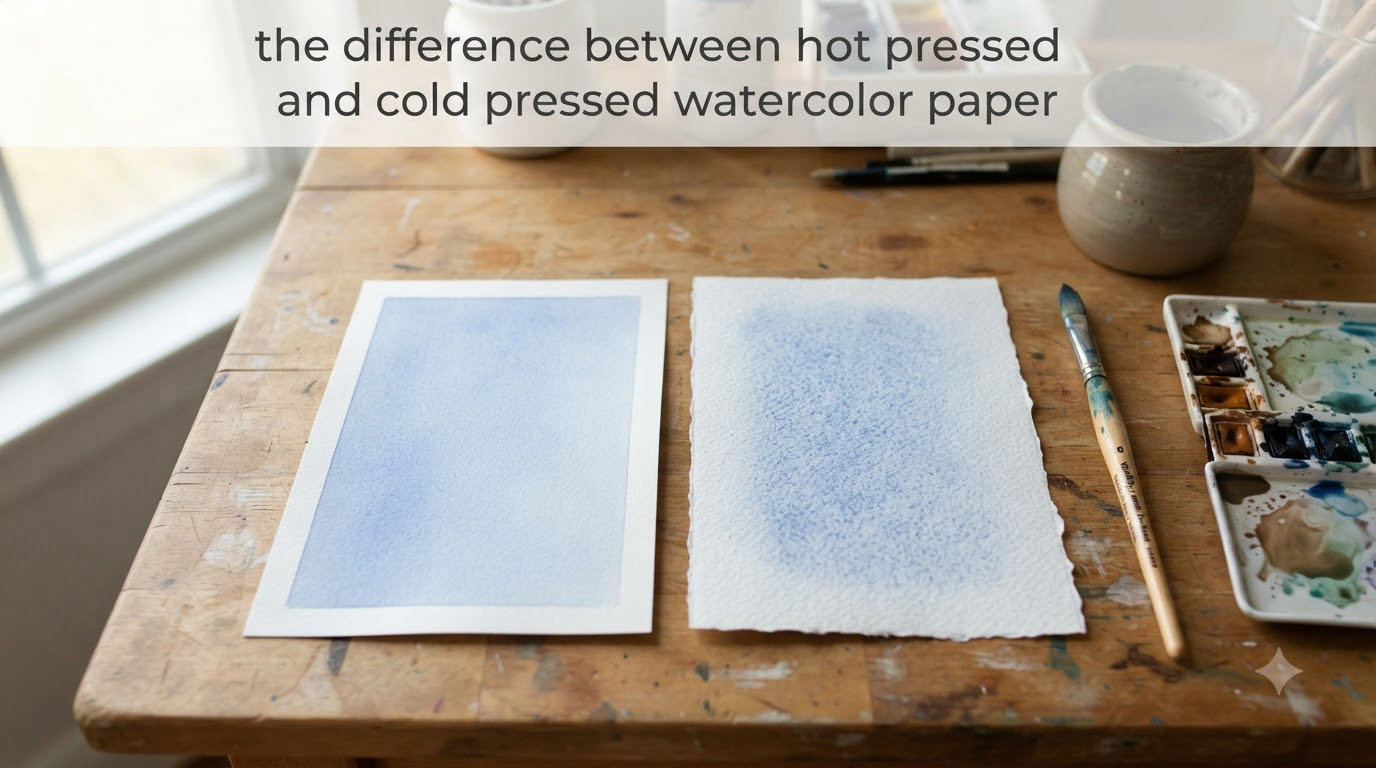
The surface has a distinct tooth – a slightly bumpy, textured finish that you can feel if you run your fingers across it. This texture comes from the fibers not being pressed flat. The bumps create tiny pockets that catch pigment and water in interesting ways.
Paint behaves differently on cold press because the texture breaks up your brushstrokes. When you lay down a wash, the pigment settles into the valleys of the paper while skipping over the peaks. This creates that characteristic granulated, textured look that many watercolorists love.
The absorbency of cold press paper is higher than hot press. The textured surface has more exposed fiber area, which means water soaks in faster. This is why cold press dries quicker and gives you less time to blend and manipulate your paint once it’s on the paper.
Hot Press Watercolor Paper: The Smooth Surface
Hot press watercolor paper is pressed between heated rollers that smooth the fiber surface almost completely flat. The result is a paper with minimal tooth – smooth to the touch with very little visible texture.
This smoothness changes everything about how paint behaves. When you apply watercolor to hot press, the pigment sits on top of the surface rather than settling into texture pockets. You have more time to blend colors because the paint doesn’t absorb as quickly.
The lack of texture makes hot press ideal for detailed work. Fine lines stay crisp. Small details remain distinct. If you’re painting botanical illustrations, portraits with delicate features, or anything requiring precision, hot press gives you control that cold press cannot match.
However, this smoothness comes with challenges. Flat washes are harder to achieve because any unevenness in your brushwork shows immediately. The paper can also be less forgiving of mistakes since lifting and reworking is more difficult on the slick surface.
Hot Press vs Cold Press: Side-by-Side Comparison
Here’s a quick reference to see the differences at a glance:
Surface Texture:
- Cold Press: Bumpy, textured surface with visible tooth
- Hot Press: Smooth, almost slick surface with minimal texture
Absorbency:
- Cold Press: Higher absorbency, water soaks in faster
- Hot Press: Lower absorbency, paint sits on surface longer
Drying Time:
- Cold Press: Dries faster due to higher absorbency
- Hot Press: Dries slower, allowing more blending time
Best Techniques:
- Cold Press: Wet-on-wet, washes, glazing, expressive brushwork
- Hot Press: Detailed work, fine lines, mixed media, dry brush
Granulation:
- Cold Press: More granulation effects as pigment settles in texture
- Hot Press: Less granulation, smoother color transitions
Skill Level:
- Cold Press: Forgiving for beginners, easier flat washes
- Hot Press: Requires more control, better for intermediate to advanced
Absorbency and Drying Time Differences
The texture difference directly impacts how your paper handles water and paint. Cold press paper absorbs water faster because the textured surface exposes more fiber area to the water. When you lay down a wash on cold press, it sinks in quickly.
This fast absorption means you have less time to blend colors on the paper. If you’re trying to create a smooth gradient, you need to work quickly. However, it also means your painting dries faster, which can be helpful if you’re working in layers.
Hot press paper has less exposed fiber surface due to the smooth pressing. Water and pigment sit on top of the paper longer before absorbing. This gives you extended working time to blend, lift, and manipulate your paint.
Many artists describe hot press as “staying wet longer,” though technically it’s about absorption rate rather than actual drying time once the water is in the paper. This property makes hot press excellent for techniques requiring precise color transitions.
Granulation – that beautiful effect where pigment particles separate and create texture – happens more dramatically on cold press. The paper’s texture encourages pigment to settle unevenly. On hot press, granulation is minimal because there’s nowhere for the pigment to “hide.”
When to Use Cold Press Watercolor Paper
Cold press is the go-to choice for many watercolor techniques and subjects. Here’s when it shines:
- Landscapes: The texture mimics natural elements like foliage, rocks, and water
- Wet-on-wet techniques: The absorbent surface handles pooled water beautifully
- Expressive, loose brushwork: The texture breaks up strokes in interesting ways
- Large washes and skies: Easier to achieve smooth gradients with less visible technique
- Glazing and layering: Each layer adheres well without lifting previous layers
- Lifting and corrections: The texture allows you to lift pigment for highlights
Most art instructors recommend cold press for beginners because it’s more forgiving. Uneven washes look intentional. Brushstroke variations add character. You can always add detail, but you can’t easily add texture back once you’ve worked on smooth paper.
When to Use Hot Press Watercolor Paper
Hot press serves a different set of artistic needs. Choose hot press when:
- Botanical illustration: Fine details and precise edges are essential
- Portraiture: Smooth skin tones without visible paper texture
- Mixed media: Works well with pen, ink, colored pencil, and graphite
- Calligraphy: Smooth surface allows clean letterforms
- Technical illustration: Crisp lines and flat color areas
- Scanning and reproduction: Less texture means cleaner digital files
Hot press is also preferred by artists who work with gouache or opaque watercolors. The smooth surface lets you build up opaque layers without underlying texture showing through.
If you enjoy working slowly and methodically, building up precise layers of color, hot press gives you the control you need. The extended blending time means you can achieve effects that would be impossible on more absorbent cold press paper.
Rough Press Paper: A Third Option
While hot press and cold press are the two main categories, there’s a third texture worth knowing: rough press. Rough paper is pressed even less than cold press, leaving a heavily textured surface with pronounced tooth.
The texture on rough paper is dramatic. When you paint on it, the pigment skips across the peaks of the texture, creating broken color effects and intense granulation. Landscapes take on an almost impressionistic quality.
Rough paper is less common than hot or cold press, and it’s definitely not for beginners. However, experienced artists use it for specific effects that no other paper can produce. If you love granulation and textural drama, rough paper is worth exploring once you’ve mastered the basics.
Paper Quality: What Matters Beyond the Press
The hot press vs cold press distinction only matters if you’re starting with quality paper. Here’s what else to look for:
Cotton Content: 100% cotton paper is the gold standard. It’s stronger, more absorbent, and archival. Cellulose papers are cheaper and fine for practice, but they don’t handle water as well and may yellow over time.
Acid-Free: Always choose acid-free or pH-neutral paper. Acidic paper deteriorates and yellows. Archival quality paper ensures your artwork lasts.
GSM/Weight: Paper weight matters for water handling. Common weights include:
- 90 lb (190 GSM): Lightweight, buckles easily, requires stretching
- 140 lb (300 GSM): Standard weight, good for most work, may need stretching for heavy washes
- 300 lb (640 GSM): Heavyweight, minimal buckling, expensive but excellent for wet techniques
I recommend 140 lb paper for most artists. It offers a good balance of performance and cost. Save the 300 lb paper for final pieces where buckling would ruin the work.
Brand-to-Brand Texture Variations
Here’s something that surprised me when I started experimenting: not all cold press papers feel the same. The texture varies significantly between manufacturers.
Arches cold press has a pronounced, regular texture that many artists love. Fabriano cold press tends to be slightly smoother with a more subtle tooth. Strathmore cold press falls somewhere in between and is often recommended for beginners due to its moderate texture.
Hot press papers also vary, though less dramatically. Some have a slight eggshell texture while others are nearly glass-smooth. Arches hot press is known for being particularly smooth, while some student-grade hot press papers retain more texture than you’d expect.
If you’re frustrated with how your paint behaves, try a different brand before changing your technique. The paper might be the culprit, not your brushwork.
Which Paper Should Beginners Choose?
If you’re just starting out with watercolors, buy cold press paper. Period.
Cold press is more forgiving in every way. Uneven washes look artistic rather than amateur. The texture hides small mistakes. You can lift and correct more easily. The faster drying time helps you build layers without muddying colors.
Start with 140 lb cold press paper from a reputable brand like Arches, Fabriano, or Strathmore. Practice your washes, learn how water behaves, and get comfortable with the medium.
Once you can consistently achieve the effects you want on cold press, then experiment with hot press. Many artists eventually prefer hot press for specific projects, but almost everyone starts with cold press.
Save your hot press paper for when you’re ready to tackle detailed work or want to try mixed media techniques. Working on hot press too early can be frustrating and might make you think you’re bad at watercolor when it’s really just the wrong paper for your skill level.
Frequently Asked Questions
Is cold pressed or hot pressed watercolor paper better?
Neither is objectively better – they serve different purposes. Cold press is more versatile and forgiving, making it better for beginners and general use. Hot press is superior for detailed work and mixed media. Your artistic goals determine which is better for your specific project.
What is hot press watercolor paper used for?
Hot press watercolor paper is ideal for detailed work like botanical illustration, portraiture, and technical drawing. It’s also excellent for mixed media with pen and ink, calligraphy, and any application requiring smooth color application without visible paper texture.
When to use cold press watercolor paper?
Use cold press watercolor paper for landscapes, wet-on-wet techniques, expressive brushwork, and glazing. It’s the best choice for beginners because the texture forgives uneven washes and creates beautiful granulation effects that add character to your paintings.
What is considered the best watercolor paper?
The best watercolor paper is 100% cotton, acid-free, and 140 lb (300 GSM) or heavier. Arches and Fabriano are widely considered professional-grade brands. However, the ‘best’ paper depends on your technique – cold press for general use, hot press for detail work, and rough press for textural effects.
Can beginners use hot press watercolor paper?
Beginners can use hot press paper, but it’s not recommended. Hot press is less forgiving than cold press. The smooth surface shows every brushstroke variation and makes flat washes harder to achieve. Most instructors recommend starting with cold press and transitioning to hot press once you’ve developed basic watercolor control.
Conclusion
The difference between hot pressed and cold pressed watercolor paper comes down to one simple factor: surface texture. Cold press has a bumpy, textured surface that absorbs water quickly and creates beautiful granulation. Hot press has a smooth surface that keeps paint workable longer and allows precise detail work.
If you’re just starting your watercolor journey, grab some 140 lb cold press paper and start painting. Once you’ve mastered the basics, experiment with hot press for detailed projects. Understanding these papers gives you the knowledge to choose the right surface for every artistic challenge you face.