
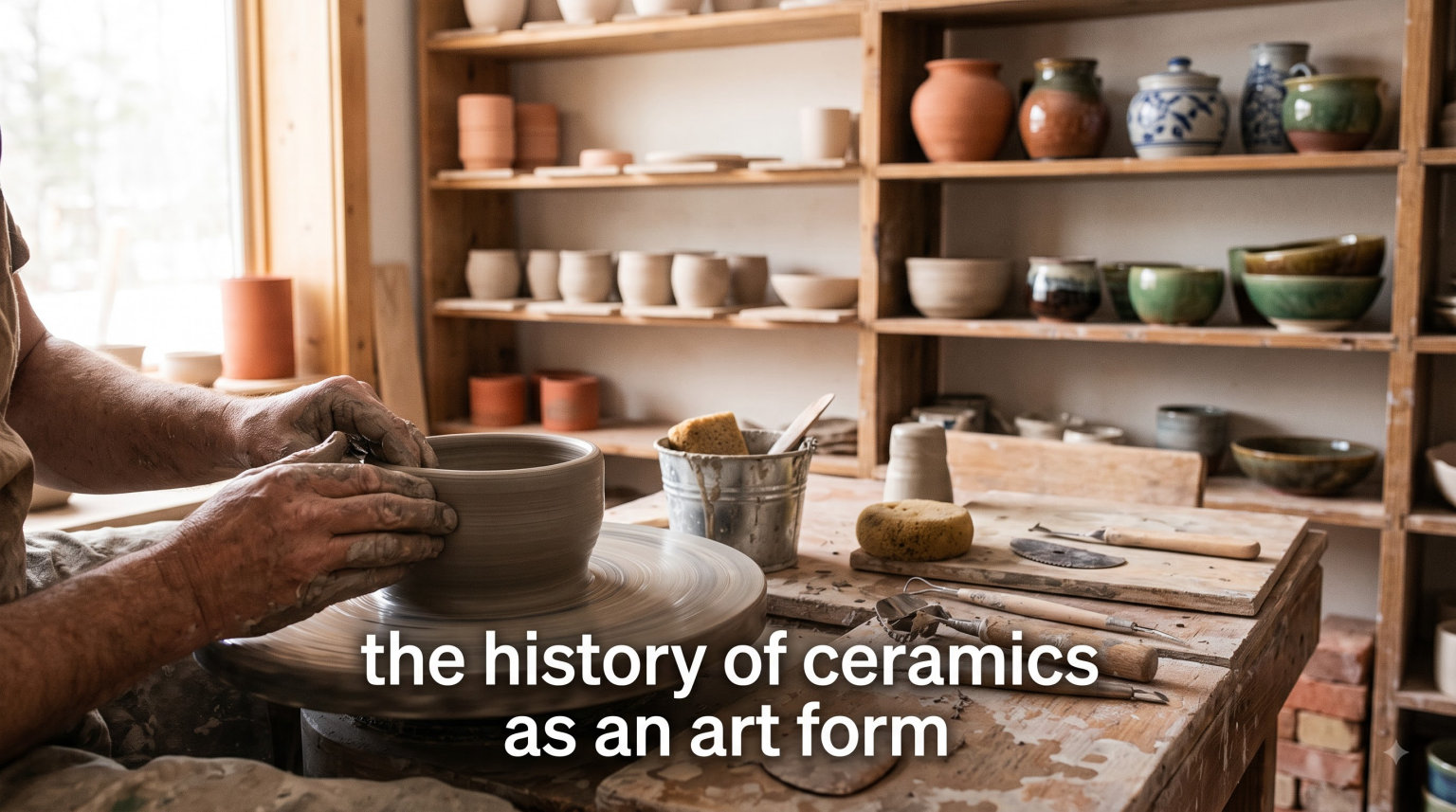
The history of ceramics as an art form spans over 30,000 years, making it one of humanity’s oldest creative traditions. From the moment our ancestors first shaped wet clay and discovered it could transform through fire into something durable, ceramic art has been intertwined with human civilization. Today, understanding this rich history helps us appreciate why ceramics holds such a unique position at the intersection of functionality and artistic expression.
This comprehensive exploration traces the evolution of ceramics from purely functional objects to recognized fine art. We’ll examine the major innovations, cultural exchanges, and artistic movements that shaped ceramic traditions across different civilizations and time periods. The journey reveals how this ancient medium continues to inspire contemporary artists working in studios around the world.
Whether you are an art enthusiast, a practicing ceramicist, or simply curious about how pottery became recognized as art, this guide provides a thorough foundation in ceramic art history.
Table of Contents
Prehistoric Origins: The First Ceramic Artists (28,000-10,000 BCE)
The earliest evidence of ceramics dates back to the Upper Paleolithic period, approximately 28,000 to 24,000 BCE. The famous Venus of Willendorf, discovered in Austria, represents one of the oldest known ceramic figurines. These early ceramic sculptures were not primarily functional objects but rather artistic expressions with ritual or symbolic significance.
Archaeological findings from Dolní Věstonice in modern-day Czech Republic reveal fired clay figurines dating to around 26,000 BCE. These prehistoric artists worked with clay that was fired at relatively low temperatures, producing pieces that were brittle by later standards but revolutionary for their time. The creation of these figurines required imagination, technical skill, and an understanding of material properties.
The transition from figurines to functional pottery occurred gradually as human societies evolved. Around 14,000 BCE, evidence of ceramic containers appears in Japan and China, though these early vessels were often crude and used primarily for storage rather than cooking. The Jomon culture of Japan, which began around 10,500 BCE, developed some of the world’s most distinctive early pottery, characterized by cord-marked patterns and remarkable artistic sophistication.
Video recommendation: Consider embedding “The History of Ceramics Podcast: The First Pot” (YouTube) in this section to provide an engaging visual introduction to prehistoric ceramic origins.
The Neolithic Revolution: Pottery Becomes Essential (10,000-4,000 BCE)
The Neolithic period marked a transformative era in the history of ceramics as agriculture emerged as the dominant way of life. As humans settled into permanent communities and shifted from hunting and gathering to farming, the demand for ceramic vessels skyrocketed. Pottery became essential for storing grain, cooking food, and carrying water.
The earliest known permanent pottery production sites emerged in the Middle East around 9,000 BCE. Syrian archaeologists have uncovered pottery fragments from this period showing remarkable consistency in form and technique, suggesting specialized production methods were already developing. This period established fundamental techniques that would influence ceramic production for millennia.
In East Asia, the Jomon culture of Japan (10,500-300 BCE) produced some of the world’s most aesthetically sophisticated Neolithic pottery. Jomon means “cord-marked,” referring to the distinctive decorative patterns created by pressing cord into wet clay. These vessels served practical purposes but also displayed remarkable artistic creativity, with forms inspired by nature including squash, gourd, and flame shapes.
Chinese Neolithic pottery, particularly the Yangshao culture (5,000-3,000 BCE), developed painted ceramics featuring geometric patterns and stylized fish and human figures. These pieces demonstrate how early potters began using their work as a canvas for artistic expression beyond mere decoration of functional forms. The black-on-red painted pottery of the Yangshao represents some of humanity’s earliest attempts at artistic storytelling through ceramic art.
Mesopotamia and the Invention of the Potter’s Wheel (3500 BCE)
The invention of the potter’s wheel in Mesopotamia around 3500 BCE represents one of the most significant innovations in ceramic art history. This technological breakthrough revolutionized pottery production, enabling artisans to create vessels with unprecedented symmetry and precision. The wheel allowed for faster production and opened new possibilities for form and design.
Mesopotamian ceramic artists quickly developed glazing techniques that transformed the appearance and functionality of their work. Early glazes were often alkaline and produced distinctive turquoise and blue-green colors derived from copper compounds. These glazed vessels were highly prized and often used for religious or ceremonial purposes, bridging the gap between functional objects and sacred art.
The city-states of Sumer, Akkad, and later Babylon developed extensive ceramic traditions that influenced surrounding regions. Cuneiform tablets describing glaze recipes survive from this period, providing evidence of how Mesopotamian artisans documented and shared their technical knowledge. This period established Mesopotamia as a center of ceramic innovation that would influence traditions across the ancient world.
Trade networks extending from Mesopotamia to Egypt and the Indus Valley facilitated the exchange of ceramic techniques and aesthetic ideas. The development of standardized forms and mass production techniques in Mesopotamia foreshadowed later industrial applications of ceramic manufacturing.
Ancient Civilizations: Egypt, Greece, and China
Ancient Egyptian ceramics represented both functional excellence and profound spiritual significance. Egyptian faience, a sintered-quartz ceramic material glazed in vivid colors, was used extensively for tomb furnishings and religious objects. These materials were not clay-based but represented an early form of technical ceramic art that demonstrated Egyptians understood material science at sophisticated levels.
Egyptian tomb paintings and archaeological finds reveal the importance of pottery in daily life. Funerary vessels, called canopic jars, were crafted to hold the preserved organs of deceased royalty. These pieces required exceptional skill and represented some of the most technically demanding ceramics of their era.
Ancient Greek ceramics achieved unprecedented artistic heights, particularly through the black-figure and red-figure painting techniques developed around 600 BCE. Greek potters and painters transformed functional amphorae and kraters into narrative art, depicting mythological scenes and everyday life with remarkable detail. The Workshop of the Meleager and the work of the Berlin Painter represent the pinnacle of this tradition.
Greek black-figure pottery involved applying figures in a slip that turned black during firing, with details incised to reveal the red clay beneath. The later red-figure technique reversed this process, creating figures in the natural red of the clay against a black background. This allowed for greater fluidity and detail in the painted compositions.
Chinese ceramic traditions developed along distinct paths, with early Neolithic cultures producing painted pottery and ritual vessels. The Shang dynasty (1600-1046 BCE) introduced high-fired ceramics and bronze-inspired forms that would influence Chinese ceramics for millennia. Chinese potters developed regional specialties and began experiments that would eventually lead to porcelain perfection.
The Classical Period: When Pottery Became Art
The question of when pottery transitioned from functional craft to recognized art form finds its clearest answer in Classical Greece. By the 5th century BCE, Athenian pottery workshops had established systems where skilled painters collaborated with throwers, creating works valued as art independent of their functional purpose.
Athenian red-figure kraters depicting scenes from mythology and daily life now hang in major museums worldwide, recognized as masterpieces of ancient art. The Panathenaic prize amphorae, awarded to winners of athletic games, represent commissioned art objects where the ceramic vessel served primarily as a substrate for artistic expression.
This period established the distinction between household pottery and artistic ceramics that continues to influence how we understand ceramic art today. The workshops of the Kerameikos district in Athens operated like early art studios, with recognized masters whose reputations influenced the value of their work.
Greek philosophical texts from this period also reveal how contemporaries viewed ceramic art. Plato and Aristotle both discussed the role of craftspeople and artists in society, providing early theorization of art’s cultural significance. These discussions laid groundwork for later art historical thinking about ceramics.
Medieval Period and Islamic Ceramic Traditions
The medieval period saw Islamic civilizations develop ceramic traditions of remarkable sophistication. Islamic artists created geometric and calligraphic decorative systems that transformed ceramic surfaces into canvases for complex pattern work. This aesthetic emphasized the decorative potential of ceramics in ways that influenced art globally.
Persian potters of the 9th through 12th centuries developed lusterware techniques that mimicked precious metal surfaces. These ceramics featured metallic pigments applied before a second firing, producing shimmering gold and copper tones that were highly prized for court use. Persian lusterware represented a technical achievement rivaling Chinese porcelain in its complexity.
Spanish Islamic pottery, particularly from Valencia and Granada, combined local traditions with influences from Persia and Egypt. The distinctive blue and white ceramics of this tradition influenced later Spanish and Italian maiolica production. These cross-cultural exchanges demonstrate how ceramic traditions spread and evolved through artistic contact.
Islamic geometric design principles led to innovative approaches to ceramic surface decoration that remain influential today. The use of mathematical patterns to create infinite design variations represented intellectual sophistication applied to decorative arts. Ceramic tiles from the Alhambra palace complex in Granada exemplify this tradition at its highest development.
Renaissance to Industrial Age: European Pottery Evolution
The Italian Renaissance revitalized European ceramic traditions through contact with Islamic tin-glazed wares brought from Spain and the Middle East. Italian maiolica, produced from the 15th century onward, adapted these techniques to European artistic sensibilities, producing painted ceramics with narrative scenes and heraldic designs.
Urbino, Deruta, and Faenza became major maiolica centers, with workshops producing pieces for aristocratic patrons. The Istoriato style, featuring fully painted narrative scenes reminiscent of contemporary paintings, represented ceramics as a medium capable of sophisticated artistic expression. These works were displayed in Cabinets of Curiosities alongside paintings and sculptures.
Dutch Delftware, developed in the 17th century, represented another significant European ceramic tradition. Dutch potters copied Chinese blue and white porcelain patterns, creating distinctive tin-glazed earthenware that became highly popular across Europe. The town of Delft became synonymous with this style, though production eventually declined under competition from English earthenware.
English potters like Josiah Wedgwood revolutionized ceramic manufacturing during the Industrial Revolution. Wedgwood’s development of jasperware in the 1770s created a new ceramic body that could be stained in colors and took crisp raised reliefs. His systematic approach to production combined artistic design with industrial efficiency.
Chinese Porcelain: The White Gold Revolution
The development of true porcelain in China around 600 CE during the Sui and Tang dynasties represented a pinnacle of ceramic art achievement. Chinese potters discovered that deposits of a specific white clay called kaolin, combined with feldspar, could produce a translucent, vitrified ceramic when fired at extremely high temperatures.
Song dynasty (960-1279 CE) ceramics represent perhaps the highest achievement in Chinese ceramic art. The famed Jun, Ru, Guan, and Ge ware traditions produced pieces celebrated for their subtle glazes and elegant forms. Song glazes, particularly the “tea-dust” and “moonlight” variations, achieved effects that potters worldwide still admire and attempt to replicate.
European demand for Chinese porcelain drove global trade networks and spurred efforts to discover the secret of its production. Jesuit missionaries and merchants provided incomplete information about Chinese methods, but the true formula remained elusive until 1709 when Ehrenfried Walther von Tschirnhaus developed European soft-paste porcelain in Dresden.
Chinese export ceramics, particularly the blue and white porcelain produced for European markets from the Ming dynasty onward, represent one of history’s most extensive artistic commodity exchanges. These pieces adapted Chinese traditions to European tastes, creating hybrid forms that reflected cross-cultural artistic dialogue.
The Studio Pottery Movement: Reclaiming Ceramic Art (20th Century)
The 20th century witnessed a revolution in how ceramics was understood as an art form through the studio pottery movement. This movement, emerging primarily in Britain, Japan, and the United States, rejected industrial mass production in favor of handcrafted individual expression. Practitioners argued that ceramic art deserved recognition alongside painting and sculpture.
Bernard Leach and Shoji Hamada became central figures who articulated philosophical foundations for studio pottery. Leach, who had learned throwing techniques in Japan, emphasized functional beauty and the integration of Eastern and Western ceramic traditions. His book “A Potter’s Book” (1940) became a foundational text for studio potters worldwide.
Hamada’s work demonstrated how traditional techniques could serve contemporary artistic vision. His collaborations with Leach established models for artistic exchange between cultures that continue to influence ceramic education today. Both artists received recognition as “Living National Treasures” in their respective countries.
American ceramic artists like Peter Voulkos transformed ceramics into a medium for abstract expressionist art in the 1950s and 60s. Voulkos’s large-scale sculptural works broke from functional pottery traditions, treating clay as a material for pure artistic expression. His aggressive, dynamic approach challenged assumptions about what ceramics could be as art.
Women artists made crucial contributions to studio pottery despite facing significant barriers to recognition. Lucie Rie, an Austrian-born potter who worked in London, developed distinctive modernist forms and glazes that influenced generations of potters. Her work in architectural ceramics and tableware demonstrated how functional objects could achieve sculptural quality. Karen Karnas and Toshiko Takaezu further expanded possibilities for ceramic form, with Takaezu’s closed forms becoming iconic expressions of ceramic art.
For ceramic artists today, pursuing ceramic artist residencies provides opportunities to develop studio practices grounded in this rich heritage while exploring contemporary approaches.
Contemporary Ceramics: Sustainability and Innovation
Contemporary ceramic artists work in a global context that emphasizes sustainability, cultural dialogue, and technical innovation. Many artists now explicitly address environmental concerns through their material choices and production methods, reflecting broader cultural shifts toward ecological consciousness.
The sustainable ceramics movement advocates for reduced energy consumption in firing, local material sourcing, and natural glaze formulations that avoid toxic materials. Artists like Neil Brownsword have documented industrial ceramics practices while exploring new approaches that minimize environmental impact. This ethical dimension adds new meaning to ceramic art practice.
Women artists have achieved increasing recognition in contemporary ceramics, with figures like Magdalene Odundo, Klara Tove, and formafantal continuing to expand what ceramic art can express. These artists draw on diverse cultural influences while developing distinctive personal vocabularies that reflect contemporary global experience.
Digital fabrication technologies including 3D printing with ceramic materials and computer-aided design have opened new possibilities for ceramic art. Artists like Jonathan Keep explore how these technologies can serve rather than replace handcraft, creating hybrid approaches that honor traditional skills while embracing innovation. The relationship between hand and machine in ceramics remains a productive area of exploration.
Contemporary ceramic sculpture often addresses themes of consumption, memory, and cultural identity. Artists create installations exploring how ceramics carries meaning across cultures and time periods. This intellectual dimension demonstrates how seriously ceramics is now taken as a medium for contemporary art discourse.
Those interested in developing their own ceramic practice can explore learning ceramic art through art school vs apprenticeship to find the path that suits their goals and learning style.
Conclusion
The history of ceramics as an art form represents humanity’s longest-running creative dialogue with material. From the Venus figurines of 28,000 BCE to contemporary studio practice, ceramic art has continuously evolved while maintaining connections to ancient traditions. Understanding this history enriches our appreciation of both historical and contemporary ceramic works.
The transition from functional craft to recognized fine art took millennia to complete and continues to generate debate about boundaries between utility and expression. What seems clear is that ceramics occupies a unique position, capable of serving practical purposes while expressing profound artistic vision.
Museums increasingly recognize ceramics as central to art historical collections, with dedicated galleries at institutions from the Metropolitan Museum of Art to the British Museum. Understanding how museum curation of ceramic art shapes public understanding helps us appreciate how these objects communicate meaning across cultures.
As we face environmental challenges requiring sustainable material practices, ceramic art offers lessons from traditions that developed over millennia of working with earthen materials. The future of ceramics as art will likely emphasize this ecological dimension while continuing to push technical and expressive boundaries.
Frequently Asked Questions
When was pottery first invented?
Pottery was first invented during the Upper Paleolithic period, with the earliest ceramic artifacts dating to approximately 28,000-24,000 BCE. These early ceramic objects were figurines like the Venus of Willendorf, not functional vessels.
Who is credited with making pottery an art form?
No single individual is credited with making pottery an art form. The transition occurred gradually, with Greek Athenian potters of the 5th century BCE being among the first to create ceramics recognized primarily for their artistic merit rather than functional purpose.
What cultures contributed most to ceramic art development?
Chinese, Japanese, Greek, Islamic, and later European cultures made the most significant contributions. Chinese potters developed porcelain, Japanese artists created distinctive traditions like Jomon pottery, Greek painters transformed vessel surfaces into narrative art, and Islamic craftsmen innovated glazing and geometric design.
When was porcelain developed and by whom?
True porcelain was developed in China around 600 CE during the Sui and Tang dynasties. Chinese potters discovered that combining kaolin clay with feldspar and firing at high temperatures produced a translucent, vitrified ceramic previously unknown elsewhere.
What is the studio pottery movement?
The studio pottery movement emerged in the 20th century as practitioners like Bernard Leach, Shoji Hamada, and Peter Voulkos established ceramics as a fine art distinct from industrial production. The movement emphasized handcrafted individual expression and philosophical engagement with the material.
Timeline: Key Moments in the History of Ceramics as an Art Form
28,000-24,000 BCE — First ceramic figurines created in Europe (Venus of Willendorf, Dolni Vestonice)
10,500 BCE — Jomon culture pottery begins in Japan, oldest continuously produced ceramic tradition
9,000 BCE — Neolithic pottery production emerges in the Middle East
3,500 BCE — Potter’s wheel invented in Mesopotamia, revolutionizing ceramic production
2,500 BCE — Egyptian faience and tomb ceramics develop as distinct traditions
600 BCE — Greek black-figure pottery technique emerges in Athens
600 CE — Chinese porcelain developed during Sui/Tang dynasties
8th-12th centuries — Islamic lusterware innovation transforms ceramic aesthetics
15th century — Italian maiolica renaissance brings tin-glazed earthenware to new heights
1709 — European soft-paste porcelain discovered in Dresden, ending Chinese monopoly
1940s-1960s — Studio pottery movement establishes ceramics as fine art in Britain, Japan, and United States
1950s-1960s — Abstract expressionism influences ceramic sculpture through artists like Peter Voulkos