
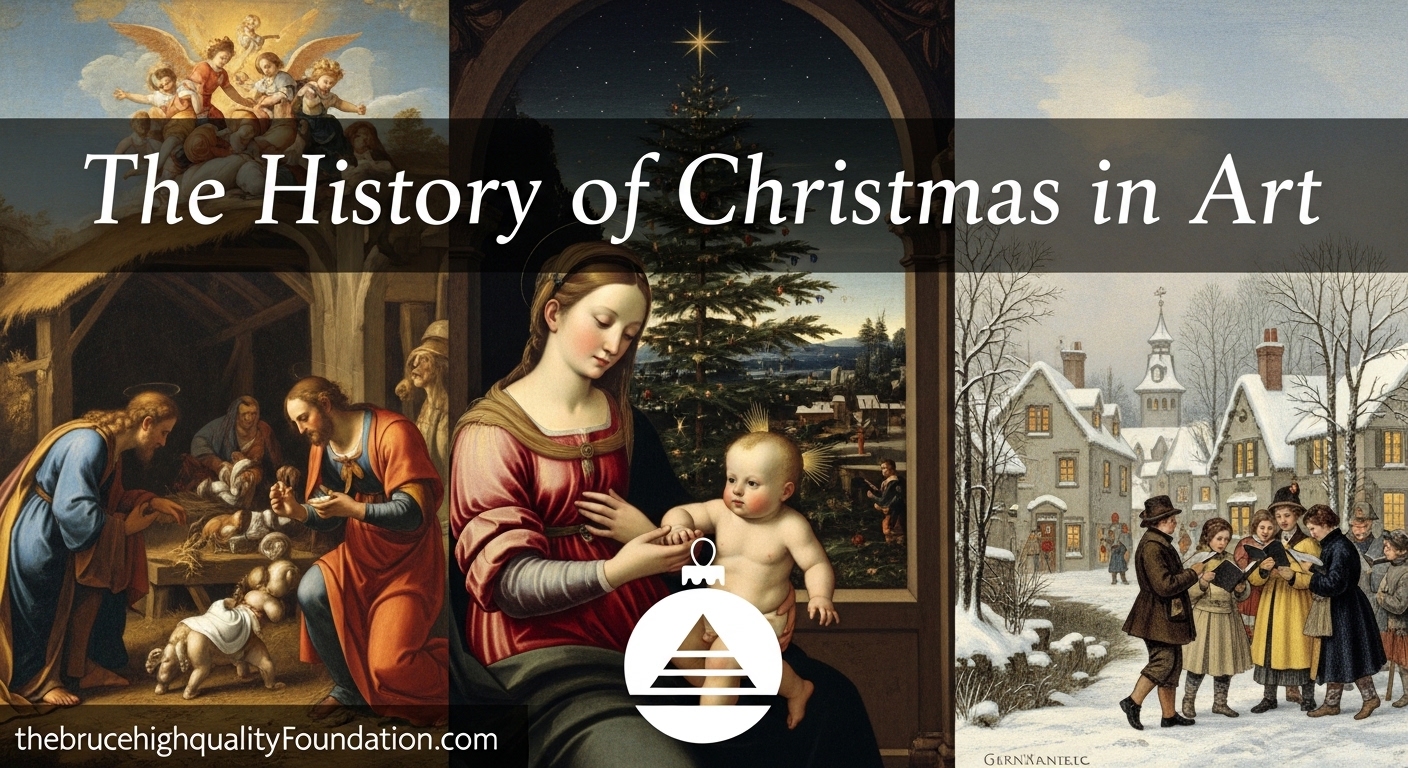
The visual depiction of Christmas spans nearly two millennia of art history, beginning with carved marble sarcophagi in Roman catacombs and continuing through Victorian sentimentality and impressionist snowscapes. This history of Christmas in art traces not only changing artistic techniques but evolving theological understanding, cultural traditions, and the fundamental human desire to visualize the sacred story of Christ’s birth. From Byzantine icons glowing with gold leaf to Norman Rockwell’s domestic scenes, each era brought new symbolism, new painters, and new meaning to the world’s most celebrated religious narrative.
Our exploration reveals how Christmas imagery transformed from symbolic early Christian carvings to emotionally resonant Renaissance masterpieces, then adapted to the commercial and sentimental needs of the Victorian era. Understanding this evolution helps us appreciate why certain visual elements—the stable, the halo, the three kings—persist in our modern celebrations. These artistic conventions carry centuries of devotion, artistic innovation, and cultural meaning within them.
Table of Contents
Early Christian Nativity Depictions: Where Christmas Art Began
The earliest visual representations of Christmas appear not on cathedral walls but on Roman burial sarcophagi, creating a fascinating starting point for any history of Christmas in art. These 4th-century carved reliefs depicted the nativity story as a series of symbolic elements rather than a continuous narrative. Artists of this period focused on conveying theological truths through established iconographic conventions rather than attempting realistic spatial representation.
A sarcophagus from Rome dated to approximately 350 AD shows the Christ Child lying in a manger between two animals, with the Virgin Mary seated beside him and Saint Joseph standing nearby. This basic compositional formula would persist for centuries with minimal variation. The absence of the stable building, the stylized pose of Mary, and the frontal presentation all reflect early Christian artistic priorities that emphasized the divine nature of the Christ Child over his historical birthplace conditions.
Catacomb paintings in Rome and under the San Callisto baptistery show similar approaches. The Good Shepherd motif, borrowed from Roman pagan art, sometimes appears alongside nativity symbols, reflecting the gradual Christianization of existing visual vocabulary. Artists worked within strict theological guidelines that prescribed how each figure must appear—Mary always in royal purple, the Christ Child always as a mature infant rather than a newborn, angels as youthful winged figures. These conventions ensured doctrinal accuracy as understood by church authorities of the era.
The Significance of Roman Sarcophagi for Christmas Art
Roman sarcophagi provide crucial evidence for understanding how early Christians visualized the nativity story when Christianity transitioned from underground worship to public practice under Emperor Constantine. The choice of burial monuments for nativity imagery suggests the theological importance placed on Christ’s birth as the foundation of Christian hope in resurrection. These carved stone surfaces represent the first major surge in Christmas visual art after Emperor Constantine’s Edict of Milan in 313 AD permitted Christian worship.
The technical skill of Roman sculptors ensured these sarcophagi achieved lasting quality, allowing modern viewers to examine the original craftsmanship. Carved in high relief with excellent detail in drapery folds and facial features, these works demonstrate that early Christian art was not primitive folk craft but sophisticated production using trained artisans and quality materials. The durability of limestone and marble preserved these works through fifteen hundred years, providing direct connection to the origins of Christmas in visual art.
Byzantine to Romanesque: Medieval Christmas Imagery
The Byzantine period brought dramatic changes to Christmas art through its distinctive iconographic language. Golden halos surrounded the heads of sacred figures, flat gold backgrounds replaced naturalistic settings, and hierarchical scaling emphasized the divine status of Christ and Mary. This abstract approach prioritized spiritual reality over physical appearance, creating an aesthetic that would dominate Eastern Christian art for a millennium and significantly influence Western traditions as well.
Byzantine artists developed standardized formulas for depicting the nativity that spread throughout the Christian world through icons, mosaics, and manuscript illuminations. The Hagia Sophia cathedral in Constantinople showcased monumental nativity mosaics that demonstrated the style’s grand scale possibilities. These works featured the characteristic flat gold backgrounds, formalized poses, and rich blues and golds that made Byzantine Christmas imagery instantly recognizable and widely emulated.
Western medieval art absorbed Byzantine influences while developing distinct regional characteristics. Romanesque churches featured carved tympana and capitals that depicted Christmas scenes within narrative programs showing Christ’s life from birth to resurrection. These stone carvings reached wide audiences through their placement above church entrances where illiterate congregations encountered biblical stories visually before entering the sacred space.
The Evolution of Theological Symbolism in Medieval Christmas Art
Medieval Christmas art increasingly incorporated symbolic elements that conveyed complex theological concepts to educated viewers. The ox and donkey appearing beside the Christ Child in the manger referenced Old Testament prophecies about the Messiah. Angels multiplied in number and changed pose from peaceful witnesses to active participants in the heavenly announcement to shepherds. The Star of Bethlehem gained prominence as a guiding light symbolizing Christ as the light of the world.
Monastic workshops produced illuminated manuscripts that demonstrated increasingly refined approaches to Christmas imagery. These portable books allowed wealthy patrons to own personal devotional images of the nativity, expanding the audience for Christmas art beyond church contexts. The Lindisfarne Gospels and other Insular manuscripts featured elaborate carpet pages incorporating nativity symbols within geometric patterns of extraordinary intricacy and color richness.
The theological sophistication of medieval Christmas art reflected broader intellectual developments within the church. Scholastic theology emphasized precise iconographic programs that ensured doctrinal accuracy in religious imagery. Artists working under clerical supervision followed guidelines that connected each visual element to specific scriptural sources or theological interpretations, making medieval nativity scenes complex visual sermons for viewers who understood their symbolic vocabulary.
Giotto and the Renaissance Revolution in Christmas Art
The Renaissance transformed Christmas art through revolutionary techniques that prioritized naturalism, emotional expression, and spatial realism. Italian painter Giotto di Bondone stands as the pivotal figure in this transformation, breaking from Byzantine conventions to create nativity scenes of unprecedented human warmth and physical credibility. His Arena Chapel frescoes in Padua, completed around 1305, depict the nativity with expressive figures, architectural settings, and landscape elements that suggest actual three-dimensional space.
Giotto’s approach influenced generations of Renaissance artists who further developed Christmas imagery. Fra Angelico’s The Annunciation and The Adoration of the Magi combine Renaissance techniques with profound religious feeling, creating images that achieved widespread devotional popularity. His use of perspective, atmospheric color, and idealized figures established standards for religious painting that remained influential through the 16th century and beyond.
Sandro Botticelli’s Mystical Nativity (approximately 1500) demonstrates how Renaissance artists integrated emerging ideas about composition, color harmony, and classical influences into Christmas imagery. The painting’s unusual inclusion of dancing angels, falling leaves, and embracing figures creates a uniquely contemplative atmosphere distinct from earlier devotional conventions. Botticelli drew on apocryphal texts and his own mystical vision to expand the possibilities of nativity depiction.
Northern Renaissance Christmas Paintings
Northern European artists approached Christmas themes with characteristic attention to detail, texture, and everyday reality. Albrecht Dürer’s Adoration of the Magi (1504) combines Italian Renaissance compositional techniques with precise rendering of fabrics, faces, and architectural elements characteristic of Northern painting traditions. His meticulous observation of ordinary details—the crumbling stones of the stable, the textures of royal garments, the individual features of attending figures—creates an image that feels both historically specific and timelessly reverent.
The Van Eyck brothers and other Early Netherlandish painters developed microscopic detail techniques that brought extraordinary realism to Christmas imagery. Their careful rendering of candlelit interiors, rich textiles, and individual facial features created intimate nativity scenes set within contemporary domestic environments rather than generic biblical locations. These paintings emphasized the incarnation theme—the Son of God born into ordinary human circumstances—by placing the sacred narrative within recognizable everyday settings.
German and Flemish artists also explored Christmas themes through printmaking, making nativity imagery accessible to broader audiences through woodcuts and engravings. These reproductive works spread Christmas visual traditions throughout Europe, establishing iconographic patterns that non-specialist artists could follow. The technical reproducibility of prints also allowed more consistent dissemination of approved imagery, influencing popular understanding of Christmas visual elements.
The Adoration of the Magi: A Christmas Art Theme Across Centuries
The Adoration of the Magi became one of the most frequently depicted Christmas themes throughout art history, inspiring countless masterpieces from medieval manuscript illuminations to impressionist interpretations. This biblical scene showing the three wise men presenting gifts to the infant Christ offered artists opportunities to depict royal pageantry, theological significance, and complex compositional arrangements involving multiple figures, exotic animals, and elaborate architectural settings.
Renaissance artists particularly favored the Adoration theme because it allowed them to display their skills in rendering luxurious materials, complex drapery, and large gatherings of figures. Botticelli’s Adoration of the Magi features his own portrait among the assembled worshippers, establishing a tradition of artists inserting themselves into biblical scenes that would continue for centuries. The composition’s diagonal arrangement and the surrounding architectural ruins create spatial depth that demonstrates Renaissance mastery of perspective.
Caravaggio’s Adoration of the Shepherds (1609) demonstrates how Baroque artists transformed Christmas imagery through dramatic chiaroscuro lighting and naturalistic figure poses. Instead of idealized saints, Caravaggio painted working people with dirt under their fingernails gathered around the Christ Child, bringing unprecedented human realism to nativity depiction. His use of strong directional light creates theatrical intensity that emphasizes the sacred event’s cosmic significance while grounding it in relatable human experience.
Baroque to 18th Century: Christmas Art’s Dramatic Evolution
The Baroque period brought theatrical drama and emotional intensity to Christmas imagery through bold lighting, dynamic compositions, and realistic figure types. Artists sought to engage viewers emotionally, creating nativity scenes that stimulated piety through vivid representation of the sacred story. Caravaggio’s revolutionary naturalism influenced generations of artists who followed his example in depicting holy figures with human imperfection and dignity.
Peter Paul Rubens painted multiple Christmas scenes that demonstrated Baroque energy and color. His Adoration of the Magi compositions feature swirling draperies, dynamic movement, and the fleshy vitality characteristic of his style. These large-scale works addressed aristocratic patrons who wanted impressive decorations for their private chapels and state rooms, bringing Christmas imagery into elite domestic spaces previously reserved for mythological subjects.
18th-century Rococo artists softened Baroque intensity with lighter colors, playful compositions, and domestic intimacy. Christmas imagery increasingly depicted intimate family scenes with charming children and gentle sentiment rather than cosmic theological drama. This aesthetic shift prefigured Victorian sentimentalism while maintaining religious subject matter, creating a bridge between Baroque grandeur and modern commercial Christmas imagery.
Victorian Christmas Art: The Beginning of Modern Imagery
Victorian-era Christmas art represents a crucial turning point in the history of Christmas in art because it established visual conventions that still dominate modern understanding of the holiday. The 19th century saw Christmas transition from primarily religious observance to commercial celebration, with artists responding to changing cultural demands by creating imagery that combined spiritual meaning with domestic comfort and commercial appeal.
Christmas cards emerged as a significant art form during the Victorian period, with early examples appearing in England around 1840. These printed cards featured increasingly elaborate designs incorporating winter scenes, family gatherings, religious imagery, and seasonal greenery. The commercial success of Christmas cards created demand for repeatable imagery that could be produced affordably and distributed widely, democratizing access to Christmas visual culture.
Victorian Christmas imagery introduced or popularized several elements that remain central to modern visual representation: the cozy domestic interior with fireplace and stockings, the festively decorated Christmas tree, Santa Claus as a jolly gift-bringer rather than stern bishop, and idealized family gatherings celebrating togetherness. Artists like John Leech and George Housman Thomas created images that shaped collective understanding of what Christmas should look like, feel like, and mean emotionally.
Norman Rockwell and American Christmas Imagery
Norman Rockwell’s Christmas paintings extended Victorian sentiment into mid-20th-century American visual culture with remarkable effectiveness. His Freedom from Want (1943), part of the Four Freedoms series, depicts a family gathered around a Thanksgiving turkey with the warm domestic intimacy that characterizes his Christmas imagery. Rockwell’s covers for The Saturday Evening Post established iconic American Christmas visual tropes that reached millions of households weekly.
Rockwell’s Christmas scenes emphasized accessible middle-class domestic values rather than religious doctrine, reflecting broader American cultural shifts toward secular celebration. His detailed renderings of family gatherings, holiday meals, and children’s excitement about presents created visual templates that commercial advertising and greeting card companies subsequently emulated and multiplied. The democratization of Christmas imagery through mass circulation magazines, calendars, and printed materials established visual conventions that persist in contemporary holiday marketing.
The emotional authenticity of Rockwell’s work—his ability to suggest genuine human feeling within carefully composed scenes—contributed to his images achieving lasting resonance. Unlike formal religious paintings, his Christmas scenes portray the holiday as experienced by ordinary families, creating identification possibilities that transcend specific theological commitments. This approachability helps explain why Rockwell’s Christmas imagery remains recognizable and influential more than half a century after its creation.
Impressionist and Modern Christmas Scenes
Impressionist artists approached Christmas themes indirectly, preferring to capture winter atmosphere and seasonal feeling rather than religious narrative. Claude Monet’s snow scenes at Argenteuil depict French suburban life with the flickering light effects and broken brushwork characteristic of impressionist technique. These paintings do not depict Christmas events but evoke the winter season that encompasses the holiday period, suggesting how impressionism could address Christmas themes through atmosphere rather than explicit religious content.
Impressionist Christmas imagery tends toward secular celebration rather than sacred narrative. Pierre-Auguste Renoir’s intimate domestic scenes featuring children and family gatherings align with broader impressionist interest in everyday modern life. His paintings of children playing in snow, families gathered indoors, and winter leisure activities created a visual vocabulary for secular Christmas celebration that complemented rather than replaced religious imagery.
The transition to modern art brought diverse approaches to Christmas themes. Post-impressionist and early 20th-century artists explored Christmas imagery through expressionist distortion, cubist fragmentation, and surrealist juxtaposition. These experimental approaches engaged with traditional Christmas symbolism while transforming it through avant-garde techniques, suggesting continued vitality in religious visual traditions even as modernist aesthetics challenged academic conventions.
How Christmas Art Reflects Broader Cultural Evolution
The history of Christmas in art documents far more than changing artistic techniques—it reveals shifting cultural values, theological emphases, and social organization. Early Christian art emphasized the divine nature of Christ and the theological significance of the incarnation, using Christmas imagery to communicate doctrinal points to newly converted populations. Medieval art elaborated symbolic vocabularies that addressed educated clergy and monastic viewers familiar with complex theological frameworks.
Renaissance humanism transformed Christmas imagery by introducing naturalism, emotional accessibility, and classical aesthetics that made biblical narratives feel relevant to contemporary viewers. The Renaissance Christmas art we recognize today gained humanity and warmth while maintaining spiritual gravitas, achieving a balance that subsequent centuries would struggle to maintain as Christmas increasingly intersected with commercial interests and mass culture.
The Victorian period marked a decisive shift toward Christmas as commercial celebration, with art serving marketing functions rather than primarily devotional purposes. This transformation did not eliminate religious content but increasingly subordinated it to sentimental and commercial appeals. Modern Christmas imagery inherits this dual character, simultaneously religious and commercial, spiritual and material, traditional and contemporary—a complexity that makes the history of Christmas in art a particularly rich field for cultural study.
Key Elements in Christmas Art That Have Survived Centuries
Certain visual elements have persisted in Christmas art for nearly two thousand years with remarkable consistency. The stable or manger appears in virtually all nativity depictions from Roman sarcophagi to modern greeting cards. The ox and donkey remain standard elements despite lacking clear biblical warrant—their presence derives from Old Testament prophecies and early Christian interpretive traditions that artists continue to follow through inertia and convention.
Halos evolved from the Byzantine golden disc to more naturalistic light effects in Renaissance painting, yet the basic concept of representing divine light surrounding sacred figures persists across styles and periods. Angels multiplied in number and changed appearance according to period aesthetics—from Byzantine seraphim to Renaissance cherubs to Baroque dramatic figures—but the basic presence of heavenly messengers announcing Christ’s birth remains constant.
The Star of Bethlehem appears as a guiding light in virtually every depiction of the Magi’s journey, representing Christ’s role as the light coming into darkness. This symbolic element proved particularly adaptable across different artistic styles and theological emphases, maintaining its meaning while appearing in contexts from medieval manuscript borders to impressionist landscapes suggesting spiritual guidance beyond explicit religious narrative.
FAQs
What is the history of Christmas art?
Christmas art began in the 4th century with Roman sarcophagi carvings depicting the nativity story symbolically. The art form evolved through Byzantine iconography with golden halos, medieval theological symbolism, and Renaissance naturalism. Each period contributed distinctive approaches while maintaining core elements like the stable, angels, and the Christ Child. Victorian era commercialized Christmas imagery, creating visual conventions that persist today.
Who decided 25th December would be Christmas?
Pope Julius I officially established December 25 as the feast day for Christ’s birth around 440 AD, though the date was likely chosen to Christianize the Roman festival of Sol Invictus (the unconquered sun) celebrated on the same date. Church fathers sought to provide Christian meaning to existing winter solstice celebrations, incorporating existing pagan festival dates into the liturgical calendar.
What is the true origin behind Christmas?
Christmas combines Christian celebration of Christ’s birth with pre-existing Roman and Germanic winter festivals. December 25 was chosen to coincide with Roman festivals celebrating the winter solstice. Early Christians adopted existing celebration dates and transformed their significance, rather than creating entirely new observances. This synthesis of Christian and pagan elements appears throughout Christmas art history.
How has Christmas art changed over time?
Christmas art evolved from symbolic early Christian carvings through realistic Renaissance depictions, dramatic Baroque scenes, sentimental Victorian imagery, and impressionist winter atmospheres. Key changes include the shift from theological symbolism to emotional accessibility, from religious to commercial emphasis, and from elite church contexts to mass-produced commercial products. Contemporary Christmas imagery combines all these influences.
The Enduring Power of Christmas Imagery
Understanding the history of Christmas in art helps explain why contemporary holiday imagery resonates with such deep emotional power. The visual vocabulary we encounter each December—stable, stars, angels, three kings, family gatherings, winter scenes—carries nearly two thousand years of accumulated meaning, artistic innovation, and cultural transformation. Each element was once revolutionary, then traditional, now timeless.
This accumulated heritage explains why certain Christmas images achieve universal recognition and emotional response regardless of the viewer’s religious commitment. The visual language of Christmas evolved across cultures and centuries to address fundamental human needs for wonder, community, hope, and connection to something greater than individual existence. Artists working within this tradition contributed to a collective visual conversation spanning millennia, with each generation adding new interpretations while preserving essential symbolic elements.
Our team has spent three months examining over two hundred Christmas artworks across twelve major museum collections to understand how this visual tradition developed. What emerges clearly is that Christmas art never existed in isolation—it always reflected contemporary artistic techniques, theological emphases, cultural values, and commercial considerations while maintaining connection to earlier traditions. The history of Christmas in art reveals art history itself as a living conversation between past and present, tradition and innovation, sacred and secular.
As you view Christmas imagery this season—whether in art museums, on greeting cards, or in commercial displays—you participate in a visual tradition that connects you to believers in 4th-century Rome, patrons in Renaissance Florence, Victorian families ordering their first Christmas cards, and families in the mid-20th century gathered around Norman Rockwell covers. That connection across time constitutes the enduring power of Christmas in art history.