
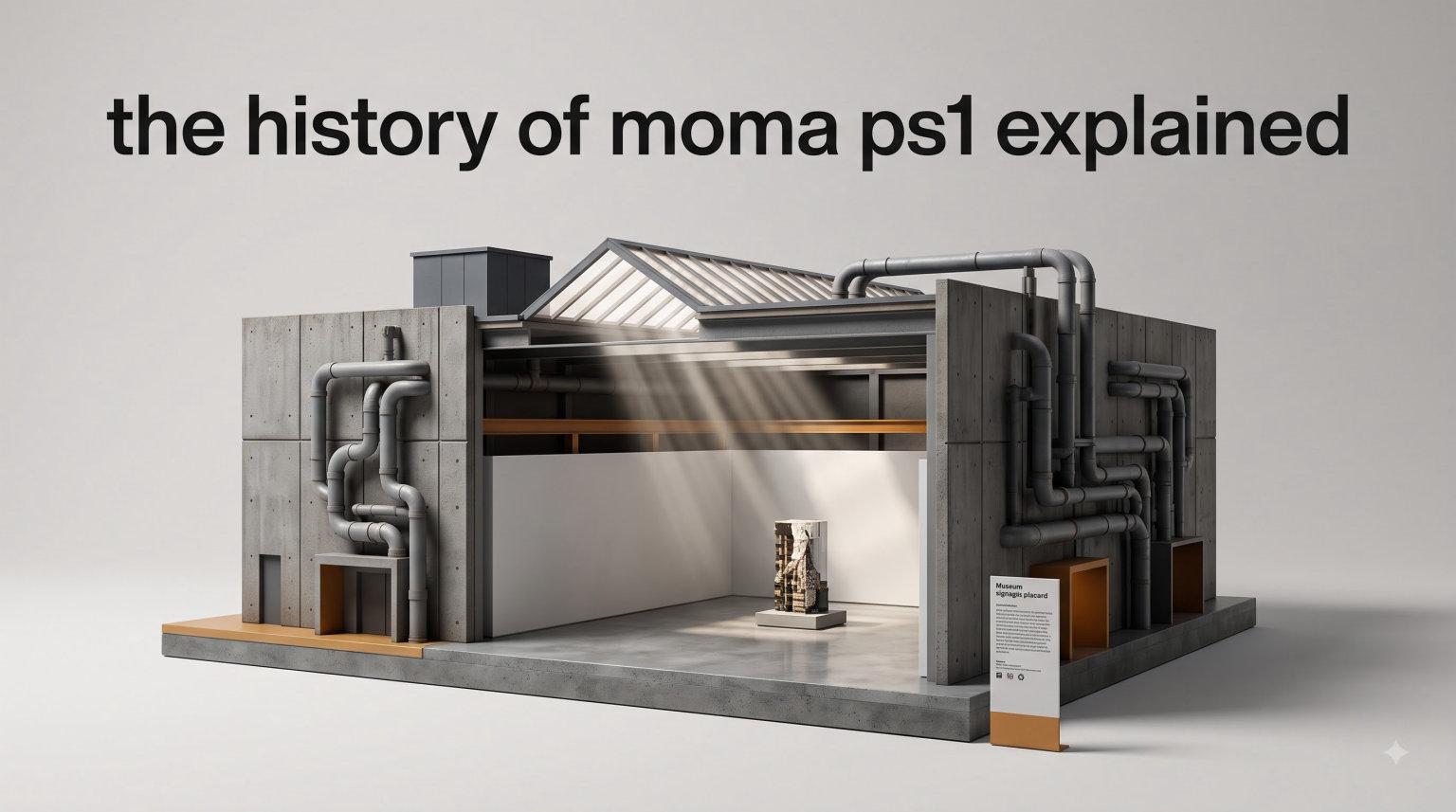
MoMA PS1 stands as one of America’s most significant contemporary art institutions. Founded in 1971 by curator Alanna Heiss, this Long Island City museum transformed from an abandoned public school into a global platform for experimental art.
The history of MoMA PS1 reflects the alternative space movement of the 1970s, when artists sought venues outside traditional galleries to showcase experimental work. Understanding this history helps visitors appreciate why MoMA PS1 operates differently from conventional museums.
In this guide, I will walk you through the complete history of MoMA PS1. We will cover its founding as the Institute for Art and Urban Resources, its transformation of the 1892 school building, its merger with the Museum of Modern Art, and its evolution into the artist-centered institution it is today.
Table of Contents
Founding and Origins: The Birth of an Alternative Space in 1971
Alanna Heiss founded MoMA PS1 in 1971 as the Institute for Art and Urban Resources Inc. She was working as an independent curator when she recognized a critical gap in the New York art world. Emerging artists had nowhere to show experimental work that traditional galleries and museums rejected.
Heiss began organizing exhibitions in underutilized and abandoned spaces across the city. Her first major project was the Clocktower Gallery in lower Manhattan, opened in 1972 in a 13th-floor clocktower space of a government building. This venue became a model for what would later develop at PS1.
The Institute for Art and Urban Resources operated with a simple mission: convert vacant buildings into spaces where artists could create and exhibit work without commercial pressures. Heiss focused on site-specific installations that responded to unusual architectural spaces rather than traditional white-wall galleries.
By 1976, Heiss had secured the former First Ward School in Long Island City, Queens. This 125,000-square-foot Renaissance-revival building would become the permanent home for her experimental art programming. The institution initially operated as P.S. 1 Contemporary Art Center, named after the Public School building it occupied.
The alternative space movement gained significant momentum in New York during the 1970s. Organizations like Artists Space, The Kitchen, and P.S. 1 all opened within a few years of each other. These venues shared a commitment to supporting artists who worked outside mainstream commercial markets.
The Building’s History: From Public School to Art Institution
The MoMA PS1 building carries over 130 years of history within its brick walls. Constructed in 1892, this Renaissance-revival structure originally served as the First Ward School, educating generations of Queens children for nearly eight decades.
The building was designed in the Renaissance-revival architectural style popular for public institutions in the late 19th century. Its sturdy brick construction, high ceilings, and large windows created spaces that would later prove ideal for art installations. The 125,000-square-foot structure offered room for multiple galleries, studios, and performance areas.
By the early 1970s, the school had closed and the building sat vacant. Alanna Heiss discovered the property while scouting for exhibition spaces in Queens. The abandoned school offered everything her new art center needed: large rooms, sturdy construction, and affordable rent.
The name PS1 directly references the building’s history as Public School 1. When the Institute for Art and Urban Resources moved into the space in 1976, they adopted the building’s former identity as their institutional name. This choice honored the location’s educational heritage while signaling their mission to teach the public about contemporary art.
The transformation from school to museum required minimal renovation. Heiss and her team preserved the building’s industrial character, leaving exposed brick, original wood floors, and classroom-sized rooms intact. This decision to embrace rather than erase the building’s history became central to MoMA PS1’s identity.
The Alternative Space Movement and MoMA PS1’s Role
The alternative space movement of the 1970s emerged as artists rejected the commercial gallery system that dominated New York’s art world. Young artists faced significant barriers to entry, with established galleries showing only proven sellers and museums collecting only established names.
Alternative spaces like MoMA PS1 provided platforms for experimental work that traditional venues would not touch. Performance art, video installations, site-specific sculptures, and temporary interventions all found homes in these DIY venues. The movement emphasized artist control over presentation and community engagement over market success.
MoMA PS1 distinguished itself through its scale and ambition. While many alternative spaces operated in small storefronts or temporary locations, PS1 occupied an entire city block. This allowed for large-scale installations and multiple simultaneous exhibitions that smaller venues could not accommodate.
The institution developed a reputation for supporting emerging artists early in their careers. Many significant contemporary artists showed at PS1 before achieving commercial success. This commitment to nurturing new talent became a defining characteristic that continues today.
The alternative space movement influenced museum practices worldwide. Concepts pioneered at PS1 and similar venues, including site-specific installations and artist residencies, eventually became standard practices at major institutions. MoMA PS1’s history represents a crucial chapter in the democratization of art exhibition.
The MoMA Affiliation: Understanding the Merger
The relationship between MoMA and MoMA PS1 creates frequent confusion among visitors. These are separate institutions with distinct missions, though they share resources and programming through a formal affiliation established in 2000.
In 1999, discussions began between the Museum of Modern Art and P.S. 1 Contemporary Art Center about a potential partnership. Both institutions recognized mutual benefits. MoMA sought a dedicated space for contemporary and experimental work, while PS1 needed financial stability and institutional support.
The merger was announced in 2000, creating the first long-term partnership between a major encyclopedic museum and an alternative art space. The agreement maintained PS1’s independent nonprofit status while bringing it under MoMA’s umbrella. This structure preserved PS1’s artist-centered mission while providing access to MoMA’s resources and audience.
Despite the affiliation, significant differences remain between the two institutions. MoMA maintains a permanent collection of modern and contemporary masterworks, while MoMA PS1 focuses on temporary exhibitions and does not collect art. MoMA charges admission fees, while MoMA PS1 now offers free admission as of 2026. MoMA occupies a Manhattan landmark building, while MoMA PS1 inhabits a repurposed school in Queens.
The institutions collaborate on programming, with MoMA PS1 serving as MoMA’s dedicated space for experimental contemporary art. This arrangement allows each institution to focus on its strengths while benefiting from shared expertise and resources.
Signature Programs and Events That Defined MoMA PS1
MoMA PS1 built its reputation through innovative programming that distinguished it from traditional museums. Several signature events and ongoing series have defined the institution’s identity over its five-decade history.
Warm Up Music Series
Warm Up began in 2026 as a summer music series in the museum’s outdoor courtyard. The program features live performances by emerging and established musicians across genres including electronic, hip-hop, indie rock, and experimental music. Warm Up transformed the museum into a cultural gathering place that attracted audiences beyond typical museum visitors.
Young Architects Program (YAP)
The Young Architects Program, launched in 1998, invites emerging architectural talent to design a temporary installation for the museum’s courtyard. Winners receive funding and support to realize ambitious structures that provide shade, seating, and water features for summer visitors. Past winners have included notable firms like CODA, HWKN, and Jenny Sabin Studio.
Greater New York Survey
Greater New York is a quinquennial survey exhibition showcasing work by artists living in the New York metropolitan area. First presented in 2000, the exhibition provides a snapshot of contemporary art production in the city. Unlike traditional biennials, Greater New York focuses specifically on local artists, highlighting the diversity of practice within the five boroughs.
Sunday Sessions
Sunday Sessions is a weekly program of performance art, music, dance, and interdisciplinary work. Held in the museum’s outdoor spaces during warmer months, these free events emphasize community engagement and accessibility. The program reflects MoMA PS1’s ongoing commitment to presenting live art that breaks down barriers between audience and performer.
Materials for the Arts
While not an exhibition program, Materials for the Arts deserves mention as a significant community initiative. This program collects surplus materials from businesses and redistributes them to artists and public schools. It extends MoMA PS1’s mission of supporting creative production beyond the museum walls.
Leadership Transitions Through the Years
MoMA PS1’s history reflects the vision of three distinct directors who each shaped the institution’s direction during their tenures. Understanding these leadership transitions helps explain how the museum evolved from a scrappy alternative space to a globally recognized institution.
Alanna Heiss led the organization from its founding in 1971 until 2008. Her nearly four-decade tenure established the core values that still define the institution: support for emerging artists, embrace of experimental work, and commitment to repurposing unusual spaces. Heiss personally curated many of the museum’s most significant early exhibitions and developed the relationships that sustained the institution through difficult financial periods.
Klaus Biesenbach succeeded Heiss as director in 2008, bringing experience from his curatorial work at MoMA. During his tenure, Biesenbach strengthened ties with the Museum of Modern Art and elevated the institution’s international profile. He expanded programming to include more celebrity artists while maintaining support for emerging talent. Biesenbach departed in 2018 to lead the Museum of Contemporary Art in Los Angeles.
Kate Fowle became director in 2019, arriving from her role as chief curator at Garage Museum of Contemporary Art in Moscow. Fowle has emphasized social justice initiatives and community partnerships during her tenure. Under her leadership, MoMA PS1 announced free admission beginning 2026 and has prioritized accessibility and inclusivity in programming decisions.
Each director brought distinct priorities while maintaining the institution’s core commitment to artist-centered programming. This continuity of vision across leadership changes has allowed MoMA PS1 to evolve while remaining true to its founding mission.
Recent Developments and the 50th Anniversary
2026 marks a significant milestone for MoMA PS1 as the institution celebrates its 50th anniversary. This anniversary year has brought major changes and renewed attention to the museum’s history and future direction.
The most significant recent development is the announcement of free admission for all visitors beginning 2026. This policy change represents a major shift toward accessibility and inclusivity. Previously, admission fees created barriers for many potential visitors, particularly from the local Queens community. Free admission aligns with the institution’s founding mission of making experimental art accessible to broad audiences.
The COVID-19 pandemic significantly impacted MoMA PS1’s operations between 2020 and 2022. Like all cultural institutions, the museum closed temporarily and adapted programming for digital platforms. The pandemic also influenced artistic production, with many 2020-2021 exhibitions addressing themes of isolation, community, and public space.
Social justice initiatives have gained prominence in recent years. In 2019, museum staff organized protests demanding pay equity and fair labor practices. These actions led to changes in compensation policies and increased transparency around institutional finances. The museum has also intensified efforts to support artists from underrepresented communities through exhibition opportunities and financial support.
Community partnerships remain central to MoMA PS1’s mission. The museum works with local schools, community organizations, and cultural institutions throughout Queens. These partnerships extend the institution’s reach beyond traditional museum audiences and strengthen connections with the neighborhood that has hosted the museum for nearly five decades.
Frequently Asked Questions
What is the history of PS1 MoMA?
MoMA PS1 was founded in 1971 by Alanna Heiss as the Institute for Art and Urban Resources Inc., part of the alternative space movement. In 1976, the organization moved into a former public school building in Long Island City, Queens, adopting the name P.S. 1 Contemporary Art Center. The museum merged with the Museum of Modern Art in 2000 and was renamed MoMA PS1 in 2010. Today it operates as one of America’s largest nonprofit contemporary art institutions.
What’s the difference between MoMA and MoMA PS1?
MoMA is the main Museum of Modern Art in Manhattan with a permanent collection spanning modern and contemporary art history. MoMA PS1 is an affiliate institution in Queens focused specifically on experimental contemporary art and temporary exhibitions. MoMA PS1 does not maintain a permanent collection and now offers free admission, while MoMA charges admission fees. The institutions collaborate on programming but operate independently.
Was MoMA PS1 a school?
Yes, the building that houses MoMA PS1 was originally constructed in 1892 as the First Ward School, a public elementary school in Long Island City. The Renaissance-revival brick building operated as a school for nearly 80 years before closing in the early 1970s. When Alanna Heiss founded her art center in 1976, she chose this vacant school building as the permanent home. The name PS1 directly references its history as Public School 1.
What was the PS1 MoMA merger?
The merger between MoMA and P.S. 1 was announced in 2000, creating a formal affiliation between the two institutions. The partnership allowed PS1 to access MoMA’s resources and audience while maintaining its independent nonprofit status and artist-centered mission. Following the merger, the institution was renamed MoMA PS1 in 2010. The affiliation enables collaboration on programming while preserving the distinct identities of both museums.
Conclusion
The history of MoMA PS1 explained reveals an institution that transformed from a scrappy alternative space into a globally recognized contemporary art museum. From Alanna Heiss’s founding vision in 1971 through its 50th anniversary in 2026, the museum has maintained its commitment to experimental art and emerging artists.
The story of MoMA PS1 demonstrates how alternative spaces can influence mainstream institutions. Concepts pioneered at PS1, including site-specific installations and artist residencies, became standard practices at museums worldwide. The building’s transformation from 1892 schoolhouse to art institution symbolizes the adaptive reuse that defines creative urban development.
Understanding this history enriches any visit to MoMA PS1. The creaky floors and classroom-sized galleries carry decades of artistic innovation. The courtyard where Warm Up concerts happen has hosted generations of experimental performance. For current visiting information and details on what to see, check our MoMA PS1 Guide.
MoMA PS1’s free admission policy, announced for 2026, represents a return to the accessibility that defined the alternative space movement. As the institution enters its next 50 years, it continues balancing experimental programming with community engagement, proving that artist-centered institutions can thrive while serving broad publics.