
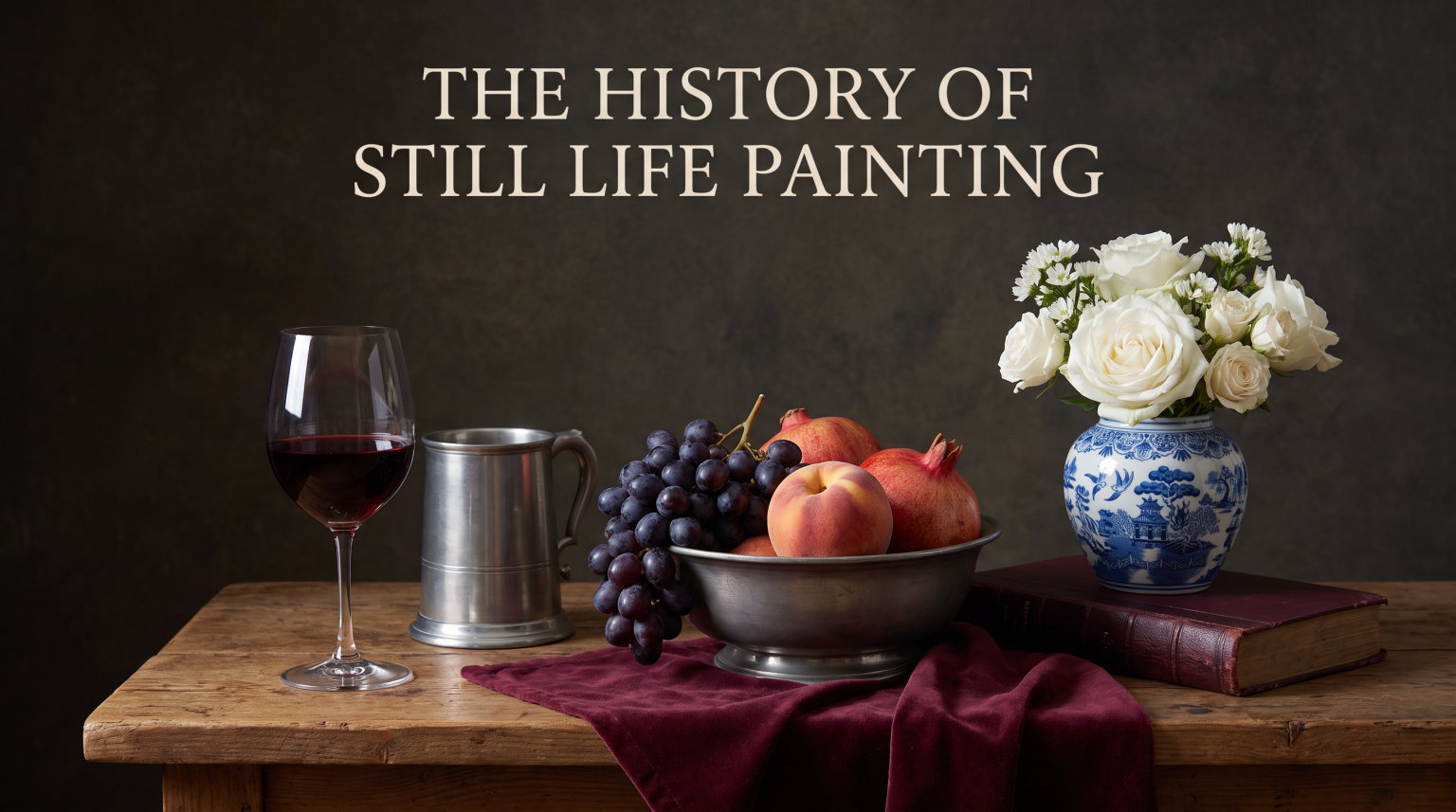
Imagine walking through an art museum and pausing before a simple bowl of fruit. That humble arrangement carries thousands of years of artistic tradition, symbolism, and innovation. The history of still life painting spans from ancient Egyptian tombs to contemporary galleries, evolving from funerary offerings to philosophical meditations on mortality and beauty. This journey reveals how one of art’s most accessible genres became a proving ground for every major artistic movement.
Table of Contents
What Is Still Life Painting?
Still life painting is a genre that depicts inanimate objects—flowers, food, household items, or natural elements—arranged in a composed setting. Unlike portraiture or history painting, still life lacks human subjects, yet it has consistently attracted major artists seeking to master realism, explore symbolism, and experiment with light and form.
In the Western art hierarchy established by the French Academy in the seventeenth century, still life was ranked below history painting and portraiture. This “low” status ironically freed artists to take creative risks without the burden of representing historical or religious narratives. The best still life works transform ordinary objects into profound statements about existence, wealth, faith, and the passage of time.
The genre encompasses diverse approaches, from hyperrealistic renderings that challenge photography to abstract interpretations that deconstruct form. Whether depicting a single apple or an elaborate banquet, still life paintings invite viewers to look closely at what might otherwise be overlooked.
Ancient Origins: Egypt, Greece, and Rome
The earliest known still life paintings emerged in ancient Egypt around the fifteenth century BCE. Egyptian tomb paintings depicted food offerings meant to sustain the deceased in the afterlife. These functional works featured carefully rendered loaves of bread, fowl, vegetables, and fruit—arranged with the flat perspective typical of Egyptian art but showing remarkable attention to naturalistic detail.
Ancient Egyptian beliefs about the afterlife required that tombs be stocked with everything the deceased might need. Painters created detailed depictions of food, beer, and household items, believing these images would somehow provide for the dead. The care and accuracy lavished on these paintings established a tradition of observational rendering that would influence Western art for millennia.
Greek artists of the classical period developed panel paintings (monotypia) featuring food and flowers, though none survive today. Ancient texts reference famous still life painters like Zeuxis and Parrhasius, who reportedly competed to create illusions so convincing that birds tried to peck painted grapes. These anecdotal accounts suggest Greek artists had mastered trompe-l’oeil techniques centuries before the term entered common usage.
Roman painters brought still life into their villa frescoes, creating elaborate arrangements of food, wine, and flowers. Roman domestic art celebrated abundance and pleasure, reflecting a culture that valued hospitality and culinary sophistication. The preserved frescoes from Pompeii and Herculaneum reveal sophisticated understanding of composition, color harmony, and spatial illusion that rivals anything produced in later centuries.
The Medieval Period: Religious Symbolism Takes Root
With the decline of classical civilization, still life painting retreated into religious symbolism. Byzantine art, which dominated medieval visual culture, used symbolic objects to convey spiritual messages rather than naturalistic appearances. Gold backgrounds replaced naturalistic settings, and objects existed primarily as theological symbols rather than subjects for their own sake.
Medieval manuscripts occasionally featured illuminated initial letters containing small still life elements. A candle might represent Christ as light of the world. A flower could symbolize purity or the Virgin Mary. Books denoted divine wisdom. These early uses of objects as symbols established frameworks for meaning-making that would later define Dutch vanitas paintings.
The medieval period planted seeds for themes that would fully bloom during the Dutch Golden Age. Concepts like memento mori (“remember you must die”) and the transience of earthly pleasure emerged from monastic meditations and theological writings. When still life finally became an independent genre, artists drew on these rich symbolic traditions to create works dense with hidden meaning.
Gothic cathedrals featured carved stonework with symbolic objects—lions, eagles, flowers—carrying theological significance. These sculptural traditions influenced how medieval audiences interpreted visual imagery, preparing them for the symbolic complexity that would characterize Renaissance and Baroque still life painting.
The Renaissance: Still Life Comes of Age
The Italian Renaissance brought renewed interest in naturalism and human observation, creating conditions for still life’s emergence as an independent art form. Early Renaissance painters like Giotto and his followers studied nature with unprecedented care, developing techniques for rendering three-dimensional forms on flat surfaces.
Caravaggio, working in Milan around 1599, is widely credited as the father of pure still life painting. His “Basket of Fruit” (c. 1599), held at the Pinacoteca Ambrosiana in Milan, depicts a wicker basket overflowing with autumn harvest—grapes, apples, pears, figs, and a collection of leaves. This work exists for its own sake, without religious or mythological framing. Art historians recognize it as the first true still life in Western art.
Caravaggio’s revolutionary approach involved using ordinary objects as the sole subject matter, rendered with extraordinary realism and dramatic lighting. His chiaroscuro technique—contrasting areas of light and shadow—became essential to still life painting, creating depth and visual drama that elevated the genre beyond mere description. Other artists quickly adopted his innovations, launching still life into its golden age.
Northern Renaissance artists developed complementary approaches. Jan Brueghel the Elder in Flanders created elaborate flower paintings that combined botanical accuracy with luxurious color. Working with Rubens, Brueghel contributed flower studies to larger compositions while producing independent floral works that delighted wealthy collectors. These collaborations between specialists demonstrated how still life could function within larger artistic economies.
The Dutch Golden Age: Vanitas and Symbolism
No period shaped still life painting more profoundly than the Dutch Golden Age (roughly 1588-1672). With the rise of a wealthy merchant class and Calvinist restrictions on religious imagery in churches, still life became the dominant genre in Dutch art markets. Artists specialized exclusively in specific still life types, creating an unprecedented flowering of the form.
The Dutch gave still life its most enduring symbolic language: vanitas. Derived from the Latin word for “emptiness” or “futility,” vanitas paintings reminded viewers that earthly pleasures and achievements are temporary. Common elements included skulls (memento mori), hourglasses and pocket watches (time’s passage), extinguished candles (life’s brevity), and bubbles (the fragility of existence). A peeled orange or withering flower spoke to beauty’s impermanence.
Artists like Pieter Claesz (1596-1660) mastered the “monochrome” still life, using subtle tonal variations to create elegance and atmosphere. His compositions featured a few carefully chosen objects—often a roemer glass, a partially eaten meal, a pipe—arranged on a stone ledge. These humble arrangements convey profound meditations on transience through carefully observed details.
Willem Kalf (1619-1693) pioneered the pronkstilleven (“ostentatious still life”), featuring rich displays of Chinese porcelain, silver vessels, exotic fruits, and draped silk. These works celebrated Dutch mercantile wealth while maintaining underlying vanitas messages about the transience of material abundance. The contrast between lavish display and symbolic warning created productive tensions that engaged viewers intellectually and aesthetically.
The Dutch also developed specialized subgenres: ontbijtjes (breakfast pieces) featuring morning meals, banketjes (banquet pieces) showing elaborate feasts, and bloemstukken (flower paintings) capturing botanical beauty at its peak and sometimes its wilting. This specialization allowed artists to develop extraordinary technical mastery in specific areas.
The Four Types of Still Life
Art historians typically categorize still life paintings into four main types, each with distinct characteristics and purposes. Understanding these categories helps viewers appreciate the diversity within the genre and the specific challenges each type presented to artists.
Flower paintings represent one of the most technically demanding still life categories. Artists depicted single blooms, small bouquets, or elaborate arrangements, often combining flowers that would never bloom together in nature. The fleeting beauty of cut flowers allowed painters to explore seasonal symbolism while demonstrating technical mastery of delicate petals, translucent light, and complex color harmonies. Artists like Rachel Ruysch (1664-1750) created flower paintings so vibrant they seemed to pulse with life.
Banquet or breakfast pieces emerged as distinctly Dutch contributions to still life painting. These paintings showed prepared foods on tables—cold meats, cheeses, bread, wine, and fruit—arranged with casual elegance. They reflected Dutch domestic culture and merchant prosperity while incorporating vanitas messages about consumption and mortality. The carefully observed details of food preparation reveal Dutch respect for craftsmanship and material quality.
Animal paintings depicted hunting scenes with dead game—birds, rabbits, fish, and other prey. These works combined the challenge of rendering fur, feathers, and scales with symbolic associations of the hunt and the circle of life and death. A mallard drake’s iridescent feathers or a fish’s silvery scales presented technical challenges that attracted artists seeking to demonstrate mastery.
Symbolic vanitas compositions brought together diverse objects—skulls, watches, books, musical instruments, scientific instruments—into complex arrangements encoding philosophical messages about knowledge, time, faith, and earthly achievement. These intellectual puzzles engaged educated viewers who could decode their layered meanings. A globe, a skull, and an open book might suggest the futile pursuit of worldly knowledge in the face of mortality.
18th and 19th Century Evolution
As the Dutch Republic declined politically and economically, French painters elevated still life to new artistic heights. Jean-Baptiste-Simeon Chardin (1699-1779) brought quiet dignity to everyday objects. His paintings of kitchens, laboratories, and children’s toys combined Dutch realism with French refinement, earning praise from critics and collectors alike. Chardin demonstrated that still life’s power lay not in dramatic subjects but in authentic observation and harmonious composition.
Chardin’s influence extended beyond France. His example encouraged artists across Europe to find meaning in humble subjects. A copper pot, a bundle of radishes, a child’s game—these became vehicles for exploring visual relationships and evoking domestic warmth. His successor in France, Jean-Baptiste-Siméon Chardin, opened paths that later Impressionists would follow.
The eighteenth century saw still life gain increasing acceptance in the French Academy, though it remained officially classified below history painting. This official hierarchy had little effect on artistic practice, as collectors continued purchasing still life paintings and ambitious artists pursued excellence in the genre. The relaxed attitudes toward hierarchy in pre-revolutionary France allowed still life to flourish.
The Impressionists revolutionized still life by capturing momentary light effects and breaking objects into luminous brushstrokes. Monet painted haystacks and water lilies with equal devotion to what others might consider mundane subjects. Renoir’s舞女 and fruit arrangements pulsed with life through broken color. Their approach liberated still life from the requirement for finished surfaces and precise drawing.
Post-Impressionists pushed further in their explorations. Cézanne reconfigured still life geometry, showing how objects relate spatially through color and form rather than traditional linear perspective. His apples and vases influenced generations of modernists, demonstrating that still life’s true subject was not realistic imitation but formal relationships and perceptual experience.
Modern Art and Cubism
The twentieth century fundamentally transformed still life through abstraction. Cubism, pioneered by Pablo Picasso and Georges Braque around 1907, shattered objects into geometric facets, presenting multiple viewpoints simultaneously. Their guitar and clarinet still lifes questioned whether objects existed as fixed entities or as collections of shifting perspectives.
Picasso’s “Still Life with Chair Caning” (1912) mixed actual oilcloth with painted elements, blurring boundaries between art and reality. This collage approach, influenced by Cubism’s interest in material reality, opened doors for later movements including Pop Art’s celebration of consumer objects and conceptual approaches to artistic practice.
Cézanne, though working before Cubism officially emerged, planted its intellectual seeds. His Mont Sainte-Victoire paintings and still lifes revealed how forms could be understood through underlying geometric structures—spheres, cylinders, cones—that related to each other spatially. Modern artists recognized that still life’s essence lay not in realistic imitation but in exploring how we perceive and conceptualize the visual world.
The Surrealists found rich territory in still life’s dreamlike possibilities. Giorgio de Chirico arranged classical sculptures with fruit and shadows, creating melancholic visions of time’s labyrinth. His mysterious Perspectives suggested ancient ruins meeting modern anxiety. Salvador Dalí painted melting clocks that extended vanitas symbolism into Freudian territory, exploring the subjectivity of time itself.
Abstract Expressionists generally avoided still life’s literal subject matter, but their interest in gesture, material, and spontaneous creation influenced how later artists approached traditional subjects. Contemporary painters often combine gestural freedom with observational precision, creating hybrids that reflect multiple artistic traditions simultaneously.
Contemporary Still Life
Today’s still life painters work in digital contexts their predecessors could never have imagined. Hyperrealistic artists like Ralph Goings, Cynthia Back, and Tom Wesselmann create paintings so precise they challenge photography itself. These works raise questions about perception, authenticity, and representation in an image-saturated world where photographs are taken for granted.
Contemporary photographers continue still life’s traditions through staged arrangements exploring consumer culture, identity, and mortality. Artists like Jeff Wall and Tara Donovan use everyday materials—shipping pallets, plastic cups, paper fans—to create monumental works that transform the mundane into the sublime. Their installations force viewers to reconsider objects they might otherwise overlook.
The line between photography and painting has blurred considerably in contemporary practice. Many artists trained in one medium work in another, bringing photographic precision to painted surfaces or painterly spontaneity to photographic prints. This cross-fertilization reflects broader trends toward media hybridity in contemporary art.
Non-Western traditions increasingly inform contemporary practice. Japanese ikebana (flower arranging), Chinese scholar’s rocks, and Islamic geometric patterns offer alternative frameworks for understanding arrangements and compositions. Global art discourse recognizes still life as a truly universal genre, expressed differently across cultures but addressing similar themes of beauty, transience, and human relationship with objects.
The influential contemporary artists working in still life today demonstrate that this ancient genre remains vital. Whether exploring guerrilla art and public installations or traditional canvas work, contemporary practitioners build on centuries of innovation while finding fresh approaches to timeless questions.
Technical Elements: Composition and Technique
Still life painting requires mastery of several technical elements that distinguish excellent examples from merely competent ones. Understanding these technical aspects helps viewers appreciate the skill involved and the choices artists make when arranging and rendering their subjects.
Composition determines how viewers’ eyes move through a painting. The 70/30 rule suggests roughly 70% of a composition should feature main subjects or focal points, while 30% provides negative space or secondary elements. In practice, artists balance objects to create visual rhythm, tension, and harmony. Still life compositions often use diagonal arrangements to create dynamic energy or horizontal arrangements for calm stability.
Light and shadow (chiaroscuro) create three-dimensionality and mood. Caravaggio’s dramatic lighting influenced generations of still life painters who sought to create theatrical effects through carefully controlled light sources. Understanding how light falls on different surfaces—matte, shiny, transparent—requires extensive observation and practice.
Texture rendering challenges still life painters to make canvas look like metal, fabric, flesh, or plant material. This challenge motivated trompe-l’oeil painters who sought to create illusions so convincing that viewers questioned whether they were looking at painting or reality. Contemporary hyperrealists continue pursuing these illusions with photographic reference and meticulous technique.
Color harmony ties compositions together. Dutch masters often limited their palettes to create tonal unity, while other artists used contrasting colors to create visual excitement. The color relationships in a successful still life create emotional resonance beyond individual object descriptions.
Still Life in Non-Western Traditions
While this article has focused primarily on Western still life traditions, the genre exists in cultures worldwide, though often with different emphases and purposes. Exploring these non-Western approaches enriches our understanding of how humans represent inanimate objects visually.
Japanese art developed sophisticated traditions of flower arrangement (ikebana) and nature depiction that influenced visual representation. Screens and scrolls featuring plants, shells, and seasonal motifs created contexts for still-life-like imagery that carried different philosophical implications than Western counterparts. Japanese aesthetics emphasizing impermanence (mono no aware) and asymmetrical beauty (wabi-sabi) created distinctive approaches to depicting natural objects.
Chinese painting traditions featured “flower-and-bird” (hua-niao) subjects that parallel Western still life in some respects. Artists like Xu Xi (c. 1500-1557) created meticulous depictions of flowers, insects, and natural objects combining scientific observation with artistic elegance. Chinese painting theory emphasized capturing spirit (qi) rather than mere physical accuracy.
Islamic art traditions developed geometric and floral patterns for architectural decoration that featured still-life-like elements within complex decorative systems. These traditions valued pattern, rhythm, and mathematical precision rather than illusionistic representation. Understanding these different aesthetic values helps contextualize Western still life’s particular emphasis on deception and realism.
Contemporary global art has largely moved beyond rigid cultural categories. Artists today draw on diverse traditions while working across media and cultural boundaries. The result is a truly international still life practice that reflects our globally connected world while maintaining connections to local traditions and concerns.
Conclusion
The history of still life painting reveals art’s endless capacity to find meaning in the ordinary. From Egyptian tomb offerings to contemporary hyperrealism, artists have returned to inanimate objects as subjects for meditation, technical demonstration, and philosophical inquiry. This consistency across millennia suggests something fundamental about human perception and our need to understand our place in the material world.
What began as funerary necessity—feeding the dead through magical substitution—became a vehicle for exploring mortality, wealth, faith, and perception itself. The genre that the French Academy considered beneath history painting became instead a laboratory for artistic innovation. Every major movement—Renaissance naturalism, Baroque chiaroscuro, Impressionist light, Cubist fragmentation—tested itself against still life’s challenges.
Today, still life continues evolving. Digital tools, global perspectives, and contemporary concerns expand what artists can do with a bowl of fruit or a collection of everyday objects. The genre’s accessibility—its relatable subjects and immediate visual appeal—belies its depth. When you encounter a still life painting, you’re seeing accumulated wisdom of thousands of years of artistic practice, each generation building on what came before while pushing in new directions.
For those interested in exploring art history further, our guide to 50 most important performance art pieces in history offers another window into how artists have challenged conventions across time. Similarly, understanding appropriation art in modern contexts reveals how contemporary artists continue questioning representation, originality, and meaning in visual culture.
The history of still life painting teaches us that nothing is ever truly still. Every object carries stories of those who made it, owned it, arranged it for viewing. Every painting captures a moment in an ongoing conversation between artists, objects, and audiences—a conversation that continues today, reflecting our contemporary preoccupations while maintaining connections to ancient human concerns about mortality, beauty, and meaning.