
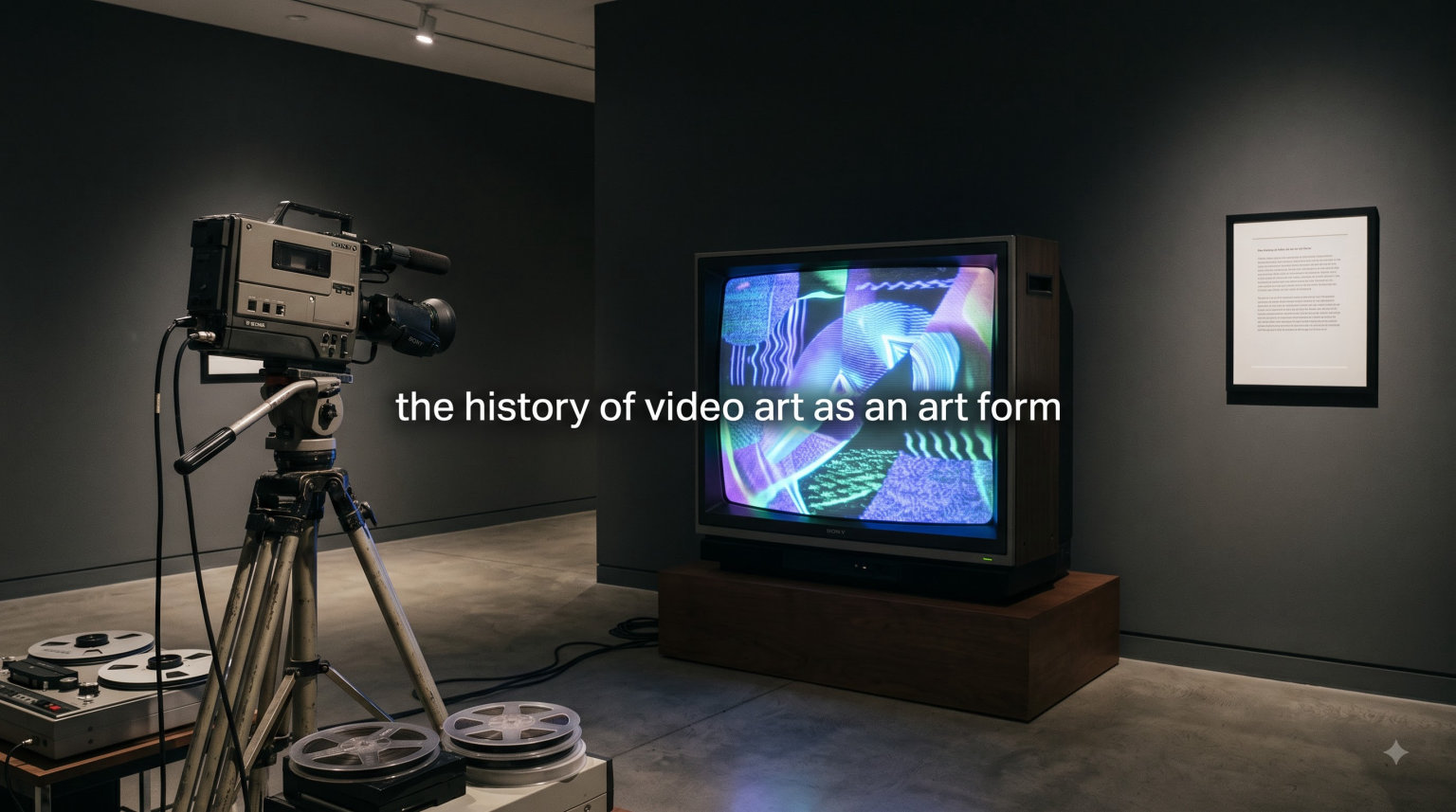
Video art is an art form that uses video technology as its primary visual and audio medium, emerging during the late 1960s when portable video equipment first became available outside corporate broadcasting studios. The history of video art as an art form traces back to a handful of radical artists who saw television and video not as entertainment tools, but as raw creative material. What started with a portable Sony recorder and a handful of provocateurs has grown into one of the most dynamic forces shaping contemporary art today.
I have spent years studying this medium, visiting installations from MoMA in New York to the Tate Modern in London, and the story of video art never stops surprising me. Artists grabbed technology designed for news broadcasts and turned it into something deeply personal, political, and sometimes strange. This guide walks through every major era, every key artist, and every technological shift that made video art what it is in 2026.
Table of Contents
What Is Video Art?
Video art is work produced using video as a medium. Unlike cinema or television, video art does not need a narrative, a script, or a commercial purpose. It can be a single-channel video played on a monitor, a multi-room installation with dozens of screens, or a live performance broadcast in real time. The artist uses the camera, the screen, and the signal itself as creative tools.
The distinction between video art and experimental film matters. Experimental film typically involves celluloid, a darkroom, and a theatrical viewing setup. Video art uses magnetic tape or digital recording, monitors or projectors, and was born from the same cultural moment as conceptual art and Fluxus. The medium is the message, as Marshall McLuhan famously said, and video artists took that idea literally.
There are several forms video art can take. Single-channel video is a single video played on one screen, essentially the simplest format. Video installation uses multiple monitors or projections arranged in physical space, turning the room itself into part of the artwork. Video sculpture combines physical objects with video displays. Interactive video art responds to the viewer’s presence or input. Performance-based video art documents or incorporates live actions. Each format emerged at different points in the history we are about to trace.
Key terms you will encounter include the Sony Portapak, the first portable video recorder that made the entire medium possible. A video synthesizer generates or manipulates video signals electronically. Cathode ray tube, or CRT, refers to the classic television monitors many early video artists used as display surfaces. Understanding these terms helps make sense of how artists worked within and against the limits of their equipment.
The History of Video Art: Origins and Early Beginnings
Video art did not appear out of nowhere. Its roots stretch back to the late 1950s, when the German artist Wolf Vostell began incorporating television sets into his artwork. In 1958, Vostell created “TV Decollage,” an installation that used multiple television screens showing distorted broadcast images. He saw television as a cultural force worth confronting, not ignoring. His work treated the TV set as both subject and object, a strategy that would define video art for decades.
The story most people point to as the official birth of video art centers on Nam June Paik, a Korean-American artist who had been working with televisions and modified electronics since the early 1960s. In 1963, Paik presented “Exposition of Music – Electronic Television” at the Galerie Parnass in Wuppertal, Germany. The exhibition featured thirteen modified television sets, some with magnets placed on them to distort the broadcast signal into abstract patterns. This was not yet video art in the way we understand it today, but it was the first time an artist had treated the television set as a sculptural and painterly medium.
Everything changed in 1965 when Sony released the Portapak, the first commercially available portable video tape recorder. The Portapak was bulky by today’s standards, but it was small enough for one person to carry and operate. For the first time, an artist could record video without a broadcast studio, without a network, without permission. Paik supposedly purchased one of the first Portapak units in the United States and recorded footage of Pope Paul VI’s motorcade driving through New York City on October 4, 1965. He played the tape that same evening at the Cafe a Go Go in Greenwich Village. Whether this exact sequence of events happened precisely this way has been debated by art historians, but the symbolic weight is clear: video art was born the moment an artist could record and play back moving images independently.
The Fluxus art movement provided the philosophical backdrop for these early experiments. Fluxus artists rejected the preciousness of traditional art objects and embraced everyday materials, chance operations, and audience participation. Paik was deeply involved with Fluxus, having studied with composer John Cage and collaborated with artists like George Maciunas and Joseph Beuys. The Fluxus spirit gave video art its freedom from convention. Video was cheap, immediate, and reproducible, everything that painting and sculpture were not.
Other early pioneers quickly followed. In Europe, artists like Wolf Vostell and Gerrit Thomas Rietveld experimented with broadcast intervention, inserting artistic content into television schedules without prior approval. In Japan, the collectives Video Hiroba and JVC experimented with video as a communal, participatory medium. These parallel developments across continents prove that video art was not the invention of a single person but a global response to new technology.
Key Pioneers Who Shaped Video Art
Nam June Paik: The Father of Video Art
Nam June Paik is widely considered the father of video art. Born in Seoul in 1932, Paik studied music and philosophy before turning to art. His background in music shaped his approach to video. He treated electronic signals the way a composer treats sound, arranging, distorting, and layering them into new compositions. His 1974 work “TV Buddha” features a statue of Buddha facing its own image on a closed-circuit television, a meditation on self-reflection, technology, and spirituality that still feels relevant decades later.
Paik’s “Global Groove” from 1973 is a frenetic, 28-minute video that mixes performance art, commercials, and experimental imagery into something that anticipated MTV by nearly a decade. His “Electronic Superhighway” installations used dozens of monitors to create maps and landscapes from screens, predicting the internet age. Paik coined the term “electronic superhighway” in 1974, years before anyone used the word “internet” in common conversation. He passed away in 2006, but his influence saturates every corner of video art today.
Bruce Nauman: The Body as Medium
Bruce Nauman began using video in the late 1960s to record performances in his studio. Unlike Paik, who was fascinated by technology itself, Nauman treated the camera as a neutral witness. In works like “Walking in an Exaggerated Manner Around the Perimeter of a Square” (1967-68), Nauman recorded himself performing simple, repetitive physical actions. The video was not meant to be entertaining. It was meant to make the viewer aware of their own body and attention. Nauman’s stripped-down approach influenced generations of artists who saw that video art did not require special effects or electronic wizardry.
Joan Jonas: Feminist Video Art Pioneer
Joan Jonas began making video art in the early 1970s, and her work quickly became central to the feminist art movement. In “Vertical Roll” (1972), Jonas performed in front of the camera while the video signal was intentionally disrupted, creating a jarring, rhythmic visual effect that mirrored the fragmentation of female identity under patriarchal culture. Her works combined performance, performance art, masks, mirrors, and video in ways that felt theatrical and personal at the same time. Jonas proved that video art could address politics and identity as powerfully as any painting or sculpture.
Bill Viola: Spiritual Immersion
Bill Viola has spent over four decades creating video installations that explore themes of birth, death, consciousness, and human emotion. His works are often large-scale projections shown in darkened rooms, engulfing the viewer in slow-motion imagery of water, fire, and human figures. “The Crossing” (1996) shows a figure on a double-sided screen, slowly consumed by water on one side and fire on the other. “The Greeting” (1995) reimagines a Pontormo painting as a slow-motion video, extending a brief moment of human connection into a ten-minute experience. Viola’s work demonstrates that video art can be deeply emotional and contemplative, not just conceptual or political.
Other Essential Artists
Andy Warhol dabbled in video throughout his career, creating early video portraits and producing cable access shows that blurred the line between art and entertainment. Vito Acconci used video to document provocative performance pieces that tested boundaries between artist and viewer. Dara Birnbaum deconstructed television imagery, particularly representations of women in media, using repetition and editing as critical tools. Peter Campus created early video installations that used closed-circuit cameras to place the viewer inside the artwork. Each of these artists expanded what video art could be and do.
The 1970s: Video Art Comes Into Its Own
The 1970s marked the decade when video art moved from radical experiment to recognized art form. Several forces drove this transformation. Portable video equipment became cheaper and more widely available. Art schools began incorporating video into their programs. Museums started collecting and exhibiting video work. And a new generation of artists, particularly women and artists of color, discovered that video was an accessible way to make art about identity, politics, and personal experience.
Feminist video art was one of the most powerful movements of the decade. Artists like Joan Jonas, Dara Birnbaum, and Martha Rosler used video to critique media representations of women, document their bodies and performances, and create work that existed outside the male-dominated gallery system. Rosler’s “Semiotics of the Kitchen” (1975) is a deadpan parody of cooking shows in which she demonstrates kitchen tools with increasingly aggressive gestures. The six-minute video remains one of the most referenced works of feminist art ever made.
Institutional recognition arrived quickly. The Museum of Modern Art in New York established its video program in the early 1970s, and the Whitney Museum of American Art began including video art in its Biennial exhibitions. The Kitchen, founded in New York in 1971 by Steina and Woody Vasulka, became a legendary space for video art, performance, and experimental music. European institutions followed, with the Kunsthalle Dusseldorf and the Musee National d’Art Moderne in Paris beginning to collect and exhibit video work.
Community access television became an unexpected platform for video art. In the United States, the development of public access cable channels in the early 1970s gave artists free airtime and equipment. Groups like TVTV (Top Value Television) used portable video gear to produce alternative coverage of political events. In Canada, the theorist Marshall McLuhan’s ideas about media and technology influenced a generation of video artists, and institutions like the Western Front in Vancouver provided crucial support for experimental video work.
Technology advanced too. Video synthesizers, devices that could generate and manipulate electronic images without a camera, became available. Stephen Beck’s Direct Video Synthesizer and the Paik-Abe Video Synthesizer, developed by Nam June Paik and engineer Shuya Abe, allowed artists to create abstract imagery directly from electronic signals. These devices expanded the visual vocabulary of video art beyond what a camera could capture, opening the door to entirely non-representational video work.
The 1980s and 1990s: From Analog to Digital
The 1980s brought new influences and technologies to video art. The launch of MTV in 1981 changed how a generation thought about moving images. Music videos compressed experimental visual techniques into three-minute packages, and video artists responded by either embracing the new visual language or pushing further away from it. Some artists, like Dara Birnbaum, directly sampled and re-edited television footage, treating broadcast media as raw material.
Digital technology began replacing analog equipment in the late 1980s and early 1990s. Nonlinear editing systems allowed artists to manipulate video footage with unprecedented precision. Where early video artists had to edit tape by physically cutting and splicing magnetic tape, digital editing made the process faster, cheaper, and more experimental. The shift from analog to digital also changed the look of video art, introducing cleaner images, new effects, and eventually high-definition resolution.
The period produced some of the most ambitious video installations to date. Bill Viola created room-sized environments using multiple projections and complex sound design. Gary Hill explored the relationship between language and moving image in works like “Insofar As It Is Always Already Taking Place” (1990), which used seventeen monitors arranged in a sculptural formation. Tony Oursler projected faces onto fabric dolls and everyday objects, creating unsettling figurative installations. Matthew Barney combined video with sculpture and performance in his sprawling “Cremaster Cycle,” which premiered in the late 1990s and became one of the most talked-about art projects of the era.
Video art biennials and festivals proliferated during this period. The World Wide Video Festival in The Hague, the VideoBrasil festival in Sao Paulo, and the International Video Festival in Vigo, Spain, gave artists international platforms outside the traditional gallery and museum system. These events helped build a global community of video artists and audiences, connecting practitioners across borders and cultures. Understanding where video art fits within the broader trajectory of art history, including the distinction between modern art vs contemporary art, helps contextualize these developments.
By the end of the 1990s, video art was firmly established in the art world. Major museums had dedicated media galleries. Art schools taught video production alongside painting and sculpture. The Venice Biennale and Documenta regularly featured video installations. What had begun as an outsider’s medium three decades earlier was now central to contemporary art practice.
Contemporary Video Art: 2026 and Beyond
Video art in 2026 operates in a landscape that Nam June Paik could barely have imagined. High-definition cameras, drone footage, 3D rendering, virtual reality, and artificial intelligence have all become available tools. Artists work with resolutions and processing power that make the grainy Portapak footage of the 1960s look like ancient artifacts. Yet the core impulse remains the same: using moving images and sound to create experiences that challenge how we see the world.
Several artists have defined the contemporary era. Christian Marclay’s “The Clock” (2010) is a 24-hour video installation composed of thousands of clips from films and television shows, each referencing the actual time displayed on a clock. The piece runs in real time, so that the time shown on screen always matches the time in the gallery. It is a monumental achievement in found-footage art and has been exhibited at major museums worldwide. Pipilotti Rist creates saturated, dreamlike video installations that fill entire rooms with color, sound, and projected imagery. Her work “Pixel Forest” (2016) suspended thousands of LED lights from a gallery ceiling, creating an immersive environment that dissolved the boundary between video and physical space.
Hito Steyerl, a German artist and writer, addresses the politics of digital images, surveillance, and military technology. Her video essays combine documentary footage, digital animation, and sharp analysis. Works like “How Not to Be Seen: A Fucking Didactic Educational .MOV File” (2013) blend humor and critique in ways that feel tailored to the internet age. Steyerl’s practice demonstrates that video art can engage with contemporary politics as directly as any journalistic medium.
Virtual reality has opened an entirely new dimension for video artists. VR installations place the viewer inside the artwork, removing the boundary between observer and image. Artists like Jordan Wolfson, Lauryn Spielvogel, and Nonny de la Pena have created VR experiences that range from disturbing to transcendent. Immersive projection mapping, where video is projected onto buildings, landscapes, and sculptural surfaces, has transformed public spaces into temporary artworks. TeamLab, a Japanese collective, creates massive digital environments where viewers walk through fields of digital flowers and cascading waterfalls of light.
The smartphone era has complicated video art in fascinating ways. When billions of people carry high-definition video cameras in their pockets and share moving images on platforms like TikTok, Instagram, and YouTube, the question of what distinguishes video art from everyday video becomes urgent again. Some artists have embraced social media as a platform. Amalia Ulman created “Excellences & Perfections” (2014), a months-long performance conducted entirely through Instagram posts, in which she fabricated an elaborate fictional identity. The work was later exhibited in galleries, raising questions about where video art lives and who it is for.
Streaming platforms have made video art more accessible than ever. Online archives like Electronic Arts Intermix, UbuWeb, and the Arte channel stream historic and contemporary video works. During the COVID-19 pandemic, museums and galleries pivoted to presenting video art online, accelerating a trend that was already underway. While nothing replaces standing in a darkened room surrounded by Bill Viola’s projections, the increased accessibility has introduced new audiences to the medium.
How to Experience Video Art Today
One of the most common questions people ask is where they can actually see video art in person. The good news is that video art is more visible today than at any point in its history. Major museums with significant video art collections include the Museum of Modern Art and the Whitney Museum of American Art in New York, the Tate Modern in London, the Centre Pompidou in Paris, and the ZKM Center for Art and Media in Karlsruhe, Germany. Many of the best galleries in NYC also regularly feature video art exhibitions.
Video art festivals offer another entry point. The Transmediale in Berlin, the Impressions Festival in Geneva, and the aforementioned VideoBrasil in Sao Paulo are among the most important annual events. In the United States, the Images Festival in Toronto and the Experimental Film and Video Festival in Chicago provide platforms for emerging artists. Many of these festivals offer online programs, making it possible to experience video art from anywhere in the world.
For those who want to go deeper, several books and documentaries are worth seeking out. Barbara London’s “Video Art: The First Fifty Years” provides an excellent historical overview from a curator who helped build MoMA’s video collection. Michael Rush’s “Video Art” is another comprehensive survey. For documentaries, “Video Art: An Instrument for Everyday Life” and the PBS series “Art in the Twenty-First Century” feature segments on video artists. Online, the Electronic Arts Intermix catalog and the Video Data Bank at the School of the Art Institute of Chicago offer extensive streaming archives.
FAQs
When did video art get its start?
Video art began in the mid-1960s, with most historians pointing to 1965 as the pivotal year. That was when the Sony Portapak, the first portable video tape recorder, became commercially available. Nam June Paik is credited with creating some of the earliest video art works using this device, though Wolf Vostell had been incorporating television sets into art installations as early as 1958. The medium emerged alongside the Fluxus movement and the broader conceptual art scene of the 1960s.
Who is considered the father of video art?
Nam June Paik is widely recognized as the father of video art. Born in Seoul, South Korea, in 1932, Paik began experimenting with television as an artistic medium in the early 1960s and was among the first artists to use the Sony Portapak to create independent video works. His key contributions include TV Buddha, Global Groove, and the concept of the electronic superhighway. His work spans video installation, single-channel video, broadcast intervention, and video sculpture.
What are the 7 elements of visual art?
The seven elements of visual art are line, shape, form, space, value, color, and texture. These elements apply to video art as well as traditional media like painting and sculpture. In video art, artists also work with additional elements specific to the moving image: time, motion, sound, and light. Video artists manipulate these elements through camera work, editing, projection, and installation design to create their works.
How is video art different from film?
Video art differs from film in several key ways. Video art does not require a narrative, script, or traditional storytelling structure. It is often displayed in galleries and museums rather than theaters, and it can take the form of installations with multiple screens, sculptures incorporating monitors, or single-channel works. Film typically uses celluloid stock, while video art historically used magnetic tape and now uses digital recording. Video art also tends to be shorter or presented as loops, and it prioritizes concept over entertainment.
Where can I see video art in person?
You can see video art at major museums including MoMA and the Whitney in New York, the Tate Modern in London, and the Centre Pompidou in Paris. Video art festivals such as Transmediale in Berlin and VideoBrasil in Sao Paulo also showcase the medium. Many galleries in major cities feature video art exhibitions regularly. Online, organizations like Electronic Arts Intermix and the Video Data Bank offer streaming access to historic and contemporary video art works.
The History of Video Art: Why It Still Matters
The history of video art as an art form is ultimately a story about artists refusing to accept the limits of their tools. When the Sony Portapak appeared in 1965, it was designed for journalists and businesses. Nam June Paik and his contemporaries saw something different: a way to make art that moved, spoke, and existed in time. Over six decades, video artists have pushed against every constraint, from the technical limitations of analog tape to the conceptual boundaries between art and entertainment, high culture and low culture, the gallery and the screen.
Video art matters today because we live in a world saturated with moving images. Understanding how artists have thought about, manipulated, and challenged video since the 1960s gives us tools to think more critically about the media we consume every day. Video art teaches us to look at screens differently, to question what we see, and to recognize that the technology in our hands can be used for purposes far beyond what its manufacturers intended.
I encourage you to seek out video art wherever you can find it. Visit a museum, stream a work online, attend a festival. The medium rewards attention, and its history rewards study. From Wolf Vostell’s distorted televisions in 1958 to the immersive digital environments of 2026, video art has been one of the most inventive and challenging art forms of the past century, and it shows no sign of slowing down.