
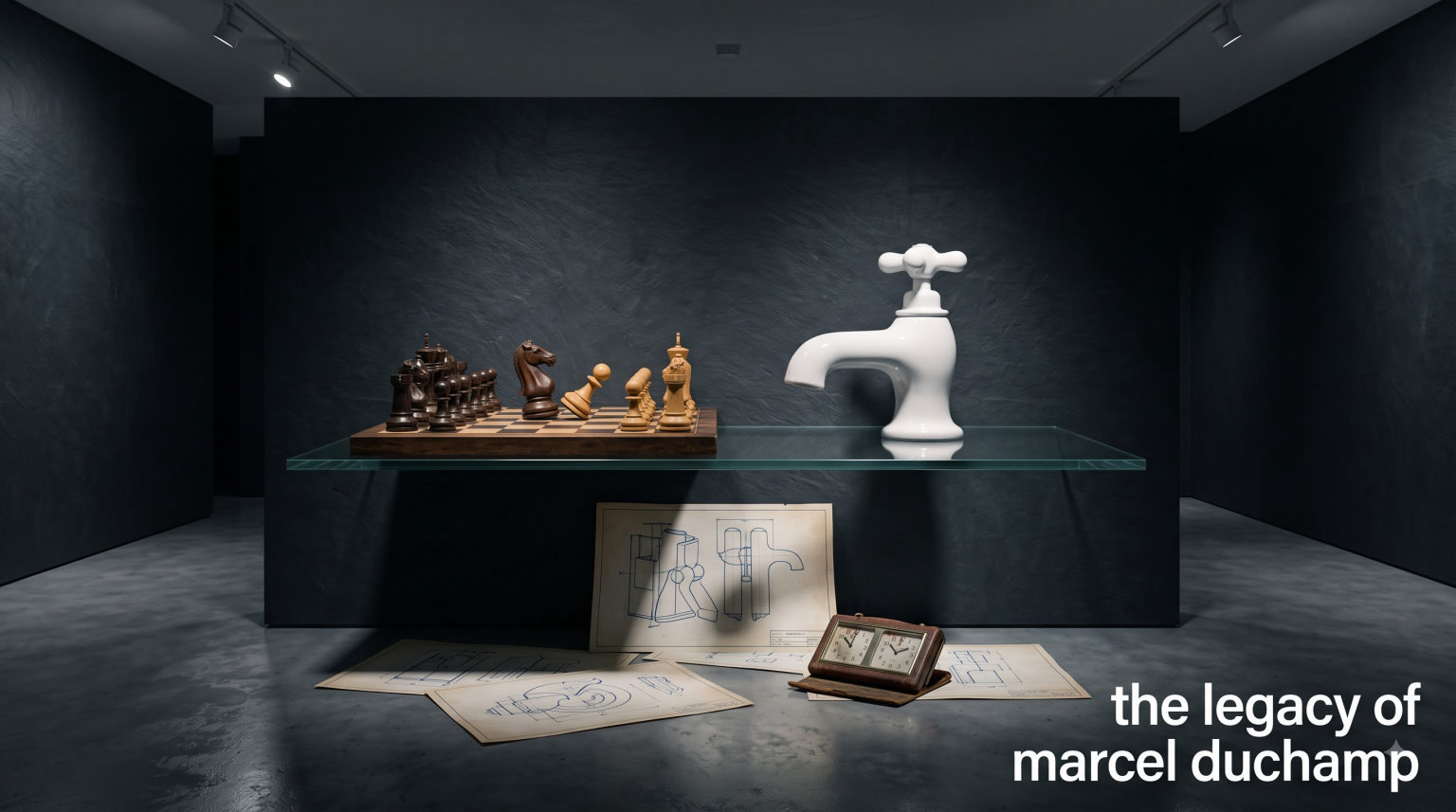
Marcel Duchamp fundamentally transformed our understanding of what art can be. By taking ordinary mass-produced objects and declaring them art, he invented the readymade and sparked a conceptual revolution that echoes through every gallery and museum today. His legacy extends far beyond a single work or moment—it represents a permanent questioning of artistic convention that continues to shape how we create, view, and debate art in the contemporary world.
When Duchamp submitted a standard urinal to an art exhibition in 1917, signed under a pseudonym, he was not simply trolling the establishment. He was proposing something radical: that the designation of an object as art depends not on its maker’s hands but on the viewer’s recognition of an idea. That single provocative act established an intellectual framework that influenced Pop Art, Minimalism, Conceptual Art, and virtually every avant-garde movement that followed.
In this comprehensive exploration of the legacy of Marcel Duchamp, we trace his journey from technical painter to revolutionary provocateur, examine his most significant works, and understand why his ideas remain perhaps the most consequential in modern art history. Whether you are an art student encountering his work for the first time or a seasoned observer seeking deeper understanding, Duchamp’s career poses questions that never fully close.
Table of Contents
Who Was Marcel Duchamp
Marcel Duchamp was born in 1887 in Blainville-Crevon, Normandy, France, into an artistic family that encouraged creative pursuits. His brothers included the painter Gaston Duchamp and the sculptor Jacques Villon, both significant artists in their own right. This environment of creative exchange shaped Duchamp’s early development, exposing him to the emerging avant-garde movements that would later define his career.
After studying at the Académie Julian in Paris, Duchamp began experimenting with the Post-Impressionist and Fauvist styles popular in early 20th-century France. However, he quickly grew dissatisfied with what he called “retinal art”—work that appealed merely to the eye without engaging the intellect. This distinction between visual pleasure and intellectual stimulation would become the central tension of his entire career.
The pivotal moment came in 1912 with his painting “Nude Descending a Staircase, No. 2.” The work depicted a figure in motion through overlapping planes, simultaneously capturing movement and fragmentation in a way that blurred the boundary between Cubism and something entirely new. When the painting was rejected from the Salon des Indépendants in Paris, Duchamp began to question the entire premise of exhibiting art through traditional channels.
This rejection marked his departure from painting altogether and the beginning of his search for a new kind of artistic practice—one that would engage mind rather than eye. Within five years, he had invented the readymade and changed art history permanently.
The Cubist Years: Before the Revolution
Before Duchamp became the philosopher-artist who challenged art’s definitions, he was a technically skilled painter working within—and sometimes pushing against—the Cubist movement. His early works from 1909 to 1912 reveal an artist rapidly evolving through Post-Impressionism, Fauvism, and Cubism, each phase building toward his eventual break with conventional artistic practice.
“Nude Descending a Staircase, No. 2” remains the most famous artifact of this period. The painting shows a figure walking down stairs, rendered as multiple overlapping images that suggest motion and sequence. Rather than the static nudes of academic tradition or the fragmented geometries of analytical Cubism, Duchamp created something kinetic and almost cinematic.
When this painting was shown at the 1913 Armory Show in New York—the first major exhibition of European modern art in America—it caused immediate controversy. American critics and audiences were shocked by its departure from realistic representation. The painting was sold to a collector for $324, making it one of the most talked-about works in the exhibition.
Yet even as “Nude Descending a Staircase” brought Duchamp international attention, he had already begun to move beyond its conclusions. He grew increasingly skeptical that even the most innovative visual approach could accomplish what he wanted: art that engaged thinking rather than merely looking. This realization propelled him toward the conceptual breakthrough that would define his legacy.
The Readymade Revolution: Art Without Making
The readymade represents Duchamp’s most radical and enduring contribution to art. By selecting ordinary mass-produced objects and designating them as art, he proposed that the creative act lies in the selection rather than the fabrication. This seemingly simple idea dissolved the boundary between art and everyday life, transforming how we understand artistic authorship and meaning.
Duchamp’s first documented readymade was “Bicycle Wheel” (1913), consisting of a wheel mounted on a stool. He later described the experience of spinning the wheel in his studio as a kind of relaxation, but the object itself posed fundamental questions: Was this art? If so, what made it art? The wheel was identical to thousands of other wheels—the only difference was that Duchamp had placed it in an artistic context.
In 1914, he advanced this concept with “Bottle Rack,” a mass-produced bottle drying rack that he purchased and simply signed. The rack functioned exactly as it always had—nothing was added or changed—yet now it existed in the domain of art. With this gesture, Duchamp demonstrated that the transformative power lay not in physical modification but in contextual reframing.
The implications extended far beyond the objects themselves. If an ordinary urinal could be art, then the traditional criteria for evaluating art—skill, beauty, originality of execution—became irrelevant. What mattered was the intellectual proposition, the question posed to the viewer. Duchamp’s readymades invited audiences to participate in meaning-making rather than passively receive aesthetic pleasure.
As Duchamp’s pioneering readymades demonstrated, the artist’s role could shift from maker to selector, from craftsperson to philosopher. This conceptual turn opened infinite possibilities for subsequent artists while simultaneously generating endless debate about the nature and limits of art.
Major Works That Shocked the Art World
Fountain: The Urinal That Started a Revolution
In 1917, Duchamp submitted a standard porcelain urinal to the Society of Independent Artists exhibition in New York. Signed “R. Mutt,” the object was titled “Fountain” and represented perhaps the most provocative single gesture in art history. The society, which had promised no jury and no rejection, refused the piece—setting off a debate that continues today.
The original “Fountain” was never photographed and disappeared from history. What survived was a photograph taken by Duchamp’s friend Man Ray, which subsequently became the work’s primary documentation. Seven replicas were created in the 1960s with Duchamp’s authorization, and these now appear in major museum collections worldwide.
The significance of “Fountain” extends far beyond its physical form. The choice of a urinal—something deliberately anti-aesthetic, associated with bodily functions, and mass-produced rather than hand-crafted—attacked every value that traditional art held sacred. By selecting this particular object, Duchamp asked whether art is about what something looks like or about what it means.
The controversy also revealed the hollowness of institutional claims to openness. The Society of Independent Artists had proclaimed itself a democratic venue without selections, yet it rejected the very work that tested this commitment. Duchamp’s experiment exposed the gap between theoretical acceptance and practical resistance to genuine innovation.
The Large Glass: The Unfinished Masterpiece
“The Bride Stripped Bare by Her Bachelors, Even,” commonly known as “The Large Glass,” represents Duchamp’s most ambitious and complex work. Created between 1915 and 1923, this piece employed unconventional materials including lead wire, dust, and mirror varnish on a large glass panel, remaining permanently unfinished despite decades of intermittent work.
The work depicts a complex narrative of desire and frustration between a bride figure and her bachelor observers. Unlike traditional painting, The Large Glass incorporated chance operations—Duchamp allowed dust to accumulate naturally on the surface, incorporating accidents into the final composition. This embrace of randomness further distanced him from artistic control and intentionality.
Duchamp considered The Large Glass his major work and continued to reflect on it throughout his life. He referred to the accompanying notes and studies as contained in “The Green Box,” a collection of ninety-three documents that elaborated the work’s theoretical framework. Together, these materials constituted what Duchamp called a “delay” in painting—a suspension of conventional artistic conclusions.
The Large Glass exists in a state of perpetual incompletion, yet this very quality embodies Duchamp’s philosophy. Rather than presenting a finished aesthetic object, he created an ongoing intellectual situation that resists closure. Visitors who encounter the work at the Philadelphia Museum of Art encounter not merely an artwork but a proposition about art’s relationship to time, process, and knowledge.
L.H.O.O.Q.: Mona Lisa with a Mustache
In 1919, Duchamp purchased a cheap reproduction of Leonardo da Vinci’s Mona Lisa and added a mustache and goatee, inscribing the letters “L.H.O.O.Q.” below the image. When read in French, this abbreviation forms a crude pun meaning “she has a hot ass.” The intervention transformed one of art history’s most revered images into a statement about art’s relationship to humor, sex, and reverence.
The work exemplified Duchamp’s technique of appropriation—taking existing cultural artifacts and changing their context to generate new meaning. By modifying the Mona Lisa rather than creating something original, he questioned the Romantic emphasis on artistic uniqueness and creative genius. If a pencil mark on a postcard could recontextualize the world’s most famous painting, what happened to the concept of artistic authorship?
“L.H.O.O.Q.” also demonstrated Duchamp’s engagement with wordplay and linguistic complexity. His titles throughout his career often functioned as puns or visual jokes, adding interpretive layers that resisted straightforward understanding. This integration of language with visual art anticipated later developments in semiotics and deconstruction.
The work’s humor should not obscure its seriousness. “L.H.O.O.Q.” attacks the worship of artistic masterpieces while simultaneously acknowledging their continuing power. Duchamp did not destroy the Mona Lisa—he defaced it in a way that revealed both the painting’s cultural status and the arbitrary nature of that reverence. The intervention remains one of art history’s most discussed single gestures.
Dada, New York, and the Artist as Provocateur
Duchamp’s career intersected closely with the Dada movement, though he maintained ambivalent relationships with its various practitioners. Dada emerged during World War I as a radical rejection of rational culture and artistic convention, embracing nonsense, chance, and anti-bourgeois provocation. Duchamp’s readymades and conceptual approach aligned perfectly with Dada’s anti-art stance.
During the war years, Duchamp relocated to New York, forming significant relationships with Francis Picabia and Man Ray. These artists shared his interest in challenging artistic conventions and their New York circle became a crucial node in the developing avant-garde network. Together, they produced the journal “The Blind Man” and organized exhibitions that tested public tolerance for innovation.
Picabia, in particular, represented a kindred spirit—a fellow traveler in the exploration of art beyond traditional aesthetics. His mechanical portraits and Dada publications created a community of inquiry into art’s nature and purpose. Man Ray, originally Emmanuel Radnitzky, became a close collaborator and documentarian of Duchamp’s activities, producing photographs and films that extended the conceptual project.
Yet Duchamp never fully committed to Dada’s collective identity, preferring to maintain his individual trajectory. While Dada celebrated chaos and irrationality, Duchamp’s work remained curiously methodical and precise. He used chance operations but within a framework of rigorous intellectual investigation. This distinction would prove crucial for his later influence on Conceptual Art.
The Dada connection nonetheless positioned Duchamp within a broader cultural moment that questioned everything traditional culture held certain. The movement’s rejection of logic and embrace of absurdity provided fertile ground for Duchamp’s continued experiments in redefining art’s boundaries.
The Chess Years: Retirement and Semi-Retirement
In 1923, Duchamp essentially abandoned art to pursue chess at a competitive level. This decision shocked the art world, which had expected his revolutionary work to continue indefinitely. Yet the chess withdrawal was itself consistent with his philosophical approach—the willingness to follow an idea wherever it led, even if it meant abandoning one field for another.
Duchamp had played chess throughout his artistic career, and his skill level was genuine. He competed in French championship tournaments and corresponded extensively about chess problems and strategy. The game appealed to him for many of the same reasons that art once had: the interplay of intellect, strategy, and unpredictable outcomes.
Yet even during the apparent retirement, Duchamp continued working intermittently on The Large Glass. The “retirement” was never complete, and he maintained relationships with artists, collectors, and dealers throughout the chess years. The work on The Large Glass proceeded slowly, incorporating chance operations and philosophical developments that kept the project alive.
The alter ego “Rose Selavy” also emerged during this period, allowing Duchamp to maintain multiple identities and perspectives. The name, which sounds like “Rose is alive” when spoken aloud, enabled him to sign works and correspondences from a feminine perspective, further destabilizing assumptions about artistic identity and authorship.
Legacy and Influence: From Pop Art to Conceptualism
Duchamp’s influence pervades virtually every significant art movement since the 1960s. His insistence on idea over object, concept over execution, and questioning over acceptance created a template that subsequent generations of artists have adapted, extended, and challenged in countless ways.
Pop Art absorbed Duchamp’s appropriation strategies most directly. Artists like Andy Warhol (who famously said “Duchamp c’est plus important que nous”) and Roy Lichtenstein recognized in his work a precedent for using mass-produced imagery in fine art contexts. The Pop embrace of commercial culture and mechanical reproduction extended the readymade logic into painting and sculpture.
Minimalism adopted Duchamp’s preference for industrial production and seriality. Artists like Donald Judd and Dan Flavin created objects that resembled readymades in their emphasis on industrial processes and rejection of artistic manual skill. However, Minimalism often stripped away Duchamp’s irony and conceptual complexity, creating objects that functioned quite differently in viewer experience.
Conceptual Art represents perhaps the most direct inheritance of Duchamp’s legacy. Artists like Joseph Kosuth, Lawrence Weiner, and Sol LeWitt created works where the idea or proposition held primary importance, with physical manifestation becoming secondary. Weiner’s famous statement—”As long as the idea is the same and the intention is the same, it doesn’t matter if the piece is made by anyone else”—echoes Duchamp’s elevation of selection over creation.
The broader phenomenon of appropriation art, explored in our discussion of conceptual art history, traces its lineage directly to Duchamp’s interventions. Artists like Sherrie Levine, Richard Prince, and Jeff Koons have made recontextualization and appropriation central to their practices, building on the framework that Duchamp established.
Digital Age Relevance: Internet, Memes, and AI Art
Perhaps no artist from the pre-digital era seems more prescient about contemporary culture than Duchamp. His challenges to originality, authorship, and the uniqueness of the art object find new dimensions in internet culture, meme production, and artificial intelligence art.
The meme format essentially operationalizes Duchamp’s readymade logic at cultural scale. A meme takes existing images, videos, or texts and recontextualizes them through captions or modifications, generating new meanings from pre-existing materials. The most successful memes—like Duchamp’s readymades—derive their power not from technical skill but from clever selection and repositioning.
NFT art and digital scarcity technologies represent another frontier where Duchamp’s questions remain relevant. The very concept of blockchain-verified ownership for digital files echoes the issue of authenticity that Duchamp explored with his readymades. What does it mean to “own” a digital image when it can be copied infinitely? Duchamp raised similar questions about physical objects decades earlier.
Artificial intelligence art generation systems, which create images based on text prompts, raise profound questions about the readymade concept. When an AI system synthesizes styles and images from its training data, is it performing something like selection? Artists using these tools operate in a space Duchamp helped prepare, though the ultimate implications remain contested.
Appropriation art continues to develop in the digital context, with artists remixing, sampling, and recontextualizing existing materials at unprecedented scale. Duchamp’s original provocation—that choosing and repositioning constitutes a creative act—has become commonsense in digital culture, even as debates about intellectual property and artistic credit continue.
Critiques and Controversies
Duchamp’s legacy is not without its critics. The critique that he was a “lazy revolutionary” who simply selected rather than created objects has persisted since his lifetime. This view holds that true artistic contribution requires technical skill and genuine making, not merely the assertion of an idea.
The lazy critique misses something essential about Duchamp’s achievement. Selecting an object as art requires developing the capacity to perceive artistic potential in ordinary things—a genuine creative faculty that cannot be reduced to passive reception. Duchamp’s choices were far from arbitrary; they reflected sophisticated understanding of what would provoke productive thought in viewers.
Feminist scholars have raised important questions about gender dynamics in Duchamp’s work. His use of the masculine pseudonym “R. Mutt” to submit “Fountain,” and the subsequent debate about whether the actual urinal was purchased by his female assistant, reveals complicated gender politics. Some critics argue that his provocations, while appearing radical, ultimately reinforced certain patriarchal structures of the art world.
The question of whether Duchamp’s work requires skill remains genuinely contested. If art involves selecting rather than making, what role does expertise play? This question has only become more pressing as digital tools enable more people to create and distribute creative work without traditional technical training.
Institutional critique, which examines how museums and galleries shape artistic meaning, has deep roots in Duchamp’s practice. His challenges to the institutional dynamics Duchamp challenged remain relevant for contemporary artists examining how cultural institutions define and control artistic value.
Conclusion: The Enduring Question
The legacy of Marcel Duchamp ultimately reduces to a single, ongoing question: What is art? He did not answer this question so much as demonstrate that it could be asked, and asked again, without resolution. Each generation of artists and viewers inherits his provocation and must find their own response.
Duchamp shifted art’s center of gravity from making to thinking, from object to concept, from passive reception to active interpretation. These transformations have proven irreversible. Even artists who work in traditional media operate within a landscape that Duchamp fundamentally altered.
His career demonstrated that the most radical art need not be visually spectacular or technically demanding. It need only pose a question that transforms how we understand experience itself. The urinal in the gallery asks us to reconsider everything we thought we knew about value, authorship, and meaning.
As we face new technologies and cultural conditions that continue to challenge artistic conventions, Duchamp’s example provides both inspiration and warning. His work reminds us that innovation often emerges not from mastering existing forms but from questioning their premises entirely. The legacy of Marcel Duchamp is ultimately the legacy of critical thought itself—relentless, questioning, and permanently unfinished.
FAQs
Why was Marcel Duchamp important?
Marcel Duchamp fundamentally changed what art could be by inventing the readymade—ordinary objects designated as art. His conceptual approach, prioritizing ideas over aesthetic appeal, paved the way for Conceptual Art, Minimalism, and Pop Art, making him one of the most influential artists of the 20th century.
What was Marcel Duchamp’s great contribution to art?
Duchamp’s great contribution was the readymade concept: selecting mass-produced everyday objects and declaring them art. This shifted art’s focus from manual skill and visual beauty to intellectual proposition, fundamentally altering the relationship between artist, object, and viewer.
How did Duchamp influence modern art?
Duchamp’s influence extends across multiple movements: Pop Art absorbed his appropriation strategies; Minimalism adopted his industrial aesthetic; Conceptual Art embraced his dematerialization of the art object; and contemporary appropriation art, internet culture, and even AI art continue his exploration of authorship and originality.
What is a readymade in art?
A readymade is an ordinary mass-produced object that an artist selects and presents as art, without significant modification. Duchamp’s first readymades included a bicycle wheel (1913), bottle rack (1914), and most famously, a urinal titled Fountain (1917). The concept challenges viewers to reconsider what qualifies as art.