
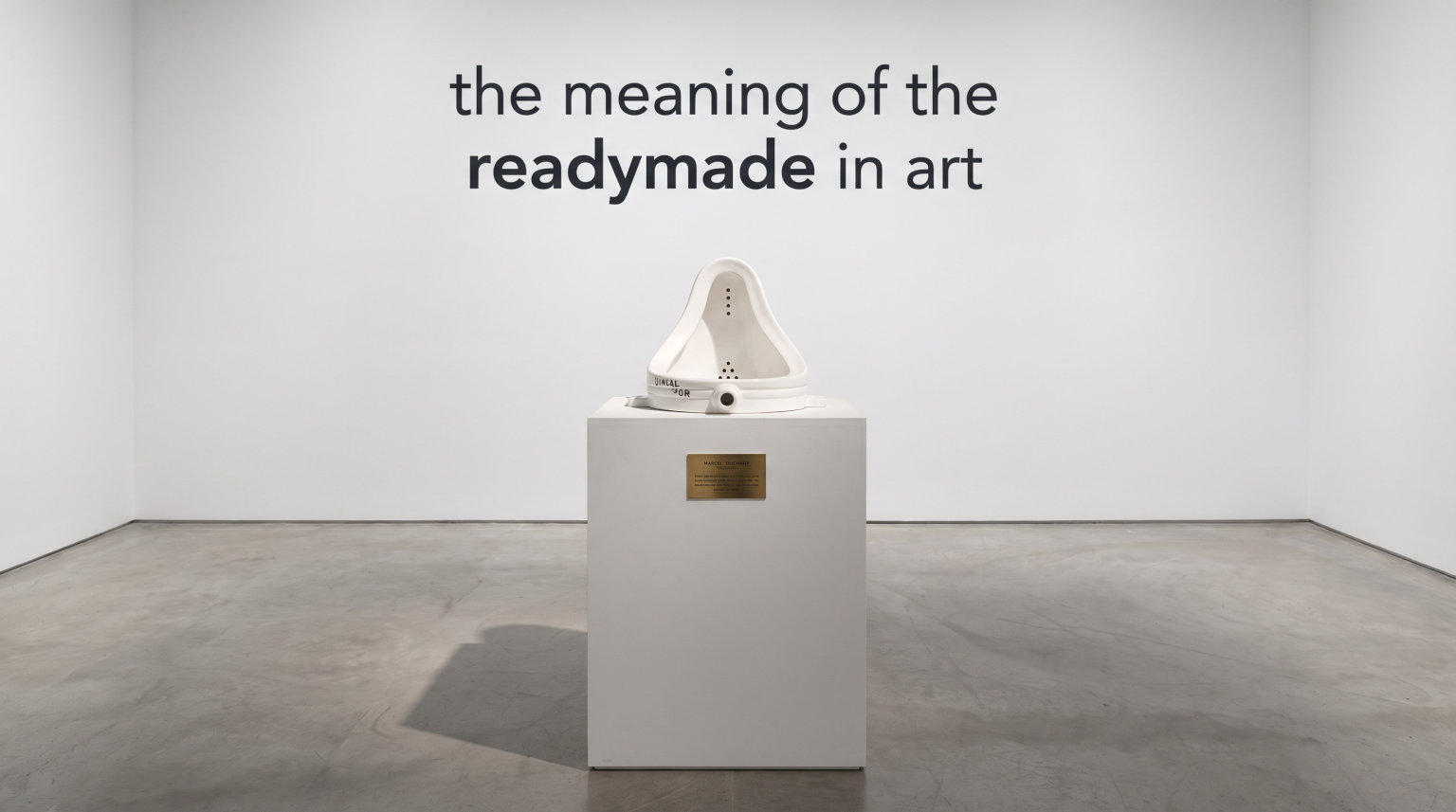
A readymade is an ordinary, manufactured object that an artist selects, designates, and presents as a work of art, stripping it of its original function and giving it new meaning. The term was first used by French artist Marcel Duchamp around 1916 to describe the provocative objects he chose to exhibit as art, and it has since become one of the most important concepts in modern art history. If you have ever stood in a gallery looking at a urinal or a snow shovel and wondered how it ended up on a pedestal, you have already encountered the central question behind the readymade: what actually qualifies something as art?
The meaning of the readymade in art goes far beyond simply putting a household item in a museum. It is a philosophical challenge to the idea that art must involve manual skill, aesthetic beauty, or creative labor in the traditional sense. When Duchamp proposed that an artist’s choice alone could transform a mass-produced object into a work of art, he opened a door that changed the direction of conceptual art and continues to shape how we think about creativity, authorship, and the art world itself in 2026.
In this guide, I will walk you through exactly what the readymade means, where it came from, the most famous examples, and why a century-old urinal still sparks heated debates in art classrooms and Reddit threads alike. Whether you are an art student, a curious gallery visitor, or someone who just wants to understand what all the fuss is about, this article will give you a clear, thorough understanding of the readymade and its lasting impact.
Table of Contents
What Is a Readymade in Art?
A readymade is a mass-produced, commercially manufactured object that an artist has chosen, isolated from its original context, and presented as a work of art. The artist does not craft, sculpt, or paint the object. Instead, the artistic act lies entirely in the selection and designation. Duchamp himself described the readymade as an object that became art through the artist’s decision alone, not through any physical transformation.
This is what separates the readymade from nearly every other art form that came before it. For centuries, Western art had been defined by technical mastery, the ability to render a face in paint, carve marble into flesh, or compose a scene with mathematical precision. The readymade threw all of that out the window. Duchamp called traditional art “retinal,” meaning it was designed to please the eye. His readymades were the opposite: they were designed to engage the mind.
Several key characteristics define a readymade:
Manufactured origin: The object is mass-produced, not handmade by the artist.
Intentional selection: The artist chooses the object deliberately, often based on visual indifference or neutrality.
Contextual shift: The object is removed from its normal use and placed in an art context, such as a gallery or museum.
New title: The artist often renames the object, giving it a new identity and layer of meaning.
Conceptual priority: The idea behind the choice matters more than the object’s appearance or craftsmanship.
Duchamp once said he chose his readymades based on a principle of “visual indifference,” meaning he picked objects that did not attract him for their beauty or interesting form. The point was not to find an aesthetically pleasing item and put it on display. The point was to demonstrate that the artist’s will, not the object’s qualities, was what made something art. This distinction is the key to understanding the meaning of the readymade in art, and it is what makes the concept so radical even a century later.
The Origin and History of the Readymade
The readymade was born out of one of the most rebellious periods in art history: the Dada movement. Emerging during World War I, Dada was an anti-art, anti-establishment movement that rejected the logic, reason, and aesthetic norms of a society that artists felt had led Europe into catastrophic war. Dada artists embraced absurdity, chance, and provocation. The readymade fit perfectly into this worldview.
Marcel Duchamp is universally credited as the originator of the readymade, though the story is more nuanced than a single moment of inspiration. Duchamp had been moving away from traditional painting since 1912, when his painting Nude Descending a Staircase scandalized audiences at the Salon des Independants in Paris. By 1913, he was experimenting with attaching a bicycle wheel to a kitchen stool in his studio, not as a finished artwork but as a private amusement. This piece, later titled Bicycle Wheel, is often considered his first readymade, though Duchamp did not initially classify it as such.
The first true, intentional readymade came in 1914 when Duchamp purchased a commercially made bottle rack and signed it. He followed this in 1915 with In Advance of the Broken Arm, a standard snow shovel that he inscribed with a title suggesting a tongue-in-cheek preventive function. By 1916, Duchamp had begun using the word “readymade” to describe these objects, and in 1917 he submitted the most famous (and infamous) readymade of all: Fountain.
The timing mattered. Duchamp was living in New York during the war years, surrounded by a community of expatriate artists and intellectuals who were open to radical ideas. The Society of Independent Artists, of which Duchamp was a board member, had declared they would accept any work of art submitted for exhibition, provided the artist paid the entry fee. Duchamp submitted Fountain, a standard porcelain urinal laid flat and signed “R. Mutt,” under a pseudonym. The board rejected it, despite their own rule, and Duchamp resigned in protest. The incident became legendary, and Fountain became the defining symbol of the readymade and a touchstone for appropriation art practices that followed.
Duchamp produced relatively few readymades in his lifetime, perhaps thirteen or so, but their influence was enormous. Each one was a carefully considered philosophical gesture, not a random act. He spent months, sometimes years, deciding which objects to select and how to present them. The casual appearance of the readymade belied a deep, deliberate thought process about the nature of art itself.
Famous Readymade Artworks and Their Significance
The best way to understand the meaning of the readymade in art is to look at the most famous examples. Each of Duchamp’s readymades carries its own distinct commentary, and together they form a body of work that redefined what art could be.
Fountain (1917)
Fountain is the most famous readymade in history and arguably the most influential artwork of the twentieth century. It consists of a standard porcelain urinal, laid flat on its back and signed “R. Mutt 1917.” Duchamp submitted it to the Society of Independent Artists exhibition under the pseudonym Richard Mutt, a name he derived from the Mott Iron Works company (which manufactured the urinal) and the comic strip characters Mutt and Jeff.
When the exhibition committee rejected the piece, Duchamp resigned and published an anonymous editorial defending it. The editorial argued that whether Mr. Mutt made the fountain with his own hands or not was irrelevant. He had chosen it. He had selected an ordinary article of life and created a new thought for that object. The original Fountain was lost or discarded, but authorized replicas were made in the 1950s and 1960s, and these are now held in major museums including Tate Modern and the Philadelphia Museum of Art. In 2004, a survey of 500 art experts named Fountain the most influential artwork of the modern era.
Bicycle Wheel (1913)
Bicycle Wheel consists of a front bicycle wheel mounted upside down on a wooden kitchen stool. Duchamp created it in his Paris studio as a personal experiment. He later described enjoying the visual effect of watching the wheel spin, comparing it to watching a fireplace. It was not initially conceived as a formal artwork but was later recognized as an early readymade. The piece demonstrates how the readymade could blur the line between functional object and sculptural form, inviting viewers to see everyday items in a completely different way.
Bottle Rack (1914)
The Bottle Rack, also called Bottle Dryer or Helix of Chaffless, was a commercially produced rack used for drying wine bottles. Duchamp purchased it and signed it without making any modifications. He later called it the first “true” readymade because he selected it purely for its functional anonymity, not for any aesthetic appeal. The original was mistakenly thrown out by Duchamp’s sister when she was cleaning his studio, which only reinforced the irony of the readymade’s existence: an artwork mistaken for junk.
L.H.O.O.Q. (1919)
L.H.O.O.Q. is one of Duchamp’s most recognizable assisted readymades. He took a cheap postcard reproduction of Leonardo da Vinci’s Mona Lisa and drew a mustache and goatee on the face. The title, when pronounced in French, forms a bawdy pun that translates roughly to “she has a hot bottom.” This piece is classified as an assisted readymade because Duchamp modified an existing, manufactured object (the postcard) rather than simply designating it as art. It is simultaneously a joke, an act of iconoclasm, and a serious challenge to the reverence with which society treats certain artworks.
In Advance of the Broken Arm (1915)
This piece is an ordinary snow shovel with an inscription painted on the blade. The title suggests that the shovel serves as a tool to prevent broken arms caused by slipping on ice, adding a layer of dry humor to the object. Duchamp produced several versions over the years. Like Fountain, it demonstrates how a simple title can transform the way we see a mundane object, giving it narrative and conceptual weight it never possessed before.
Types of Readymades: Pure, Assisted, and Corrected
Duchamp himself categorized readymades into several types, and understanding these distinctions helps clarify the range of the concept.
The Pure Readymade
A pure readymade is an unmodified, manufactured object that the artist selects and designates as art without altering it in any way. Bottle Rack and Fountain are the clearest examples. The artist’s only intervention is the act of choosing, naming, and presenting the object. No physical changes are made. This is the purest expression of Duchamp’s idea that artistic choice alone can create art.
The Assisted Readymade
An assisted readymade is a manufactured object that the artist has modified or combined with other elements to create a new composition. Bicycle Wheel is an assisted readymade because Duchamp combined two separate objects (a wheel and a stool) into a single piece. L.H.O.O.Q. is another example, since Duchamp drew on the postcard. The modification is typically minimal, preserving the readymade’s conceptual character while adding a layer of intervention.
The Corrected Readymade
A corrected readymade involves a small, specific alteration to the object, such as adding a detail or changing a component. Duchamp’s Why Not Sneeze Rrose Selavy? (1921), a birdcage filled with marble cubes shaped like sugar lumps and a thermometer, falls into this category. The object is still recognizably manufactured, but the artist has made deliberate changes that create new meaning.
The Reciprocal Readymade
Perhaps the most tongue-in-cheek category, the reciprocal readymade involves using a recognized work of art as a functional object. Duchamp’s famous (and possibly apocryphal) suggestion was to use a Rembrandt painting as an ironing board. This category inverts the readymade logic entirely: instead of elevating a mundane object to the status of art, it reduces a masterpiece to the status of a tool. It is a thought experiment that underscores the readymade’s philosophical challenge.
Readymade vs Found Object: What Is the Difference?
One of the most common sources of confusion in art history is the distinction between the readymade and the found object. The terms are related, and they overlap in practice, but they are not interchangeable.
A readymade specifically refers to a manufactured, mass-produced object selected by the artist. The emphasis is on the object’s industrial origins and the artist’s act of designation. Duchamp coined the term to describe objects that came “ready made” from a factory or store, with no handcrafting involved.
A found object, or objet trouve in French, is a broader category. It includes any object, whether natural or manufactured, that an artist discovers and incorporates into an artwork. A piece of driftwood, a stone with an interesting shape, or a rusty nail found on the street could all be found objects. Found objects may be chosen for their aesthetic qualities, their texture, their form, or their symbolic resonance.
The key differences come down to origin and intention:
Manufactured vs natural: Readymades are always manufactured. Found objects can be natural or man-made.
Selection criteria: Duchamp chose readymades for their visual indifference, deliberately avoiding objects with inherent beauty. Found objects are often selected precisely for their aesthetic appeal or visual interest.
Conceptual framework: Readymades are about the philosophical statement of designation. Found objects are often used for their material or visual contribution to a larger work.
Historical usage: The readymade is specifically associated with Duchamp and the Dada movement. Found object art has a longer history and broader usage across many movements, including Surrealism and assemblage.
Think of it this way: all readymades are found objects in a loose sense, but not all found objects are readymades. The readymade is a specific subset with a particular philosophical intent rooted in Duchamp’s practice. For a deeper exploration of how artists have used existing materials in different ways, the history of appropriation art provides additional context.
The Philosophical Significance of the Readymade in Art
The readymade is not just an art movement or a technique. It is a philosophical argument made physical. When Duchamp placed a urinal in a gallery and called it Fountain, he was asking a question that art had never seriously confronted before: what makes something art? Is it the skill of the maker? The beauty of the object? The context in which it is displayed? The intention of the person who presents it?
Duchamp’s answer was radical: art is what an artist says is art. The creative act lies not in the hands but in the mind. This idea, that concept precedes craft, became the foundation of conceptual art and influenced generations of artists who followed. It shifted the entire basis of art from visual pleasure to intellectual engagement.
The readymade also raised uncomfortable questions about the art market and the institutions that validate art. When a signed urinal can be exhibited as art, what does that say about the galleries, museums, critics, and collectors who decide what is valuable? Duchamp’s gesture exposed the machinery behind the art world’s authority. It revealed that “art” is not an inherent quality of an object but a status granted by consensus and context.
This connects directly to what philosophers call the institutional theory of art, most notably articulated by Arthur Danto and George Dickie in the later twentieth century. The theory holds that something becomes art when the art world, the network of artists, curators, critics, and institutions, recognizes it as such. Duchamp’s readymades were a practical demonstration of this principle decades before the philosophers formalized it.
The readymade also challenged the notion of authorship. If an artist does not make the object, what exactly is the artist’s contribution? Duchamp argued that the artist’s contribution is the idea, the act of choosing and framing. This was a dramatic departure from centuries of Western art theory that equated artistic value with manual virtuosity. In forum discussions I have read, people frequently express frustration with this idea, asking whether readymades “count” as real art. That frustration is itself part of the point. The readymade is designed to provoke exactly that reaction, forcing the viewer to examine their assumptions about what art is and why they hold those beliefs.
Finally, the readymade raised questions about originality and reproducibility that feel even more relevant in 2026. Most of Duchamp’s original readymades were lost, discarded, or destroyed. The versions displayed in museums today are replicas authorized by Duchamp or his estate. If the idea is the artwork, does it matter that the physical object is a copy? This question anticipates contemporary debates about digital art, NFTs, and the nature of ownership in an age of infinite reproduction.
How Readymades Changed Art Forever
The impact of the readymade on the history of art is difficult to overstate. It did not simply add a new category to the list of art forms. It fundamentally altered the way artists, critics, and the public think about what art can be and what it can do.
The most direct line of influence runs from Duchamp’s readymades to the development of conceptual art in the 1960s. Artists like Joseph Kosuth, Sol LeWitt, and Lawrence Weiner explicitly cited Duchamp as a precursor, adopting his principle that the idea behind an artwork is more important than its physical form. Kosuth’s One and Three Chairs (1965), which presents a physical chair, a photograph of the chair, and a dictionary definition of “chair,” is essentially a readymade with a philosophical footnote attached.
The readymade also influenced Pop Art. Andy Warhol’s Brillo Boxes (1964), which consisted of wooden boxes screen-printed to look identical to Brillo soap pad cartons, drew directly on Duchamp’s strategy of using mass-produced commercial goods as art. The difference was that Warhol handcrafted his boxes to look manufactured, adding another layer of irony to the readymade tradition.
Contemporary art is full of readymade descendants. Damien Hirst’s pharmacy installations, Tracey Emin’s My Bed (1998), which displayed her actual unmade bed in a gallery, and Sherrie Levine’s photographs of famous artworks by other artists all extend the readymade logic into new territory. Ai Weiwei’s Dropping a Han Dynasty Urn (1995) uses the destruction of a historical artifact as a readymade gesture, combining Duchamp’s provocation with political commentary. The strategies vary, but the core idea remains the same: the artist’s choice and context, not the object’s inherent qualities, create the art.
Art collectives and collaborative movements have also drawn on the readymade’s legacy of challenging institutional authority. For anyone interested in how these ideas continue to play out in group practices, exploring some of the most influential art collectives of recent decades reveals the readymade’s DNA in collaborative and socially engaged art.
In 2026, the readymade’s influence extends into digital spaces, where artists use found images, memes, screenshots, and AI-generated content in ways that echo Duchamp’s logic. The question of what constitutes art when anyone can select, share, and recontextualize an image is the readymade question updated for the internet age.
FAQs
What does readymade mean in art?
In art, a readymade is a mass-produced, manufactured object that an artist selects and designates as a work of art without physically altering it. The term was coined by Marcel Duchamp around 1916 to describe objects like his famous Fountain, a porcelain urinal signed with a pseudonym and submitted to an art exhibition. The artistic act lies in the choice and presentation, not in crafting the object itself.
What is Duchamp’s concept of the readymade?
Duchamp’s concept of the readymade was that an ordinary, manufactured object could become art solely through the artist’s act of selecting it and giving it a new context and title. He believed the idea behind the choice was more important than any physical skill or aesthetic quality of the object. Duchamp described choosing readymades based on visual indifference, deliberately picking objects that held no particular beauty or interest to him personally.
What is an example of a readymade?
The most famous example of a readymade is Duchamp’s Fountain (1917), a standard porcelain urinal laid flat and signed R. Mutt. Other notable examples include Bicycle Wheel (1913), a bicycle wheel mounted on a stool, and Bottle Rack (1914), a commercial wine bottle drying rack. Each was a manufactured object that Duchamp selected, titled, and presented as art.
Is readymade art actually art?
Whether readymades are art remains one of the most debated questions in modern art. The art world, including major institutions like MoMA and Tate, recognizes readymades as significant artworks. The philosophical position behind the readymade is that art is defined by the artist’s intention and the context in which an object is presented, not by the manual skill involved in making it. The debate itself is part of what makes the readymade conceptually powerful.
What is the difference between a readymade and a found object?
A readymade is specifically a manufactured, mass-produced object selected by the artist and designated as art. A found object is a broader term that includes any discovered item, whether natural or manufactured, incorporated into an artwork. Readymades emphasize industrial origin and the philosophical act of designation, while found objects are often chosen for their visual or material qualities.
Why are readymades important in art history?
Readymades are important because they fundamentally changed how the art world defines art. By demonstrating that an artist’s concept and choice could create art without any physical craft, Duchamp shifted the focus from technical skill to intellectual meaning. This shift laid the groundwork for conceptual art, influenced Pop Art, and continues to shape contemporary art practices in 2026.
Conclusion: Why the Readymade Still Matters
The meaning of the readymade in art is ultimately a question about the nature of art itself. When Marcel Duchamp selected a urinal, a bicycle wheel, and a bottle rack and declared them to be artworks, he was not playing a prank. He was making a serious, carefully considered argument that art is defined by intention, not by technique, and that the context in which we encounter an object shapes our understanding of it as much as the object’s physical properties.
That argument won. Every major art institution in the world now collects and exhibits readymades. Conceptual art, Pop Art, installation art, and much of the contemporary art you see in galleries today traces its lineage directly back to Duchamp’s radical gesture. The questions the readymade raised, about authorship, originality, the role of institutions, and the definition of art, are still being debated in classrooms, studios, and online forums in 2026.
If you take one thing away from this guide, let it be this: the readymade is not about the object. It is about the idea. And that simple shift, from object to idea, changed everything.