
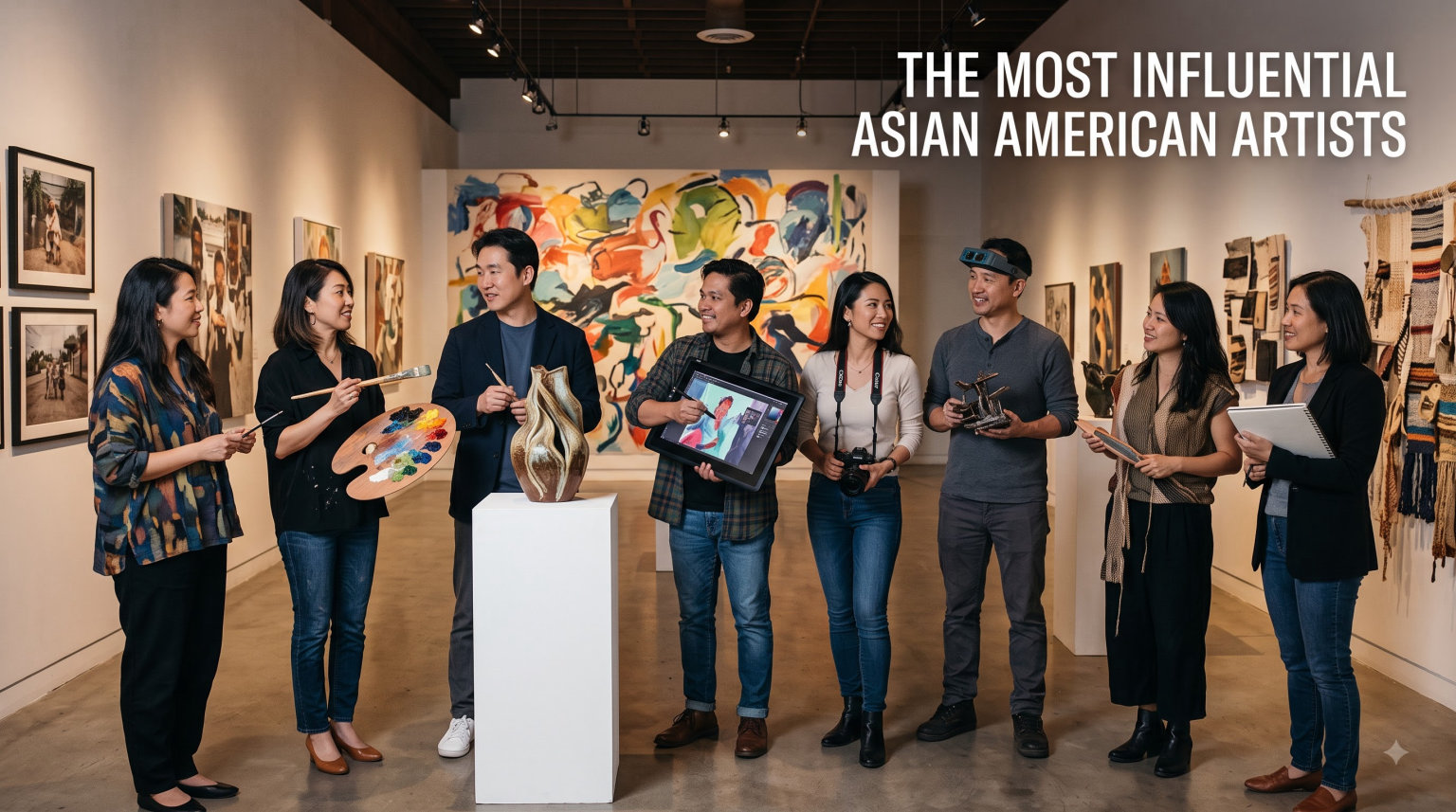
When you walk through the permanent collections of major American museums, you might notice something: the contributions of Asian American artists are far more significant than most people realize. From the ink-wash landscapes of early 20th-century immigrants to the immersive installations filling galleries today, Asian American creators have shaped the direction of American art for over a century.
Our team spent weeks researching the most influential Asian American artists across every medium, from painting and sculpture to video art and architecture. What we found is a rich, layered history of creators who bridged Eastern and Western traditions, challenged what American art could look like, and opened doors for future generations.
This guide covers 25 pioneering Asian American artists spanning from the 1880s to the present day. We organized them chronologically so you can see how each generation built on the last, pushing boundaries in abstract expressionism, Fluxus, conceptual art, installation, and beyond. Whether you are an art student building a syllabus, a collector researching artists, or simply someone who wants to understand American art history more fully, this article will give you a solid foundation.
The most influential Asian American artists did not just participate in American art movements. They transformed them. Many introduced techniques rooted in centuries-old Asian traditions, such as ink painting, miniature painting, and ceramic arts, into distinctly American contexts. Others used their work to confront painful histories like Japanese internment, the Partition of India, and ongoing struggles with identity and belonging.
Before we dive in, one important note: this is not an exhaustive list. The Asian American art world is vast and growing. We selected these 25 artists based on their institutional recognition, influence on other artists, representation in major museum collections, and lasting impact on American art history. There are many more deserving creators whose stories deserve telling.
Table of Contents
The Most Influential Asian American Artists: Early Pioneers (1880s-1940s)
The story of Asian American art begins with immigrants who arrived in the United States carrying deep artistic traditions from their homelands. These early pioneers faced discrimination, exclusion laws, and the challenge of working in a country that rarely valued their perspectives. Yet they created extraordinary work that laid the groundwork for everything that followed.
Chiura Obata (1885-1975)
Chiura Obata was one of the most significant Japanese American artists to work on the West Coast, and his life story mirrors the broader Japanese American experience in the 20th century. Born in Okayama, Japan, Obata immigrated to California in 1903 and quickly became known for his stunning watercolor and ink-wash landscapes of Yosemite and the Sierra Nevada.
What made Obata remarkable was his ability to merge traditional Japanese sumi-e painting techniques with the sweeping grandeur of the American landscape. His Yosemite series, created during trips between 1927 and 1930, captures the terrain with a sensitivity that feels both ancient and distinctly modern. The work earned him a professorship at UC Berkeley in 1932.
In 1942, Obata and his family were incarcerated at Tanforan Assembly Center and later Topaz War Relocation Center as part of the Japanese American internment. During this devastating period, Obata founded art schools at both camps, teaching over 600 students. His internment sketches and paintings are now held in the Smithsonian American Art Museum and serve as powerful historical documents of injustice.
After the war, Obata returned to Berkeley and resumed teaching until his retirement in 1954. His legacy lives on not just in his own work but in the generations of students he mentored. The 2022 Obata retrospective at the Smithsonian, titled “Chiura Obata: An American Modern,” cemented his reputation as a foundational figure in American art.
Isamu Noguchi (1904-1988)
Isamu Noguchi may be the most widely recognized Asian American artist of the 20th century. Born in Los Angeles to a Japanese poet father and an American writer mother, Noguchi spent his childhood moving between Japan and the United States, an experience that shaped his lifelong artistic project of bridging cultures.
Trained as a sculptor under Constantin Brancusi in Paris, Noguchi developed a style that blended organic, biomorphic forms with rigorous craftsmanship. His stone and metal sculptures feel simultaneously ancient and futuristic. But Noguchi refused to be confined to one medium. He designed iconic furniture, including the famous Noguchi coffee table and Akari paper lanterns, which are still manufactured today and sold in design stores worldwide.
His public works are equally significant. Noguchi designed playgrounds, plazas, and gardens across the United States and Japan, including the California Scenario sculpture garden in Costa Mesa and the Moerenuma Park in Sapporo. The Noguchi Museum in Long Island City, New York, which he designed himself, remains one of the most beautiful artist-designed spaces in the country.
During World War II, Noguchi voluntarily entered the Poston internment camp in Arizona for several months, hoping to design improvements to camp conditions. He later described this decision as naive. The experience deepened his commitment to creating art that could heal divisions and connect people across cultures.
C. C. Wang (1907-2003)
C. C. Wang (Wang Chi-chien) was a Chinese American painter, calligrapher, and collector who preserved and reimagined the Chinese landscape painting tradition for American audiences. Born near Shanghai, Wang studied with some of the last great masters of Chinese literati painting before moving to New York in 1949.
In the United States, Wang found ways to keep the classical ink painting tradition alive while subtly modernizing it. His landscapes maintain the compositional principles and brushwork of Song and Ming dynasty masters, but they carry a quiet melancholy that reflects the experience of displacement. He became a beloved teacher in New York’s Chinese American community and was recognized by the Metropolitan Museum of Art, which acquired several of his works.
Wang was also a major collector of Chinese paintings, and his connoisseurship helped build important American collections of Chinese art. He served as a bridge between two art worlds at a time when few institutions in the United States showed serious interest in Chinese painting traditions.
I. M. Pei (1917-2019)
Ieoh Ming Pei, known universally as I. M. Pei, was one of the most celebrated architects of the 20th century. Born in Guangzhou, China, Pei came to the United States in 1935 to study at MIT and Harvard. He went on to design some of the most recognizable buildings in the world.
His most famous commission, the glass and steel pyramid entrance to the Louvre in Paris, was controversial when it opened in 1989 but is now one of the most beloved landmarks in the city. In the United States, his East Building of the National Gallery of Art in Washington, D.C., is considered a masterwork of modern museum architecture. Other major projects include the John F. Kennedy Library in Boston, the Bank of China Tower in Hong Kong, and the Miho Museum in Japan.
Pei received the Pritzker Architecture Prize in 1983, often called the Nobel Prize of architecture. His work is characterized by geometric clarity, the expressive use of materials like concrete, glass, and stone, and a sensitivity to context that makes each building feel like it belongs exactly where it stands. Pei’s career demonstrated that an immigrant artist could shape the most prominent public spaces in the Western world.
Miyoko Ito (1918-1983)
Miyoko Ito is one of the most underappreciated figures in American abstract painting. Born in Berkeley, California, to Japanese parents, Ito was incarcerated at the Tanforan Assembly Center during World War II, where she met Chiura Obata and studied art. After the war, she attended the School of the Art Institute of Chicago on a scholarship.
Ito developed a distinctive style that merged abstract painting with surrealist undertones. Her works feature luminous, hard-edged forms floating in ambiguous spaces, suggesting dreamlike architectural interiors or imaginary landscapes. While her Chicago contemporaries gained more attention, Ito’s paintings have been reassessed in recent years as important contributions to American abstraction.
The 2018 exhibition “Miyoko Ito: Heart of Hearts” at the Bridgette Mayer Gallery in Philadelphia introduced her work to new audiences. Today, art historians recognize her as a key figure in the Bay Area and Chicago art scenes whose contributions deserve wider recognition.
Post-War and Abstract Expressionist Asian American Artists (1940s-1960s)
The decades following World War II saw an explosion of creative energy in American art. Asian American artists were active participants in movements like abstract expressionism and Fluxus, even though their contributions were often underrecognized at the time. This period produced some of the most innovative artists of the 20th century.
Toshiko Takaezu (1922-2011)
Toshiko Takaezu transformed American ceramics from a craft discipline into a fine art. Born in Hawaii to Japanese immigrant parents, Takaezu studied at the University of Hawaii and later at the Cranbrook Academy of Art in Michigan. She is best known for her large, closed-form ceramic vessels, which she called “trees.”
These tall, sealed pots have no functional openings. They are not vessels for holding anything. Instead, they are sculptural forms that Takaezu built, glazed, and fired with extraordinary attention to surface and color. She often enclosed small clay beads inside the closed forms so they would rattle when moved, adding an auditory dimension to the work. This gesture captures her philosophy: art should engage all the senses.
Takaezu taught at Princeton University for over two decades, mentoring generations of ceramic artists. In 2022, a major posthumous retrospective at the Noguchi Museum in New York brought renewed attention to her work. Her pieces are held in the collections of the Smithsonian American Art Museum, the Metropolitan Museum of Art, and the Museum of Fine Arts, Boston.
Ruth Asawa (1926-2013)
Ruth Asawa is one of the most beloved sculptors in American art history, and her story is as compelling as her work. Born in Norco, California, to Japanese immigrant farmers, Asawa and her family were incarcerated at the Santa Anita Assembly Center and later the Rohwer War Relocation Center in Arkansas during World War II.
After the war, Asawa studied at Black Mountain College in North Carolina, where she learned from Josef Albers and encountered avant-garde ideas that would shape her career. She began crocheting wire into intricate, suspended forms that hang from the ceiling like biomorphic clouds or sea creatures. These wire sculptures, which she started making in the late 1940s, remain her signature achievement.
Asawa was also a fierce advocate for arts education in San Francisco. She helped establish the San Francisco School of the Arts, which was renamed the Ruth Asawa San Francisco School of the Arts in her honor in 2010. A major retrospective at the San Francisco Museum of Modern Art in 2023 and her representation by David Zwirner gallery have solidified her reputation as one of the most important sculptors of the 20th century.
Yayoi Kusama (1929-present)
Yayoi Kusama is arguably the most commercially successful living artist in the world. Born in Matsumoto, Japan, Kusama moved to New York City in 1958 and quickly became part of the avant-garde scene, showing work alongside Andy Warhol and Claes Oldenburg before returning to Japan in the 1970s.
Kusama’s signature motifs, polka dots and infinity nets, appear across paintings, sculptures, and her famous Infinity Mirror Rooms, immersive installations lined with mirrors that create the illusion of endless space. These rooms have drawn millions of visitors to museums worldwide, making Kusama one of the most visited contemporary artists on the planet. In 2023, a major retrospective at the Hong Kong Museum of Art drew record crowds.
While Kusama has lived in a psychiatric hospital in Tokyo voluntarily since 1977, she continues to produce new work daily from her nearby studio. Her paintings from the last decade are among the most vibrant and energetic of her career. She represented Japan at the Venice Biennale in 1993 and was the first woman to represent Japan at the festival. Her influence on contemporary art, fashion, and popular culture is immeasurable.
Nam June Paik (1932-2006)
Nam June Paik is widely credited as the father of video art. Born in Seoul, Korea, Paik studied music and art history in Tokyo and Germany before settling in New York in 1964. His breakthrough came with his participation in the Fluxus movement, where he created provocative performance pieces that combined music, electronics, and audience participation.
In 1965, Paik purchased one of the first portable Sony video cameras and began creating work that used television screens as an artistic medium. His 1974 installation “TV Garden” filled a gallery with television sets showing his video art, scattered among live plants. His 1995 piece “Electronic Superhighway: Continental U.S., Alaska, Hawaii” used 336 television monitors to create a map of the United States, each state represented by video clips.
Paik saw the potential of electronic media decades before the internet age. He coined the term “electronic superhighway” in 1974, presaging the digital revolution. His work is held by virtually every major contemporary art museum in the world, and his influence on media artists, digital creators, and anyone working with technology in art is profound.
On Kawara (1932-2014)
On Kawara was a Japanese American conceptual artist whose work explored time, existence, and the nature of consciousness itself. Born in Kariya, Japan, Kawara moved to New York City in 1965 and began his most famous project, the “Today” series, also known as the Date Paintings.
Each Date Painting consists of the date on which it was made, painted in white letters against a solid background. Kawara made nearly 3,000 of these paintings between January 4, 1966, and shortly before his death in 2014. If he could not finish a painting on the day it was begun, he destroyed it. The rigid self-imposed rules gave the work a meditative, almost devotional quality.
Kawara also maintained other long-running projects, including “I Got Up” (postcards sent to friends recording his waking time), “I Met” (lists of people he encountered), and “I Went” (maps of his daily movements traced in red ink). Together, these works constitute one of the most sustained explorations of daily life and the passage of time in the history of art. Kawara’s work was the subject of a major retrospective at the Guggenheim Museum in 2015.
Asian American Artists Who Shaped Identity and Social Commentary (1960s-1990s)
Starting in the 1960s, a new generation of Asian American artists began explicitly exploring themes of identity, heritage, immigration, and social justice. The civil rights movement and the Asian American political awakening of the late 1960s gave artists new language and new audiences for work that addressed the complexities of bicultural experience.
Yoko Ono (1933-present)
Yoko Ono’s contributions to conceptual and performance art are enormous, though they were long overshadowed by her association with John Lennon. Born in Tokyo, Ono moved to New York in the early 1950s and became a central figure in the downtown art scene and the Fluxus movement.
Her 1964 performance “Cut Piece,” in which audience members were invited to cut away pieces of her clothing with scissors, is now recognized as a landmark of feminist and participatory art. Her “instruction paintings,” which consist of written directions rather than visual images, such as “Painting to Be Stepped On,” challenged the very definition of what a painting could be.
In recent years, major institutions have given Ono the art-historical recognition she deserves. The Museum of Modern Art in New York mounted “Yoko Ono: One Woman Show, 1960-1971” in 2015, and the Tate Modern held a major exhibition of her work in 2024. Her peace activism, feminist art, and experimental music have influenced generations of artists across disciplines.
Bernice Bing (1936-1998)
Bernice Bing was a Chinese American abstract expressionist painter whose work and life story embody the intersections of race, gender, and sexuality in American art. Born in Chinatown, San Francisco, Bing was raised in mostly white foster homes after her mother died when she was six. She studied at the California College of the Arts, where she encountered the work of abstract expressionist painters and Zen Buddhist philosophy.
Bing’s paintings merge the gestural energy of abstract expressionism with the calligraphic traditions of Chinese ink painting. Her large-scale canvases pulse with bold strokes and luminous color fields that feel both spontaneous and deeply considered. She was also one of the few openly lesbian Asian American artists of her generation, and her identity informed both her work and her marginalization within art institutions.
For much of her career, Bing worked outside the mainstream art world, running community arts programs in Northern California. It was only after her death from cancer in 1998 that her work began receiving serious institutional attention. The 2020 exhibition “Into the View: Bernice Bing” at the University of California, Santa Cruz helped introduce her paintings to a new generation.
Shigeko Kubota (1937-2015)
Shigeko Kubota was a Japanese American video and performance artist who played a critical role in establishing video art as a serious artistic medium. Born in Niigata, Japan, Kubota moved to New York in 1964 and became closely associated with the Fluxus movement alongside Nam June Paik, whom she later married.
Her 1965 performance “Vagina Painting,” in which she attached a paintbrush to her underwear and painted on paper while squatting, was a provocative response to the male-dominated action painting of the New York School. It remains one of the most discussed performance pieces of the 1960s. Kubota went on to create deeply personal video sculptures that combined television monitors with three-dimensional forms, often memorializing friends and loved ones who had died.
Kubota served as video curator at the Anthology Film Archives in New York and was one of the first artists to receive a fellowship from the newly formed National Endowment for the Arts. Her work is held in the collections of MoMA, the Whitney Museum of American Art, and the Tokyo Metropolitan Museum of Photography.
Zarina (1937-2020)
Zarina Hashmi, known professionally as Zarina, created spare, beautiful works about home, displacement, and the borders that separate people. Born in Aligarh, India, Zarina experienced the Partition of India in 1947, an event that forced her family to relocate and that became the emotional core of her art.
Working primarily in printmaking, Zarina created minimalist woodcuts and etchings that map memory, geography, and loss. Her “Home Is a Foreign Place” series (1999) consists of 36 small woodcut prints, each titled with an Urdu word related to home and illustrated with an abstract geometric image. The series is now held by the Metropolitan Museum of Art and is considered one of the most powerful meditations on displacement in contemporary art.
Zarina represented India at the Venice Biennale in 2011, and her work was the subject of a major retrospective at the Hammer Museum in Los Angeles in 2012. She lived and worked in New York for decades, and her influence on contemporary artists exploring themes of migration and belonging continues to grow.
Martin Wong (1946-1999)
Martin Wong was a Chinese American painter whose vibrant, detailed depictions of New York’s Lower East Side captured a neighborhood and a way of life that has largely disappeared. Born in Portland, Oregon, and raised in San Francisco’s Chinatown, Wong moved to New York in 1978 and immersed himself in the downtown art scene.
Wong’s paintings are dense with imagery: brick tenement buildings, hand-painted storefront signs, constellations, and sign language hands. He was fascinated by the visual language of urban environments and the communities that create them. His work documenting the Nuyorican and African American communities of the Lower East Side is both an artistic achievement and an important social record.
Wong was openly gay at a time when few Asian American male artists were. His paintings often include coded references to queer desire alongside their depictions of street life. He died of AIDS-related complications in 1999, but his reputation has grown steadily since then. The Bronx Museum held a major retrospective, “Martin Wong: Human Instamatic,” in 2015, and his work is now collected by MoMA, the Whitney, and the Metropolitan Museum of Art.
Pacita Abad (1946-2004)
Pacita Abad was a Filipina American painter whose wild, exuberant works celebrate color, pattern, and the experience of global migration. Born in Batanes, the northernmost province of the Philippines, Abad came to the United States in 1970 intending to study law but instead became a visual artist, a decision that changed the course of her life.
Abad is best known for her trapunto paintings, large-scale stitched and stuffed canvases that she embellished with buttons, shells, beads, mirrors, and fabric. These works draw on Filipino textile traditions, African mask aesthetics, and Indonesian batik patterns. Abad traveled to over 60 countries, and each culture she encountered left its mark on her art.
Her most famous public work is the painted bridge at the Singapore Management University, which she covered in 55,000 circles of color shortly before her death from cancer in 2004. The Walker Art Center in Minneapolis held a major retrospective, “Pacita Abad: Life in the Margins,” in 2023, introducing her work to audiences who had never encountered it before. Abad is one of the few Southeast Asian American artists to receive major institutional recognition.
Theresa Hak Kyung Cha (1951-1982)
Theresa Hak Kyung Cha was a Korean American artist, writer, and filmmaker whose single published novel, “Dictee” (1982), has become one of the most important works of Asian American literature and conceptual art. Born in Busan, Korea, Cha moved to the United States as a child and grew up in the San Francisco Bay Area.
Cha’s artistic output spanned video, performance, mail art, and language-based works that explored displacement, exile, and the failure of language to fully communicate experience. Her videos are haunting, fragmented, and deeply personal, often incorporating French, English, and Korean text in ways that highlight the gaps between what we say and what we mean.
Tragically, Cha was murdered in New York City in 1982, just days after the publication of “Dictee.” She was 31 years old. In the decades since her death, her work has been rediscovered and celebrated by artists and scholars worldwide. The Berkeley Art Museum and Pacific Film Archive holds the largest collection of her work, and her influence on conceptual art, feminist art, and Asian American cultural production continues to grow.
Contemporary Asian American Artists Defining the Present (1990s-Today)
The most influential Asian American artists working today build on the foundations laid by earlier generations while expanding into new territories: bio art, immersive digital installations, experimental film, and large-scale public commissions. Their work is more visible, more collected, and more celebrated than ever before.
Maya Lin (1959-present)
Maya Lin became one of the most famous artists in America at the age of 21, when her design for the Vietnam Veterans Memorial in Washington, D.C., was selected from over 1,400 submissions. Born in Athens, Ohio, to Chinese immigrant parents who were both professors at Ohio University, Lin’s design, a black granite wall inscribed with the names of the dead, descending into the earth, was initially controversial but is now considered one of the most powerful public monuments in the world.
Lin has gone on to build a remarkable career spanning architecture, sculpture, and environmental art. Her “What Is Missing?” project is an ongoing multimedia memorial to species and habitats lost to environmental destruction. She has designed the Civil Rights Memorial in Montgomery, Alabama, the Museum of Chinese in America in New York, and numerous other public and private commissions.
In 2016, Lin received the Presidential Medal of Freedom from President Obama. She remains one of the most respected public artists in the United States and a powerful advocate for environmental awareness through art.
Shahzia Sikander (1969-present)
Shahzia Sikander single-handedly revived and reinvented the Indo-Persian miniature painting tradition for contemporary art. Born in Lahore, Pakistan, Sikander studied at the National College of Arts in Lahore, where she trained in the rigorous techniques of Mughal miniature painting. She then moved to the United States to attend the Rhode Island School of Design, where she began breaking the rules of the tradition she had mastered.
Sikander’s paintings and animated videos are filled with tiny, exquisitely rendered figures, Islamic geometric patterns, and mysterious symbols that shift and transform when viewed closely. Her work explores identity, colonialism, gender, and the experience of being a Muslim woman in America, all through the lens of a centuries-old art form made new.
In 2006, Sikander received a MacArthur Fellowship, the so-called “genius grant.” Her large-scale animated video installation “Disruption as Rapture” was shown at the Philadelphia Museum of Art in 2016, and her work is held by MoMA, the Whitney, the Tate Modern, and the Smithsonian. She has also created monumental public sculptures, including a 16-foot bronze statue titled “Witness” installed at a New York City courthouse in 2023.
Sarah Sze (1969-present)
Sarah Sze creates sprawling, site-specific installations from everyday objects: toothpicks, ladders, light bulbs, paper clips, plastic bottles, live plants, and video screens. Born in Boston to a Chinese American family, Sze studied at Yale and the School of Visual Arts before her work caught the attention of the contemporary art world in the late 1990s.
Her installations are like three-dimensional drawings that fill entire rooms, climbing up walls and across ceilings. They seem to grow organically, as if the materials had assembled themselves. Sze uses light, shadow, and video projections to create environments that feel both scientific and poetic, like laboratory experiments crossed with daydreams.
Sze represented the United States at the Venice Biennale in 2013 and received a MacArthur Fellowship in 2003. Her work has been shown at the Tate Modern, the Guggenheim, the Whitney, and many other major institutions. She is a professor at Columbia University and continues to push the boundaries of what installation art can be.
Anicka Yi (1971-present)
Anicka Yi makes art you can smell. Born in Seoul, Korea, and raised in the United States, Yi creates installations and sculptures using biological materials, bacteria, scents, and chemical compounds. Her work challenges the dominance of vision in art by engaging the senses of smell and touch.
Her 2015 exhibition “You Can Call Me F” at The Kitchen in New York included a “smell-scape” composed of chemical analyses of women’s bodies, challenging viewers to confront their biases about gender and cleanliness. Her 2017 installation at the Whitney Biennial used bacteria cultured from human subjects to grow living art on agar plates.
Yi won the Hugo Boss Prize in 2016, and her work has been shown at the Venice Biennale, the Tate Modern, and the Museum of Contemporary Art, Los Angeles. She represents a new direction in Asian American art, one that engages with science, technology, and the nonhuman world in ways that earlier generations could not have imagined.
Wu Tsang (1982-present)
Wu Tsang is a filmmaker, performance artist, and installation maker whose work centers on queer and trans communities of color. Born in Worcester, Massachusetts, to a Chinese American family, Tsang studied at the Art Institute of Chicago and UCLA before emerging as one of the most important young artists of the 2010s.
Tsang’s 2012 documentary “Wildness” chronicled the Silver Platter, a Los Angeles bar that served as a gathering place for Latinx and trans communities. Her later work has expanded into immersive film installations that use multiple screens, live performance, and original music to create emotionally powerful environments. Her work “Of Whales” was featured at the 2022 Venice Biennale.
In 2018, Tsang received a MacArthur Fellowship, one of the youngest recipients that year. Tsang is one of the most prominent transgender artists working today, and their work has been shown at MoMA, the Tate Modern, the Guggenheim, and the New Museum. Tsang’s practice demonstrates how contemporary Asian American artists engage with intersectional identities in ways that expand the possibilities of art itself.
Key Themes and Art Movements in Asian American Art
Looking across the careers of these 25 artists, several themes and movements emerge that help us understand what connects them and why their contributions matter so much to American art history.
Identity and Bicultural Experience
The most consistent theme across Asian American art is the exploration of identity. Artists like Bernice Bing, Martin Wong, and Theresa Hak Kyung Cha made work that refused to simplify the Asian American experience. Their art holds the tension between cultures, languages, and histories without trying to resolve it. This is not just a theme but a method: the bicultural experience becomes a way of seeing that enriches the work itself.
Forum discussions among art enthusiasts and community members reveal a deep hunger for this kind of complexity. People do not want tokenized representations. They want artists who incorporate their heritage authentically, as a lived experience rather than a marketable aesthetic. The artists on this list do exactly that.
The Fluxus Movement
Several Asian American artists played key roles in Fluxus, the international art movement of the 1960s and 1970s that emphasized process, participation, and the blurring of art and life. Yoko Ono, Nam June Paik, Shigeko Kubota, and On Kawara were all central figures in Fluxus circles. The movement’s emphasis on simplicity, chance, and everyday actions resonated with artistic traditions from East Asia, including Zen Buddhism and the integration of art into daily life.
Abstract Expressionism and Asian American Painters
Art historians have long noted the influence of East Asian ink painting traditions on abstract expressionism, but the direct contributions of Asian American painters like Bernice Bing and Miyoko Ito are less widely recognized. These artists did not just absorb abstract expressionism. They brought their own cultural traditions to it, creating paintings that merge calligraphic gesture with color field expansiveness in ways that expand what abstract painting can do.
The Godzilla Asian American Arts Network
In 1990, a group of Asian American artists in New York formed Godzilla: Asian American Arts Network, a collective that advocated for greater visibility and institutional support for Asian American artists. The group included artists like Bing Lee, Margo Machida, and Ken Chu, and it organized exhibitions, published writings, and pressured museums to include more Asian American artists in their programs.
Godzilla disbanded in the early 2000s, but its impact was significant. The collective helped create the institutional infrastructure that allows contemporary Asian American artists to have the careers they do today. Understanding this history is essential for understanding why Asian American art has become more visible in recent years.
Immigration, Displacement, and Memory
From Chiura Obata’s internment paintings to Zarina’s meditations on the Partition of India to Theresa Hak Kyung Cha’s explorations of exile, the experience of displacement recurs throughout Asian American art. This is not incidental. It is foundational. The experience of leaving one home and arriving in another, of living between languages and cultures, generates a particular kind of artistic vision: one that is alert to loss, attentive to memory, and capable of seeing beauty in impermanence.
Gender and LGBTQ+ Perspectives
Asian American art has been enriched by the contributions of women and LGBTQ+ artists who have challenged both mainstream and community norms. Bernice Bing, Shigeko Kubota, Martin Wong, and Wu Tsang have each expanded the definition of Asian American identity through their work. Their contributions remind us that the Asian American art world is not monolithic. It contains multitudes.
Institutional Recognition and Legacy of Asian American Artists
The institutional landscape for Asian American art has changed dramatically over the past two decades. Major museums that once ignored Asian American artists are now actively acquiring their work, mounting retrospectives, and incorporating their contributions into the main narrative of American art history.
Major Museum Collections and Exhibitions
The Smithsonian American Art Museum maintains one of the most significant collections of Asian American art in the country. The National Gallery of Art has featured works by Isamu Noguchi, Hung Liu, Zarina, and Shahzia Sikander in dedicated exhibitions. The Museum of Modern Art in New York holds work by many of the artists on this list, including Yayoi Kusama, Nam June Paik, and On Kawara.
Recent retrospectives have brought new attention to artists who were previously overlooked. Ruth Asawa’s 2023 show at SFMOMA, Pacita Abad’s 2023 retrospective at the Walker Art Center, and Bernice Bing’s growing recognition all suggest that the art world is finally catching up to what these artists accomplished.
MacArthur Fellows
Several artists on this list have received MacArthur Fellowships, one of the most prestigious honors in American arts and sciences. Shahzia Sikander (2006), Sarah Sze (2003), Anicka Yi (2023), and Wu Tsang (2018) have all been recognized, signaling that the foundation views Asian American artists as among the most important creative minds of their generations.
Venice Biennale Representation
The Venice Biennale, often called the Olympics of the art world, has featured increasing numbers of Asian American artists. Yayoi Kusama represented Japan in 1993, Sarah Sze represented the United States in 2013, and Wu Tsang’s work was featured in the 2022 Biennale. This growing presence reflects both the quality of the work and the expanding definition of what American art looks like on the world stage.
Representation Gaps That Remain
Despite this progress, significant gaps remain. Southeast Asian American artists, Filipino American artists, and South Asian American artists are still underrepresented in major museum collections compared to East Asian American artists. LGBTQ+ Asian American artists continue to face barriers to recognition. And many smaller community-based arts organizations that nurture emerging Asian American artists struggle with funding and visibility.
The good news is that the trajectory is clear. Each year brings more exhibitions, more acquisitions, and more scholarship on Asian American art. The artists on this list helped build that momentum, and the next generation is already pushing it further.
FAQs
Who are some influential Asian American artists?
Some of the most influential Asian American artists include Isamu Noguchi (sculpture and design), Yayoi Kusama (installation and painting), Nam June Paik (video art), Ruth Asawa (wire sculpture), Maya Lin (architecture and public art), Chiura Obata (ink and watercolor painting), and Shahzia Sikander (contemporary miniature painting). These artists span multiple mediums and eras, from early 20th-century pioneers to living contemporary masters.
Who is the most famous Asian American artist?
Yayoi Kusama is arguably the most famous Asian-born artist working in America today, known for her Infinity Mirror Rooms and polka dot motifs. Among American-born Asian American artists, Isamu Noguchi (sculpture and design) and Maya Lin (architecture and the Vietnam Veterans Memorial) are the most widely recognized. All three have had major museum retrospectives and are represented in top museum collections worldwide.
How have Asian American artists influenced American art?
Asian American artists have influenced American art by introducing techniques rooted in Asian traditions (ink painting, miniature painting, ceramics) into Western contexts, pioneering new media like video art (Nam June Paik), creating some of the most iconic public monuments in the United States (Maya Lin’s Vietnam Veterans Memorial), and expanding the thematic range of American art to include immigration, displacement, bicultural identity, and social justice.
Who was the first famous Asian American artist?
Chiura Obata (1885-1975) is widely regarded as one of the first Asian American artists to achieve significant recognition. A Japanese-born painter who immigrated to California in 1903, Obata became a professor at UC Berkeley and created celebrated landscapes of Yosemite. His internment camp paintings are now held by the Smithsonian. Other early pioneers include Isamu Noguchi (born 1904) and C. C. Wang (born 1907).
Which Asian American artists have won the MacArthur Fellowship?
Asian American artists who have received the MacArthur Fellowship include Shahzia Sikander (2006) for her reinvention of Indo-Persian miniature painting, Sarah Sze (2003) for her sculptural installations, Anicka Yi (2023) for her bio art and scent-based installations, and Wu Tsang (2018) for filmmaking and performance exploring queer and trans communities of color.
What themes do Asian American artists explore in their work?
Common themes in Asian American art include identity and bicultural experience, immigration and displacement, cultural heritage and tradition, the tension between East and West, the impact of historical events like Japanese internment and the Partition of India, gender and LGBTQ+ identity, and social justice. Many Asian American artists also explore universal themes like time, memory, and human connection through the lens of their specific cultural backgrounds.
The Lasting Legacy of the Most Influential Asian American Artists
The most influential Asian American artists did not wait for permission to make their mark on American culture. They painted in internment camps, built monuments on the National Mall, turned television sets into art objects, and filled galleries with wire sculptures and infinity mirrors. Their work is now woven into the fabric of American art history, even if the full extent of their contributions is still being understood.
What unites these 25 artists across more than a century is not a single style or movement. It is a shared willingness to hold complexity, to bridge traditions, and to create work that speaks to both personal experience and universal human concerns. From Chiura Obata’s Yosemite landscapes to Wu Tsang’s immersive films, the tradition of Asian American art is one of constant reinvention and fearless experimentation.
If this article has done its job, you now have a starting point for exploring these artists further. Visit their exhibitions when they come to a museum near you. Seek out the books, catalogs, and documentaries about their lives and work. And remember that for every artist on this list, there are dozens more whose stories are still waiting to be told. The history of Asian American art is still being written, and it is richer than most people imagine.