
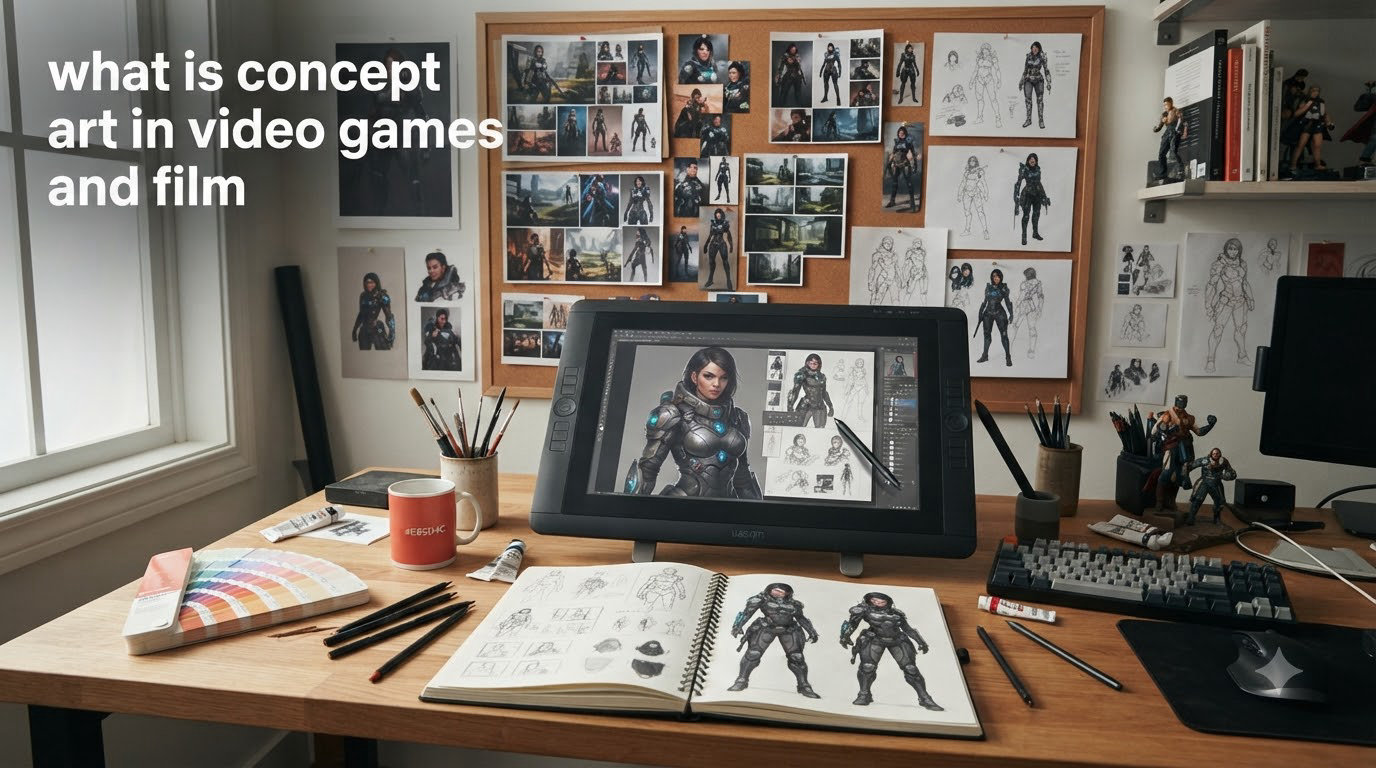
Concept art in video games and film is visual artwork created before final production to represent ideas for characters, environments, and props. It serves as the foundation for how games and films look, feel, and communicate their visual identity to audiences. This guide breaks down everything you need to know about concept art in entertainment.
Whether you are a game developer planning your first project, a film student exploring pre-production, or simply curious about how your favorite entertainment gets its visual style, understanding concept art is essential. Our team has spent years studying how visual development studios work and reviewing portfolios from working concept artists. We will walk you through the complete picture.
Table of Contents
What Is Concept Art?
Concept art is a form of visual artwork created to convey an idea for use in films, video games, animation, and other visual media before final production begins. It acts as a blueprint that guides the work of 3D modelers, animators, environment artists, and the entire production team.
The primary purpose of concept art is problem-solving through visual exploration. Artists do not create finished pieces; they explore possibilities, test silhouettes, and establish visual languages that will define a project. A concept artist might create fifty sketches to find one that perfectly captures a character’s personality while remaining manufacturable as a 3D model.
It is important to distinguish concept art from conceptual art, a term from the fine art world referring to artwork where ideas take precedence over traditional aesthetics. Some readers encounter confusion around this distinction, but they are entirely different fields. Wikipedia clarifies that concept art specifically serves production purposes in entertainment media.
The Role of Concept Art in Video Games
Concept art in video games serves as the visual foundation for entire virtual worlds. Game development teams rely on concept artists to establish the look of characters, environments, weapons, vehicles, and UI elements before programmers write a single line of code or 3D artists build a single polygon.
The role includes establishing visual consistency across a game. When a player explores a fantasy world, every tree, building, and character must feel part of the same visual universe. Concept art defines the shape language, color palettes, and stylistic boundaries that keep a game visually cohesive through hundreds of artists and years of production.
Game concept art also serves practical gameplay purposes. Artists must consider how characters will be animated, how environments will be navigated, and how players will read important visual information. A sword must look dramatic in concept but also readable as a weapon during combat. An enemy design must be distinct from the player character at a glance.
The Role of Concept Art in Film
Concept art in film primarily functions as pre-visualization, helping directors and production designers explore how scenes and sets will look before committing to expensive builds. Film productions invest millions in sets, props, and costumes, making visual exploration before production essential for budget management.
Film concept artists work closely with directors to interpret scripts into visual imagery. A single scene description in a screenplay might generate dozens of concept sketches exploring different moods, angles, and design approaches. This exploration phase prevents costly changes during filming when sets are already built.
Environment concept art for film planning often focuses on practical considerations that differ from games. How will actors move through the space? How will cameras capture the environment? What lighting will create the desired mood? These practical questions shape how film concept art approaches architectural and environmental design.
Key Concept Art Styles
Concept artists work in three primary stylistic approaches, each serving different storytelling purposes. Understanding these styles helps you identify what approach fits your project’s needs.
Realistic Concept Art
Realistic concept art aims for believable, grounded visuals that could exist in the real world. This style dominates science fiction and historical projects where plausibility matters. Artists studying realistic concept art focus on anatomy, materials, physics, and natural color variations.
Games like The Last of Us Part II use realistic concept art to create immersive worlds that feel connected to our own reality. The visual development team gathered extensive reference photography to inform designs that read as authentic and grounded.
Stylized Concept Art
Stylized concept art deliberately exaggerates, simplifies, or interprets reality according to a project’s artistic direction. This approach allows for more expressive character designs, vibrant color palettes, and unique visual identities that could not exist in reality.
Games like Fortnite and Genshin Impact use stylized concept art as their foundation. These projects embrace non-realistic proportions, exaggerated features, and fantastical color schemes that create memorable, shareable visual identities.
Abstract Concept Art
Abstract concept art appears less frequently in production work but serves important purposes in early ideation and mood exploration. Abstract explorations help artists break away from literal thinking and discover unexpected visual solutions.
Most concept art work blends realistic and stylized elements depending on the project phase. Early exploration sketches might be more abstract, while final designs for production typically ground themselves in either realistic or stylized visual languages.
Types of Concept Art
Concept art divides into several specialized categories based on subject matter. Each type requires different skills and serves distinct production purposes.
Character Concept Art
Character concept art focuses on protagonists, antagonists, NPCs, and any creature or figure appearing in a game or film. Character artists must understand anatomy, costume design, silhouette readability, and how designs will translate into 3D models or practical costumes.
A character concept artist creates multiple design variations exploring different poses, expressions, and costume options. They produce turnaround sheets showing designs from multiple angles, ensuring the 3D modeling team can reproduce the character consistently from any camera position.
Environment Concept Art
Environment concept art establishes the visual world surrounding characters, from vast landscapes to intimate interior spaces. Environment artists must understand architecture, landscape design, atmospheric perspective, and how to create spaces that serve storytelling while remaining technically feasible.
Environment concepts for games often incorporate modular design thinking. Artists consider how environments will be broken into reusable pieces that level designers can assemble efficiently. This practical consideration shapes how environment concept art approaches structural design.
Props and Vehicle Concept Art
Props and vehicle concept art covers everything characters interact with or travel in, from handheld weapons to massive spaceships. These designs must balance visual appeal with practical functionality, ensuring objects can be animated, operated by characters, and manufactured within production constraints.
Vehicle concept art requires particular attention to scale, mechanism, and movement. An artist designing a fantasy aircraft must consider how it will take off, land, and maneuver in ways that can be animated convincingly within a game’s visual budget.
The Concept Art Process
The concept art process follows a generally consistent workflow across industries, though timelines and iteration counts vary significantly between games and film.
Research and Reference Gathering
Every concept art project begins with research. Artists gather reference images exploring real-world subjects, historical styles, competitor projects, and anything else informing their visual exploration. This research phase prevents obvious mistakes and helps artists find unexpected inspiration.
Forum discussions among working concept artists reveal that most initial work is not polished paintings but rather quick sketches exploring forms and ideas. Many professionals use photo-bashing techniques, combining photographic references with painted elements to speed up ideation while maintaining realism.
Sketching and Iteration
The sketching phase produces multiple rough concepts exploring different directions. Artists work quickly, knowing that most sketches will be discarded. This rapid iteration allows teams to explore many possibilities before investing in detailed development of any single direction.
Feedback loops with art directors, game designers, and directors shape which concepts advance and which return to the sketch phase. A single approved concept might undergo twenty rounds of revision before reaching final design status.
Finalization and Production Handoff
Approved concepts receive final rendering and documentation for production teams. Final concept art includes multiple angles, color variations, and detailed notes explaining design intentions. This documentation ensures 3D modelers and environment artists can execute designs consistently.
For games, this handoff initiates a concurrent workflow where multiple production teams work from the same concept foundation. For film, final concepts might proceed to additional visualization or directly to set construction teams.
Tools and Skills for Concept Artists
Successful concept artists combine traditional artistic fundamentals with digital tool proficiency. Understanding what skills matter helps aspiring artists focus their development efforts.
Software Tools
The concept art industry standard software includes Photoshop for digital painting and compositing, Procreate for tablet-based sketching, Blender for 3D reference and blocking, and Clip Studio Paint for line work. Many artists combine multiple tools within a single project workflow.
Our team has reviewed portfolio requirements from major game studios and film production companies. The common thread is proficiency in at least one industry-standard digital painting application, with Photoshop remaining the most frequently mentioned requirement in job postings.
Essential Skills
Beyond software, concept artists need strong foundational drawing skills including anatomy, perspective, composition, and color theory. The ability to work quickly under pressure and accept feedback gracefully matters as much as technical execution.
Shape language understanding allows concept artists to create visually distinct characters and environments. Silhouette readability ensures designs communicate clearly at small sizes and from unexpected angles. These skills separate professional concept art from amateur work.
Portfolio quality matters more than formal education according to working professionals in forum discussions. Studios hiring concept artists care primarily about the work shown in portfolios, not degrees or certifications.
Film vs Game Concept Art: Key Differences
While film and game concept art share foundational skills, significant differences affect how artists approach work in each industry.
Production Pipeline Differences
Film concept art typically produces relatively small numbers of highly polished images before production begins. Once filming starts, concept art’s role diminishes significantly. Game concept art continues throughout production, with artists creating assets for every piece of content entering the game.
Games require concept art for thousands of individual assets, from major characters to background props. This volume demands concept artists who can maintain quality while working at high speeds. Film projects might employ a handful of concept artists creating hundreds of images; games might employ dozens creating thousands.
Iterative vs Fixed Design
Film designs, once approved and built, rarely change significantly. A designed set either gets built or gets scrapped. Game designs remain fluid throughout production, with concept artists revising characters and environments as gameplay testing reveals new requirements.
This iterative nature means game concept artists must be comfortable with designs changing after apparent completion. An artist might create a final character design, then revise it three months later when game designers realize the character needs to fit through smaller doorways.
Technical Constraints
Game concept art must account for technical real-time rendering constraints. A character concept must be modelable within polygon budgets, readable at various distances, and animatable given rigging limitations. Film concept art faces fewer such constraints since rendered frames do not need to calculate in real-time.
Understanding these differences helps professionals transition between industries and helps project managers set appropriate expectations for concept art deliverables.
AI in Concept Art Workflow
Artificial intelligence tools have entered the concept art workflow, creating both opportunities and concerns within the industry. Understanding how these tools fit into modern production helps you make informed decisions about incorporating them.
Ideation Assistance
AI image generation tools like Midjourney and Stable Diffusion help concept artists explore visual possibilities faster than manual sketching alone. Artists use these tools to generate reference imagery, test color palettes, and explore stylistic variations without spending hours on initial sketches.
Forum discussions among working concept artists reveal that most professionals use AI tools for ideation rather than final output. The speed of AI generation allows artists to explore more directions before committing to any single approach.
Human Refinement Remains Essential
AI-generated images rarely match production requirements directly. Concept artists refine AI outputs using traditional digital painting techniques, adjusting composition, anatomy, and stylistic consistency. The human eye for visual problem-solving remains essential for creating production-ready designs.
Industry concerns about AI replacing concept artists appear overblown based on current production practices. Studios still need artists who understand storytelling, design principles, and production pipelines. AI tools augment human creativity rather than replacing the foundational thinking that makes concept art valuable.
Frequently Asked Questions
How much do video game concept artists get paid?
Video game concept artist salaries vary significantly by experience and location. Entry-level positions typically range from $45,000 to $65,000 annually in the United States, while senior concept artists at major studios can earn $100,000 to $150,000 or more. Freelance concept artists set their own rates, which can range from $50 to $200+ per hour depending on reputation and project scope.
What is the role of concept art in game design?
Concept art in game design establishes the visual identity and direction for all game assets before production begins. It helps game designers and developers communicate ideas visually, ensures consistency across the game’s art style, and serves as a reference guide for 3D modelers and animators. Concept art prevents costly redesigns by establishing clear visual parameters early in development.
Who is the best concept artist?
The concept art industry includes many renowned artists, but identifying a single ‘best’ is subjective and depends on specific styles and project needs. Notable concept artists include Feng Zhu (known for film work), Craig Mullins (influential digital painter), and many others working at major studios. Portfolio quality and fit for specific project needs matter more than generalized rankings.
How much does it cost to hire a concept artist?
Hiring a concept artist costs vary widely based on experience, project complexity, and employment arrangement. Freelance concept artists might charge $50-150 per hour or $500-5000+ per project depending on scope. Studio artists might command salaries from $60,000 to $150,000 annually. Custom character designs typically range from $500 to $3000 per character, while full environment concepts can cost $2000 to $10,000 or more.
Conclusion
Concept art in video games and film serves as the visual foundation that shapes how entertainment looks and feels. It bridges the gap between creative vision and technical production, enabling teams to explore ideas quickly before committing resources to final execution.
The field offers diverse career opportunities for artists who combine strong fundamentals with digital tool proficiency and the ability to work under creative direction. Whether you are exploring influential contemporary artists working in concept art for inspiration or starting your own visual development journey, understanding these foundational principles positions you for success.
For solo developers and small studios, investing in quality concept art prevents expensive revisions later. For aspiring concept artists, building a strong portfolio demonstrating fundamentals and style adaptability opens doors to an exciting industry where visual storytelling shapes how millions experience entertainment.