
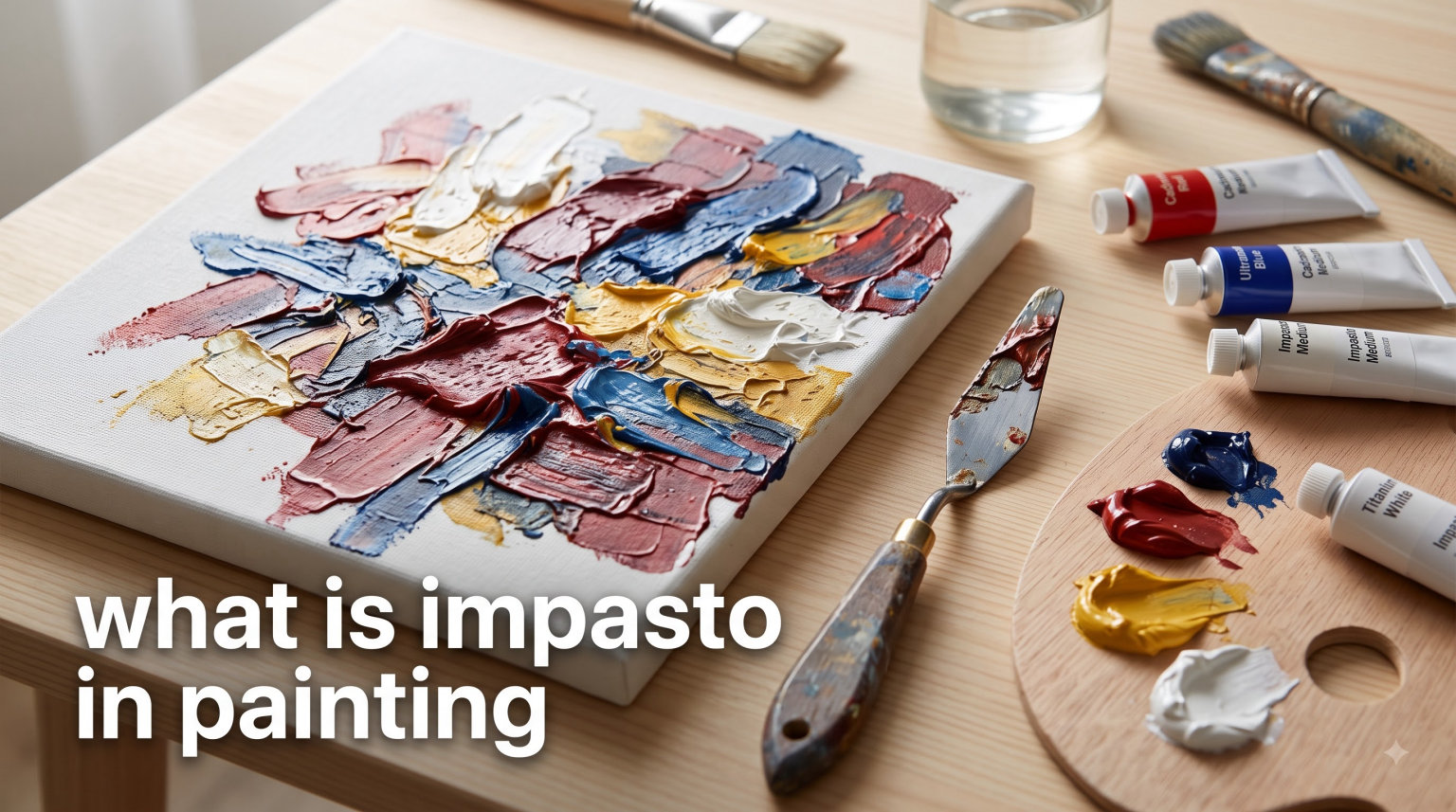
Impasto transforms a flat canvas into a sculptural surface you can almost feel through your eyes. When I first stood before a Van Gogh painting at the Museum of Modern Art, I understood why this technique has captivated artists for centuries. The paint seemed alive, rising from the canvas in dramatic ridges that caught the gallery lights.
What is impasto in painting? It is a technique where paint is laid on a surface thickly enough that brush or painting-knife strokes remain visible, creating texture and dimension. The word comes from Italian, meaning “dough” or “paste.” This impasto technique stands in direct contrast to smooth, blended painting styles where every trace of the artist’s hand disappears.
In this guide, I will walk you through everything you need to understand about impasto. You will learn why artists choose thick paint over thin glazes, which materials work best, and how to try it yourself without ruining your first attempt.
Table of Contents
What Is Impasto
Impasto is paint applied so thickly that it stands out from the surface, creating physical texture you could theoretically touch. The Italian word literally translates to “dough” or “paste,” describing the consistency needed to achieve this effect.
Unlike traditional painting where artists aim for invisible brushwork, impasto celebrates the mark-making process. Every stroke remains visible, every decision recorded in three dimensions. The technique emerged during the Renaissance when Venetian painters like Titian began experimenting with thicker paint applications to catch light.
The key distinction lies in depth. Standard painting might use paint layers measured in fractions of a millimeter. Impasto builds up areas where paint protrudes significantly, sometimes several millimeters or even centimeters from the canvas surface.
How Impasto Works
Impasto creates visual interest through physical texture. When light hits a textured surface, it bounces off at different angles. Raised ridges catch highlights while valleys fall into shadow. This interplay happens naturally without the artist mixing lighter and darker paints.
The technique also changes how we perceive color. Thick paint reflects light differently than thin glazes. Colors appear more saturated and luminous because light penetrates the paint layer, bounces off the white ground beneath, and returns through the pigment. This optical mixing creates depth impossible with smooth techniques.
Beyond the physics, impasto carries emotional weight. Visible brushstrokes reveal the artist’s gesture, speed, and energy. Van Gogh’s swirling impasto conveys movement and psychological intensity. Rembrandt’s thick highlights on noses and jewelry create focal points that draw the viewer’s eye.
Light and Shadow Dynamics
The three-dimensional nature of impasto creates actual shadows on the painting surface. When gallery lighting hits a heavily textured canvas from the side, real shadows form in the crevices between paint ridges. This physical shadow reinforces the illusion of depth within the image itself.
Viewers unconsciously read these shadows as depth cues. A thick stroke of white paint catching direct light reads as a sunlit wave or snow peak. The same stroke in shadow becomes a cloud or foam. The texture itself becomes part of the image’s meaning.
Materials and Mediums
Oil paint remains the traditional medium for impasto. Its slow drying time allows artists to work wet-into-wet, building up thick layers without disturbing underlying strokes. Oil maintains its shape as it dries, preserving the texture created while painting.
However, heavy-body acrylics have revolutionized impasto for modern painters. These paints come pre-thickened with a consistency similar to oil straight from the tube. For even more texture, artists add acrylic gel medium, which bulks up the paint without changing its color.
Oil Paint Considerations
Traditional oil paint works beautifully for impasto straight from the tube. Professional-grade oils contain higher pigment loads and less filler, allowing thicker applications. Some artists add cold wax medium or impasto medium to oil paint for even more body.
The downside? Oil paint dries slowly. Thick impasto layers might take weeks or months to fully cure. This extended timeline requires patience and careful studio planning.
Acrylic Alternatives
Heavy-body acrylics dry within hours, making them practical for impasto work. The paint skin forms quickly on the surface while the interior remains workable longer. For maximum texture, mix acrylic paint with modeling paste or heavy gel medium.
Acrylic impasto does have limitations. The paint tends to level slightly as it dries, losing some peak definition. Additionally, acrylics darken as they cure, so colors may shift from their wet appearance.
Tools for Application
The palette knife creates the most dramatic impasto effects. These flexible metal blades can deposit thick ridges of paint, scrape away layers, and create sharp edges impossible with brushes. Different blade shapes produce different marks, from broad swaths to fine details.
Bristle brushes work well for textured brushstrokes. The stiff hairs leave distinct marks in thick paint. Synthetic brushes lack the stiffness needed for heavy impasto work. Some artists use unconventional tools like combs, cardboard, or even their fingers.
Famous Artists Who Used Impasto
Vincent van Gogh stands as impasto’s most famous practitioner. His swirling, rhythmic brushstrokes in works like “Starry Night” and “Wheatfield with Crows” demonstrate how texture becomes emotion. Contemporary critics sometimes dismissed his heavy paint application as crude. Today we recognize it as revolutionary expression.
Rembrandt used selective impasto for dramatic effect. He piled paint thickly on highlighted areas like jewelry, faces, and fabrics while keeping backgrounds thin and atmospheric. This contrast draws viewers exactly where the artist intended.
Renaissance Origins
Titian and other Venetian Renaissance painters pioneered impasto in the 16th century. Before this innovation, most painting aimed for enamel-smooth surfaces. Titian realized thick paint could create texture that read as velvet, skin, or fabric more convincingly than careful blending.
The technique spread through the Baroque period. Painters like Rembrandt and Velazquez used it for dramatic lighting effects. However, the Academy later discouraged visible brushwork, pushing impasto underground until the 19th century.
Modern Masters
Frank Auerbach built up portraits from decades of accumulated paint. His subjects emerge from what appears to be sculpted pigment rather than painted canvas. The physical weight of his paint creates psychological weight in his images.
Jackson Pollock took impasto into abstraction. His drip paintings layer paint so thickly the canvas becomes relief sculpture. Willem de Kooning’s slashing brushstrokes and thick impasto defined Abstract Expressionism’s aggressive energy.
How to Apply Impasto
You do not need expensive materials to start experimenting with impasto. Begin with a sturdy canvas or panel that can support weight without sagging. Pre-primed canvases work, but mounting on rigid panel prevents flexing that could crack thick paint.
Load your brush or palette knife with more paint than you think you need. Impasto requires confidence. Tentative, thin applications defeat the purpose.
Step 1: Prepare your surface. Ensure your canvas or panel can handle weight. Stretch canvas tightly or work on rigid wood panel.
Step 2: Choose your medium. Oil paint works directly. For acrylic, squeeze heavy-body paint or mix standard paint with gel medium.
Step 3: Load your tool. Pick up a generous amount of paint on your palette knife or stiff brush.
Step 4: Apply decisively. Place the paint in one confident motion. Do not overwork the stroke.
Step 5: Build in layers. Let each layer set slightly before adding more. Wet-into-wet blending creates smooth transitions.
Step 6: Step back frequently. Impasto looks different from a distance than up close. Check your work from viewing distance.
Tips and Common Mistakes
The most common beginner error is trying to achieve impasto with standard paint consistency. Thin paint cannot hold peaks. Either start with heavy-body formulation or add medium to thicken standard paint.
Another mistake involves overworking wet paint. Once you place a stroke, leave it alone. Impasto celebrates decisive gesture. Blending and fussing destroy the fresh energy that makes the technique appealing.
The Main Drawback
Impasto’s primary disadvantage is drying time. Thick oil paint takes weeks or months to fully cure. During this time, the surface remains vulnerable to dust, damage, and accidental contact.
Additionally, thick paint can crack if applied over flexible surfaces or in incompatible layers. Following the fat-over-lean rule helps prevent this, applying more flexible, oily layers over stiffer underlayers.
Preventing Cracks
Cracking occurs when upper layers dry faster than lower layers or when inflexible paint sits atop flexible substrate. Use rigid panels for heavy impasto rather than stretched canvas. If using canvas, keep impasto moderate.
Acrylic impasto rarely cracks but can shrink slightly as water evaporates. This sometimes reveals canvas texture beneath. Applying a textured ground before painting minimizes this issue.
FAQs
What paint do I use for impasto?
Oil paint works best for traditional impasto because it holds peaks and dries slowly. Heavy-body acrylic paint also works well and dries faster. Add gel medium to standard acrylics for extra thickness. Palette knives and stiff bristle brushes are essential tools.
What is one drawback to the use of impasto?
The main drawback is extended drying time. Thick oil paint takes weeks or months to fully cure. This leaves the painting vulnerable to dust and damage during drying. Additionally, thick paint can crack over time if applied improperly or on flexible surfaces.
Did Vincent van Gogh use impasto?
Yes, Vincent van Gogh is one of history’s most famous impasto practitioners. His swirling, textured brushstrokes in paintings like Starry Night and The Bedroom demonstrate how impasto conveys emotion. Contemporary critics sometimes dismissed his heavy technique as crude, but it is now recognized as revolutionary.
What famous artists use impasto?
Major artists who used impasto include Rembrandt, Titian, Vincent van Gogh, Jackson Pollock, Willem de Kooning, and Frank Auerbach. Rembrandt used selective impasto for highlights. Titian pioneered the technique during the Renaissance. Modern artists like Auerbach built portraits from decades of accumulated paint.
Conclusion
What is impasto in painting? It is the transformation of paint from mere color into physical presence. This technique has defined some of art history’s most powerful works, from Rembrandt’s glowing portraits to Van Gogh’s turbulent landscapes.
If you have never tried impasto, start with a small study using heavy-body acrylics. The immediate results will show you why artists fall in love with thick paint. Remember that impasto in painting is not about perfection. It is about presence, gesture, and the courage to let your marks show.
Whether you work in oils or acrylics, the principles remain the same. Load your tool generously. Apply paint confidently. Step back and let the texture speak. That is the magic of impasto.