
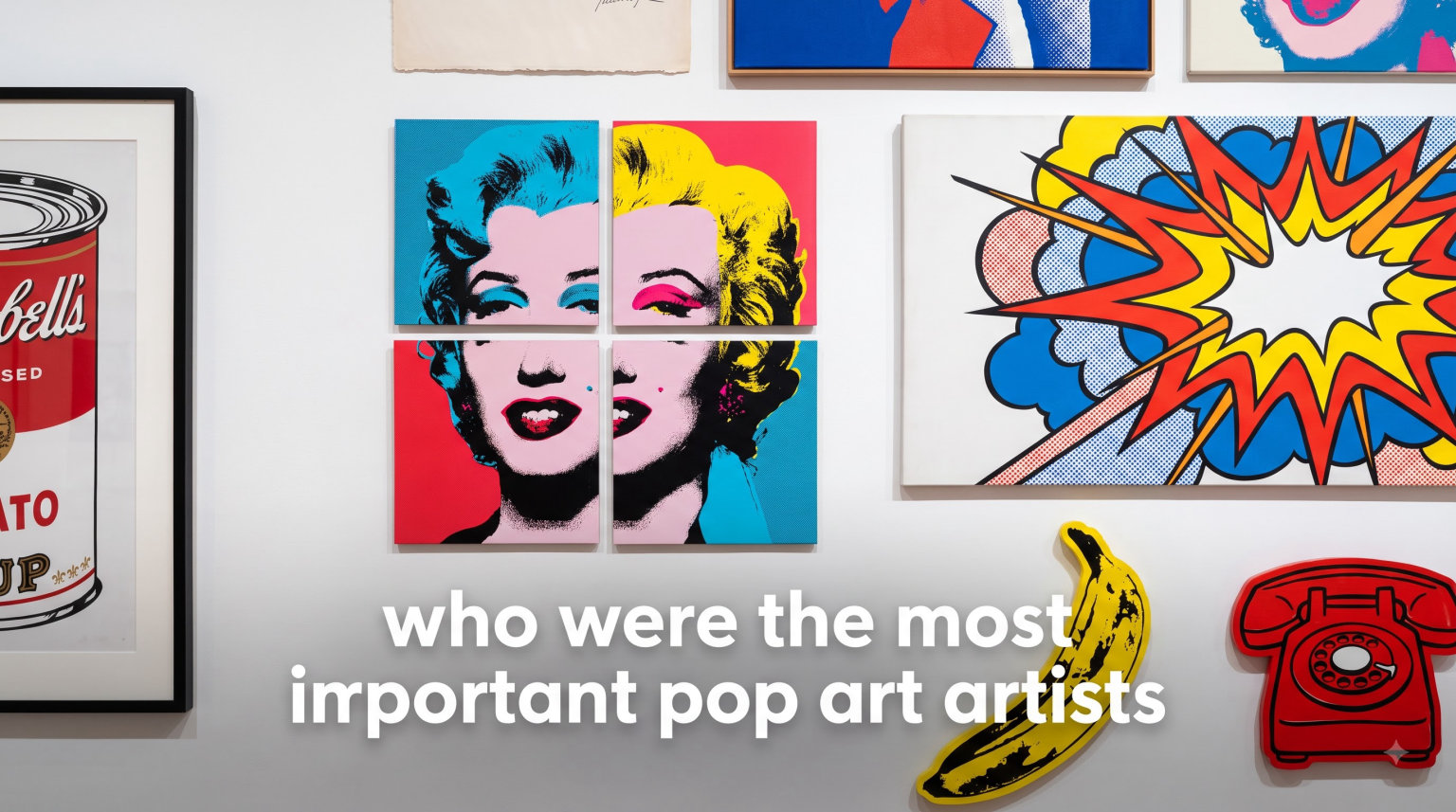
Pop Art transformed the art world by blurring the lines between high culture and everyday consumer goods. When people ask who were the most important pop art artists, the answer extends beyond household names like Andy Warhol to include a diverse group of innovators from both sides of the Atlantic.
The most important Pop Art artists include Andy Warhol, Roy Lichtenstein, Keith Haring, Richard Hamilton, Robert Rauschenberg, and James Rosenquist. These six figures defined the movement through their revolutionary approaches to popular culture imagery, commercial techniques, and mass media themes.
Our team has spent years studying the Pop Art movement, visiting major exhibitions at MoMA, Tate Modern, and the Whitney. This guide draws from that direct experience to give you accurate, art-historical context on each artist’s contribution.
Table of Contents
What Is Pop Art? Understanding the Movement
Pop Art emerged in the mid-1950s in Britain and exploded across America in the 1960s as a direct reaction against Abstract Expressionism. While Jackson Pollock and his contemporaries focused on emotional, gestural abstraction, Pop Art founders looked outward to advertising, comic books, and consumer products.
The term “Pop Art” was coined in 1954 by British artist John McHale, though it gained widespread recognition after critic Lawrence Alloway used it in 1958. The movement embraced mechanical reproduction, bold colors, and imagery from mass culture.
British Pop Art tended toward a more academic, ironic critique of consumer culture. American Pop Art was brasher, more celebratory, and deeply embedded in the actual machinery of advertising and celebrity that it depicted.
Key Characteristics of Pop Art
Several visual signatures define Pop Art across all its practitioners. Bold, flat colors replaced the textured brushwork of earlier movements. Artists borrowed directly from commercial sources like packaging, advertisements, and comic strips.
Mechanical reproduction techniques became legitimate artistic methods. Appropriation—lifting existing imagery without alteration—became acceptable practice. Repetition of familiar icons created new meaning through context and scale.
The movement deliberately collapsed the distinction between “high” art (painting, sculpture) and “low” culture (advertising, comic books, consumer goods).
Andy Warhol: The King of Pop Art
Andy Warhol stands as the most recognizable figure in Pop Art history. Born in Pittsburgh in 1928 to working-class Slovakian immigrants, Warhol began his career as a commercial illustrator for magazines like Glamour and Harper’s Bazaar before pivoting to fine art in the late 1950s.
Warhol’s 1962 breakthrough came with his Campbell’s Soup Cans series—32 canvases depicting the canned soup varieties Campbell’s offered at the time. The work’s deadpan presentation of commercial products as art subjects shocked the establishment while establishing Warhol’s signature approach.
His studio, known as The Factory, became a legendary gathering place for artists, musicians, actors, and socialites. Warhol employed silkscreen printing techniques to mass-produce his images, deliberately removing the artist’s hand from the work and questioning notions of originality and authenticity.
Warhol’s appropriation techniques revolutionized how artists could engage with existing imagery. His Marilyn Diptych (1962), featuring repeated images of Marilyn Monroe, commented on celebrity, death, and mechanical reproduction simultaneously.
Other iconic Warhol works include the Elvis series, Brillo Boxes (1964), and his Mao portraits from the 1970s. Warhol’s influence extends far beyond visual art into film, music, and contemporary celebrity culture itself.
Warhol’s Enduring Legacy
Warhol died in 1987 following complications from gallbladder surgery, but his influence has only grown. The Andy Warhol Museum in Pittsburgh holds the largest collection of his works. His prediction that “in the future, everyone will be world-famous for 15 minutes” seems prophetic in the age of social media.
Roy Lichtenstein: Master of the Comic Strip
Roy Lichtenstein developed one of the most distinctive visual styles in 20th-century art. Born in Manhattan in 1923, he worked as a commercial artist and teacher before his 1961 painting Look Mickey caught the attention of gallery owner Leo Castelli.
Lichtenstein’s breakthrough came from an unexpected source. His son challenged him to paint as well as the cartoonists whose work appeared in comic books. Rather than imitating the loose brushwork of Abstract Expressionism, Lichtenstein embraced the mechanical aesthetics of commercial printing.
His signature technique involved hand-painted Ben-Day dots—the same dot patterns used in newspaper and comic book printing to create shading and color variation. This mechanical texture became his trademark and a commentary on mass reproduction.
Whaam! (1963), housed at Tate Modern, remains his most famous work. The diptych depicts a fighter plane shooting down an enemy aircraft, lifted directly from a DC Comics war comic. The work measures 13 feet wide and transforms disposable entertainment into monumental art.
Other significant works include Drowning Girl (1963), Girl with Ball (1961), and his later Mirror series from the 1970s. Lichtenstein continued refining his style until his death in 1997, eventually moving beyond comic sources to engage with art historical subjects rendered in his signature dot style.
The Technique Behind the Dots
Lichtenstein didn’t simply copy comic panels. He selected specific images, often cropped them for maximum emotional impact, and then recreated them using stencils and oil paint. The Ben-Day dots were painstakingly applied using perforated metal screens and paint rollers.
This labor-intensive process to create “mechanical” looking art contained its own irony. Lichtenstein’s work questioned authenticity while requiring tremendous artistic skill to execute.
Keith Haring: Street Art Pioneer
Keith Haring brought Pop Art energy to the streets and subways of New York City. Born in 1958 in Reading, Pennsylvania, Haring moved to New York in 1978 to study at the School of Visual Arts. He quickly became immersed in the downtown art scene alongside Jean-Michel Basquiat and Kenny Scharf.
Haring’s breakthrough came in the early 1980s when he began drawing with white chalk on the black paper panels covering expired advertising spaces in New York subway stations. These ephemeral drawings—sometimes created in minutes before transit police arrived—reached thousands of commuters daily.
His visual vocabulary was instantly recognizable: radiant babies, barking dogs, flying saucers, and dancing figures outlined in bold, energetic lines. Unlike many Pop Art predecessors, Haring’s work carried explicit social and political messages about nuclear proliferation, apartheid, drug addiction, and AIDS awareness.
In 1986, Haring opened the Pop Shop in SoHo, selling t-shirts, toys, and posters featuring his imagery. He deliberately wanted his art accessible to everyone, not just wealthy collectors. This democratic approach alienated some art world figures but cemented his connection to popular culture.
Diagnosed with AIDS in 1988, Haring established the Keith Haring Foundation that same year to provide funding and imagery to AIDS organizations and children’s programs. He died in 1990 at age 31, leaving behind a massive body of work and a foundation that continues his philanthropic mission.
Haring’s Public Art Legacy
Haring created over 50 public artworks in cities worldwide, many specifically for hospitals, orphanages, and children’s centers. His Crack is Wack mural on a Harlem handball court remains a landmark. The work’s accessibility and positive messaging set it apart from the more ironic or detached tone of earlier Pop Art.
Richard Hamilton: The Father of British Pop Art
Richard Hamilton earned the title “Father of Pop Art” for creating what many consider the first Pop Art work. Born in London in 1922, Hamilton studied at the Royal Academy and the Slade School of Fine Art before becoming involved with the Independent Group—a collective of artists and writers exploring popular culture’s relationship to fine art.
In 1956, Hamilton created Just What Is It That Makes Today’s Homes So Different, So Appealing? for the This Is Tomorrow exhibition at Whitechapel Gallery. The collage depicts a muscle-bound man holding a large Tootsie Pop with a nude woman reclining on a sofa. The interior contains every 1950s consumer icon: a television, tape recorder, vacuum cleaner advertisement, and comic book.
Hamilton created a list of Pop Art characteristics in 1957 that remains influential: popular (designed for mass audience), transient (short-term solution), expendable (easily forgotten), low-cost, mass-produced, young (aimed at youth), witty, sexy, gimmicky, glamorous, and Big Business.
Unlike his American counterparts, Hamilton maintained a critical, analytical distance from consumer culture. His works often engaged with political themes, including his extensive series addressing the Troubles in Northern Ireland and the Gulf War.
Hamilton continued working until his death in 2011. His influence on British art extends through his teaching at the University of Newcastle and London, where he mentored students including Bryan Ferry (who formed Roxy Music) and the artists who would become associated with the Young British Artists movement.
British vs American Pop Art
British Pop Art emerged from academic and critical discourse about mass culture. Artists like Hamilton viewed American consumerism with anthropological detachment. American Pop Art, by contrast, emerged from within that consumer culture. Warhol celebrated Campbell’s soup because he actually ate it. Lichtenstein loved comic books. This distinction shaped the tone of each nation’s Pop Art output.
Robert Rauschenberg: The Bridge Between Movements
Robert Rauschenberg occupies a unique position between Abstract Expressionism and Pop Art. Born in Texas in 1925, Rauschenberg studied at the Kansas City Art Institute, Academie Julian in Paris, and Black Mountain College under Josef Albers.
His “Combine” paintings from the 1950s incorporated found objects, fabric, newspaper, and three-dimensional elements into painted surfaces. Works like Bed (1955)—an actual quilt and pillow mounted on canvas—challenged traditional definitions of painting and sculpture.
Monogram (1955-59) remains his most famous Combine: a taxidermied Angora goat wearing a tire around its middle, standing on a painted platform. The work is simultaneously absurd, poetic, and deeply influential on later installation and assemblage art.
Rauschenberg’s Silkscreen paintings from the early 1960s brought photographic imagery directly into his work, incorporating press photos of space launches, athletes, and political figures. These works share territory with Pop Art while maintaining the gestural energy of Abstract Expressionism.
He was the first American to win the Golden Lion at the Venice Biennale (1964), effectively crowning American art’s international dominance. Rauschenberg worked until his death in 2008, constantly experimenting with new technologies including digital printing and performance.
Rauschenberg’s Technical Innovations
Rauschenberg developed solvent transfer techniques in the 1950s, allowing him to transfer printed images onto paper by dissolving the ink and rubbing it onto a new surface. This DIY approach to appropriation influenced generations of artists working with found imagery.
James Rosenquist: From Billboards to Fine Art
James Rosenquist brought his experience as a billboard painter to the gallery walls. Born in North Dakota in 1933, Rosenquist moved to New York City at age 17 and supported himself painting advertisements high above Times Square.
His most famous work, F-111 (1964-65), measures 26 feet by 86 feet and wraps around gallery walls. The painting features a fighter jet bomber interspersed with images of spaghetti, a light bulb, a beach umbrella, and a child under a hair dryer. The work comments on Vietnam War militarism while acknowledging the omnipresence of advertising.
Rosenquist’s style involved taking fragments of commercial imagery and recombining them in unsettling ways. Unlike Lichtenstein’s comic focus or Warhol’s celebrity obsession, Rosenquist engaged with the overwhelming visual noise of American consumer culture itself.
His paintings often feature cropped, disconnected images that suggest narratives without completing them. A tire, a plate of food, a pair of hands—each rendered with billboard-scale precision but arranged in dreamlike, disorienting compositions.
Rosenquist continued working until his death in 2017. His large-scale paintings remain in major collections worldwide, and his influence on contemporary billboard-scale art is unmistakable.
The Scale of Rosenquist’s Vision
Rosenquist’s billboard background taught him to work fast and think big. His paintings often required viewers to move physically through space to experience them. This environmental approach to painting anticipated installation art and immersive experiences that dominate museums today.
Other Notable Pop Art Artists
Several other artists made significant contributions to the Pop Art movement. Understanding their work provides a fuller picture of how Pop Art developed across different contexts and styles.
Robert Indiana: The LOVE Artist
Robert Indiana created one of the most reproduced images in art history. His LOVE sculpture—with its tilted “O”—appears on stamps, cards, and public installations worldwide. Born in Indiana (he took the state’s name), he worked in Coenties Slip alongside Agnes Martin and Ellsworth Kelly before developing his hard-edge, text-based Pop Art style.
David Hockney: British Pop’s Playful Side
David Hockney brought California swimming pools and suburban domesticity to Pop Art. His swimming pool paintings from the 1960s, with their flat planes of blue and stylized figures, capture a specific moment of American leisure. Hockney continues working today, having moved through photography, iPad drawings, and stage design.
Tom Wesselmann: Still Life and the Female Form
Tom Wesselmann’s Great American Nude series flattened the female form into pure Pop imagery, borrowing from advertising while referencing art history. His Still Life series treated consumer goods with the reverence traditionally reserved for fruit bowls and flowers.
Claes Oldenburg: Soft Sculptures
Claes Oldenburg transformed hard consumer objects into soft sculptures. His Floor Burger (1962) and Giant Soft Fan (1966-67) took everyday items and made them monumental, floppy, and slightly absurd. With his wife Coosje van Bruggen, he created large public sculptures of ordinary objects.
Female Pioneers of Pop Art
Women artists contributed significantly to Pop Art despite limited recognition. Marisol Escobar created sculptural assemblages combining folk art and Pop imagery. Pauline Boty was the only female member of the British Pop Art movement before her death in 1966. Rosalyn Drexler painted wrestling and movie scenes with flat, graphic energy. Niki de Saint Phalle’s shooting paintings and Nana sculptures bridged Pop and Nouveau Réalisme.
More recent scholarship has recovered these artists’ contributions, though they remain less known than their male counterparts.
The Cultural Impact and Legacy of Pop Art
Pop Art fundamentally changed what art could be and who it could address. Before Pop Art, museums and galleries primarily served educated elites. After Pop Art, advertising aesthetics became legitimate subject matter, and popular culture entered the permanent collections of major institutions.
The movement influenced nearly every subsequent art development. Conceptual Art adopted Pop’s interest in ideas over craftsmanship. Photorealism took Pop’s engagement with photographic imagery to extreme lengths. Neo-Geo and the Pictures Generation of the 1980s returned to Pop strategies of appropriation and critique.
Contemporary artists like Jeff Koons and Takashi Murakami explicitly position themselves as Pop Art heirs. Koons’ balloon animal sculptures and Murakami’s anime-inspired characters continue blurring commercial and fine art boundaries. Banksy’s street art carries Pop Art’s accessibility and ironic engagement with mass media.
Pop Art’s influence extends into design, fashion, and digital culture. Instagram’s visual language—bold colors, flat graphics, repetition—echoes Pop Art strategies. Meme culture performs Pop Art’s central operation: lifting familiar imagery, repeating it with variation, and generating new meaning through context.
Perhaps Pop Art’s greatest legacy is its democratization of art. By declaring that soup cans, comic strips, and subway drawings could be subjects for serious artistic attention, Pop Art expanded the boundaries of what qualified as art. That expansion continues today.
Frequently Asked Questions
Who were the main artists of pop art?
The main artists of Pop Art include Andy Warhol, Roy Lichtenstein, Keith Haring, Richard Hamilton, Robert Rauschenberg, and James Rosenquist. These six artists defined the movement through their revolutionary approaches to popular culture imagery, commercial techniques like silkscreen printing and Ben-Day dots, and their engagement with mass media themes from the 1950s through the 1980s.
Who is the most famous pop artist?
Andy Warhol is the most famous Pop Art artist. His Campbell’s Soup Cans, Marilyn Diptych, and factory-produced silkscreen works made him the public face of the movement. Warhol’s celebrity connections, avant-garde films, and quotable personality cemented his status as a cultural icon whose influence extends far beyond visual art into contemporary celebrity culture.
Who is considered the king of pop art?
Andy Warhol is widely considered the king of Pop Art. His Factory studio, silkscreen production methods, celebrity portraits, and ubiquity in popular culture earned him this title. Warhol’s ability to transform consumer products and celebrities into high art while maintaining an ironic, detached persona defined Pop Art for the general public.
What is the difference between British and American Pop Art?
British Pop Art emerged from academic critique and viewed American consumer culture with anthropological distance. Richard Hamilton and the Independent Group analyzed mass media rather than celebrating it. American Pop Art emerged from within consumer culture—Warhol genuinely loved Campbell’s soup and Hollywood stars. American Pop was brasher, more celebratory, and less ironic than its British counterpart.
Why is Pop Art important today?
Pop Art remains important because it established the legitimacy of appropriation, mechanical reproduction, and popular culture as artistic subjects. Contemporary digital culture—memes, Instagram aesthetics, and viral imagery—operates on Pop Art principles. Artists like Jeff Koons and Takashi Murakami continue Pop Art strategies, while street art and graphic design remain deeply influenced by the movement’s visual language.
Conclusion
Pop Art transformed the art world by declaring that everyday consumer culture deserved the same attention as traditional fine art subjects. The most important Pop Art artists—Andy Warhol, Roy Lichtenstein, Keith Haring, Richard Hamilton, Robert Rauschenberg, and James Rosenquist—each contributed unique approaches to engaging with mass media and popular imagery.
Warhol’s Factory production and celebrity portraits, Lichtenstein’s comic-inspired Ben-Day dots, Haring’s accessible street art, Hamilton’s critical collages, Rauschenberg’s Combines, and Rosenquist’s fragmented billboards created a movement that continues influencing artists today.
Understanding who were the most important pop art artists means recognizing how they expanded art’s possibilities. By embracing commercial techniques, popular imagery, and democratic distribution, these artists created work that speaks as clearly to contemporary audiences as it did to viewers in the 1960s.
Whether you are an art collector, student, or simply curious about the movement that brought soup cans and comic strips into museums, the legacy of Pop Art surrounds us in every aspect of contemporary visual culture.