
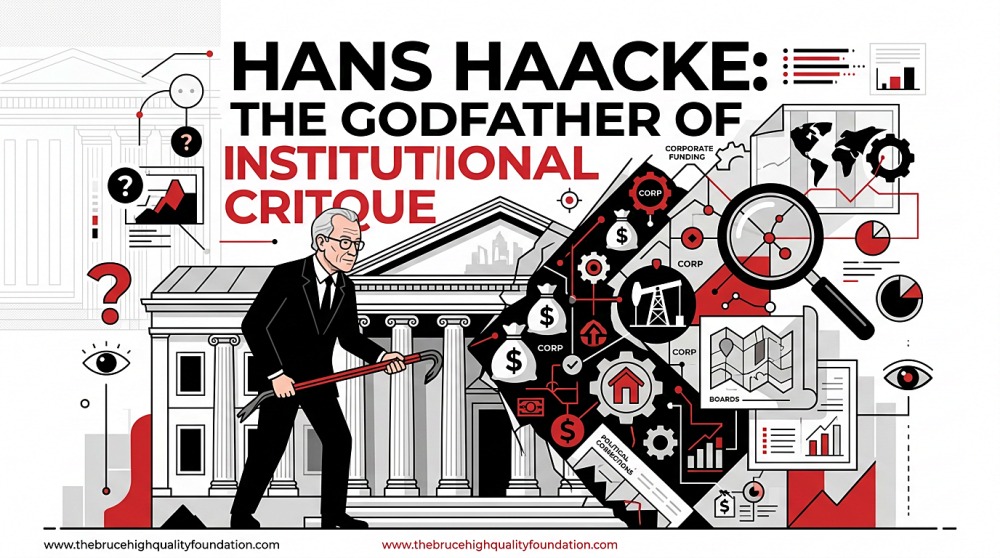
Hans Haacke is widely recognized as the godfather of institutional critique, a movement that fundamentally changed how we understand the relationship between art, money, and power. His pioneering work over six decades has exposed the hidden financial and political structures that support museums and galleries, challenging the myth that art institutions are neutral spaces. In 2026, his influence on contemporary art and activism remains as powerful as ever, making his work essential study for anyone seeking to understand how cultural institutions really operate.
What sets Haacke apart from other conceptual artists is his relentless documentation of uncomfortable truths. He does not create abstract critiques; he presents facts, records, and provenance research that reveal exactly who funds our museums and what those donors expect in return. This approach has made him both celebrated and feared in the art world, with major institutions simultaneously collecting his work while nervously anticipating what connections he might expose next.
This comprehensive guide explores Haacke’s biography, his evolution from kinetic art to political systems, and the specific techniques that earned him his reputation as institutional critique’s most consistent critic. Whether you are an art history student, museum professional, or contemporary art enthusiast, understanding Haacke’s work provides crucial insight into the power structures that shape our cultural landscape.
Table of Contents
Who Is Hans Haacke?
Hans Haacke was born on August 12, 1936, in Cologne, Germany, into a world on the brink of massive political and social upheaval. His early experiences in post-war Germany shaped his acute awareness of how institutions function and how power operates through cultural channels. This formative context helps explain why his work consistently interrogates the structures that most artists take for granted.
Haacke’s formal art education began at the Staatliche Werkakademie Kassel, where he developed his foundational understanding of art and design. In 1961, he moved to Philadelphia to study at the Tyler School of Art on a Fulbright grant, a pivotal moment that would eventually lead to his permanent relocation to the United States. His time in Philadelphia exposed him to new conceptual frameworks and connected him to emerging movements in American contemporary art.
During his early years in Germany, Haacke became associated with the Zero group, an influential collective of artists exploring kinetic art, light, and environmental phenomena. This connection placed him at the center of experimental art practices in 1960s Europe, alongside figures like Otto Piene and Gunther Uecker. The Zero group’s focus on systems, processes, and viewer interaction would profoundly influence Haacke’s later political work, establishing conceptual foundations he continues to build upon in 2026.
Early Career: From Kinetic Art to Environmental Systems
Haacke’s early work focused on kinetic art and environmental systems, exploring physical processes like condensation, air currents, and biological growth. His famous Condensation Cube (1963-1965) exemplifies this period: a sealed plexiglass box that naturally generates condensation through temperature differentials, creating an ever-changing visual display without the artist’s direct intervention. These works established Haacke’s reputation as a pioneer of systems art, demonstrating his interest in real-time processes rather than static objects.
The concept of “real-time systems” became central to Haacke’s practice during this period. Unlike traditional sculptures or paintings that remain fixed after completion, his environmental works continued to change and evolve based on atmospheric conditions, temperature, and humidity. This approach treated the artwork as a living system integrated with its surroundings, foreshadowing his later investigations into social and institutional systems.
His early experiments with water systems, air flow, and biological processes might seem unrelated to his later political work, but they established crucial methodological patterns. Haacke learned to observe systems, document their behavior, and present findings without editorial embellishment. These skills translated directly into his institutional critique phase, where he applied the same observational rigor to museum funding structures and corporate sponsorship networks.
The Zero group connection provided Haacke with a theoretical framework for understanding art as an interactive system rather than a discrete object. Group members rejected traditional composition in favor of dynamic processes, light experiments, and environmental responsiveness. Haacke absorbed these principles and eventually applied them to social environments, treating museums and galleries as systems with inputs (funding), processes (curatorial decisions), and outputs (exhibitions and their political effects).
What Is Institutional Critique?
Institutional critique is a form of conceptual art that emerged in the late 1960s, centered on exposing and analyzing the power structures within museums, galleries, and other cultural institutions. Rather than accepting these institutions as neutral containers for art, practitioners like Haacke revealed how they are embedded in complex networks of money, politics, and social influence that determine what art gets shown and how it is interpreted. The movement treats the institution itself as both subject and medium of artistic investigation.
Haacke is widely considered the leading exponent and godfather of institutional critique, having developed the most consistent and rigorous approach to institutional analysis over his 60-year career. While other artists occasionally critiqued museums or created site-specific interventions, Haacke made institutional analysis his primary focus, developing repeatable methodologies that could be applied to any cultural institution. His work demonstrates that every exhibition is political, every donor has interests, and every curatorial decision reflects power structures.
The core technique of institutional critique involves exposing the connections between art institutions and their funding sources, particularly corporate sponsorship and wealthy donor networks. Haacke pioneered the use of provenance research, documentary evidence, and real-time investigations to reveal how money flows through cultural institutions and how those flows influence programming decisions. This approach has proven prescient as museum funding controversies have become increasingly public in 2026, with protests against toxic donors and demands for institutional transparency echoing Haacke’s decades-long concerns.
Key Works That Defined Institutional Critique
Manet-Projekt 74
Manet-Projekt 74 (1974) stands as one of Haacke’s most influential works, demonstrating his signature method of provenance research applied to institutional critique. The piece investigated the ownership history of Edouard Manet’s painting Bunch of Asparagus, tracing its path through German collections during the Nazi era. Haacke’s research revealed that the painting had been owned by a Jewish collector who was forced to sell it under Nazi pressure, and that the current holder, the Wallraf-Richartz Museum in Cologne, had accepted it as a donation from a collector with questionable wartime activities.
More controversially, Haacke exposed the Nazi background of the donor who gave the Manet to the museum. This revelation created immediate institutional panic, as the museum faced uncomfortable questions about its acquisition practices and its willingness to accept tainted donations. The work demonstrated how provenance research could function as artistic practice, transforming dry historical investigation into a powerful institutional intervention.
The Wallraf-Richartz Museum ultimately cancelled the exhibition of Manet-Projekt 74, providing Haacke with exactly the kind of institutional response that proved his point. By suppressing the work, the museum demonstrated the very power structures Haacke was investigating: the desire to protect donors, the fear of negative publicity, and the willingness to censor art that exposes uncomfortable truths. This pattern of cancellation and controversy would repeat throughout Haacke’s career.
Shapolsky et al. Manhattan Real Estate Holdings
Shapolsky et al. Manhattan Real Estate Holdings, A Real-Time Social System, as of May 1, 1971 (1971) represents Haacke’s expansion from museum politics to broader social systems. The work documented the real estate empire of Harry Shapolsky, a prominent New York landlord known for speculative practices in low-income neighborhoods. Haacke created charts, maps, and documentation showing how Shapolsky’s companies bought, sold, and managed properties, often engaging in practices that harmed tenants while generating massive profits.
The piece created immediate controversy because it connected the art world directly to real estate speculation and slum landlord practices. Shapolsky was not just any businessman; he was a figure whose activities affected thousands of New Yorkers, and Haacke’s documentation made those connections visible. The work demonstrated that art institutions are embedded in urban economic systems, not separate from them, and that cultural philanthropy often derives from problematic sources.
This work was scheduled for exhibition at the Guggenheim Museum in 1971, but the museum cancelled the show just days before opening. The cancellation became one of the most infamous cases of institutional censorship in contemporary art history, proving Haacke’s argument that museums would suppress art to protect their interests and relationships with powerful figures. The incident established Haacke’s reputation as an artist museums feared, a status he maintains in 2026.
MetroMobiltan
MetroMobiltan (1985) marked Haacke’s mature phase of institutional critique, targeting corporate sponsorship and its connections to political oppression. The work was created for a show at the Museum of Modern Art in New York and investigated the museum’s relationship with Mobil Oil Corporation, a major donor and sponsor. Haacke revealed that Mobil was actively supporting the apartheid regime in South Africa through its business operations while simultaneously burnishing its reputation through cultural philanthropy in New York.
The installation featured a massive banner from a Mobil-sponsored exhibition of African art juxtaposed with documentation of the company’s South African operations and its support for apartheid. By placing these elements in dialogue, Haacke demonstrated how corporate philanthropy functions as “whitewashing,” allowing companies to associate themselves with progressive cultural values while engaging in oppressive political activities elsewhere. The work exposed the contradictions that corporate sponsorship creates for cultural institutions.
MoMA’s response to MetroMobiltan was notably different from the Guggenheim’s earlier cancellation. Perhaps recognizing that suppressing the work would validate Haacke’s critique, MoMA allowed the exhibition to proceed. However, the work generated significant controversy and established a template for activist critiques of museum funding that continues to influence protests against toxic donors in 2026. Haacke’s methodology of connecting cultural philanthropy to corporate malfeasance has been widely adopted by contemporary activism movements.
The Guggenheim Controject and Institutional Censorship
The 1971 cancellation of Haacke’s Guggenheim exhibition remains a defining moment in institutional critique history. The museum’s director, Thomas Messer, personally intervened to cancel the show, citing concerns about the museum being turned into an “information center” and the invasion of privacy regarding the Shapolsky family. These justifications revealed precisely the institutional anxieties that Haacke’s work was designed to expose: fear of transparency, protection of wealthy donors, and prioritization of institutional relationships over artistic freedom.
The cancellation generated significant publicity and debate within the art world, with many critics and artists supporting Haacke while defending institutions argued that museums had legitimate interests in managing their donor relationships. The controversy established a pattern that would repeat throughout Haacke’s career: his work would be accepted by major institutions, then generate conflict when it exposed uncomfortable truths about those same institutions. This dynamic demonstrates both the power and the peril of institutional critique as an artistic strategy.
In 2026, the Guggenheim controversy remains a touchstone for discussions about museum censorship and artistic freedom. The incident is frequently cited in debates about whether institutions can legitimately host critical art about themselves, a question that has become increasingly urgent as museums face growing pressure to address their funding sources and their complicity in various forms of social harm. Haacke’s experience proved that institutional critique works best when it provokes response, even when that response is suppression.
Haacke’s Methods and Techniques
Haacke’s institutional critique relies on specific, repeatable techniques that distinguish his work from more impressionistic political art. His primary method is documentary research, using public records, financial documents, and provenance research to establish factual connections between art institutions and their funding sources. This approach treats the artwork as a research project, presenting evidence rather than opinions and allowing viewers to draw their own conclusions from the documented facts.
Provenance research, borrowed from art historical methodology, becomes in Haacke’s hands a tool for political investigation. By tracing the ownership history of artworks and donations, he reveals patterns of wealth accumulation, problematic sources of cultural philanthropy, and the mechanisms by which museums legitimize tainted money through association with art. This technique proved particularly powerful in Manet-Projekt 74, where Nazi-era provenance revealed ongoing institutional complicity with problematic historical legacies.
Haacke also pioneered the concept of “real-time social systems,” applying his early interest in physical processes to social and institutional dynamics. His works often include ongoing or time-sensitive elements that respond to current events, institutional decisions, or public reactions. This approach keeps his critique contemporary and responsive, ensuring that the work cannot be dismissed as historical commentary irrelevant to present concerns. In 2026, this methodology remains vital for addressing ongoing issues of museum funding and corporate sponsorship.
Haacke and Other Institutional Critics
While Haacke is recognized as the godfather of institutional critique, he was not the only artist investigating these themes. Marcel Broodthaers, the Belgian conceptual artist, similarly critiqued museums and their role in constructing artistic value, though his approach was more poetic and metaphorical than Haacke’s documentary rigor. Where Broodthaers used fictional museums and theatrical interventions, Haacke presented hard evidence and specific accusations, establishing a more confrontational model for institutional critique.
Andrea Fraser, an American artist who emerged in the 1980s and 1990s, extended Haacke’s methods into performance and institutional psychoanalysis. Her famous work Museum Highlights (1989) used the persona of a museum docent to expose the class assumptions and cultural hierarchies embedded in museum education. Fraser has consistently acknowledged Haacke’s influence, and her work represents a second generation of institutional critique that internalized Haacke’s insights while developing new methodological approaches.
Carey Young, a British artist represented in the Tate collection, represents a third generation of institutional critique influenced by Haacke. Her work often addresses legal systems, corporate structures, and institutional language, applying Haacke’s investigative methods to new domains. The Whitney Museum has noted that Haacke is considered the “most harsh and consistent critic of museums,” distinguishing him from contemporaries who may have critiqued institutions occasionally but never made it their primary focus across six decades of practice.
Legacy and Contemporary Relevance in 2026
Haacke’s influence on contemporary art and activism cannot be overstated. Over 60 years of consistent practice, he has established institutional critique as a major genre of contemporary art and provided methodological foundations that younger artists continue to employ. His work appears in major museum collections including MoMA, the Whitney, SFMOMA, and the Tate, an ironic validation of his critique that institutions simultaneously collect and fear his work.
In 2019, the New Museum in New York mounted a major retrospective titled “All Connected,” demonstrating Haacke’s continued relevance and institutional significance. The exhibition traced his evolution from kinetic systems to political investigations, confirming that his early and late work share consistent methodological concerns. Reviews of the show emphasized how prescient Haacke’s critiques remain, with current debates about museum funding, toxic donors, and institutional accountability echoing concerns he first raised decades ago.
The question “why are museums afraid of Hans Haacke?” has become a standard reference point in discussions of institutional power. Museums fear his work because it exposes the financial and political structures they depend upon but prefer to keep hidden. His provenance research threatens donor relationships, his corporate investigations threaten sponsorship deals, and his institutional analysis threatens the mythology of the museum as a neutral space above politics. These fears are validated every time an institution hesitates to show his work or nervously anticipates what his next investigation might reveal.
Haacke’s awards and recognition include the Golden Lion at the Venice Biennale (1993), the Goslarer Kaiserring (2018), and numerous academic honors. These accolades demonstrate that despite institutional anxieties, the art world recognizes his importance and influence. His writings and publications, including Working Conditions and various critical essays, provide theoretical frameworks that continue to shape discussions of institutional critique in art history and museum studies programs.
Visitors can see Haacke’s work at major institutions worldwide, including the Museum of Modern Art in New York, the Whitney Museum, the Tate in London, and the San Francisco Museum of Modern Art. Each of these institutions maintains his work while nervously anticipating what he might investigate next, a paradox that perfectly captures the uncomfortable relationship between institutional critique and the institutions it critiques. In 2026, his work remains essential viewing for anyone seeking to understand how power operates through cultural institutions.
Frequently Asked Questions
What did Hans Haacke do?
Hans Haacke is a German-born conceptual artist who pioneered institutional critique, exposing connections between money, politics, and art institutions through documentary research and provenance investigation. His work investigates museum funding, corporate sponsorship, and the power structures that determine what art is shown and how institutions operate.
What is institutional critique in art?
Institutional critique is a form of conceptual art that exposes and analyzes power structures within museums, galleries, and cultural institutions. It reveals how these institutions are embedded in networks of money and politics rather than being neutral spaces for art. Haacke is widely considered the godfather of this movement.
Who or what did Hans Haacke’s work critique?
Haacke’s work critiques museums, galleries, corporate sponsors, wealthy donors, and the art world system. He exposed Nazi connections in museum provenance, real estate speculation by cultural philanthropists, and corporate support for apartheid. His work targets the hidden financial and political structures that support cultural institutions.
What awards did Hans Haacke win?
Haacke has received numerous awards including the Golden Lion at the Venice Biennale (1993), the Goslarer Kaiserring (2018), and the Skowhegan Medal for Sculpture. He has also received honorary doctorates and academic honors recognizing his six-decade contribution to contemporary art and institutional critique.
Where can I see Hans Haacke’s work?
Haacke’s work is held in major collections including the Museum of Modern Art (MoMA) in New York, the Whitney Museum, the San Francisco Museum of Modern Art (SFMOMA), the Tate in London, and numerous European museums. His work has been featured in major retrospectives including the 2019 New Museum exhibition All Connected.
Why are museums afraid of Hans Haacke?
Museums fear Haacke because his work exposes uncomfortable truths about their funding sources, donor relationships, and corporate sponsorships. His provenance research and documentary investigations reveal connections institutions prefer to keep hidden. The 1971 Guggenheim cancellation demonstrated that museums will censor art to protect their interests.
Conclusion: The Enduring Power of Institutional Critique
Hans Haacke’s six-decade career as the godfather of institutional critique has fundamentally changed how we understand art institutions and their relationship to power. His pioneering work exposed the connections between money, politics, and art that most museums preferred to keep hidden, establishing methodological approaches that continue to influence contemporary activism and art practice in 2026. From his early kinetic systems to his landmark investigations of museum funding, Haacke has demonstrated that art can be a rigorous tool for institutional analysis.
The techniques Haacke developed, documentary research, provenance investigation, and real-time social systems, remain vital tools for understanding how cultural institutions operate. His work proves that museums are not neutral containers for art but active participants in political and economic systems that shape what we see and how we understand it. This insight, once controversial, has become increasingly mainstream as debates about museum funding and toxic donors dominate contemporary cultural discourse.
Whether you encounter his work at MoMA, the Whitney, the Tate, or in art history texts, Haacke’s institutional critique offers essential perspective on the power structures that shape our cultural landscape. As the art world continues grappling with questions of funding, accountability, and institutional responsibility, Haacke’s work provides both historical foundation and methodological inspiration for those seeking to expose uncomfortable truths about how our cultural institutions really operate.