
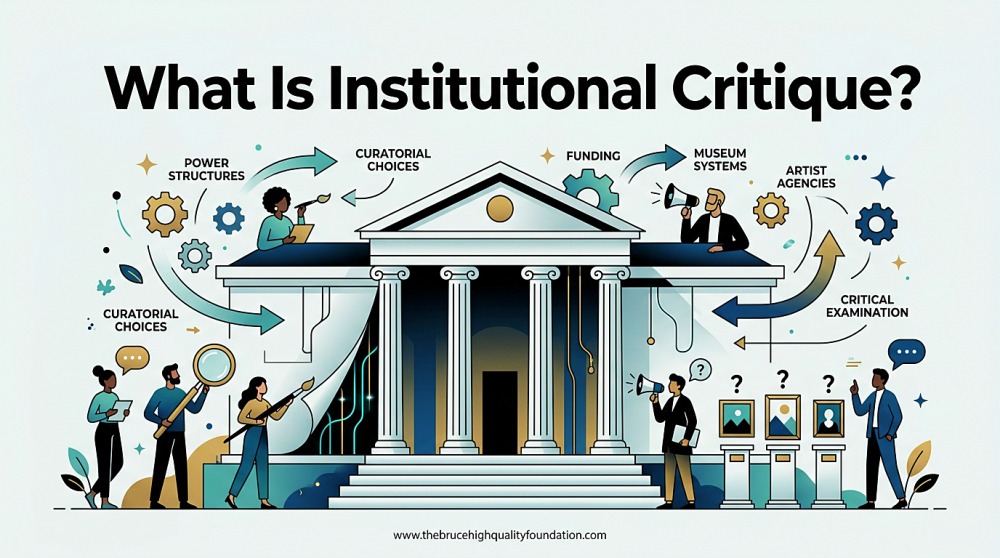
Have you ever walked through a museum and wondered who decides what art deserves to be on the walls? I remember standing in front of a prestigious gallery exhibition and suddenly questioning whose interests were being served by the arrangement, the labels, even the gift shop positioned strategically at the exit.
That questioning impulse sits at the heart of institutional critique. In this guide, I will walk you through everything you need to understand about this rebellious art movement that turned the spotlight away from artworks and onto the institutions that display them. By the end, you will see museums and galleries through an entirely new lens.
Table of Contents
What Is Institutional Critique?
Institutional critique is an art movement and practice where artists systematically examine and challenge the workings of art institutions like museums and galleries, exposing hidden systems of funding, power, and bias. Rather than creating objects for display, artists working in this mode investigate the context of display itself.
The term describes both a specific art movement that emerged in the late 1960s and an ongoing artistic strategy that continues to evolve in 2026. At its core, institutional critique asks uncomfortable questions about who controls art, who profits from it, and whose voices get amplified or silenced by the structures we call “the art world.”
Think of it this way: while traditional artists might paint a picture to hang in a gallery, institutional critique artists might instead investigate the gallery’s real estate holdings, trace its corporate donors, or expose the labor conditions of its security guards. The artwork becomes the revelation of these usually invisible systems.
Historical Origins and Context
The institutional critique movement emerged in the late 1960s alongside conceptual art and the broader cultural upheaval of that era. Artists began asking why the institutions that bought and exhibited their work deserved such unquestioned authority. This was not abstract philosophy; it was a direct response to real events in the art world.
In 1971, the Guggenheim Museum cancelled a major Hans Haacke exhibition just days before opening. The museum’s board members realized Haacke had researched and planned to expose their own real estate dealings and slumlord activities. This censorship attempt proved exactly what Haacke suspected: museums were not neutral temples of culture but active players with financial interests and political connections.
The political climate of the 1960s and 1970s fueled this critical turn. Civil rights movements, anti-war protests, and feminist activism created an environment where questioning authority felt natural and necessary. Artists began to see museums as part of the power structures they wanted to challenge, not separate from them.
The connection to conceptual art runs deep. As artists moved away from creating physical objects and toward ideas, performances, and documentation, they naturally began examining the frameworks that give art meaning. If a work’s value depends on being in a museum, then the museum itself becomes part of the artistic material.
Key Artists of Institutional Critique
First Wave Pioneers (1960s-1970s)
Hans Haacke stands as perhaps the most significant figure in early institutional critique. His work systematically investigates the social and economic conditions of art display. When the Guggenheim censored his 1971 exhibition, he turned the cancellation itself into a celebrated work. Haacke’s practice demonstrates how exposing institutional power structures can become powerful art.
Daniel Buren developed his “in-situ” approach, creating works that respond directly to specific architectural and institutional contexts. His signature striped patterns appear in museums, galleries, and public spaces, always calling attention to how the location shapes meaning. Buren forces viewers to notice what they usually ignore: the walls, the lighting, the framing devices.
Marcel Broodthaers, a Belgian poet turned artist, created fictional museum departments and elaborate institutional parodies. His “Museum of Modern Art, Department of Eagles” (1968) used bureaucratic language and official-looking signage to mock museum authority while simultaneously embodying it. Broodthaers understood that to critique institutions, you sometimes had to become one.
Michael Asher took a more subtle approach, often making interventions so minimal they were almost invisible. He might remove a wall, relocate a security desk, or alter lighting to expose how these supposedly neutral elements shape our experience of art. Asher taught generations of artists to look for power in architecture itself.
Second Wave Artists (1980s-1990s)
Andrea Fraser brought institutional critique into the realm of performance and embodied experience. Her famous 2003 video “Untitled” documented an encounter with a collector who paid for private time with the artist, blurring lines between art transaction, intimacy, and labor. Fraser’s writings about institutional critique remain essential texts for understanding the movement’s evolution.
Fred Wilson gained recognition for his “Mining the Museum” project in 1992, where he rearranged the Maryland Historical Society’s collection to expose hidden narratives of slavery and oppression. Wilson demonstrated that institutional critique could work within existing collections, using the museum’s own objects to tell stories the curators had suppressed.
Adrian Piper combined institutional critique with rigorous philosophical inquiry and personal narrative. Her work examines how race, gender, and class operate within art world structures, often creating uncomfortable confrontations with viewers about their own assumptions and privileges.
Notable Works and Examples
Landmarks of the Movement
Hans Haacke’s “Manet-PROJEKT ’74” (1974) traced the provenance of a Manet painting back to its original Jewish owners who were forced to sell under Nazi persecution, then connected this history to the current financial interests of the exhibition’s sponsors. The work was cancelled, but the cancellation became legendary.
Andrea Fraser’s “Museum Highlights” (1989) featured the artist giving museum tours in character as a docent, delivering biting commentary about institutional politics with a smile and cheerful tone. The performance exposed how museums use friendly presentation to mask controversial funding and decision-making.
Daniel Buren’s “When Attitudes Become Form” intervention (1969) involved placing his striped patterns throughout the exhibition space rather than on designated walls, making the architecture itself the artwork and forcing viewers to reconsider the container as much as the contents.
Contemporary Examples (2010s-2026)
Hans Haacke’s “Gift Horse” (2014), installed on the Fourth Plinth in London’s Trafalgar Square, tied a giant ribbon to a skeletal horse sculpture with a live stock ticker showing the London Stock Exchange’s performance. This contemporary work connected historical monument traditions directly to contemporary finance capitalism.
In the 2020s, artists have extended institutional critique to digital platforms and social media. Projects examining how algorithms shape art discovery, how Instagram creates new forms of institutional gatekeeping, and how NFT markets replicate traditional art world power structures all represent the movement’s evolution. These digital-era critiques ask the same fundamental questions: who controls access, who profits, and whose voices get heard?
Recent controversies around museum boards and fossil fuel funding, such as campaigns targeting the Whitney Museum’s connections to tear gas manufacturers, continue this tradition. Activist groups like Decolonize This Place employ institutional critique tactics to demand accountability from contemporary museums.
Techniques and Approaches
Institutional critique employs several distinct strategies, often in combination. Understanding these approaches helps you recognize institutional critique when you encounter it in galleries and museums.
Archival Research and Documentation
Many artists begin with deep research into institutional histories, funding sources, board connections, and real estate holdings. Haacke pioneered this approach, treating corporate records and museum archives as artistic material. The resulting artworks often take the form of charts, documents, and evidence displays that would look at home in a courtroom.
Site-Specific Interventions
Artists create works that respond to specific architectural or contextual elements of a given institution. Buren’s striped interventions exemplify this: the work cannot exist elsewhere because its meaning derives entirely from its relationship to that particular space. These interventions make visible what we usually ignore: walls, lighting, security systems, signage.
Performance and Participatory Works
Andrea Fraser and others use their own bodies and interactions as the medium. By performing roles within institutions, these artists expose the labor, relationships, and power dynamics that normally remain hidden. The performance becomes a mirror reflecting the audience’s own complicity in institutional structures.
Institutional Mirroring and Parody
Broodthaers created fictional museums that perfectly mimicked real ones, using the same language, signage, and bureaucratic structures. This technique reveals how institutional authority depends on performative elements like official language and proper display. When an artist successfully parodies a museum, the real museum’s authority suddenly looks constructed rather than natural.
Contemporary Relevance in 2026
Why should you, as an ordinary gallery visitor, care about institutional critique? Because it fundamentally changes how you experience art. Once you understand that museums are not neutral spaces but active players with interests and biases, you begin asking better questions about everything you see.
Recent debates on forums like r/ContemporaryArt reveal ongoing frustration that institutional critique has been “captured” by the very market it critiques. Museums now proudly exhibit institutional critique works, collecting the art that criticizes them. This absorption raises valid questions about whether critique can remain effective once it becomes part of the establishment.
The digital era offers new frontiers for institutional critique. As algorithms replace curators and social media platforms become new gatekeepers, artists are developing strategies to examine these invisible systems. Questions about data collection, platform monetization, and digital accessibility extend the movement’s original concerns into virtual spaces.
In 2026, institutional critique matters because the art world remains as politically and financially entangled as ever. Corporate sponsors, problematic board members, and unequal representation continue to shape what art gets shown and celebrated. The movement’s fundamental questions about power, access, and accountability remain urgently relevant.
Frequently Asked Questions
What is the institutional critique movement in art?
The institutional critique movement in art began in the late 1960s when artists started systematically examining and challenging the workings of museums, galleries, and other art institutions. Rather than creating traditional artworks, these artists investigated funding sources, corporate connections, curatorial biases, and power structures. Key figures include Hans Haacke, Daniel Buren, Andrea Fraser, and Fred Wilson. The movement continues today, extending its analysis to digital platforms and contemporary art market structures.
What is the institutional theory of art criticism?
The institutional theory of art criticism examines how art institutions shape meaning, value, and interpretation. It asks who controls access to art, whose interests are served by institutional structures, and how museums and galleries function as gatekeepers. This theory treats the art world as a complex system involving collectors, donors, curators, and corporate sponsors rather than a pure aesthetic realm. It emerged alongside the institutional critique art movement and shares its concern with exposing hidden power dynamics.
What are the 4 elements of art critique?
The four traditional elements of art critique are description, analysis, interpretation, and judgment. Description involves identifying the literal elements present in an artwork. Analysis examines how those elements work together and relate to artistic principles. Interpretation explores meaning, symbolism, and context. Judgment offers an evaluation of the work’s success and significance. These elements differ from institutional critique, which examines the context of display rather than the artwork itself.
Is institutional critique still relevant today?
Yes, institutional critique remains highly relevant in 2026. Current debates about museum funding from fossil fuel companies, arms manufacturers, and problematic donors demonstrate ongoing needs for accountability. The movement has evolved to address digital platforms, social media algorithms, and NFT markets as new forms of institutional power. However, some critics argue that institutional critique has been absorbed by the art market it once challenged, with museums now collecting the very works that criticize them.
How does institutional critique differ from conceptual art?
Institutional critique emerged from conceptual art and shares its emphasis on ideas over objects, but focuses specifically on exposing art world power structures. While conceptual art might investigate the nature of art itself, language, or perception, institutional critique targets museums, galleries, funding systems, and curatorial practices specifically. The two movements overlap significantly, with many artists like Hans Haacke and Andrea Fraser working in both modes. Institutional critique can be understood as a specific application of conceptual art strategies to institutional analysis.
Conclusion
Institutional critique transforms how we understand the art world by revealing the invisible systems that shape what we see and value. From its origins in the rebellious 1960s to its continued evolution in 2026, this movement reminds us that museums and galleries are not neutral temples but active participants in cultural power dynamics.
The next time you visit an exhibition, consider asking the questions that institutional critique artists have raised: Who funded this show? Whose voices are missing from these walls? What interests are being served by this beautiful presentation? These questions do not diminish art; they deepen our engagement with it. The rebellious spirit of institutional critique lives on in every visitor who refuses to accept the art world at face value.