
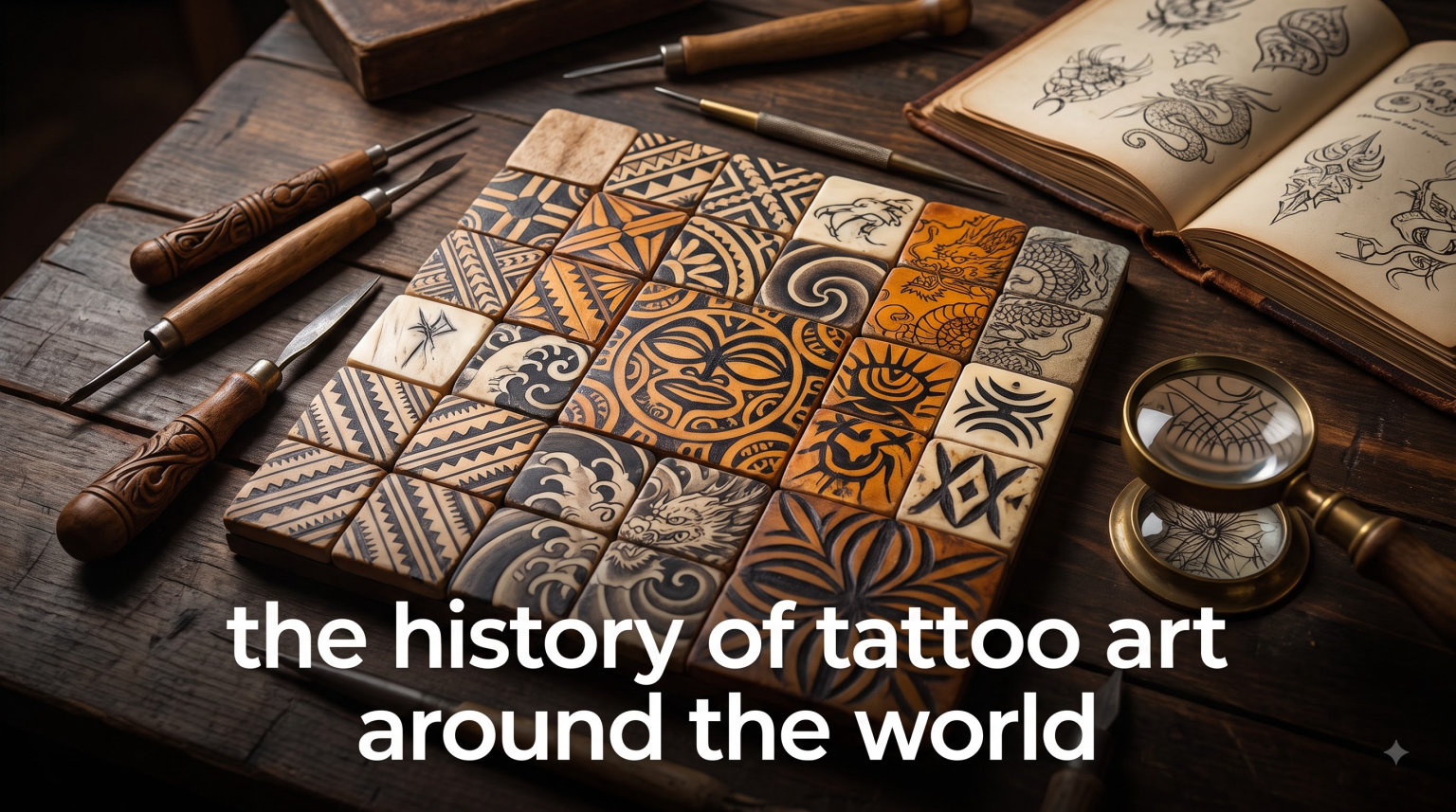
Tattooing stands as one of humanity’s oldest and most widespread art forms, with evidence of permanent body markings stretching back thousands of years across every inhabited continent. The history of tattoo art around the world reveals how diverse civilizations, separated by oceans and centuries, arrived at the same fundamental practice of inserting pigment beneath the skin to create lasting designs. From ceremonial rites of passage to markers of spiritual protection, from symbols of status and rank to declarations of personal identity, tattoos have carried profound meaning throughout human history. This comprehensive exploration traces the evolution of tattooing from its earliest documented origins through the cultural transformations of the modern era, examining how different societies developed distinct techniques, aesthetics, and traditions that continue to influence artists and enthusiasts today.
Table of Contents
Otzi the Iceman: The World’s Oldest Tattoo
The earliest confirmed evidence of human tattooing dates to approximately 3370 BC, discovered not in a museum collection but frozen in ice high in the Otzal Alps between Austria and Italy. In 1991, German hikers stumbled upon a remarkably preserved natural mummy that would become known as Otzi the Iceman. What they found was not merely a prehistoric corpse but a window into the lives of Copper Age Europeans.
When researchers carefully examined Otzi’s preserved skin, they identified a total of 61 tattoos distributed across his body. These markings consisted of simple lines and crosses located on specific anatomical points: his lower spine, left wrist, right knee, and both ankles. Notably, many of these tattoo locations correspond to areas where modern acupuncture practitioners apply needles to treat joint pain and digestive issues, suggesting ancient peoples may have understood the therapeutic value of skin stimulation.
The technique used to create Otzi’s tattoos remains a subject of scholarly debate. Some researchers believe ancient practitioners used sharpened bone or stone tools to make small incisions in the skin, then rubbed charcoal or other pigment materials into the wounds. Others suggest the marks may have resulted from decorative scars created through controlled injury. Regardless of the exact method, the presence of these tattoos demonstrates that tattooing practices existed in Europe at least 5,000 years ago.
Otzi’s tattoos also raise intriguing questions about the cultural significance of body marking in prehistoric Europe. Since his body was found near a mountain pass used for seasonal migration between valleys, researchers hypothesize his tattoos may have served practical purposes such as indicating membership in a particular group, marking successful hunts, or signifying passage into adulthood. The simple geometric patterns, while not elaborate by later standards, represent humanity’s first documented steps toward using the body as a canvas for permanent artistic expression.
Ancient Egyptian Tattoo Practices
Ancient Egypt represents one of the most well-documented early tattooing civilizations, with evidence stretching back to approximately 2000 BC. The Egyptian approach to tattooing differed dramatically from what came before, introducing more elaborate decorative patterns and establishing traditions that would influence cultures throughout the Mediterranean and Middle East.
Egyptian tattoos primarily adorned women, with the most common designs consisting of geometric patterns of dots and lines arranged in rhythmic, repetitive patterns across the abdomen, thighs, and breasts. One particularly significant motif, known as the “wadjet” or eye of Horus symbol, appears frequently in tattoo designs found on female mummies. This connection suggests Egyptian tattoos carried protective qualities, with the wadjet specifically associated with health, healing, and safeguarding of important bodily functions.
Research into Egyptian tattooing expanded dramatically in 2016 when state-of-the-art CT scanning technology revealed previously unknown tattoos on the mummified remains of two ancient Egyptian priestesses. These New Kingdom figures, dating to approximately 1300 BC, displayed intricate tattoo designs including figurines, snakes, and abstract patterns on their thighs, abdomen, and shoulders. The placement and complexity of these markings indicate Egyptian tattooing had evolved far beyond simple scratches into a sophisticated artistic practice reserved for individuals of significant religious or social standing.
The cultural function of Egyptian tattoos appears to have been deeply connected to fertility, protection during childbirth, and religious devotion. Egyptian women of childbearing age commonly bore tattoos on their abdomens, possibly as protective magic designed to ensure safe delivery and abundant milk production. Priestesses engaged in sacred rituals similarly displayed tattooed symbols connecting them to specific deities and spiritual practices. This association between tattooing and the divine feminine would persist in various forms throughout subsequent Mediterranean civilizations.
Tattoo Instruments and Techniques Through History
The evolution of tattoo instruments reflects humanity’s technological progress across millennia. From primitive bone needles to sophisticated electric machines, the tools used to create permanent body markings have continuously adapted to available materials, cultural preferences, and artistic requirements of each era and region.
Before the advent of metal metallurgy, ancient tattoo practitioners relied on natural materials abundantly available in their environments. In Polynesian cultures, tattooists developed the hand-tapping method, using implements carved from bone, turtle shell, or wood to deliver ink into the skin. The traditional Hawaiian tool, known as the “kak,” consisted of a wooden handle attached to a serrated bone or tusk tip that was tapped with a shorter stick to drive pigment into the flesh. Each strike created thousands of microscopic wounds, gradually building up the design through thousands of precise impacts.
The Polynesian tattooing process required extraordinary patience and technical skill. Master tattooists, called “tufuga” in Samoa, underwent years of apprenticeship before practicing independently. The traditional tap-tap method could require multiple sessions spanning weeks or months to complete a full-body design, with each session lasting hours until the practitioner, the client, or both could no longer endure the pain and blood loss. Designs were often divided into sections corresponding to different phases of life or achievement, allowing work to pause and resume as circumstances permitted.
In Southeast Asia, particularly in regions covering modern-day Thailand, Cambodia, and Myanmar, practitioners developed the “skin staking” technique using bamboo needles and specialized tools. This method involved sharpening bamboo to fine points, dipping them in ink, then driving them into the skin with rapid hand movements. Japanese traditional tattooing, known as “Tebori,” employed similar hand-drilling methods using metal needles attached to wooden handles, with artists controlling needle depth and ink distribution through years of intensive training. These manual techniques produced distinctive aesthetic qualities impossible to replicate with modern electric equipment, which is why traditional practitioners continue using them today.
The invention of the modern tattoo machine fundamentally transformed Western tattooing practices. Samuel O’Reilly, an American tattoo artist of Irish descent, patented the first electric tattoo machine in 1891, adapting Thomas Edison’s electric pen design for tattooing purposes. This innovation reduced session times from hours to minutes and enabled the creation of far more detailed and complex designs than hand-poking methods allowed. The 20th century saw rapid refinement of electric tattoo equipment, with artists continuously improving needle configurations, ink formulations, and insertion depths to achieve increasingly sophisticated artistic effects.
Polynesian and Maori Tattoo Traditions
Polynesian tattooing represents one of the most sophisticated and culturally significant body modification traditions in human history. Encompassing the islands of Hawaii, Samoa, Tonga, Tahiti, New Zealand, and countless smaller Pacific islands, this tradition developed elaborate visual languages capable of expressing complex information about an individual’s ancestry, social rank, personal achievements, and spiritual connections.
The word “tattoo” itself derives from the Polynesian term “tatau,” demonstrating the profound influence these island cultures had on global understanding of the practice. Captain James Cook encountered the tradition during his voyages through the Pacific in the 1770s and introduced the word into English usage, where it gradually replaced older European terms like “pricking” or “staining.” This linguistic legacy underscores how fundamentally Polynesian tattoo culture shaped Western perceptions of body modification.
Samoan tattooing traditions, called “tatau,” represent the most unbroken lineage of traditional tattoo practice in the world. Samoan men traditionally received extensive body tattoos covering everything from the knees to the waist, while women bore smaller patterns on their hands, arms, and occasionally backs. The full male torso tattoo, known as the “pe’a,” required hundreds of sessions and could take up to a year to complete, with the final stages traditionally administered during elaborate ceremonies celebrating the completion of the work. A fully tattooed Samoan man was considered to have demonstrated extraordinary pain tolerance, commitment to cultural values, and readiness for adult responsibilities.
New Zealand’s Maori people developed their own distinctive tattoo tradition called “moko,” distinguished by intricate carved patterns carved into the face and body. Maori moko served as a permanent record of genealogy, similar to a written family tree encoded onto skin. Each moko was unique to its wearer, with specific patterns reserved for particular iwi (tribes) and hapu (sub-tribes), and individual elements indicating specific ancestors in the wearer’s lineage. The face moko, or “moko kauae,” traditionally adorned only women, signifying their role as cultural transmitters and family historians.
Maori facial moko reached extraordinary levels of complexity, with spiral patterns (called “kirituhi” when worn by non-Maori) representing the double helix of DNA long before Western scientists discovered the structure of genetic material. The position of elements on the face carried specific meanings: patterns near the eyes related to wisdom and perception, while markings around the mouth concerned communication and oratory abilities. A Maori warrior’s moko was so distinctive and information-rich that colonial observers sometimes compared it to a written document or identification card.
Contemporary Polynesian and Maori tattoo artists have witnessed remarkable revitalization of their ancestral traditions, with young people across the Pacific increasingly seeking traditional-style tattoos as expressions of cultural identity and pride. Modern practitioners often train for years in traditional techniques, learning to use the same hand-tapping methods employed by their ancestors, while also studying the historical meanings and protocols surrounding tattoo practices. This renaissance reflects broader global movements toward cultural preservation and Indigenous rights recognition.
Japanese Tattoo History: Irezumi
Japan developed one of the world’s most visually striking and technically demanding tattoo traditions, known as “irezumi” (literally “inserting ink”). While tattooing existed in Japan for centuries, the art form reached its zenith during the Edo period (1603-1868), eventually becoming so highly valued that Japanese tattoo artists influenced art movements far beyond the archipelago’s shores.
Early Japanese tattooing served various functions across different social classes. Commoners often received small, single-character tattoos as identification marks for merchant guilds or labor organizations, much like modern membership cards. Criminals received punitive tattoos indicating their offenses and social status, a practice that created lasting stigma around certain tattoo designs that were associated with criminality. Meanwhile, certain professions and social groups developed their own tattoo traditions, creating a complex visual culture where the same body markings could carry radically different meanings depending on the wearer’s background.
The classic Japanese full-body tattoo design, called “horimono” when it covers large body areas, emerged during the Edo period as a distinctive art form blending indigenous Japanese aesthetics with foreign influences from Chinese and Southeast Asian tattoo traditions. These elaborate designs typically featured mythological creatures such as dragons, tigers, carp, and phoenixes, combined with cherry blossoms, waves, clouds, and other elements of traditional Japanese art. The composition followed strict conventions regarding placement, with dragons typically covering the back (symbolizing power and protection), koi fish on the chest or arm (representing perseverance and transformation), and cherry blossoms on the shoulders or thighs (signifying the beauty and transience of life).
Japanese tattoo artists, called “tebori masters,” developed extraordinary technical skills requiring decades of apprenticeship to master. The traditional method involved inserting ink beneath the skin using bundles of needles attached to wooden handles, with artists developing distinctive personal styles recognizable to knowledgeable observers. Unlike Western tattooing, which emphasized clean lines and uniform color saturation, Japanese tattooing embraced visible texture and deliberate variation in ink depth, creating pieces that appeared almost painted onto the body rather than injected into it. This aesthetic approach reflected broader Japanese artistic values emphasizing the beauty of imperfection and the evidence of human handwork.
The Meiji government’s criminalization of tattooing in 1872 nearly destroyed Japanese tattoo traditions. Following Japan’s opening to Western trade and the arrival of large numbers of foreign visitors, authorities became concerned that visible tattoos on Japanese citizens embarrassed the nation in the eyes of outsiders. This prohibition remained in effect for nearly a century, driving tattooing underground and creating a gulf between traditional practitioners and mainstream society. Only in 1948 did Allied occupation authorities lift the prohibition, allowing Japanese tattooing to gradually return to public visibility.
Contemporary Japanese tattoo artists continue both traditional and modern approaches, with some masters maintaining strict adherence to historical techniques and designs while others innovate with new technologies and aesthetic influences. Japanese-style tattoos have achieved global popularity, with tattoo enthusiasts worldwide seeking horimono pieces regardless of their connection to Japanese culture. This international appreciation has created complex questions about cultural appropriation and appreciation, as non-Japanese wearers adopt designs with meanings they may not fully understand.
African Tattoo Traditions
Africa hosts extraordinary diversity in tattoo practices, with traditions varying dramatically between North African kingdoms, Sub-Saharan pastoralist societies, and the continent’s numerous other cultural groups. Unlike the single dominant tradition that characterizes tattooing in some world regions, African tattoo culture encompasses dozens of distinct practices developed in isolation from one another.
The Berber peoples of North Africa, particularly the Tuareg and other Amazigh (Berber) groups, developed sophisticated tattoo traditions dating back thousands of years. Tuareg women traditionally received facial tattoos consisting of geometric patterns dotting the chin, lips, and forehead, with the specific designs indicating tribal affiliation and personal beauty. These tattoos were applied during puberty rituals, transforming young women into marriageable adults through a painful process involving soot-based pigments inserted beneath facial skin. The practice was so fundamental to Tuareg identity that non-tattooed women were sometimes considered incomplete or unsuitable for marriage.
Among the Wodaabe people of Niger, tattooing served as an essential component of courtship and mate selection rituals. Both men and women received decorative markings, but those adorning women were particularly elaborate, including patterns across the face, arms, and torso designed to enhance physical attractiveness according to Wodaabe beauty standards. These markings emphasized features considered most desirable: large eyes, full lips, and symmetrical facial proportions. The visual enhancement provided by tattoos played a crucial role in georce (beauty) competitions where young people demonstrated their physical qualities to potential mates.
Sub-Saharan African tattoo practices often incorporated scarification alongside or instead of traditional tattooing techniques. Scarification involved creating raised scars through repeated cutting or burning of the skin, producing patterns that healed into permanent, slightly raised welts. This technique produced dramatically different visual effects from ink-based tattoos, creating designs that appeared carved into the skin rather than drawn upon it. Many African cultures considered scarification more beautiful and more authentically African than ink tattoos, with the practice carrying associations of courage, endurance, and connection to ancestors.
The Makonde people of Tanzania and Mozambique developed distinctive facial tattoo traditions called “binadamu,” featuring intricate patterns carved into the faces of both men and women. These markings signified group identity and individual beauty, with the specific patterns varying between different Makonde subgroups. Like many African tattoo traditions, binadamu practices declined significantly during the colonial period when Christian missionaries and European administrators actively discouraged what they considered primitive or pagan customs. Today, younger generations are reviving these traditions as expressions of cultural pride and ethnic identity.
Native American Tattoo Traditions
Indigenous peoples throughout North and South America developed diverse tattoo traditions before European contact, with practices varying dramatically between different tribal groups, climate zones, and cultural systems. These traditions shared certain common elements, including the use of tattooing to mark important life transitions, demonstrate tribal affiliation, and display personal achievements or spiritual connections.
Many Native American tattoo traditions employed incising rather than puncturing techniques, creating designs through cutting rather than needle-based insertion of pigment. The resulting marks often resembled scars more than conventional tattoos, with raised or textured surfaces creating distinctive visual effects. These patterns frequently covered large body areas, transforming the skin into a canvas for elaborate personal narratives encoded in visual form.
Among the Haida, Tlingit, and other Pacific Northwest coastal tribes, tattooing practices reflected the same artistic traditions visible in carved totem poles, woven blankets, and other material culture. Designs featuring ravens, eagles, bears, whales, and other regional animals appeared on the body just as they appeared on wooden monuments and woven objects. The connection between body decoration and environmental surroundings demonstrates how tattoo traditions emerged organically from broader cultural relationships with place, resources, and spiritual beings.
The Cherokee and other southeastern tribes practiced tattooing for both decorative and medicinal purposes, with specific designs used to treat various physical ailments. Medical tattoos were placed directly over problem areas or along energy meridians believed to conduct healing forces throughout the body. This therapeutic application of tattooing parallels similar practices documented in ancient Egyptian and Chinese medical traditions, suggesting independent development of the same fundamental concepts across geographically separated cultures.
European colonization dramatically disrupted Native American tattoo traditions through a combination of forced assimilation policies, Christian missionary activities, and deliberate suppression of Indigenous cultural practices. Beginning in the early 19th century, U.S. and Canadian governments actively worked to eliminate tattooing and other body modification practices as part of broader efforts to “civilize” Native peoples. The Indian Removal Act of 1830 and subsequent residential school systems specifically targeted cultural practices including tattooing, with the result that many tribal tattoo traditions were lost entirely or preserved only in fragmentary form.
Contemporary Native American tattoo revival movements are working to recover lost traditions and create new ones that honor ancestral practices while addressing modern contexts. Indigenous tattoo artists across North America are researching historical accounts, interviewing elders, and studying museum collections to reconstruct traditional designs and techniques. These efforts are complicated by the historical suppression of Indigenous knowledge and the difficulty of distinguishing authentic traditions from romanticized imitations, but the movement continues to grow as Native communities assert their rights to cultural self-determination.
20th Century Western Tattoo Evolution
The history of tattoo art around the world underwent revolutionary transformation during the 20th century, shifting from a practice associated primarily with circus performers, sailors, and military personnel to a mainstream art form embraced by diverse populations. This evolution reflected broader social changes regarding self-expression, body autonomy, and artistic freedom.
Early 20th century America saw tattooing become increasingly associated with working-class men, particularly soldiers, sailors, and laborers who acquired tattoos as symbols of service, adventure, and masculinity. Naval sailors contributed significantly to tattoo culture, returning from Pacific deployments with elaborate pieces featuring anchors, ships, swallows, and patriotic themes. Military service provided opportunities for tattoo acquisition that crossed class boundaries, allowing working-class men to access body art previously associated with circus performers and social outcasts.
The invention and refinement of electric tattoo machines during this period enabled dramatic expansion of Western tattoo capabilities. These devices reduced session times from hours to minutes and made possible the fine detailed work that characterizes modern tattooing. Artists like Norman “Sailor Jerry” Collins developed distinctive American tattoo styles blending Japanese influences with Western sensibilities, creating the “old school” aesthetic featuring bold lines, limited color palettes, and iconic imagery that remains influential today.
The counterculture movements of the 1960s and 1970s transformed tattooing’s cultural associations, introducing body art to new demographics and contexts. The hippie movement embraced tattooing as a symbol of natural beauty and rejection of mainstream values, while the punk movement adopted tattoos as expressions of rebellion and anti-establishment politics. These connections between tattooing and youth subcultures fundamentally altered public perceptions of body modification, transforming it from a permanent marker of marginal social status to a potentially mainstream form of self-expression.
By the 1980s and 1990s, tattooing had become increasingly associated with artistic expression and individual identity rather than gang membership, criminality, or social deviance. Celebrity tattoos featured prominently in media coverage, demonstrating that respected public figures could embrace body art without suffering social stigma. Television shows brought tattoo artistry into living rooms across America, presenting tattoo artists as skilled professionals and tattoo collecting as a respectable pursuit. This media exposure contributed to what industry observers called the “tattoo renaissance,” a period of rapid growth and mainstream acceptance that continues into the present.
The Modern Tattoo Renaissance
The period from approximately 2000 to the present has witnessed what scholars and practitioners describe as a global tattoo renaissance, characterized by unprecedented artistic innovation, cross-cultural exchange, and mainstream acceptance of body modification practices. The history of tattoo art around the world has entered a new phase defined by hybridization, democratization, and constant technical evolution.
Contemporary tattoo artists operate in a global marketplace where techniques, styles, and aesthetic influences flow freely between cultures. Japanese horimono techniques influence American traditional tattooists, while Polynesian tap-tattoo methods are taught in European tattoo conventions. This cross-pollination has produced hybrid styles that draw from multiple cultural traditions, sometimes creating controversy among practitioners who believe certain designs should remain exclusive to their originating cultures.
The rise of social media has fundamentally transformed how tattoo culture operates and spreads. Instagram, Pinterest, and specialized platforms have created global networks where artists share work, clients research potential artists, and styles spread from one continent to another within days. This connectivity has raised overall artistic standards by exposing artists to diverse techniques and enabling rapid dissemination of innovations. It has also created challenges, including concerns about cultural appropriation when designs move outside their original contexts and debates about originality in an era of constant visual reference.
Modern tattoo equipment has advanced significantly beyond the basic electric machines of the 20th century. Contemporary artists have access to precisely engineered needle configurations, innovative ink formulations, and sophisticated power supplies that enable unprecedented control over insertion depth, speed, and ink flow. UV-reactive and blending inks allow effects impossible with traditional pigments, while digital stencil systems enable artists to project complex designs directly onto clients’ bodies. These technological advances have expanded artistic possibilities while also reducing some of the health risks associated with older equipment.
The relationship between tattooing and the fine art world has evolved dramatically in recent decades. Major museums now host tattoo exhibitions, with institutions presenting shows examining tattooing as a legitimate art form worthy of scholarly attention. Contemporary artists who began in tattoo studios have transitioned to gallery exhibition, while traditionally trained fine artists have begun incorporating tattoo aesthetics into their work. This institutional recognition has helped legitimize tattooing in contexts where it was previously dismissed as merely decorative or even shameful.
The demographics of tattoo culture have expanded to include populations previously underrepresented in the medium. Women now comprise roughly half of all tattoo collectors in many Western countries, reversing historical patterns where body art was predominantly male. Older adults are increasingly seeking tattoos, with some deliberately choosing designs that challenge assumptions about age and body modification. LGBTQ+ communities have developed distinctive tattoo traditions expressing identity and pride, while religious and spiritual seekers have adapted traditional sacred tattoo practices for contemporary contexts.
Conclusion: Tattooing’s Enduring Human Appeal
The history of tattoo art around the world reveals a practice far more ancient, diverse, and meaningful than most contemporary discussions acknowledge. From Otzi the Iceman’s mysterious markings to the elaborate full-body suits of traditional Polynesian warriors, from the spiritual protection symbols of ancient Egyptian women to the criminal stigmas imposed by modern nation-states, tattooing has served as a mirror reflecting humanity’s deepest concerns about identity, belonging, spirituality, and self-expression.
What makes tattooing’s global history particularly remarkable is the fundamental similarity of its functions across radically different cultural contexts. Every documented tattoo tradition connects body modification to rites of passage, marking transitions from childhood to adulthood, single life to marriage, or civilian to warrior status. Every tradition associates tattoos with spiritual protection, whether deflecting evil forces, honoring ancestral spirits, or establishing connections with supernatural beings. Every tradition uses tattoos to communicate social status, distinguishing between members and non-members, leaders and followers, honored guests and ordinary people.
As tattooing continues its global renaissance in 2026, understanding its historical roots helps us appreciate the profound human needs this practice addresses. The decision to permanently mark one’s body remains a significant choice, carrying implications about identity, commitment, and self-understanding that simpler decorative choices lack. Whether we choose ancestral patterns reconnecting us to cultural heritage, custom designs expressing personal narratives, or traditional motifs honoring universal human experiences, tattoos connect us to the longest thread of human cultural expression.
FAQs
What is the earliest evidence of tattoos?
The earliest confirmed evidence of tattooing dates to approximately 3370 BC, found on Otzi the Iceman, a naturally preserved mummy discovered in the Alps in 1991. His body bears 61 tattoos consisting of simple lines and crosses.
What function did ancient Egyptian tattoos serve?
Ancient Egyptian tattoos primarily served protective and religious purposes. Women wore tattoos on their abdomens for protection during childbirth, while priestesses displayed tattooed symbols connecting them to specific deities. Common designs included the wadjet (eye of Horus) symbol associated with health and healing.
What instruments did ancient cultures use for tattooing?
Ancient cultures developed diverse tattooing tools. Polynesian practitioners used hand-tapping implements carved from bone or turtle shell. Japanese traditional tattooing employed metal needles attached to wooden handles. Many African cultures used thorns, bone needles, or cutting implements to create tattoo or scarification marks.
Why do Maori facial designs represent status?
Maori moko tattoos served as permanent visual records of genealogy and social standing. Each moko was unique, encoding information about the wearer’s tribal affiliation, family lineage, and personal achievements. Facial patterns indicated specific ancestors and positions within complex kinship systems.
How did tattoos become popular in the Western world?
Western tattoo popularity evolved through several phases. In the early 20th century, tattoos were associated with sailors and military personnel. Counterculture movements of the 1960s-70s introduced tattoos to new demographics. By the 1990s, television shows and celebrity influence helped transform tattoos into mainstream artistic expression.
What is the history of tattooing in Japan?
Japanese tattooing reached its peak during the Edo period (1603-1868) with elaborate full-body designs called horimono. The Meiji government banned tattooing in 1872, driving it underground until 1948. Contemporary Japanese tattoo artists continue both traditional tebori techniques and modern approaches, with horimono designs now popular worldwide.