
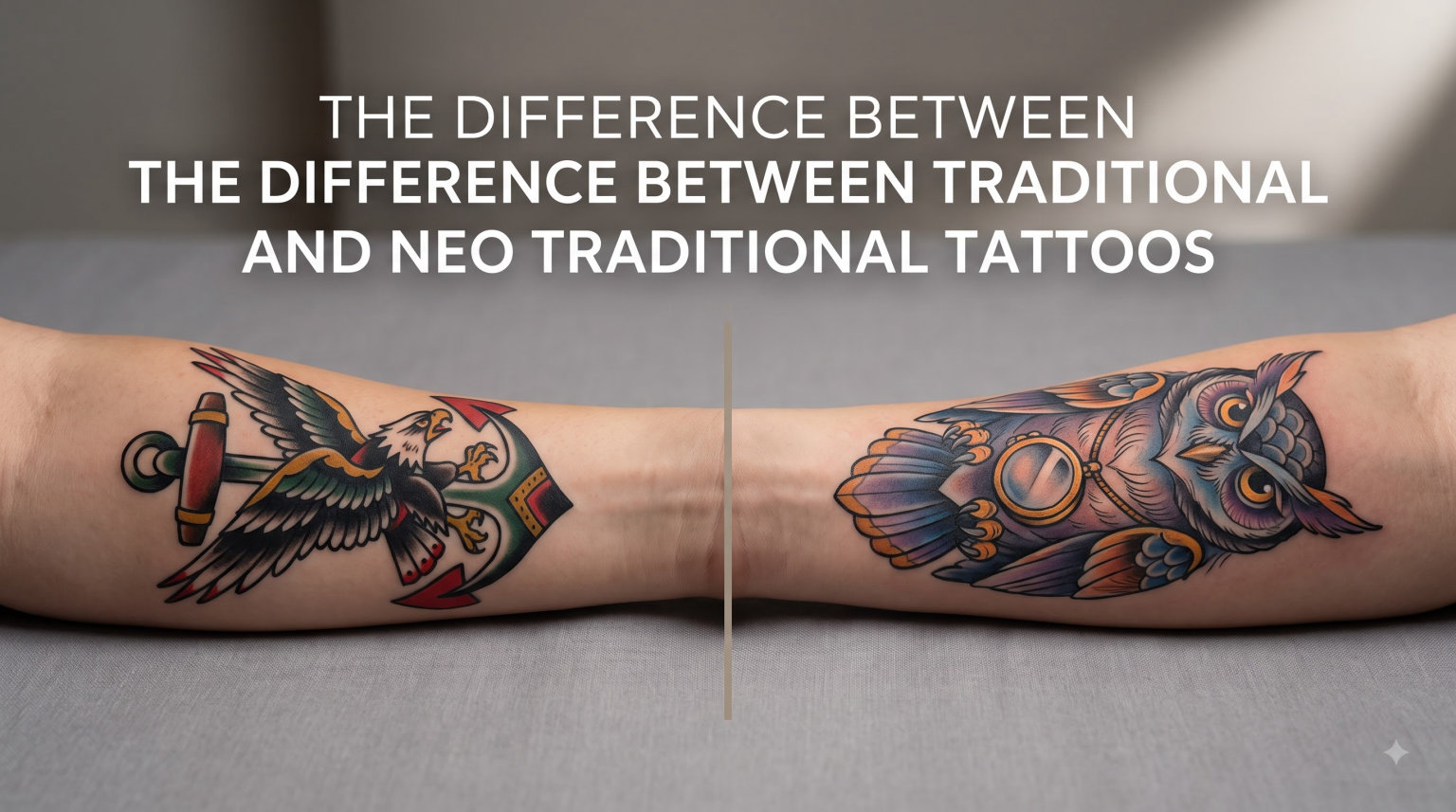
If you have ever walked into a tattoo studio or scrolled through tattoo portfolios online, you have likely encountered two of the most popular styles in American tattooing: traditional tattoos and neo traditional tattoos. Both styles have deep roots in tattoo history, and both are celebrated for their bold aesthetics and timeless appeal. However, understanding the difference between traditional and neo traditional tattoos can help you make a more informed decision when choosing your next piece of body art.
Whether you are getting your first tattoo, adding to a growing collection, or simply curious about these iconic styles, this guide will walk you through everything you need to know. We will explore the historical origins of each style, compare their technical differences in linework, color, and shading, and help you determine which style might be right for your next tattoo.
Table of Contents
Historical Origins: Where Traditional and Neo Traditional Tattoos Begin
The Birth of American Traditional Tattoos
American traditional tattoos, often called “old school” tattoos, emerged in the early twentieth century and reached their peak of popularity during the 1940s through 1960s. This style was pioneered by legendary tattoo artists like Norman “Sailor Jerry” Collins, who helped establish the foundational principles that still define the look today.
Traditional tattoos were characterized by bold, single-weight linework, a limited but vibrant color palette, and iconic imagery that told stories of rebellion, patriotism, and personal symbolism. Rose, skulls, eagles, anchors, daggers, and swallows were among the most popular subjects. The style was designed to be visually striking from across the room, with colors that popped and lines that held their clarity over time.
The limited color palette was not merely an aesthetic choice but also a practical one. In the early days of tattooing, ink options were restricted, and artists worked with what was available. This constraint inadvertently created a signature look that has become synonymous with the traditional tattoo style: bold outlines with solid, unmodulated colors that age gracefully.
The Rise of Neo Traditional Tattoos
Neo traditional tattoos began emerging in the 1980s and 1990s as tattoo artists started experimenting with the foundations laid by their traditional predecessors. This evolution was influenced by broader artistic movements, particularly Art Nouveau and Art Deco, which emphasized ornamentation, fluidity, and decorative complexity.
Artists began pushing the boundaries of what a tattoo could be, introducing varied line weights, more complex compositions, expanded color palettes, and sophisticated shading techniques. Where traditional tattoos favored simplicity and bold readability, neo traditional tattoos embraced detail, depth, and illustrative complexity while still honoring the bold outline aesthetic that makes tattoos stand out on skin.
The neo traditional movement represented a natural artistic progression. As tattoo culture became more mainstream and artists received formal training through traditional tattoo apprenticeships and art schools, the craft evolved to incorporate more sophisticated artistic principles while maintaining the structural integrity of traditional tattooing.
Linework Comparison: The Foundation of Both Styles
One of the most significant differences between traditional and neo traditional tattoos lies in their approach to linework. Understanding this distinction is often the clearest way to identify which style you are looking at or which style you prefer.
Traditional Tattoo Linework
Traditional tattoos feature bold, single-weight lines that remain consistent throughout the entire design. This uniform line weight creates a clean, iconic look that is instantly recognizable. The outlines are typically thick and dark, providing a strong visual boundary between the tattoo and the surrounding skin.
This consistent line weight serves both aesthetic and practical purposes. From an aesthetic standpoint, it creates a bold, graphic quality that reads clearly even from a distance. From a practical standpoint, these sturdy outlines age well, holding their definition as the tattoo settles into the skin over years and decades.
Neo Traditional Tattoo Linework
Neo traditional tattoos introduce variation in line weight, using thicker lines in some areas and thinner lines in others to create visual hierarchy and depth. This approach allows for more nuanced artistic expression, enabling artists to emphasize certain elements of the design while creating subtle transitions between different components.
While neo traditional tattoos maintain the bold outline structure that defines tattoo artistry, the varying line weights add a level of sophistication and detail that distinguishes them from their traditional counterparts. This technique requires greater skill from the artist, as they must balance visual drama with compositional complexity.
Color Palette: Limited Versus Expanded
Color choice is another defining characteristic that separates traditional from neo traditional tattoos. The approach to color directly impacts the overall feel and long-term appearance of a tattoo.
The Classic Limited Palette of Traditional Tattoos
Traditional tattoos are known for their limited but vibrant color palette, typically consisting of red, black, blue, green, and yellow. These colors were chosen for their visibility on skin and their ability to remain stable over time. The colors are applied in solid, unmodulated blocks, creating a flat but bold appearance.
This limited palette contributes to the timeless quality of traditional tattoos. The colors are iconic, evoking a sense of nostalgia and classic tattoo aesthetics. When these solid colors age, they tend to mellow slightly but maintain their visual impact, which is why traditional tattoos often look better as they mature compared to more complex colored work.
The Expanded Palette of Neo Traditional Tattoos
Neo traditional tattoos embrace a much broader color palette, incorporating pastels, gradients, and subtle color transitions that would be impossible in traditional work. Artists use color blending techniques to create depth, dimension, and visual interest that goes far beyond the flat color blocks of traditional tattoos.
Color psychology plays a significant role in neo traditional work. The expanded palette allows artists to evoke specific emotions and create more nuanced narratives within their designs. A single neo traditional piece might incorporate dozens of color variations, creating an almost painting-like quality on the skin.
Shading Techniques: Flat Versus Dimensional
Shading is where traditional and neo traditional tattoos diverge most dramatically in terms of technique and visual result.
Solid Shading in Traditional Tattoos
Traditional tattoos employ flat, solid shading techniques that rely on color blocking rather than gradient transitions. Shadows and highlights are indicated through the use of different solid colors rather than gradual blends. This approach maintains the graphic, illustration-like quality of traditional work while ensuring longevity and readability.
The shading in traditional tattoos is designed to be forgiving and long-lasting. By avoiding subtle gradients that can blur and spread over time, traditional tattoos maintain their clean appearance for decades with minimal maintenance.
Dimensional Shading in Neo Traditional Tattoos
Neo traditional tattoos utilize sophisticated shading techniques including gradients, stippling, and layering to create the appearance of depth and three-dimensionality. Artists may use multiple passes of varying ink tones to build up dimension, similar to how a painter builds up layers on a canvas.
This dimensional approach allows neo traditional tattoos to achieve a more realistic or illustrative quality, where subjects appear to have volume and presence on the skin. The shading can suggest lighting, texture, and spatial relationships that flat shading cannot achieve.
Imagery and Subject Matter
Both traditional and neo traditional tattoos have signature approaches to imagery and subject matter, reflecting their respective aesthetic philosophies.
Iconic Imagery of Traditional Tattoos
Traditional tattoos favor classic, time-tested imagery that carries symbolic meaning. Popular subjects include roses, skulls, eagles, swallows, anchors, hearts, daggers, and naval imagery. These designs are often immediately recognizable and carry cultural significance that has endured for generations.
The imagery in traditional tattoos is typically simplified and stylized for maximum visual impact. A traditional rose, for example, will have bold petals and clean lines that read clearly at any size. This iconic approach ensures the tattoo remains impactful as a statement piece.
Stylized Custom Work in Neo Traditional Tattoos
Neo traditional tattoos embrace a wider range of subject matter and often feature custom, stylized interpretations of traditional themes. While neo traditional artists may work with similar underlying subjects, they approach them with greater complexity, ornamentation, and personal interpretation.
Popular neo traditional subjects include highly detailed animal portraits, ornate floral compositions, mythological creatures, and elaborate figurative work. The style allows for extensive personalization, making each tattoo a unique artistic creation rather than a variation on a classic template.
Aging and Longevity: How Each Style Holds Over Time
Understanding how traditional and neo traditional tattoos age is essential for making a long-term decision about body art.
The Aging Process of Traditional Tattoos
Traditional tattoos are renowned for their longevity. The bold, single-weight lines and solid color blocks hold up exceptionally well over time, often looking better decades after they are inked than they did when fresh. The simplicity of the design works in its favor: even as ink settles and skin changes, the fundamental graphic impact remains intact.
Traditional tattoos require relatively minimal maintenance to look good throughout their lifetime. Sun protection and occasional touch-ups can help maintain their vibrancy, but the style is forgiving of the natural aging process.
The Aging Process of Neo Traditional Tattoos
Neo traditional tattoos, while beautiful when fresh, may require more attention as they age. The detailed linework and subtle shading that give neo traditional tattoos their distinctive look can soften and blur over decades. Colors may blend where gradients once existed, potentially reducing the clarity of the original design.
This does not mean neo traditional tattoos are a poor choice. With proper care, quality execution, and periodic maintenance from a skilled artist, neo traditional tattoos can age beautifully. The key is understanding that the intricate details that make these tattoos special may evolve over time, much like the brushstrokes in a painting may change as canvas and paints age.
Which Style Is Right for You?
Choosing between traditional and neo traditional tattoos depends on several personal factors. Consider the following questions to guide your decision.
Consider Your Personal Aesthetic
Do you prefer bold, iconic designs that make a clear statement? Traditional tattoos might be your style. Are you drawn to detailed, ornate work with rich color gradients and visual complexity? Neo traditional could be your calling.
Think about the other art in your life and the aesthetic choices you make. Traditional tattoos appeal to those who appreciate clean lines and graphic clarity. Neo traditional tattoos suit individuals who value artistic detail and are willing to invest in ongoing maintenance.
Think About Placement and Size
Traditional tattoos typically work well in a wide range of sizes, from small flash pieces to large-scale works. Their bold lines ensure readability even at smaller scales. Neo traditional tattoos often require more space to fully realize their intricate details, making them better suited for medium to large placements where the artistry can be appreciated.
Consider Your Long-Term Commitment
Both styles represent a long-term commitment, but they differ in maintenance requirements. If you want a tattoo that will age gracefully with minimal intervention, traditional offers excellent longevity. If you are prepared to invest in occasional touch-ups and are comfortable with your tattoo evolving over time, neo traditional can be a rewarding choice.
Consulting with a skilled tattoo artist is always recommended. Professional artists can assess your vision, discuss realistic expectations for your chosen style, and create custom work that reflects your personality. Many artists specialize in one or both styles and can guide you toward the best choice for your specific situation. You may also want to explore supplies recommended by tattoo artists if you are looking to invest in quality supplies recommended by tattoo artists for your collection.
Frequently Asked Questions
What is the difference between neo and traditional tattoos?
Traditional tattoos feature bold single-weight lines, a limited color palette, and iconic imagery with flat shading. Neo traditional tattoos add varied line weights, expanded color palettes with gradients, and more detailed, illustrative designs while maintaining bold outlines.
How do I tell if my tattoo is traditional or neo traditional?
Look at the linework: if lines are consistently bold with uniform weight, it is likely traditional. Varying line weights with more detail suggests neo traditional. The color palette also matters: limited, solid colors indicate traditional while expanded palettes with gradients suggest neo traditional.
Which tattoo style lasts longer?
Traditional tattoos typically age better due to their bold, simple lines that remain readable even as ink settles. Neo traditional tattoos can also last well, but the detailed work may soften over decades. Both styles benefit from proper aftercare, sun protection, and periodic touch-ups.
What is the 1/3 rule tattoo?
The 1/3 rule is a design principle suggesting that negative space should make up about one-third of a tattoo composition. While not exclusive to neo traditional style, this principle is often applied in neo traditional designs to create visual balance and enhance the illustrative quality.
Can I combine traditional and neo traditional elements?
Absolutely. Many tattoo artists blend elements from both styles, creating custom designs that honor traditional bold linework while incorporating neo traditional details, color gradients, and personal symbolism. Discuss your vision with a skilled artist to create a unique piece that combines the best of both approaches.
Conclusion
Understanding the difference between traditional and neo traditional tattoos comes down to appreciating two distinct approaches to body art that share a common heritage. Traditional tattoos offer bold, iconic simplicity with time-tested longevity. Neo traditional tattoos provide intricate, illustrative depth with greater artistic complexity.
Both styles have earned their place in tattoo culture and continue to inspire artists and enthusiasts worldwide. Whether you gravitate toward the clean lines and vibrant colors of traditional work or the ornate details and dimensional shading of neo traditional designs, your choice should reflect your personal aesthetic and long-term vision for your body art collection.
Take time to study portfolios, speak with experienced artists, and consider how each style aligns with your taste and lifestyle. The best tattoo is not just one that looks beautiful when fresh, but one that will continue to bring you pride and joy for decades to come.