
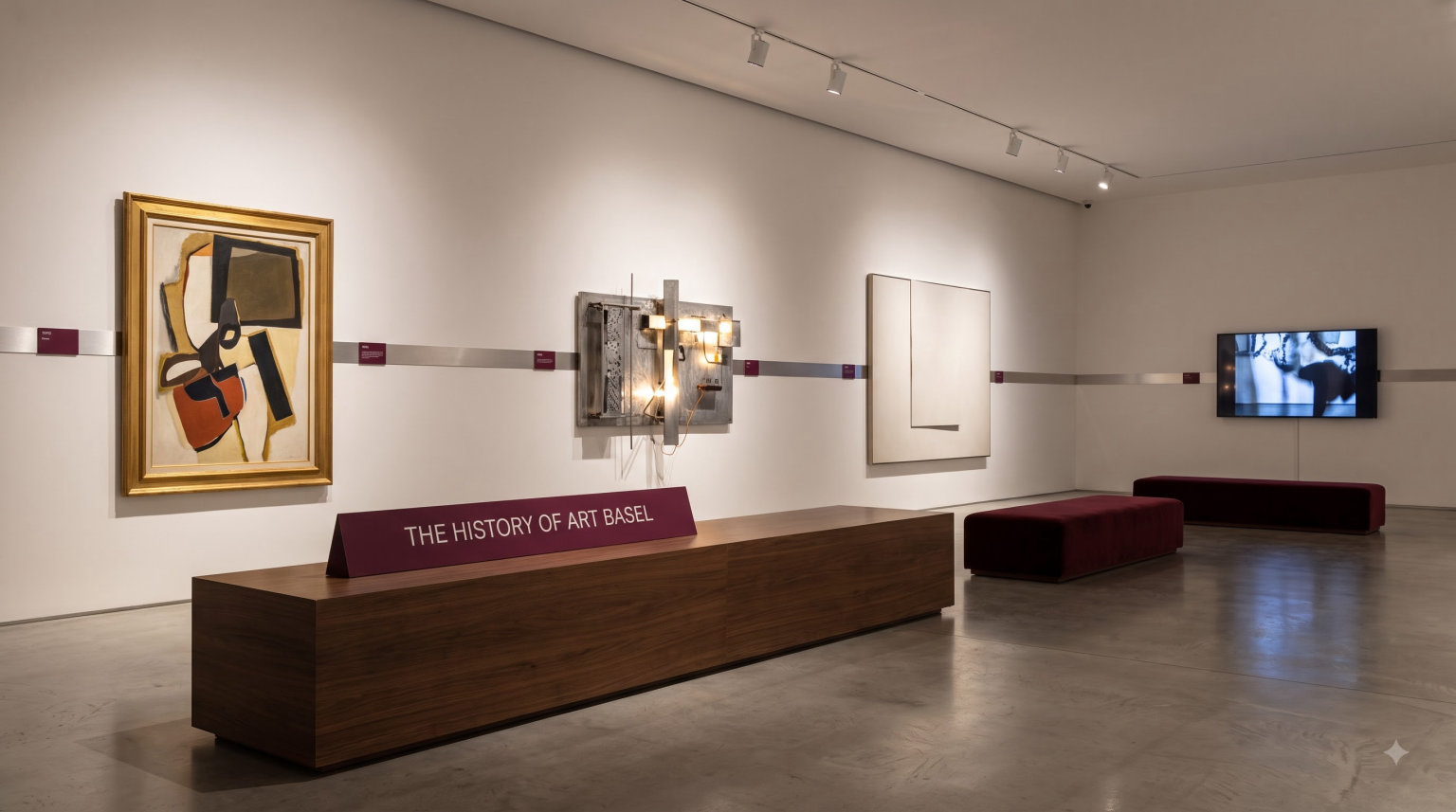
Art Basel stands as the world’s most influential contemporary art fair, shaping how collectors, curators, and artists connect with one another across the globe. Since its founding in 1970 in Basel, Switzerland, this exhibition has grown from a regional gallery gathering into a global phenomenon that defines the contemporary art calendar. Understanding the history of Art Basel reveals why it remains indispensable to the art world, and how it transformed from a bold experiment into an international powerhouse that now hosts annual events on four continents.
For more than five decades, Art Basel has served as the benchmark against which all other art fairs measure themselves. The fair’s rigorous selection process, its commitment to artistic excellence, and its ability to bring together the most important players in the contemporary art world have made it an essential destination for anyone serious about art. Whether in Basel, Miami Beach, Hong Kong, Paris, or soon Qatar, Art Basel continues to set the agenda for contemporary art discourse and market activity.
Table of Contents
The Founding of Art Basel in 1970
In 1970, three visionary Swiss gallerists decided to create something entirely new for their city. Ernst Beyeler, Trudl Bruckner, and Balz Hilt founded Art Basel with a simple but ambitious goal: to bring together galleries from around the world in a setting that prioritized quality and artistic excellence above all else. Their experiment took place at the Messe Basel exhibition center, and the inaugural event attracted 90 galleries from 10 countries alongside approximately 16,000 visitors.
What made this first fair remarkable was not just its scale but its underlying philosophy. The founders believed that art fairs could be about more than commerce. They wanted to create a platform where galleries could showcase their best work, where collectors could discover emerging talent, and where the international art community could gather to exchange ideas. This vision resonated immediately, setting Art Basel apart from other exhibitions from the very beginning.
The choice of Basel as the host city was strategic. Located at the intersection of France, Germany, and Switzerland, the city had long been a crossroads for European culture and commerce. Its accessibility made it easy for international visitors to attend, while its reputation as a center for art and finance provided the perfect backdrop for a prestigious new fair. The presence of major banks and financial institutions meant that potential collectors were already present in the city, creating an ideal environment for art transactions.
The inaugural edition established patterns that would define Art Basel for decades to come. The fair introduced the concept of themed sectors, allowing galleries to present work in contexts that emphasized artistic relationships rather than simply placing booths side by side. This curatorial approach distinguished Art Basel from competitors and attracted galleries that valued thoughtful presentation over mere commercial display.
The Three Founders: Ernst Beyeler, Trudl Bruckner, and Balz Hilt
Ernst Beyeler brought to Art Basel decades of experience as one of Europe’s most respected gallery owners. His gallery had become known for handling important modern and contemporary works, and his relationships with major collectors and institutions gave the new fair immediate credibility in the art world. Beyeler understood what it meant to organize exhibitions that could attract serious attention, and his expertise helped shape the fair’s early direction.
Beyeler’s gallery on the Basel waterfront had become a destination for collectors seeking important works by Picasso, Matisse, and other masters of modern art. His understanding of what collectors wanted, combined with his networks among wealthy European families, helped ensure that the new fair would attract the audience it needed to succeed. His reputation as a serious dealer rather than a mere commercial operator set the tone for the entire enterprise.
Trudl Bruckner represented the operational force behind the fair’s creation. Her understanding of the gallery business and her commitment to creating meaningful connections between galleries and collectors proved essential to the event’s success. Bruckner’s vision extended beyond simply hosting an exhibition; she wanted to build something that would strengthen the entire art ecosystem, creating opportunities for galleries of all sizes to participate in a major international event.
Balz Hilt completed the founding trio, bringing his own gallery’s reputation and network to the project. His experience with the Swiss art scene and connections to galleries across Europe helped expand the reach of the new fair beyond what either of the other founders could have achieved alone. The combination of these three distinct but complementary perspectives created a foundation of genuine collaboration rather than competition.
Together, these three gallerists created a collaborative model where competition coexisted with community. Their partnership demonstrated that art fairs could serve both commercial interests and cultural advancement simultaneously. This balance remains central to Art Basel’s identity today, even as the organization has grown into a global enterprise with hundreds of employees and operations across multiple continents.
Their combined influence established standards that still define Art Basel today. From the beginning, the fair maintained a rigorous selection process, ensuring that only galleries meeting the highest standards could participate. This exclusivity became part of the fair’s identity, attracting increasingly prestigious participants year after year and creating a virtuous cycle of quality that strengthened the event’s reputation with each edition.
The Evolution of Art Basel Through the Decades
The 1980s brought significant growth and internationalization to Art Basel. As contemporary art gained increasing attention from major museums and private collectors worldwide, the fair’s role as a marketplace for important work expanded correspondingly. The decade saw the introduction of new sectors and programming that added depth to the exhibition, transforming it from a pure commercial event into something approaching a comprehensive survey of contemporary art practice.
The 1990s witnessed further maturation of the art market and Art Basel’s position within it. The fair began to influence art criticism and collecting trends more directly, with works presented at Basel gaining attention that translated into museum acquisitions and scholarly attention. This decade also saw the expansion of ancillary programming, including lectures, panels, and special exhibitions that deepened the intellectual dimension of the fair.
The turn of the millennium brought both challenges and opportunities. Art Basel faced increasing competition from new fairs emerging in cities across Europe, Asia, and the Americas. Rather than resting on its established position, the organization began exploring strategies for growth that would extend its reach beyond the original Swiss event. The success of these strategies would become apparent in the dramatic expansions of the 2000s and 2010s.
Art Basel Miami Beach: The American Expansion
The year 2002 marked Art Basel’s first major expansion beyond Switzerland. The fair’s organizers recognized that the American art market required a dedicated platform, and Miami Beach offered the perfect combination of cultural infrastructure and international accessibility. The inaugural Art Basel Miami Beach attracted 150 galleries and drew over 30,000 visitors, immediately establishing itself as the most important art event in the Americas.
Miami Beach’s transformation into an art destination permanently altered the city’s cultural identity. During Art Basel week, the city comes alive with satellite fairs, museum exhibitions, private parties, and collector events. The fair’s presence helped catalyze Miami’s rise as a contemporary art capital, attracting investment that transformed neighborhoods and created new cultural institutions. The Wynwood district, in particular, evolved from an industrial area into a vibrant arts neighborhood largely due to the attention generated by Art Basel.
The Miami Beach edition introduced several innovations that became permanent features across all Art Basel events. Unlimited, a sector dedicated to large-scale installations and ambitious projects, debuted in Miami Beach and quickly became one of the fair’s most celebrated sections. This sector allows galleries to present works that would be impossible in traditional booth settings, creating encounters with art that challenge conventional exhibition boundaries and demonstrate the scale of ambition that contemporary art can achieve.
Statements, another key sector, focuses specifically on solo presentations of emerging artists. This section gives newer galleries and less established artists a platform to present their work to the world’s most influential collectors and curators. The emphasis on discovery remains central to Art Basel’s identity, ensuring that each edition offers opportunities to uncover new talent before they become established names in the field.
The success of Miami Beach demonstrated that the Art Basel model could be successfully transplanted to different cultural contexts. The American edition maintained the same commitment to quality and curatorial ambition while adapting to local conditions and preferences. This ability to maintain core values while embracing local variation would prove essential to the organization’s subsequent expansions.
Art Basel Hong Kong: Bridging East and West
2013 saw Art Basel establish its presence in Asia with the launch of Art Basel Hong Kong. The decision to expand into the Asian market reflected the region’s growing importance in the global art world. Hong Kong’s status as a major financial hub and its geographic position connecting East and West made it the ideal location for this expansion. The territory had already established itself as an important center for art auctions and galleries, making it receptive to a major international fair.
The first Hong Kong edition welcomed 250 galleries from 35 countries, demonstrating the fair’s ability to draw international participation. Collectors from across Asia, as well as visiting international figures, found in Hong Kong a convenient location to engage with contemporary art from around the world. The fair quickly became the most important art event in Asia, attracting attendance that exceeded expectations and establishing Art Basel as the definitive platform for contemporary art in the region.
Art Basel Hong Kong plays a crucial role in bridging cultural differences within the global art community. The fair provides Asian collectors with access to Western galleries and artists while simultaneously offering Western participants exposure to Asian artists and institutions. This exchange has accelerated the integration of Asian perspectives into the broader contemporary art dialogue, enriching the field with diverse voices and traditions that had previously received less attention from international audiences.
The Hong Kong fair has continued to grow in influence and attendance. Each edition introduces new elements designed to respond to the unique characteristics of the Asian market, including special programming focused on Chinese contemporary art and other regional traditions. The fair’s success has reinforced Art Basel’s position as the definitive global platform for contemporary art, with operations across three continents supporting a unified artistic vision while respecting local particularities.
The introduction of Kabinett, a sector featuring curated presentations within booths, added additional depth to the Hong Kong edition. This format allows galleries to present focused exhibitions that explore specific themes, artists, or historical moments in greater detail than traditional booth displays permit. The sector has proven particularly well-suited to presenting historical work that contextualizes contemporary practices within longer artistic lineages.
Art Basel Paris and the Qatar Expansion
2022 brought Art Basel to Paris, establishing the fair at the Grand Palais in the French capital. This move marked the fair’s return to Europe in a new capacity, supplementing rather than replacing the original Basel exhibition. Paris’s rich artistic heritage and its position as a global center for culture made it a natural fit for Art Basel’s continued expansion. The Grand Palais, with its Belle Époque architecture, provided a dramatic setting befitting the city’s cultural significance.
Art Basel Paris immediately drew significant attention from the international art community. Galleries from across the world brought ambitious projects to Paris, creating an edition that honored the city’s artistic legacy while advancing contemporary art discourse. The fair’s programming included special exhibitions and events that engaged with Paris’s museum landscape, creating connections between the commercial fair and the city’s institutional resources.
The announcement of Art Basel Qatar for 2026 represents the fair’s latest expansion strategy. This new location will further extend Art Basel’s global footprint into the Middle East, a region with growing interest in contemporary art and substantial collector communities. Qatar’s investments in cultural infrastructure, including the Museum of Islamic Art and numerous upcoming institutions, demonstrate the country’s commitment to becoming a major art destination on the world stage.
These expansions reflect Art Basel’s broader strategy of creating a truly global network. Each location operates independently while maintaining the standards and philosophy that define the Art Basel brand. The result is a constellation of events that serves collectors and galleries wherever they are located, reducing barriers to participation and expanding access to contemporary art for audiences worldwide.
Key Sectors and Features of Art Basel
Art Basel’s exhibition floor is organized into distinct sectors, each serving different aspects of the contemporary art ecosystem. Galleries, the main sector, features traditional booth presentations where galleries showcase work by their represented artists. This forms the backbone of the fair, bringing together hundreds of galleries from around the world in a concentrated display of contemporary artistic production.
Unlimited, as mentioned earlier, represents one of Art Basel’s most innovative contributions to art fair design. This sector breaks free from the booth format entirely, allowing galleries to present large-scale installations, performance documentation, video works, and other ambitious projects that require more space than traditional displays. The sector has become known for presenting works that would be impossible to show in gallery settings, creating encounters with art at scales that challenge viewer expectations.
Statements focuses specifically on emerging artists and new galleries, providing a platform for work that has not yet achieved mainstream recognition. This sector has launched numerous careers, with collectors and curators attending specifically to discover the next generation of important artists. The selection process for Statements emphasizes artistic innovation and potential rather than market track record, ensuring that the fair maintains its commitment to discovery.
Feature presents curated exhibitions organized around specific themes, artists, or historical moments. Unlike the general Galleries sector, Feature presentations are developed with particular curatorial visions that give coherence to diverse bodies of work. This sector has hosted important historical rediscoveries and thematic exhibitions that have reshaped how viewers understand particular periods or movements in art history.
Art Basel’s Impact on the Art World
The influence of Art Basel extends far beyond its own exhibitions. The fair has fundamentally changed how the art market operates, creating a platform where trends are established and fortunes are made. Artists who debut at Art Basel often see their careers transformed overnight, with collector interest and museum acquisitions following quickly after positive reception at the fair. The fair’s ability to concentrate so much market activity in a single week has made it the single most important commercial moment in the contemporary art calendar.
Art Unlimited exemplifies the fair’s commitment to ambitious, boundary-pushing work. Launched in 2000, this sector allows galleries to present monumental installations that transcend traditional booth displays. Artists like Maurizio Cattelan, whose infamous banana installation “Comedian” debuted at Art Basel Miami Beach in 2019, have used the platform to create works that capture global attention and generate extensive discussion about the nature and value of art itself.
The fair’s impact on art criticism and discourse cannot be overstated. Art Basel generates substantial media coverage, with thousands of journalists attending each edition. The conversations started at Art Basel often define the terms of artistic debate for years afterward, influencing what gets exhibited, collected, and discussed in museums and galleries worldwide. Major collectors and curators use the fair to signal their interests and priorities, setting agendas that ripple through the entire art ecosystem.
Art Basel’s influence extends to the digital realm as well. The fair has embraced technology in various forms, from virtual viewing rooms that emerged during the pandemic to increased attention to digital art and new media. These adaptations demonstrate the organization’s ability to evolve while maintaining its core commitment to connecting artists, galleries, and collectors through meaningful encounters with art.
Notable Moments and Artworks
Throughout its history, Art Basel has hosted numerous artworks and moments that have captured public attention and sparked broader cultural conversations. Maurizio Cattelan’s “Comedian,” featuring a banana taped to a wall, became perhaps the most discussed artwork of recent years when it debuted at Art Basel Miami Beach in 2019. The piece, which sold for $120,000, sparked debates about the nature of art, the role of the artist, and the relationship between value and meaning in the contemporary art world.
Other notable presentations have included large-scale installations by artists like installation artist Anish Kapoor, whose monumental sculptures have filled the Unlimited sector with works that transform viewer perception of space. The sector has also hosted ambitious performance art, video installations, and mixed-media projects that challenge the boundaries of what can be experienced as art.
The fair has also been the site of important art market moments, including record-breaking sales and significant collector acquisitions. Works that debut at Art Basel often appear subsequently in major museum collections, demonstrating the fair’s role as a bridge between commercial presentation and institutional recognition. This relationship between the fair and museums has strengthened the legitimacy of contemporary art while creating commercial opportunities for artists and galleries alike.
COVID-19 and Art Basel’s Resilience
The year 2020 brought unprecedented challenges to Art Basel and the entire art world. The COVID-19 pandemic forced the cancellation of Art Basel Miami Beach, marking the first time since the fair’s founding that a major edition could not proceed as planned. This disruption tested the organization’s adaptability and commitment to its community of galleries, collectors, and artists.
In response, Art Basel developed digital initiatives that allowed galleries to maintain connections with collectors and audiences despite travel restrictions and social distancing requirements. Virtual viewing rooms provided online access to artworks, while digital programming extended the fair’s intellectual content to remote audiences. These innovations, while not replacing the experience of attending the fair in person, demonstrated the organization’s ability to adapt to extraordinary circumstances.
The recovery in 2021 showed the enduring importance of in-person art fairs to the art ecosystem. Both Art Basel Basel and Art Basel Miami Beach returned with strong editions, demonstrating that collectors and galleries remained committed to the unique value that physical encounters with art provide. The pandemic reinforced rather than undermined the significance of Art Basel’s core mission: bringing people together to engage with contemporary art.
The History of Art Basel: A 55-Year Journey
From its modest beginnings in 1970 to its current status as a global phenomenon, Art Basel’s journey reflects the transformation of the contemporary art market itself. What began as an experiment by three Swiss gallerists has become the industry’s most important event, setting standards for quality, curatorial ambition, and commercial rigor that other art fairs aspire to match.
The fair’s expansion across multiple continents represents more than geographic growth. Each new location brings new audiences, new artistic voices, and new cultural contexts into the Art Basel orbit. This expansion has made the fair more inclusive and diverse while maintaining the selectivity that ensures quality remains paramount. The organization’s ability to grow without diluting its core identity represents one of its most significant achievements.
Looking forward, Art Basel continues to evolve. The announcement of Qatar expansion demonstrates willingness to explore new territories and engage new communities. As the art world itself changes, with new technologies, new markets, and new artistic practices emerging, Art Basel’s ability to adapt while preserving its founding vision will determine its continued relevance.
For collectors, artists, galleries, and art enthusiasts, Art Basel remains the essential destination. Its history offers a window into how contemporary art became the global phenomenon it is today, and its ongoing evolution suggests that the fair will continue shaping the art world for decades to come. Understanding this history provides context for every subsequent development in contemporary art and offers insight into where the industry might be heading next.
The story of Art Basel is ultimately a story about the power of vision combined with execution. Three gallerists with a clear sense of what the art world needed created something that has outlasted their individual careers and will likely continue to influence the art world for generations. As Art Basel enters its next chapter, expanding into new cities and confronting new challenges, the foundations they built remain remarkably solid, providing a platform for contemporary art that seems only to grow in importance with each passing year.
FAQs
When was Art Basel founded and by whom?
Art Basel was founded in 1970 in Basel, Switzerland, by three Swiss gallerists: Ernst Beyeler, Trudl Bruckner, and Balz Hilt. The inaugural fair featured 90 galleries from 10 countries and attracted approximately 16,000 visitors.
How has Art Basel expanded beyond Basel, Switzerland?
Art Basel has expanded to four additional cities: Miami Beach (2002), Hong Kong (2013), Paris (2022), and Qatar (announced for 2026). Each location operates independently while maintaining the same quality standards and philosophy as the original Basel fair.
What makes Art Basel significant in the art world?
Art Basel is considered the most prestigious contemporary art fair globally because of its rigorous selection process, its influence on art market trends, and its role as a platform for artist discovery. The fair attracts the world’s most influential collectors, curators, and gallery owners, making it essential for anyone serious about contemporary art.
How many visitors does Art Basel attract annually?
Art Basel attracts over 250,000 visitors annually across all its locations combined. The Basel fair alone typically draws around 90,000 visitors over its six-day run, while Miami Beach and Hong Kong editions each attract between 40,000 and 80,000 visitors.
What is Art Unlimited and when was it created?
Art Unlimited is a sector within Art Basel dedicated to large-scale installations and ambitious projects that cannot fit in traditional booth settings. It debuted in 2000 at Art Basel Miami Beach and has since become one of the fair’s most celebrated features, allowing galleries to present monumental works that challenge conventional exhibition boundaries.