
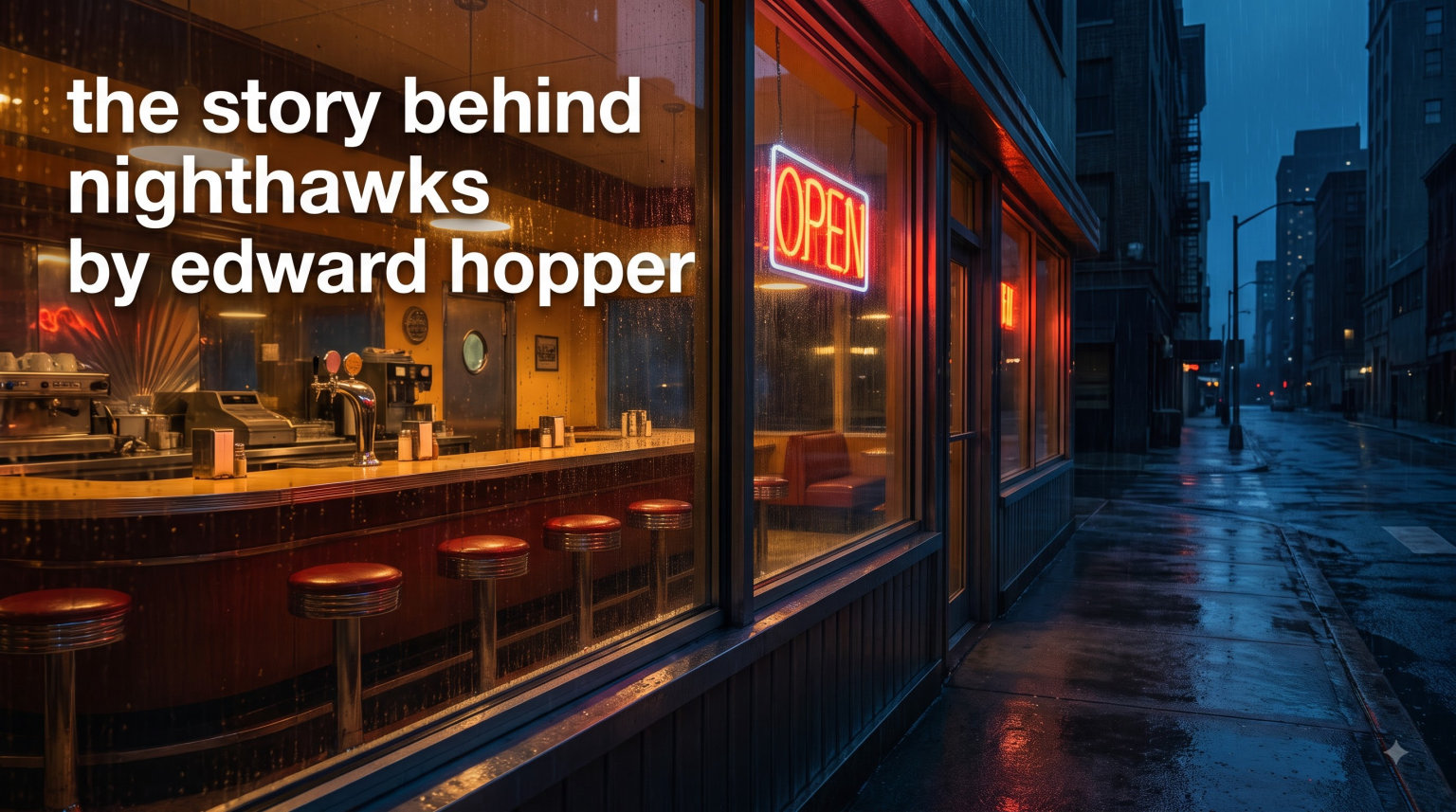
Edward Hopper’s Nighthawks is one of the most recognizable paintings in American art. You have probably seen this image countless times, reproduced in textbooks, posters, films, and even on merchandise. Yet the story behind this haunting 1942 masterpiece reveals why it continues to captivate viewers more than eight decades after its creation.
The painting depicts four figures in a downtown diner late at night. They sit in a pool of harsh fluorescent light while the city outside falls into complete darkness. There is something deeply unsettling about this scene, and that is precisely what Hopper intended. Let me take you through the fascinating history, context, and meaning of this iconic work.
Table of Contents
What Is Nighthawks?
Nighthawks is an oil-on-canvas painting completed in January 1942, measuring 33 inches by 60 inches. It currently hangs in the Art Institute of Chicago, where crowds still gather daily to glimpse its mysterious atmosphere. The painting has become so ubiquitous that many people encounter it first in reproduction before ever seeing the original.
The scene shows a diner with large plate glass windows, occupied by four anonymous figures. Two men sit at the counter, one facing forward and one with his back turned to the viewer. A woman in a striking red dress occupies a booth alongside a man who appears much older. A bartender stands behind the counter, though his face remains obscured by the angle of view.
The color palette dominates in deep greens, amber, and the artificial white of fluorescent light. These colors create an almost surreal quality, as if the diner exists in its own isolated world, disconnected from the darkness that surrounds it. The night beyond the windows is absolute, emphasizing how cut off these figures are from whatever lies outside.
What strikes viewers most is the sense that these four people share a physical space but exist in completely separate psychological worlds. They do not interact with each other, do not seem to acknowledge one another’s presence. The diner becomes a stage where isolated individuals perform the ritual of being together without ever truly connecting.
Historical Context: Painting in Wartime America
Hopper completed Nighthawks in January 1942, just weeks after the bombing of Pearl Harbor. On December 7, 1941, Japanese forces attacked the American naval base in Hawaii, killing over 2,400 people and pulling the United States into World War II. The attack shocked a nation that had remained largely isolated from global conflicts despite the ongoing war in Europe.
The country was gripped by fear in the weeks following Pearl Harbor. Citizens worried about additional attacks on the American mainland. Coastal cities implemented blackout drills. Gas rationing limited travel and forced people to stay close to home. The future felt deeply uncertain, and Americans questioned what lay ahead for their nation and their lives.
New York City, where Hopper lived and worked, seemed particularly affected. The city’s lights were dimmed during blackouts. Skyscrapers stood dark against the night sky. The familiar rhythms of urban life shifted as people retreated indoors, uncertain what each new day might bring. Hopper witnessed these changes firsthand, and they clearly influenced the isolation he captured in Nighthawks.
Within this atmosphere of anxiety, Hopper created a painting that perfectly reflected the national mood. The diner represents a kind of refuge, a place where people gather but find no real comfort or connection. Hopper himself noted that the painting expressed more than just a nighttime scene. It reflects the loneliness and isolation that permeated American life during wartime, when fear kept people apart even as they sought companionship.
The Four Figures and Their Identities
The identities of Nighthawks’ figures have fascinated viewers for decades. Hopper and his wife Josephine served as models for at least two of the figures, though the artist never fully confirmed who represented whom. The man at the counter on the left is believed to be Hopper himself, his elongated proportions and contemplative posture unmistakable to those who knew his features.
The woman in the red dress is thought to be Josephine, Hopper’s third wife who frequently modeled for his paintings. She wears the vibrant red that contrasts sharply against the muted greens of the interior, making her the visual focal point of the composition. Her exact pose and what she holds in her hand have never been definitively identified. She appears to be holding something small, possibly a cigarette or matches, but Hopper never confirmed this detail, choosing instead to let the mystery remain unsolved.
The man with his back turned to the viewer remains the most anonymous of the four. He wears a light-colored suit and fedora, the generic attire of a businessman or office worker. His isolation seems complete, his attention entirely absorbed by whatever occupies his thoughts. He faces nothing but wall and window, his gaze directed at emptiness.
The fourth figure, the bartender, exists as almost a shadow, present but undefined. His face stays hidden, making him more symbol than person. He represents the invisible workers who kept cities running through the night, serving drinks to lonely customers seeking escape from their daily lives. His presence is required for the scene to function, yet he remains as isolated as the customers he serves.
The Mystery of the Missing Door
One of the most frequently asked questions about Nighthawks concerns the missing door. Viewers immediately notice that there is no visible entrance or exit in the diner. Where do these people come from? How do they leave? This absence is not an oversight but a deliberate artistic choice that has become one of the painting’s most discussed features.
When asked about the door, Hopper reportedly said he did not know where it was. His wife Josephine recalled that he never intended to include one. Hopper was not the type of artist to leave such an obvious element to chance. The absence was calculated, designed to serve specific artistic purposes that align with his larger themes.
By removing any visible entry point, Hopper emphasized the permanence of the figures’ isolation. Without a door, there is no easy way in or out. The characters appear trapped within their own private worlds, unable to connect with each other or escape their circumstances. The diner becomes a glass box, a display case where people are trapped alongside one another but fundamentally alone.
This choice connects to Hopper’s broader artistic interests. He frequently painted scenes where figures existed in spaces without clear exits, where isolation seemed inescapable rather than chosen. The missing door reinforces this theme, suggesting that modern life traps us in situations we cannot easily leave, surrounded by others yet profoundly alone.
Artistic Technique: Light and Atmosphere
Hopper employed fluorescent lighting to create the painting’s distinctive atmosphere. In 1942, fluorescent bulbs were relatively new technology, having been introduced to American businesses just a decade earlier. The sight of fluorescent lights in a diner would have been somewhat novel, suggesting a modern, almost futuristic space.
These lights cast a harsh, clinical glow quite different from the warm light of traditional incandescent bulbs. They revealed everything in merciless detail, eliminating the soft shadows that romanticized ordinary scenes. For Hopper, this quality perfectly suited his interest in depicting modern life with honest, unflinching clarity.
The fluorescent light in Nighthawks serves multiple purposes. It illuminates the figures with clinical precision, revealing every detail of their faces, clothes, and postures. Yet this same light creates deep shadows in the corners and recesses of the diner, adding to the sense of isolation and unease. The light exposes without comforting.
The green hues dominating the scene contribute significantly to its psychological effect. In color psychology, green can suggest sickness, decay, or nausea. Hopper used these tones strategically throughout the painting to create discomfort. The artificial lighting transforms ordinary objects into elements of anxiety, making even a simple diner counter feel sinister and strange.
Light and shadow work together to emphasize Hopper’s themes. The figures exist in a pool of brightness while darkness surrounds them completely. They appear visible yet somehow unreachable, displayed yet trapped behind glass. This cinematic quality, with its dramatic contrasts and isolated figures, influenced generations of filmmakers and photographers who would later cite Nighthawks as a major inspiration.
Van Gogh’s Influence
Hopper drew inspiration from European art history, particularly from Vincent van Gogh’s Cafe Terrace at Night (1888). That earlier painting depicts people gathered at an outdoor cafe under artificial light, enjoying the evening atmosphere in Arles, France. The warmth of the scene, with its golden light and engaged figures, represents everything Hopper would transform in his own work.
Van Gogh’s treatment of night, light, and communal gathering clearly influenced Hopper’s approach. Both paintings feature figures in outdoor or semi-outdoor spaces, lit by artificial light, gathered but not necessarily connected. The European master’s influence is visible in Hopper’s interest in capturing the unique quality of nighttime in urban environments.
However, where Van Gogh painted warmth, connection, and enjoyment, Hopper transformed these elements into their opposites. His figures gather but do not interact. They sit under artificial light but feel no warmth. The cafe becomes a place of isolation rather than community, of disconnection rather than communion. Hopper took Van Gogh’s celebration of human connection and revealed its absence.
This dialogue between Hopper and Van Gogh reveals how American artists of the twentieth century engaged with European traditions while transforming them for their own contexts. Hopper stripped away the romanticism that characterized much European art and left behind something colder, more honest about the complexities of modern loneliness.
Why Does Nighthawks Feel So Lonely?
The sense of loneliness in Nighthawks comes from deliberate choices Hopper made throughout his career. He was consistently drawn to scenes of empty streets, closed storefronts, and solitary figures in public spaces. His paintings often asked questions about connection, community, and the meaning of modern life in increasingly anonymous urban environments.
What makes Nighthawks particularly powerful is how close the figures sit without touching or speaking. They share a physical space but exist in separate psychological worlds. The man at the counter and the woman in the booth are near enough to converse, yet neither makes any move toward the other. Even the couple in the booth seems disconnected, their attention directed away from each other toward separate private concerns.
Hopper once explained that he aimed to paint his own ideas rather than simply copy what he saw. He wanted to capture emotional truth, the deeper reality that existed beneath surface appearances. This approach gave his work its distinctive power to move viewers across generations. He was not interested in merely recording a scene; he wanted to express something true about human experience.
The painting resonates because it expresses feelings many people recognize from their own lives. Loneliness in crowded places. Disconnection from those around us. The sense that we can be physically present yet psychologically absent. These experiences make Nighthawks feel relevant to contemporary audiences decades after its creation, speaking to something universal about human consciousness.
In this way, Nighthawks transcends its wartime origins. While it was created in a specific historical moment, its themes of isolation and disconnection speak to permanent features of human experience. The painting captures something true about modern urban life that remains relevant regardless of when or where one encounters it.
Nighthawks Today: Location and Legacy
Nighthawks remains at the Art Institute of Chicago, where it has been on display since the museum acquired it shortly after its completion in 1942. The painting draws visitors from around the world who want to experience its power in person. Standing before the actual work reveals details and atmosphere that reproductions cannot capture, particularly the subtle variations in the green and amber tones.
The painting has influenced countless films, photographs, and works of art. Directors from Alfred Hitchcock to David Lynch have cited Hopper’s compositions as visual references. The image appears regularly in television shows, advertisements, and album covers, demonstrating its enduring cultural reach. Nighthawks has become so associated with urban nightlife that its image often serves as shorthand for late-night isolation.
Nighthawks represents a defining moment in American art history. It captures something essential about how Americans experienced their cities, their lives, and their anxieties during a transformative period of the twentieth century. The painting transcended its moment of creation to become a universal statement about human isolation, loneliness, and the difficulty of genuine connection.
For those who visit the Art Institute of Chicago, standing before Nighthawks offers an experience difficult to describe but impossible to forget. The painting’s power lies not just in its technical execution but in its ability to make viewers see their own loneliness reflected back at them, rendered beautiful and significant by an artist who understood that being alone together is one of the defining conditions of modern existence.
Frequently Asked Questions
What is the story behind the Nighthawks painting?
Nighthawks is a 1942 painting by Edward Hopper depicting four people in a downtown diner late at night. Painted weeks after Pearl Harbor, it captures the anxiety and isolation of wartime America. The painting shows two men, a woman in a red dress, and a bartender, all seemingly lost in their own worlds despite being in close proximity.
What was the historical context for Edward Hopper’s Nighthawks?
Hopper painted Nighthawks in January 1942, just weeks after the bombing of Pearl Harbor on December 7, 1941. The United States had entered World War II, and Americans lived in fear of further attacks. The painting reflects this atmosphere of anxiety, loneliness, and uncertainty about the future.
What is the lady holding in Nighthawks?
The identity of what the woman in the red dress is holding has never been definitively confirmed. Art historians believe she may be holding a cigarette or perhaps just gesturing with her hand. Hopper himself never clarified this detail, adding to the painting’s air of mystery.
What is the point of Nighthawks?
Nighthawks explores themes of urban loneliness, isolation, and the disconnect that can exist between people even when they are physically close. The painting serves as a meditation on modern life, anonymity, and the existential isolation that Hopper observed in American cities.
Why is there no door in Nighthawks?
The missing door in Nighthawks was intentional, not an oversight. Hopper deliberately omitted the door to emphasize the permanence of the figures’ isolation. Without a visible exit, the characters appear trapped within their own private worlds, unable to connect with each other or escape their loneliness.
Conclusion
Nighthawks by Edward Hopper continues to speak to viewers across generations because it captures something universal about human experience. The painting expresses the loneliness of modern life, the anxiety of uncertain times, and the difficulty of genuine connection even among people physically close together.
The story behind Nighthawks reveals an artist responding to his moment in history while transcending it. Hopper painted in 1942, but his vision speaks to anyone who has ever felt alone in a crowded room, disconnected from those around them, or trapped by circumstances beyond their control. The painting does not judge or moralize; it simply shows us ourselves, reflected in the amber light of a downtown diner.
That is the enduring power of Nighthawks. It shows us ourselves, our cities, our anxieties, and our hopes, all rendered in oil and light against a backdrop of urban darkness. The painting reminds us that isolation is a shared human experience, and that recognition itself brings some measure of comfort. We are not alone in our loneliness, because Hopper has shown us that loneliness is something we all share.