
By Bruce High Quality Foundation | May 15, 2026 | Categories: Art, Learn
Table of Contents
What Is Digital Art? Understanding the Medium
Digital art represents one of the most significant artistic developments of the twentieth and twenty-first centuries, fundamentally transforming how we create, distribute, and experience visual culture. Unlike traditional art forms that rely on physical materials like canvas, clay, or paint, digital art exists as electronic data that can be reproduced, modified, and transmitted instantaneously across global networks. This distinction elevates digital art beyond mere technique—it constitutes a genuinely new artistic medium with unique properties and possibilities that artists and theorists continue to explore and debate.
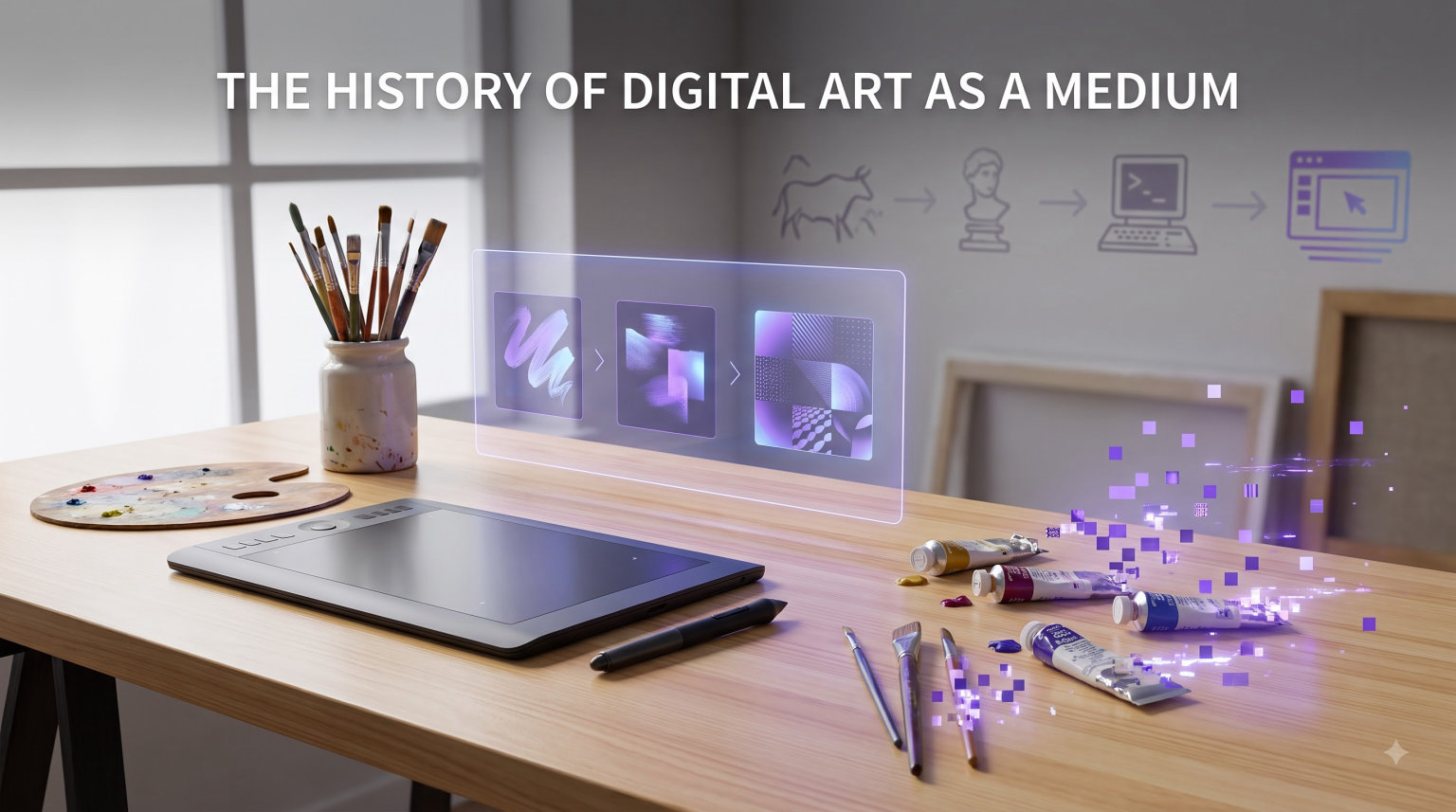
The history of digital art as a medium spans more than six decades of continuous innovation, beginning with rudimentary computer graphics experiments in the 1960s and evolving through artificial intelligence systems and blockchain technologies in recent years. Understanding this history requires examining not only the technological developments that enabled new forms of artistic expression but also the cultural contexts that shaped how artists engaged with emerging tools and concepts. The medium emerged at the intersection of computer science, avant-garde art movements, and countercultural experimentation, creating conditions for radical experimentation that continues to produce groundbreaking work today.
A critical question in contemporary art discourse concerns whether digital art constitutes a genuine artistic medium in the traditional sense or whether it represents something more like a movement characterized by shared technological contexts rather than formal properties. Proponents of the medium interpretation emphasize the unique technical processes involved in creating digital artwork and the distinctive aesthetic qualities that result from these processes. Critics sometimes argue that digital art lacks the material presence and tactile authenticity that historically defined artistic media. This debate remains central to understanding the history of digital art and its place within broader art historical narratives.
Throughout this comprehensive exploration, we will trace the evolution of digital art from its origins in early computing environments through periods of rapid technological change to the current moment characterized by artificial intelligence generators and non-fungible tokens (NFTs). Our journey will highlight key figures whose pioneering work established foundational practices, examine how changing technological capabilities opened new creative possibilities, and consider the implications of digital technologies for established concepts of authorship, originality, and artistic value that have governed art markets and museum collections for centuries.
The 1960s: The Birth of Computer Art
The history of digital art begins in the early 1960s, a period when computers remained massive institutional machines accessible only to trained technicians and research scientists. Despite these limitations, visionary artists recognized the creative potential embedded within these computational systems and began experimenting with nascent graphics capabilities that would eventually transform visual art practice worldwide. These pioneering efforts occurred independently across multiple countries, suggesting that cultural interest in machine-generated imagery emerged organically from broader conversations about technology’s role in post-industrial society.
John Whitney stands as one of the earliest and most influential figures in computer art history. Working during the late 1950s and early 1960s, Whitney developed early computer graphics techniques using analog computers and modified WWII anti-aircraft targeting systems to create mesmerizing patterns of moving light. His seminal work Catalog (1961) and subsequent pieces demonstrated that computers could produce aesthetically compelling visual output far removed from the utilitarian graphs and charts that dominated early computational visualization. Whitney’s approach emphasized algorithmic beauty—beautiful images emerging from mathematical formulas rather than direct artistic manipulation of physical materials.
Frieder Nake, working in Germany, contributed crucial early developments in algorithmic art practice. Active from the early 1960s, Nake created systematic drawings using plotter machines controlled by mathematical instructions. His work with construction series and matrix operations explored the aesthetic possibilities of systematic rule-following and the creative tensions between human intention and machine execution. Nake’s documentation of his processes established important precedents for understanding computer art as collaborative practice involving both artist and machine, anticipating debates about creative authorship that remain relevant in discussions of AI-generated work today.
Vera Molnar, another foundational figure from this period, pursued similar investigations into machine aesthetics through her work with plotter drawings. Molnar’s systematic approach to visual composition emphasized concepts like randomness within constraints and serial variation within ordered structures. Her paintings and graphic works demonstrated that computers could participate in genuinely artistic activity rather than merely serving as tools for reproducing human designs. Molnar continued developing her practice well into the twenty-first century, witnessing and contributing to the evolution of digital art from marginal experiment to central cultural phenomenon.
Desmond Paul Henry, working in Britain during the early 1960s, developed drawing machines based on analog computer technology that produced complex, swirling line patterns through automated processes. His three “Drawing Machines,” built between 1959 and 1962, created intricate compositions that anticipated later developments in generative art. Henry’s work demonstrated that creative automation could produce aesthetically satisfying results through the systematic application of mechanical and computational processes to artistic problem-solving.
The aesthetic and conceptual foundations established during this pioneering period remain relevant to contemporary digital art practice. Early computer art demonstrated that technological systems need not merely replicate traditional artistic effects but could generate genuinely novel visual experiences unavailable through conventional approaches. These early experiments established crucial conceptual frameworks for understanding digital art as a distinctive medium characterized by algorithmic processes, systematic variation, and creative collaboration between human operators and computational systems.
The 1970s: Video Art and Art-Technology Collaborations
The 1970s witnessed dramatic expansion of technological possibilities available to artists, particularly through the widespread availability of video recording and playback equipment. Video technology enabled artists to create time-based works exploring temporal dynamics impossible to achieve in static visual forms, while also providing new approaches to capturing and presenting real-world imagery through electronic processing. This period saw increasing institutional recognition of collaborations between artists and engineers as legitimate and productive artistic practice.
Nam June Paik emerged as the dominant figure in video art during this period, establishing aesthetic and technical approaches that continued influencing digital art practice for decades. Paik’s seminal work Global Serial (1974) and Electronic Superhighway (1974) demonstrated video’s capacity for real-time manipulation of imagery and its potential for creating immersive viewing experiences. His experiments with multiple monitors, video feedback, and electronic image processing established technical and conceptual precedents for contemporary video installation art and interactive media works.
The formation of Experiments in Art and Technology (EAT) in 1966 represented another crucial development of this period. EAT facilitated collaborations between artists and engineers that produced innovative technical solutions for artistic problems while also raising important questions about authorship, expertise, and the relationship between technical knowledge and artistic creativity. Projects like Grass Field (1969), which used microphone feedback to create sound from air movement, demonstrated the creative possibilities that emerged when artists gained access to technical expertise and sophisticated equipment.
Wolfgang Max Moesl and other artists working in Europe during this period developed computer-controlled systems for generating visual output that extended the algorithmic approaches pioneered in the 1960s. These works explored the creative potential of rules and systems as artistic media, emphasizing process over product and systematic variation over fixed compositions. The emphasis on process and procedure anticipated later developments in generative art and software art that would become central to digital art practice.
The 1970s also saw increasing theoretical reflection on the implications of digital technologies for artistic practice. Critics and theorists began examining questions about originality, reproduction, and the status of art objects in an era of electronic media. Walter Benjamin’s influential essay on mechanical reproduction gained renewed relevance as artists and theorists grappled with questions about authenticity and aura in computational contexts. These theoretical discussions established frameworks for understanding the distinctive properties of digital media that continue informing contemporary art discourse.
The 1980s: Harold Cohen and AARON — AI Enters the Studio
The 1980s marked a crucial transitional period in the history of digital art as emerging artists and theorists began explicitly using the term “digital art” to describe work produced using computer technology. This decade witnessed the emergence of artificial intelligence as a subject for artistic exploration, with pioneering practitioners developing systems capable of autonomous creative activity that challenged established assumptions about the nature of artistic creativity and authorship. The decade also saw increasing availability of personal computing technology that made digital art practice accessible beyond specialized research institutions.
Harold Cohen stands as perhaps the most significant figure in early AI art development. A painter trained at the Slade School of Fine Art in London who later became professor of visual arts at the University of California, San Diego, Cohen began developing AARON in 1973 as a system capable of producing original artwork without direct human guidance during execution. Cohen’s approach drew on cognitive science research to create a computer program that encoded knowledge about composition, color, and artistic tradition, enabling AARON to generate visually compelling images through algorithmic processes.
Cohen’s work with AARON raised fundamental questions about the nature of creativity that continue resonating in contemporary debates about AI art. Was AARON truly creative, or merely simulating creative output through sophisticated pattern matching? Did Cohen’s role as AARON’s creator constitute a form of artistic authorship even when he did not directly produce the images? These questions anticipated later discussions about attribution and originality that have become pressing concerns as AI generation tools become increasingly sophisticated and widespread.
Throughout the 1980s, Cohen continued refining AARON’s capabilities, enabling the system to produce increasingly complex and varied compositions. He presented AARON’s work in exhibitions and publications that brought AI art to broader public attention, establishing important precedents for how AI-generated artwork could be presented and discussed within art market contexts. Cohen’s articulate theorization of his work helped establish conceptual frameworks for understanding autonomous creative systems that influenced subsequent generations of researchers and artists.
The 1980s also saw increasing commercialization of computer graphics technology that would eventually transform popular visual culture. Pixar, founded in 1986 as part of George Lucas’s Lucasfilm operation, began developing sophisticated rendering software that established new standards for computer-generated imagery. While Pixar focused primarily on entertainment industry applications, the technological innovations emerging from commercial research would eventually influence fine art practice and blur boundaries between commercial and artistic digital production.
Digital painting software began emerging during this period, with programs like MacPaint (1984) introducing new possibilities for creating and manipulating images using personal computers. These tools enabled artists to work with digital media in ways analogous to traditional painting, establishing technical and conceptual foundations for contemporary digital illustration and design practice. The accessibility of these tools foreshadowed the democratization of digital art production that would accelerate dramatically in subsequent decades.
The 1990s: The Internet Revolution and Telematic Art
The 1990s represented a transformative period for digital art as the World Wide Web emerged from academic and military contexts to become a mass medium connecting millions of users worldwide. The internet created entirely new contexts for artistic production, distribution, and reception while also enabling new forms of collaborative and distributed creative practice. Artists quickly recognized the web’s potential as an artistic medium with distinctive properties unavailable in previous technological systems, giving rise to new genres and movements that challenged established boundaries between art and technology.
Telematic art emerged as a distinctive genre during this period, describing artwork that used telecommunications networks to create connections between distant locations or participants. Artists like Roland Cosgrove and others developed projects exploring how network technologies could enable shared aesthetic experiences spanning geographic boundaries. These works raised questions about presence, location, and the nature of artistic experience in an era when physical co-presence no longer seemed necessary for meaningful artistic engagement.
The net.art movement developed as artists began creating works specifically designed for web browser contexts. Unlike earlier computer art that existed primarily in gallery or institutional contexts, net.art existed only within the networked environment of the World Wide Web, making internet connectivity a prerequisite for experiencing the work. Artists like Oleg Kireev, Heiko Hoer, and many others created browser-based works exploring HTML’s capabilities for generating dynamic visual experiences that responded to user interaction in novel ways.
The 1990s witnessed dramatic expansion of digital art into mainstream cultural contexts. Digital effects became increasingly prominent in film and television production, while computer graphics transformed advertising, design, and entertainment industries. This mainstreaming of digital visual technology created new contexts for fine art practice while also raising questions about relationships between commercial and artistic applications of similar technical means. Artists increasingly worked across boundaries between commercial and fine art contexts, contributing to the erosion of categorical distinctions that had governed art markets and critical frameworks.
Interactive installations became increasingly sophisticated during this period as artists gained access to more powerful computing hardware and sensor technologies. Works like those by Jeffrey unmatched demonstrates the growing sophistication of digital installation art, which combined digital visual output with physical environments and viewer participation to create immersive aesthetic experiences. These installations anticipated the emphasis on interactivity and immersion that would characterize much contemporary digital art practice.
The theoretical discourse surrounding digital art expanded dramatically during this period as critics and scholars developed frameworks for understanding emerging practices. Questions about dematerialization—the tendency of digital art to exist as information rather than physical objects—challenged established assumptions about art’s material presence and its implications for collecting, preservation, and institutional display. Theorists like Frank Popper and others developed comprehensive overviews of electronic and digital art that situated contemporary developments within longer art historical trajectories.
The 2000s: Software Evolution and Interactive Experiences
The first decade of the twenty-first century witnessed continued refinement of digital art practices as artists developed increasingly sophisticated relationships with software tools and computational systems. This period saw the emergence of software art as a distinctive genre with its own aesthetic concerns and technical practices, while also witnessing growing institutional recognition of digital art through museum acquisitions, gallery exhibitions, and academic programs specifically focused on digital media practice.
Cory Arcangel emerged as a leading figure in software art during this period, creating works that examined video games, operating systems, and other software systems as artistic media. His modification of Nintendo games and other consumer software products drew attention to the cultural significance of ubiquitous computing technologies while also raising questions about authenticity, modification, and the boundaries between authorized use and creative intervention. Arcangel’s work demonstrated that seemingly trivial or mundane software systems could serve as legitimate subjects for serious artistic exploration.
Rafael Lozano-Hemmer developed large-scale interactive installations that used sensor technologies and projection systems to create responsive environments responding to viewer movement and behavior. His work Shadow Box (2003) and similar projects demonstrated the artistic potential of real-time tracking systems, creating experiences that existed only momentarily in specific locations while also documenting these moments through photography and video. Lozano-Hemmer’s approach emphasized the ephemeral and site-specific qualities of interactive digital art, challenging assumptions about how digital works could function within traditional art institutions.
The evolution of creative software tools during this period dramatically expanded possibilities for digital art production. Adobe Photoshop, Illustrator, and other professional design applications became increasingly sophisticated, enabling artists to create complex digital compositions with unprecedented control and flexibility. Open-source alternatives like Processing emerged, providing artists with programming environments specifically designed for visual output and generative systems. These tools lowered barriers to entry while also establishing technical standards that shaped subsequent practice.
Digital sculpture developed as a distinct practice during this period as artists began using 3D printing and other fabrication technologies to translate digital designs into physical objects. This development challenged binary distinctions between digital and physical art that had characterized earlier discourse, suggesting instead that digital and material practices could operate in productive tension and collaboration. Museums and galleries increasingly acquired digital sculpture works, establishing market values and institutional recognition for practices that would have seemed eccentric or marginal just decades earlier.
Theoretical discourse evolved to address growing sophistication of digital art practice. Questions about authenticity and originality took new forms as digital reproduction became indistinguishable from “original” digital files. Discussions of remix culture, appropriative practice, and the significance of digital copying challenged romantic assumptions about artistic authorship that had dominated modernist art discourse. Artists and theorists developed new frameworks for understanding creative practice in networked contexts where copying and modification constituted standard rather than exceptional activities.
The 2010s–Present: AI Generators and NFT Revolution
The most recent period in digital art history has witnessed perhaps the most dramatic technological transformation since the emergence of personal computing in the 1970s and 1980s. Artificial intelligence image generation systems, non-fungible token (NFT) technologies, and blockchain-based provenance tracking have fundamentally challenged established assumptions about artistic authorship, originality, and value that have governed art markets and critical frameworks for generations. Artists working today navigate technological capabilities that would have seemed science fictional just decades earlier, while also confronting entirely new economic and legal questions about how AI-generated work relates to existing frameworks for intellectual property and creative attribution.
Generative adversarial networks (GANs) emerged as crucial technology for AI art generation beginning around 2014. Developed by Ian Goodfellow and colleagues, GANs use competing neural networks to generate increasingly realistic images through iterative refinement processes. Artists quickly adopted these tools for creative purposes, developing aesthetic approaches that emphasized the distinctive visual qualities of machine-generated imagery rather than attempting to simulate human artistic styles. The emergence of StyleGAN, BigGAN, and other specialized architectures enabled increasingly sophisticated control over generated outputs while also raising questions about authenticity and attribution.
DALL-E, released by OpenAI in 2021, represented a watershed moment in public awareness of AI art generation capabilities. Unlike earlier GAN-based systems, DALL-E demonstrated remarkable ability to generate contextually appropriate images from natural language descriptions, enabling non-technical users to create sophisticated visual outputs through textual prompts. Subsequent systems including DALL-E 2, Stable Diffusion, and Midjourney extended these capabilities while also introducing new aesthetic possibilities and ethical concerns. Artists began developing practices specifically designed for these tools, creating works that could only exist through human-AI collaboration rather than either human labor alone or autonomous machine generation.
The NFT (non-fungible token) phenomenon beginning around 2020 dramatically transformed digital art markets by providing mechanisms for establishing and tracking unique ownership of digital files that could previously be reproduced infinitely without distinction from “originals.” NFT technology uses blockchain systems to create verifiable records of ownership and transaction history, enabling digital artworks to function as collectible assets with established provenance chains. While NFT markets experienced significant volatility, the technology established important precedents for how digital art might function within established art market frameworks.
Beeple’s Everydays: The First 5000 Days (2021), sold at Christie’s for $69 million, became the most famous example of NFT art market dynamics, demonstrating that collectors would pay substantial sums for digital works authenticated through blockchain technology. This sale and similar transactions attracted enormous public attention while also generating significant controversy within art communities. Critics questioned whether NFT technology truly addressed longstanding concerns about digital art authenticity and originality, while supporters argued that blockchain-based authentication represented genuine innovation in art market infrastructure.
Contemporary artists work across diverse approaches to AI and NFT technologies, ranging from enthusiastic adoption to critical distance and outright rejection. Some artists embrace AI generation tools as genuinely creative media deserving serious artistic attention, while others question whether machine learning systems trained on existing artworks without permission constitute acceptable artistic practice. These debates echo earlier controversies about appropriation, mechanical reproduction, and other technological disruptions to established art world assumptions, suggesting that digital art’s relationship to broader art historical trajectories remains active and contested terrain.
Questions about copyright, intellectual property, and the legal status of AI-generated work have become pressing concerns as these technologies mature. Existing frameworks for protecting creative work were developed assuming human authorship, leaving unclear how AI-generated images should be treated within intellectual property systems. Artists, lawyers, and policymakers continue grappling with these questions, which will likely require significant legal and regulatory innovation to resolve satisfactorily. The resolution of these questions will substantially shape how digital art markets function in coming decades.
Digital Art as a Medium: The Ongoing Debate
The question of whether digital art constitutes a genuine artistic medium in the traditional sense or whether it represents something more like a movement characterized by shared technological contexts rather than formal properties remains central to contemporary art discourse. This question matters not merely for taxonomic precision but because different characterizations imply different critical standards, institutional arrangements, and market structures that shape how digital art is created, presented, and valued. Understanding the medium versus movement debate requires examining both theoretical frameworks and practical considerations that inform how artists, critics, collectors, and institutions engage with digital art.
Those arguing for the medium interpretation emphasize the distinctive technical processes involved in creating digital artwork. Unlike painting or sculpture, which employ physical materials to produce unique objects, digital art typically involves creating files that can be reproduced without loss of quality and transmitted instantaneously across global networks. This dematerialization constitutes a genuinely novel characteristic requiring new critical and institutional approaches rather than merely adapting existing frameworks developed for traditional media. Additionally, digital art often involves algorithmic processes, systematic procedures, and collaborative relationships with computational systems that have no parallels in traditional art practice.
Critics of the medium interpretation sometimes argue that digital art lacks the material presence and tactile authenticity that historically defined artistic media. This critique emphasizes that much digital art exists primarily as information rather than physical objects, challenging assumptions about what art objects are and how they function within cultural contexts. Other critiques focus on digital art’s dependence on rapidly obsolescing technological systems, suggesting that works dependent on specific software environments or hardware configurations may become inaccessible as technologies evolve. Questions about preservation and institutional stability remain challenging for digital art advocates to address satisfactorily.
Accessibility and democratization represent crucial aspects of digital art’s distinctive character that complicate medium versus movement categorizations. Digital technologies have dramatically lowered barriers to entry for art production, enabling individuals without formal training or access to expensive materials to create and distribute work to global audiences. This democratization challenges gatekeeping functions that traditional art institutions have historically exercised while also raising questions about quality, expertise, and the criteria appropriate for evaluating increasingly diverse creative outputs. The relationship between accessibility and artistic quality remains genuinely contested terrain with significant implications for how digital art is understood and valued.
The resolution of medium versus movement questions may prove less important than continued exploration of digital art’s distinctive possibilities and limitations. Artists working with digital technologies continue developing practices that challenge established categories and assumptions, producing work that demands new critical and theoretical frameworks. The history of digital art as a medium remains ongoing, with contemporary developments representing perhaps early stages of a transformation whose ultimate implications remain impossible to predict from current perspectives. Future historians will likely characterize our period as a transitional moment in longer trajectories that we can only partially perceive from within.
Key Takeaways: Why Digital Art History Matters
The history of digital art as a medium encompasses more than six decades of continuous innovation, experimentation, and transformation that has fundamentally altered how we understand artistic practice in contemporary contexts. From early computer graphics experiments by pioneers like John Whitney and Frieder Nake through Harold Cohen’s pioneering AI system AARON, from the internet revolution and telematic art of the 1990s to contemporary AI generators and NFT markets, digital art has consistently challenged established assumptions about what art is, how it should be created, and what values it should embody.
Understanding this history matters for multiple reasons beyond academic interest. Collectors and investors in digital art benefit from understanding the contexts and precedents that shape how contemporary markets function and what factors determine value in a rapidly evolving landscape. Artists working with digital technologies gain insight into how their current practices relate to longer trajectories of innovation and experimentation, potentially identifying opportunities for original contribution to ongoing conversations. General audiences develop richer appreciation for the cultural significance of technologies that increasingly shape daily life experiences.
The trajectory of digital art history suggests that we are currently experiencing a particularly significant moment of transition as AI technologies introduce new capabilities and challenges that may require fundamental rethinking of established frameworks for understanding creativity, authorship, and value. The questions raised by contemporary developments—about intellectual property, authenticity, human-machine collaboration, and the status of generated outputs—represent continuations of debates that began with earliest computer art experiments. How these questions eventually resolve will substantially shape digital art’s future development and cultural significance.
As digital technologies continue evolving at accelerating rates, the history of digital art as a medium provides essential context for understanding where we are, how we arrived here, and what possibilities and challenges lie ahead. The pioneers whose experiments established foundations for contemporary practice could not have anticipated the capabilities available to today’s artists, yet their questions and concerns remain relevant to contemporary practitioners. Digital art history thus offers not merely retrospective understanding but active guidance for navigating ongoing transformations in creative practice and cultural value.