
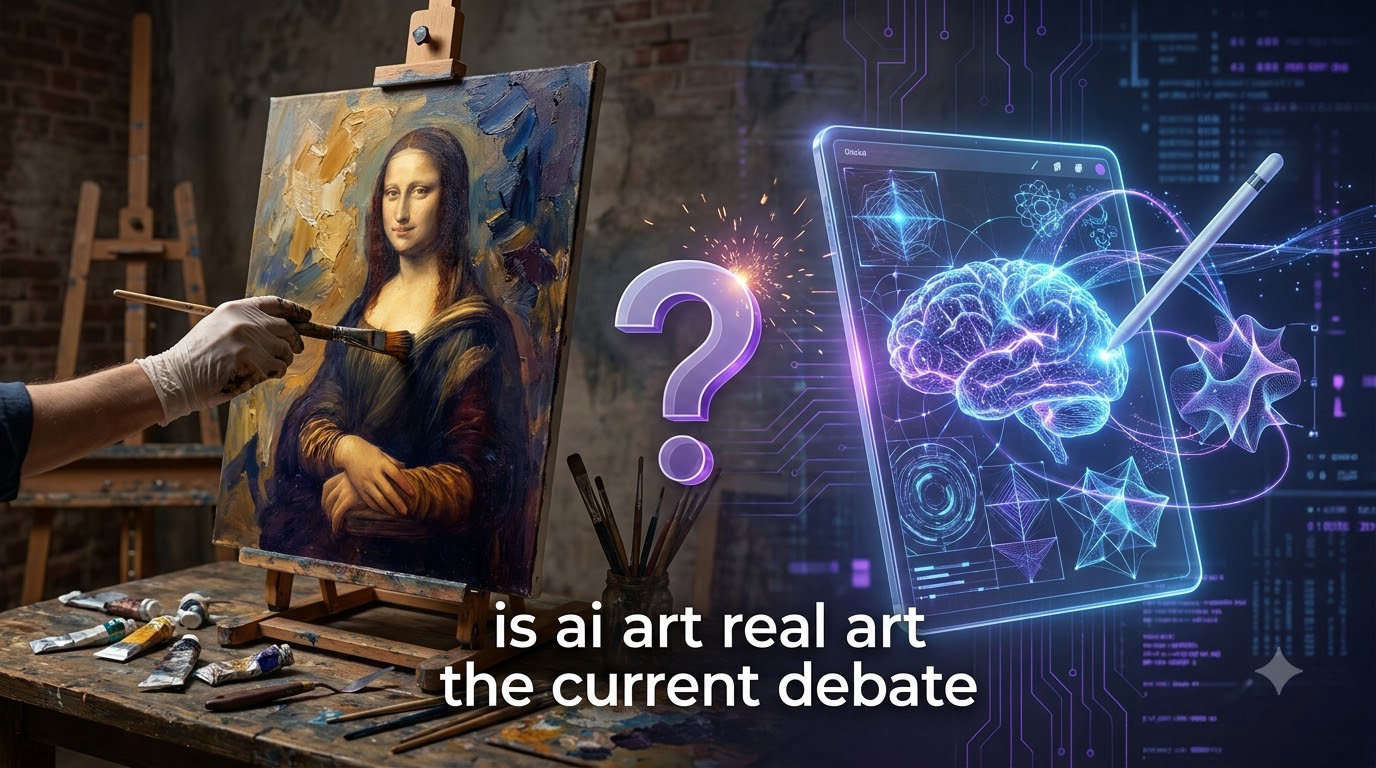
In August 2022, a digital artwork called Théâtre D’opéra Spatial won first place in the digital arts category at the Colorado State Fair. The artist, Jason Allen, had used the AI image generator Midjourney to create the piece, and the art world erupted. Some called it cheating. Others called it the future. That single event ignited a firestorm that is still burning in 2026, and it forced millions of people to confront a question that sounds simple but refuses to stay answered: is AI art real art?
Our team has been tracking this debate since it began, and what started as a niche argument among digital artists has grown into a global conversation touching philosophy, law, ethics, and the very definition of creativity. Whether you are a working artist worried about your livelihood, a collector wondering what is worth buying, or simply someone curious about where the lines are drawn, this article will walk you through every major angle of the debate as it stands in 2026.
We will break down the philosophical arguments around intentionality, consciousness, and skill. We will look at what real artists think, what courts have decided, and what history tells us about moments exactly like this one. By the end, you will have a clear framework for forming your own opinion on whether AI-generated art deserves the same recognition as work made by human hands.
Table of Contents
What Is AI Art? Understanding the Technology
Before we can debate whether AI art is real art, we need to understand what it actually is. AI-generated art refers to images, music, text, or other creative works produced or significantly shaped by artificial intelligence algorithms. The most common tools people use in 2026 include DALL-E, Midjourney, and Stable Diffusion, all of which fall under a category called generative AI.
These systems work by training on massive datasets of existing images, paintings, photographs, and illustrations. A type of machine learning model called a diffusion model learns to recognize patterns, styles, compositions, and color relationships across millions of examples. When you type a text prompt like “a sunset over a cyberpunk city in the style of Van Gogh,” the model uses what it learned to generate a new image that matches your description.
Older AI art systems used Generative Adversarial Networks, or GANs. A GAN pits two neural networks against each other: one creates images while the other tries to detect whether they are real or generated. Through this adversarial process, the generator gets better and better at producing convincing outputs. While GANs produced some of the earliest widely recognized AI art, diffusion models have largely taken over the field because they offer more control and higher quality results.
The key thing to understand is that these models do not simply copy and paste pieces of existing artwork. They learn statistical patterns and relationships, then produce new combinations. Whether that process counts as “creation” is exactly what the rest of this debate hinges on.
The Philosophical Debate: Is AI Art Real Art?
This is the heart of the matter, and philosophers, artists, and critics have staked out positions across a wide spectrum. The debate over whether AI art is real art centers on three major arguments, each of which deserves its own examination.
The Intentionality Argument
One of the oldest ideas in art theory is that art requires intention. When a painter puts brush to canvas, every stroke represents a deliberate choice. The artist intends to communicate something, whether it is an emotion, a story, or an aesthetic experience. This intentionality, many argue, is what separates art from random visual noise.
AI systems do not have intentions. A diffusion model does not want to create something beautiful or meaningful. It processes a text prompt through mathematical operations and outputs pixels. There is no moment of creative decision-making during the actual image generation. The AI does not pause and think, “I should add more warmth to this sunset.” It follows the statistical path its training data suggests.
But here is the counterargument, and it is a strong one: the human who writes the prompt does have intentions. Prompt engineering has become a skill in its own right, with experienced practitioners spending hours refining their inputs, adjusting parameters, and iterating through dozens of versions to achieve a specific vision. Some artists argue that the AI is simply a tool, like a camera or a paintbrush, and the real creative act belongs to the person wielding it.
The Consciousness and Experience Argument
Art has always been tied to human experience. We value a Frida Kahlo self-portrait not just for its visual qualities but because we know it came from a person who lived through real pain. We feel something extra when we learn that Van Gogh painted Starry Night from an asylum window. The artist’s lived experience, their suffering, their joy, their unique perspective on the world, adds a layer of meaning that no purely technical analysis can capture.
AI has no consciousness. It has never felt grief, never stood in awe of a landscape, never had a childhood memory that shapes how it sees the world. When an AI generates an image that looks melancholic, it is not because the AI feels melancholy. It is because the training data contains patterns associated with visual representations of melancholy that humans created. The emotion is borrowed, not felt.
Critics of this argument point out that we do not actually know what consciousness is or how it relates to creativity. Some cognitive scientists argue that human creativity itself is essentially a pattern-matching process, pulling from memories, influences, and experiences in ways that are not so different from what AI does, just far more complex and embodied. If human creativity is ultimately a form of sophisticated pattern recognition, the gap between human and AI creation may be smaller than it feels.
The Skill and Craft Argument
Traditional artists spend years, sometimes decades, developing their craft. A watercolor painter learns to control the flow of pigment and water. A sculptor develops an intuitive understanding of how stone will respond to each chisel strike. This investment of time and effort is deeply meaningful to the people who make it, and many argue that it is essential to what makes something art rather than mere production.
Generating an AI image takes seconds. You type a prompt, click a button, and receive a result. There is no physical skill involved, no years of practice, no muscle memory built through repetition. For many working artists, this feels like a shortcut that bypasses the struggle they believe gives art its value.
Supporters of AI art respond that the barrier to entry has shifted rather than disappeared. Anyone can type a basic prompt, but creating consistently excellent AI art requires understanding composition, color theory, art history, and the nuances of how different models interpret language. The skill has moved from the hand to the mind, and some people are remarkably good at it while others are not. That differential, they argue, is where artistry lives.
Forum discussions on Reddit reveal how personal this argument feels. Artists in communities like r/ArtistHate express genuine frustration that years of dedicated practice can feel undermined by someone producing comparable visual results in minutes. The pain is not abstract; it is tied to real career consequences and a sense that the art community is devaluing the very commitment that attracted them to art in the first place.
History Tells Us: When Photography Faced the Same Question
If you want perspective on the AI art debate, look at what happened when the camera was invented. In 1839, when Louis Daguerre introduced the daguerreotype, painters were horrified. Charles Baudelaire called photography “the refuge of every would-be painter, every painter too ill-endowed or too lazy to complete his studies.” The French poet and critic argued that photography was a mechanical process, not art, and that it would corrupt public taste.
Sound familiar? The arguments against photography in the 19th century are nearly identical to the arguments against AI art in 2026: it requires no skill, it merely captures what already exists, it lacks the artist’s personal touch and creative vision. Photography was excluded from art salons, dismissed by critics, and treated as a technical novelty rather than a legitimate art form.
It took roughly a century for photography to gain full acceptance as an art form. Along the way, photographers like Ansel Adams, Dorothea Lange, and Henri Cartier-Bresson demonstrated that the camera could be used with extraordinary artistic vision. They made choices about composition, lighting, timing, and subject matter that elevated photography beyond mere documentation.
The same pattern repeated with digital art in the 1990s and early 2000s. Traditional painters dismissed Photoshop and digital tablets as cheating. Digital artists had to fight for recognition in galleries and exhibitions. Today, digital art is widely accepted, and no one questions whether a painting made on an iPad counts as real art.
The historical lesson is not that AI art will automatically follow the same trajectory. It might. But history does show that the art world has a consistent pattern of initially rejecting new technologies before eventually incorporating them. The question is whether AI represents a fundamentally different kind of disruption or simply the latest chapter in a very old story.
What Artists Actually Think About AI Art
There is no single “artist perspective” on AI art, but there are some clear patterns. In our research across forums, interviews, and public statements, we found that artists fall into roughly three camps, and the divisions often depend on what kind of art they make and how they make their living.
The first camp sees AI as an existential threat. These are primarily illustrators, concept artists, and commercial artists whose work is most directly competitive with what AI can produce. When a client can generate a usable illustration in minutes instead of commissioning one over weeks, the economic pressure is immediate and real. These artists point to job losses, reduced rates, and a growing expectation from clients that they should work faster because AI can do it. For them, the debate is not academic. It is about survival.
The second camp sees AI as a creative tool, similar to a new medium or a digital brush. These artists tend to work in fine art or experimental spaces where the economic pressure is less direct. They use AI to generate ideas, explore variations, or create elements that they then incorporate into larger works. Several artists who initially opposed AI have adopted hybrid workflows, using AI to handle repetitive tasks or generate starting points that they refine with traditional techniques. These artists tend to argue that the question “is AI art real art” is too broad to be useful and that what matters is the quality and intention behind the final work.
The third camp is cautiously curious but concerned about ethics. These artists are not opposed to AI in principle, but they have serious objections to how current AI models were built. The training data for most major image generators includes billions of images scraped from the internet, many of them copyrighted works by artists who never gave consent. For these artists, the issue is not whether AI can make art but whether the process of teaching AI to make art was done ethically.
Harvard University interviewed experts across multiple creative fields for their coverage of this topic, and the range of opinions was striking. A novelist compared AI art to translation software: useful but lacking the creative soul of original work. A musician argued that the spontaneity of live, in-the-moment composition is something AI cannot replicate because AI has no “moment” to be in. A mixed-media artist saw potential in human-AI collaboration but worried about homogenization, that AI might push everyone toward a statistical average of what art looks like rather than encouraging truly original voices.
The Legal Battlefield: Copyright and Authorship
The legal status of AI-generated art is evolving rapidly, and the current landscape in 2026 can be summarized in one sentence: pure AI-generated works generally cannot be copyrighted, but works involving significant human creative input with AI assistance often can.
In the United States, the Copyright Office has consistently held that copyright protection requires human authorship. In the case of Thaler v. Vidal, the courts ruled that an AI system cannot be listed as the author of a copyrighted work. This means that if you generate an image purely through an AI tool with no meaningful human modification, you cannot claim copyright over that image. Anyone could, in theory, copy it and use it themselves.
However, the situation becomes more nuanced when humans are actively involved. If an artist generates an AI image and then significantly modifies it, combines it with other elements, or incorporates it into a larger original composition, the human-authored portions may be eligible for copyright protection. The Copyright Office has indicated it evaluates these cases on a spectrum, looking at the degree of human creative control involved.
The training data issue presents another legal frontier. Multiple lawsuits are working through the courts in 2026 alleging that AI companies violated copyright by training their models on copyrighted images without permission or compensation. These cases could reshape the entire AI art landscape, potentially requiring companies to license training data, compensate artists whose work was used, or even alter how their models are trained.
Different countries are taking different approaches. The European Union’s AI Act includes provisions related to transparency in AI-generated content. China has introduced regulations requiring labeling of AI-generated content. Japan has taken a relatively permissive stance on training data use. This patchwork of international regulations means that the legal answer to “is AI art real art” depends in part on where you live and where the art was created.
Ethical Concerns: Bias, Consent, and Authenticity
Beyond the philosophical and legal questions, the AI art debate raises serious ethical issues that affect real people and real communities.
The consent problem is perhaps the most pressing. Most major AI image generators were trained on datasets that include millions of images created by human artists who were never asked for permission. When you use one of these tools to generate an image “in the style of” a living artist, you are benefiting from that artist’s lifetime of work without their consent and without compensating them. For many artists, this is not a philosophical abstraction. It is their intellectual property being used to build a product that may compete with them.
Algorithmic bias is another significant concern. AI models learn from the data they are trained on, and that data reflects human biases. Studies have shown that AI image generators can perpetuate racial stereotypes, gender biases, and cultural narrowness. If the training data is predominantly Western art and imagery, the AI’s outputs will tend to reflect Western aesthetic values and underrepresent other cultural traditions. This is not just an aesthetic issue; it shapes whose visual culture gets amplified and whose gets marginalized.
Authenticity and disclosure present their own challenges. When someone shares an AI-generated image without disclosing its origin, they are presenting machine-produced content as human-created. This is not just a matter of honesty. It affects how viewers interpret the work. Knowing that a human painted something versus knowing that an algorithm generated it changes the meaning we assign to it. Many in the art community argue that mandatory disclosure of AI involvement is an ethical minimum, not an optional courtesy.
The devaluation of human skill ties all of these concerns together. Artists on forums like Reddit describe a feeling of profound discouragement when they see AI-generated images that took seconds to create winning competitions or attracting attention that once went to hand-crafted work. The concern is not just economic but cultural: if we stop valuing the time, effort, and dedication that traditional art requires, we risk losing something irreplaceable about the human creative spirit.
The Spectrum of AI Involvement in Art
One of the most helpful ways to think about this debate is to stop treating it as binary, either AI art is real art or it is not, and instead recognize a spectrum of AI involvement. Not all AI art is the same, and where a particular work falls on this spectrum has enormous implications for how we evaluate it.
At one end, there is AI as a reference tool. An artist might use an AI image generator to explore color palettes, test compositions, or generate reference images that they then use as inspiration for a completely hand-painted work. The final piece contains no AI-generated content at all. Almost everyone agrees this is unproblematic; the AI is functioning like a mood board or a search engine.
Next comes AI-assisted creation. The artist generates AI elements but substantially modifies, paints over, or integrates them into a larger original work. The human creative contribution is dominant, but AI played a meaningful role in the process. Most legal frameworks and many critics are comfortable calling this art because the human creative choices are evident and substantial.
Further along the spectrum is AI co-creation, where the artist and the AI contribute roughly equally. The human writes detailed prompts, selects the best outputs, refines them, and makes iterative adjustments. The AI handles the actual image rendering. This is where the debate gets heated, because both contributions are significant and neither can produce the final result alone.
At the far end is full AI generation, where a user types a brief prompt and accepts the output with little or no modification. This is the most controversial category. The human contribution is minimal, and the argument that this qualifies as “art” rests almost entirely on the claim that writing the prompt is itself a creative act. This is where even many AI art supporters draw the line.
Understanding this spectrum helps explain why the debate often feels circular. Two people can argue past each other because one is thinking about AI-assisted creation while the other is thinking about full AI generation. They are not actually disagreeing about the same thing.
Frequently Asked Questions
Is AI-generated art legally considered art?
In most jurisdictions, AI-generated art can be displayed, sold, and exhibited, but pure AI-generated works without significant human modification generally cannot receive copyright protection. The US Copyright Office has ruled that copyright requires human authorship. However, works that involve substantial human creative input alongside AI tools may qualify for protection. The legal landscape is still evolving as courts consider cases about training data, fair use, and the boundaries of human authorship.
What do professional artists think about AI art?
Professional artists are deeply divided. Commercial illustrators and concept artists tend to view AI as a direct economic threat to their livelihoods. Fine artists and experimental creators are more likely to explore AI as a creative tool, with several adopting hybrid workflows that combine AI generation with traditional techniques. A significant group supports AI in principle but opposes how current models were trained on artists’ work without consent. Across all camps, most artists agree that transparency and ethical training practices are essential.
Does AI art require creativity?
It depends on what level of AI involvement we are talking about. Writing effective prompts, iterating on results, and refining outputs does involve creative decision-making. However, the AI system itself does not possess creativity in any meaningful sense; it applies statistical patterns learned from training data. The creativity question centers on whether the human’s role in guiding the AI counts as a creative act comparable to traditional artistic methods.
Is using AI to create art cheating?
This depends on context. In a fine art or experimental context, using AI is widely seen as simply another tool, similar to how photographers use cameras or digital artists use software. However, entering a purely AI-generated image in a competition without disclosing its origin, or presenting AI work as entirely hand-crafted, is generally considered dishonest. The key factors are transparency about the process and whether the rules of the specific context allow AI involvement.
How is the art world responding to AI art?
The art world’s response is mixed and evolving rapidly. Some galleries have begun exhibiting AI art, and a few major museums have acquired AI-generated works for their collections. Art competitions have updated their rules, with some creating separate categories for AI-generated work and others banning it entirely. Art schools are debating whether to teach AI tools alongside traditional techniques. The commercial art market has seen significant disruption, particularly in illustration and concept art, while the fine art market has been slower to embrace AI-generated pieces.
Will AI art devalue human-created art?
The evidence so far suggests a split effect. In commercial illustration and stock imagery, AI has already driven down prices and reduced demand for human-created work at the lower end of the market. However, in the fine art world, human-created works continue to command premium prices, and some collectors are specifically seeking out works with proven human authorship as AI art becomes more common. Provenance, the documented history of who made a piece and how, may actually become more valuable as a differentiator in a world saturated with AI-generated imagery.
Where the Debate Stands and Where It Is Going
The question of whether AI art is real art does not have a clean answer, and honestly, it probably should not. What we have instead is a living, shifting conversation that reflects our deepest values about creativity, effort, originality, and what it means to be human.
The strongest case against AI art rests on intentionality, lived experience, and craft, the idea that art gains its meaning from the conscious human struggle behind it. The strongest case for AI art points to the creative vision of prompt engineers, the historical pattern of new media winning acceptance, and the reality that tools have always shaped artistic output. Both sides have legitimate points, and neither can claim total victory.
What is clear in 2026 is that the debate over whether AI art is real art is reshaping the creative landscape in real time. Courts are writing new rules. Galleries are rewriting exhibition policies. Artists are rethinking their workflows. And the technology itself keeps advancing, making the questions harder, not easier, with each passing month.
If you are an artist, the most practical step you can take is to stay informed and experiment thoughtfully. Try the tools. Understand what they can and cannot do. Decide for yourself where on the spectrum of AI involvement you are comfortable working. If you are a collector or enthusiast, ask questions about how a piece was made and what the artist’s process involved. The more transparent and informed this conversation becomes, the better the outcomes will be for everyone who cares about art, in whatever form it takes.