
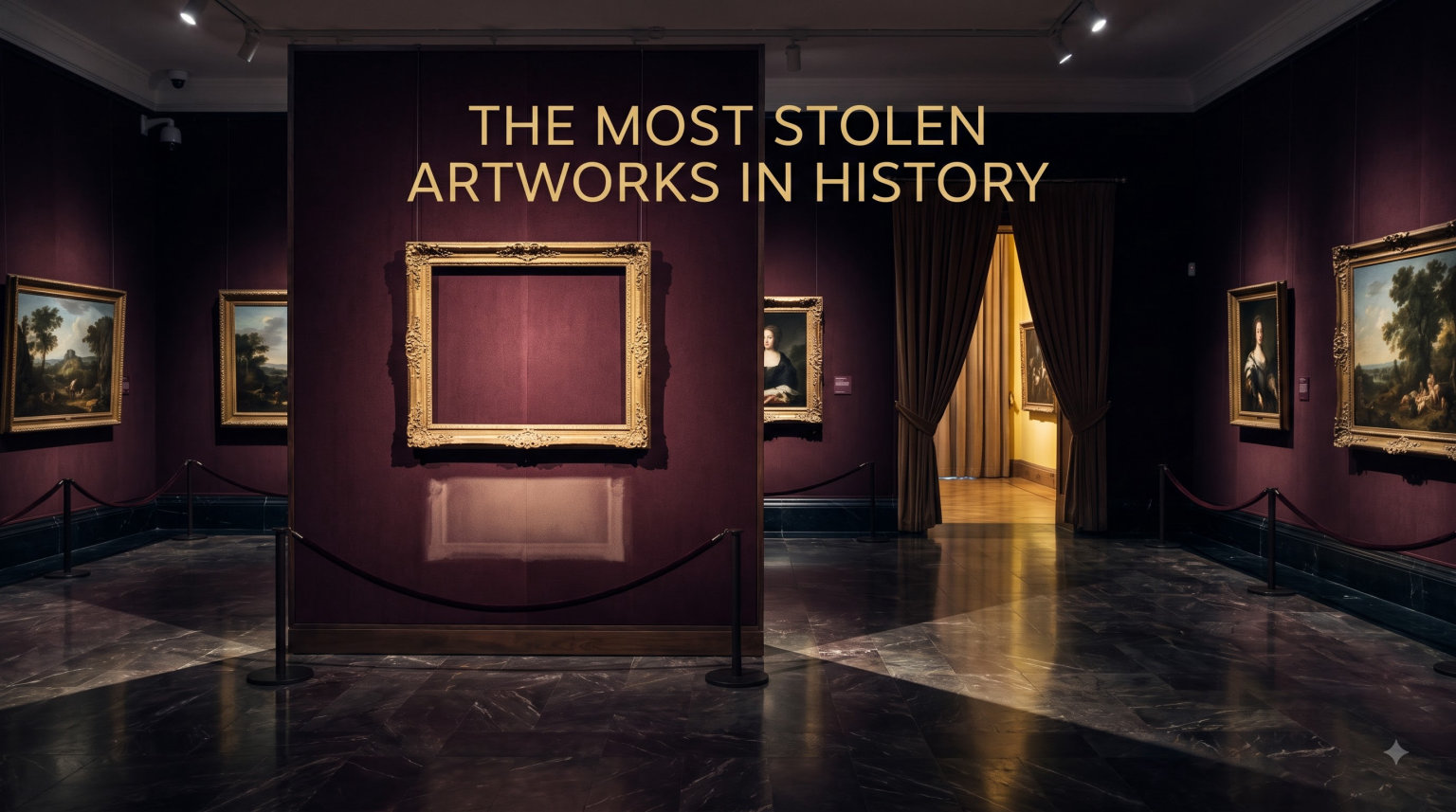
Art theft is one of the oldest crimes in the cultural world, and the most stolen artworks in history have stories that read like thriller novels. From Napoleon looting masterpieces across Europe to masked gunmen walking out of museums with priceless paintings, the history of stolen art spans centuries and continents. Some works have been taken multiple times, recovered against all odds, or vanished without a trace. Others remain missing to this day, haunting the institutions that once proudly displayed them.
The Ghent Altarpiece, painted by Jan and Hubert van Eyck in the 15th century, holds the record as the single most stolen artwork in history. It has been targeted seven separate times by everyone from Calvinist iconoclasts to Napoleon Bonaparte and Adolf Hitler. That one altarpiece survived it all and still hangs in St. Bavo’s Cathedral in Ghent, Belgium, is nothing short of remarkable.
In this guide, our team walks through the most stolen artworks in history, covering the famous heists, the daring recoveries, and the cases that still frustrate investigators. We also look at why thieves target specific works, how museums fight back with modern security, and what happens to the art that disappears into the black market. Whether you are an art history enthusiast or simply fascinated by true crime, these stories reveal a side of the art world most people never see. And if you want to explore more about cultural heritage and art history, we have additional resources that connect these themes to the broader world of artistic preservation.
Table of Contents
Why Thieves Steal Art (And Why It Rarely Pays Off)
The first question most people ask is simple: why steal a painting you can never sell? That question gets to the heart of art crime. A stolen masterpiece cannot be auctioned at Sotheby’s or displayed in a legitimate gallery. Its provenance, the documented history of ownership, is instantly tainted the moment it leaves a museum wall. So what drives someone to steal a painting worth millions when converting it to cash is nearly impossible?
The motivations behind art theft are more varied than most people realize. Some thieves act on commission, working with a black market buyer who specifically requests a certain painting. Others use stolen art as collateral in organized crime networks, trading a stolen Picasso for weapons or drugs. There are also cases of political motivation, where art is stolen as an act of nationalism or cultural reclamation. Vincenzo Peruggia, the man who stole the Mona Lisa in 1911, genuinely believed the painting belonged in Italy, not France.
The reality is that very few art thieves make money from their crimes. According to the FBI, only about 5 to 10 percent of stolen artwork is ever recovered, and the thieves who are caught typically face lengthy prison sentences. The black market for stolen art does exist, but it operates nothing like the movies suggest. A stolen Rembrandt cannot simply be sold to a wealthy collector in a shadowy backroom deal. Most buyers want legal ownership, and any reputable dealer will run provenance checks before touching a high-value work.
What makes a painting attractive to thieves comes down to a few factors. Fame is the biggest one. A universally recognized painting like The Scream by Edvard Munch is impossible to sell, but its notoriety makes it a powerful bargaining chip. Value matters too, though not in the way you might expect. Thieves often do not know the exact appraised value of what they are stealing. They know it is important because it hangs in a major museum behind glass. Finally, accessibility plays a role. Paintings displayed in smaller galleries with limited security are far more vulnerable than those in the Louvre or the Met.
The Most Stolen Artworks in History
Below, we cover the artworks that have been targeted most frequently and the stories behind each theft. These are not just crimes against property. They are crimes against cultural heritage that robbed communities, nations, and the world of irreplaceable works of creative genius. Here are the most stolen artworks in history, ranked by frequency, notoriety, and cultural impact.
1. The Ghent Altarpiece (Adoration of the Mystic Lamb) – Stolen Seven Times
No single artwork in human history has been stolen as many times as the Ghent Altarpiece, also known as the Adoration of the Mystic Lamb. Completed in 1432 by brothers Hubert and Jan van Eyck, this massive polyptych panel painting sits in St. Bavo’s Cathedral in Ghent, Belgium. It is widely considered one of the most important paintings in European art history and one of the first great oil paintings of the Northern Renaissance. Over the course of six centuries, it has been taken, dismantled, smuggled, and recovered seven separate times.
The first theft came in 1566 during the Protestant Reformation, when Calvinist iconoclasts stormed Catholic churches and destroyed religious art. The altarpiece was dismantled and hidden to protect it. Napoleon Bonaparte took several panels in 1794 during his military campaigns across the Low Countries, shipping them to the Louvre in Paris. They were returned after Napoleon’s defeat. In 1816, a local vicar secretly sold two side panels to an art dealer, and they eventually ended up in a Berlin museum.
The most dramatic theft occurred during World War II. Hitler ordered the altarpiece seized as part of the Nazi campaign to loot European art treasures. The panels were hidden in the Altaussee salt mine in Austria alongside thousands of other stolen masterpieces. The Monuments Men, a special Allied unit tasked with recovering looted art, found the altarpiece in 1945 and returned it to Belgium. Before that, in 1934, thieves stole two panels depicting the Just Judges and St. John the Baptist. The St. John panel was returned, but the Just Judges panel has never been found. It remains one of art history’s greatest unsolved mysteries. A replacement copy now fills its place in the altarpiece.
2. Mona Lisa – The 1911 Theft That Made It Famous
The Mona Lisa by Leonardo da Vinci is arguably the most recognized painting on Earth, and its fame is partly the result of one of the most audacious art thefts in history. On August 21, 1911, a handyman named Vincenzo Peruggia walked into the Louvre in Paris, removed the painting from the wall, and walked out with it hidden under his coat. He had worked at the museum and knew the building’s layout and security routines intimately.
Peruggia kept the painting in a trunk in his Paris apartment for over two years. He believed the Mona Lisa rightfully belonged in Italy, since Leonardo had painted it there before the French king Francis I acquired it. His plan was to return it to an Italian museum as a patriotic gesture. In December 1913, Peruggia finally contacted an art dealer in Florence named Alfredo Geri, offering to sell the painting. Geri contacted the police, and Peruggia was arrested when he showed up for the handoff at the Uffizi Gallery.
The theft transformed the Mona Lisa from a well-regarded Renaissance portrait into a global icon. Before 1911, the painting was known mainly to art historians and visitors of the Louvre. During the two years it was missing, newspapers around the world ran front-page stories about the stolen masterpiece. Crowds lined up to see it when it was returned to the Louvre in January 1914. That media frenzy is one reason the Mona Lisa draws roughly 10 million visitors per year today, making it the most visited artwork on the planet.
3. The Isabella Stewart Gardner Museum Heist – 13 Works Worth $500 Million (1990)
The largest property theft in history took place in the early hours of March 18, 1990, at the Isabella Stewart Gardner Museum in Boston. Two men dressed as police officers talked their way past security guards, handcuffed the guards in the basement, and spent 81 minutes removing 13 works of art from the museum’s walls and frames. The stolen pieces included works by Rembrandt, Vermeer, Degas, Manet, and Govert Flinck.
Among the stolen works, the most devastating loss was Vermeer’s The Concert, one of only 34 known Vermeer paintings in existence. Two Rembrandt paintings were taken as well, including his only known seascape, Christ in the Storm on the Sea of Galilee, and A Lady and Gentleman in Black. Rembrandt’s Self-Portrait was also stripped from its frame. The total value of the stolen works has been estimated at over $500 million, making this the single most valuable art theft ever recorded.
More than three decades later, not a single painting has been recovered. The empty frames still hang on the museum walls as a memorial to the missing works and a symbol of the ongoing investigation. The FBI has offered a $10 million reward for information leading to the recovery of the art. Over the years, investigators have explored connections to organized crime figures, including the Boston-based criminal Whitey Bulger, but no definitive link has been established. The Gardner Museum heist remains the most notorious unsolved art crime in the world.
4. The Scream by Edvard Munch – Stolen Twice
Edvard Munch’s The Scream is one of the most iconic images in all of art, and it has been stolen not once, but twice from separate Norwegian museums. There are actually four versions of The Scream, two paintings and two pastels, and two of them have been taken in high-profile thefts.
The first theft occurred on February 12, 1994, during the opening ceremony of the Winter Olympics in Lillehammer, Norway. While the world’s attention was focused on the games, two thieves broke into the National Gallery in Oslo through a window and stole the 1893 painted version. They left a note reading, “Thanks for the poor security.” The painting was recovered three months later in a sting operation involving Norwegian police and the British undercover agent Charles Hill, who posed as a buyer from the Getty Museum.
The second theft happened on August 22, 2004, when armed and masked gunmen stormed the Munch Museum in Oslo in broad daylight. They grabbed the 1910 painted version of The Scream along with Munch’s Madonna and fled in a getaway car. Two people were injured during the robbery. The paintings were recovered in 2006 after Norwegian police arrested several suspects. The Scream had suffered some water damage and minor scratches but was restored and returned to public display. These two thefts made The Scream one of the most stolen paintings of the modern era.
5. Rembrandt’s Jacob de Gheyn III – Stolen Four Times
Rembrandt’s portrait of Jacob de Gheyn III has earned the nickname “the Takeaway Rembrandt” because it has been stolen from the Dulwich Picture Gallery in London no fewer than four times. That makes it the most frequently stolen painting from a single institution in recorded history. The small portrait, measuring just 29 by 24 centimeters, has been taken in 1966, 1973, 1981, and 1983.
Each time, the painting was recovered. The 1981 theft had a particularly interesting ending: the thief left the painting on the back of a bicycle outside a police station. In another instance, a woman found the painting leaning against a wall in a London cemetery. Each theft appears to have been opportunistic rather than carefully planned, which speaks to the painting’s small size and the gallery’s limited security at the time. Today, the Dulwich Picture Gallery has significantly upgraded its security systems, and Jacob de Gheyn III has remained safely on its wall since the last recovery in 1983.
6. Caravaggio’s Nativity with St. Francis and St. Lawrence – Still Missing Since 1969
One of the most devastating losses in art history occurred in October 1969, when Caravaggio’s Nativity with St. Francis and St. Lawrence was cut from its frame in the Oratory of San Lorenzo in Palermo, Sicily. The large canvas, painted around 1609, depicted the birth of Christ with St. Francis and St. Lawrence in adoration. It was one of Caravaggio’s last major works and a masterpiece of Baroque painting.
The theft has been linked to the Sicilian Mafia, and multiple theories exist about the painting’s fate. Some informants have claimed the painting was destroyed, possibly by being rolled up too tightly or fed to pigs. Others believe it is still in the possession of a private collector connected to organized crime. In 2009, a former Mafia member turned informant stated that the painting had been kept in good condition but changed hands among crime families for decades. The FBI has listed the painting on its top stolen art list, and the Italian government has offered rewards for its recovery. The estimated value exceeds $20 million, though its cultural significance is impossible to quantify.
7. World War II Nazi Art Looting – The Largest Systematic Theft in History
No discussion of the most stolen artworks in history is complete without addressing the Nazi looting campaign during World War II. The scale of art theft under the Third Reich was unprecedented. Adolf Hitler, a failed art student himself, ordered the systematic seizure of artworks across occupied Europe. A special unit known as the Einsatzstab Reichsleiter Rosenberg, or ERR, was tasked with confiscating art from museums, private collections, churches, and synagogues.
Conservative estimates suggest the Nazis stole over 600,000 works of art during the war. The targets ranged from Renaissance masterpieces in Italian museums to Impressionist paintings in French private collections. Jewish families were especially targeted, and many lost entire collections built over generations. The paintings were intended for a massive museum Hitler planned to build in his hometown of Linz, Austria. Other works were sold to fund the Nazi war machine, and many were stored in salt mines, castles, and underground bunkers for safekeeping.
The recovery effort, led in part by the Monuments, Fine Arts, and Archives program (the real-life Monuments Men), returned thousands of works after the war. But hundreds of thousands of pieces were never found. In recent decades, ongoing provenance research has led to major discoveries. The 2012 discovery of the Gurlitt Collection in Munich, where over 1,400 works including pieces by Picasso, Matisse, and Chagall were found in a single apartment, demonstrated that Nazi-looted art continues to surface. Restitution claims from descendants of original owners remain active, and the process of returning stolen art from this era is far from complete.
8. The Concert by Johannes Vermeer – The Most Valuable Unrecovered Painting
Johannes Vermeer’s The Concert, painted around 1664, is widely considered the single most valuable missing painting in the world. It was stolen during the Isabella Stewart Gardner Museum heist in 1990 and has not been seen since. Vermeer’s output was extremely limited, with only about 34 paintings attributed to him, making each one extraordinarily rare and valuable. When a Vermeer does appear at auction, it commands tens of millions of dollars.
The Concert depicts two women and a man making music together in a parlor, a common theme in Dutch Golden Age painting. Its composition, use of light, and psychological depth are quintessential Vermeer. The painting was purchased by Isabella Stewart Gardner herself in the late 19th century and had been a centerpiece of her museum’s collection ever since. Because the painting was cut from its frame rather than removed cleanly, experts have expressed concern about its condition after more than 30 years of unknown storage conditions.
The absence of The Concert represents an irreplaceable loss. Art historians have compared it to losing a chapter of a book that can never be rewritten. Every Vermeer that exists is a pillar of our understanding of 17th-century Dutch art. The Concert, with its intimate portrayal of music-making and domestic life, offered insights into Vermeer’s technique and worldview that no other work can replace.
9. Cellini’s Saliera – The $60 Million Salt Cellar Heist (2003)
Benvenuto Cellini’s Saliera is not a painting but a gold and enamel salt cellar created in the 1540s for King Francis I of France. Standing just 26 centimeters tall, it is the only surviving gold work by Cellini and is considered a masterpiece of Mannerist decorative art. The piece depicts the gods of the sea and the earth in an intricate sculptural composition that served as both a functional salt cellar and a display of royal wealth.
On May 11, 2003, a thief named Robert Mang broke into the Kunsthistorisches Museum in Vienna through a window and took the Saliera from its display case. The theft was remarkably simple: Mang exploited a construction scaffolding on the building’s exterior to reach an unalarmed window. The museum had recently upgraded its security system, but the specific window Mang used was not yet connected to the new alarm. The Saliera was valued at approximately $60 million, making it one of the most valuable single-object thefts in European history.
Mang hid the piece under his bed for nearly three years. He turned himself in to police in January 2006 after authorities released surveillance footage and offered a reward. The Saliera was recovered undamaged and returned to the museum later that year, where it is now displayed behind reinforced glass with significantly upgraded security.
10. Van Gogh Paintings – Repeated Targets Across Multiple Museums
Vincent van Gogh’s work has been targeted by thieves more than almost any other artist, with multiple paintings stolen from different museums around the world. In 1991, 20 paintings were stolen from the Van Gogh Museum in Amsterdam in what was then the largest art theft in the Netherlands. The works were recovered a short time later in an abandoned car. In 2002, two paintings, Congregation Leaving the Reformed Church in Nuenen and View of the Sea at Scheveningen, were stolen from the same museum and not recovered until 2016, when Italian authorities found them in a house connected to the Camorra crime syndicate.
In March 2020, Van Gogh’s The Parsonage Garden at Nuenen in Spring 1884 was stolen from the Singer Laren Museum in the Netherlands. The theft occurred during a period when the museum was closed due to the COVID-19 pandemic, making it an opportunistic crime during a time of reduced security. The painting was recovered in 2021 when a detective working undercover arranged to purchase it from a suspect. Also in 2020, a Van Gogh painting titled Spring Garden was stolen from a museum in the Netherlands and later recovered hidden in a bag. The frequency of Van Gogh thefts speaks to both the artist’s universal fame and the enduring appeal of his work on the black market.
How Museums Protect Art From Thieves Today
Museum security has evolved dramatically since the days when the Mona Lisa hung on a wall with nothing more than a glass cover. Modern institutions deploy layers of technology and human oversight that would have been unthinkable a century ago. Motion sensors, infrared cameras, pressure-sensitive display cases, and biometric access controls are now standard in major museums worldwide.
Many high-value paintings are protected by reinforced glass or acrylic barriers that are bulletproof and shatter-resistant. Climate-controlled display cases serve dual purposes, preserving the artwork from environmental damage while also creating a physical barrier against theft. GPS tracking devices are sometimes embedded in frames or attached directly to works, allowing authorities to track a piece if it is removed from the building.
Behind the scenes, most major museums maintain 24-hour security operations centers with live camera feeds monitored around the clock. Security personnel conduct regular patrols, and many institutions have armed guards posted in galleries containing their most valuable works. Cybersecurity has also become a concern, as thieves could theoretically disable alarm systems remotely if they gain access to a museum’s network.
Despite all these advances, no system is foolproof. The Isabella Stewart Gardner Museum heist proved that even a well-staffed institution can be compromised through social engineering. Smaller galleries and regional museums often lack the budgets to implement the same level of security as the Louvre or the Met. Art theft remains a persistent threat, and the ongoing challenge is balancing public access with protection. After all, the purpose of art is to be seen. Locking every painting in a vault defeats that purpose entirely.
Do Stolen Artworks Ever Come Home?
The short answer is yes, but not often enough. The FBI estimates that only 5 to 10 percent of all stolen artwork is ever recovered. That means the vast majority of stolen paintings, sculptures, and artifacts remain missing, potentially destroyed, or hidden in private collections. However, some recovery stories are remarkable enough to give hope.
In 2005, a painting by Goya titled Children with a Cart was stolen from a truck in Pennsylvania while being transported to an exhibition. It was recovered three weeks later when the thieves, unable to sell it, abandoned it in a hotel room. The 2006 recovery of Cellini’s Saliera after three years in a thief’s bedroom showed that even highly publicized works can eventually surface. The 2016 recovery of the two Van Gogh paintings stolen in 2002 demonstrated that perseverance by law enforcement, even across international borders, can pay off.
Interpol maintains a database of stolen works of art that currently lists over 52,000 objects. The FBI’s Art Crime Team, established in 2004, has recovered more than $800 million in stolen art and cultural property. Private investigators and art recovery specialists like the Art Loss Register also play a role, maintaining the world’s largest private database of lost and stolen art. These organizations rely on tips from informants, undercover operations, and increasingly, digital tools like image recognition software to match recovered works with theft reports.
The reality, though, is that many stolen artworks will never be recovered. Time works against investigators. Witnesses die, evidence degrades, and trails go cold. The Gardner Museum paintings have been missing for over 30 years. Caravaggio’s Nativity has been gone for more than 50. Each passing year makes recovery less likely, but not impossible. The field of provenance research is growing, and new technologies are making it harder for stolen art to remain hidden forever.
FAQs
What is the most stolen artwork of all time?
The Ghent Altarpiece, also known as the Adoration of the Mystic Lamb by Jan and Hubert van Eyck, is the most stolen artwork of all time. It has been stolen seven separate times across six centuries, targeted by Calvinist iconoclasts, Napoleon Bonaparte, and the Nazis during World War II. The altarpiece currently resides in St. Bavo’s Cathedral in Ghent, Belgium, though one panel depicting the Just Judges has been missing since 1934.
What is the biggest art theft in history?
The biggest art theft in history by total value is the Isabella Stewart Gardner Museum heist of March 18, 1990, when 13 works of art valued at over $500 million were stolen from the museum in Boston. Two men dressed as police officers gained entry, restrained the guards, and spent 81 minutes removing works by Rembrandt, Vermeer, Degas, and Manet. None of the 13 stolen works have been recovered, and the FBI continues to offer a $10 million reward for information.
What famous artworks have been stolen?
Many famous artworks have been stolen throughout history. Some of the most notable include the Mona Lisa by Leonardo da Vinci (stolen in 1911 and recovered in 1913), The Scream by Edvard Munch (stolen twice, recovered both times), the Ghent Altarpiece by the van Eyck brothers (stolen seven times), The Concert by Johannes Vermeer (stolen in 1990, still missing), and Rembrandt’s Jacob de Gheyn III (stolen four times, recovered each time).
What are the 13 stolen paintings from the Gardner Museum?
The 13 works stolen from the Isabella Stewart Gardner Museum include: Vermeer’s The Concert, Rembrandt’s Christ in the Storm on the Sea of Galilee, Rembrandt’s A Lady and Gentleman in Black, Rembrandt’s Self-Portrait, Rembrandt’s Landscape with an Obelisk (attributed), Govert Flinck’s Landscape with an Obelisk, five works on paper by Edgar Degas, Edouard Manet’s Chez Tortoni, an ancient Chinese bronze beaker, and a bronze eagle finial from a Napoleonic flag. None have been recovered.
Are stolen paintings ever recovered?
Yes, stolen paintings are sometimes recovered, but the rate is low. The FBI estimates that only 5 to 10 percent of stolen artwork is ever found. Some notable recoveries include the Mona Lisa (recovered after 2 years in 1913), The Scream (recovered twice, in 1994 and 2006), and two Van Gogh paintings from the Amsterdam museum theft (recovered in 2016 after 14 years). However, many works, like Vermeer’s The Concert and Caravaggio’s Nativity, remain missing decades after being stolen.
Why do thieves steal paintings they cannot sell?
Thieves steal paintings for several reasons despite being unable to sell them through legitimate channels. Some are commissioned by black market buyers. Others use stolen art as collateral in organized crime deals. Some thieves act out of nationalist or political motivations, believing a painting belongs in their home country. In many cases, thieves underestimate how difficult it is to sell a recognizable stolen masterpiece and end up abandoning or destroying the work when they realize there is no market for it.
The Ongoing Fight to Protect Our Cultural Heritage
The most stolen artworks in history share a common thread: each theft represents a moment when society failed to protect something irreplaceable. Whether taken by a lone handyman with a coat, an organized crime ring, or an authoritarian regime waging war, these losses remind us that art is vulnerable in ways that go beyond physical security. Paintings carry stories, cultural identity, and the creative vision of individuals who shaped how we see the world.
Some of the works covered in this article, like the Ghent Altarpiece and the Mona Lisa, survived their ordeals and emerged even more famous. Others, like Vermeer’s The Concert and Caravaggio’s Nativity, remain missing, their absence a quiet void in the museums and churches that once held them. The Gardner Museum heist alone accounts for $500 million in unrecovered art, and the FBI investigation remains open.
What gives hope is the growing field of art crime investigation and provenance research. Organizations like the FBI Art Crime Team, Interpol’s Works of Art unit, and the Art Loss Register continue to track and recover stolen pieces every year. New technologies, from digital provenance databases to AI-powered image recognition, are making it harder for stolen art to disappear permanently. The fight to protect our cultural heritage is far from over, and every recovered painting is proof that persistence can still win. If you want to explore more about how art and cultural heritage intersect on the global stage, our guide to the Venice Biennale and cultural preservation offers a deeper look at how the art world is working to safeguard its treasures for future generations.