
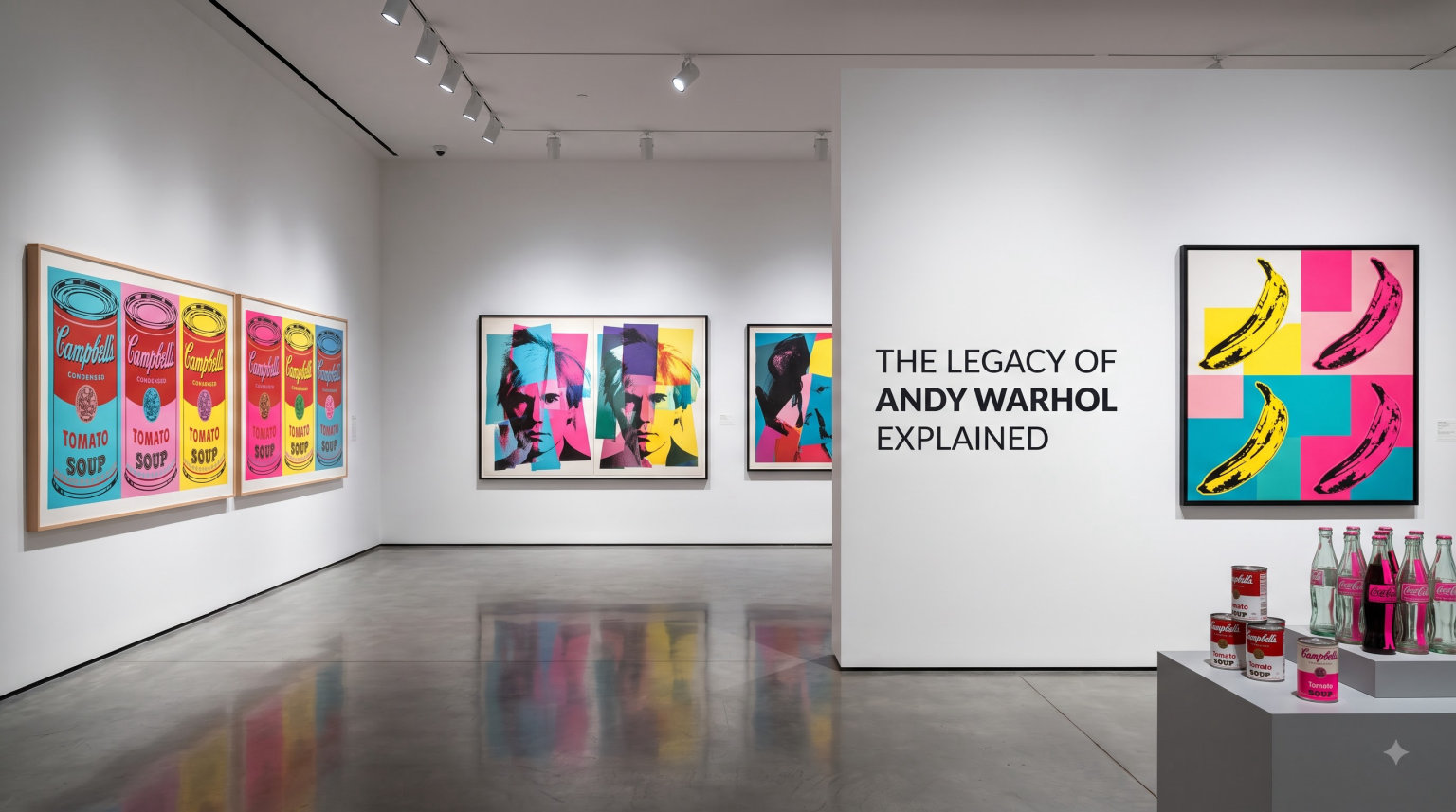
Andy Warhol’s legacy is the radical idea that art could be mass-produced, celebrity-driven, and indistinguishable from commerce — and that this very blur was the point. Born Andrew Warhola Jr. in 1928, the Pittsburgh-raised artist took soup cans, Marilyn Monroe’s face, and Brillo boxes and turned them into some of the most recognizable images in art history. He did not just make art about popular culture. He made popular culture into art.
Warhol died in 1987, but his influence has only grown. Every time someone chases viral fame on TikTok, every time a brand collaborates with a contemporary artist, every time a digital creator mass-produces images for an online audience, they are walking through a door that Warhol kicked open. His approach to appropriation — borrowing images from advertising, news, and celebrity culture — set the template for how artists engage with media today.
In this guide, I will walk through the legacy of Andy Warhol explained from every angle that matters: his early life, his breakthrough with Pop Art, the cultural laboratory he called The Factory, his most iconic works, and the reasons his ideas still shape how we think about fame, art, and consumer culture in 2026. Whether you are an art student trying to understand Warhol for the first time or someone curious about why a guy who painted soup cans matters so much, this article has you covered.
Table of Contents
Who Was Andy Warhol?
Andy Warhol was born Andrew Warhola Jr. on August 6, 1928, in Pittsburgh, Pennsylvania. His parents, Andrej and Julia Warhola, were Slovakian immigrants who settled in a working-class neighborhood called Oakland. His father worked in a coal mine. His mother, an embroiderer and occasional artist, encouraged Andy’s creative interests from an early age. The family spoke Slovak at home and attended St. John Chrysostom Byzantine Catholic Church, grounding Warhol in an Eastern European immigrant experience that would quietly shape his lifelong sense of being an outsider looking in.
As a child, Warhol developed Sydenham’s chorea, a nervous system disorder sometimes called St. Vitus’ dance. The illness kept him bedridden for months. During that time, his mother gave him his first camera and taught him to draw. She also placed chocolate bars on his pillow — a small detail that feels almost too perfect when you consider the artist who would later turn consumer products into museum pieces. Those bedridden months were formative: Warhol learned to observe, to look at the world from a distance, and to fill empty hours with imagery.
Warhol studied pictorial design at the Carnegie Institute of Technology (now Carnegie Mellon University), graduating in 1949. His senior thesis focused on the relationship between art and commercial advertising — a subject that would become his life’s work. That same year, he moved to New York City with barely any money and a portfolio full of drawings, determined to make it as a commercial illustrator.
The move to Manhattan was not glamorous. Warhol lived in cramped apartments, knocked on magazine doors, and took whatever illustration work he could find. But his timing was remarkable. Postwar America was exploding with consumer goods, advertising, and a new visual language of brands and logos. Warhol did not just observe this language. He absorbed it completely.
How Andy Warhol Changed the Art World: The Rise of Pop Art
Warhol’s journey from commercial illustrator to one of the most important artists of the 20th century was neither accidental nor instant. He spent the 1950s building a successful career in advertising illustration, winning awards for his distinctive blotted-line technique — a method that involved drawing an image, pressing wet ink onto absorbent paper, and creating a slightly irregular, hand-printed look. Major magazines like Glamour and Vogue hired him. He drew shoes for I. Miller advertisements. He was, by all conventional measures, thriving in the commercial art world.
But Warhol wanted more. He wanted to be taken seriously as a fine artist. The problem was that the fine art establishment in late-1950s New York was dominated by Abstract Expressionism — think Jackson Pollock dripping paint on massive canvases, Mark Rothko floating color fields, Willem de Kooning slashing at figures. These artists championed emotional intensity, individual expression, and the heroic gesture of the artist’s hand. Warhol’s sensibility was the exact opposite.
He was drawn to mechanical reproduction, to flat surfaces, to images that looked like they came off a printing press rather than from an anguished soul. When he saw Jasper Johns’ flag paintings and Robert Rauschenberg’s combine works in the late 1950s, Warhol sensed a shift. The art world was beginning to accept imagery from everyday life.
In 1961, Warhol started painting commercial products — Coca-Cola bottles, telephones, dollar bills. Then in July 1962, Los Angeles gallery owner Irving Blum gave Warhol his first solo exhibition at the Ferus Gallery. The show consisted of 32 canvases, each depicting a different variety of Campbell’s Soup. Priced at $100 each, the canvases sat largely unsold. A nearby gallery owner even placed actual soup cans in his window as a mocking display.
The art world did not know what to make of it. Was it a joke? Was it a critique? Was it celebration? Warhol never fully answered those questions, and that ambiguity was the point. By presenting identical soup cans as art objects, he collapsed the distance between the grocery store aisle and the gallery wall. He forced viewers to confront why they valued one painted image over another. The Campbell’s Soup Cans exhibition launched Pop Art into the mainstream conversation and made Warhol its most visible figure.
Did Warhol invent Pop Art? No. Artists like Richard Hamilton in Britain and Roy Lichtenstein in America were exploring similar territory. But Warhol became the movement’s defining voice because he went further than anyone else in erasing the boundary between commercial imagery and fine art. He did not just reference consumer culture. He treated consumer culture as his raw material, his subject, and his philosophy all at once.
His approach was a direct challenge to the art world’s assumptions about originality, authorship, and value. When Abstract Expressionists insisted that art came from deep personal emotion, Warhol responded with flat, mechanically reproduced images. When critics demanded meaning, Warhol offered blank stares and cryptic one-liners. “If you want to know all about Andy Warhol,” he once said, “just look at the surface of my paintings and films and me, and there I am. There’s nothing behind it.”
The Iconic Works That Defined Andy Warhol’s Legacy
Warhol produced thousands of works across painting, printmaking, sculpture, film, and photography. But a handful of pieces define his artistic legacy and reveal the core ideas behind his practice. Here are the works that matter most and what they mean.
Campbell’s Soup Cans (1962)
The 32-canvas series that started it all. Each canvas depicts a single flavor of Campbell’s Condensed Soup, hand-painted but designed to look mechanically produced. The work operates on multiple levels: as a portrait of everyday American life (Warhol claimed he ate Campbell’s soup for lunch every day for 20 years), as a challenge to art’s fetish for originality, and as a deadpan statement that anything — even a soup can — can be art if the artist says so.
Marilyn Diptych (1962)
Created shortly after Marilyn Monroe’s death in August 1962, this silkscreen painting reproduces the actress’s face 50 times across two panels. One panel bursts with color; the other fades into black and white, with some faces smudged and nearly invisible. It is Warhol at his most emotionally complex — a meditation on celebrity, mortality, and the way mass media turns real people into endlessly reproducible images. The Marilyn series also marked Warhol’s first major use of the photo-silkscreen technique, which would become his signature method.
Brillo Boxes (1964)
Warhol’s Brillo Boxes were wooden replicas of supermarket shipping cartons, screen-printed with the Brillo brand logo. Visually, they were nearly indistinguishable from the actual boxes you would find in a grocery warehouse. Philosopher Arthur Danto later cited the Brillo Boxes as the moment that ended the history of art — meaning that after Warhol, there were no longer any visual criteria that could separate an artwork from an everyday object. Whether Danto was right or not, the piece crystallized Warhol’s central question: What makes something art?
Death and Disaster Series (1962-1964)
Less famous than his celebrity portraits but arguably more powerful, Warhol’s Death and Disaster series used newspaper photographs of car crashes, electric chairs, race riots, and suicides, silkscreened repeatedly onto canvas. The repetition desensitized the viewer, mimicking the way mass media numbs us to violence. These works revealed that Warhol was not just a playful commentator on soup cans and celebrities. He was processing the dark undercurrent of American media culture — the way tragedy becomes entertainment when reproduced on newsprint.
Eight Elvises (1964)
This silkscreen painting repeats an image of Elvis Presley in cowboy attire eight times across a long horizontal canvas. The figure is both a celebrity idol and a ghostly, fading image. It captures Warhol’s obsession with fame’s transience — the idea that even the biggest stars become commodities, reproduced and consumed until they blur into abstraction. In 2008, Eight Elvises sold for $100 million in a private sale, making it one of the most expensive paintings ever sold at the time.
Warhol developed the photo-silkscreen technique in 1962, and it became the backbone of his artistic practice. The process involved transferring a photographic image onto a mesh screen, then pushing ink through the screen onto canvas or paper. It allowed Warhol to reproduce the same image dozens of times with slight variations — more ink here, less pressure there, a misaligned screen creating unexpected distortion. The technique embodied his philosophy: art did not need to be unique, hand-crafted, or emotionally expressive. It could be mechanical, repeatable, and still carry enormous cultural weight.
Inside The Factory: Warhol’s Creative Universe
In 1963, Warhol established The Factory at 231 East 47th Street in Midtown Manhattan. The name was not ironic. It was a literal description. The space was covered in silver paint, aluminum foil, and mirrors — a gleaming, disorienting environment that looked like the inside of a television set. Warhol hired assistants to help him produce silkscreen prints, and he filled the space with an ever-shifting cast of collaborators, hangers-on, musicians, writers, filmmakers, drag queens, socialites, and drifters.
The Factory was part art studio, part party venue, part social experiment. Warhol called his regular collaborators “Superstars” — a term that captured his belief that anyone could be famous if they were interesting enough on camera. He gave roles in his films to people who had never acted before. He recorded conversations, photographed visitors with his Polaroid camera, and collected the detritus of daily life in cardboard boxes he called Time Capsules. These boxes — eventually numbering over 600 — contained everything from fan mail and restaurant receipts to art supplies and wigs. They form one of the most detailed archives of daily life in 1960s and 1970s New York.
The Factory also incubated one of the most influential bands in rock history. Warhol met the Velvet Underground in 1965 and became their manager and creative director. He designed the iconic banana cover for their debut album, The Velvet Underground and Nico (1967), and pushed them toward a darker, more experimental sound. The band’s influence on punk, alternative, and indie rock is incalculable. Brian Eno once said that while the Velvet Underground’s first album only sold 30,000 copies, “everyone who bought one of those 30,000 copies started a band.”
Warhol’s filmmaking at The Factory deserves more attention than it typically receives. Between 1963 and 1968, he made over 60 films, including Empire (1964) — an eight-hour stationary shot of the Empire State Building — and Chelsea Girls (1966), a split-screen documentary of life among his Superstars. These films were shown in art galleries and avant-garde cinemas, not multiplexes, and they expanded Warhol’s obsession with duration, boredom, and the boundary between entertainment and tedium. His 1964 film Sleep showed poet John Giorno sleeping for over five hours. It was cinema stripped to its most basic function: watching.
On June 3, 1968, radical feminist writer Valerie Solanas walked into The Factory and shot Warhol in the chest. He was clinically dead before emergency surgery saved his life. The shooting fundamentally changed Warhol. He became more guarded, more business-focused, and more isolated. The original silver Factory closed, and Warhol relocated to a more conventional office space on Union Square. The era of open-door creative chaos was over.
The Business of Art: Warhol as Entrepreneur
Andy Warhol was one of the first fine artists to treat his career as a business operation, and he did so without apology. “Being good in business is the most fascinating kind of art,” he wrote in The Philosophy of Andy Warhol (1975). “Making money is art and working is art and good business is the best art.” This was not a joke. Warhol genuinely believed that commercial success and artistic credibility were not opposites — they were the same thing.
His portrait business exemplified this philosophy. Starting in the 1970s, Warhol accepted commissions to paint portraits of wealthy clients, celebrities, and socialites. He charged roughly $25,000 per portrait, used Polaroid photographs as source material, and silkscreened the results onto canvas with his signature flat, colorful style. Critics dismissed these commissions as commercial sellouts. Warhol did not care. He was producing art that people paid money for, and he saw no contradiction between artistic value and financial value.
Warhol also co-founded Interview Magazine in 1969, turning his obsession with celebrity into a publishing venture. The magazine featured unedited, rambling conversations between famous people — a format that felt radically casual at the time but now looks like a precursor to podcast culture. Interview gave Warhol a platform to document the social world he moved through, and it became a profitable business in its own right.
His Time Capsules project, begun in 1974, was perhaps his most ambitious entrepreneurial gesture. Every day, Warhol placed objects from his desk and studio into a cardboard box. When a box filled up, he sealed it, dated it, and started a new one. Over 600 boxes accumulated before his death, creating an archive of consumer culture, personal correspondence, and the sheer volume of material that passed through a busy artist’s life. The Time Capsules were not organized, curated, or annotated. They were raw accumulation — a mirror of the information overload that would define the internet age.
Warhol’s business instincts anticipated the way art functions today. The contemporary art market thrives on brand-name artists, limited editions, high-profile collaborations, and social media presence. Warhol was doing all of this decades before Instagram existed. He understood that an artist’s persona could be as valuable as the art itself, and he built his brand with the precision of a Madison Avenue advertising campaign.
15 Minutes of Fame: The Prediction That Came True
“In the future, everyone will be world-famous for 15 minutes.” This is perhaps Andy Warhol’s most famous quote, and it has proven to be one of the most accurate cultural predictions of the 20th century. The line appeared in a 1968 exhibition catalog for a show at the Moderna Museet in Stockholm, though Warhol reportedly first said it in conversation with photographer Nat Finkelstein. Like many Warhol statements, its precise origin is murky — and that ambiguity is entirely fitting.
The concept was simple and devastating: in a media-saturated world, fame would become democratized, fleeting, and available to anyone who could capture the public’s attention for even a brief moment. Warhol was describing a future where the barriers to fame would collapse, where ordinary people could become celebrities overnight, and where the distinction between famous and obscure would dissolve into a blur of media coverage.
He was describing the internet. He was describing reality television. He was describing TikTok, YouTube, and every platform that lets anyone broadcast themselves to millions of viewers with nothing more than a phone camera. The fact that Warhol articulated this idea in 1968 — decades before the World Wide Web existed — is staggering.
Think about how fame works in 2026. A teenager posts a video and gets 10 million views overnight. A random person at a sporting event becomes a meme. An unknown musician blows up on Spotify. A podcaster with a laptop builds an audience larger than most television networks. This is not a distortion of Warhol’s prediction. This is his prediction, playing out in real time, at a scale he could not have imagined.
Warhol himself practiced what he preached. He filmed everyone who visited The Factory, photographed every face he found interesting, and turned his own persona into a constantly performed artwork. He understood that fame was not a quality inherent in a person — it was a product of being seen, documented, and reproduced. He lived in the world he predicted, and he built the tools to participate in it: the camera, the screen, the repeated image.
Warhol later updated his prediction in the 1970s, reportedly saying, “I’m bored with that line. In the future, everyone will be famous for 15 minutes, and then everyone will be famous for being famous.” If the original quote described YouTube, the update described the Kardashians. Warhol saw the entire arc of celebrity culture before it unfolded.
Warhol’s Queer Identity and Its Influence on His Art
Andy Warhol was a gay man living and working in mid-century America, a time when homosexuality was classified as a mental disorder, was illegal in every state, and could destroy a public career. Warhol never hid his sexuality, but he rarely discussed it directly either. Instead, he encoded his perspective into his art, his choice of subjects, and the community he built around him.
His outsider position as a queer man in a straight-dominated art world gave him a particular vantage point. He understood what it meant to observe culture from the margins, to see the performance of identity up close, and to recognize that the images society presents as natural are often carefully constructed. This awareness permeates his work. When Warhol painted Marilyn Monroe’s face 50 times, he was not just commenting on celebrity. He was commenting on the way identity itself can be constructed, repeated, and worn like a mask.
In 1964, Warhol was commissioned to create a mural for the New York State Pavilion at the World’s Fair. He produced a series called 13 Most Wanted Men, featuring silkscreened mug shots of wanted criminals drawn from an NYPD flyer. The pieces were large, direct, and clearly homoerotic — handsome men staring out from the wall with confrontational gazes. Officials painted over the mural before the fair opened. Warhol offered to replace it with a giant portrait of Robert Moses, the fair’s organizer, but the offer was declined. The incident remains a powerful example of how Warhol’s queer perspective clashed with mainstream institutions, and how he weaponized that tension.
The Factory itself functioned as a queer space in an era when such spaces were rare and risky. Drag queens, transgender performers, and openly gay men were central to Warhol’s circle. His films featured performers like Holly Woodlawn, Candy Darling, and Jackie Curtis — transgender women who were given screen time and visibility that mainstream culture denied them. Warhol’s Superstars were not just artistic collaborators. They were a community of people who existed outside conventional norms, and Warhol used his platform to amplify their presence.
Art historians and critics have increasingly recognized that Warhol’s queer identity is not a biographical footnote — it is essential to understanding his entire artistic project. His fascination with surface, performance, masks, and constructed identity all connect to the experience of navigating the world as a gay man who had to manage how he was perceived at every moment.
Warhol’s Death and the Foundation That Carries His Legacy
Andy Warhol died on February 22, 1987, at New York Hospital. He was 58 years old. The official cause was cardiac arrhythmia following gallbladder surgery, though the circumstances drew scrutiny and speculation. Warhol had delayed the surgery out of fear of hospitals, a phobia that dated back to his childhood illness. By the time he went in, his condition had deteriorated significantly.
His death sent shockwaves through the art world, but in characteristic Warhol fashion, he had already planned for his legacy. In 1987, his will established The Andy Warhol Foundation for the Visual Arts, which received the bulk of his estate. The Foundation’s mission was to advance the visual arts, particularly work that was experimental, under-recognized, or challenging — the kind of art Warhol himself had championed throughout his career.
The Foundation has become one of the most significant grant-making organizations in the art world. It has distributed hundreds of millions of dollars to artists, arts organizations, and scholarly programs. It also manages Warhol’s extensive archive, including the Time Capsules, photographs, films, and artworks that continue to generate exhibitions and scholarship worldwide. In a very real sense, Warhol’s most enduring artwork may be the Foundation itself — an institution that embodies his belief in supporting creative risk-taking.
The Andy Warhol Museum opened in Pittsburgh in 1994, housing the largest collection of Warhol’s work in the world. Located just a few miles from where he grew up, the museum spans seven floors and includes paintings, drawings, prints, photographs, sculptures, films, and archival materials. It is the largest museum in North America dedicated to a single artist, a fact that would have amused Warhol — who once said, “I always thought I’d like my own tombstone to be blank. No epitaph and no name.”
Posthumously, Warhol’s market value has exploded. His works have sold for hundreds of millions of dollars at auction. Silver Car Crash (Double Disaster) (1963) fetched $105.4 million at Sotheby’s in 2013. Eight Elvises reportedly sold for $100 million in a private sale in 2008. Shot Sage Blue Marilyn (1964) sold for $195 million at Christie’s in 2022, making it the most expensive 20th-century artwork ever sold at auction. These prices reflect not just the art market’s appetite for brand-name artists, but the enduring cultural resonance of Warhol’s ideas.
Why Andy Warhol Still Matters: His Influence on Contemporary Art
Andy Warhol’s shadow stretches across nearly every corner of contemporary art and culture. Jeff Koons’ gleaming balloon animals, Damien Hirst’s spot paintings produced by assistants, Takashi Murakami’s brand collaborations with Louis Vuitton and Supreme, KAWS’ cartoon-character sculptures — all of these artists inherited Warhol’s playbook. They treat art as a brand, embrace mass production, blur the line between high culture and commerce, and understand that an artist’s persona is part of the product.
The connection to digital art and NFT culture is even more direct. When Beeple sold a digital collage for $69 million at Christie’s in 2021, the art world saw a Warholian moment: a mechanically reproducible image treated as a unique art object with enormous financial value. The questions Warhol raised about originality, reproduction, and what makes something art are the exact same questions the NFT market is still wrestling with in 2026. Warhol did not predict blockchain, but he predicted the cultural conditions that made it possible.
Street art and appropriation art also carry Warhol’s DNA. Banksy’s stenciled images, Shepard Fairey’s Obama Hope poster, and Barbara Kruger’s text-overlay works all use the same strategy Warhol pioneered: take an existing image from popular culture, reframe it, and let the context do the work. The entire genre of appropriation art — from Sherrie Levine’s re-photographed Walker Evans prints to Richard Prince’s Instagram screenshots — descends directly from Warhol’s practice.
Warhol’s relevance extends beyond the art world. His insight that images can be mass-produced and consumed like products predicted the economics of social media platforms, where user-generated content generates billions of dollars in advertising revenue. His understanding that fame is a manufactured product predicted the influencer industry. His interest in the intersection of art, commerce, and technology predicted the creative economy that now employs millions of people worldwide.
Artists, designers, musicians, filmmakers, and digital creators continue to cite Warhol as an influence not because they admire his technique (though many do), but because he articulated a set of ideas about culture that have only become more accurate with time. He saw that we were becoming a society defined by images, brands, and attention, and he made art from that insight. The fact that his work feels more relevant in 2026 than it did in 1962 is the strongest possible proof of his legacy.
FAQs
What is the legacy of Andy Warhol’s art?
Andy Warhol’s art legacy rests on three pillars: he erased the boundary between commercial imagery and fine art, he pioneered the use of mass-production techniques (especially silkscreen printing) in a fine art context, and he predicted celebrity-obsessed, image-driven culture decades before social media existed. His works remain among the most valuable and recognizable in art history, and his ideas continue to influence contemporary art, digital culture, and the creative economy.
What is the meaning behind Andy Warhol’s artwork?
Warhol’s artwork explores the relationship between consumer culture, celebrity, and mass media. His Campbell’s Soup Cans elevate everyday products to art objects, questioning what qualifies as art. His Marilyn Monroe portraits examine how mass media turns real people into reproducible images. His Death and Disaster series confronts how repeated exposure to violent imagery numbs viewers. Warhol deliberately kept his meanings ambiguous, insisting that the surface of his work was the whole story.
Who is Andy Warhol and why is he important?
Andy Warhol (1928-1987) was an American artist who became the leading figure of the Pop Art movement. He is important because he fundamentally changed what counted as art by using commercial images, mass-production techniques, and celebrity culture as his primary subjects. His work challenged the art world’s assumptions about originality, authorship, and value, and his ideas about fame and mass media predicted social media culture by decades.
How did Andy Warhol influence Pop Art?
Warhol influenced Pop Art by becoming its most visible and radical practitioner. While other artists like Roy Lichtenstein also explored popular imagery, Warhol went furthest in eliminating hand-crafting from the artistic process. His use of silkscreen printing to mass-produce identical images, his choice of commercial products as subjects, and his willingness to treat art as a business all defined the movement’s core principles. He showed that Pop Art could be both critically respected and commercially successful.
Who said everyone gets 15 minutes of fame?
Andy Warhol said ‘In the future, everyone will be world-famous for 15 minutes.’ The quote appeared in the catalog for a 1968 exhibition at the Moderna Museet in Stockholm, Sweden. Warhol later updated the idea, saying everyone would be famous for being famous u002du002d a prediction that anticipated reality television and influencer culture. The concept has proven remarkably accurate in the age of social media, viral videos, and internet memes.
Did Andy Warhol invent Pop Art?
No, Andy Warhol did not invent Pop Art. The movement emerged independently in Britain and America in the mid-1950s. British artist Richard Hamilton is often credited with coining the term, and American artists like Jasper Johns, Robert Rauschenberg, and Roy Lichtenstein were exploring similar ideas before Warhol. However, Warhol became the movement’s defining figure because his work most completely embodied Pop Art’s core ideas: the use of commercial imagery, mechanical reproduction, and the fusion of art with consumer culture.
What syndrome did Andy Warhol have?
Andy Warhol had Sydenham’s chorea, also known as St. Vitus’ dance, as a child. This nervous system disorder results from untreated streptococcal infection and causes involuntary, rapid, uncoordinated movements. The illness kept Warhol bedridden for several months during his childhood, a period during which his mother gave him his first camera and encouraged him to draw. Many biographers consider this bedridden period formative in developing Warhol’s artistic sensibilities and his habit of observing the world from a distance.
The Lasting Legacy of Andy Warhol Explained
The legacy of Andy Warhol is not a single idea. It is a constellation of insights about art, commerce, celebrity, and the power of images that have only grown more relevant since his death in 1987. He showed that everyday objects could be art, that mechanical reproduction could be beautiful, and that fame itself is a manufactured product. He built a creative community, launched careers, and produced a body of work that continues to break auction records.
Most importantly, Warhol gave us a framework for understanding the world we live in now — a world where images travel faster than ideas, where brands function as identities, and where anyone with a phone camera can reach millions. The legacy of Andy Warhol explained in its simplest terms is this: he saw the future of culture before it arrived, and he made art from what he saw.