
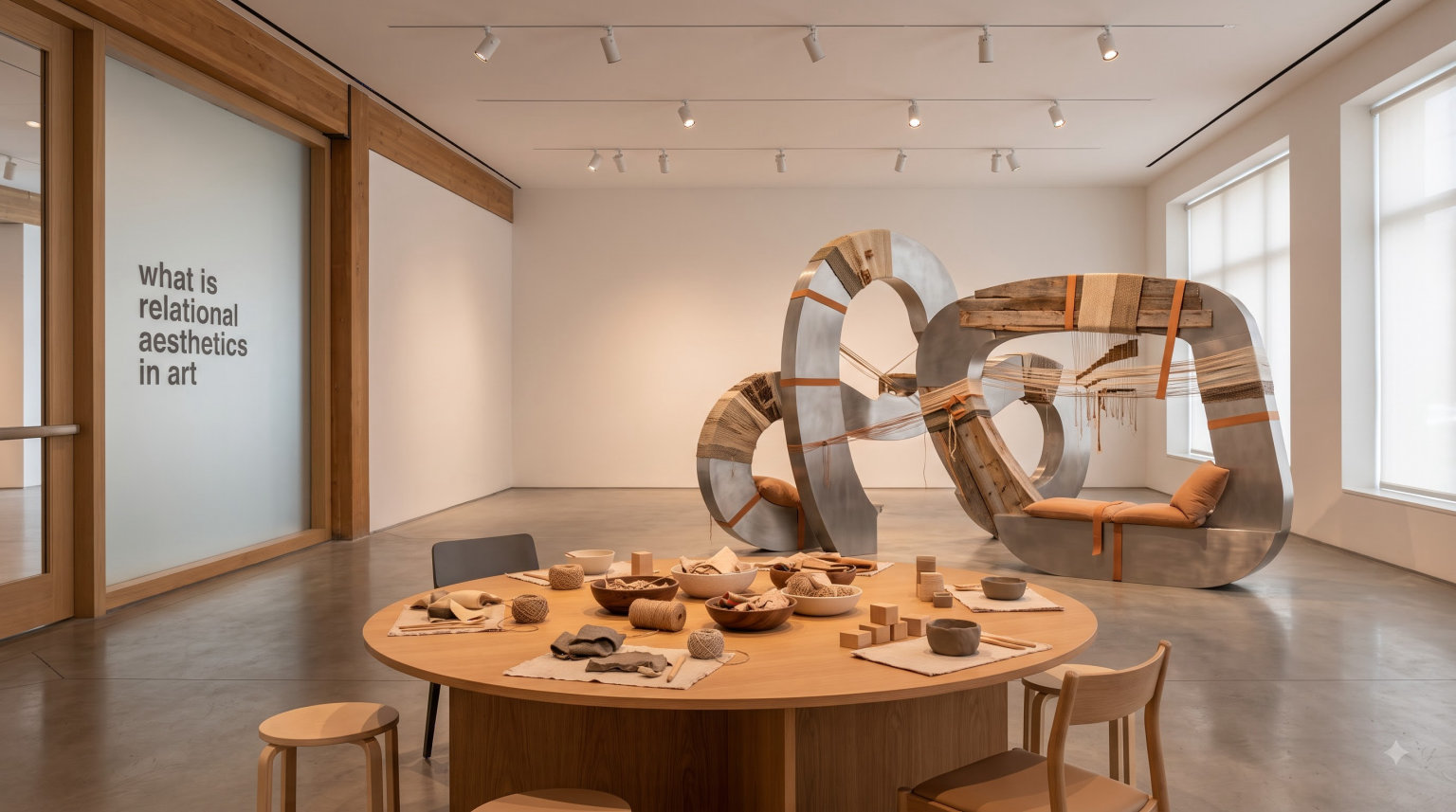
Imagine walking into a gallery and being handed a bowl of homemade soup by the artist. You sit at a table with strangers, eating together, talking. The “artwork” is not the soup or the table but the human connections formed in that moment. This is relational aesthetics in art.
Relational aesthetics represents one of the most significant shifts in contemporary art practice over the past three decades. Rather than creating objects for viewers to passively observe, artists working in this movement create experiences, situations, and environments that require human participation to exist. The movement challenges everything we thought we knew about what art could be and how it functions in society.
In this comprehensive guide, we will explore the origins of relational aesthetics, its key theoretical underpinnings, the artists who pioneered this approach, and why it remains relevant in our increasingly digital world. Whether you are an art student, a curious observer, or someone looking to understand contemporary art movements, this article will give you a solid foundation in relational aesthetics theory and practice.
Table of Contents
What Is Relational Aesthetics?
Relational aesthetics is an art movement coined by French curator Nicolas Bourriaud in the 1990s that describes art practices which take human relations and their social context as their primary subject matter. Rather than creating independent objects for contemplation, relational artists design situations, events, or environments where viewing becomes a shared, participatory experience.
Bourriaud defined the concept in his 1998 book Relational Aesthetics, writing: “Relational aesthetics is an art form that takes as its theoretical horizon the realm of human interactions and their social context, rather than the assertion of an absolute and singular private space.” This definition established the movement’s core principle: art exists not in objects but in the spaces between people.
The movement emerged as a response to the isolation and alienation many people felt in increasingly mediated, digital societies. Where traditional art invited solitary contemplation of a distant masterpiece, relational aesthetics invited collective participation in shared experiences. The artwork could only be completed through the presence and engagement of its audience.
Key characteristics of relational aesthetics include:
-
Participation over observation: Viewers become active participants, not passive spectators
-
Ephemerality: Many works exist only temporarily, leaving no permanent object
-
Social context: Art is created in response to and shaped by its social environment
-
Dialogue and exchange: Communication between participants becomes the medium
-
The artist as facilitator: The role shifts from creator to enabler of experiences
Nicolas Bourriaud and the Birth of the Theory
The 1998 Book
Nicolas Bourriaud, a French curator and critic born in 1965, served as co-director of the Palais de Tokyo in Paris. His book Relational Aesthetics (1998) was groundbreaking not because it invented a new art form, but because it provided theoretical framework for practices that had been emerging throughout the 1990s. Bourriaud identified a tendency among certain artists to prioritize human interaction over the creation of discrete objects.
The book drew on ideas from philosophy, sociology, and art theory to articulate why these practices mattered. Bourriaud was influenced by the writings of philosopher Jacques Ranici?re, whose concept of the “distribution of the sensible” informed Bourriaud’s understanding of how art could create new forms of social engagement. The theoretical foundation gave artists working in participatory modes a shared vocabulary and set of concerns.
Bourriaud later expanded his theoretical work with Postproduction (2002), which addressed how contemporary artists appropriation and transform existing cultural forms, and Altermodern (2009), his proposal for a new aesthetic paradigm responding to globalization. Together, these texts established Bourriaud as one of the most influential art theorists of his generation.
Altermodern and Postproduction
While relational aesthetics focused on human interaction as the artwork’s medium, Bourriaud’s subsequent theoretical work addressed the broader context in which these practices existed. Postproduction examined how artists in the 1990s and 2000s increasingly worked with, rather than against, existing cultural productions. Rather than creating from scratch, they reworked, combined, and transformed materials that already existed.
Altermodern, articulated through a 2009 Tate Triennial exhibition Bourriaud curated, proposed that contemporary art was responding to the conditions of postmodernism by embracing a new aesthetic characterized by travel, translation, and the search for new forms of knowledge production. Relational aesthetics fit within this broader framework as one response to the globalized, mediated condition of modern life.
Key Artists and Their Works
Several artists have become central figures in relational aesthetics, each bringing their own approach to creating art based on human interaction and social context. Understanding their individual practices helps illuminate the breadth and depth of the movement.
Rirkrit Tiravanija
Rirkrit Tiravanija, born in 1961 in Buenos Aires and raised in Thailand, is perhaps the most recognizable figure in relational aesthetics. His work typically involves cooking and serving food to gallery visitors, transforming exhibition spaces into makeshift kitchens and dining areas. His 1992 installation Untitled (Free) at the 4th Berlin Biennial is often cited as a foundational moment: visitors could sit on cushions and eat rice and curry prepared by the artist.
For Tiravanija, the act of cooking and sharing food creates temporary communities where strangers can become acquainted in a relaxed, domestic setting. The artwork is not the food itself but the relationships formed around the table. His practice raises questions about value, exchange, and the commodification of art objects. When you experience one of Tiravanija’s cooking installations, you become part of a living, breathing work that only exists through your participation.
Felix Gonzalez-Torres
Felix Gonzalez-Torres (1957-1996) created works that addressed love, loss, and the AIDS crisis through deceptively simple installations. His “candy pieces” invited visitors to take candy from piles or walls, gradually depleting the work over the exhibition’s duration. These pieces embodied relational aesthetics through their emphasis on shared experience and physical participation.
One of his most famous works, Untitled (Portrait of Ross in LA) (1991), consisted of 175 pounds of candy arranged on the floor, equivalent to the body weight of his partner Ross who died from AIDS-related complications. Visitors were encouraged to take the candy, their bodies literally consuming and dispersing the work. Gonzalez-Torres’s art transformed the viewing public into active participants in an ongoing process of mourning and remembrance.
Gillian Wearing
British artist Gillian Wearing, born in 1963, explores identity, memory, and personal confession through participatory works. Her 1992-93 series Signs of the Times invited members of the public to write their private thoughts on slates, revealing desires, fears, and frustrations that contrasted with public presentation of self. This direct engagement with ordinary people became a hallmark of her practice.
Wearing’s work creates spaces for personal disclosure and exchange, often revealing the gap between how people present themselves publicly and what they truly feel. Her approach demonstrates that relational aesthetics extends beyond creating pleasant shared experiences to confronting difficult truths about human nature and social relations.
Liam Gillick
Liam Gillick, born in 1959, creates installations and environments that examine corporate culture, social organization, and linguistic systems. His works often involve constructed environments with minimal furniture, signage, and color schemes that suggest alternative social possibilities. Gillick’s theoretical engagement with the premises of relational aesthetics distinguishes him from more purely experiential practitioners.
His 1994 work Liminal demonstrates this approach: a sleek, white environment with minimal furniture and directional signage created a space that seemed to promise something just beyond the viewer’s grasp. Gillick’s interest in social modulation rather than pure interaction places him in a more analytical relationship with relational aesthetics’ core concerns.
Olafur Eliasson
Icelandic-Danish artist Olafur Eliasson, born in 1967, creates large-scale installations that immerse viewers in sensory experiences of natural phenomena. His 2003 Tate Modern installation The Weather Project brought an artificial sun and fog to the museum’s Turbine Hall, attracting over two million visitors who lay on the floor gazing upward, sharing the experience with strangers.
While Eliasson’s work does not always fit neatly within relational aesthetics’ framework, his emphasis on shared experience, viewer participation, and the creation of social spaces distinguishes his practice. The Weather Project transformed the museum into a public gathering space where thousands of people experienced wonder together, blurring boundaries between artwork, architecture, and human community.
To explore more artists who shaped contemporary art, see our guide to influential contemporary artists.
Historical Precursors
Relational aesthetics did not emerge from nowhere. Several earlier art movements and practices laid groundwork for the movement’s key concerns with participation, ephemerality, and social engagement.
Dada and Fluxus
The Dada movement of the early 20th century challenged conventional artistic practice through anti-art gestures, random chance operations, and audience participation. Dadaists like Marcel Duchamp questioned what counted as art and who determined its value. Fluxus artists in the 1960s extended these concerns through events, performances, and interactive installations that dissolved boundaries between art and everyday life.
Fluxus artists like George Maciunas and Yoko Ono created works that required viewer participation to be completed. Ono’s 1964 piece Cut Piece invited audience members to cut away portions of her clothing, making each performance unique based on who participated and what they chose to remove. These precedents established the groundwork for relational aesthetics’ emphasis on viewer engagement.
Happenings and Situationists
Allan Kaprow, who coined the term “Happenings” in the late 1950s, created events that blurred distinctions between art and life. Happenings were temporary, site-specific experiences that required participant action to exist. Kaprow was influenced by Jackson Pollock’s action painting but extended it to create situations where everyone present became part of the artwork.
The Situationist International, active from 1957 to 1972, developed concepts like d?riv? (drift) and d?tournement (recontextualization) that examined how people could actively construct their own experiences rather than passively consuming culture. Their emphasis on psychogeography and participatory urban exploration influenced artists interested in creating alternative social situations.
For deeper exploration of performance art’s evolution, see our article on performance art history.
Community Art Movements
Throughout the 1970s and 1980s, various community-based art practices emerged that prioritized collaboration and social engagement over individual artistic expression. Artists like Suzanne Lacy and the Women Artists in Residence collective created works addressing social issues through collective action and public engagement. These movements demonstrated that art could serve social purposes beyond aesthetic contemplation.
Key Concepts: Microtopias and Beyond
Microtopias
Bourriaud introduced the concept of “microtopias” to describe the small-scale utopian spaces that relational artworks create. Rather than proposing grand visions of social transformation, relational artists construct temporary enclaves where alternative forms of human interaction become possible, if only briefly.
A shared meal in a gallery might create a microtopia: a space where hierarchies dissolve, strangers become companions, and the transactional logic of everyday life yields to gift economy and genuine hospitality. These temporary formations do not change the world directly but demonstrate that different ways of relating are possible, planting seeds for broader social imagination.
Participation vs Interaction
A key distinction in relational aesthetics theory separates participation from mere interaction. Interaction implies a responsive relationship between viewer and work: you push a button, something happens. Participation implies something deeper: the viewer becomes a co-producer of the artwork, their presence and choices fundamentally shape what the work becomes.
When you eat Felix Gonzalez-Torres’s candy or sit at Rirkrit Tiravanija’s table, you do not simply interact with an existing object. Your participation creates the work anew each time. This distinction matters because it highlights how relational aesthetics fundamentally challenges traditional conceptions of artistic authorship and viewer relationship.
Ephemerality
Many relational artworks deliberately resist preservation or collection. The ephemeral nature of these works means they exist only in the moment of their happening. This creates challenges for art institutions, collectors, and art historians accustomed to works that can be stored, exhibited, and sold. Some artists embrace documentation through photography or video, but these records are understood as secondary to the actual experience.
This ephemerality can be frustrating for audiences accustomed to taking home artwork souvenirs, but it also creates urgency and presence. Knowing that a work will disappear creates motivation to fully engage with the experience while it lasts.
Relational Aesthetics vs Traditional Art
Understanding relational aesthetics becomes easier when we compare it to traditional art forms and the assumptions that underlie them.
Objects vs Experiences: Traditional art produces objects that can be possessed, displayed, and traded. Relational aesthetics produces experiences that exist only in their happening. A painting can be bought and sold; a shared meal cannot.
Solitary Contemplation vs Collective Participation: Traditional art often invites individual viewers to contemplate works privately, forming personal responses unmediated by others. Relational aesthetics creates collective experiences where viewer responses are shaped by the presence of other participants.
Fixed Meaning vs Emergent Significance: Traditional artworks typically carry meanings that persist across viewings, even if interpretations vary. Relational artworks generate significance differently each time they occur, depending on who participates and what happens.
Artist as Creator vs Artist as Facilitator: Traditional conceptions of artistic genius position the artist as origin of meaning and value. Relational aesthetics often positions the artist as someone who sets up situations for others to create, shifting the locus of creativity from individual genius to collective process.
These differences do not make relational aesthetics “better” than traditional art, but they do highlight how the movement represents a genuine shift in artistic values and practices. Understanding these distinctions helps explain both what relational aesthetics offers and what critiques have been leveled against it.
Criticism and Debates
Relational aesthetics has generated significant critical debate since its emergence. Art critics and scholars have raised important questions about the movement’s theoretical foundations and social implications.
Claire Bishop’s Critique
Art theorist Claire Bishop emerged as one of relational aesthetics’ most prominent critics. Her 2012 book Artificial Hells: Participatory Art and the Politics of Spectatorship challenged what she saw as the movement’s na??ve optimism about human community and social transformation. Bishop argued that many relational artworks merely created pleasant experiences without genuinely disrupting dominant social structures.
Bishop proposed that participatory art should be evaluated based on its “antagonistic” potential: its ability to create genuine conflict or challenge rather than simply facilitating pleasant social interaction. Works that merely encouraged people to share meals or conversation without questioning underlying power relations might be entertaining but failed to fulfill art’s critical potential. Her critique sparked ongoing debates about the political efficacy of relational aesthetics.
Political Dimensions
Questions about the political dimensions of relational aesthetics remain contested. Critics have asked: can art that creates temporary pleasant experiences genuinely contribute to social change? Does the emphasis on shared experience distract from the more urgent work of political organizing and structural transformation?
Some artists working within relational aesthetics have taken these critiques seriously, creating works that engage more directly with political issues. The AIDS activism of ACT UP influenced Felix Gonzalez-Torres’s work, for example, connecting aesthetic practice to urgent political concerns. Other practitioners have been criticized for avoiding difficult political questions in favor of comfortable social pleasantries.
The debate continues to evolve as artists and theorists explore how relational aesthetics might contribute to genuine social transformation rather than merely creating microtopias that exist in isolation from broader political realities.
Contemporary Relevance and Digital Age
Relational aesthetics emerged before social media and smartphones transformed how we communicate and relate to each other. Yet the movement’s concerns seem even more relevant today as digital mediation increasingly shapes human interaction.
Social media platforms create unprecedented opportunities for connection while simultaneously reducing many interactions to superficial metrics of likes and shares. The genuine human encounter that relational aesthetics values becomes increasingly rare and precious in this context. Artists working with relational concerns respond to this condition in various ways.
Some create offline spaces that offer relief from digital saturation: shared meals, in-person conversations, physical co-presence. Others explore how digital tools can facilitate genuinely relational experiences rather than pseudo-connections. The movement’s fundamental insight remains valuable: human beings need real encounters with others to thrive, and art can help create conditions for such encounters.
In an age of increasing isolation, virtual communication, and algorithmic mediation, relational aesthetics offers a counter-proposal: art that brings people together in shared physical and social space, creating microtopias where genuine human connection becomes possible. The movement’s emphasis on participation, ephemerality, and social context provides resources for imagining how art might address contemporary conditions.
Conclusion
Relational aesthetics in art represents a fundamental shift in how we understand artistic practice and its relationship to human community. Rather than producing objects for contemplation, relational artists create situations that require participation to exist. The movement, theorized by Nicolas Bourriaud in the 1990s, draws on earlier art movements including Dada, Fluxus, and Happenings while establishing its own distinctive approach.
Key artists like Rirkrit Tiravanija, Felix Gonzalez-Torres, Gillian Wearing, Liam Gillick, and Olafur Eliasson have demonstrated the breadth of relational aesthetics in practice. From cooking installations to candy piles, from confessional artworks to large-scale immersive environments, these practitioners have explored how art can facilitate genuine human encounter in an increasingly mediated world.
Critics like Claire Bishop have raised important questions about the movement’s political efficacy and potential to merely create pleasant experiences without challenging dominant structures. These debates continue to shape how we understand relational aesthetics’ contributions and limitations.
As digital technology increasingly mediates our relationships, the movement’s emphasis on physical presence and shared experience becomes ever more relevant. Relational aesthetics offers not just an art historical category but a set of practices and values that might help us imagine how to build genuine community in challenging times.
Whether you encounter relational aesthetics in a gallery, a public square, or an unexpected shared moment, the movement invites you to recognize that art can be more than objects: it can be a way of being together.