
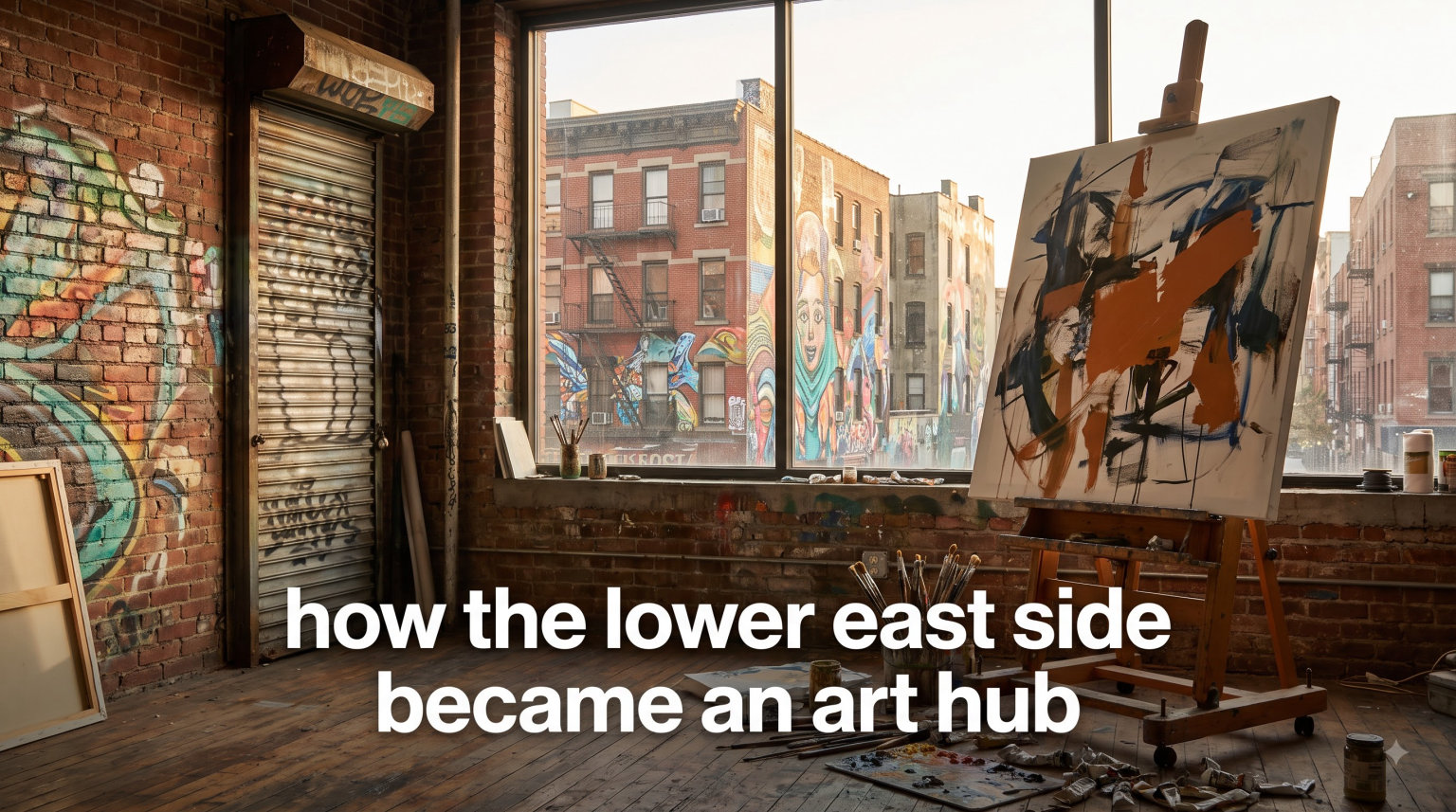
The Lower East Side became an art hub through a combination of affordable rents, rich immigrant heritage, and a counter-culture spirit that welcomed experimental art when no other Manhattan neighborhood would. Artists drawn to the neighborhood found something rare in New York City: space to create without commercial pressure. The transformation spans over a century, from turn-of-the-century tenements to the street art revolution of the 1980s, making the Lower East Side one of the most significant art districts in American cultural history.
In this guide, I will walk you through the key moments, movements, and artists that transformed this compact Manhattan neighborhood into a creative powerhouse. You will learn how immigrant communities, avant-garde poets, punk musicians, and guerrilla artists all contributed to the area’s legendary artistic reputation.
Table of Contents
How Immigrant History Shaped the Lower East Side’s Creative Soul
The story begins in the late 1800s, when waves of Jewish, Italian, and Irish immigrants arrived in the Lower East Side, turning the neighborhood into one of the most densely populated places on Earth. These new arrivals brought with them rich artistic traditions from their home countries, from Yiddish theater to folk music, creating a vibrant cultural incubator in cramped tenement buildings that would later influence generations of artists.
The Henry Street Settlement, founded in 1893, became a cornerstone of community arts education in the neighborhood. This settlement house provided exhibition space, art classes, and performance venues for local residents who might otherwise never have had access to formal artistic training. Our team has seen how similar community-driven arts organizations created pathways for young artists from working-class backgrounds to develop their talents.
It was in these tenement buildings that the Ashcan School emerged in the early 1900s. Artists like Robert Henri and John Sloan began painting the gritty realities of Lower East Side life, rejecting the polished subjects of academic art in favor of street scenes, labor, and immigrant daily existence. This movement established a pattern that would define the neighborhood: art that reflected authentic human experience rather than elite aesthetics.
The connection between immigrant struggle and creative expression was not coincidental. When you live in small apartments, share spaces intensely, and face economic hardship together, you develop a particular sensitivity to human experience. Forum discussions frequently note how this intensity of lived experience translated directly into artistic output, giving Lower East Side art a raw energy that distinguished it from more comfortable neighborhoods.
The 1960s-70s Artistic Emergence: From Bohemia to Art District
In the 1960s, demographics above Houston Street began shifting as the area above Delancey Street transformed into a bohemia for writers, poets, musicians, and artists. This was when the neighborhood began earning the name that would define its artistic identity: the East Village. Young creators drawn by cheap rents discovered a part of Manhattan where landlords cared little about tenants transforming old buildings into studios and experimental spaces.
The beat poetry scene of the 1950s had already planted seeds for this artistic flowering. Poets like Allen Ginsberg and Jack Kerouac had made the neighborhood their home, creating a literary underground that influenced everything from punk music to conceptual art. When CBGB opened on Bowery in 1973, it created a legendary venue where punk and new wave bands would rehearse the raw energy that would eventually influence visual art across the neighborhood.
Early artist-run galleries began appearing on 10th Street during this period, creating alternatives to the uptown commercial gallery system. These spaces operated on shoestring budgets, showing work by emerging artists who could not afford the representation fees charged by established galleries. The experimental atmosphere attracted creators from all disciplines, establishing the collaborative spirit that remains a hallmark of the neighborhood.
The affordability that drew artists to the Lower East Side was directly connected to the neighborhood’s reputation as a place where mainstream society’s rules did not apply. When rent for a loft on the Lower East Side cost a fraction of what it did in Chelsea or the Upper East Side, artists could take risks with their work that would have been financially impossible elsewhere. This economic reality created genuine freedom, not just the appearance of it.
The Artists Who Defined an Era: Basquiat, Haring, and the East Village Scene
No discussion of Lower East Side art would be complete without acknowledging the artists who emerged from this neighborhood and changed global art history. Jean-Michel Basquiat arrived in the area as a teenager, tagging buildings throughout SoHo and the Lower East Side under the signature SAMO. His poetic, politically charged tags caught the attention of Andy Warhol and gallery owner Larry Gagosian, launching a career that would make Basquiat one of the most recognized artists of the 20th century.
Keith Haring arrived in New York City in 1978, studying at the School of Visual Arts while developing his signature bold lines and dancing figures. He found community at Club 57 in the East Village, where he created murals, organized exhibitions, and built the connections that would define his public art practice. I have seen how Haring’s commitment to accessible art directly reflected the democratic spirit of the neighborhood that had welcomed him.
The abstract expressionists Willem de Kooning and Franz Kline had earlier established the neighborhood’s connection to revolutionary art movements. Both artists maintained studios in the area during the 1940s and 1950s, proving that the Lower East Side could nurture artists who pushed the boundaries of what art could be. Their success attracted subsequent generations, creating a self-perpetuating creative community.
Richard Hambleton, known as Shadowman, painted mysterious silhouette figures throughout the Lower East Side and Manhattan from the late 1970s through the 1980s. Working alongside the Rivington School, a collective of street artists active in the 1980s, Hambleton helped establish the neighborhood as the birthplace of the street art movement in America. Understanding the distinction between street art and graffiti requires recognizing how artists like these transformed public spaces into galleries without walls.
The neighborhood’s energy seemed to seep directly into the art being created there. Forum users frequently describe the LES/East Village of the 1980s as a golden era of artistic expression, when run-down buildings and cheap rents created conditions that allowed genuine creativity to flourish. This authenticity is what made the art coming out of the neighborhood feel different from work created in more commercial settings.
Beat Poetry and the Creative Underground
Before the gallery boom of the 1980s, the Lower East Side was already home to one of the most important literary movements in American history. The Beat Generation, centered around figures like Allen Ginsberg, Jack Kerouac, and William S. Burroughs, made the neighborhood their spiritual home during the 1940s and 1950s. The Gas Station Cafe on Avenue B became a gathering point for poets, while other coffeehouses and bars hosted readings that attracted artists from across the country.
The connection between Beat poetry and visual art was deeper than shared geography. Ginsberg’s emphasis on authentic expression and his willingness to confront mainstream taboos influenced how visual artists approached their work. The literary culture created an intellectual atmosphere that valued experimentation over commercial success, a value system that persisted long after the Beat era ended.
The counter-culture spirit of the Beat Generation laid groundwork for everything that followed in the Lower East Side art scene. When punk musicians, graffiti artists, and conceptual painters arrived in the neighborhood during the 1970s and 1980s, they inherited a tradition of challenging artistic and social conventions. This continuity of spirit, rather than any specific technique, is what connected the various movements that made the neighborhood significant.
Our research into forum discussions reveals that cultural observers frequently credit Beat poetry with establishing the Lower East Side’s identity as a place where artistic experimentation was not just tolerated but expected. This reputation for radical openness became self-reinforcing: the more the neighborhood was known for welcoming unconventional art, the more unconventional artists it attracted.
Artist Collectives and the DIY Spirit: Colab, ABC No Rio, and Beyond
The Colab artist collective, active from 1979 to 1984, represents perhaps the purest expression of the Lower East Side’s collaborative spirit. This group of artists, including Jean-Michel Basquiat, Keith Haring, and Kenny Scharf, organized exhibitions, published artwork, and created projects that challenged the boundaries between commercial art and political action. Their work demonstrated that artist communities could produce significant cultural output without relying on traditional gallery structures.
The Real Estate Show in 1980 exemplified the collective’s approach to art as social commentary. When artists occupied a city-owned building on Delancey Street to protest gentrification and affordable housing shortages, they transformed an act of political protest into a gallery exhibition. The city responded by shutting down the show, but the publicity cemented the Lower East Side’s reputation as a neighborhood where art and politics intertwined.
ABC No Rio, founded in 1980, created a cooperative gallery space that has maintained operations for over four decades. This achievement alone demonstrates the staying power of the DIY ethos that defines Lower East Side art. The gallery’s emphasis on community participation, political activism, and experimental art created a model for artist-run spaces that has influenced communities across the country.
What made these collectives significant was not just their artwork but their demonstration that artists could build alternative institutions outside the commercial gallery system. When the neighborhood eventually experienced gentrification and rising rents, the collective model provided a framework for artists to share resources and maintain community even as individual studios became unaffordable.
Gallery Development and the Chelsea Migration
The 1980s saw an explosion of commercial galleries in the East Village, with spaces like Gracie Mansion Gallery and Fun Gallery representing the neighborhood’s new artistic energy. These galleries showed work by emerging artists who had previously been shut out of the commercial art world, creating a market for the kind of experimental, politically engaged art that defined the era. By the mid-1980s, the East Village had become the most talked-about art district in America.
The story of Lower East Side galleries is incomplete without addressing the Chelsea migration that began in the 2000s. As rents in the East Village rose due to gentrification, galleries began relocating to Chelsea, where new developments offered more square footage at competitive rates. This migration temporarily shifted the center of gravity in New York’s art world, but it did not diminish the Lower East Side’s significance.
By September 2015, Crain’s New York Business reported that the Lower East Side was home to some 224 galleries, demonstrating the neighborhood’s continued importance in the art world even after the Chelsea migration. The NADA art fair, which brought contemporary art to the neighborhood, further cemented the LES position as a center for emerging artists and experimental galleries.
The return of galleries to the Lower East Side reflected economic realities as much as artistic preference. When Chelsea’s real estate costs became prohibitive, artists and dealers alike recognized that the Lower East Side’s infrastructure of artist studios, alternative spaces, and creative community remained intact. You can explore our comprehensive guide to NYC galleries for more context on how these neighborhoods have evolved.
What distinguishes the current gallery scene from its predecessors is the emphasis on artist-run spaces and experimental programming. While commercial galleries certainly operate in the neighborhood, some of the most interesting exhibitions continue to happen in cooperative spaces that reject traditional curatorial models. This commitment to experimentation honors the neighborhood’s legacy while adapting to changed economic circumstances.
The Modern Lower East Side Art Scene: Legacy and Continuity
Today’s Lower East Side maintains its artistic identity through a combination of historic murals, contemporary street art, and galleries that continue the neighborhood’s tradition of supporting experimental work. Walking the streets, you will encounter artwork on nearly every block, from historic Keith Haring murals to new pieces by emerging artists who have come to the neighborhood for the same reasons their predecessors did: affordable space and creative community.
Dimes Square has emerged as the neighborhood’s most recent artistic hub, drawing young artists and gallery owners who appreciate its walkable scale and concentration of creative energy. This small intersection has become known for its experimental galleries, artist-run projects, and the kind of collaborative spirit that characterized earlier eras. Forum discussions specifically mention Dimes Square as the current embodiment of the LES art scene’s continued evolution.
The impact of gentrification remains the central challenge facing the Lower East Side art community. Rising rents have pushed many artists out of the neighborhood entirely, while commercial galleries increasingly cater to collectors rather than supporting emerging artists. The question of how the neighborhood can maintain its artistic identity while experiencing rapid economic transformation has no easy answers, but the community’s history suggests that adaptation is possible.
Current artists working in the Lower East Side face different challenges than their predecessors but operate within a tradition of creative resilience. The DIY ethos that defined earlier collectives remains present in new forms, from artists sharing studio spaces to community-organized exhibitions that bypass traditional gallery structures. This continuity of spirit, more than any specific institution, is what preserves the neighborhood’s artistic legacy.
When comparing the Lower East Side to other NYC art districts, the neighborhood stands apart for its integration of street art, gallery culture, and community activism. While Chelsea focuses primarily on commercial galleries and SoHo has lost much of its artistic character to retail and luxury development, the Lower East Side maintains a diverse ecosystem that includes both commercial and alternative spaces. This diversity is the neighborhood’s greatest strength and the reason its artistic story continues to unfold.
Frequently Asked Questions
Is the Lower East Side artsy?
Yes, the Lower East Side is considered one of NYC’s most artistic neighborhoods. Its transformation from immigrant tenements to an art hub spans over a century, with the neighborhood being home to pioneering street artists like Basquiat and Haring, as well as over 200 galleries today.
Who was the famous street artist in New York City?
While several artists defined NYC street art, Jean-Michel Basquiat and Keith Haring are among the most famous. Both began their careers in the Lower East Side, with Basquiat’s SAMO tags and Haring’s subway drawings establishing them as pioneers of the street art movement.
What was the Lower East Side known for?
The Lower East Side was originally known as an immigrant gateway, receiving millions of Jewish, Italian, and Irish newcomers in the late 1800s. By the 1960s-80s, it became known as the East Village art scene, and today it’s recognized as a vibrant art hub with galleries, street art, and a continued creative legacy.
When did the Lower East Side get gentrified?
Gentrification accelerated in the 1990s and 2000s, when rising rents began displacing artists and long-term residents. By the 2010s, many galleries had moved to Chelsea, though the neighborhood maintained its artistic identity. Today, areas like Dimes Square represent the contemporary art scene amid ongoing gentrification pressures.
Conclusion
The Lower East Side became an art hub because of a unique combination of factors that are difficult to replicate elsewhere: immigrant-driven cultural energy, affordable space for experimentation, and a community ethos that valued artistic risk over commercial success. From the tenement studios of the Ashcan School to the street art revolution of the 1980s to today’s Dimes Square galleries, the neighborhood has continuously reinvented itself while maintaining its creative soul.
What makes the Lower East Side’s artistic legacy significant extends beyond individual artists or specific artworks. The neighborhood established a model for how art communities can form, thrive, and persist in the face of economic pressure. Artist collectives like Colab and ABC No Rio demonstrated that creative communities could build their own institutions, while the Chelsea migration proved that the creative ecosystem could adapt to changing conditions.
For anyone interested in understanding how art districts form and evolve, the Lower East Side remains the most instructive case study in American cultural history. The neighborhood’s transformation from immigrant gateway to global art capital demonstrates that artistic innovation often flourishes at the margins of society, where economic pressure creates the conditions for genuine experimentation. As the neighborhood continues to evolve, its artistic story is far from complete.
If you are exploring the connection between street art and gallery culture, the Lower East Side offers the most complete illustration of how these two worlds interact. The famous guerrilla artists who shaped public art emerged from the same community that supported experimental galleries, demonstrating that street art and gallery art are not opposing forces but complementary expressions of creative energy. Understanding this connection helps explain why the Lower East Side has remained vital even as the art world has undergone massive transformations.