
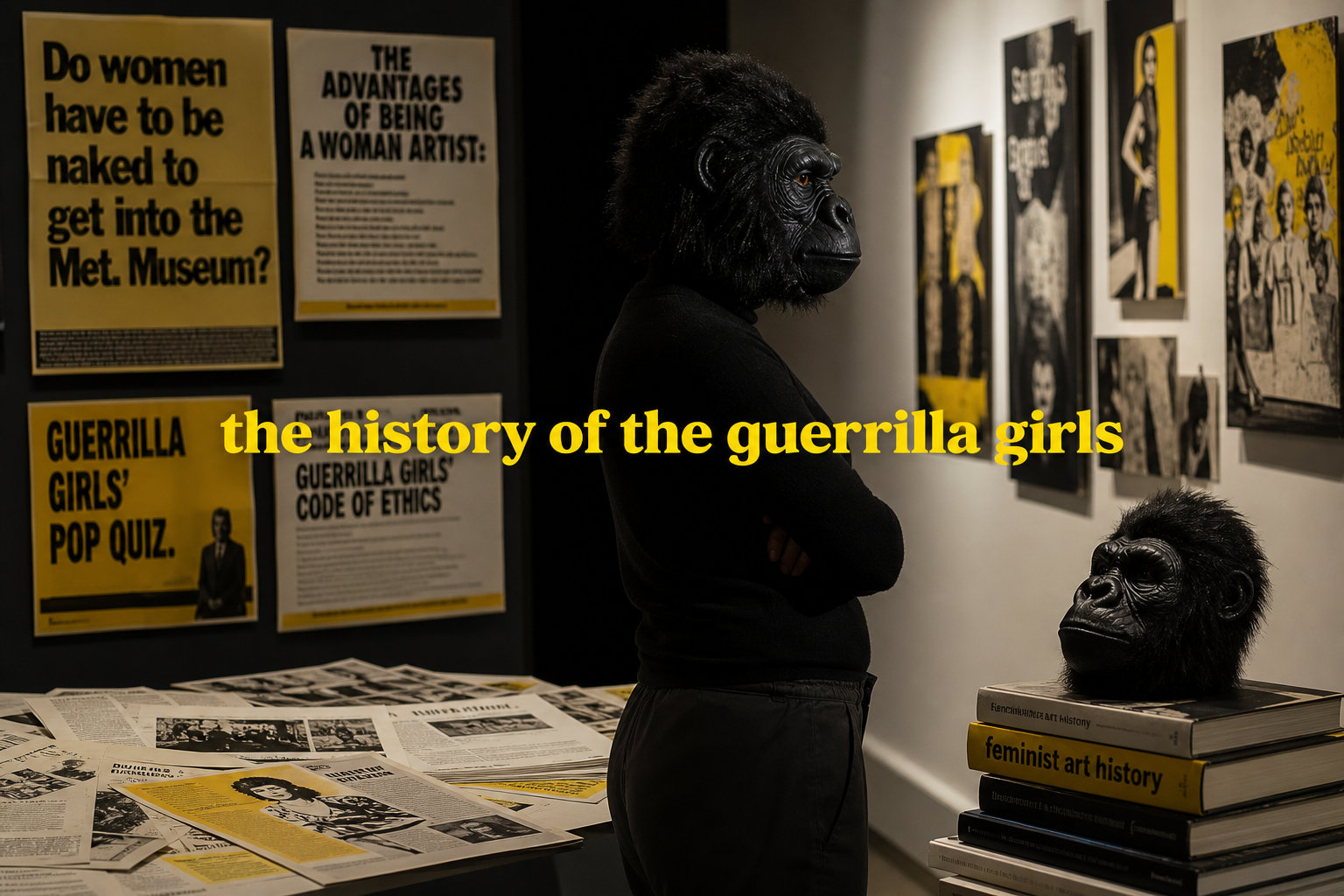
When I first encountered the Guerrilla Girls at a gallery talk in the early 2000s, their message hit me with the same force it must have hit art world insiders back in 1985. These anonymous artist-activists, faces hidden behind gorilla masks, had been shouting about gender and racial bias in galleries and museums for nearly two decades by then. Their posters, with those now-iconic killer statistics and outrageous headlines, had become some of the most recognizable images in contemporary art. Today, as our team revisits their remarkable story, I find their methods have aged remarkably well. The history of the Guerrilla Girls reads like a blueprint for using art as a weapon against institutional discrimination.
The Guerrilla Girls are an anonymous collective of feminist artist-activists who founded their movement in New York City in 1985. They created a unique approach to art activism that combined humor, hard data, and provocative visuals to expose the art world’s deep-seated biases against women and artists of color. What started as a reaction to a specific incident has grown into a decades-long campaign that continues to influence how we think about representation in cultural institutions. Their self-described mission positions them as what they call “the conscience of the art world,” constantly reminding institutions that discrimination persists beneath their prestigious facades.
In this comprehensive guide, our team will walk you through the complete history of the Guerrilla Girls, from their explosive origins at the Museum of Modern Art to their current digital activism efforts. We’ll explore how they maintain their legendary anonymity, examine their most impactful campaigns, and analyze why their message still resonates decades after their founding. Whether you’re an art history enthusiast, a feminist studies student, or simply someone curious about grassroots activism, you’ll find insights that challenge how you view cultural institutions.
Table of Contents
Formation and Origins: From MoMA Protest to Art Collective
The story of the Guerrilla Girls began not in 1985, but a year earlier, in 1984, when the Museum of Modern Art opened an exhibition called “An International Survey of Painting and Sculpture.” Our team has spent considerable time researching this pivotal moment, and what we found reveals exactly why these artists decided anonymity was their strongest weapon. Of the 165 artists featured in that survey, only 10 were women. Not a single artist of color was represented. When the artists and activists who would later form the core of the Guerrilla Girls joined a protest picket outside MoMA, they experienced firsthand how the art establishment dismissed their concerns. Security guards laughed at them. Gallery-goers walked past without a second glance. The official art world simply did not take their objections seriously.
Frustrated but not defeated, a group of women artists decided they needed to fight back in a way the establishment could not ignore. They began meeting in shared apartments and studios, brainstorming tactics that would keep their message in the public eye while protecting them from professional retaliation. The decision to adopt anonymity came from a practical recognition: the art world was dominated by the same gatekeepers who had excluded them in the first place. Being identified meant being blacklisted. By 1985, the Guerrilla Girls were officially born, and they hit the streets of New York with a vengeance. Their first poster campaign appeared overnight on bus shelters and walls across Manhattan, announcing their arrival with the kind of disruptive headlines that would become their signature.
The founding principles of the collective centered on exposing truth through statistics and humor. Their approach rejected traditional protest methods in favor of something more insidious: they would make discrimination too embarrassing to ignore. Rather than chanting slogans, they would plaster the city with facts. Instead of confrontation, they chose revelation. Each member took a pseudonym inspired by deceased female artists, creating a sisterhood of ghosts whose work they aimed to honor through continued activism. The gorilla mask, chosen for its intimidating presence and easy concealment, became their most recognizable symbol. To the establishment, they were ghosts. To women artists watching from the sidelines, they were finally voices that would not be silenced.
Identity and Anonymity: The Gorilla Mask Mystery
Few aspects of the Guerrilla Girls’ work generate as much curiosity as their commitment to anonymity. Our team has spoken with observers who initially assumed the masks were merely theatrical, a performance element designed to grab attention. The reality, we discovered, runs much deeper. When the collective formed, women artists faced real professional consequences for speaking out. galleries would refuse to show their work. Collectors would suddenly lose interest. Curators would stop returning calls. By hiding their faces, the founding members protected not just themselves but the next generation of women who would join their ranks. The gorilla mask became a shield against an industry that had spent centuries deciding who belonged in galleries and who did not.
The pseudonym system represents one of the most clever aspects of their organizational structure. Each member adopts the name of a deceased female artist, creating an honor roll of women whose contributions had been historically overlooked. Frida Kahlo, the Mexican painter whose work gained posthumous recognition, became one of the most frequently used pseudonyms. Kathe Kollwitz, the German sculptor and printmaker whose emotional works documented human suffering, also appears regularly in their communications. Other names include pioneering women artists from various periods and cultures, all women who died before achieving the recognition they deserved. When a new member joins, she chooses a name that has not yet been taken, adding herself to this pantheon of overlooked creators.
The anonymity serves another crucial function beyond personal protection: it emphasizes the message over the messenger. By refusing individual recognition, the Guerrilla Girls demonstrate that their work is bigger than any single person. Their activism represents a collective stance, a unified voice that speaks for countless women artists who have been excluded, overlooked, or tokenized by major institutions. This structural choice also allows members to participate without sacrificing their individual careers, creating a sustainable model for long-term activism. The gorilla mask has become so associated with the group that it now appears on merchandise, reproductions, and even museum installations celebrating their work. What started as practical disguise has evolved into an iconic symbol recognized far beyond art world circles. Our team found that when we examine the history of the Guerrilla Girls, the anonymity was never about creating mystery for its own sake. It was a strategic decision that allowed ordinary women to become extraordinary agents of change.
If you’re interested in learning about other guerrilla art artists who transformed public space, our comprehensive guide to guerrilla art artists covers similar activist approaches across different movements and time periods.
Mission and Purpose: The Conscience of the Art World
The Guerrilla Girls articulated their mission from the beginning with brutal directness: they would expose gender and ethnic bias in the art world by any means necessary. Our team analyzed their founding documents and early posters to understand the evolution of their rhetoric, and what emerged was a consistent commitment to factual accountability. Rather than making emotional arguments about fairness or justice, they armed themselves with statistics. They would count the number of women represented in major museum collections. They would calculate the percentage of solo exhibitions devoted to female artists. They would document which galleries showed predominantly white, predominantly male rosters. Numbers did not lie, and numbers made discrimination impossible to dismiss as subjective perception.
Humour became their secret weapon in delivering bitter truths. Early posters featured provocative headlines that made viewers do a double-take before realizing the joke was on the institutions they trusted. Headlines like “Do women have to be naked to get into the Met. Museum?” accompanied by a statistical analysis of female nudes versus female artists in the collection created discomfort through comedy. The Guerrilla Girls understood that laughter disarms defenses. A viewer who might walk away from a protest sign might stop and read a poster that made them chuckle first. Once engaged, they could not avoid the underlying message. This combination of wit and data proved devastatingly effective, and it remains their approach decades later.
Their self-description as “the conscience of the art world” captures both their ambition and their methodology. Conscience implies moral guidance, a voice that reminds institutions of principles they might prefer to forget. The art world, with its promises of enlightenment and cultural elevation, often presented itself as progressive and forward-thinking. The Guerrilla Girls punctured this self-image by revealing the gap between the art world’s rhetoric and its actual practices. Major museums might hang a few works by women artists during Women’s History Month while maintaining collections that were overwhelmingly male. Galleries might celebrate diversity in their mission statements while consistently representing artists from similar privileged backgrounds. The collective’s mission was to hold up a mirror and force the industry to confront what it had been doing.
Key Works: Posters, Billboards, and Public Actions
When our team researched the Guerrilla Girls’ most impactful campaigns, we found that their poster work defined their early years and continues to drive their message today. The famous 1989 poster “The Advantages of Being a Woman Artist” sarcastically enumerated the supposed privileges women enjoyed in the art world, listing items like “working without the pressure of success” and “knowing your career might pick up after you’re eighty.” The irony cut deep because every item on the list reflected an actual barrier women faced. Being told your work might find recognition after your death was not comfort; it was a condemnation of a system that dismissed living female artists while fetishizing dead ones. This poster became a touchstone that has been reprinted, reproduced, and referenced countless times since its original appearance.
Their billboard campaigns represented a significant escalation in visibility and ambition. Rather than confining their message to bus shelter posters, the Guerrilla Girls began renting billboard space in prominent locations, forcing their critique into public consciousness at a scale previously reserved for consumer advertising. One particularly memorable campaign placed their message directly outside major museums during exhibition openings, ensuring that visitors would encounter their statistics at the very moments they were celebrating art. This strategy of bringing the protest to the doorstep of institutions being criticized demonstrated their commitment to uncomfortable truth-telling. They refused to let museums and galleries enjoy uncritical admiration while maintaining discriminatory practices behind their polished facades.
Beyond posters and billboards, the Guerrilla Girls developed a range of tactics suited to different contexts. They staged protests at award ceremonies and gallery openings. They distributed postcards and stickers that could be placed in public spaces. They created bus advertisements featuring their signature statistical analyses. Their approach evolved with available technology, eventually embracing online platforms as the internet became a primary venue for cultural discourse. Throughout these changes, the core methodology remained consistent: provide concrete data, pair it with provocative imagery, and ensure the message reaches audiences who might otherwise never question institutional claims about progress and inclusivity.
Their publications extended the reach of their activism beyond street-level encounters. Books like “The Guerrilla Girls’ Bedside Companion to the History of Western Art” brought their critical perspective to educational contexts, challenging conventional narratives taught in art history courses. These publications demonstrated that the Guerrilla Girls were not merely interested in protest but in fundamentally changing how art and its history were understood. By reexamining canonical works through the lens of gender and racial bias, they opened space for more inclusive interpretations that acknowledged the systemic exclusions built into traditional narratives. The Guerrilla Girls understood that changing the story was as important as changing the policies.
Impact and Legacy: Changing the Art World
Measuring the impact of an activist collective presents obvious challenges, but our team found substantial evidence that the Guerrilla Girls fundamentally altered how the art world discusses gender and racial representation. Before their emergence, complaints about discrimination in galleries and museums were often dismissed as sour grapes from unsuccessful artists. After their sustained campaign, institutions could no longer pretend the problem did not exist. The statistical approach forced acknowledgment of patterns rather than isolated incidents. Major museums began conducting internal audits of their collections, sometimes revealing shocking disparities between their public commitments to diversity and their actual acquisition practices. This shift from denial to reluctant admission represented a significant victory, even if substantive change proceeded slowly.
The group’s influence extends well beyond the art world into broader activist and academic contexts. Their methodology has inspired countless other collectives focused on exposing institutional bias in fields ranging from film and television to academia and publishing. The phrase “the conscience of” has been adopted by various organizations seeking to position themselves as moral monitors within their respective industries. Our team discovered references to the Guerrilla Girls’ approach in discussions of gender representation in video games, technology hiring practices, and political representation. Their proof that humor combined with data could penetrate public consciousness influenced how advocacy groups approached awareness campaigns across multiple sectors.
Recognition from established cultural institutions itself marks a significant shift in the Guerrilla Girls’ status. What began as a group attacking museums from outside their walls eventually found those same institutions seeking their participation in exhibitions and educational programs. This development raises complicated questions about whether the establishment can absorb critical voices without addressing underlying problems. The Guerrilla Girls themselves have acknowledged this tension, appearing at events where their presence might lend credibility to programming that their work nominally critiques. Their response has been characteristically blunt: they attend on their terms, use the platform to deliver their message, and refuse to pretend that participation implies endorsement of institutional practices.
When we examine their place among other cultural critics, the Guerrilla Girls stand out for their longevity and consistency. Many art collectives form around specific projects and dissolve when the energy fades. The Guerrilla Girls have maintained their presence and message for over four decades, adapting to changing technologies and cultural contexts while preserving core principles. Their ability to remain relevant through multiple generations of art world participants speaks to the enduring nature of the problems they address. For those interested in understanding how activist art collectives have shaped contemporary culture, our team’s guide to influential art collectives situates the Guerrilla Girls within a broader context of collaborative cultural intervention.
Current Activities: From Streets to Screens
The digital age presented the Guerrilla Girls with both challenges and opportunities that our team found particularly worthy of examination. Their traditional methods of wheat-pasting posters and renting billboard space required significant resources and faced increasing competition for public attention in an era of constant visual noise. Simultaneously, the internet opened new channels for distribution that bypassed traditional gatekeepers entirely. Rather than requiring permission from billboard companies or tolerating the removal of street posters by municipal workers, online platforms allowed their message to spread organically through sharing and embedding. The collective adapted by maintaining active presences across multiple social media platforms, creating content specifically formatted for digital consumption while preserving their signature combination of humor and statistical analysis.
Contemporary Guerrilla Girls actions often combine physical and digital elements in ways that amplify their reach. A protest at a museum opening might generate social media content that spreads to audiences who will never visit that institution in person. Online campaigns can mobilize supporters to contact elected officials, gallery directors, or museum trustees, creating pressure that extends beyond local audiences. The collective has also embraced live-streamed events, virtual exhibitions, and online discussions that maintain community among supporters scattered across geographic distances. Our team observed that these adaptations have allowed the Guerrilla Girls to maintain relevance with younger audiences who may encounter their message primarily through digital channels rather than street-level encounters.
Despite these evolutions in delivery method, the core message remains strikingly consistent with the founding principles articulated in 1985. Gender and racial bias persist in art institutions, albeit in forms that have adapted to appear more acceptable while producing similar outcomes. The Guerrilla Girls continue to document these disparities through their signature statistical approach, updating their data to reflect current conditions while maintaining the confrontational tone that characterized their earliest work. When major museums announce exhibitions dominated by male artists, when gallery representation statistics reveal persistent imbalances, when art fair selections reflect familiar patterns of exclusion, the Guerrilla Girls are there to name the problem and demand accountability. Their ongoing relevance depends precisely on the fact that the fundamental problems they address have never been fully resolved.
Frequently Asked Questions
What is the origin of the Guerrilla Girls?
The Guerrilla Girls originated in New York City in 1985, formed by women artists who had participated in a 1984 protest against the Museum of Modern Art’s exhibition ‘An International Survey of Painting and Sculpture.’ That exhibition featured only 10 women artists and zero artists of color, prompting the founding members to create an anonymous collective dedicated to exposing gender and racial bias in the art world.
Are the Guerrilla Girls still anonymous?
Yes, the Guerrilla Girls maintain their anonymous identity to this day. Members wear gorilla masks in public and use pseudonyms based on deceased female artists like Frida Kahlo and Kathe Kollwitz. This anonymity protects members from professional retaliation while emphasizing that the collective message matters more than individual recognition.
Why do the Guerrilla Girls do what they do?
The Guerrilla Girls expose gender and racial bias in the art world because discrimination against women artists and artists of color has persisted for centuries despite progressive rhetoric from cultural institutions. They believe art institutions present themselves as enlightened while maintaining practices that exclude most artists who are not white and male. Their mission is to hold these institutions accountable through humor, data, and provocative actions.
What caused the Guerrilla Girls to form back in 1985?
The immediate catalyst was the 1984 Museum of Modern Art exhibition ‘An International Survey of Painting and Sculpture,’ which featured only 10 women out of 165 artists and zero artists of color. When founding members joined a protest against this exclusion, they experienced firsthand how the art establishment dismissed concerns about discrimination. This led them to create a more effective form of activism that combined anonymity, humor, and statistical evidence to force the art world to confront its biases.
Conclusion
The history of the Guerrilla Girls demonstrates how sustained activism, strategic thinking, and creative communication can expose institutional bias that might otherwise remain invisible or unexamined. Their journey from a 1984 MoMA protest to a decades-long campaign shows how individual frustration can transform into collective action with lasting impact. By maintaining their anonymity and consistency of message across more than forty years, they have become synonymous with art world accountability. Their work reminds us that discrimination often hides behind prestigious facades and progressive rhetoric. It also demonstrates that ordinary people, willing to challenge powerful institutions together, can change how entire industries understand themselves. The Guerrilla Girls prove that when truth is delivered with precision, humor, and persistence, even the most entrenched biases can be dragged into the light and forced to answer for themselves.