
Performance art is the one medium where you can’t hide behind a canvas, a lens, or a keyboard. You are the work. And that terrifies people — which is exactly why most who google “how to make performance art” never actually make any. This guide fixes that. I’ll walk you through everything from the core idea to the final bow, including the unglamorous stuff nobody else tells you about: how to time it, how to document it, how to survive the post-performance comedown, and how to stop sounding pretentious while doing it.
Table of Contents
What Is Performance Art? (Quick Answer)
Performance art is a live artwork in which the artist uses their own body, actions, time, and presence as the medium. It is built on five core elements — time, space, body, the artist’s presence, and the relationship between artist and audience — and it is designed to provoke a reaction rather than produce a permanent object. Unlike theatre, it is usually unscripted in the traditional sense, rooted in visual art rather than narrative, and often documented through photo or video so it can survive beyond the moment it happens.
Here’s the 30-second cheat sheet before we go deep:
| Element | What It Means | Quick Example |
|---|---|---|
| Concept | The single idea the work is about | Endurance, identity, grief, labor |
| Body | Your physical self as the material | Standing, walking, cutting, eating, waiting |
| Time | How long it lasts and why | 7 minutes vs. 1 year (Tehching Hsieh) |
| Space | Where it happens and what the space means | Gallery, street, forest, your kitchen |
| Audience | Who watches and how close they get | Silent, participatory, absent, hostile |
| Documentation | How the work survives after it ends | Photos, video, written score, objects |
Step 1 — Understand What Performance Art Actually Is (and Isn’t)
Before you make anything, you need to stop confusing performance art with theatre, stand-up, dance, or a TikTok skit. Tate defines it as art for which the artist uses their own body as the medium and performs an action or series of actions which become the artwork. That’s the cleanest definition you’ll find.
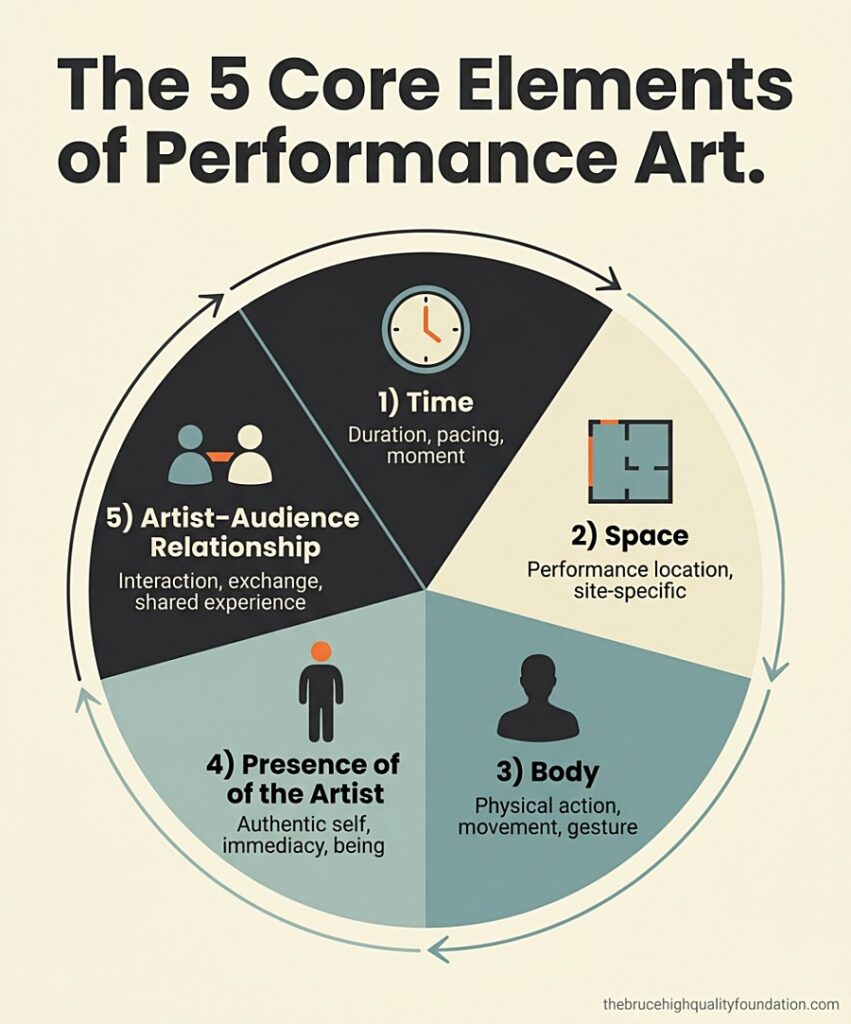
Historically, performance art involves five basic elements: time, space, body, presence of the artist, and the relation between the artist and the public. Every strong piece I’ve ever seen consciously manipulates at least three of those five. Marina Abramović’s The Artist Is Present is pure body + time + audience. Tehching Hsieh’s Time Clock Piece is body + time + space, stretched to an inhuman length.
A useful mental test: if you could film your idea as a short film and it would mean the same thing, it probably isn’t performance art. Performance art needs the live fact of the body being there — or the deliberate absence of it — to work.
How It’s Different From Theatre
Performance art emerged with a critical and antagonistic position towards scenic arts. Theatre pretends. Performance art does. If an actor on stage “cuts” themselves, it’s fake blood. If a performance artist cuts themselves, it’s real. That literalness is the whole point.
A Very Short History You Should Actually Know
- 1910s — Italian Futurists and Dada cabarets stage provocations designed to scandalize audiences. These are the roots.
- 1950s–60s — Allan Kaprow’s “Happenings,” Fluxus events, Yves Klein’s Anthropometries, Yoko Ono’s Cut Piece(1964).
- 1970s — The term “performance art” becomes mainstream. Chris Burden has himself shot. Marina Abramović starts the Rhythm series. Vito Acconci does Seedbed. Ana Mendieta does the Siluetas.
- 1980s–90s — Tehching Hsieh’s year-long pieces. Laurie Anderson crosses into music. Coco Fusco and Guillermo Gómez-Peña bring in identity and post-colonial critique.
- 2000s–present — Abramović’s The Artist Is Present (2010) turns performance art into a museum blockbuster. Pussy Riot, Tania Bruguera, and Petr Pavlensky push it back into political risk.
For a deeper dive into the movement’s timeline and key figures, the Tate’s performance art glossary is the most reliable short reference on the web.
Step 2 — Find an Idea Worth Your Body
Most first-time performance art fails at the idea stage, not the execution stage. The single most common mistake is trying to say five things at once. Pick one.
Ask yourself these four questions and write the answers on a single index card:
- What is the one thing this piece is about? (One noun. “Grief.” “Waiting.” “Labor.” “Shame.”)
- Why does it have to be performed and not painted, filmed, or written? If you can’t answer this honestly, switch medium.
- What does my body specifically bring that nobody else’s could? Your scars, your gender, your language, your size, your history.
- What’s the smallest, simplest action that communicates the idea?
The JAŠA principle is worth stealing here: To grow as an artist, you need a period in which you close yourself into something very small, to crack something, and only then try to get freer. Start small. One action. One room. One hour.
Good Starting Prompts (Steal These)
- Repeat one mundane action until it becomes strange (brushing hair for 3 hours).
- Carry something heavy from point A to point B without explaining why.
- Hand objects to strangers and watch what they do with them.
- Eat, drink, or cook something in public with a rule attached.
- Stand still in a busy place for a fixed duration.
- Write a score — a set of instructions — and perform it exactly, Fluxus-style.
Bad Starting Ideas (Skip These)
- Anything that relies on shocking the audience without a reason
- Anything you haven’t thought about for longer than a weekend
- “I’ll figure it out on the day”
- Nudity used as a shortcut to meaning
- Self-harm. (More on this under ethics.)
Step 3 — Choose Your Time, Space, and Constraints
Once the idea is locked, you’re making three decisions: how long, where, and what rules.
Time
Duration is a compositional tool. A 4-minute piece and a 4-hour piece about the same idea are not the same piece. Short durations hit hard and leave; long durations grind meaning into the audience’s bones. Decide the length before you start and stick to it — the commitment to duration is often the work itself.
Space
Your space is not a backdrop; it’s a collaborator. A gallery gives you context and protection but filters your audience to art-world insiders. A street gives you strangers and unpredictability but no safety net. A domestic space makes things intimate and uncomfortable. Your own bedroom makes it confessional.
Liv Fontaine, writing for Frieze, made a point I think about a lot: After almost ten years of performing in galleries, I now feel much happier doing my act at punk shows in fringe venues. Art spaces are great, but it’s in the pubs that I feel I can really get down to business. If no one wants to programme you, programme yourself. The venue changes the work. Choose on purpose.
Rules / Score
Write your piece as a score — a short set of instructions a stranger could follow. Example:
Piece for One Performer Walk into the room. Place the bowl of salt on the floor. Kneel. Eat one spoonful of salt every minute until the bowl is empty or you cannot continue. Leave without speaking.
A written score forces clarity. If you can’t write it down in under 10 lines, your idea is still mushy.
Step 4 — Materials, Tools, and Setup
Performance art has a reputation for being “free” because there’s no canvas. It isn’t. Here’s a realistic kit for a first serious piece:
| Category | What You Need | Why |
|---|---|---|
| Body prep | Water, comfortable base layer, any specific costume/uniform | You will be in that outfit longer than you think |
| Props | Only what the score requires, nothing extra | Every extra object dilutes meaning |
| Space | Marked boundary (tape, rope, chalk, rug) | Tells the audience where the work is |
| Timing | Silent timer, analogue clock, or an assistant with a cue | You cannot trust your own sense of time under pressure |
| Documentation | Camera on tripod (wide shot), second camera for detail, a dedicated photographer if possible | Without documentation, the work ends forever when you stop |
| Safety | First-aid kit, water, a trusted person with the power to stop the piece | Non-negotiable for anything physical |
| Audience info | A short printed text or wall label stating title, duration, and any content warnings | This is where the concept lives for most viewers |
On Documentation (Don’t Skip This)
Most of performance art history exists only because somebody photographed it. Chris Burden’s Shoot lives as a single black-and-white still. Abramović’s Rhythm 0 survives as grainy photos and testimony. Plan your documentation beforethe performance, not during. Use a tripod. Use a second angle. Record audio separately if sound matters. And as one MetaFilter commenter put it bluntly, It’s ok to not perform at all, but quietly do a task and document it. The performance doesn’t always need an audience present when it occurs. Sometimes the documentation is the work.
Step 5 — Rehearse, But Not Too Much
This is the counter-intuitive part. You should rehearse enough to know the physical reality of your piece (how heavy, how long, how cold, how exhausting) — but not so much that you pre-feel the experience and drain it of risk on the night.
My rule: rehearse the logistics fully, and rehearse the emotional core exactly once. Walk through the space. Time the actions. Test the props. But don’t keep doing the whole thing over and over — the live version needs to still contain something you haven’t met yet.
Step 6 — The Day Of: How to Actually Perform
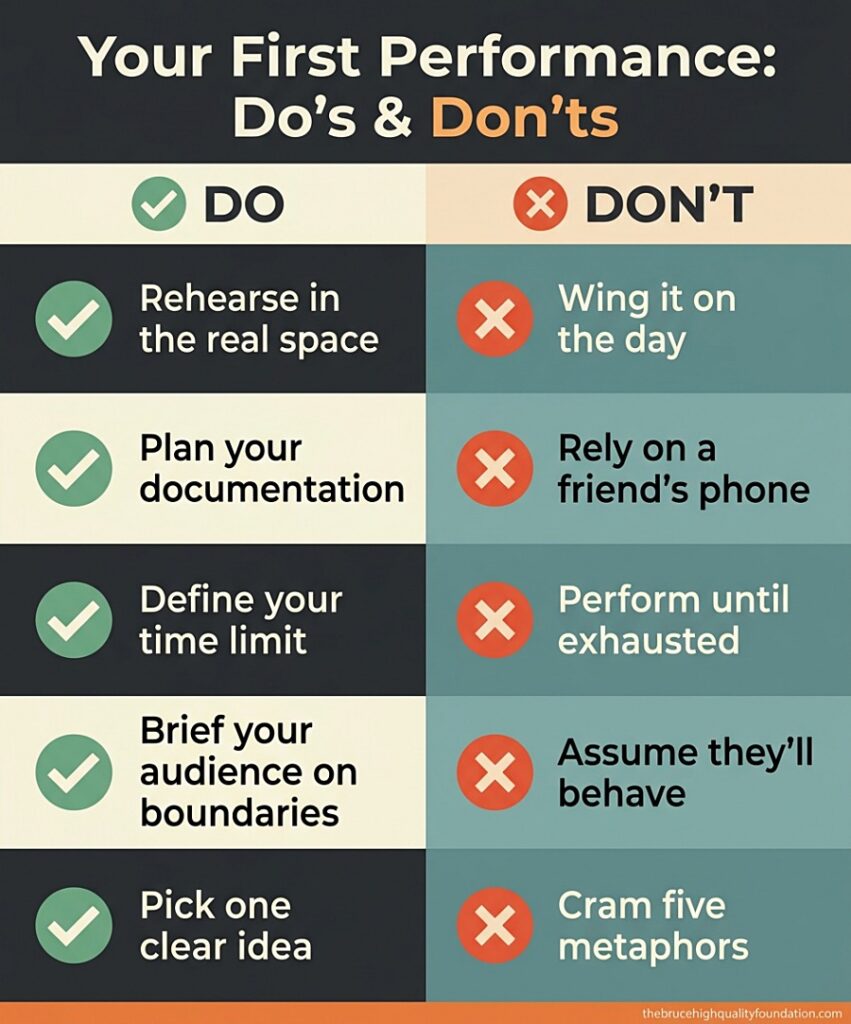
Here’s the honest sequence for performance day:
- Eat lightly and hydrate early. You don’t want a full stomach under stress.
- Arrive at the space at least 2 hours early. Re-mark your boundary, set your props, test documentation.
- Brief your camera person and your safety person. Both need to know the stop-conditions.
- Brief the audience minimally. A title, a duration, and — if needed — a content warning. Don’t explain the piece. Explaining kills it.
- Start on time. Ritualizing the beginning makes everything after it feel inevitable.
- Hold your concentration, not your face. New performers try to “look intense.” Don’t. Just do the action. The intensity is in the action itself.
- Don’t break character to reassure the audience. Their discomfort is often part of the piece.
- End cleanly. A defined ending is 90% of a good piece. Walk out. Sit down. Blow out a candle. Whatever it is, make it unambiguous.
Handling Hecklers and Interruptions
Public performance invites interference. Liv Fontaine again, with the most useful sentence I’ve read on this: Spectators often see performers’ bodies as public property, so be clear about your boundaries with organizers and audiences. Decide in advance what you will and won’t allow. Have a person whose only job is to intervene if a line is crossed.
Step 7 — After the Performance
Nobody warns you about the crash. After you pour everything into a live piece, there is a hollow hour (or week) afterward where you feel faintly insane, under-slept, and unsure whether any of it was worth anything. This is normal. Budget for it. Don’t book another gig the next day. Don’t read the comments.
Then do these three things within 48 hours:
- Back up your documentation in two places.
- Write a 200-word description of what you did, in plain language, while it’s fresh. This becomes your archive, press release, and grant-application text.
- Pick your three best stills and one video clip. That’s your portfolio asset. You don’t need more.
Step 8 — Ethics, Safety, and the Line You Shouldn’t Cross
Performance art has a long tradition of endurance and risk. It also has a body count of burnout, injury, and real psychological damage. A short list of things I treat as non-negotiable:
- Never perform anything you haven’t thought about sober for at least a week.
- Never perform alone with physically risky material. Have a stop-person.
- Never use non-consenting participants. Bystanders in public aren’t automatic collaborators.
- Be honest about power. If you’re performing about someone else’s trauma, ask whether that’s your story to tell.
- Self-harm is not a shortcut to depth. Real pain is real pain. Don’t confuse it with rigor.
Common Mistakes First-Time Performance Artists Make
- Over-explaining. If the wall text is longer than the performance, the performance is doing nothing.
- Too many props. Every object you add is another thing the audience has to decode.
- No time limit. Open-ended pieces drift into self-indulgence.
- Bad documentation. One phone camera at chest height is not documentation.
- Performing for the camera instead of the room. The people in front of you are the primary audience.
- Copying Abramović. She already did it. Do something only you can do.
- Being “weird for weird’s sake.” The work has to be about something or it’s just pantomime.
Beginner → Intermediate → Advanced Progressions
| Level | What to Try | Typical Duration | Audience |
|---|---|---|---|
| Beginner | A private score performed alone and documented | 5–15 minutes | Camera only |
| Beginner+ | A score performed in an art class or studio crit | 5–20 minutes | Peers |
| Intermediate | A public piece in a small venue, pub, zine launch, or open-call show | 10–45 minutes | Curious strangers |
| Intermediate+ | A gallery-programmed piece with formal documentation | 30 min – 2 hrs | Art audience |
| Advanced | Durational work, site-specific commissions, collaborations with musicians or dancers | Hours to days | Mixed, sometimes absent |
| Master level | Long-durational, year-long, or international commissioned work | Weeks to years | Public + museum |
Where to See Performance Art (So You Can Learn by Watching)
You cannot make good performance art without seeing a lot of it. Start here:
- MoMA’s performance art collection — Abramović, Acconci, Schneemann, Ono, and others, with historical notes and video documentation.
- Tate Modern’s Tanks — a physical space dedicated to live and performance art in London.
- The Wikipedia overview of performance art — surprisingly solid for timelines and a complete list of pioneers including Carolee Schneemann, Marina Abramović, Ana Mendieta, Chris Burden, Hermann Nitsch, Joseph Beuys, Nam June Paik, Tehching Hsieh, Yves Klein, and Vito Acconci.
- UbuWeb — free, archival video of foundational performance pieces.
- Performa Biennial (New York) — the biggest contemporary performance art festival, with an open archive of past programs.
Pro Tips From Working Performance Artists
- “You need a period in which you close yourself into something very small, to crack something, and only then try to get freer.” (JAŠA) Start narrow. Go deep. Widen later.
- “If no one wants to programme you, programme yourself.” (Liv Fontaine) Don’t wait for permission. Rent a room. Invite ten people. That’s enough.
- “You must have complete conviction in what you do because there is an element of sacrifice to performance.”(Liv Fontaine, in Frieze magazine) If you don’t believe in the piece completely, the audience will smell it in thirty seconds.
- Find one peer, not ten mentors. One trusted collaborator who’ll tell you the truth is worth more than a whole Instagram following.
FAQs
Can you make performance art alone, without an audience?
Yes. Many foundational works were made without live audiences and exist only as documentation. If the action is real and documented honestly, the absence of an audience can itself be part of the concept.
Do I need to go to art school to be a performance artist?
No. Art school helps with crit environments and contacts, but performance art’s entry barrier is a body, an idea, and the willingness to do the thing. Many of the best performance artists came from music, dance, activism, or nothing at all.
How long should my first performance be?
Between 5 and 20 minutes. Short enough to sustain concentration, long enough to create a real experience. Duration-for-duration’s-sake is an advanced move — don’t start there.
Is performance art the same as theatre?
No. Theatre represents; performance art enacts. In theatre, a gunshot is sound design. In performance art, if a gun is fired, it’s fired. Performance art grew out of visual art, not drama, and historically defined itself against theatre.
How do I document a performance properly?
Use a static wide-angle camera on a tripod for the whole duration, a second camera or photographer for detail and reaction shots, and record audio separately if sound matters. Back everything up the same day in two locations. Your documentation is the work’s afterlife.
Can performance art be funny?
Absolutely. Humor is one of the most underused tools in the medium. Fluxus was often funny on purpose. A laugh can disarm an audience and let a harder idea slip through.
What should I do if the audience interrupts or heckles?
Decide in advance whether interruption is part of the piece or a violation of it. Brief your organizer. Have one trusted person empowered to intervene. Don’t improvise safety in the moment.
How do performance artists make money?
Grants, commissions, teaching, residencies, and — crucially — selling the objects and documentation left behind. As JAŠA puts it, concepts and performances are great, but to make a living you also need something tangible that collectors can buy: the props, the stills, the scores, the prints from the performance.
Is it okay to copy a famous performance to learn?
As an exercise for yourself, yes. As a public piece, no. Re-performance is its own discipline and usually requires permission from the original artist or their estate.
What’s the single biggest mistake beginners make?
Trying to say too much in one piece. The strongest performance work is almost always about one thing, executed with absolute commitment.
Next Steps — What to Do This Week
- Pick one idea. Write it as a score in under 10 lines.
- Choose your duration, space, and one prop.
- Rehearse the logistics once.
- Perform it — even if the audience is just your camera.
- Back up the documentation and write your 200-word description.
That’s a real performance piece. Most people never get past step 1. You just did. Save this guide, bookmark it, and come back to it before your second piece — because the second one is harder than the first, and that’s when most people quit.