
Picking between a portfolio school and a liberal arts college isn’t really a choice between two kinds of education. It’s a choice between two completely different bets on your future. One bet says: I know exactly the kind of creative I want to be, and I want the fastest, most direct route to a job. The other says: I’m an artist, but I’m also a person with a brain that wants to wander, and I trust that the wandering will make my work better. Both bets win — for different people. I’ve watched friends thrive in both worlds and crash out of both worlds, and almost every crash came from picking the wrong path for the wrong reason.
This guide is the conversation I wish someone had walked me through when I was 17.
Table of Contents
Portfolio Schools vs. Liberal Arts at a Glance
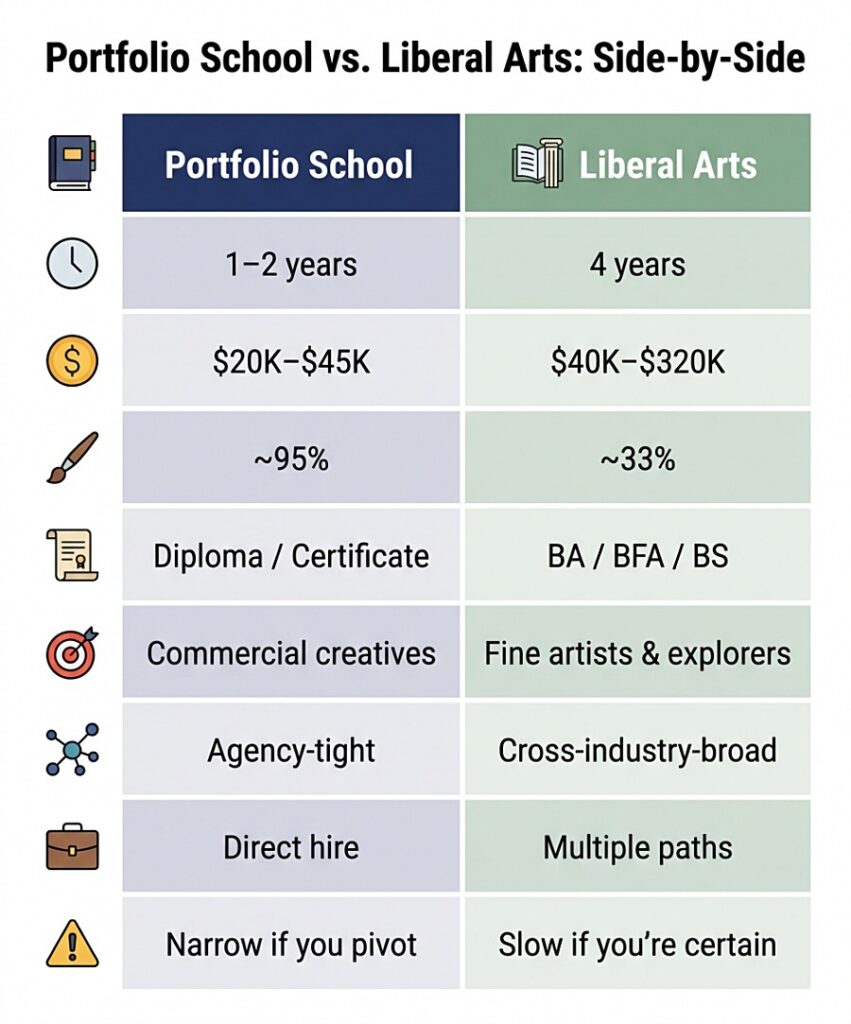
| Factor | Portfolio School | Liberal Arts College |
|---|---|---|
| Length | 1–2 years (some 6-month online) | 4 years |
| Typical cost | $20K–$45K total | $40K–$320K total |
| Curriculum | ~95% studio/craft, agency-style | ~33% studio, ~67% academics |
| Degree | Diploma or certificate (some BFA/MFA partnerships) | BA, BFA, or BS |
| Best for | Advertising creatives, designers, illustrators with a specific commercial goal | Fine artists, conceptually driven artists, undecided creatives, artist-academics |
| Job placement | 85–100% at top schools | Varies widely |
| Network | Tight, agency-focused | Broad, cross-industry |
| Risk | Narrow if you change your mind | Slow if you already know what you want |
Quick answer: A portfolio school is the right path for a young artist who already knows they want a career in advertising, branding, or commercial design and wants the shortest, most job-focused route there. A liberal arts college is the right path for a young artist whose work is still forming, who wants to make fine art or pursue an art-adjacent career (curator, art historian, art therapist, art teacher), or who wants to keep options open beyond visual art. Neither is “better.” The wrong fit, however, will cost you years and tens of thousands of dollars.
The rest of this article unpacks exactly how to figure out which one is yours.
What a Portfolio School Actually Is (And Isn’t)
A portfolio school is a short, intensive, trade-school-style program built around one product: a portfolio strong enough to land you a junior creative job at an advertising agency, branding studio, or design firm. The model was pioneered by Ron Seichrist, who founded The Portfolio Center in Atlanta in the 1970s before launching Miami Ad School. Portfolio schools are not art schools in the RISD or Pratt sense. They’re closer to creative boot camps run by working professionals.
The format is consistent across the major schools:
- Studio over lecture. Students spend most of their time creating campaigns, with instructors functioning as creative directors who critique work the way real CDs do at agencies.
- Agency-style classrooms. Small cohorts (often 8–15 students), shared workspaces, real briefs, fast turnarounds.
- Two tracks. Most schools split students into Art Direction (visual) or Copywriting (verbal), with a third Strategy track at some schools.
- Mentorship and placement. Top schools pair second-year students with industry mentors and report job placement rates of 85% to nearly 100%.
The major U.S. portfolio schools you’ll hear about are Miami Ad School, Creative Circus (Atlanta), VCU Brandcenter (the only one that’s a 2-year master’s program and an O’Toole Award winner from the American Association of Advertising Agencies), Denver Ad School, Adhouse (NYC), and newer online-first programs like book180. Free alternatives have emerged as well — The One Club for Creativity’s One School is a tuition-free, 16-week program for Black creatives that has reported placement at well over 100 agencies and brands. D&AD Shift offers a similar free program in partnership with Google.
What Portfolio School Is Not
Portfolio school is not where you go to find yourself. It’s not where you go to “explore.” It’s not a fine art education. You will not paint nudes from observation, you will not study Renaissance composition for a semester, and you will not write a thesis on Cy Twombly. You will pitch concepts, kill your darlings in front of strangers, learn to use Adobe CC like it’s a second language, and produce more work in 18 months than most undergraduates produce in four years. If that sounds thrilling, you’re the right person. If it sounds suffocating, keep reading.
What a Liberal Arts Education Gives an Artist
A liberal arts college is a four-year, broad-based undergraduate institution where art is one major among many — alongside English, biology, philosophy, history, computer science, and so on. About 200 private liberal arts colleges exist in the U.S., plus liberal arts-style undergraduate programs nested inside larger universities (think Yale College, Harvard’s Visual and Environmental Studies, or the College of Letters and Science at UCLA).
For a young artist, the appeal is structural: roughly one-third of your coursework is in your major, one-third is general education in humanities and sciences, and one-third is electives. You can major in studio art and minor in neuroscience. You can double-major in painting and philosophy. You can change your mind in sophomore year and graduate as an art historian who still paints. The framework treats the artist as a whole intellectual person rather than a vocational specialist.
A few real strengths to know:
- Tight-knit art communities. Because the art department is smaller, students often play an active role in shaping it — running galleries, building shows, organizing critique groups. You’re not one of 800 illustration majors; you’re one of 30 studio majors that the faculty actually knows by name.
- Cross-pollination. Your roommate is a biochem major. Your studio crit group includes someone writing a thesis on labor history. The friction generates work that art-school bubbles often can’t.
- Optionality. If you decide at 20 that you’d rather curate than paint, you’re already at the institution that can pivot you there. You don’t have to transfer.
- Academic rigor. Programs like Yale, Brown, Williams, Bard, Wesleyan, and Bennington produce conceptually serious artists precisely because the studio work is forced to live next to literature, theory, and history.
The trade-off is real, though. You will spend less time in the studio. Your facilities are likely smaller than an art school’s. Your professors may be excellent artists, but the surrounding ecosystem won’t be saturated with visiting critics, gallery openings, and industry recruiters the way RISD or SAIC is. And if your goal is to be a working junior art director at an ad agency by 22, you’ve taken the long road.
The Real Decision Framework
Most “vs.” articles on this topic fence-sit. I won’t. Here’s the framework I’d actually use, broken into the four questions that matter.
1. How specific is your goal?
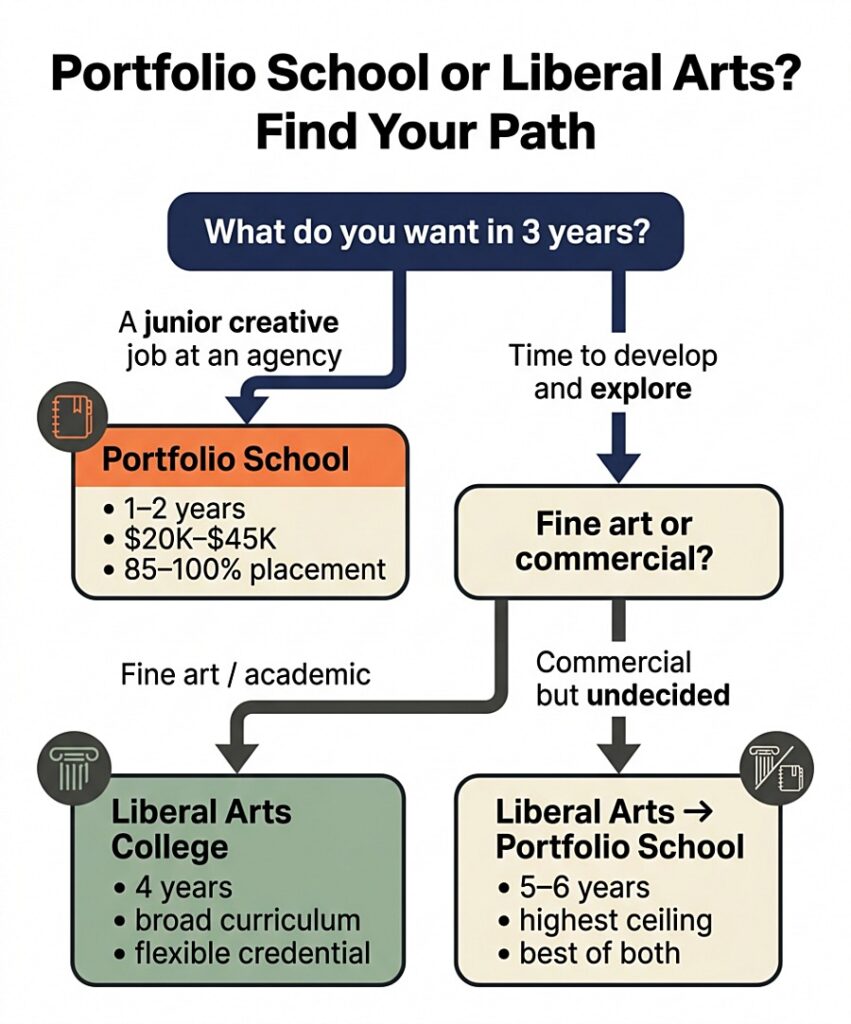
This is the question. If you can finish the sentence “I want to be a ___ at ___ within three years of graduating,” and the answer involves the word “agency,” “studio,” “brand,” or “creative team,” portfolio school is almost certainly the better bet. The whole institution is engineered for that outcome.
If you can’t finish that sentence — or if your answer involves words like “explore,” “develop my voice,” “find what I want to say,” “maybe grad school,” “maybe teach,” “I’m not sure yet but I love making things” — liberal arts is the safer, more honest choice. Spending $40,000 on a portfolio school when you don’t yet know what kind of creative you want to be is the most expensive way to find out you don’t want to be one.
2. What kind of artist are you, fine or commercial?
Portfolio schools train commercial creatives. Liberal arts colleges train (among others) fine artists. These are different tribes. A fine artist’s career is built on exhibitions, grants, residencies, gallery representation, and critical writing. A commercial creative’s career is built on agency work, client briefs, awards shows, and a book. The skills overlap less than people think. A portfolio school will not teach you how to apply for a Skowhegan residency. A liberal arts college will not teach you how to ideate eight campaign directions for a fast-food client by Tuesday.
3. How much room do you need to change your mind?
Eighteen-year-olds change. The brain is still cooking. About a third of the artists I know who started college dead certain about their path ended up somewhere completely different. A liberal arts degree is built for that turn. A portfolio school is not — you’ll graduate with a great ad book and very little else if your interests drift.
4. What’s the real cost picture?
Portfolio schools cost $20,000 to $45,000 total. A four-year private liberal arts college can cost anywhere from $40,000 (in-state public liberal arts equivalents) to over $320,000 at the priciest privates. Both can be drastically reduced with merit aid, need-based aid, and scholarships, and all numbers should be checked directly with the school before you commit. The honest comparison is total debt against expected first-job salary. A junior creative at a mid-tier ad agency makes roughly $50K–$70K. A studio art graduate’s first job is much harder to predict. Run the numbers before you fall in love with a school.
The Hybrid Path Nobody Talks About Enough
Here’s the move I’d recommend to anyone who can swing it: liberal arts undergrad, then portfolio school as a finishing program. This is exactly the path many VCU Brandcenter students take. They major in English, psychology, marketing, or studio art at a four-year college, develop a brain and a worldview, then enter a one- or two-year portfolio program to weaponize that brain for the agency world.
The result is a creative who can think like an English major and execute like an art director. Agencies love these people. They tend to make Creative Director faster than the pure portfolio-school grads, because they can read a room, write a strategy memo, and hold their own with clients.
The downside is time and money — six years of education instead of two or four. But if you can afford it (or make it cheap with aid), it’s the path with the highest creative ceiling and the most career flexibility.
Common Mistakes I See Young Artists Make
- Confusing prestige with fit. RISD is incredible. So is Williams. Neither is automatically right for you.
- Letting parents pick the safer-sounding option. “Liberal arts” sounds parent-safe even when the kid clearly belongs in a studio. The reverse also happens.
- Underestimating debt. A $200K liberal arts loan to make experimental video work is a brutal trade. Be honest with yourself.
- Going to portfolio school at 18. Most portfolio schools quietly prefer students with some life experience. Going straight from high school often means you don’t have enough to draw on creatively, and you’ll get eaten alive in critique.
- Picking based on a campus visit. Campuses are designed to look beautiful. Talk to second-years and recent grads instead. Ask them what they wish they’d known.
- Assuming the network will materialize. It won’t unless you actively build it. This is true at both kinds of school.
Pro Tips From Working Artists and Creative Directors
- The portfolio is the credential. This is true in both worlds, but doubly so for commercial creatives. Nobody at an agency will ever ask where you went to school after your first job. They’ll ask to see your book.
- Take the philosophy class. Even at a portfolio school, find a way to feed the brain outside of craft. The best creatives I know are the ones who read.
- Apprenticeship still works. Working as a studio assistant for a practicing artist or interning at a small agency can teach you more in six months than a year of coursework. Don’t dismiss it as a path.
- Online portfolio schools are legitimate now. The pandemic broke the old assumption that you had to be in a physical room. Online programs from book180, One School, and Miami Ad School’s online tracks place graduates at real agencies. They cost less and let you keep a job.
- Beware of “art school” gear envy. Bigger studios and fancier equipment do not produce better artists. Discipline and reps do.
Where to See the Work and Verify the Reputations
Before you commit to any school, look at the actual student work it produces. Portfolio schools post recent student books on their websites — Miami Ad School, Creative Circus, and VCU Brandcenter all publish galleries. For liberal arts colleges, look at thesis exhibitions on the department website and check whether recent grads have shown work at places like the Museum of Modern Art, the Whitney, or smaller respected galleries. Award shows are another tell: the One Club Young Ones, D&AD New Blood, and the ADC Awards regularly publish lists of which schools won the most pencils each year. If a school’s name keeps coming up, that’s a real signal.
FAQ
Is portfolio school better than a four-year art degree?
Neither is universally better. Portfolio school is faster, cheaper, more focused, and built specifically to land you an agency job in advertising or branding. A four-year degree (whether liberal arts or art school) gives you broader skills, more time to develop, a more flexible credential, and a wider network. Pick portfolio school if your goal is specific and commercial. Pick a four-year program if your goal is still forming, fine-art-oriented, or academically ambitious.
Do agencies actually hire portfolio school graduates?
Yes — top portfolio schools regularly report placement rates between 85% and nearly 100% of their graduates. Miami Ad School, Creative Circus, and VCU Brandcenter are well-known recruiting pipelines for major agencies including Wieden+Kennedy, Droga5, BBDO, R/GA, Ogilvy, and Mother. The hire-rate at free programs like One School also exceeds 70% across more than 100 agencies and brands.
Can you get into advertising without going to portfolio school?
Yes. Plenty of working creative directors came up through liberal arts degrees, journalism programs, design schools, or pure self-teaching. A portfolio school accelerates the process but isn’t the only way in. What you absolutely need is a portfolio that demonstrates conceptual thinking — the school is just one efficient way to build it.
How much does portfolio school cost in 2026?
Total tuition for a full two-year program at the major schools generally runs between $20,000 and $45,000, depending on the school and city. Some online and shorter programs run under $15,000. VCU Brandcenter, as a master’s program, costs more and requires a bachelor’s degree to enter. Always verify the current tuition directly on each school’s website before applying — numbers shift year to year.
Is a liberal arts degree worth it for a fine artist?
For many fine artists, yes. The deeper engagement with theory, history, philosophy, and cross-disciplinary ideas often produces more conceptually mature work than studio-only training. Many of the artists currently shown in major museums hold liberal arts degrees from places like Yale, Bard, Bennington, Cooper Union, and Williams.
What if I want to do both?
Do liberal arts undergrad first, then a one- or two-year portfolio school after. This is a well-trodden path and arguably produces the strongest commercial creatives in the industry — you arrive with a worldview already in place, and the portfolio school sharpens it into a hireable book.
Are online portfolio schools as good as in-person ones?
They’ve become legitimate. Programs like book180 (six months, online) and Miami Ad School’s online tracks place graduates at real agencies. The trade-off is less in-person serendipity, but the work itself can be just as strong if you bring discipline. Hire rates and student work are the only metrics that matter — check both.
Does it matter what the school is called for getting hired?
Less than you think after the first job. Hiring creative directors look at the book first, the school second. School name can open the first door; everything after that is the work.
Final note for young artists reading this: the school you pick matters less than the work you do once you’re there. I’ve watched portfolio school grads coast on their school’s reputation and produce mediocre books. I’ve watched liberal arts kids out-work everyone in the room and end up with three job offers before graduation. The pattern is consistent. Whichever path you pick, treat it as raw material — not a guarantee. The work is still on you.