
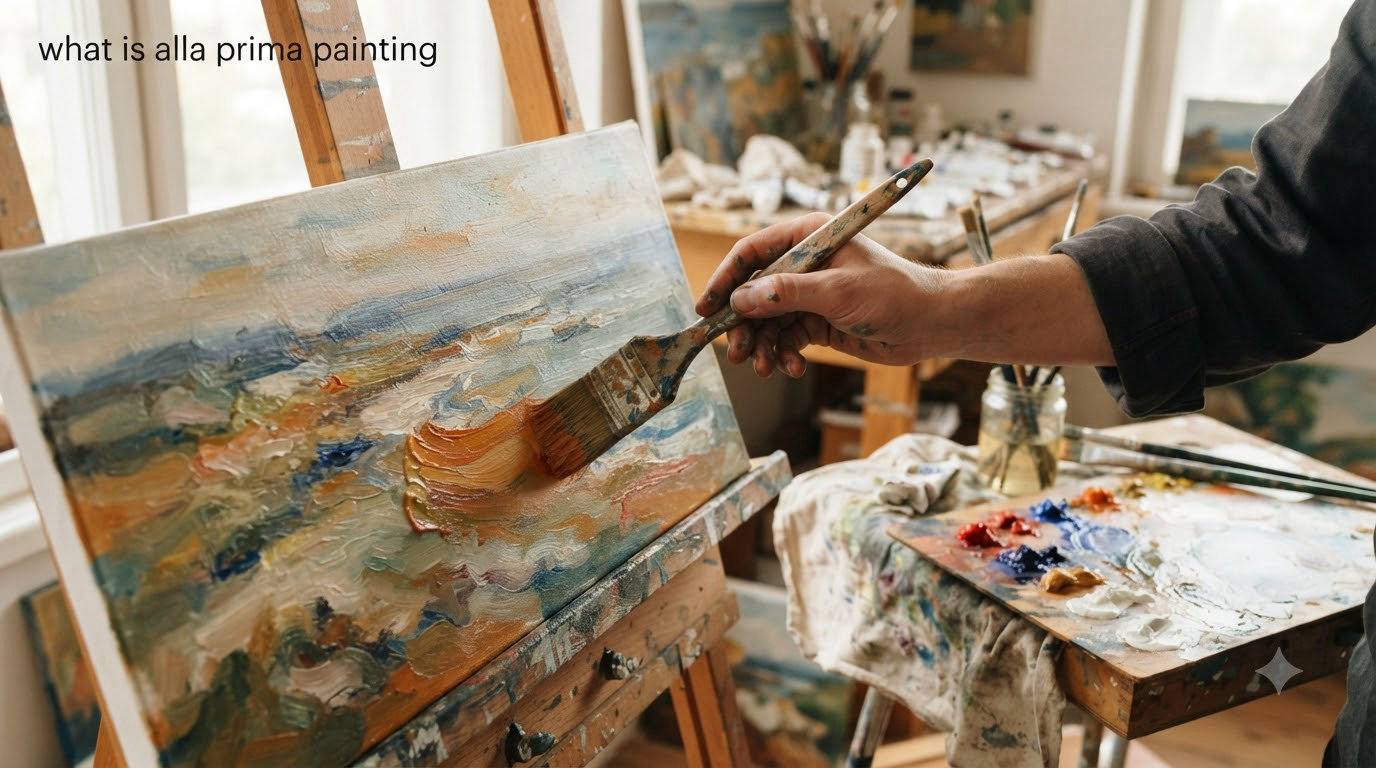
Alla prima is an Italian phrase meaning “at first attempt,” and it describes a painting technique where you apply wet paint directly onto still-wet layers, completing the entire artwork in a single session. Instead of waiting for paint to dry between layers, you work while everything remains wet and workable. This approach produces fresh, spontaneous results that feel alive on the canvas.
If you have ever wondered what is alla prima painting and whether it is something you can learn, the short answer is yes. Artists at every skill level use this method, from complete beginners to professionals who paint en plein air. The technique rewards boldness and quick decision-making, and it teaches you to trust your instincts with a brush.
In this guide, we will walk through everything you need to know about alla prima painting in 2026: what it is, how it works, its history, the step-by-step process, common mistakes, and practical tips for getting started. Whether you paint with oils, acrylics, or watercolor, this article will give you a clear foundation to start practicing today.
Table of Contents
What Is Alla Prima Painting?
Alla prima painting is a direct painting method in which the artist completes a work in one sitting without allowing underlying layers to dry. The term comes from Italian and translates literally to “at first attempt.” It is sometimes called “au premier coup” in French, meaning “at first stroke.”
The core characteristic of alla prima is the wet-on-wet application. You lay down a stroke of paint, and before it dries, you add more paint on top of it or blend it into adjacent areas. This creates soft transitions, visible brushwork, and a sense of immediacy that layered approaches often lack.
Traditional painting methods, by contrast, involve building up paint in multiple sessions. An artist might create an underpainting, let it dry for days or weeks, then apply glazes and scumbles over the top. This indirect approach gives precise control over color and detail but requires significant patience.
Alla prima flips that approach entirely. You work from general shapes to specific details in a compressed timeframe, typically one to four hours. The painting evolves in real time, and the artist makes permanent decisions quickly because the paint stays wet throughout the process.
This technique is most commonly associated with oil painting, where the extended drying time gives artists hours of open working time. However, painters also use alla prima with acrylics, gouache, and even watercolor, adapting their speed and approach to match the medium’s properties.
Alla Prima vs Wet-on-Wet vs Direct Painting: Clearing Up the Confusion
One of the most common sources of confusion in painting circles is the relationship between alla prima, wet-on-wet, and direct painting. These terms get used interchangeably, but they are not exactly the same thing. Understanding the distinction helps you communicate clearly about your process.
Wet-on-wet (also written as “wet-in-wet”) refers to the physical act of applying wet paint onto a surface that is already wet with paint. It is a technique or application method. You can use wet-on-wet within a traditional multi-session painting without completing the entire piece alla prima style.
Alla prima is a broader concept that encompasses the entire painting approach. It means finishing the painting in one session, and wet-on-wet is the primary technique you use to do that. Every alla prima painting involves wet-on-wet, but not every wet-on-wet application is part of an alla prima painting.
Direct painting is the umbrella term for any approach where you apply paint directly to the canvas without building up transparent glazes over a dried underpainting. Alla prima is a type of direct painting, but so is any single-session approach regardless of whether you use wet-on-wet techniques throughout.
Plein air painting often gets lumped into this conversation too, but plein air simply means painting outdoors from life. Many plein air painters work alla prima because changing light conditions demand speed. But plein air is about location, not technique, and you could paint outdoors using indirect methods if you wanted.
Au premier coup is the French equivalent of alla prima. You will see this term used in historical texts and by classically trained painters. It means exactly the same thing: “at first stroke,” completing the painting in one go.
The History of Alla Prima Painting
Alla prima painting did not emerge overnight. Its history stretches back centuries, evolving alongside changing artistic philosophies and the development of paint technology.
The earliest hints of alla prima appear in the work of 16th-century Venetian masters like Titian and Tintoretto. These painters began exploring looser, more direct methods as an alternative to the rigid Flemish technique of building up thin glazes. Titian’s later works show visible brushwork and wet-into-wet blending that would have felt revolutionary at the time.
In the 17th century, Frans Hals became one of the first painters to make alla prima central to his practice. His portraits, such as “The Laughing Cavalier” and “Malle Babbe,” display the loose, energetic brushwork that defines the technique. Hals could capture a fleeting expression with just a few confident strokes, something that only alla prima allows.
Diego Velazquez, the Spanish court painter, pushed the technique further. Works like “Portrait of Innocent X” and “Las Meninas” show a mastery of direct painting that influenced centuries of artists. Velazquez worked wet-into-wet to capture the quality of light and the texture of fabrics with remarkable economy.
The real explosion of alla prima came with the Impressionists in the 19th century. Claude Monet, Pierre-Auguste Renoir, and Camille Pissarro embraced the technique as essential to capturing fleeting effects of light and atmosphere. Monet’s haystacks and water lily series were painted rapidly outdoors, often in sessions of just an hour or two, because the light changed that fast.
Vincent van Gogh took alla prima in a more expressive direction. His thick, impasto brushwork in paintings like “Wheatfield with Crows” shows alla prima used not just for speed but for emotional intensity. Each stroke carries physical energy and feeling.
John Singer Sargent, perhaps the greatest portraitist of the era, used alla prima to create works of stunning virtuosity. His painting “Group with Parasols” and countless portrait sketches demonstrate how alla prima could produce results of extraordinary refinement when guided by deep skill.
In the 20th century, alla prima became the default approach for many artists. The daily painting movement, championed by painters like Duane Keiser and Carol Marine, brought alla prima to a new generation of artists who complete small works in a single session as a daily practice. Richard Schmid’s influential book “Alla Prima II” codified the technique for modern painters and remains the standard reference in 2026.
How to Paint Alla Prima: A Step-by-Step Process
Learning how to paint alla prima is less about following rigid rules and more about developing a rhythm of working. That said, a clear process helps you avoid the common trap of overworking your painting. Here is the approach I recommend, broken into six steps.
Step 1: Prepare Your Surface
Start with a toned surface rather than a stark white canvas. This is called an imprimatura, and it serves as your middle value. A thin wash of burnt umber, raw sienna, or a neutral gray works well. Let this layer dry before you begin painting. The toned ground eliminates the intimidation of a blank white canvas and gives you an immediate sense of value relationships.
Step 2: Block In the Major Shapes
Squint at your subject and identify the largest shapes of light and dark. Using a large brush, block in these shapes with thin paint. Do not worry about color accuracy yet. Focus on getting the correct values and proportions. This stage should take 10 to 15 minutes maximum.
Think of this as the scaffolding for your painting. If the big shapes are wrong, no amount of detail will save the piece later. Many alla prima painters work from dark to light at this stage, establishing the shadow masses first.
Step 3: Establish Color Relationships
Once your major shapes are in place, begin filling them with color. Work across the entire canvas rather than finishing one area at a time. This keeps the painting unified and lets you compare color relationships as you go.
Use a limited palette of three to five colors plus white. A common starting palette includes ultramarine blue, burnt umber, cadmium red, cadmium yellow, and titanium white. Fewer colors mean fewer decisions and less chance of mixing muddy colors.
Step 4: Work from General to Specific
Gradually refine your shapes, adding smaller forms and more accurate color mixtures. Each pass should address smaller areas and more subtle distinctions. Resist the urge to jump into details too early. Keep using larger brushes than you think you need.
This is where alla prima rewards patience. Even though you are working quickly, the progression from big shapes to small details prevents chaos. The wet-on-wet nature of the paint means earlier strokes blend into later ones naturally.
Step 5: Refine Edges and Add Highlights
In the final stage, adjust your edges. Some should be sharp and defined, others soft and lost. The variety of edge quality is what makes a painting feel three-dimensional. Add your brightest highlights and darkest accents last, since these anchor the value structure.
Highlights placed on still-wet paint will blend slightly with the surrounding color, creating a natural luminosity. This is one of the unique advantages of alla prima over dried-layer methods.
Step 6: Stop Painting
This may be the hardest step. Knowing when to stop is critical in alla prima because overworking is the fastest way to ruin a painting. When the main shapes read clearly, the color relationships work, and the surface still has life and variety in the brushwork, step away.
One practical tip from the painting community: if you feel yourself “nudging” paint around without making real improvements, stop immediately. You can always scrape back to the canvas and redo a passage, but you cannot undo muddy overworking.
Benefits and Advantages of Alla Prima Painting
Alla prima offers a set of benefits that go beyond just finishing a painting quickly. Here is why so many artists are drawn to this approach.
Freshness and spontaneity. The single-session constraint forces decisive mark-making. Brushstrokes retain their original energy because you are not layering over dried paint. The result is a surface that feels alive and immediate.
Speed and efficiency. You can complete an entire painting in one to four hours rather than stretching the process over weeks. This makes alla prima ideal for plein air painting, travel sketching, and daily painting practice.
It loosens up tight painters. Many artists who struggle with overworking and excessive detail find that alla prima breaks those habits. The time pressure and wet paint force you to commit to strokes rather than endlessly refining.
Flow state and creative engagement. Because alla prima demands continuous decision-making, it naturally produces a flow state. You are fully engaged in the present moment, responding to what is happening on the canvas in real time. Many painters describe this as one of the most satisfying creative experiences available.
Ideal for capturing changing conditions. For plein air painters, alla prima is essential. Light changes fast outdoors, and you need a method that lets you capture it before it shifts. Monet understood this better than anyone, which is why he painted the same subjects repeatedly at different times of day.
Builds confidence. Every alla prima session is an exercise in trusting your eye and your hand. Over time, this builds a confidence that transfers to all your painting, even when you return to more methodical approaches.
Common Mistakes to Avoid in Alla Prima Painting
The biggest challenge beginners face with alla prima is the same one that comes up in forum discussions again and again: muddy colors from over-blending. Here is how to avoid that and other frequent pitfalls.
Over-blending on the canvas. When you keep stroking the same area, the colors mix into a flat, lifeless gray-brown. Instead of blending by stroking back and forth, mix your color on the palette and place it with a single confident stroke. If a passage is wrong, scrape it off and repaint it rather than trying to fix it by blending.
Not planning your values. Value (how light or dark something is) matters more than color. If your value structure is incorrect, no amount of beautiful color will save the painting. Do a quick thumbnail sketch or value study before you touch the canvas.
Using too many colors. This is the “rainbow painting” problem. New painters often load their palette with a dozen colors and end up with chaotic, disconnected hues. Stick to a limited palette and learn to mix the colors you need from a small number of tubes.
Ignoring fat over lean. If you paint with oils, the fat over lean principle still applies even in alla prima. Your later layers should have slightly more oil (medium) than earlier ones. In practice, this means starting with thinner paint and finishing with richer, more buttery paint.
Working too small or too tight. Alla prima thrives on bold, physical brushwork. Tiny brushes and tight rendering defeat the purpose. Use the largest brush that will do the job, and resist the urge to pick at details with a small sable.
Panicking under time pressure. The clock can feel intimidating, but alla prima is not about rushing. It is about working efficiently. Take a breath, plan your approach, and trust the process. Many experienced alla prima painters report that the time constraint actually frees them from overthinking.
Tips for Getting Started with Alla Prima Painting
Starting alla prima painting does not require expensive materials or years of training. Here are practical tips that come directly from artists who practice this method regularly.
Use a limited palette. Three to five colors plus white is all you need. A split-primary palette (warm and cool of each primary) gives you enormous mixing range with minimal complexity. Richard Schmid famously worked with just a handful of colors for most of his career.
Try the 30-minute timer challenge. Set a timer for 30 minutes and try to complete a small painting before it goes off. Artists on forums like r/oilpainting consistently report that this exercise pushes them past overthinking and into genuine responsiveness. The paintings may not be masterpieces, but the practice builds the instinct you need.
Work in a consistent size. Painting on the same size canvas or panel every time helps you develop muscle memory and rhythm. Many daily painters work on 6×8 inch or 8×10 inch panels because the scale is manageable and the format becomes familiar.
Practice value studies first. Before adding color complexity, paint monochrome alla prima studies using just one color and white. Burnt umber and white is a classic combination. This teaches you to see and judge values accurately, which is the foundation of alla prima success.
Use bigger brushes than you think you need. This is perhaps the single most common piece of advice from experienced alla prima painters. A brush that feels too large forces you to paint shapes rather than details, which is exactly what you want in the early and middle stages of the painting.
Learn to scrape and repaint. Keep a palette knife handy. When an area is not working, scrape the paint off the canvas and start that passage over. This is far more effective than trying to fix mistakes by adding more paint on top of paint that is already wrong.
What Mediums Work Best for Alla Prima?
While alla prima is most closely associated with oil painting, the technique can be adapted to several mediums. Each has its own considerations.
Oil Painting (Best Suited)
Oils are the natural home for alla prima because of their long open time. An oil painting can stay workable for 12 to 72 hours depending on the pigments and medium used. This gives you plenty of time to blend, adjust, and refine within a single session. The slow drying also allows for wet-into-wet techniques that create beautiful soft edges and color transitions.
Acrylic Painting
Acrylics dry fast, which makes alla prima challenging but not impossible. You need to work quickly, and blending is more difficult because the paint skins over within minutes. Using a stay-wet palette and acrylic retarder can extend your working time. Some painters prefer acrylics for alla prima specifically because the fast drying forces even more decisive brushwork.
Watercolor and Gouache
Watercolor painters use a similar technique called “wet-in-wet,” where wet pigment is applied to wet paper. The mechanics are different from oil alla prima (you are working on absorbent paper rather than a non-absorbent surface), but the philosophy of working spontaneously in one session is the same. Gouache, being opaque, behaves more like oil paint and is well-suited to alla prima approaches.
Alkyd Paints
Alkyd paints offer a middle ground between oils and acrylics. They handle like oils but dry faster, typically becoming touch-dry in 6 to 12 hours. This makes them a good option for alla prima painters who want the handling qualities of oil with a shorter overall drying time.
FAQs
What is the alla prima method of painting?
The alla prima method is a painting technique where the artist applies wet paint onto still-wet layers and completes the entire artwork in a single session. The term comes from Italian, meaning ‘at first attempt.’ Unlike traditional layered painting where each layer dries before the next is applied, alla prima keeps the entire surface workable throughout the process, allowing for wet-on-wet blending and spontaneous brushwork.
What are the benefits of alla prima painting?
Alla prima painting offers fresh and spontaneous brushwork, speed (completing paintings in one session), improved confidence with a brush, and a natural flow state during the creative process. It is especially valuable for plein air painters who need to capture changing light quickly. The technique also helps tight painters loosen up and break the habit of overworking details.
Who are the famous alla prima artists?
Famous alla prima artists include Frans Hals (17th century portraits with energetic brushwork), Diego Velazquez (Spanish court painter), Claude Monet (Impressionist landscapes), Vincent van Gogh (expressive impasto works), John Singer Sargent (master portraitist), and Pierre-Auguste Renoir. In the modern era, Richard Schmid codified the technique in his book Alla Prima II, and daily painters like Carol Marine continue the tradition.
What does alla prima mean?
Alla prima is an Italian phrase that translates to ‘at first attempt.’ In painting, it refers to completing a work in one sitting without letting layers dry. The French equivalent is ‘au premier coup,’ meaning ‘at first stroke.’
Can you do alla prima with acrylics?
Yes, you can paint alla prima with acrylics, though it is more challenging than with oils because acrylics dry quickly. Using a stay-wet palette and acrylic retarder medium extends your working time. Some artists actually prefer acrylics for alla prima because the fast drying time forces more decisive and confident brushwork. Working on a smaller scale also helps manage the quicker drying.
How long does an alla prima painting take?
Most alla prima paintings take between one and four hours to complete, depending on the size and complexity of the subject. Small daily paintings (6×8 or 8×10 inches) might take 30 to 90 minutes. Larger works or complex subjects like portraits can take three to four hours. The defining factor is that the painting is completed before the paint dries.
Is alla prima suitable for beginners?
Yes, alla prima is suitable for beginners. In fact, many art instructors recommend it because it teaches you to make decisions quickly, trust your observations, and avoid the perfectionism that stalls progress. Starting with a limited palette, small canvases, and simple subjects like fruit or single objects makes the approach accessible. The 30-minute timer exercise is a popular beginner drill.
What is the difference between alla prima and wet-on-wet?
Wet-on-wet is a technique where you apply wet paint onto an already wet surface. Alla prima is a complete painting approach that includes wet-on-wet application but also encompasses the philosophy of finishing a painting in one session. Every alla prima painting uses wet-on-wet, but you can use wet-on-wet techniques within a multi-session painting without it being alla prima.
Final Thoughts on Alla Prima Painting
Alla prima painting is a technique that rewards boldness, preparation, and trust in your own eye. It asks you to make permanent decisions quickly, to commit to your strokes, and to stop before you overwork the surface. For many artists, this constraint is not a limitation but a liberation.
Whether you are drawn to the freshness of Impressionist landscapes, the bravura brushwork of Sargent’s portraits, or the expressive energy of Van Gogh, alla prima gives you a direct path to painting that feels alive. Start with a limited palette, a small canvas, and a simple subject. Set a timer for 30 minutes. See what happens.
The beauty of understanding what is alla prima painting is that it opens a door to a practice you can continue refining for a lifetime. Every session teaches you something new about color, value, and the confidence to let your brush speak on its own.