
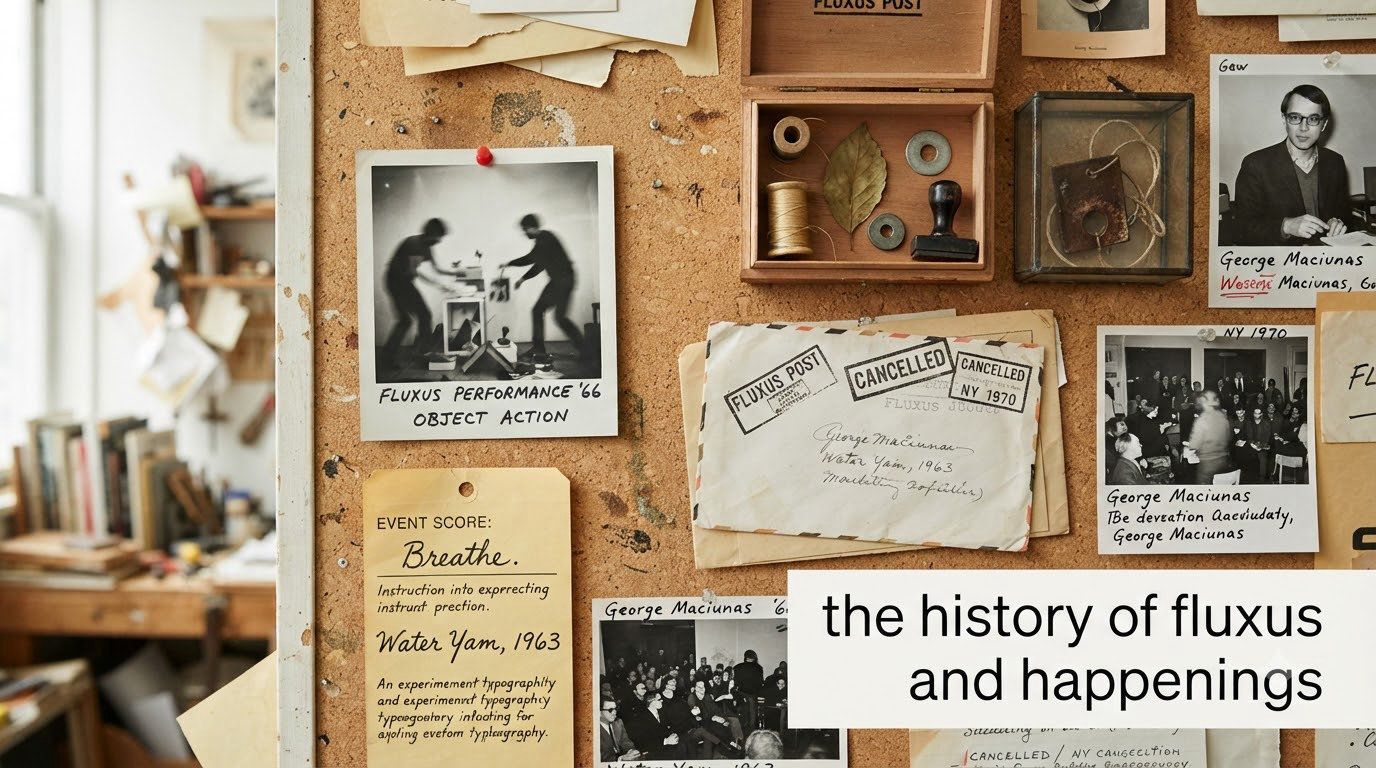
The Fluxus movement stands as one of the most playful yet radical disruptions in 20th-century art history. Emerging in the late 1950s from the experimental circles around John Cage, Fluxus artists questioned everything the art world held sacred. They created events, multiples, and experiences that blurred the line between art and everyday life. Understanding the history of Fluxus and Happenings reveals how a loose network of international artists fundamentally challenged what art could be and who it was for.
Fluxus was not a style but a sensibility, a way of approaching creativity that prized process over product, chance over control, and participation over passive viewing. The movement spanned roughly from 1959 to 1978, with its peak activity concentrated in the 1960s. Artists involved came from backgrounds in music, poetry, visual art, and performance, unified by a shared commitment to making art that was accessible, ephemeral, and often humorous.
What made Fluxus particularly significant was its response to the formalist tendencies that dominated post-war art. While abstract expressionists sought to create monumental canvases that spoke of individual genius, Fluxus artists turned toward the everyday, the modest, and the collaborative. They drew energy from the anti-establishment currents of the 1960s, connecting artistic experimentation to broader social questions about authority, institutions, and individual expression.
Table of Contents
What Was Fluxus?
Fluxus was an international, interdisciplinary art movement that sought to blur the boundaries between art and everyday life. The term itself, suggested by George Maciunas, suggested flow and movement, reflecting the nature of the work which resisted categorization. Unlike traditional art objects that could be bought and sold, Fluxus emphasized experiences, events, and ideas.
At its core, Fluxus represented an anti-art philosophy. Fluxus artists rejected the commercialization of art, the elitism of galleries and museums, and the preciousness of artistic technique. They wanted to bring art back to basics, to make it available to everyone, and to inject humor and playfulness into creative practice.
The movement encompassed performance, visual art, music, poetry, and experimental theater. Works often involved simple instructions that anyone could execute, eliminating the barrier between artist and audience. A Fluxus event might last seconds or hours, happen anywhere, and involve everyday objects or nothing at all.
The term intermedia, coined by Fluxus artist Dick Higgins, described the approach of crossing boundaries between artistic disciplines. Rather than specializing in one medium, Fluxus artists worked across multiple forms, often simultaneously. This interdisciplinary stance reflected a belief that artistic categories were artificial constraints that limited creative possibilities.
Historical Origins of Fluxus
The roots of Fluxus trace back to a pivotal year in American cultural history. In 1959, John Cage began teaching at The New School for Social Research in New York, gathering a remarkable group of young artists and thinkers who would become the core of Fluxus. The experimental atmosphere of these classes encouraged students to question everything they had learned about art.
John Cage’s Influence
Cage was revolutionizing music with his incorporation of silence, chance operations, and everyday sounds. His composition 4’33”, which consisted entirely of silence, had already challenged fundamental assumptions about what music could be. His compositions invited listeners to consider ambient sounds as musical material, collapsing the distinction between music and noise.
His teachings attracted artists who would become central to Fluxus, including George Maciunas, Al Hansen, and others. Cage’s emphasis on non-intention and his interest in Eastern philosophy, particularly Zen Buddhism, profoundly influenced those who would become Fluxus artists. They learned from him that art need not be about technical virtuosity or self-expression.
Cage’s use of the I Ching, an ancient Chinese divination text, to determine musical parameters introduced chance as a creative force. Rather than imposing their will on materials, artists could let the work reveal itself through randomized processes. This approach had enormous implications for Fluxus, which adopted chance operations as a central methodology.
George Maciunas and the Fluxus Name
George Maciunas became the central organizer and architect of the Fluxus movement. Born in Lithuania in 1931, Maciunas immigrated to the United States and developed a keen interest in avant-garde art. His organizational skills and design sensibility would shape how Fluxus presented itself to the world.
Maciunas coined the name Fluxus in 1961 or 1962, depending on the source consulted. The name combined the Latin word for flow with suggestions of effluent and flux. The name captured the liquid, ever-changing nature of the movement. He also designed many of the iconic Fluxus publications and announcements, with their distinctive graphic style that mixed humor with modernism.
In September 1961, Maciunas organized the first Fluxus event at the AG Gallery in New York, which he co-directed with artist Ray Kelly. This event brought together artists working in the experimental tradition and established Fluxus as a recognizable movement. From there, the network expanded rapidly, connecting artists across multiple cities and countries.
Maciunas’s role cannot be overstated. He served as the movement’s organizer, publisher, and often its most vocal advocate. While other artists contributed creative work, Maciunas provided the infrastructure that allowed the movement to function as a coherent entity. His design work created the visual identity that made Fluxus immediately recognizable.
Key Artists in the Fluxus Movement
The Fluxus movement included a remarkable diversity of talent, with artists from Korea, Germany, Japan, the United States, and beyond contributing to its development. Each brought unique perspectives and practices that enriched the collective enterprise. The international character of Fluxus distinguished it from other avant-garde movements, which tended to be centered in specific national contexts.
Yoko Ono
Yoko Ono joined the Fluxus circle in the early 1960s, bringing her background in avant-garde performance and conceptual art. Born in Tokyo in 1933, Ono had been involved in experimental art since the 1950s, performing instruction-based works that asked participants to imagine or perform simple actions.
Her instruction-based works, which she called Instruction Paintings, asked participants to imagine or perform simple actions that existed primarily in the realm of thought. These pieces could be executed by anyone, anywhere, without special materials or training. They represented the perfect realization of Fluxus principles.
Ono’s piece “Cut Piece” invited audience members to cut away portions of her clothing while she remained motionless on stage. First performed in 1964, the work explored themes of vulnerability, consent, and the relationship between performer and viewer. The piece continues to be performed by other artists, demonstrating its lasting power.
Her contributions demonstrated how Fluxus ideas could generate powerful, lasting art. Through her work with Fluxus and her subsequent career, Ono helped establish performance art as a serious artistic medium. Her approach combined spiritual depth with political engagement, pointing toward the expanded conception of art that Fluxus championed.
Nam June Paik
Nam June Paik, a Korean-born artist, became one of Fluxus’s most innovative figures. Born in Seoul in 1932, Paik was trained as a musician before turning to visual art. He was initially associated with the European avant-garde, studying with Cage in New York before joining the Fluxus circle.
Paik would go on to pioneer video art, creating works that anticipated the digital revolution by decades. But his Fluxus work focused on performances that challenged conventions in provocative ways. He saw humor as a weapon against artistic pretension.
In one famous performance, Paik played piano while progressively destroying the instrument. In another, he kissed various audience members while his assistant documented the interactions. His work combined humor with criticism, often skewering the pretensions of the art world.
Paik’s career demonstrated the potential of Fluxus ideas to generate new artistic directions. His later video installations, which combined multiple screens with performance elements, showed how Fluxus interdisciplinary approaches could evolve into major artistic achievements.
Alison Knowles
Alison Knowles brought a distinctive emphasis on accessibility and everyday materials to her Fluxus practice. Her performances often involved simple, repeatable actions that could be executed by anyone. She sought to remove the barrier between artist and audience, creating works that belonged to everyone.
Knowles’s “Identical Lunch” involved eating the same meal at the same restaurant every day for a year, documenting the experience. The piece transformed an ordinary routine into an artistic meditation on presence, attention, and the passage of time. This piece exemplified the Fluxus interest in routine, presence, and finding art in daily life.
Her approach was gentle, humorous, and deeply human. Rather than shocking audiences, Knowles invited them to reconsider the artistic potential of ordinary experience. She showed that Fluxus could embrace gentleness alongside provocation.
Knowles also contributed to the development of Fluxus multiples, creating editions of designed objects that could reach wider audiences. Her work demonstrated that Fluxus ideas could take material form without losing their democratic character.
George Brecht
George Brecht contributed the concept of the event score, which would become central to Fluxus practice. Born in Philadelphia in 1926, Brecht brought a scientific background to his artistic work. His training in chemistry influenced his systematic approach to artistic experimentation.
Unlike traditional musical scores, Brecht’s event scores were simple, often cryptic instructions that could be performed in countless ways. They emphasized the idea that art exists in the space between instruction and execution. A score like “Water” might be interpreted as a drawing, a performance, or a concept.
Brecht’s “Word Event” simply asked participants to consider a word. Another score instructed performers to “bring something to a place where something has been forgotten.” These minimal prompts generated infinite variations, demonstrating that creativity could emerge from constraint rather than freedom.
His work established the template for instruction-based art that would become central to conceptual art practices in the following decades. Brecht showed that the written instruction could function as a complete artistic work, independent of any specific execution.
Joseph Beuys
Joseph Beuys, though primarily associated with German performance art, maintained connections to Fluxus artists and shared their interest in expanding artistic definition. Born in 1921 in Germany, Beuys developed a unique body of work that combined shamanistic ritual with political engagement.
His belief that “everyone is an artist” resonated deeply with Fluxus philosophy. Beuys proposed that artistic creativity was a fundamental human capacity, not a specialized professional skill. This democratic vision of art aligned perfectly with Fluxus commitments to accessibility.
Beuys’s performances often involved elaborate rituals with symbolic materials like fat, felt, and copper. While distinct from typical Fluxus events, his work shared the emphasis on process, presence, and transformation. His influence on Fluxus and Fluxus’s influence on him operated in both directions.
Philosophy and Anti-Art
Fluxus emerged in direct opposition to the prevailing values of the established art world. The movement rejected the emphasis on original genius, technical mastery, and precious materials that characterized mainstream art. Instead, Fluxus artists celebrated ordinary objects, simple actions, and collaborative creation.
The term anti-art described this stance, though Fluxus artists preferred to think of themselves as simply making a different kind of art rather than rejecting art entirely. Their work questioned the assumptions underlying art institutions, exhibition practices, and the art market.
Fluxus anti-commercialism manifested in multiple ways. Artists created multiples, inexpensive editions of art objects designed for wide distribution. They refused to create works that could be commodified easily, instead emphasizing ephemeral experiences and instructions that resisted ownership.
The democratization of art remained a core Fluxus commitment. By creating works that anyone could perform or execute, Fluxus artists challenged the special status of trained artists. Art became a universal human capacity rather than a professional specialization. This vision anticipated contemporary discussions about creative participation and user-generated content.
The political context of the 1960s informed Fluxus anti-establishment stance. The movement emerged during a period of intense social upheaval, when questions about authority, institutions, and individual freedom were being hotly debated. Fluxus artists brought artistic experimentation into conversation with broader cultural criticisms.
Event Scores and Performance
Event scores represented one of Fluxus’s most significant innovations. These brief written instructions could generate performances that varied enormously in their execution. Unlike traditional theatrical scripts, event scores did not dictate specific actions or meanings. Instead, they provided frameworks for creative interpretation.
What Are Event Scores?
An event score might read as simply as “turning,” “a flame,” or “the cloud.” These minimal prompts invited interpretation and participation. The score existed as a kind of seed that grew differently in each performance context. This approach reversed traditional relationships between instruction and execution.
While traditional art forms emphasized the artist’s intention and technical execution, event scores placed emphasis on the performer’s interpretation and the circumstances of each performance. The score was not a blueprint but an invitation. This democratization of the performative act challenged assumptions about artistic authority.
This approach drew heavily on John Cage’s chance operations and musical experiments. Just as Cage used the I Ching to determine musical parameters, Fluxus artists used scores to remove their personal preferences from the creative process. The result emphasized process over product, happening over object.
Event scores could be performed by anyone, anywhere, at any time. This universality reflected Fluxus’s commitment to accessibility. Art did not require special training, expensive materials, or institutional support. It required only attention and willingness to participate.
Participation and Chance Operations
Fluxus events often involved chance elements that introduced unpredictability and surprise. Artists deliberately avoided complete control, allowing circumstance and randomness to influence the outcome. This approach connected to Eastern philosophical traditions, particularly Zen Buddhism.
Audience participation remained central to many Fluxus events. Rather than passive viewing, Fluxus demanded engagement. The boundary between performer and spectator dissolved, creating shared experiences that belonged to everyone present. This participatory model anticipated later developments in performance art and interactive media.
Some events were designed to happen spontaneously in everyday contexts. A Fluxus artist might perform a simple action in a subway station or restaurant, transforming ordinary space into artistic territory. These interventions demonstrated that art could exist anywhere, at any moment. They proposed that the potential for art was present in all human activities.
The integration of chance and participation produced events that could never be precisely repeated. Each occurrence was unique, shaped by the specific participants, location, and circumstances. This emphasis on unrepeatable experiences challenged the art market’s preference for reproducible objects.
Happenings vs Fluxus
One of the most common sources of confusion in discussing Fluxus involves its relationship to Happenings, a related but distinct movement in American art. While Fluxus and Happenings shared certain characteristics, they emerged from different contexts and embodied different priorities. Understanding the distinction illuminates both movements.
Happenings was developed by Allan Kaprow in the late 1950s, building on the work of Jackson Pollock and abstract expressionism. Kaprow sought to create events that broke down the boundary between art and daily life, much like Fluxus. However, Happenings tended to be more spontaneous and less formally organized than Fluxus events.
The key distinction lies in intentionality and structure. Fluxus events typically followed specific scores or instructions, even if those instructions allowed considerable interpretation. Happenings, as Kaprow conceived them, allowed for greater spontaneity and improvisation. They emerged from the moment rather than from pre-planned instructions.
Another important difference concerned duration and frequency. Fluxus artists often created repeatable events that could be performed multiple times in different contexts. Happenings typically existed as unique, unrepeatable experiences that could not be precisely duplicated. This reflected different philosophical priorities about the relationship between art and time.
Despite these differences, Fluxus artists and Happenings artists influenced each other, and the terms were sometimes used interchangeably in the 1960s. Both movements challenged traditional art boundaries, and both emphasized participation and the elimination of distance between art and life. The cross-pollination between the movements enriched both.
Kaprow himself was ambivalent about the relationship between Happenings and Fluxus. He appreciated the experimental energy of Fluxus but worried about its increasing formalization. Happenings, in his conception, should remain genuinely spontaneous, emerging from the specific social situation rather than from pre-existing plans.
Fluxus Festivals and Multiples
Between 1962 and 1964, Fluxus organized a series of major festivals that brought together artists from around the world and established the movement’s international reputation. These events showcased the diversity and vitality of Fluxus practice, demonstrating that the movement had moved beyond New York to become a global phenomenon.
The 1962-63 European Tour
The FLUXUS International Festival of the Newest Art took place in Wiesbaden, Germany, in September 1962. This event, organized by Maciunas, presented performances, concerts, and exhibitions by artists from Europe, Asia, and North America. It represented the first major gathering of the international Fluxus network.
The festival lasted for several days and included events by George Maciunas, Yoko Ono, Nam June Paik, and many others. Performances ranged from quiet, meditative pieces to chaotic, participatory events. The variety demonstrated the breadth of approaches that could be called Fluxus.
The festival continued in Paris later in 1962, then expanded to other European cities including Amsterdam, Copenhagen, and Stockholm. These events introduced Fluxus to European audiences and fostered connections between artists who had previously worked in isolation. The international dimension of the festivals reflected Fluxus’s rejection of national categories.
The 1963 Fluxus festival in Paris featured performances including George Maciunas’s “Anorganic Composition” and pieces by Yoko Ono and Nam June Paik. The festivals combined serious artistic experimentation with the playful, sometimes absurd humor characteristic of Fluxus. Audiences encountered art that challenged their expectations at every turn.
Multiples and Objects
Alongside performances, Fluxus artists created multiples, inexpensive editions of art objects designed for wide distribution. These ranged from printed materials to designed objects to edible items. Multiples embodied the Fluxus commitment to accessibility and anti-commercialism.
George Maciunas designed many multiples, including boxes containing collections of small works by various artists. These Fluxkits could be mailed and collected, making art available outside traditional gallery channels. The multiples cost very little, democratizing access to art in a way that traditional art objects could not.
Some multiples took unconventional forms. Alison Knowles created edible multiples, including a recipe card for “The Identical Lunch” that participants could use to recreate her performance. Other artists produced recordings, stamps, and everyday objects transformed through Fluxus sensibility.
The creation of multiples addressed a fundamental tension in Fluxus philosophy. While Fluxus emphasized ephemeral experiences over collectible objects, they recognized that some material trace of events was necessary for the movement to reach audiences beyond those present at specific performances. Multiples represented a compromise that maintained accessibility while creating shareable objects.
Zen Buddhism and Eastern Influence
Zen Buddhism profoundly shaped Fluxus philosophy and practice. Through John Cage, many Fluxus artists encountered Zen concepts that challenged Western assumptions about art, self, and meaning. The emphasis on presence, simplicity, and non-attachment reflected Zen influence.
Cage had studied Zen with D.T. Suzuki in New York, and he incorporated Zen principles into his musical compositions. His interest in silence, chance, and non-intention resonated with artists seeking alternatives to Western artistic conventions. Zen suggested that art could emerge from emptiness rather than from technical skill.
The Zen concept of beginner’s mind influenced Fluxus profoundly. This approach valued coming to creative work without preconceptions or technical training, approaching each moment as if experiencing it for the first time. Fluxus artists embraced this attitude, creating works that avoided the sophistication and complexity that characterized mainstream art.
Fluxus artists valued spontaneity over planning, process over product, and presence over representation. These attitudes manifested in the minimal scores, everyday materials, and participatory events that characterized Fluxus. Rather than imposing form on materials, Fluxus artists often let materials speak for themselves.
The influence of Zen appeared most clearly in the emphasis on here-and-now experience. Fluxus events demanded full attention to the present moment, rather than reflection on past achievements or future productions. Art became a way of being fully present rather than a way of producing objects that represented experience.
Fluxus West Expansion
While Fluxus originated in New York, the movement quickly spread to other regions. Artists like Robert Filliou brought Fluxus ideas to France, while others established Fluxus practices across Europe and eventually in California, where a distinct Fluxus West sensibility developed.
Robert Filliou, based in France, contributed a philosophical dimension to Fluxus thought. He spoke of “Teaching and Learning as Minor Art” and proposed that art could be found in neglected or ordinary activities. His mild, poetic approach balanced the more aggressive tendencies in Fluxus.
Filliou created works that found art in the mundane, like his “La Telephone” which connected two tin cans across the Atlantic, enabling imaginary conversations between Paris and New York. This piece suggested that artistic connection could transcend physical distance, anticipating digital communication.
In California, artists like Stanley Brouwn developed Fluxus practices adapted to the particular context of the American West. Brouwn’s work involved collecting everyday objects and presenting them as art, challenging viewers to reconsider the status of ordinary things. The expansion demonstrated the portability of Fluxus ideas across different cultural contexts.
The international dimension of Fluxus distinguished it from purely American art movements. Artists maintained connections across national boundaries, sharing ideas and collaborating despite Cold War tensions. Fluxus represented an alternative to the national categories that structured most cultural production during the 1960s.
Fluxus and Its Relationship to Dada and Neo-Dada
Fluxus drew explicit connections to the Dada movement of the early 20th century. Like Dada artists, Fluxus artists used humor, absurdity, and provocation to challenge artistic conventions. Both movements emerged in periods of social crisis and directed their energy against established institutions.
Marcel Duchamp, the central figure of Dada, influenced Fluxus profoundly. His readymades, ordinary objects presented as art, established a precedent that Fluxus artists built upon. Rather than creating original works, artists could designate existing objects as art, challenging the creative ideology of mainstream art.
The term Neo-Dada was sometimes used to describe the approach that preceded and overlapped with Fluxus. Artists like Jasper Johns and Robert Rauschenberg had already begun challenging artistic conventions in the 1950s, creating works that incorporated everyday objects and gestural mark-making. Fluxus pushed these experiments further.
What distinguished Fluxus from earlier anti-art movements was its systematic development of alternative practices. While Dada remained largely negative in its critique, Fluxus proposed specific alternatives: event scores, multiples, international festivals, and participatory events. The movement created infrastructure for alternative artistic practice.
Legacy and Impact on Later Art Movements
Fluxus left an indelible mark on contemporary art, influencing movements from conceptual art to performance art to installation art. The movement’s emphasis on ideas over objects, on participation over spectatorship, and on accessibility over exclusivity became foundational principles for later developments.
Conceptual artists of the late 1960s and 1970s built directly on Fluxus foundations. Like Fluxus artists, conceptual artists emphasized the idea over its material expression, used instruction-based formats, and challenged the art market’s emphasis on collectible objects. Lawrence Weiner, one of the most important conceptual artists, explicitly acknowledged Fluxus influence.
Sol LeWitt, who created instructional works that could be executed by others, drew on Fluxus precedents. His “Sentences on Conceptual Art” proposed that ideas could function as art independent of their material execution. These developments showed how Fluxus principles could generate new artistic movements.
Performance art in the 1970s and beyond drew heavily on Fluxus precedents. The use of the body as artistic medium, the emphasis on duration and presence, and the integration of everyday actions all connected to Fluxus practice. Artists like Chris Burden and Marina Abramovic developed approaches that extended Fluxus experiments.
The democratization of art that Fluxus championed continues to resonate in contemporary practice. Artists today routinely create work that invites participation, uses everyday materials, and resists commodification, following paths that Fluxus artists first explored. The sharing economy and social media have created new contexts for Fluxus-style artistic practice.
If you want to explore more about how Fluxus connects to broader traditions in performance art history, our comprehensive guide covers fifty essential works that shaped the field.
FAQs
What is Fluxus art?
Fluxus was an international, interdisciplinary art movement active from approximately 1959 to 1978. It sought to blur the boundaries between art and everyday life through performance, events, multiples, and conceptual works. Fluxus emphasized anti-art philosophy, accessibility, and participation.
When and where did Fluxus begin?
Fluxus began in 1959 in New York City, emerging from John Cage’s classes at The New School for Social Research. The first organized Fluxus event took place in 1961 at the AG Gallery in New York.
Who were some important artists involved in Fluxus?
Key Fluxus artists included Yoko Ono, Nam June Paik, George Maciunas, Alison Knowles, George Brecht, and Joseph Beuys. The movement was international in scope, with significant contributions from Korean, German, Japanese, and American artists.
What kinds of materials and methods did Fluxus artists use?
Fluxus artists used everyday materials, found objects, simple instructions (event scores), and performance. They created multiples (inexpensive art objects), event scores (instruction-based performances), and participatory events that emphasized process over product.
How did Fluxus challenge traditional ideas of art?
Fluxus challenged traditional art by rejecting commercialization, technical virtuosity, and precious materials. Fluxus artists embraced anti-art philosophy, created works anyone could perform, used chance operations, and emphasized accessibility over exclusivity.
What impact did Fluxus have on later art movements?
Fluxus influenced conceptual art, performance art, video art, and contemporary installation practices. Its emphasis on democratizing art, instruction-based works, and participation became foundational principles for later movements.
What is the difference between Fluxus and Happenings?
While both challenged art boundaries, Happenings (developed by Allan Kaprow) emphasized spontaneity and improvisation, often existing as unrepeatable events. Fluxus events typically followed specific scores or instructions and could be repeated in different contexts. Fluxus was also more internationally organized than Happenings.
Who was George Maciunas?
George Maciunas (1931-1978) was the central organizer and architect of Fluxus. Born in Lithuania, he immigrated to the United States where he coined the name Fluxus, organized key events and festivals, and designed many Fluxus publications and multiples.
Conclusion
The history of Fluxus and Happenings reveals a pivotal moment when artists fundamentally reimagined what art could be. Fluxus demonstrated that creativity belongs to everyone, not just trained professionals. It showed that art could emerge from simple instructions and everyday materials, from chance and participation rather than technical mastery.
The movement’s influence extends far beyond its peak years in the 1960s. Contemporary artists working in participatory practices, conceptual approaches, and ephemeral formats all build on Fluxus foundations. The questions Fluxus raised about art’s relationship to commerce, institutions, and daily life remain urgent today.
Understanding Fluxus helps us appreciate how thoroughly it transformed artistic possibilities. The movement proved that art need not be precious, expensive, or confined to galleries. It could happen anywhere, involve anyone, and cost nothing but attention. In challenging everything the art world held dear, Fluxus opened doors that remain open today.
The playful spirit of Fluxus, its insistence on joy and humor alongside serious artistic inquiry, offers a model for creative practice that remains vital and relevant. The history of Fluxus reminds us that art can be a way of living rather than a way of producing, a presence rather than a representation, a conversation rather than a monologue.
As we consider the ongoing democratization of creative practice through digital platforms and social media, Fluxus principles seem more relevant than ever. The movement’s insight that everyone possesses creative capacity anticipates contemporary discussions about user-generated content, participatory culture, and the dissolution of boundaries between producers and consumers. Fluxus was not simply a historical phenomenon but a set of principles that continue to shape artistic possibility.