
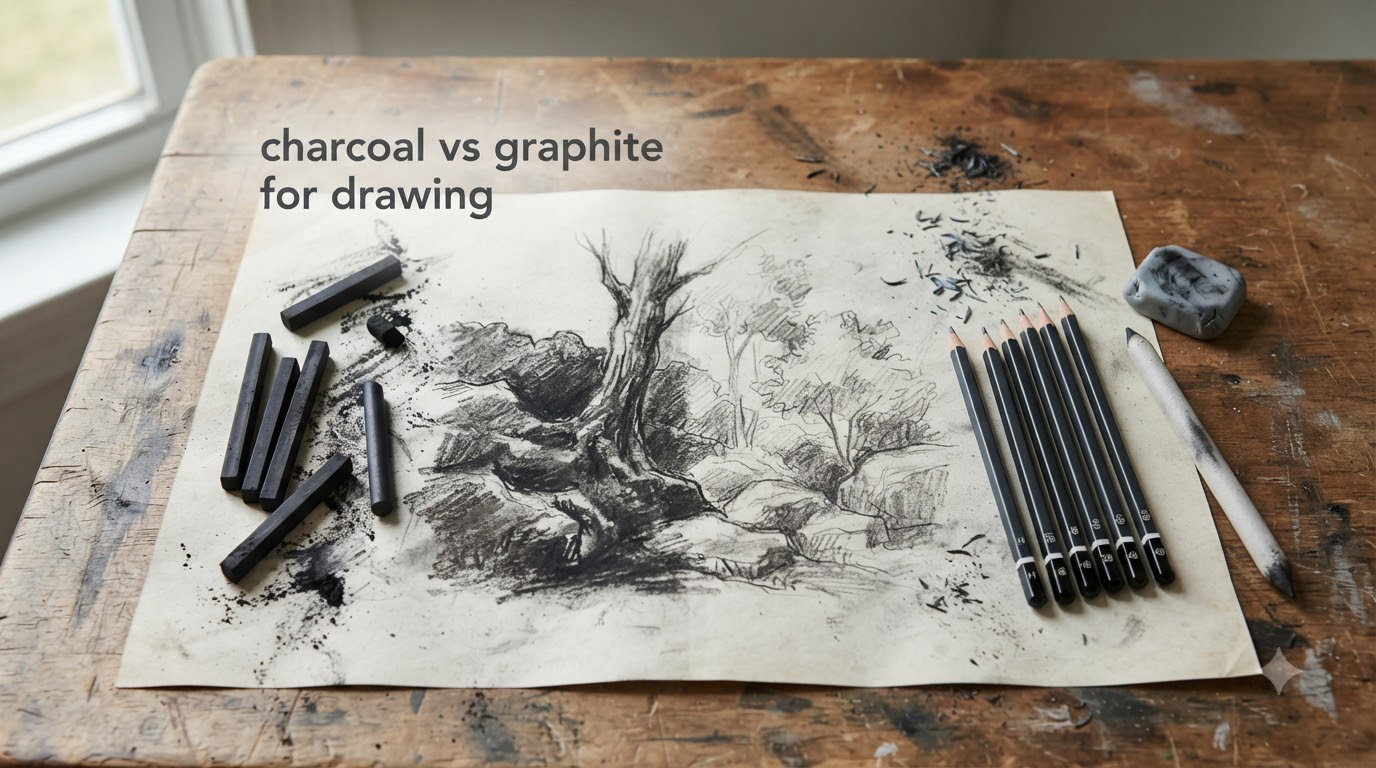
When I first started taking drawing seriously, I grabbed whatever pencils were in my desk and assumed graphite was the only option for serious work. Then I watched a portrait artist create something so dramatic and alive with charcoal that I put down my mechanical pencils and never looked back. That moment changed how I understood these two carbon-based mediums. Both charcoal and graphite have unique strengths, and understanding their differences will help you choose the right tool for your artistic vision.
This guide breaks down everything you need to know about charcoal vs graphite for drawing. We cover their origins, how they work, their pros and cons, and exactly when to reach for each one.
Table of Contents
What is Charcoal?
Charcoal is one of the oldest drawing materials humans have ever used. Artists create it by burning organic materials like willow branches, vines, or wood in a controlled environment with limited oxygen. This incomplete combustion process leaves behind soft, brittle carbon that crumbles easily onto paper.
You will find three main types of charcoal in art stores today. Vine charcoal comes from thin, burned grape vines and offers a soft, easily erasable mark perfect for preliminary sketches. Willow charcoal, made from willow wood, provides similar qualities with slightly harder edges. Compressed charcoal takes things further by binding powdered charcoal into sticks or pencils, creating darker, more permanent marks that adhere strongly to paper.
Charcoal pencil variants exist too, wrapping compressed charcoal in wooden casings similar to graphite pencils. These give you more control while maintaining that signature charcoal darkness. Some artists even use powdered charcoal applied with brushes or blending tools for large atmospheric areas.
The chemical structure of charcoal creates its distinctive qualities. Unlike graphite’s orderly atomic layers, charcoal forms an irregular, chaotic arrangement of carbon particles. When you draw with charcoal, these loosely bound particles break apart and scatter as dark powder across the paper surface, filling in the tooth of the paper rather than adhering in smooth lines.
What is Graphite?
Graphite is a naturally occurring mineral composed of crystallized carbon. History records that English colonists discovered graphite deposits in Borrowdale, Cumberland in 1564, initially mistaking it for a form of lead. The confusion gave us the name “pencil lead” even though no actual lead exists in modern pencils.
Modern graphite drawing materials mix refined graphite powder with clay binders and water. Manufacturers heat this mixture and press it into rods or encase it in wooden barrels. The ratio of graphite to clay determines the pencil’s hardness. More clay creates harder pencils that produce lighter, precise marks. Less clay means softer pencils that deposit more graphite and create darker, richer tones.
The pencil grading system reflects this range. Hard pencils (H, 2H, 4H, 6H) create light, fine lines perfect for technical drawings and architectural work. Middle grades (HB, 2B) balance darkness with control. Soft, dark pencils (3B, 4B, 5B, 6B and beyond to 9B) produce the deepest graphite tones available, though they sacrifice some precision.
Graphite’s atomic structure explains its smooth, gliding feel. Carbon atoms arrange in flat, hexagonal layers held together by weak chemical bonds. When you draw, these layers shear off cleanly and transfer onto paper in a smooth, consistent manner. This layered structure also creates graphite’s characteristic slight sheen, especially in heavier applications.
Key Differences Between Charcoal and Graphite
Understanding how these two mediums compare helps you make informed decisions for your artwork. Here is a direct comparison of their most important characteristics.
| Characteristic | Charcoal | Graphite |
|---|---|---|
| Appearance | Rich, matte black finish that absorbs light | Slightly reflective, metallic sheen |
| Texture | Soft, crumbly, powdery application | Smooth, consistent glide |
| Darkest Value | True black, can achieve intense depth | Limited to dark gray; never reaches true black |
| Erasability | Difficult once set; can smear easily | Easy to erase cleanly |
| Smudging | Smudges readily; requires fixative | Somewhat smudge-resistant; more stable |
| Layering | Excellent buildup with rich gradations | Can layer but may become shiny |
| Paper Damage | Minimal; works well on textured papers | Can burnish smooth with heavy pressure |
| Control | Less precise; expressive strokes | Highly precise; detailed work possible |
| Messiness | Produces significant dust and debris | Relatively clean application |
| Fixative Required | Yes, to prevent smudging | No, but optional for protection |
The most striking visual difference lies in their finishes. While charcoal gives a rich, matte black finish that absorbs light, graphite will always remain slightly reflective and metallic looking. This is why heavy graphite layering often appears shiny in photographs or under gallery lighting, while charcoal maintains its velvety darkness.
Artists who want the darkest possible blacks consistently choose charcoal. Graphite has a physical limitation where no matter how hard you press or how many layers you build, you cannot achieve the absolute black that charcoal reaches effortlessly. However, this limitation also means graphite never gets muddy or loses contrast the way layered charcoal can.
Pros and Cons of Each Medium
Charcoal Advantages
Charcoal excels at creating dramatic, high-contrast artwork with expressive energy. The powdery application allows you to block in large shapes quickly and build up rich, layered atmospheres. Many artists report that charcoal drawings have a living, breathing quality that graphite struggles to match.
The medium responds beautifully to blending techniques. Blending stumps, chamois cloths, and even your fingers can push and shape charcoal across the paper in ways that create soft transitions impossible to achieve smoothly with graphite. This makes charcoal ideal for portrait shading, atmospheric landscapes, and any work requiring subtle value gradations.
Charcoal also offers incredible versatility. You can work broadly with chunky sticks for expressive marks or refine details with thin pencil-format charcoal. The variety of charcoal types from extra-soft vine to hard compressed gives you a full range of values and line qualities within a single medium.
Charcoal Disadvantages
The messiness factor cannot be ignored. Charcoal produces significant dust that spreads everywhere and can stain clothing and surfaces permanently. This requires proper workspace setup with paper coverings and good ventilation, especially for those with respiratory sensitivities.
Erasing charcoal presents real challenges. Once charcoal particles settle into paper tooth, they become difficult to remove completely without damaging the paper surface. Kneaded erasers help lift some charcoal, but you will never achieve the crisp erasure possible with graphite. This makes corrections more challenging and preliminary sketch work with charcoal more committal.
Charcoal requires fixative spray to properly set and protect finished work. Without fixative, even minor contact smudges and damages the drawing. You need to apply multiple thin coats with proper drying time between layers, adding significant time to your finishing process. This extra step frustrates many beginning artists.
Graphite Advantages
Graphite offers exceptional control and precision. The smooth, consistent line quality lets you create fine details, technical drawings, and photorealistic renderings with confidence. Mechanical pencils extend this precision further with consistently thin lead diameters impossible to achieve with standard wooden pencils.
The clean, predictable application makes graphite more accessible for beginners. There is less mess, easier corrections, and more forgiving interaction with different paper types. Graphite works well on smooth papers where charcoal might skip or appear inconsistent.
Erasers perform exactly as expected with graphite. You can lift lines cleanly, create highlights, and correct mistakes without paper damage. This predictability reduces frustration and supports the learning process without fighting your materials.
Graphite requires no protective spray when finished. Your work remains stable and smudge-resistant without additional steps, making it more practical for sketches, studies, and work that moves through your studio quickly.
Graphite Disadvantages
The reflective quality of graphite creates challenges for finished artwork. Heavy layering produces a metallic sheen that photographs poorly and can look inconsistent under variable lighting conditions. Artists selling original graphite work or creating pieces for exhibition sometimes find this limitation frustrating.
Graphite has a darkness ceiling. Even the softest 9B pencils cannot achieve the absolute black that charcoal reaches naturally. If your artistic goals require true blacks and maximum contrast, graphite will always feel somewhat limited compared to charcoal’s range.
The smooth texture of graphite can sometimes read as sterile or lacking energy, particularly in expressive work. Some viewers and artists perceive graphite drawings as too controlled, too neat, missing the gestural energy that makes charcoal work feel alive and immediate.
Best Use Cases
For dramatic, high-contrast shading and bold strokes, charcoal art delivers impact that graphite cannot match. Portrait artists frequently use charcoal for final renderings where the rich blacks create dimensional depth and emotional intensity. Life drawing sessions often favor charcoal for quick, expressive captures of the human form where speed matters more than precision.
For detailed sketching, architectural drawings, and technical illustration, graphite remains the superior choice. The consistent line quality and precise control support work where accuracy and refinement take priority over expressive mark-making. Many professional illustrators use graphite for client-approved preliminary sketches before committing to final media.
Experienced artists frequently combine both mediums in mixed media artwork. You can establish composition and values with graphite, then layer charcoal over specific areas to push values darker and add expressive energy. The contrast between graphite’s precision and charcoal’s drama creates visual interest impossible with either medium alone.
For beginners, graphite often makes the more forgiving starting point. The ability to erase cleanly, the minimal mess, and the predictable application let you focus on fundamental skills without battling your materials. Once you understand value control and shading fundamentals with graphite, transitioning to charcoal becomes easier because you already understand the underlying principles.
Did Leonardo da Vinci use charcoal? Historical evidence suggests yes. Renaissance artists commonly used charcoal for preliminary sketches and underdrawings, valuing its easy application and ability to be brushed away before final painting. Many rediscoveries of underdrawings in old masters’ paintings reveal charcoal sketch lines beneath oil paint layers.
Tips and Techniques
Blending charcoal requires different techniques than graphite. Use a kneaded eraser for lifting and shaping rather than spreading. Blending stumps work well for softening edges, but avoid over-blending which creates muddy grays. Work from dark to light by adding charcoal rather than trying to lift it back to lighter values.
With graphite, vary your pencil angle and pressure to maximize value range. Hold pencils farther back for lighter, more gestural marks. Use the pencil’s edge for consistent thin lines and the flat side for broad shading strokes. Layer gradually, building values in multiple light passes rather than one heavy application that damages paper tooth.
Sealing charcoal work properly matters for long-term preservation. Apply fixative in thin, even coats from 12-18 inches away. Move in sweeping horizontal passes, overlapping each stroke by about 50 percent. Three thin coats work better than one heavy coat which can cause streaks or pooling. Let each coat dry completely before adding the next.
Protect your workspace regardless of medium. Cover your drawing surface with scrap paper to catch debris. Use a spray fixative in well-ventilated areas, preferably outdoors or near open windows. Clean your hands before eating or touching other surfaces to prevent transferring charcoal or graphite stains.
Store unfinished charcoal drawings flat between sheets of glassine paper to prevent smudging. Do not stack multiple charcoal works directly on top of each other. Graphite drawings can be stored more casually since they resist smudging, though glassine protection remains advisable for valuable work.
FAQs
Is charcoal or graphite better for sketching?
Graphite is generally better for controlled, precise sketches where you need clean lines and easy corrections. Charcoal excels in expressive, gestural sketching where dramatic value and energy matter more than precision. Many artists use graphite for preliminary studies and charcoal for final expressive work.
Is charcoal or graphite better for beginners?
Graphite is typically more forgiving and easier for beginners to learn with. The clean application, easy erasing, and predictable results let new artists focus on fundamental skills like shading and proportion without fighting their materials. Once you understand values and shading basics with graphite, transitioning to charcoal becomes easier.
What are the disadvantages of using charcoal for drawing?
Charcoal is messy, producing significant dust that stains. It smudges easily and requires fixative spray to protect finished work. Erasing charcoal is difficult and often leaves shadows in the paper. The messiness and extra sealing step make charcoal less convenient than graphite for quick studies and practice work.
Did Leonardo da Vinci use charcoal?
Yes, historical evidence and technical analysis of Renaissance paintings suggest that artists like Leonardo da Vinci commonly used charcoal for preliminary sketches and underdrawings. Charcoal was valued for its easy application and the ability to brush it away before final painting layers were applied.
Conclusion
Choosing between charcoal vs graphite for drawing ultimately depends on your artistic goals, working style, and the specific requirements of each project. Graphite offers precision, cleanliness, and predictability that serves technical work and controlled rendering beautifully. Charcoal provides dramatic depth, expressive energy, and unmatched darkness that brings portraiture and expressive work to life.
Neither medium is objectively better than the other. Serious artists typically develop fluency with both, selecting each based on what the work demands. Start with graphite to build fundamental skills, then experiment with charcoal to expand your expressive range. Understanding both mediums transforms you from someone who uses drawing tools into someone who truly understands drawing materials and can leverage their unique properties for maximum artistic impact.