
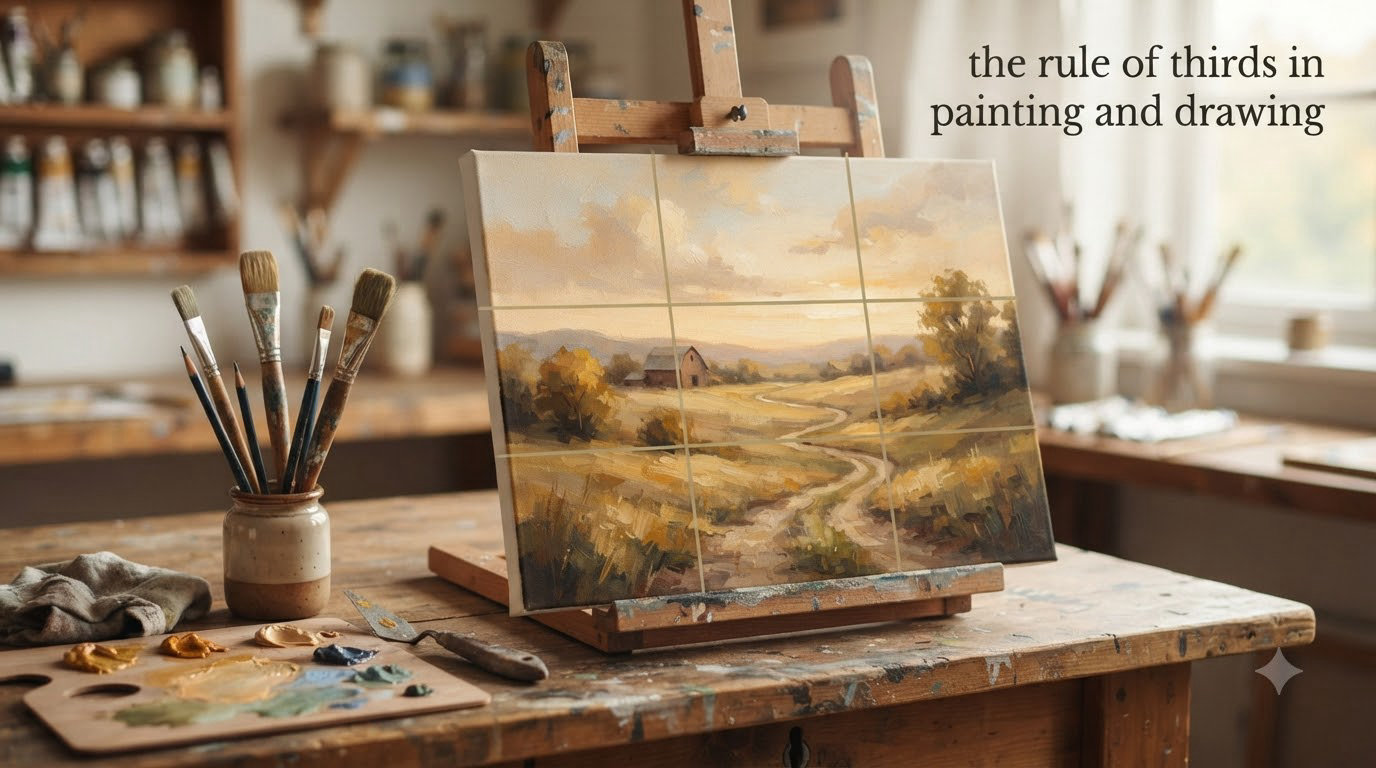
The rule of thirds in painting and drawing is one of the most fundamental composition techniques that artists use to create visually engaging artwork. This simple yet powerful guideline divides your canvas into a 3×3 grid, with focal points placed along the lines or at their intersections. In this complete guide, you will learn exactly how to apply the rule of thirds, see examples from master painters, and understand when to break this guideline for maximum impact in 2026.
Table of Contents
What is the Rule of Thirds in Painting and Drawing?
The rule of thirds is a compositional guideline that suggests dividing your canvas or picture plane into nine equal parts using two equally spaced horizontal lines and two equally spaced vertical lines. This creates a grid that helps artists position key elements in their work for more dynamic, visually pleasing compositions. Instead of placing your main subject directly in the center, you position it along these imaginary lines or at the four intersection points where the lines cross.
These intersection points are sometimes called power points or sweet spots because elements placed there tend to draw the viewer’s eye more effectively than centered compositions. The human eye naturally gravitates toward these off-center positions, making artwork feel more balanced and engaging. This is why photographers, painters, and illustrators have relied on this technique for centuries.
The rule works because it creates visual tension and interest. A centered subject can feel static or formal, while an off-center placement creates movement and flow as the viewer’s eye travels through the composition. When you place horizon lines along the horizontal thirds rather than through the middle, you give the sky or land appropriate emphasis while maintaining visual balance.
How to Apply the Rule of Thirds in Your Artwork
Applying the rule of thirds in painting and drawing is straightforward once you understand the basic framework. Start by visualizing your canvas divided into three equal horizontal sections and three equal vertical sections. Imagine drawing lines that create nine equal rectangles, similar to a tic-tac-toe grid. The four points where these lines intersect are your power points for placing focal elements.
For landscape paintings, position your horizon line along one of the horizontal thirds lines rather than dead center. If you want to emphasize the sky, place the horizon along the lower third line. If the landscape below deserves more attention, push the horizon to the upper third. This creates breathing room and visual interest that a centered horizon lacks.
In portrait work, position the eye or face along the upper horizontal third line. Many artists place the dominant eye near one of the intersection points on the upper third. This creates a more engaging portrait than centering the face, as it guides the viewer to look directly at the subject before exploring the rest of the composition.
For still life compositions, place your main object near one of the intersection points. Arrange supporting elements along the grid lines to create visual flow. Negative space becomes more intentional when you use the rule of thirds, allowing empty areas to breathe while maintaining overall balance in the piece.
Rule of Thirds Examples in Famous Paintings
Looking at master painters reveals how consistently the rule of thirds in painting and drawing appears across different eras and styles. Johannes Vermeer, the Dutch Golden Age painter, frequently used this composition technique in works like “Girl with a Pearl Earring” where the subject’s face aligns with the upper right intersection point, creating an intimate yet dynamic portrait.
J.M.W. Turner employed the rule of thirds in his landscapes, placing horizons along the lower third to emphasize dramatic skies filled with light and movement. His compositions feel expansive because he gave the sky two-thirds of the visual space while keeping land elements along the lower grid lines. This technique draws viewers into the atmospheric depth of his work.
Pierre-Auguste Renoir’s impressionist works demonstrate how the rule of thirds works in more casual compositions. His figures often fall along the grid lines, with garden scenes arranged so focal elements occupy the intersection points. Even without rigid adherence, the underlying thirds structure creates pleasing arrangements that feel natural rather than forced.
When you study paintings with grid overlays, you will notice that even seemingly informal compositions often follow this principle. Compositional awareness develops over time as you train your eye to see these divisions. You can apply this same analytical approach when displaying art with compositional awareness in your own space or when curating collections.
Applying the Rule of Thirds in Drawing
Drawing exercises offer an excellent way to internalize the rule of thirds before tackling complex paintings. Start with simple thumbnail sketches where you block in compositions using the grid system. Draw three vertical lines and three horizontal lines on small paper squares, then position simple shapes like circles or rectangles at intersection points. This practice builds intuitive understanding that transfers directly to larger works.
Landscape drawings benefit enormously from thirds placement. Sketch a horizon line at the lower third, then place trees, buildings, or figures along the vertical grid lines. Use intersection points for your most important elements. When drawing from photo references, hold a viewfinder with a grid overlay to analyze how professional photographers already use this principle to frame their shots.
Portrait and figure drawings require careful eye placement using the rule of thirds. Position the eyes along the upper horizontal line, with the dominant eye near a vertical third. The nose can fall along the middle third, and the chin along the lower third. This division creates naturally balanced facial proportions that feel harmonious without being rigid.
Abstract and non-representational drawings can still benefit from thirds placement. Even without recognizable subjects, you can arrange shapes, lines, and color areas using the grid system to create visual balance. Many abstract artists use compositional frameworks intuitively, placing emphasis in thirds while maintaining overall harmony in their pieces. When you want to analyze composition in art, understanding thirds placement helps explain why certain abstract arrangements feel more dynamic than others.
History and Origins of the Rule of Thirds
The rule of thirds in painting and drawing traces its roots to the Renaissance period when artists began systematically studying proportion and composition. While the golden ratio had been used since antiquity, the specific thirds division became more explicitly discussed in the 18th and 19th centuries as art theory evolved. Painters and critics formalized what many artists had been doing intuitively for centuries.
Some scholars trace the principle back to John Thomas Smith’s “Remarks on Rural Scenery” published in 1791, where he discussed dividing compositions into thirds for improved visual impact. However, artists had been applying similar principles long before this written documentation. The concept emerged naturally from observing what compositions felt most pleasing to the human eye.
Renaissance masters like Leonardo da Vinci used proportional systems extensively, though often with golden ratio applications rather than strict thirds. The thirds guideline became more popularized as art education expanded and compositional principles were breaking down into teachable rules. Today, it remains one of the first composition techniques taught in drawing and painting classes worldwide.
Conceptual artists like Christo and Jeanne-Claude approached composition differently, often using massive scale and environmental context rather than traditional grid systems. However, even their work demonstrates conceptual art and composition techniques that consider visual placement and viewer engagement in thoughtful ways.
Rule of Thirds vs Golden Ratio: Understanding the Connection
Many artists wonder about the relationship between the rule of thirds and the golden ratio. While both are compositional guidelines that create pleasing arrangements, they differ in their mathematical foundations and visual outcomes. The golden ratio (approximately 1:1.618) produces a spiral pattern that feels naturally occurring in nature and art, while the rule of thirds creates a simpler grid-based division.
The golden ratio often appears in master paintings through compositional arrangement rather than strict mathematical application. When you overlay both systems on a canvas, you will notice that the intersection points of the thirds grid fall near, but not exactly on, golden ratio points. This slight difference can create noticeably different compositions, with thirds feeling more structured and golden ratio feeling more organic.
For practical purposes, the rule of thirds is easier to apply quickly while painting or sketching. You can visualize the grid without precise measurements, making it more accessible for field work and preliminary sketches. The golden ratio requires more careful calculation, which can interrupt the creative flow when you are working on location or capturing spontaneous inspiration.
Neither principle should be followed rigidly. Some compositions work better with centered placement, and experienced artists know when to break these rules intentionally. The goal is not mathematical perfection but visual communication. Understanding both systems gives you more tools for creating effective compositions that serve your artistic vision rather than constraining it.
Common Mistakes When Using the Rule of Thirds
Beginners often make the mistake of placing focal points too close to the edge when using the rule of thirds in painting and drawing. While intersection points should guide placement, elements that sit too near the canvas edge feel cramped and uncomfortable. Aim for positioning important elements within the general area of the intersection points rather than exactly at the corners of your canvas.
Another frequent error is over-rigid adherence to the grid in every situation. The rule of thirds is a guideline, not a law. Some compositions genuinely work better with centered placement, particularly when symmetry or formal balance serves the artistic purpose. Portraits with religious or symbolic significance, for example, often use centered compositions intentionally to convey authority or stability.
Forgetting about negative space represents another common pitfall. The rule of thirds helps you use empty space intentionally, not just place subjects on the grid lines. Ensure the empty areas in your composition feel deliberate and balanced rather than accidental. The space around your focal point matters as much as the placement of the focal point itself.
Square formats present unique challenges because the equal divisions can feel constraining. When working with square canvases or paper, you might experiment with placing elements at different points along the grid or even using multiple focal points at separate intersection points. This creates visual interest without forcing the composition into predictable patterns that feel formulaic.
FAQs
What is the rule of thirds in a painting?
The rule of thirds is a compositional guideline that divides the canvas into nine equal parts using two horizontal and two vertical lines. Artists place focal points along these lines or at their intersections to create more dynamic, visually engaging paintings rather than static centered compositions.
Why do artists use the rule of thirds?
Artists use the rule of thirds because it creates more visually interesting and dynamic compositions than centering subjects. The technique guides the viewer’s eye through the artwork using natural power points at intersection areas, creating visual flow and pleasing arrangements that feel balanced without being rigid.
What is the 70/30 rule in art?
The 70/30 rule in art refers to compositional balance where approximately 70% of the visual weight falls in one area while 30% balances it elsewhere. This creates asymmetrical balance similar to the rule of thirds but with more dramatic proportion differences, often used to emphasize one element while maintaining overall harmony.
What are the 7 laws of drawing?
The seven laws of drawing typically include: 1) The law of alignment and gesture, 2) The law of proportion, 3) The law of light and shadow, 4) The law of perspective, 5) The law of composition, 6) The law of values, and 7) The law of edges. These fundamental principles guide artists in creating convincing, well-composed artwork.
Who famously got rejected from art school?
Vincent van Gogh was famously rejected from the Royal Academy of Fine Arts in Brussels, though his journey included many art schools turning him away. Rather than being a barrier to success, these rejections often pushed artists to develop unique styles outside traditional academic training.
Final Thoughts on the Rule of Thirds in Painting and Drawing
The rule of thirds in painting and drawing remains one of the most valuable compositional tools available to artists at any skill level in 2026. By understanding how to divide your picture plane into thirds, position focal points at intersection areas, and create visual flow through off-center placement, you gain a framework that serves everything from quick sketches to finished masterpieces.
Practice applying the rule in your next drawing session. Start with thumbnail compositions, then move to larger works. Over time, you will find yourself naturally seeing the grid system in everyday scenes, photographs, and existing artwork. This visual literacy transforms how you approach composition in all your artistic endeavors.
Remember that guidelines exist to serve your artistic vision, not restrict it. Once you internalize the rule of thirds, you will know exactly when to break it intentionally for maximum impact. The masters understood these principles deeply, which allowed them to break rules effectively when the composition demanded it. Study their work, practice consistently, and develop your own compositional instincts.
If you want to see these principles in action among professional collections, visit galleries where you can observe compositional techniques in gallery settings. Seeing masterworks in person reveals how artists applied these principles with subtlety and sophistication that photographs cannot fully capture.