
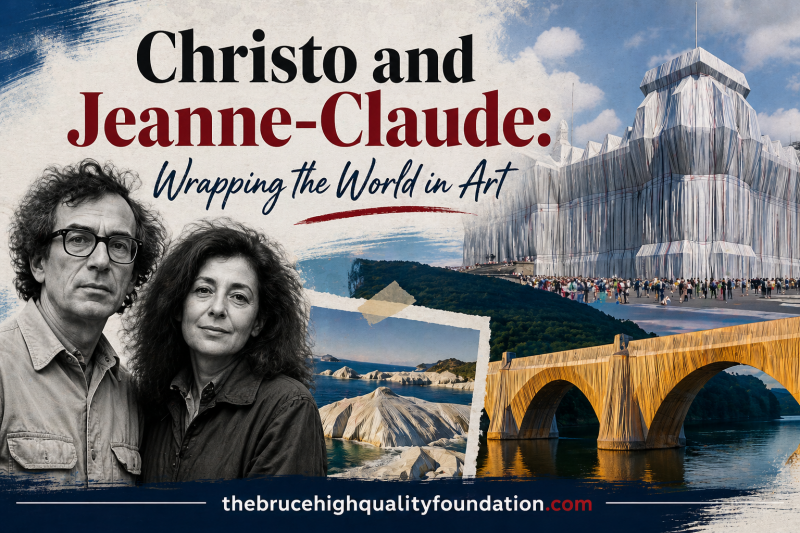
Imagine walking through Central Park and encountering 7,503 gates draped in flowing saffron fabric, creating golden pathways through the winter landscape. Picture the German Parliament building transformed into a gleaming silver sculpture wrapped in polypropylene fabric, or walking across a floating dock that lets you feel like you’re stepping on water itself. These were not dreams or digital renderings. They were real experiences created by Christo and Jeanne-Claude, the husband-and-wife artistic team who spent over five decades wrapping the world in fabric and redefining what public art could be.
Christo and Jeanne-Claude were environmental artists who created some of the most ambitious temporary installations in art history. Their work transformed familiar landmarks and landscapes into something entirely new, often using millions of square feet of fabric to wrap buildings, surround islands, or create pathways where none existed before. What made their art unique was not just its massive scale, but its temporary nature. Each installation existed for only a few weeks before being dismantled forever, leaving behind only photographs, memories, and preparatory drawings.
Their philosophy centered on what they called “revelation through concealment.” By wrapping objects, they didn’t hide them. They revealed new forms, new ways of seeing, and new relationships between structures and their surroundings. Their work challenged conventional ideas about permanence in art, commercial sponsorship, and who could access monumental cultural experiences.
Table of Contents
The Artists Behind the Fabric
Christo Javacheff was born in Gabrovo, Bulgaria in 1935. Growing up behind the Iron Curtain shaped his understanding of freedom and artistic independence. He studied at the Sofia Academy of Fine Arts before defecting to the West in 1957, first to Prague, then Vienna, and finally settling in Paris. These early experiences with borders, barriers, and the contrast between hidden and revealed spaces would later inform his artistic practice.
Jeanne-Claude Denat de Guillebon was born in Casablanca, Morocco in 1935 to a French military family. She met Christo in Paris in 1958, and they married in 1960. From the very beginning of their relationship, they worked as a creative team, though the art world would not always give Jeanne-Claude equal credit for their collaborative output. They both changed their names legally to “Christo” and “Jeanne-Claude” to share a single artistic identity, though they continued to sign works with both names.
Their early work began modestly with wrapped objects, furniture, and small-scale items. These packages and wrapped objects served as prototypes for the monumental environmental works that would define their career. By the late 1960s, they had begun creating large-scale installations that required years of planning, engineering, and negotiation with governments and communities.
Recent scholarship has re-examined Jeanne-Claude’s role in their partnership, revealing that she was often the driving force behind project logistics, engineering decisions, and creative vision. The controversy over credit suppression became particularly visible in 2021 when L’Arc de Triomphe Wrapped was publicized with Christo’s name alone, despite being a collaborative work planned by both artists before Jeanne-Claude’s death in 2009. Art historians and critics have increasingly emphasized that their work was always a true partnership, with Jeanne-Claude contributing equally to the conceptual and practical aspects of every major installation.
Why They Wrapped: The Philosophy of Concealment and Revelation
Christo and Jeanne-Claude repeatedly stated that their wrapped objects had no deeper meaning beyond their visual impact. They rejected symbolic interpretations that suggested wrapping represented censorship, preservation, or hidden truths. Instead, they argued that wrapping simply created a new form, a new aesthetic experience that revealed aspects of the wrapped object that went unnoticed when visible.
This concept of “revelation through concealment” became the foundation of their artistic philosophy. When they wrapped the Reichstag in Berlin, the fabric didn’t hide the building. It emphasized its contours, its scale, and its relationship to the city around it. The silver fabric caught the changing light throughout the day, transforming the familiar landmark into something dynamic and new. Visitors who had walked past the building hundreds of times suddenly saw it differently, noticing architectural details and proportions that had become invisible through familiarity.
The temporary nature of their work was equally important. Christo and Jeanne-Claude insisted that their installations must be free to experience and available to everyone. Unlike museum exhibitions that charge admission, their projects were public art in the truest sense. This commitment to accessibility also meant that their work was fundamentally about presence. You had to be there during those specific weeks to experience it. The temporary nature created urgency and exclusivity without elitism. Everyone who chose to visit had the same opportunity, regardless of wealth or status.
They maintained complete independence from corporate sponsors, governments, and galleries. Every project was entirely self-funded through the sale of preparatory drawings, collages, and early works. This independence allowed them to maintain complete creative control and refuse any commercial use of their projects. They turned down millions in sponsorship offers to preserve the integrity of their vision.
Christo and Jeanne-Claude’s Major Projects: A Complete Guide
The scale of Christo and Jeanne-Claude’s environmental art defies easy categorization. Their projects required thousands of workers, millions of dollars, and years of planning. Yet each installation lasted only a brief moment in time. This section explores their most significant works, from early experiments to their final posthumous installation.
Wrapped Reichstag, Berlin (1995): Wrapping a Symbol of Democracy
The Wrapped Reichstag remains their most iconic work and one of the most visited art installations in history. For two weeks in June 1995, the German Parliament building was completely wrapped in 100,000 square meters of silver polypropylene fabric, secured with 15 kilometers of blue rope. The project took 24 years to approve, with Christo and Jeanne-Claude submitting proposals repeatedly to the German government starting in 1971.
The political significance of wrapping the seat of German democracy cannot be overstated. The Reichstag had been burned in 1933, bombed during World War II, and stood as a complex symbol of German history. By wrapping it, Christo and Jeanne-Claude created a temporary work of art that allowed millions of people to see this loaded symbol in a new way. Over five million people visited the installation, walking around and through the fabric-draped columns and porticos.
The silver fabric reflected the changing light throughout the day, appearing almost white in bright sun and glowing softly at dusk. The wrapping emphasized the building’s neoclassical proportions while temporarily erasing its historical weight. For those two weeks, the Reichstag was neither a political battleground nor a historical monument. It was simply a beautiful form in space, free for everyone to experience without admission fees or barriers.
The Gates, Central Park (2005): 7,503 Saffron Portals
The Gates transformed New York’s Central Park into a golden corridor for 16 days in February 2005. Christo and Jeanne-Claude installed 7,503 gates along 23 miles of park pathways, each supporting free-hanging saffron-colored fabric panels that waved in the winter wind. The project cost $21 million and was funded entirely by Christo and Jeanne-Claude through the sale of their preparatory drawings and early works.
The timing in deep winter was intentional. The bare branches of trees allowed the saffron fabric to stand out against the grey-brown landscape and pale sky. When snow fell during the installation period, the contrast between white ground and golden fabric created an almost magical landscape that drew millions of visitors. The gates were positioned to frame views of the park’s natural and architectural features, creating new sightlines and encouraging visitors to walk pathways they might never have explored.
Over four million people visited The Gates during its brief existence. For New Yorkers, it became a shared experience that transcended the usual divisions of the city. People from every neighborhood and background walked through the park together, experiencing something that would never exist again. The temporary nature made each visit feel precious. You had to be there during those specific February days, or you missed it forever.
Floating Piers, Lake Iseo, Italy (2016): Walking on Water
Floating Piers allowed visitors to walk on water across Italy’s Lake Iseo for 16 days in June 2016. The installation consisted of 100,000 square meters of shimmering yellow fabric covering floating docks that connected the mainland to the lake’s islands of Monte Isola and San Paolo. Over 1.2 million people walked the 3-kilometer floating pathway, experiencing the sensation of walking on water as the fabric-covered piers responded to the movement of waves beneath them.
This was the first major project completed after Jeanne-Claude’s death in 2009, though she had been deeply involved in its planning. Christo carried forward their shared vision, overseeing the engineering challenge of creating stable floating walkways that could support thousands of visitors while maintaining the illusion of walking directly on water. The golden fabric changed color throughout the day, appearing almost orange in morning light and soft yellow in the afternoon sun.
The experience was disorienting in the best way. Walking on the floating piers, you felt the movement of the lake beneath your feet while seeing the landscape from a perspective that had never been accessible before. The pathway transformed the relationship between visitors and the lake, making the water itself feel different. Where the lake had been a barrier, it became a surface to be walked across.
Surrounded Islands, Biscayne Bay (1983): Pink Polypropylene Paradise
Surrounded Islands transformed 11 islands in Miami’s Biscayne Bay by surrounding them with 6.5 million square feet of floating pink polypropylene fabric for two weeks in May 1983. The bright pink fabric contrasted dramatically with the blue-green water of the bay, creating what Christo described as a “pink necklace” visible from the air, water, and surrounding land.
The project required enormous environmental coordination to protect the bay’s ecosystem. Teams of workers in boats unfurled the fabric borders around each island, anchoring them carefully to avoid damage to mangroves and marine life. The pink color was chosen specifically for its interaction with the tropical light and water, creating different visual effects depending on viewing angle and time of day.
The installation drew hundreds of thousands of visitors who viewed it from boats, airplanes, helicopters, and the surrounding shores. It remains one of the most photographed environmental art projects in history and established Christo and Jeanne-Claude’s reputation for creating works that existed simultaneously as intimate experiences and monumental landscape transformations.
Running Fence, Sonoma and Marin Counties (1976): 24 Miles of White
Running Fence consisted of a 24.5-mile white nylon fabric fence running through ranchland in Sonoma and Marin Counties, California, for two weeks in September 1976. The fence crossed hills, roads, and farmland before ending at the Pacific Ocean, creating a visible line through the landscape that existed for just 14 days before being completely removed.
The project required navigating complex property rights and local opposition. Christo and Jeanne-Claude spent years meeting with ranchers, obtaining permissions from 59 private landowners, and working through legal challenges from community members who opposed the installation. The struggle for approval became part of the project’s story, highlighting the challenges of creating large-scale temporary art.
When finally installed, the white fence created a striking visual element that emphasized the rolling contours of the California landscape. The fabric panels rippled in the coastal wind, appearing almost alive as they responded to changing weather. The fence’s journey to the ocean created a narrative element, suggesting a connection between inland farmland and the Pacific coast.
Early Masterpieces: Valley Curtain, Wrapped Coast, and Pont Neuf
Before their famous wrapping projects of the 1990s and 2000s, Christo and Jeanne-Claude created several landmark works that established their approach to environmental art. Valley Curtain (1972) involved hanging a 400-foot-high orange curtain across Rifle Gap in Colorado. After 28 months of preparation and $750,000 in costs, the curtain was installed but lasted only 28 hours before wind destroyed it. Despite the brief duration, the project entered art history as a bold attempt to transform a natural landscape through temporary intervention.
Wrapped Coast (1969) in Little Bay, Sydney, Australia, covered one million square feet of rocky coastline with fabric and rope. It required 17,000 man-hours from 100 workers and volunteers, establishing the collaborative labor model that would characterize all their future projects. The wrapped Australian coastline drew 50,000 visitors during its ten-week existence and proved that monumental environmental art could attract substantial audiences.
Pont Neuf Wrapped (1985) covered Paris’s oldest bridge in sandstone-colored fabric, transforming the historic structure for two weeks. The project took nine years to approve and required complex coordination with Parisian authorities. The wrapping emphasized the bridge’s elegant curves and stone details, making the familiar landmark appear almost ancient and renewed simultaneously. It demonstrated that their wrapping philosophy worked as effectively on architecture as on natural landscapes.
Final Works: L’Arc de Triomphe Wrapped (2021) and the Unrealized Over the River
L’Arc de Triomphe Wrapped was the final Christo and Jeanne-Claude project, completed posthumously in September 2021 after Christo’s death in 2020. The Paris monument was wrapped in 25,000 square meters of silvery-blue recyclable polypropylene fabric and 3,000 meters of red rope, realizing a vision the artists had conceived in 1961 when they lived near the monument. The project sparked controversy when early publicity emphasized Christo alone, prompting debate about Jeanne-Claude’s equal contribution and the erasure of her role in their collaborative work.
Over the River was the project that never happened. Planned for the Arkansas River in Colorado, it would have suspended 5.9 miles of translucent fabric panels above the river for two weeks. Christo and Jeanne-Claude spent 20 years and $15 million on preparation and permits before canceling the project in 2017. Opposition from local communities, environmental groups, and political figures made the installation impossible. The cancellation demonstrated the limits of even their determination and resources.
The cancellation was personally devastating to Christo, but he channeled the refunded permitting fees into completing the London Mastaba in 2018, a 600-ton sculpture of 7,000 painted oil barrels floating on Serpentine Lake in London. This final completed project during his lifetime returned to their early work with oil barrel sculptures while applying the same temporary, monumental approach that defined their career.
How Christo and Jeanne-Claude Funded Their $20 Million Art Projects
Perhaps the most remarkable aspect of Christo and Jeanne-Claude’s work was their complete independence from traditional art world funding. They never accepted sponsorships, grants, corporate partnerships, or government arts funding. Every project, from the earliest wrapped objects to the multimillion-dollar Reichstag installation, was entirely self-funded.
Their funding model was simple but effective. They sold preparatory drawings, collages, scale models, and early wrapped objects created during the planning phases of their major projects. Christo would create hundreds of drawings and collages showing the proposed installation from various angles, in different lights, and with technical details. These works were sold to collectors, galleries, and museums to generate the capital needed for the actual installation.
This approach had several important consequences. First, it ensured complete creative control. Without sponsors to please, they could make every artistic decision independently. Second, it meant their public installations could be completely free to visitors, fulfilling their commitment to accessible art. Third, it created a fascinating relationship between the permanent preparatory works and the temporary installations they depicted.
The financial scale was staggering. The Gates cost $21 million. The Floating Piers cost $17 million. Wrapped Reichstag cost over $13 million. All of it came from art sales, not investors or sponsors. Christo maintained that this independence was essential to their artistic integrity. “We pay for everything,” he repeatedly stated. “We do not accept sponsorships of any kind.”
Controversies and Tragedies: The Umbrellas, Credit Debates, and Over the River
The artistic achievements of Christo and Jeanne-Claude were not without controversy, tragedy, and criticism. Understanding these difficult aspects provides essential context for evaluating their legacy and the complex realities of creating monumental temporary art.
The Umbrellas project in 1991 ended in tragedy. The installation involved simultaneously placing 1,760 yellow umbrellas in California and 1,340 blue umbrellas in Japan to create a commentary on the similarities and differences between the two landscapes. After three weeks of successful exhibition, a woman was killed by a windblown umbrella in California, and a worker was electrocuted while dismantling umbrellas in Japan. Christo immediately ordered the project closed, and the remaining umbrellas were removed. The deaths cast a shadow over the project and raised serious questions about safety in environmental art.
The credit controversy surrounding Jeanne-Claude’s role intensified in the years after her death. For decades, many articles, exhibition labels, and press releases emphasized Christo as the primary artist, with Jeanne-Claude mentioned as an assistant or afterthought. In reality, she was an equal partner in every aspect of their work, from conceptual development to engineering decisions to political negotiations. The 2021 L’Arc de Triomphe Wrapped project became a flashpoint when early publicity credited Christo alone, sparking outrage from art historians and critics who had been documenting Jeanne-Claude’s overlooked contributions.
Environmental critics raised valid concerns about the impact of their massive installations. Surrounding islands with fabric, wrapping coastlines, and suspending materials over rivers all carried environmental risks. The materials alone, millions of square feet of polypropylene and nylon, represented significant industrial production. While Christo and Jeanne-Claude always committed to complete cleanup and restoration after each project, the environmental cost of temporary art remains a legitimate subject for debate.
The Over the River cancellation represented a rare defeat. After 20 years of planning and $15 million in preparatory costs, they were forced to abandon the project due to sustained opposition from local communities and political leaders. Some opponents described the planned installation as “hanging pornography in a church,” reflecting deep cultural divides about appropriate uses of natural landscapes. The cancellation demonstrated that even their persistence and resources had limits.
Legacy and Recognition: How Christo and Jeanne-Claude Changed Public Art
The influence of Christo and Jeanne-Claude on contemporary art cannot be overstated. They fundamentally expanded the possibilities of public art, environmental art, and temporary installation. Their work influenced generations of artists working with site-specific installation, land art, and socially engaged practice.
Their major awards included the Praemium Imperiale from the Japan Art Association in 2006, often described as the Nobel Prize for the arts. They received recognition from governments worldwide, including Germany’s highest cultural honors for the Reichstag project. Their work is held in major museum collections globally, and their preparatory drawings command significant prices at auction.
Perhaps more important than institutional recognition was their impact on public understanding of art. Millions of people who would never visit a contemporary art museum experienced Christo and Jeanne-Claude’s installations. The Gates alone introduced four million people to conceptual environmental art. These visitors didn’t need art historical training to appreciate the experience. They simply needed to walk through a park, look at a building, or cross a lake.
The re-evaluation of Jeanne-Claude’s role continues to shape their legacy. Art historians and feminist scholars have documented her equal contribution to their collaborative practice, correcting decades of inadequate recognition. This process parallels broader movements in art history to acknowledge the overlooked contributions of women artists and artistic partners.
Wolfgang Volz’s photography became an essential part of their legacy. His extensive documentation of every project created an archive that allows these temporary works to persist visually long after the physical installations were removed. His photographs captured not just the installations themselves, but the human experience of encountering them, the crowds, the interactions, and the ways people responded to these transformed spaces.
Frequently Asked Questions About Christo and Jeanne-Claude
Why did Christo and Jeanne-Claude wrap things?
Christo and Jeanne-Claude wrapped objects and buildings based on their philosophy of revelation through concealment. They believed that wrapping didn’t hide objects but revealed new aspects of their form and relationship to surroundings. They rejected symbolic interpretations, stating their work had no deeper meaning beyond visual impact and the experience of seeing familiar things transformed.
What buildings did Christo wrap?
Christo and Jeanne-Claude wrapped several major buildings including the Reichstag in Berlin (1995), the Pont Neuf bridge in Paris (1985), and L’Arc de Triomphe in Paris (2021). Their building wraps used polypropylene fabric and rope to transform architectural landmarks into temporary sculptures that emphasized form and scale.
What did Christo wrap in Sydney?
In 1969, Christo and Jeanne-Claude created Wrapped Coast at Little Bay in Sydney, Australia. They covered one million square feet of rocky coastline with fabric and rope, creating a monumental environmental installation that lasted ten weeks and drew 50,000 visitors.
What is the significance of the wrapped Reichstag?
The Wrapped Reichstag (1995) was significant as both an artistic achievement and political symbol. Wrapping the German Parliament building transformed a complex historical monument into a temporary work of art that five million people visited. It demonstrated how wrapping could reveal new perspectives on familiar landmarks while remaining completely accessible and free to the public.
Did Christo ever sell his artwork?
Yes, Christo and Jeanne-Claude sold preparatory drawings, collages, scale models, and early works to fund their installations. However, they never sold the actual installations themselves, which were always temporary and free to experience. Their self-funding model allowed complete independence from corporate sponsors and government arts funding.
What happened to the artist Christo?
Christo died on May 31, 2020, at age 84. He continued working after Jeanne-Claude’s death in 2009, completing Floating Piers (2016), London Mastaba (2018), and planning L’Arc de Triomphe Wrapped, which was completed posthumously in 2021 according to their shared vision.
Did Christo work alone?
No. Christo worked in partnership with Jeanne-Claude from 1961 until her death in 2009. All major projects were collaborative works created by both artists. After Jeanne-Claude died, Christo completed projects they had planned together. Recent scholarship has emphasized Jeanne-Claude’s equal contribution, correcting decades of inadequate recognition of her role.
The Enduring Impact of Wrapping the World
Christo and Jeanne-Claude created art that refused to follow conventional rules. Their work was temporary in an art world obsessed with permanence. It was free in a culture of expensive museum admissions and exclusive galleries. It was massive yet ephemeral, transforming landmarks for mere weeks before disappearing forever.
Their philosophy of revelation through concealment continues to resonate in 2026. By wrapping the familiar, they taught us to see the world differently. The Reichstag was never just a parliament building again after they wrapped it in silver fabric. Central Park’s pathways were reimagined through saffron gates. Lake Iseo became a surface to walk across rather than a body of water to observe from shore.
Their partnership reshaped how we understand artistic collaboration. The ongoing re-evaluation of Jeanne-Claude’s equal contribution serves as a reminder that creative vision often comes from multiple sources, and that recognizing those contributions matters for understanding art history accurately.
Today, their projects exist only in memory, photography, and the preparatory drawings sold to fund them. Yet their influence persists in every temporary installation that transforms public space, in every artist who refuses corporate sponsorship to maintain independence, and in every viewer who experienced something they never expected and will never forget. Christo and Jeanne-Claude didn’t just wrap buildings and landscapes. They wrapped our understanding of what art could be, revealing new possibilities through the fabric of their extraordinary vision.