
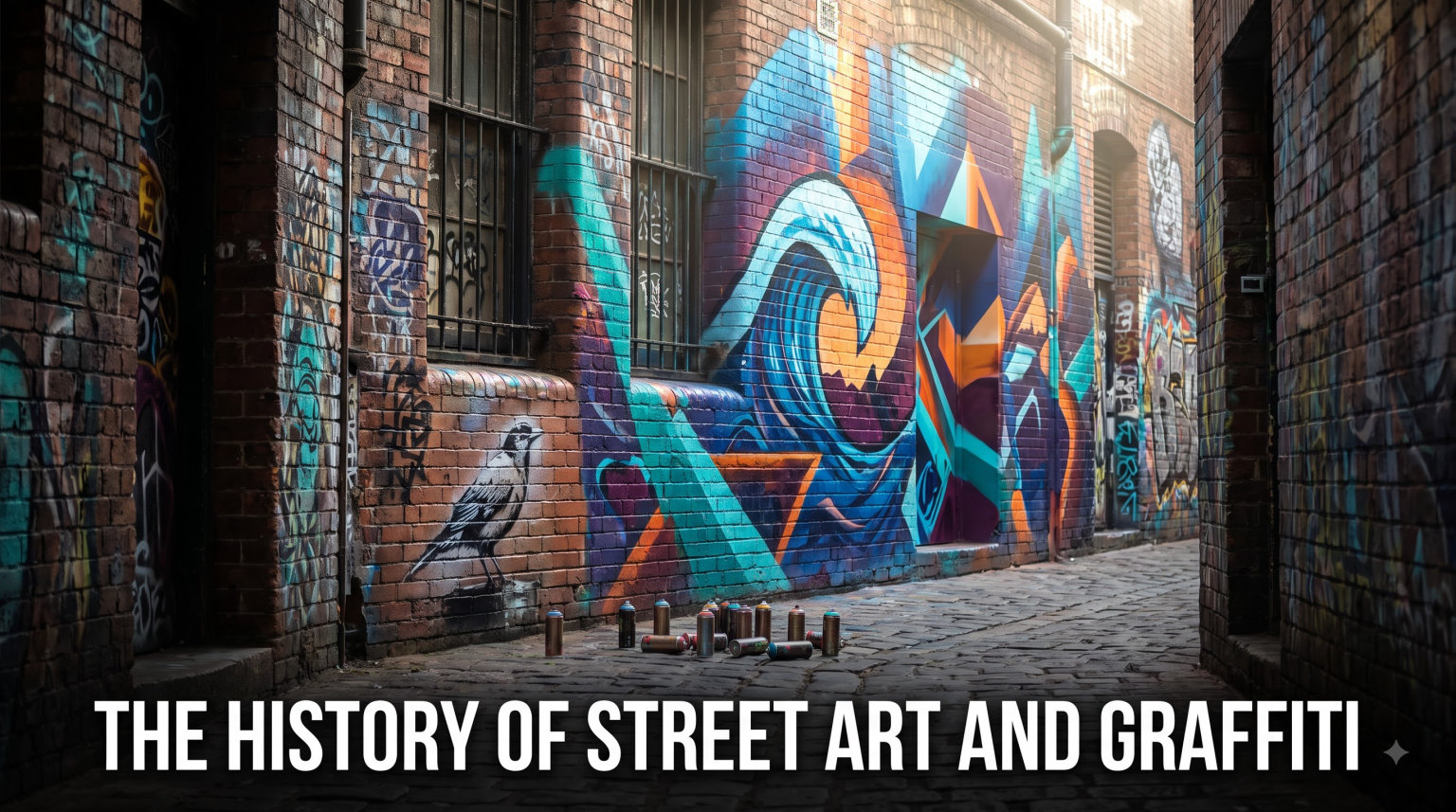
Walk through almost any major city in 2026 and you will see it: bold colors on concrete, political messages on brick, cartoon characters staring out from alley walls. Street art and graffiti have become such a normal part of the urban landscape that it is easy to forget this visual language has been evolving for thousands of years. The history of street art and graffiti does not start in 1970s New York, even though that is the era most people picture. It starts with our earliest ancestors scratching images into cave walls, continues through Roman soldiers carving their names into stone, and eventually explodes into the global movement we know today.
I have spent years studying how urban art grew from an underground act of rebellion into a respected art form displayed in major museums. Our team traced the key moments, the pioneering artists, and the cultural shifts that shaped this story. If you want to understand how we got from ancient handprints on stone to Banksy pieces selling for millions, this guide walks you through every major chapter. For a deeper look at the artists who pushed this movement forward, check out our profiles of guerrilla art artists who transformed public space.
Table of Contents
Ancient Origins: Graffiti Before There Was a Word for It
The impulse to mark a wall is older than writing itself. Long before spray cans existed, humans found ways to leave their mark on the surfaces around them. Understanding these ancient origins is the first step in tracing the history of street art and graffiti.
The earliest examples date back roughly 17,000 years. The Lascaux cave paintings in France feature hundreds of animal figures and abstract symbols painted onto stone walls. These were not commissioned works or gallery pieces. They were raw, direct expressions placed on the most available canvas our ancestors had. Similar cave art appears in Indonesia, Australia, and across Africa, proving this was a universal human behavior, not a local quirk.
Ancient Egypt contributed its own form of wall marking. Workers and travelers carved hieroglyphic graffiti into temple walls and along trade routes. These markings were not official inscriptions. They were personal notes, complaints about working conditions, and boasts about completed projects. Sound familiar? The same motivations that drive modern taggers drove these ancient writers.
The city of Pompeii preserves what may be the richest collection of ancient graffiti ever found. When Mount Vesuvius buried the city in 79 AD, it also preserved thousands of handwritten messages on its walls. Roman citizens wrote political slogans, romantic declarations, insults, and advertisements. One famous example reads: “I am amazed, O wall, that you have not fallen in ruins, you who support the wearisome chatter of so many scribblers.” Even in antiquity, people complained about graffiti.
Viking explorers left runic inscriptions on walls and monuments from Scandinavia to North America. Greek athletes carved boasts about their victories into temple stones at Olympia. In each case, the pattern is the same: ordinary people using public surfaces to declare “I was here.” This is the same drive that powers modern graffiti, just separated by millennia.
The Birth of Modern Graffiti: 1960s and 1970s
Modern graffiti as we recognize it today was born in American cities during the late 1960s. Two cities played the biggest role: Philadelphia and New York. The history of street art and graffiti takes its modern shape in this era, driven by young people who wanted their names seen by as many people as possible.
Philadelphia: Where It Started
Most accounts credit Darryl “Cornbread” McCray as the first modern graffiti writer. In the mid-1960s, Cornbread was a teenager in North Philadelphia who started writing his name on walls and transit vehicles to get the attention of a girl he liked. The strategy worked for that purpose, but it also sparked something bigger. Cornbread began writing his name everywhere he could reach, and soon other young Philadelphians followed his lead. He reportedly even tagged a Jackson 5 concert jet and an elephant at the Philadelphia Zoo, stunts that earned him legendary status.
New York City: The Explosion
New York took what Philadelphia started and multiplied it a hundredfold. In 1971, The New York Times published an article about TAKI 183, a Greek-American teenager named Demetrius who worked as a messenger in Manhattan. TAKI wrote his nickname and his street number (183rd Street in Washington Heights) on subway cars, walls, and subway stations across the city. When the Times article ran, it turned TAKI 183 into a celebrity and inadvertently inspired thousands of imitators.
Other early NYC pioneers included Julio 204, who wrote his name on subway cars along 204th Street, and Cay 161, whose tags appeared across upper Manhattan. The key innovation these writers shared was the subway system. By writing on the outside of trains, a single tag could be seen across all five boroughs in a single day. The subway became a rolling gallery, and writers competed fiercely for visibility.
The Culture of “Getting Up”
By the mid-1970s, a distinct culture had formed around subway graffiti. Writers developed the concept of “getting up,” which meant getting your name seen as widely as possible. The more visible your tag, the more respect you earned. Writers formed crews for mutual protection and collaboration. Numbers in graffiti often indicated the year painted, an area code, a crew number, or a personal significance. The community had its own rules too, with the most famous being: if you get caught, you face the consequences alone. That code of silence was and remains central to graffiti culture.
For more on how this art form compares to the gallery world that eventually embraced it, read our breakdown of Street Art vs. Gallery Art.
Graffiti Style Evolution: From Tags to Wildstyle
As competition among writers intensified, simple tags were no longer enough to stand out. The history of street art and graffiti is also a story of visual innovation, as artists pushed letterforms to increasingly complex levels.
Tags
A tag is the most basic form of graffiti: a quickly written nickname, usually done with a marker or a single color of spray paint. Tags are about speed and frequency. A writer wants to put up as many tags as possible across the widest area. Think of tags as the signature, the calling card that says “I was here.” Every graffiti artist starts with tags before moving on to more complex forms.
Throw-Ups
A throw-up (sometimes called a “throwie”) is a step up from a tag. It uses two colors and consists of an outline filled in quickly, often with bubble-style letters. The goal is still speed: a writer wants to execute a throw-up fast enough to avoid getting caught, but large enough to be visible from a distance. Throw-ups became the standard for writers who wanted more presence than a tag but could not invest the time required for a full piece.
Pieces (Masterpieces)
A piece, short for masterpiece, is a large, detailed, multi-colored work that takes significant time and skill to complete. Pieces usually include three or more colors, detailed lettering, characters, and background designs. The term “masterpiece” reflects the ambition: these are the works that earn a writer lasting recognition. Whole subway cars covered in elaborate pieces became the ultimate achievement during the 1970s and early 1980s.
Wildstyle
Wildstyle graffiti is the most technically demanding form. It features interlocking letters, arrows, spikes, and decorative elements that make the text nearly impossible for outsiders to read. Wildstyle developed as both an artistic challenge and a form of coded communication: only other writers and those immersed in the culture can decipher the text. This style pushed graffiti into increasingly abstract visual territory and helped establish it as a legitimate art form requiring serious skill.
Heaven Spots
One term that comes up often in graffiti culture is the “heaven spot.” A heaven spot is a location that is extremely difficult to reach: rooftops, the tops of bridges, highway signs, or any surface that requires significant risk to access. Writers who successfully tag heaven spots earn massive respect because the difficulty of reaching these spots demonstrates both commitment and daring. The term captures something essential about graffiti culture: it rewards risk, visibility, and audacity above all else.
The Hip-Hop Connection: Graffiti as the Fourth Element
You cannot tell the history of street art and graffiti without talking about hip-hop. By the late 1970s, graffiti had become one of the four foundational elements of hip-hop culture, alongside DJing, MCing (rapping), and breakdancing. This connection was not accidental. All four elements emerged from the same communities in the South Bronx and upper Manhattan during the same period.
Young people in these neighborhoods faced systemic neglect, crumbling infrastructure, and few creative outlets. Hip-hop culture provided a way to transform limited resources into powerful forms of expression. You did not need a recording studio to be a rapper. You did not need a dance studio to be a breakdancer. And you did not need a canvas or a gallery to be a graffiti writer. All you needed was a spray can and a wall.
Fab Five Freddy (Fred Brathwaite) played a key role in connecting graffiti to the broader hip-hop movement. A painter and hip-hop pioneer, Fab Five Freddy bridged the worlds of downtown art galleries and uptown street culture. His work helped establish graffiti as a visual component of hip-hop rather than an isolated phenomenon. He later hosted the influential music video show “Yo! MTV Raps,” bringing hip-hop culture, including its visual arts component, to a national audience.
The hip-hop connection gave graffiti cultural context and community. Writers were not just individuals marking walls. They were part of a broader movement that valued creativity, competition, and self-expression in the face of limited opportunities. This cultural framework helped graffiti survive the intense crackdowns of the 1980s and laid the groundwork for its global spread.
From Streets to Galleries: The 1980s Art World Embrace
The 1980s marked a turning point in the history of street art and graffiti. What had been treated as pure vandalism by city authorities suddenly became valuable to art dealers, collectors, and curators. This transition was controversial then and remains debated today.
Jean-Michel Basquiat
Jean-Michel Basquiat is the most famous example of this transition. Basquiat began his career as half of the graffiti duo SAMO, writing cryptic poems and slogans across lower Manhattan in the late 1970s. His raw, powerful visual style caught the attention of the art world, and by the early 1980s he was exhibiting in major galleries. Basquiat’s paintings sold for tens of thousands of dollars while he was still in his early twenties. His friendship and collaboration with Andy Warhol cemented his status as a serious fine artist, not just a former graffiti writer. Basquiat died in 1988 at age 27, but his legacy endures as proof that graffiti-born talent could command the highest levels of art world respect.
Keith Haring
Keith Haring took a different path into the gallery world. Haring began by drawing chalk figures on black paper panels in New York subway stations. These unauthorized drawings became so popular that commuters would wait to see new ones. Haring’s bold, cartoon-like figures became an instantly recognizable visual language. He opened the Pop Shop in 1986, selling his imagery on affordable merchandise, a move that democratized access to his art but also drew criticism from those who saw it as commercialization. Haring died in 1990 from AIDS-related complications, but his imagery remains among the most recognizable in all of contemporary art.
The Sellout Debate
The gallery embrace created a permanent tension within the graffiti community. Was moving into galleries a betrayal of the street-level ethos that defined the culture? Or was it a natural progression that gave talented artists the resources and recognition they deserved? This debate continues in 2026. Some writers see gallery representation as the ultimate validation. Others view it as abandoning the rebellious, anti-establishment roots of the form. The tension between these positions has shaped how street art and graffiti have evolved over the past four decades.
For more on the artists who have navigated this boundary between street and institutional recognition, explore our feature on the most influential contemporary artists.
The Contemporary Street Art Scene: Banksy, Fairey, and Beyond
From the 1990s onward, the history of street art and graffiti entered a new phase. Artists began using new techniques, reaching global audiences, and commanding prices that would have stunned the early pioneers. Street art became a recognized genre with its own stars, its own market, and its own controversies.
Banksy: The Anonymous Phenomenon
No discussion of contemporary street art is complete without Banksy. This anonymous England-based artist began working in Bristol in the 1990s and has since become the most famous street artist in the world. Banksy’s stencil art combines dark humor, political commentary, and striking visual simplicity. His works have appeared on walls across every continent. In 2018, his painting “Girl with Balloon” partially shredded itself moments after selling at auction for $1.4 million, a stunt that became one of the most discussed art events of the decade. Banksy’s anonymity is central to his mystique and his message: he is the famous artist that nobody knows, and his refusal to reveal his identity is itself a statement about the art world’s obsession with celebrity.
Shepard Fairey and OBEY
Shepard Fairey built an art empire from a sticker. His “Andre the Giant Has a Posse” sticker campaign, launched in 1989, evolved into the global OBEY brand. Fairey’s “Hope” poster for Barack Obama’s 2008 presidential campaign became one of the most recognized political images of the 21st century. His work blends wheat paste posters, screen printing, and stencil techniques with political messaging rooted in propaganda and counterculture.
Women Pioneers
The history of street art and graffiti has too often been told as a story of men. But women have been part of this movement from its early days, even if they received less recognition. Lady Pink (Sandra Fabara) began painting subway trains in 1979 and became one of the few women accepted in the male-dominated graffiti scene of the early 1980s. Claw Money (Claudia Gold) developed a distinctive claw symbol that became ubiquitous in New York. Swoon (Caledonia Curry) created intricate wheat-paste portraits that brought a new level of detail to street-level work. These artists and many others challenged the assumption that graffiti was exclusively a male domain.
Global Street Art Capitals
Street art became a global phenomenon, with certain cities emerging as major centers. Berlin became an open-air gallery after the fall of the Wall, with the East Side Gallery preserving works by artists from around the world on a remaining section of the Berlin Wall. Sao Paulo developed a distinctive style called “pichacao,” tall, narrow lettering painted on high-rise buildings. Melbourne earned recognition for its vibrant laneway street art scene. These cities proved that the movement was not just an American phenomenon but a global language of urban expression.
Preservation vs. Removal
One of the most complex debates in 2026 centers on what happens to street art after it is created. Should unsanctioned works be preserved or removed? When a Banksy appears on a building, does the property owner have the right to destroy it, or does the cultural value of the work take precedence? Some cities have created legal mural districts where artists can work without fear of prosecution. Others invest heavily in graffiti removal programs. The tension between preserving spontaneous urban art and maintaining clean public spaces reflects the deeper tension between graffiti as art and graffiti as vandalism that has existed since the beginning.
For those interested in how museums engage with street art, our MoMA PS1 guide covers an institution known for its commitment to contemporary and urban art exhibitions.
Street Art vs Graffiti: Understanding the Difference
One question comes up constantly in discussions about this topic: what is the actual difference between street art and graffiti? The history of street art and graffiti shows that while these terms are often used interchangeably, they refer to related but distinct practices.
Graffiti is primarily text-based. It focuses on letters, words, and names. The core goal is visibility: getting your name or your crew’s name seen by as many people as possible. Graffiti is typically done with spray paint or markers and is almost always unsanctioned. The culture around graffiti emphasizes competition, reputation, and “getting up.”
Street art is primarily image-based. It includes stencils, wheat-paste posters, stickers, murals, installations, and sculptures placed in public spaces. Street art often carries a political or social message. It is more likely to be commissioned or at least tolerated by property owners and city governments. Street artists tend to see themselves as making interventions in the urban environment, transforming blank walls into something that engages passersby.
The reality is more complicated than this simple split. Many artists work in both traditions. A graffiti writer might produce stencil-based street art, and a street artist might incorporate tagging into their work. The boundary between the two is porous, and the debate about where one ends and the other begins is part of what keeps the culture alive and evolving. What matters most is recognizing that both forms share a common ancestor: the human impulse to mark a surface and say “I was here.”
FAQs
What is the history of street art?
Street art traces back to prehistoric cave paintings roughly 17,000 years ago, but as a modern movement it began in the 1960s and 1970s in Philadelphia and New York City. Early writers like Cornbread and TAKI 183 popularized tagging on city walls and subway trains. Through the 1980s, artists like Jean-Michel Basquiat and Keith Haring brought graffiti-influenced work into galleries. By the 2000s, artists like Banksy and Shepard Fairey turned street art into a globally recognized art form blending political commentary with urban aesthetics.
Who was the first modern graffiti artist?
Most historians credit Darryl ‘Cornbread’ McCray as the first modern graffiti artist. In the mid-1960s, Cornbread began writing his name on walls and transit vehicles throughout North Philadelphia. His original motivation was to impress a girl, but his prolific tagging inspired a wave of imitators and helped launch the modern graffiti movement.
When did graffiti start?
Graffiti in the broadest sense started with prehistoric cave paintings tens of thousands of years ago. Ancient examples include Egyptian hieroglyphic graffiti, Greek inscriptions at temples, and Roman graffiti preserved at Pompeii. Modern graffiti, characterized by stylized writing with spray paint and markers on urban surfaces, began in the mid-1960s in Philadelphia and exploded in New York City during the early 1970s.
What is the difference between graffiti and street art?
Graffiti is primarily text-based, focused on letters, names, and words, and is almost always unsanctioned. Street art is primarily image-based, using stencils, wheat paste, stickers, and murals, and is sometimes commissioned or tolerated. Many artists work in both styles, and the boundary between them is fluid. Both share roots in using public surfaces for unsanctioned creative expression.
Who is the famous artist that nobody knows?
Banksy is the most famous anonymous artist in the world. This England-based street artist has never publicly revealed his identity despite producing some of the most recognized and valuable artworks of the 21st century. His anonymity is itself a statement about the art world’s obsession with celebrity and the commodification of art.
What is a heaven spot in graffiti?
A heaven spot is a graffiti location that is extremely difficult and dangerous to reach, such as rooftops, the tops of bridges, highway overpasses, or high walls. Writers who successfully tag heaven spots earn significant respect in the graffiti community because the risk and effort involved demonstrate serious commitment to getting their name seen.
Who are famous graffiti artists?
Key figures in graffiti history include Cornbread (first modern writer), TAKI 183 (popularized tagging in NYC), Jean-Michel Basquiat (SAMO to gallery star), Keith Haring (subway drawings), Lady Pink (women’s graffiti pioneer), Banksy (anonymous stencil artist), Shepard Fairey (OBEY and Hope poster), Fab Five Freddy (bridge between graffiti and hip-hop), and Swoon (wheat-paste portrait artist).
How did graffiti become popular?
Graffiti spread through a combination of factors: the New York City subway system acted as a rolling gallery showing tags across all five boroughs, The New York Times article about TAKI 183 in 1971 gave the movement mainstream attention, hip-hop culture in the late 1970s provided a cultural framework, and gallery exhibitions in the 1980s by artists like Basquiat and Haring legitimized graffiti-influenced work as fine art.
The History of Street Art and Graffiti: Where It Stands Today
Looking at the full history of street art and graffiti, what stands out is how consistent the core motivation has been. From cave painters in Lascaux to teenagers on New York subways to Banksy selling work for millions, the drive is the same: to be seen, to be heard, to leave a mark on the world. What has changed is the context. Street art in 2026 exists in a complicated space between underground culture and mainstream acceptance, between vandalism and valuable art, between individual expression and corporate branding.
The future will likely bring more of these tensions, not fewer. Digital tools and social media have given street artists new ways to document and share their work globally. NFTs and digital art have opened new markets and raised new questions about ownership and authenticity. Cities continue to grapple with how to balance the cultural value of street art against property rights and urban maintenance. Whatever happens next, the story is far from over. To see how artists continue to push these boundaries, revisit our profiles of guerrilla art artists who transformed public space.